The Duke of Rothmere had come to discuss a marriage. Instead, he found the woman he intended to marry being blamed for a debt she had spent three years trying to prevent.
Lavinia stood motionless in the library doorway, the small leather case pressed against her chest as though it contained something too fragile to survive another careless touch.
The rain had softened outside, but the silence inside Harcourt House had become almost unbearable.
Beatrice looked at her younger sister, then at the case.
“Mother’s will?”
Lavinia nodded, her fingers tightening around the worn leather.
“Father told me it had been destroyed years ago.”
Sir Reginald rose so abruptly that his chair scraped across the polished floor.
“Lavinia, you will return to your room immediately.”
For once, his youngest daughter did not obey.
“I found it in Mother’s old writing cabinet,” she said. “Behind the false bottom.”
Thomas closed his eyes.
Julian noticed.
“Did you know about this?” the Duke asked him.
Thomas said nothing.
That silence was answer enough.
Lavinia walked toward Beatrice and placed the case on the desk.
The brass clasp was cold beneath Beatrice’s fingers.
She remembered the case.
Her mother had once kept pressed flowers inside it, along with letters tied in blue ribbon.
After her death, Sir Reginald had ordered everything removed from her chambers.
Beatrice had been seventeen.
She had asked for one small keepsake.
Her father had told her that sentiment was an expensive habit.
Now, nearly seven years later, the case had returned to her.
She opened it carefully.
Inside lay a folded document, a narrow silver key, and a letter addressed in her mother’s familiar handwriting.
Beatrice stared at the name.
Miss Beatrice Harcourt.
Not Sir Reginald.
Not Lavinia.
Hers.
Her thumb rested against the fading ink.
For a moment, the room around her seemed to recede.
“Read it,” Julian said gently.
She unfolded the letter.
The paper carried a faint scent of lavender, so distant that she could not tell whether it was real or merely something her memory had preserved.
“My dearest Beatrice,” she began.
Her voice faltered.
Julian drew closer but did not reach for the letter.
Beatrice swallowed and continued.
“If this reaches you, it means I was unable to explain certain decisions before leaving you.”
She paused, struggling with the strange intimacy of hearing her mother’s words after so many years.
“I have watched you count the household expenses when you believed no one was looking. I have watched you speak kindly to servants whom others scarcely notice. You have a gift for seeing what people need, even when they cannot ask.”
Beatrice lowered the page.
Her mother had known.
All those years of being called difficult, unfeminine, and excessively serious suddenly seemed less certain.
She forced herself to continue.
“I leave you the income and future ownership of the northern meadowlands, including the old mill and its adjoining rights, to be held in trust until your twenty-fifth birthday or your marriage, whichever comes first.”
Julian’s eyes moved toward the river map.
“The northern meadowlands,” he repeated.
Beatrice looked up.
Those fields bordered the weakest stretch of the Rothmere river.
They were the same lands her father had supposedly mortgaged.
But they had never been his to pledge.
Sir Reginald gripped the chair.
“Your mother intended those arrangements to remain within the family.”
“They are within the family,” Beatrice replied. “They belong to me.”
Her father looked away.
Lavinia drew a trembling breath.
“There is more.”
She pointed toward the bottom of the document.
Beatrice read the final clause.
Her mother had appointed two trustees to safeguard the inheritance.
One was a solicitor named Edmund Vale.
The other was the late Duke of Rothmere.
Julian stared at the signature.
“My father.”
Sir Reginald’s face had turned an unhealthy shade of grey.
“Your father agreed to the arrangement because he understood the necessity of preserving the connection between our families.”
Julian looked at him.
“He agreed to protect a young woman’s inheritance. That is not the same as purchasing her hand in marriage.”
“Without that connection, the land would have been worthless to either estate.”
“Then you should have explained the matter honestly.”
Sir Reginald opened his mouth.
Beatrice spoke first.
“How much of the income have you taken?”
The question hung in the room.
Her father avoided her eyes.
“Beatrice, you cannot understand the obligations of maintaining a household of our standing.”
“How much?”
“Investments failed.”
“How much, Father?”
He slammed his hand against the desk.
“Enough!”
Beatrice did not move.
Julian stepped beside her.
“Sir Reginald, the question was perfectly clear.”
The older man looked from one face to another.
For the first time, he seemed to understand that no one intended to rescue him from the consequences of his own decisions.
“Nearly eight thousand pounds,” he admitted.
Lavinia covered her mouth.
Thomas stared at the carpet.
Beatrice’s fingers went still.
Eight thousand pounds.
She knew exactly how many families could live through a winter on a fraction of that amount.
She knew how many roofs could be repaired, how many tenant debts forgiven, how many failing fields restored.
And she knew how little of that money had ever reached the people who needed it.
“What did you do with it?”
Sir Reginald’s silence deepened.
Thomas answered.
“He invested it in a shipping venture.”
Beatrice turned.
“A shipping venture?”
Thomas nodded reluctantly.
“The ships never returned.”
“And you helped him conceal the losses.”
“I believed the money could be recovered.”
“You believed marrying Lavinia would protect your position while leaving me responsible for repairing what you had destroyed.”
Thomas flinched.
He had no denial ready.
Beatrice studied the man she had once trusted.
She remembered him standing beneath the apple trees at Harcourt, promising that one day they would have a quiet home together.
She remembered his letters growing shorter.
His visits becoming less frequent.
The afternoon he had announced his intention to marry Lavinia, he had barely looked at her.
She had spent months wondering what she had lacked.
Now she understood.
It had not been affection that drew him elsewhere.
It had been the belief that Lavinia offered comfort without questions.
“You could have told me,” she said.
Thomas’s shoulders sank.
“I was ashamed.”
“Then you should have endured your shame instead of making me endure your dishonesty.”
He lowered his eyes.
No one spoke for several seconds.
At last, Julian turned toward Sir Reginald.
“Tomorrow morning, I shall send for Mr. Vale. Until he examines these documents, no further transaction involving the meadowlands will take place.”
Sir Reginald tried to protest.
Julian cut him off.
“And no one in this house will attempt to persuade Miss Harcourt into marriage.”
Beatrice looked at him sharply.
He met her gaze.
“Not even me.”
Something in her expression softened.
Only slightly.
But he saw it.
By morning, the rain had stopped.
A pale mist lay over the Harcourt gardens, and water dripped from the bare branches outside Beatrice’s window.
She had slept perhaps an hour.
On her desk lay the silver key from her mother’s case.
She turned it slowly between her fingers, wondering which lock it belonged to.
A quiet knock interrupted her thoughts.
Lavinia entered carrying two cups of tea.
For several moments, neither sister spoke.
Then Lavinia set one cup beside Beatrice.
“I never knew Thomas had asked you to sign those papers.”
Beatrice watched steam rise from the porcelain.
“Did you know he was helping Father?”
“Not at first.”
“And afterward?”
Lavinia lowered her eyes.
“Yes.”
The honesty hurt more than Beatrice had expected.
“Why didn’t you tell me?”
Lavinia sat opposite her.
“Because I thought if everything came undone, he would leave me too.”
Beatrice looked at her sister.
Lavinia had always been admired for her beauty, her effortless manners, her ability to make a room turn toward her.
Yet now she seemed painfully young.
“Has he promised to marry you?”
“Yes.”
“And do you believe him?”
Lavinia stared at her untouched tea.
“I don’t know anymore.”
Beatrice reached across the table and touched her hand.
“You must decide what you will accept from him. But do not mistake being chosen for being cherished.”
Lavinia’s eyes filled.
She turned her face away before the tears fell.
That afternoon, Edmund Vale arrived at Harcourt House.
He was a thin, silver-haired gentleman whose leather document case appeared older than his coat.
He examined the will, the forged agreements, and the records Beatrice had maintained for years.
His expression grew increasingly grave.
By sunset, he had established three things.
Beatrice’s inheritance was valid.
The disputed loans had been secured without her consent.
And Sir Reginald had concealed financial transactions that could expose him to criminal prosecution.
Yet one detail troubled the solicitor more than the others.
“The old Duke left instructions regarding the river rights,” he said, spreading another map across the table.
Julian leaned forward.
“What instructions?”
“He believed the northern embankment would eventually require reconstruction. The work was to be funded jointly by Rothmere and the Harcourt trust.”
Beatrice examined the map.
A faint line traced the river beyond the old mill.
“Why was the work never completed?”
Mr. Vale hesitated.
“Because the trust funds were withdrawn.”
Sir Reginald had not merely stolen his daughter’s inheritance.
He had taken the money intended to protect hundreds of acres from flooding.
Julian looked toward the window.
Beyond the distant trees, the river lay hidden in the evening mist.
“How much time do we have?”
Beatrice studied the recorded water levels.
“If the winter rains arrive early, perhaps weeks.”
Mr. Vale closed his case.
“And if they arrive tomorrow?”
No one answered.
Three days later, Beatrice traveled to Rothmere.
Julian had offered her a carriage, accompanied by a maid, and rooms in the eastern wing under the supervision of his widowed aunt, Lady Eleanor.
Society would undoubtedly find something to whisper about.
Beatrice found that she had begun to care considerably less about whispers.
Rothmere Castle rose above the countryside in pale stone, its towers reflecting the weak autumn sunlight.
But the grandeur concealed a troubled estate.
The western fields were neglected.
The mill required repairs.
Several tenant cottages stood empty.
And the steward, Mr. Fenwick, greeted Beatrice with the strained courtesy of a man who disliked discovering that his employer had invited someone capable of understanding accounts.
“I assure you, Miss Harcourt, everything is entirely under control.”
Beatrice examined the expense ledger.
“Then perhaps you can explain why the same bridge was repaired four times in eighteen months.”
Fenwick blinked.
“The weather has been unusually difficult.”
“And why the timber payments went to a supplier whose business closed two years ago?”
His face tightened.
Julian, standing near the fireplace, folded his arms.
“An excellent question, Fenwick.”
The steward looked toward the door.
For the next hour, Beatrice asked questions.
Quiet ones.
Precise ones.
By the time she finished, the missing funds amounted to more than enough to begin repairing the southern embankment.
Julian dismissed Fenwick that evening, pending a full investigation.
When the room had emptied, he found Beatrice standing before the great window overlooking the fields.
“You have accomplished in one afternoon what my advisers failed to do in six months.”
She glanced at him.
“Your advisers were not paid to discover the problem.”
He almost smiled.
“Then I have been paying the wrong people.”
“You have been trusting the wrong people.”
The words settled between them.
Julian looked beyond the window.
“That appears to be a family tradition.”
Beatrice watched his reflection in the glass.
For all his wealth and influence, the Duke seemed strangely alone.
His father had left him an estate burdened with obligations.
His advisers had concealed their failures.
His acquaintances treated marriage as an opportunity to secure alliances.
And yet he had invited her into the center of it all.
“Why did you ask me here?” she said.
He turned.
“Because I trust your judgment.”
“That is not the answer society expects.”
“I have rarely found society’s expectations useful.”
Beatrice smiled faintly.
Julian hesitated.
“May I ask you something?”
“Of course.”
“If I were to offer you marriage, would you believe it was because of the land?”
She considered him carefully.
“At present, Your Grace, I would believe you were making a practical decision.”
“And if I told you it was more than that?”
Her breath caught, almost imperceptibly.
“Then I would ask you to prove it.”
He inclined his head.
“Fair enough.”
He did not press her.
And somehow, that restraint moved her more than a declaration might have done.
Over the following fortnight, they worked together.
Beatrice visited the tenants, studied the harvest records, and reorganized the estate accounts.
Julian rode the boundaries with the surveyors and spent long evenings discussing repairs with the men who would undertake them.
They disagreed often.
Once, over the price of rebuilding the mill, Beatrice accused him of treating generosity as a substitute for planning.
He accused her of expecting the impossible from men who had scarcely enough wages to feed their families.
Neither apologized immediately.
The following morning, Julian returned with revised estimates.
Beatrice arrived carrying a plan that protected the workers’ wages.
They spread both proposals across the breakfast table.
By noon, they had reached an agreement.
Lady Eleanor watched them from behind her newspaper.
“You two argue like people who have been married for twenty years.”
Beatrice nearly spilled her tea.
Julian looked unreasonably pleased.
That evening, he found her in the library again.
Moonlight lay across the floor, and a quiet fire warmed the hearth.
She was reading a letter from the tenant families living beside the river.
“They’re frightened,” she said.
Julian came to stand beside her.
“So am I.”
She looked up.
It was the first time she had heard him admit fear.
“I have spent years believing I could manage everything if I worked hard enough,” he continued. “But there are circumstances even a Duke cannot command.”
“No,” she said softly. “There are.”
He considered her for a moment.
“Beatrice, I cannot promise you an easy life.”
She rested the letter on the desk.
“I have never expected one.”
“But I can promise that if you marry me, you will never be expected to make yourself smaller to preserve my pride.”
The room was very still.
He took a breath.
“I would rather have your disagreement than anyone else’s obedience.”
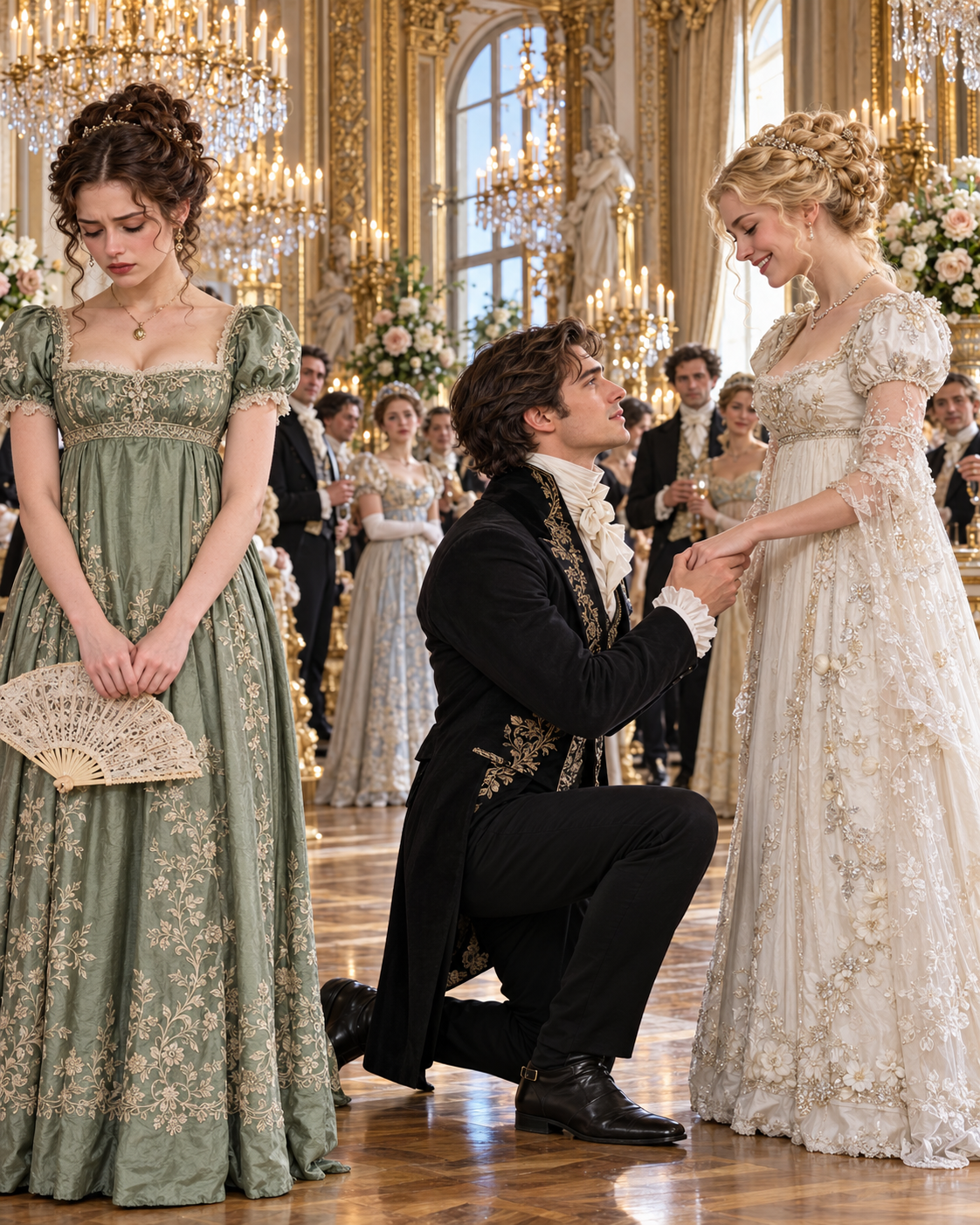
Beatrice looked down at his open hand.
For years, she had believed love required surrendering some essential part of herself.
Thomas had wanted her affection without her questions.
Her father had wanted her intelligence without her independence.
Julian was offering neither bargain.
She placed her hand in his.
“Then I believe we might make a rather formidable pair.”
His fingers closed gently around hers.
“Is that a yes?”
“It is.”
He smiled, not with triumph, but with something quieter.
Relief.
Their engagement was announced a week later.
But the celebration lasted less than a day.
Just before dawn, the river began to rise.
Heavy rain swept across Rothmere, turning the roads into channels of mud.
By morning, the water had climbed over the lower banks.
A messenger arrived soaked to the skin.
“The southern wall has broken, Your Grace.”
Julian was already reaching for his coat.
Beatrice seized the river map.
“Where?”
“Near the old mill.”
She felt the blood drain from her face.
That was the weakest section.
The point where the river narrowed before turning toward the tenant cottages.
“If the mill road floods,” she said, “the village will be cut off.”
Julian looked toward the stable yard.
“Prepare the horses.”
Beatrice caught his sleeve.
“We must open the northern drainage channel.”
“It has been blocked for years.”
“Then we clear it.”
“There’s no time.”
She looked directly at him.
“There is no time for anything else.”
They rode through driving rain toward the river.
Workers gathered along the embankment, fighting to reinforce the collapsing earth with timber and sandbags.
The water roared beneath them.
A section of fencing vanished into the current.
Julian dismounted beside the foreman.
“How many families remain in the lower cottages?”
“Six, Your Grace.”
“Get them out.”
Beatrice spread the map across a wagon.
The rain blurred the edges almost immediately.
She traced the drainage route with her finger.
“If we remove the old sluice gate, the water can be diverted through the northern meadow.”
The foreman shook his head.
“That gate hasn’t moved in twenty years.”
“Then we remove the supports.”
“It could destroy the meadowland.”
Beatrice looked toward the distant fields.
Her mother’s inheritance.
The land her father had stolen from.
The property everyone believed she should protect at any cost.
Beyond it stood the village.
Children.
Families.
People who had trusted the estate to keep them safe.
“Do it,” she said.
The foreman hesitated.
“Miss Harcourt, those fields belong to you.”
“I am aware.”
Julian turned toward her.
“Beatrice, think carefully.”
“I have.”
She folded the map.
“The land can recover. People cannot be replaced.”
Julian studied her for one brief moment.
Then he faced the workers.
“You heard Miss Harcourt. Open the channel.”
The men moved.
Axes struck timber.
Ropes strained.
The old sluice supports groaned beneath the pressure.
At first, nothing happened.
Then a violent crack split the air.
The gate shifted.
Water burst through the opening, surging across the northern meadow.
The river level beside the village began to fall.
A cheer rose from the workers.
But it ended abruptly when someone shouted from the opposite bank.
A carriage had overturned near the mill bridge.
One wheel hung over the broken roadway.
Inside were Lavinia and Thomas.
They had been traveling from Harcourt after receiving news of the flood.
Now the horses were gone, and the carriage was slipping toward the water.
Julian ran toward the bridge.
Beatrice followed.
The current struck the stone supports with terrifying force.
Thomas had managed to climb through the broken door.
But Lavinia remained trapped beneath a fallen wooden beam.
“Leave it!” she shouted.
Thomas stood frozen.
“Thomas!” Julian called. “Get back!”
The carriage shifted.
Beatrice saw the movement before anyone else.
One more collapse of the road, and the entire vehicle would be carried away.
She grabbed a coil of rope from a nearby worker.
“Secure this to the oak!”
Julian caught her arm.
“You cannot go down there.”
“I know where the carriage is caught.”
“So do I.”
“Julian—”
He held her gaze.
“Tell me what to do.”
For one brief second, all the noise seemed to fall away.
She pointed toward the damaged bridge.
“The rear axle is wedged against the stone. If you pull from the road, it will overturn. You must secure the rope beneath the frame.”
Julian nodded.
Then he climbed down.
The water struck his legs almost immediately.
Beatrice held the rope while the workers anchored it behind her.
Every movement of the carriage made her stomach tighten.
Julian reached the broken door.
He leaned inside, lifted the beam, and pulled Lavinia free.
The workers hauled them toward the bank.
Then the carriage broke loose.
The rear axle snapped.
Julian lost his footing.
He disappeared beneath the brown water.
Beatrice heard someone scream.
She did not recognize her own voice.
The rope jerked violently through her hands.
For one dreadful instant, she thought it had slipped free.
Then she saw him.
Julian surfaced several yards downstream, fighting the current.
“Pull!” she shouted.
The men heaved together.
The rope tightened.
Julian struck a submerged branch, vanished again, then reappeared beside the bank.
Beatrice dropped to her knees as the workers dragged him onto the grass.
His face was white.
His eyes were closed.
For one breath, the world seemed to stop.
Then he coughed.
Water spilled from his mouth.
Beatrice gripped his hand so tightly that he opened his eyes.
He looked at her, blinking against the rain.
“Did we save the village?”
She laughed once, a broken sound caught between relief and tears.
“Yes.”
“Good.”
He tried to sit up.
She pressed a hand against his shoulder.
“If you move before the doctor examines you, Your Grace, I shall be extremely displeased.”
His mouth curved faintly.
“Then I had better remain still.”
By evening, the rain had weakened.
The village was safe, though several cottages had suffered damage.
The northern meadow lay beneath a wide sheet of muddy water.
The mill would require rebuilding.
And Rothmere’s finances, already strained, could scarcely bear the expense.
Julian recovered at the castle under the watchful attention of Lady Eleanor and a physician who ordered him to rest.
Beatrice spent the next several days organizing shelter, food, and repairs.
She slept little.
She ate when someone remembered to bring her a plate.
And she refused every suggestion that she leave the work to others.
On the fourth evening, Julian found her alone in the estate office.
The candles had burned almost to their sockets.
She was examining a list of damaged properties.
“You missed supper,” he said.
She did not look up.
“So did three families whose homes are underwater.”
He placed a plate beside her.
“Then you should eat on their behalf.”
She glanced at the bread and cheese.
Despite everything, she smiled.
Julian sat opposite her.
For a while, they worked in silence.
Then he noticed a letter beside the ledger.
It bore Sir Reginald’s seal.
“What does he want?”
Beatrice hesitated.
“He has agreed to surrender control of the remaining Harcourt accounts.”
“That is long overdue.”
“He has also agreed to repay what he can.”
Julian studied her.
“Do you believe him?”
“I believe Mr. Vale will make certain the repayments occur.”
He nodded.
There was another letter beneath the first.
Beatrice moved it forward.
“Thomas has withdrawn from his engagement to Lavinia.”
Julian’s expression hardened.
“After everything?”
“Lavinia ended it before he could.”
He looked surprised.
Beatrice’s smile was small.
“She told him she would rather endure one season of disappointment than a lifetime of wondering whether he had married her for the right reasons.”
Julian leaned back.
“That sounds remarkably like her sister.”
“She would be furious to hear you say so.”
They shared a quiet laugh.
Then Julian reached across the table.
“Beatrice, there is something I must ask.”
She placed her hand in his.
“What is it?”
“The meadowland was your inheritance. You sacrificed it to save my tenants.”
“Our tenants,” she corrected softly.
He looked at her.
She did not withdraw the words.
“I have been thinking about what Rothmere needs,” she continued. “Not simply repairs, but a different way of managing the estate.”
She opened a fresh ledger.
“We can rebuild the mill using local labor. The improved drainage will make the lower fields safer. And if we restructure the rents for two seasons, the farmers can recover without abandoning their homes.”
Julian examined the figures.
“It will require nearly every available reserve.”
“Yes.”
“And several years before we recover the expense.”
“Probably.”
He looked up.
“Then we shall do it.”
Beatrice blinked.
“Just like that?”
“Not quite.”
He moved closer.
“I intend to argue about some of your estimates tomorrow.”
She laughed.
“Naturally.”
“But tonight, I would prefer to discuss our wedding.”
The wedding took place in early spring.
There was no extravagant celebration, no procession designed to impress the neighboring aristocracy.
The ceremony was held in the small Rothmere chapel, where sunlight fell through stained-glass windows onto the worn stone floor.
Lady Eleanor sat in the front pew.
Lavinia stood beside Beatrice, wearing a simple gown and a smile that no longer seemed rehearsed.
Sir Reginald attended quietly, having surrendered his control of the disputed property to the trust’s solicitor.
Beatrice greeted him with courtesy.
She did not pretend that everything had been forgiven.
Some wounds required more than apologies.
Some relationships could be repaired only through years of different choices.
But she no longer carried the responsibility of saving him from himself.
When Julian took her hand before the altar, his fingers were warm and steady.
The priest spoke of patience, fidelity, and devotion.
Beatrice listened, remembering the first evening she had seen Julian standing in her father’s drawing room.
He had come searching for a suitable bride.
Instead, he had found a woman surrounded by debts, ledgers, and other people’s expectations.
And he had remained.
Not because she was easy to love.
Not because she possessed a convenient inheritance.
But because he had seen the part of her that others had spent years trying to silence.
When they exchanged their vows, Julian looked directly into her eyes.
There was no grand speech.
No promise that hardship would never reach them.
Only his hand around hers.
And the quiet certainty that whatever came next, they would face it together.
Months passed.
The meadowlands slowly recovered.
The mill reopened with a new waterwheel.
Families returned to their cottages, and the riverbanks were reinforced under Beatrice’s careful supervision.
Rothmere’s debts began to decline.
The estate accounts, once a source of anxiety and deception, became records of steady improvement.
Beatrice established a small school for the tenants’ children, funded partly by the restored income from her mother’s trust.
Lavinia helped organize the lessons and eventually discovered an unexpected talent for teaching.
Sir Reginald withdrew from public life, living on a modest allowance while making regular repayments under Mr. Vale’s supervision.
Thomas left the county.
No one at Rothmere heard much of him afterward.
On a quiet autumn evening, nearly a year after the flood, Beatrice stood beside the restored mill.
The river moved gently between its banks.
Golden leaves drifted across the water.
Behind her, footsteps sounded on the gravel.
Julian came to stand beside her, carrying a folded document.
“The final reconstruction accounts,” he said.
She accepted them and glanced at the figures.
“We finished below the revised budget.”
“A miracle,” he replied solemnly.
“Good management.”
“An even greater miracle, apparently.”
She smiled and handed the papers back.
They walked along the river toward the meadow where the new grass had begun to grow.
For a while, neither spoke.
Then Julian stopped beside an old oak tree.
“I found something among my father’s papers.”
Beatrice turned.
He handed her a small envelope.
Inside was a letter written many years before, addressed to the late Duchess of Rothmere.
It was from Beatrice’s mother.
The final lines had been underlined in faded ink.
“If my daughter should ever find herself among people who mistake quiet strength for weakness, I hope she will meet someone wise enough to stand beside her rather than before her.”
Beatrice read the words twice.
Her eyes filled, though she made no attempt to hide it.
Julian took the letter gently when she offered it back.
“Your mother knew you rather well.”
“Better than I realized.”
He folded the paper.
“She would have been proud of what you’ve done.”
Beatrice looked toward the meadow.
The land that had once represented her father’s betrayal had become the place where an entire village had been saved.
Its value could no longer be measured only in pounds.
She thought of her mother, of Lavinia, of the families whose children now attended the school.
Then she looked at the man beside her.
“Do you know what I find most extraordinary?” she asked.
“What?”
“For years, I believed my worth depended upon how much I could repair for everyone else.”
Julian waited.
“And now?”
She slipped her hand into his.
“Now I know that being loved should not require being useful.”
His expression softened.
“No,” he said. “It should not.”
The evening bells began to ring from the distant chapel.
Together, they turned toward Rothmere Castle, where warm lights were appearing in the windows.
There would be more difficult harvests.
More disagreements across the breakfast table.
More decisions that neither could make alone.
Their life would never be free of uncertainty.
But Beatrice no longer feared a future she could not control entirely.
She had learned that strength did not mean carrying every burden without assistance.
That forgiveness did not require surrendering one’s boundaries.
And that true partnership was not the absence of struggle, but the willingness of two people to meet it without making either one smaller.
Years earlier, her father had believed a woman’s value lay in the marriage she could secure.
Thomas had believed affection could survive without honesty.
Even Beatrice herself had once believed that love meant earning a place in someone’s life through endless sacrifice.
She had been wrong.
The most precious thing Julian had ever given her was not his title, his fortune, or the great estate that now called her its Duchess.
It was the freedom to remain entirely herself.
And the most precious thing she had given him was not the inheritance that saved his lands.
It was the courage to build a life in which power could be shared without being diminished.
As they reached the castle steps, Julian paused and offered his arm with an exaggerated bow.
“Shall we go inside, Your Grace?”
Beatrice regarded him with amusement.
“Only if you promise not to interfere with tomorrow’s accounts.”
“I can promise no such thing.”
“Then I foresee a difficult marriage.”
“An exceptionally difficult one.”
She laughed, and he kissed her hand.
Above them, the castle windows glowed against the gathering dusk.
The river continued its quiet journey through the valley, carrying away the last fallen leaves of autumn.
Once, Beatrice had believed happiness was something other people were permitted to choose.
Now she understood that a life of dignity was not something to be granted by a father, a husband, or a title.
It was something she had the right to claim.
And as Julian opened the door and stepped aside to let her enter beside him, rather than behind him, she knew that the greatest victory of her life had never been saving Rothmere.
It was discovering that she had never needed to lose herself in order to be loved.
THE END.