The Duke of Rothford offered Beatrice Danforth a marriage without love, a fortune without affection, and one condition: she must never expect him to behave like a husband.
Beatrice stood motionless beside the open cabinet, the faded document trembling almost imperceptibly between her fingers. Across the study, Nathaniel Ashworth watched her with the expression of a man who had finally opened a door he had spent years holding shut.
“My father took it from him,” Nathaniel repeated, his voice quieter now. “And when I discovered what he had done, there was very little left to recover.”
The rain pressed against the windows. Lydia remained near the door, one hand resting on its polished frame, her earlier confidence replaced by a watchful stillness.
Beatrice lowered her eyes to the document. Her father’s signature was unmistakable. She remembered watching him write letters at the kitchen table, his left hand resting beside the paper, his pen moving in deliberate strokes.
He had died believing his own mistakes had destroyed his family.
“Explain,” she said.
Nathaniel approached the desk but stopped several feet away. “Twenty-three years ago, your father invested a considerable portion of his inheritance in a shipping enterprise managed by mine. The venture was profitable. Exceptionally profitable. But my father persuaded him to transfer his interest into a private trust, supposedly to protect it from creditors.”
Beatrice examined the signatures again.
“He trusted your father.”
“He did.”
“And your father betrayed him.”
Nathaniel did not attempt to soften the answer. “Yes.”
The simplicity of his admission unsettled her more than an elaborate defense might have done.
She turned another page. The legal language was dense, but the figures were clear enough. Her father had possessed a substantial interest in an enterprise that continued generating income long after he had been told it had failed.
“How much?” she asked.
Nathaniel looked toward the fireplace.
“Your Grace.”
“Enough that your family should never have faced financial ruin.”
Beatrice set the document on the desk with extraordinary care. She remembered her mother selling her wedding pearls, her younger brother leaving university, and the winter when they had dismissed their last servant because they could no longer afford coal for the kitchen.
Her father had spent his final years apologizing for a catastrophe he had not caused.
A quiet sound escaped her, not quite a laugh.
“And you knew.”
Nathaniel’s shoulders tightened.
“I discovered the arrangement after my father’s death.”
“Four years ago.”
“Yes.”
“Four years,” she repeated.
Lydia shifted near the door. “Perhaps now you understand why the duke was so eager to acquire a respectable wife.”
Beatrice turned toward her.
“Not another word until I ask you a question.”
The command was delivered without raising her voice. Lydia’s lips parted, then closed.
Nathaniel watched Beatrice move behind his desk and sit down as though the room had always belonged to her.
“Why was Lady Lydia receiving payments from this account?” Beatrice asked.
Lydia recovered enough composure to smile.
“Because your future husband is not quite the honorable gentleman he wishes you to believe.”
Nathaniel reached for the portfolio, but Beatrice placed her hand over it.
“I would prefer an answer supported by something other than accusation.”
Lydia’s eyes narrowed.
“The duke’s father promised my family a settlement. Nathaniel continued the arrangement after his death.”
“For what service?”
Silence followed.
Beatrice looked at the payment dates again. The first transfer had occurred shortly after the late duke’s death. The amounts increased after Nathaniel ended his relationship with Lydia.
Then she noticed a notation beside the earliest entry.
Custody of original instruments.
She raised her head.
“You possessed the original trust documents.”
Lydia’s expression changed.
Nathaniel closed his eyes briefly.
“She did,” he admitted.
“How?”
“My father entrusted them to her uncle, Sir Percival Vale, who served as his private solicitor. After his death, Lydia inherited certain papers.”
“And you paid her to keep them concealed.”
“I paid her to return them.”
Lydia gave a sharp laugh.
“You paid me because you feared what would happen if they became public.”
Nathaniel faced her.
“I feared what would happen to the people whose money my father had stolen.”
Beatrice studied him carefully.
There was a distinction between protecting innocent families and protecting an aristocratic name. Nathaniel appeared to believe he had accomplished the former. She was no longer certain.
“How many families?” she asked.
“Seven.”
The number settled heavily over the room.
“Seven families lost their money?”
“At least seven. My father’s solicitor maintained separate accounts, and some records were destroyed before I inherited the estate.”
Beatrice looked down at the portfolio.
“Then this is not merely about my father.”
“No.”
For the first time, she understood why Nathaniel’s estate was in such disorder. He had been moving money through private channels, attempting to compensate victims without exposing the fraudulent trust.
He had also been allowing Lydia to drain funds that might otherwise have supported those families.
It was an arrangement built upon fear, secrecy, and an increasingly expensive illusion of control.
“Where are the original documents?” she asked.
Lydia lifted her chin.
“Somewhere safe.”
“How reassuring.”
“You have no idea what you are interfering with, Miss Danforth.”
Beatrice rose.
“I believe I have a reasonably clear idea. You possess evidence of financial fraud. You have demanded payments in exchange for withholding it. And you have mistaken His Grace’s reluctance to expose his father for an unlimited source of income.”
Lydia’s face flushed.
“You cannot prove that.”
“Not yet.”
The two women regarded one another across the desk.
Then Beatrice reached for the bell.
A footman appeared moments later.
“Please have Lady Lydia’s carriage brought around,” she instructed. “And ask Mr. Whitcomb, the estate solicitor, to attend His Grace tomorrow morning.”
Lydia turned toward Nathaniel.
“You will allow her to dismiss me?”
Nathaniel looked at Beatrice, then at the woman who had held his household hostage for nearly two years.
“Yes.”
Lydia’s smile disappeared.
“You will regret this.”
“Perhaps,” Nathaniel answered. “But the payments end today.”
She left without another word.
Only after the carriage wheels faded into the rain did Beatrice allow herself to sit.
Nathaniel remained standing.
“I should have told you.”
“Yes.”
“I intended to restore your family’s money before our marriage.”
“Without telling me where it came from?”
He did not answer.
Beatrice looked toward the window, where the reflection of the fire trembled against the darkening glass.
“You offered me security and independence,” she said. “Yet you intended to decide what I was permitted to know.”
“I was trying to spare you.”
“From what? The truth about my father?”
“From the disgrace attached to mine.”
She turned toward him.
“Your father’s disgrace belongs to your father. Your silence belongs to you.”
Nathaniel absorbed the distinction without protest.
After a long moment, he said, “What would you have me do?”
Beatrice considered the question.
It was the first time he had asked her what should be done rather than announcing what he intended to do.
“Tomorrow,” she replied, “we begin with the accounts. All of them.”
The following morning, Beatrice arrived at Rothford House before the servants had finished lighting the fires.
By nine, she had assembled Nathaniel, Mr. Whitcomb, the chief steward, and two clerks around the long dining table.
She had ordered tea, fresh paper, sharpened pencils, and every surviving ledger from the previous twenty-five years.
Nathaniel entered to find his dining room transformed into an office.
“Good morning, Your Grace,” Beatrice said without looking up.
He surveyed the stacks of documents.
“Have you slept?”
“Enough.”
“Have you eaten?”
She paused.
“No.”
Nathaniel turned to the butler.
“Breakfast for Miss Danforth, if you please.”
“And for everyone else,” she added. “We may be here some time.”
The first week revealed an extraordinary pattern of negligence.
The late duke had maintained fraudulent trusts while neglecting essential repairs to the estate. Nathaniel, preoccupied with repairing the financial damage and concealing his father’s crimes, had permitted his steward to continue using outdated accounting methods.
Several tenants had been charged rents that exceeded their agreements. Contractors had submitted duplicate invoices. A distant cousin had been receiving an annual allowance without any documented entitlement.
Beatrice examined each discrepancy with quiet determination.
She did not accuse people without evidence. She did not waste time on dramatic confrontations. When the chief steward claimed certain records were missing, she asked him to produce the inventory showing when they had disappeared.
When he could not, she dismissed him.
Nathaniel watched the proceedings with increasing astonishment.
“You have removed three employees in five days,” he observed one evening.
“Two employees and one thief.”
“The steward served my family for thirty years.”
“Then he had thirty years to learn the difference between wages and theft.”
Nathaniel laughed.
It was an unfamiliar sound in the house.
The servants noticed.
So did Beatrice.
Their working days developed a rhythm. She examined accounts in the morning while Nathaniel met creditors, tenants, and solicitors. They took luncheon together, exchanging reports across a small table beside the library windows.
In the afternoons, they visited properties requiring attention.
One bitter morning, they traveled to a tenant farm where the roof had leaked for three winters.
The farmer’s wife greeted them with visible apprehension.
Beatrice stepped inside, noticed a bucket beneath the ceiling, and asked how long the family had been waiting for repairs.
“Since before the old duke passed, ma’am.”
Nathaniel examined the damaged beams.
“Why was I not informed?”
The woman glanced toward her husband.
“We wrote twice, Your Grace.”
Beatrice watched Nathaniel’s expression.
He did not offer excuses.
Instead, he removed his gloves and helped the farmer shift a heavy cupboard away from the wet wall.
By the following afternoon, carpenters had arrived.
Beatrice said nothing about the incident during their return journey.
But when Nathaniel reached across the carriage to straighten the blanket that had slipped from her knees, she did not move away.
Three weeks later, Mr. Whitcomb discovered the first surviving evidence that could establish the true ownership of the stolen investments.
A duplicate trust schedule had been preserved in the records of a London banking house.
The document named Beatrice’s father and six other investors.
It also revealed something unexpected.
The late duke had not merely misappropriated their money.
He had used it to purchase land that now formed part of the Rothford estate.
Nathaniel stared at the figures.
“Then the land belongs to them.”
“An equitable claim may exist,” Whitcomb answered cautiously. “The exact remedy will require examination.”
Beatrice studied the map spread across the table.
The disputed properties included valuable farmland, a small commercial wharf, and a parcel bordering the duke’s principal residence.
Together, they represented a substantial portion of his remaining wealth.
Restoring the investors’ interests could leave Nathaniel with considerably less than society imagined he possessed.
He looked at Beatrice.
“We must tell them.”
She held his gaze.
“Yes.”
There was no hesitation.
That evening, Nathaniel asked her to walk with him in the conservatory.
Rain had given way to clear skies, and moonlight rested upon the glass roof. Orange trees stood in large ceramic pots beside a narrow stone path.
“I owe you an apology,” he said.
“You have already apologized.”
“Not for the marriage.”
Beatrice stopped beside a flowering camellia.
Nathaniel looked unusually uncomfortable.
“When I proposed, I believed I was offering you a reasonable arrangement. I would provide security. You would provide respectability. Neither of us would make demands upon the other.”
“That was our understanding.”
“I no longer think it was fair.”
She studied him.
“Because I have proved useful?”
“Because I failed to consider that you deserved something more than usefulness.”
Beatrice looked away.
The words reached a place she had carefully protected for years.
She had spent her youth tending an ailing mother, managing dwindling household expenses, and ensuring that her brother had opportunities she had never been offered.
People praised her judgment. They depended upon her steadiness.
Few had ever wondered whether she was lonely.
Nathaniel stepped closer.
“I do not know what sort of husband I shall make.”
“Neither do I.”
His mouth curved.
“That is encouraging.”
“But I suspect,” she continued, “that honesty would be a promising beginning.”
He held out his hand.
After a moment, she placed hers in it.
They stood beneath the glass roof without speaking, the distance between them reduced to something neither had anticipated when the marriage contract was first signed.
The peace lasted eleven days.
Then Lydia struck.
The first rumor appeared at a dinner in Mayfair.
A duchess remarked that Nathaniel had proposed to Beatrice only because her family possessed documents capable of destroying him.
By the following afternoon, the story had changed.
Beatrice was supposedly blackmailing the duke into marriage.
Another version claimed she had discovered his debts and intended to seize control of his estate.
Within three days, invitations began disappearing.
Beatrice learned of the gossip from her younger brother, Edward, who arrived at Rothford House looking furious.
“They are saying you trapped him.”
She continued sorting correspondence.
“People have said less flattering things about me.”
“This is different.”
“How?”
“They are calling Father a fraud.”
Her hands stopped moving.
Edward stood beside the desk, his face flushed with anger.
“They claim he stole money from the duke’s family, and that you are using the marriage to conceal it.”
Beatrice slowly set down her pen.
Lydia had reversed the truth.
Nathaniel entered moments later and found Edward pacing beside the fireplace.
When he heard what had happened, his expression hardened.
“I shall speak to her.”
“No,” Beatrice said.
Both men turned.
“She wants a confrontation. Preferably one that can be repeated in every drawing room in London.”
“Then what do you suggest?” Nathaniel asked.
“We finish gathering the evidence.”
“And allow her to insult your father?”
Beatrice looked at him.
“My father endured poverty because a powerful man believed reputation mattered more than justice. I will not repeat that mistake merely because I am angry.”
Nathaniel stood still.
Then he bowed his head.
“Very well.”
But Lydia was not finished.
Two mornings later, a solicitor’s letter arrived demanding a substantial final payment in exchange for the return of documents allegedly belonging to the late duke.
Attached was a threat to publish private correspondence if Nathaniel refused.
Beatrice examined the letter.
The handwriting was unfamiliar, but the paper bore the watermark of a fashionable stationer near St. James’s.
She noticed something else.
Lydia had demanded payment within seven days.
The deadline fell on the morning of their wedding.
“She intends to force you to choose,” Beatrice said.
Nathaniel read the letter again.
“Between the documents and our marriage.”
“Between surrendering to her and allowing her to humiliate us publicly.”
He set the paper down.
“I will cancel the ceremony before I allow you to be made a spectacle.”
Beatrice looked at him sharply.
“Would you?”
“If it protects you.”
“And what happens afterward?”
“We marry privately.”
“And everyone believes the rumors.”
Nathaniel frowned.
“I do not care what society believes.”
“I know. That is one of your more admirable qualities.”
He looked surprised.
“But I care what happens to the families whose names are attached to those investments,” she continued. “If Lydia controls the story, their claims may be dismissed as another scandal manufactured for money.”
Nathaniel moved toward the window.
“Then we must obtain the originals.”
Beatrice nodded.
“And I believe I know how.”
The following afternoon, she requested a meeting with Sir Percival Vale’s former managing clerk.
The elderly gentleman, Mr. Finch, had retired to a modest house outside London.
He received Beatrice in a small parlor crowded with books and old legal journals.
At first, he refused to discuss his former employer.
Then Beatrice placed her father’s signature before him.
Mr. Finch stared at the page.
His hands began to shake.
“I remember this matter.”
“Then you remember what happened.”
He removed his spectacles.
“Sir Percival instructed me to prepare duplicate schedules. The late duke insisted that the originals remain in private custody.”
“Why?”
“Because several investors had begun asking questions.”
Beatrice leaned forward.
“Did Sir Percival know the investments were fraudulent?”
Mr. Finch hesitated.
“I believe he knew enough.”
“And Lydia?”
“She inherited his papers. But she did not inherit his knowledge of their contents.”
Beatrice considered that.
“Are you certain?”
“Quite. She came to me after his death, demanding to know which documents were valuable.”
“What did you tell her?”
“That I would not assist her.”
He rose slowly and crossed to a writing desk.
From a locked compartment, he removed a narrow envelope.
“I kept this because I feared it might someday be needed.”
Inside was a signed memorandum describing the late duke’s manipulation of the trusts.
More importantly, it identified the banking house that held certified duplicates of the original agreements.
Beatrice looked up.
“Why did you never come forward?”
Mr. Finch’s face tightened.
“I had children to feed. Sir Percival threatened to ruin me if I spoke.”
“And now?”
“My children are grown. My employer is dead. I am tired of being ashamed.”
Beatrice reached across the table and gently covered his trembling hand.
“Then perhaps we can put something right.”
Within forty-eight hours, Whitcomb had obtained certified copies from the bank and prepared formal claims on behalf of the surviving investors and their heirs.
Nathaniel signed a declaration acknowledging his father’s misconduct and committing the estate to restitution.
He also authorized an independent examination of the accounts.
The decision placed much of his inheritance at risk.
Beatrice found him alone in the library after the documents were signed.
A single candle burned beside his chair.
“You may lose the wharf,” she said.
“I know.”
“And several farms.”
“Yes.”
“Perhaps even Rothford House.”
He looked at her.
“Would you regret marrying me if I did?”
She considered him for a long moment.
“Would you still be the man who repaired Mrs. Ellison’s roof?”
Nathaniel blinked.
“Of course.”
“Then I believe we could manage.”
He rose slowly.
“Beatrice.”
She waited.
“I have spent most of my life believing that affection was a kind of debt. Something people offered because they expected repayment.”
“And now?”
“Now I find myself wanting to give you things you have never asked for.”
Her breath caught when he took her hand.
“Such as?”
“A home where you need not earn your place every morning.”
The words were spoken so quietly that she almost missed them.
For once, Beatrice had no practical answer.
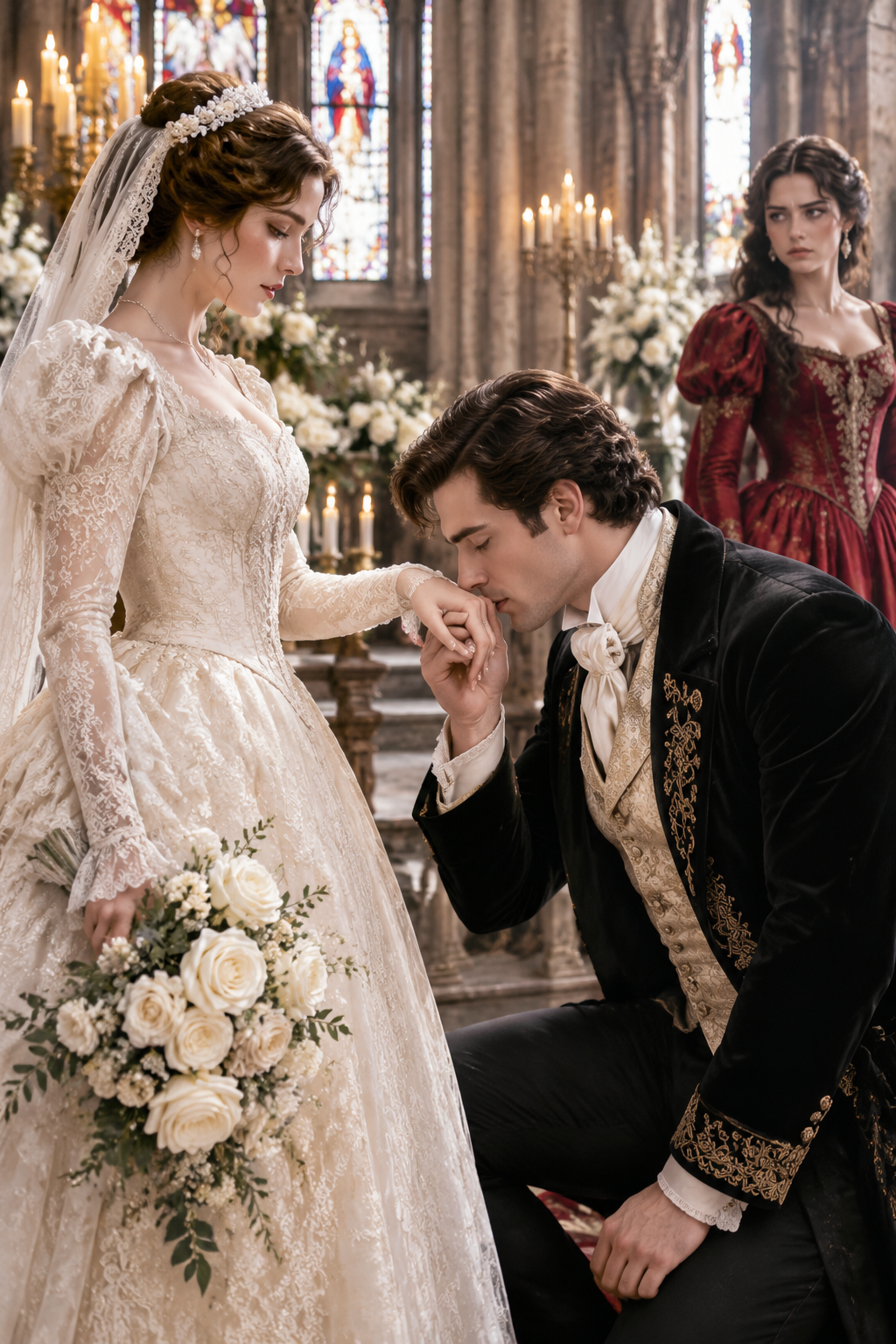
Nathaniel lifted her hand and pressed his lips against her knuckles.
She closed her eyes.
The wedding morning arrived beneath a pale blue sky.
London had spent the preceding week discussing the scandal with extraordinary enthusiasm.
Some guests attended out of affection. Others came because they expected an entertaining disaster.
The church was crowded.
Beatrice stood in a small chamber beside the nave, wearing an ivory silk gown altered from one that had belonged to her mother.
The lace at her sleeves was old, but beautifully preserved.
Edward adjusted the ribbon at her waist.
“You look lovely,” he said.
She smiled.
“You sound astonished.”
“I am astonished you are not frightened.”
Beatrice looked toward the church doors.
“I am frightened.”
Edward’s expression softened.
“Then we can leave.”
She shook her head.
“No. I have spent enough years allowing other people to determine what I deserve.”
A knock interrupted them.
A footman entered carrying a folded note.
Beatrice recognized the handwriting immediately.
Lydia.
The message contained only one sentence.
Ask your duke what he intends to do when I reveal the original agreement before the congregation.
Edward read the note over her shoulder.
“She would not dare.”
Beatrice folded it carefully.
“She already has.”
Inside the church, Nathaniel waited near the altar.
His dark morning coat fitted perfectly, but his expression betrayed unusual tension.
He had spent the previous evening preparing for the possibility of public humiliation.
He had not told Beatrice that he had also instructed Whitcomb to bring copies of every relevant document.
The organ began.
Guests turned toward the entrance.
Beatrice appeared on Edward’s arm, her gown catching the sunlight that streamed through the tall windows.
Nathaniel saw her and forgot, briefly, the hundreds of eyes watching him.
She walked steadily toward him.
Not because she felt no fear.
Because she had decided that fear would not make her choices.
Then a disturbance broke out near the rear pews.
A woman in deep crimson silk had entered the church.
Lydia.
Her appearance drew an immediate ripple of whispers.
She carried a narrow leather portfolio beneath one arm.
Nathaniel’s jaw tightened.
Beatrice saw him glance toward the doors.
Then Lydia spoke.
“Before this marriage proceeds, there is something the bride deserves to know.”
The organ fell silent.
Several guests rose halfway from their seats.
Lydia moved down the aisle, her heels striking the stone floor with deliberate precision.
“This gentleman has concealed a financial arrangement involving Miss Danforth’s family. An arrangement that makes this marriage considerably less romantic than society has been led to believe.”
Nathaniel stepped forward.
“Lady Lydia, you are interrupting a religious ceremony.”
“Then perhaps you should explain why you have been paying me for years.”
A murmur swept through the congregation.
Beatrice stood motionless beside Edward.
Lydia raised the portfolio.
“I possess the original agreements. Documents proving that the Danforth fortune was never lost at all.”
The church became utterly quiet.
Nathaniel looked toward Beatrice.
She met his eyes.
Neither moved.
Then Beatrice gently released her brother’s arm.
“Lady Lydia,” she said, her voice carrying clearly through the nave, “would you be so kind as to show us the documents?”
Lydia hesitated.
She had expected tears, denial, perhaps a desperate attempt to silence her.
She had not expected an invitation.
“Certainly.”
She opened the portfolio and removed several yellowed pages.
Beatrice walked toward her.
“May I?”
Lydia held the papers tightly.
“I think it best if I explain them.”
“Then please begin with the clause identifying the beneficial owners.”
Lydia glanced down.
“The what?”
“The people to whom the investments legally belonged.”
A few guests exchanged glances.
Beatrice continued.
“Or perhaps you would prefer to explain why your uncle retained documents concerning assets transferred without their owners’ informed consent.”
Lydia’s face lost color.
Nathaniel stepped beside Beatrice.
“Those documents establish misconduct committed by my father,” he said, his voice steady. “I discovered it after his death. I attempted to recover the money privately, and in doing so allowed myself to be manipulated by someone who possessed evidence I feared would harm innocent families.”
Lydia’s fingers tightened around the portfolio.
“You cannot prove that.”
“Mr. Whitcomb?”
The solicitor rose from the second pew.
He carried a sealed packet bearing the mark of a London banking house.
“Certified duplicates have been obtained, Your Grace. The relevant claims have been prepared, and the supporting records are available for examination by the proper authorities.”
Nathaniel faced the congregation.
“My father abused the trust placed in him. Several families suffered as a consequence. I have signed a declaration acknowledging the estate’s obligations and committed its assets to restitution.”
A murmur moved through the church.
He waited until it faded.
“I should have acted openly when I first discovered the truth. I did not. That failure is mine.”
Beatrice watched him.
There was no attempt to protect his title.
No elaborate excuse.
Only a man standing before society and accepting responsibility for what he had done and what he had failed to do.
Lydia looked from the solicitor to Nathaniel.
“You promised to protect me.”
Nathaniel’s expression softened, but his answer remained firm.
“I promised to honor lawful obligations. I did not promise to purchase your silence forever.”
She took a step backward.
“You loved me once.”
The words hung in the air.
Nathaniel looked at her for a long moment.
“Perhaps I loved the person I believed you were.”
Lydia’s eyes filled, though she blinked the tears away angrily.
“And now you love this woman?”
Nathaniel turned toward Beatrice.
She stood beside him in her mother’s ivory gown, her hands clasped tightly enough to crease the silk of her gloves.
He took one of those hands.
“Yes.”
The answer was quiet.
It required no embellishment.
Beatrice looked at him, startled by the certainty in his voice.
Nathaniel continued, speaking now only to her.
“I asked you to marry me because I wanted a peaceful life without demands. You have given me something considerably more difficult.”
A faint smile touched her mouth.
“Orderly accounts?”
A few guests laughed softly.
Nathaniel shook his head.
“The courage to become a better man.”
He raised her hand.
“And if you still wish to marry me, knowing everything that has been revealed, I would consider myself extraordinarily fortunate.”
Beatrice looked around the church.
She saw Edward standing near the pews, his eyes bright. She saw Whitcomb holding the documents that might finally restore her father’s reputation.
She saw Lydia, whose attempt to destroy the ceremony had instead brought the truth into the open.
Then she looked at Nathaniel.
“Your Grace,” she said, “I believe we have already established that I do not make important decisions without examining the evidence.”
His lips curved.
“And your conclusion?”
She stepped closer.
“That you are occasionally stubborn, frequently secretive, and in desperate need of competent supervision.”
Laughter moved through the congregation.
Nathaniel smiled.
“An accurate assessment.”
“But you are also capable of admitting when you are wrong.”
She tightened her fingers around his.
“And that, I think, is worth considerably more than a title.”
Lydia lowered the portfolio.
For the first time, there was nothing left for her to threaten.
Whitcomb approached and quietly requested the documents. After a brief hesitation, she surrendered them.
No one applauded.
No one celebrated her humiliation.
The moment passed with the subdued dignity of a chapter finally closing.
Nathaniel turned toward the clergyman.
“May we continue?”
The ceremony resumed.
When Nathaniel placed the ring upon Beatrice’s finger, his hand trembled slightly.
She noticed.
And she smiled.
Months later, the restitution proceedings were well underway.
The surviving investors and their heirs had been notified, and independent trustees were overseeing the valuation and transfer of disputed assets.
Some claims were settled through the sale of estate properties. Others required lengthy legal examination.
The process was neither simple nor painless.
Nathaniel surrendered the commercial wharf and several farms. Rothford House remained in his possession, though maintaining it required careful economies.
Beatrice reorganized the estate with characteristic precision.
Unnecessary luxuries disappeared. The servants received their wages promptly. Tenant agreements were reviewed, and essential repairs became a priority.
Nathaniel discovered that a smaller fortune, honestly administered, provided more peace than an enormous one burdened by concealment.
Edward returned to university with funds restored through his father’s estate.
Beatrice’s mother moved into a comfortable cottage near Rothford, where sunlight filled the sitting room and the garden contained more roses than she had ever dared request.
One afternoon, Beatrice visited her father’s grave.
Nathaniel accompanied her but remained several steps away.
She placed a small bunch of white flowers beside the headstone.
For years, she had believed her father had failed them.
Now she understood that he had been deceived by someone he trusted.
She touched the weathered stone.
“You were not foolish for believing a friend,” she whispered. “He was wrong to betray you.”
Nathaniel approached quietly.
“Would you like a moment alone?”
Beatrice shook her head.
“No.”
She took his arm.
“I think I have spent enough time carrying things alone.”
He covered her hand with his.
They walked back toward the waiting carriage as the afternoon sunlight spread across the churchyard.
Their marriage did not become a fairy tale without disagreements.
Beatrice continued to challenge Nathaniel’s decisions. Nathaniel occasionally objected to her habit of treating every domestic inconvenience as a problem requiring immediate reform.
Once, she discovered that he had ordered an extravagant greenhouse without consulting her.
She placed the invoice beside his breakfast plate.
He examined it, then looked up.
“It was intended as a surprise.”
“It certainly succeeded.”
“I thought you would enjoy growing flowers.”
“I would.”
“Then what is wrong?”
“The roof over the east cottages still requires repair.”
Nathaniel considered this.
Then he folded the invoice.
“I shall cancel the greenhouse.”
Beatrice studied him for a moment.
“Perhaps postpone it.”
He smiled.
“An unexpected concession.”
“Do not become accustomed to it.”
But that evening, when she entered the library, she found a small pot of violets on her writing desk.
There was no note.
Nathaniel sat beside the fire, apparently absorbed in a book.
Beatrice lifted the flowers and examined their delicate purple petals.
“Your Grace?”
“Hmm?”
“These are quite beautiful.”
He turned a page.
“So I am told.”
She crossed the room and kissed his cheek.
The book slipped from his hands.
Beatrice laughed, and Nathaniel caught her gently around the waist before she could retreat.
“That,” he murmured, “was entirely unfair.”
“Then perhaps you should complain to the household manager.”
“I understand she is a formidable woman.”
“Terrifying.”
He kissed her.
Outside, evening settled over the gardens, and the last light caught the windows of the house they had nearly lost.
A year after their wedding, Beatrice established a charitable fund to assist widows and unmarried women who had been left financially vulnerable by the mismanagement of family property.
She insisted that the fund provide practical assistance rather than mere sympathy.
Women received help securing legal advice, finding employment, and understanding the financial agreements upon which their futures depended.
Nathaniel attended the opening gathering, standing quietly near the back of the room while Beatrice addressed the guests.
She wore a simple blue gown and spoke without theatrical gestures.
“Dependence is sometimes unavoidable,” she told them. “But ignorance should never be required of those who depend upon another person’s judgment.”
Nathaniel watched the women listening to her.
Some were elderly. Others were young mothers. Several had arrived uncertain whether they belonged among such distinguished company.
Beatrice made certain every one of them was welcomed.
Afterward, an older woman approached Nathaniel.
“Your Grace, your wife is remarkable.”
He looked across the room.
Beatrice was helping a nervous young widow understand a document, patiently explaining each unfamiliar term.
“Yes,” he said.
Then, with quiet satisfaction, he added, “She always was.”
That winter, Nathaniel presented Beatrice with a small leather-bound book.
She opened it beside the fire and discovered that it contained copies of the restored financial records, together with a carefully written account of her father’s investments and the restitution made to his heirs.
On the first page, Nathaniel had written a dedication.
To Beatrice, who taught me that truth is not an enemy of love, but the ground upon which it stands.
She read the words twice.
Then she closed the book and rested her head against his shoulder.
For a long time, neither spoke.
The fire crackled softly. Wind moved through the bare branches beyond the windows.
At last, Nathaniel broke the silence.
“Do you regret our arrangement?”
Beatrice lifted her head.
“The original one?”
“Yes.”
She pretended to consider.
“The allowance was adequate. The accommodation satisfactory. The husband initially rather difficult.”
“Initially?”
“Occasionally still.”
He laughed.
Then she took his hand and placed it against her cheek.
“But I do not regret marrying you.”
Nathaniel looked at her with the same quiet wonder he had felt in the conservatory, when he first realized that the woman he had intended to keep at a comfortable distance had become the person whose presence mattered most.
“I love you, Beatrice.”
She smiled.
“I know.”
“That is all?”
She leaned closer.
“I love you too, Nathaniel.”
He kissed her forehead.
And in the warm silence that followed, Beatrice thought of the woman she had been when she first entered his study.
A practical, overlooked woman who had believed her best years were behind her.
She had expected a marriage that would save her family while asking nothing of her heart.
Instead, she had discovered that affection could grow through honesty, that respect could become tenderness, and that being needed was not the same as being loved.
Nathaniel had learned something equally important.
A title could command obedience. Wealth could purchase comfort. Fear could preserve a reputation for a time.
But none of those things could create trust.
Trust required the courage to tell the truth, especially when the truth came at a cost.
Years later, when society spoke of the Duke and Duchess of Rothford, people rarely mentioned the scandal that had nearly interrupted their wedding.
They spoke instead of the estate that had been restored through careful management, of the families who had received justice, and of the duke who had become a quieter, kinder man.
Some credited Beatrice with changing him.
Others claimed marriage had simply improved his disposition.
Nathaniel never troubled himself to correct them.
He knew the truth.
Beatrice had not rescued him by overlooking his failures.
She had loved him enough to insist that he confront them.
And Beatrice, who had once believed herself destined to remain invisible, discovered the rare happiness of being seen completely.
Not as a convenient wife.
Not as a capable manager.
Not as a woman whose worth depended upon how much she could sacrifice for others.
But as herself.
One spring evening, many years after their first meeting, Nathaniel found her standing beside the conservatory windows, watching the sunset settle over the gardens.
He approached quietly and offered his arm.
“Will you walk with me, Duchess?”
She glanced at him.
“Have you finished your correspondence?”
“Every letter.”
“And the estate accounts?”
“Approved.”
“The repairs to the north cottages?”
“Completed yesterday.”
Beatrice smiled.
“Then I suppose I have no reasonable objection.”
They stepped into the garden together.
At the edge of the path, the first roses of the season were opening beneath the golden evening light.
Nathaniel stopped and looked at her.
“Do you remember what you asked me when I proposed?”
Beatrice raised an eyebrow.
“Whether the household accounts were included?”
He laughed.
“Precisely.”
“A perfectly sensible question.”
“An extraordinary one.”
She slipped her hand into his.
“And do you remember what you promised me?”
“Security and autonomy.”
“And a quiet, passionless life.”
Nathaniel drew her closer.
“I fear I failed rather spectacularly at the last.”
Beatrice looked into the face of the man who had once believed himself incapable of offering love.
Then she kissed him beneath the flowering roses.
“Yes, my dear,” she whispered. “And I have never been more grateful for a broken promise.”
They continued along the garden path as the evening light faded, their footsteps unhurried and their hands joined.
Their story had begun with a contract designed to protect two people from disappointment.
It endured because they had eventually chosen something no contract could guarantee.
Honesty when silence would have been easier.
Courage when reputation demanded surrender.
And love that asked neither person to become smaller so the other could feel powerful.
For Beatrice Danforth, the greatest fortune she ever recovered was not the inheritance stolen from her father.
It was the life she had nearly convinced herself she no longer deserved.
And for Nathaniel Ashworth, the greatest privilege of being a duke was not the wealth, the land, or the ancient name he carried.
It was returning home each evening to a woman who knew every flaw he possessed, challenged him whenever necessary, and still reached for his hand.
Because the finest marriages are not built upon the absence of mistakes, but upon two people willing to face the truth, repair what they can, and choose each other again when the difficult work is done.
Years passed, and Rothford House became a place that neither Nathaniel nor Beatrice could have imagined during their first uneasy meeting. The grand rooms no longer existed merely to impress visitors. They were filled with conversation, the occasional laughter of children, and the comfortable disorder of a household where people were valued more than appearances.
Beatrice never abandoned her habit of examining the estate accounts each Monday morning. Nathaniel often found her at the library desk, spectacles resting low upon her nose, a pencil moving steadily across the pages.
One autumn afternoon, he entered carrying a small wooden box.
“I have something for you,” he said.
Beatrice glanced up.
“If it is another greenhouse, I shall require an explanation.”
Nathaniel smiled and placed the box before her.
Inside lay a silver pocket watch, its surface worn smooth by years of use.
Beatrice recognized it immediately.
It had belonged to her father.
For several seconds, she could not speak.
“Where did you find this?”
“Among the belongings recovered from my father’s former solicitor. Mr. Finch discovered it while sorting the remaining papers.”
She lifted the watch carefully. On its reverse were her father’s initials, engraved in the familiar, slightly uneven lettering she remembered from childhood.
“He carried this every day,” she whispered.
Nathaniel sat beside her.
“I thought it should come home.”
Beatrice opened the watch. Its hands had stopped at twenty minutes past six, but inside the cover was something she had never noticed before.
A tiny folded piece of paper.
With trembling fingers, she unfolded it.
The handwriting belonged to her father.
It contained only a few words.
For my Beatrice. Never mistake being overlooked for being unworthy.
Her eyes filled.
Nathaniel reached for her hand, but he did not interrupt the silence.
For years, Beatrice had carried the memory of her father’s final days as a burden. She remembered his apologies, his exhaustion, and the shame that had slowly extinguished the warmth in his eyes.
Now, holding the watch, she remembered something else.
The evenings when he had taught her arithmetic. The pride with which he had praised her careful reasoning. The way he had listened when others dismissed her opinions.
“He always believed I could do something important,” she said.
Nathaniel gently brushed a tear from her cheek.
“He was right.”
Beatrice looked at her husband.
“You gave me back more than his fortune.”
Nathaniel shook his head.
“No. You recovered the truth. I merely helped return what should never have been taken.”
She rested her forehead against his.
For a long moment, they remained together beside the library window, while autumn leaves drifted across the lawns.
That winter, Beatrice made one final decision concerning the recovered inheritance.
Rather than preserving the entire sum for herself, she established a permanent educational trust for girls whose families could not afford proper schooling.
The first school opened the following spring in a renovated building on the edge of the Rothford estate.
Nathaniel accompanied her to the opening ceremony.
A dozen young girls stood nervously beneath the doorway, their new books clutched against their chests.
One little girl approached Beatrice and asked whether it was true that she would be permitted to study mathematics.
“Of course,” Beatrice answered.
“Even if I am better at it than the boys?”
Beatrice smiled.
“Especially then.”
Nathaniel laughed softly beside her.
Later, as they watched the children enter their classroom, he slipped his hand into hers.
“Your father would have been proud.”
Beatrice looked toward the open doorway, where sunlight illuminated rows of small wooden desks.
“I hope so.”
“He would also have been proud of the woman you became.”
She turned toward him.
“And what of you, Your Grace? Are you satisfied with the wife you acquired through such an unromantic bargain?”
Nathaniel pretended to consider the question.
“She is rather demanding.”
“Indeed.”
“Terribly opinionated.”
“How unfortunate.”
“And quite incapable of allowing me to make an expensive mistake in peace.”
Beatrice laughed.
Nathaniel lifted her hand to his lips.
“But I would choose her again, under precisely the same circumstances, even knowing how thoroughly she intended to rearrange my life.”
Her expression softened.
“And I would choose you.”
The years continued their quiet passage.
There were difficult winters, unexpected losses, and disagreements that occasionally sent Nathaniel retreating to his study while Beatrice occupied herself with correspondence until both were ready to apologize.
But there were also countless ordinary mornings.
Breakfast shared beside an open window.
Walks through the gardens after rain.
Letters read aloud beside the fire.
Small acts of kindness that required no audience.
And each year, on their wedding anniversary, Nathaniel placed a fresh marriage contract upon Beatrice’s breakfast tray.
The first time, she had laughed at the absurdity.
The second year, she had examined it carefully.
By the fifth, the tradition had become their private amusement.
Every contract contained the same three promises.
Honesty in all matters.
Respect in every disagreement.
And the freedom to choose each other, every day.
On their twentieth anniversary, Beatrice discovered that Nathaniel had added a fourth.
That I shall never allow my wife to forget how deeply she is loved.
She read the sentence twice before looking across the breakfast table.
“You have become terribly sentimental, Your Grace.”
Nathaniel smiled over his tea.
“I blame my wife.”
“She sounds troublesome.”
“Exceedingly.”
Beatrice reached across the table and took his hand.
Outside, the gardens were bright with spring flowers, and the morning sunlight fell across the same household accounts that had once brought them together.
There were still decisions to make, responsibilities to fulfill, and people who depended upon their judgment.
But Beatrice no longer measured her worth by the number of problems she could solve.
She had learned that love did not require her to earn her place through endless sacrifice.
Nathaniel had learned that protecting someone did not mean hiding the truth from them.
And together, they had discovered that a marriage could begin without romance and still grow into something stronger than either had believed possible.
When their story was eventually told, people remembered the scandalous wedding, the stolen inheritance, and the formidable woman who had brought order to a troubled dukedom.
But those who knew them best remembered something simpler.
The duke never entered a crowded room without looking for his wife.
And whenever Beatrice saw him, no matter how many years had passed, her face softened in a way it never did for anyone else.
Their marriage had begun as an agreement between two people who expected very little from love.
It ended, many peaceful years later, as a life neither would have exchanged for all the fortunes in England.
For the woman who once believed herself invisible had finally found someone who saw her completely.
And the man who once feared love had discovered that the greatest happiness was not being admired by the world, but being truly known by one person.
THE END.