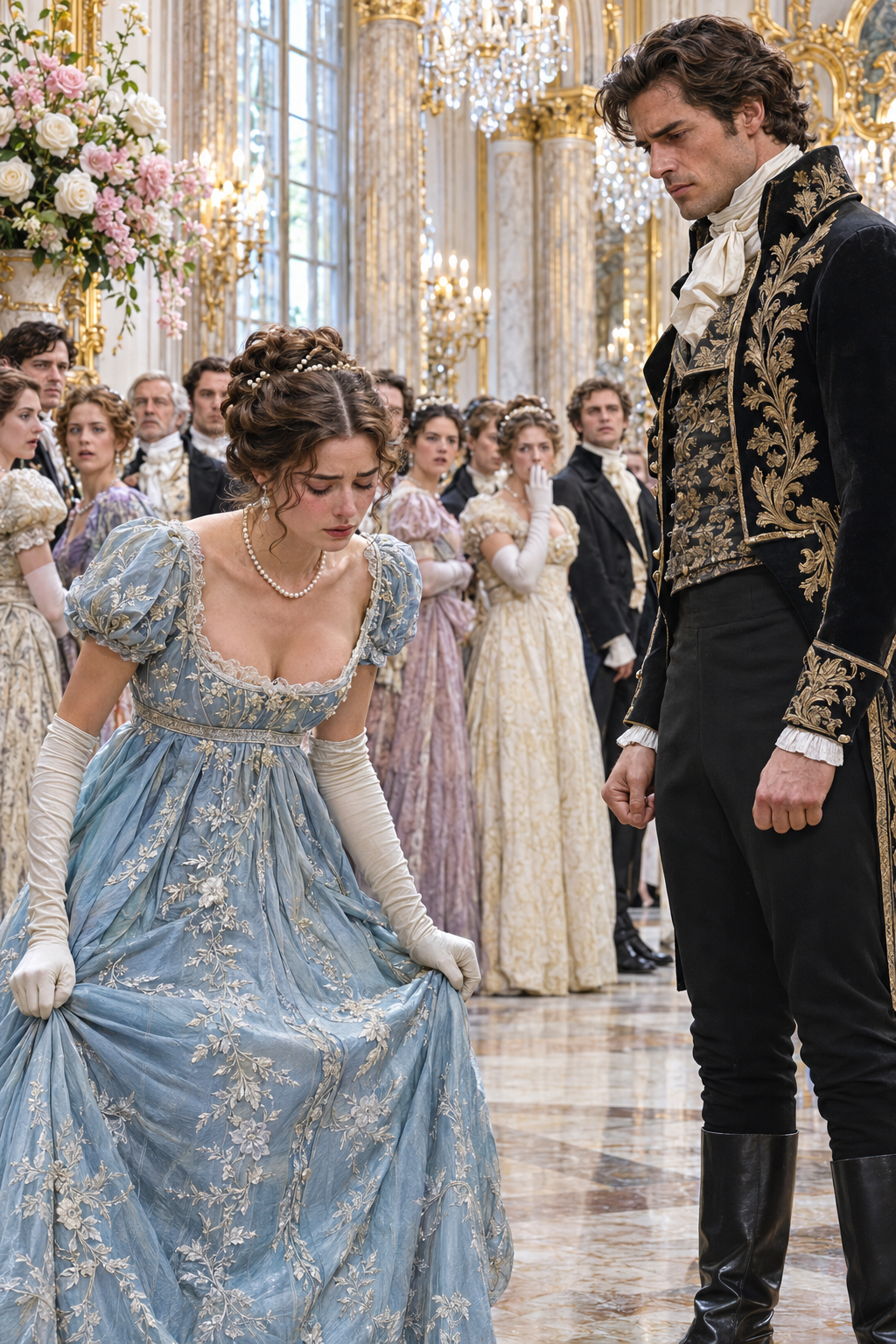
The Duke of Ravenscroft refused to take her hand before two hundred guests.
The Duke of Ravenscroft stood absolutely still, his hand resting against the back of Cordelia’s chair.
“That is precisely why you must never marry my grandson,” the Dowager Duchess repeated, her voice carrying the quiet authority of a woman accustomed to having her decisions obeyed.
Cordelia stared at her.
The room seemed unnaturally bright. Morning sunlight spilled across the Persian carpet, illuminating the silver tea service and the yellowed document lying between them.
“Then perhaps,” Cordelia said carefully, “you had better explain why.”
The duchess studied her for several seconds before reaching for the letter.
“Because your mother was Lady Eleanor Ashcombe. And twenty-three years ago, she nearly destroyed this family.”
The duke moved immediately.
“That is not the truth.”
His grandmother’s expression hardened.
“It is the truth this family has lived with.”
“No,” he answered. “It is the truth you have chosen to preserve.”
Cordelia looked between them, her fingers tightening around the gloves she had forgotten to put on.
“Was Eleanor Ashcombe my mother?”
Neither answered.
The silence was sufficient.
For twenty-three years, Cordelia had believed herself the orphaned daughter of a modest gentleman and his wife, both lost to illness before she was old enough to remember them. Her aunt had raised her with kindness, occasional severity, and a remarkable reluctance to discuss the past.
Now a woman Cordelia had never met was being placed before her like a charge in a criminal proceeding.
“Who was my father?”
The duchess lowered her eyes.
The duke’s jaw tightened.
And for the first time, Cordelia understood that whatever answer awaited her, neither wished to speak it.
“His name,” the duchess finally said, “was Julian Ravenscroft.”
Cordelia’s breath caught.
She turned toward the duke.
He was watching his grandmother with an expression of barely restrained anger.
“Julian was my father’s younger brother,” he said.
For one terrible moment, the room seemed to tilt.
Cordelia stepped backward.
“Then you and I—”
“Are not cousins,” he interrupted. “Julian was not your father.”
The duchess struck the arm of her chair with her palm.
“Enough.”
But the duke did not look away from Cordelia.
“That is what the document claims. It is not what happened.”
Cordelia felt the first cold stirrings of anger beneath her confusion.
“You both seem extraordinarily well informed about my life. Perhaps one of you would care to allow me the same privilege.”
The duke approached the table and lifted the letter before his grandmother could prevent him.
He read its contents quickly.
Then his expression changed.
“Where is the original register?”
The duchess rose.
“You are overstepping yourself.”
“Where is it?”
The words were quiet, but Cordelia had heard less authority in the duke’s voice when he had addressed a ballroom full of admirers.
The older woman stared at him.
Then she turned toward the window.
“There are matters a family must sometimes bury to survive.”
Cordelia looked at the letter still trembling slightly in his hand.
“Then perhaps this family has survived long enough at someone else’s expense.”
She took her gloves from the table.
The duke moved toward her.
“Cordelia—”
“Please do not.”
He stopped.
She looked at him, remembering his hand withdrawn before two hundred guests, his desperate use of her name, and the warning he had offered beneath the garden moon.
“You knew something was wrong with the story your grandmother told you. Yet you allowed me to walk into that ballroom knowing nothing.”
His expression softened with visible regret.
“I was trying to protect you.”
“By deciding what I was permitted to know?”
He had no answer.
Cordelia walked toward the door.
Behind her, the duchess spoke.
“If you leave this house and pursue the matter, you may discover things you would rather never have learned.”
Cordelia stopped with her hand upon the brass handle.
She did not turn.
“Then at least they will be mine to know.”
Outside, London continued its ordinary business.
Carriages passed along the pavement. A woman selling flowers called to a passing gentleman. Somewhere nearby, church bells marked the hour.
Cordelia stood beneath the portico of Ravenscroft House, struggling to reconcile the familiar world before her with the unfamiliar one that had opened behind its doors.
Her mother had possessed another name.
Her father might have been a Ravenscroft.
And the man whose attention had filled her thoughts for months might be related to her by blood.
She began walking.
By the time she reached her aunt’s house, her uncertainty had hardened into determination.
The traveling case remained open in the drawing room.
Her aunt stood beside it, folding linen with hands that seemed suddenly much older.
When Cordelia entered, the older woman looked up.
One glance at her niece’s face was enough.
“You went.”
“Yes.”
Her aunt sank slowly into the nearest chair.
Cordelia closed the door behind her.
“Who was Eleanor Ashcombe?”
The older woman pressed her lips together.
Then she covered her face with both hands.
And began to cry.
Cordelia had seen her aunt angry, disappointed, anxious, and exhausted. She had never seen her surrender so completely to grief.
For several minutes, the only sound was the ticking of the clock above the fireplace.
Finally, her aunt lowered her hands.
“Eleanor was my younger sister.”
Cordelia sat opposite her.
“Why did you tell me my mother was named Margaret?”
“Because Margaret was the name she chose when she fled London.”
“Fled from whom?”
Her aunt looked toward the window.
“From people who believed a woman’s reputation mattered more than her life.”
She rose and crossed to a small writing desk.
From its lowest drawer, she removed a wooden box Cordelia had seen occasionally but never been permitted to open.
Inside lay a miniature portrait, several faded ribbons, and a packet of letters.
Her aunt lifted the portrait.
The young woman painted upon its ivory surface possessed Cordelia’s dark eyes and unmistakable curve of the mouth.
Cordelia took it carefully.
For a moment, she could only stare.
“She looks like me.”
“She used to say you had your father’s stubbornness.”
Cordelia raised her head.
“Then tell me who he was.”
Her aunt sat beside her.
“His name was Thomas Vale. He was a physician’s son, educated at Edinburgh, and the kindest man I ever knew.”
The name meant nothing to Cordelia.
But her aunt spoke it with such tenderness that it immediately became real.
“He met Eleanor when she was staying with the Ravenscrofts. They were engaged in secret because her guardians would never have approved of him.”
“What happened?”
“Julian Ravenscroft happened.”
Her aunt took a slow breath.
“Julian was charming when he wished to be. He was also reckless, deeply in debt, and accustomed to obtaining whatever caught his interest. Eleanor’s inheritance would have paid his creditors.”
Cordelia looked down at the miniature.
“He wanted to marry her?”
“His mother wanted it more.”
The words settled heavily between them.
According to her aunt, Eleanor had inherited a considerable fortune from her maternal grandfather, including an estate in Hampshire and investments held in trust until marriage.
Julian had courted her publicly.
But Eleanor had refused him.
When she announced her intention to marry Thomas Vale, the Ravenscrofts threatened to withdraw their protection and expose private correspondence that might make her appear compromised.
Then Eleanor discovered she was expecting a child.
“Thomas wanted to marry her immediately,” her aunt whispered. “But he disappeared three days before the ceremony.”
Cordelia’s fingers closed around the portrait.
“Disappeared?”
“His carriage was found overturned near a narrow bridge outside London. They told us he had drowned.”
“Was his body found?”
Her aunt shook her head.
A chill traveled down Cordelia’s spine.
“Then how could they be certain?”
“We weren’t. Not at first.”
Her aunt drew another letter from the box.
“After his disappearance, Julian claimed that Eleanor had secretly married him and that her child was his. He produced witnesses. Documents. Everything necessary to make his story appear respectable.”
“But she denied it.”
“Until the day she died.”
Cordelia lowered her gaze.
Her aunt continued with difficulty.
“Eleanor fell ill shortly after your birth. She survived long enough to make me promise that you would never be raised in Ravenscroft House.”
“And you accepted money to keep that promise?”
Her aunt’s eyes filled again.
“I accepted money because they threatened to take you from me. The allowance was part of an agreement stating that I would not challenge their account of your parentage. I convinced myself that leaving London would keep you safe.”
Cordelia sat very still.
For twenty-three years, her aunt had carried a secret that had shaped every part of their lives.
“You should have told me.”
“I know.”
“Even if the truth was dreadful.”
“I know, my darling.”
There was no defense in her voice now.
Only regret.
Cordelia reached across the table and took her aunt’s hand.
The older woman began to cry again.
This time, Cordelia did not withdraw.
They sat together until the afternoon light shifted across the carpet.
Then Cordelia asked the question that had been waiting beneath everything else.
“Why does the duke believe Thomas Vale was my father?”
Her aunt looked surprised.
“Because Thomas was his father’s closest friend. They studied together when they were boys.”
Cordelia frowned.
“And the duke knows this?”
“He must know something. His father investigated Thomas’s disappearance before he died.”
“What did he discover?”
Her aunt hesitated.
Then she whispered, “Enough to frighten the Dowager Duchess.”
That evening, Cordelia received a message from Ravenscroft House.
It contained only four words.
Meet me at St. Anne’s.
There was no signature.
But she recognized the handwriting.
The duke had written her name upon a dance card three weeks earlier, and she had remembered the unusual slant of his letters.
At seven o’clock, she entered the quiet churchyard.
The sky was turning lavender above the rooftops. Ivy climbed the old stone walls, and the first evening lamps glowed beyond the iron railings.
The duke stood beside a weathered monument, his hat in his hands.
He turned as she approached.
“I was uncertain you would come.”
“So was I.”
He accepted the rebuke.
For several moments, neither spoke.
Then he reached into his coat and withdrew a small leather notebook.
“This belonged to my father.”
Cordelia hesitated before accepting it.
Inside were dates, names, and brief observations written in a hurried masculine hand.
One page had been marked with a ribbon.
She read the entry aloud.
“Thomas Vale did not drown. I have seen the man who arranged his disappearance.”
The duke watched her carefully.
“My father wrote that eleven months after yours was declared dead.”
Cordelia looked up.
“Then why did he do nothing?”
“He tried.”
The duke’s voice was low.
“Three weeks later, he fell from his horse during a morning ride. My grandmother called it an accident. I was sixteen.”
Cordelia looked back at the notebook.
“Do you believe she was involved?”
“I believe my father was afraid of someone. And I believe he was about to tell the truth.”
A distant carriage rattled over the stones beyond the churchyard.
Cordelia closed the book.
“Why are you giving this to me?”
“Because it belongs to the story of your life. Not mine.”
She studied his face.
“Is there more?”
He nodded.
“My father’s papers mention a solicitor named Edmund Harrow. He managed Eleanor’s inheritance and witnessed the supposed marriage to Julian.”
“Where is he?”
“Living quietly in Bath. At least, he was six months ago.”
Cordelia drew a breath.
“Then I shall go to Bath.”
The duke almost smiled.
“That was precisely what I expected you to say.”
He stepped closer.
“I can arrange a carriage.”
“No.”
He stopped.
Cordelia held the notebook against her chest.
“You may help me, Your Grace. But you will not decide my course.”
For the first time since the ball, genuine amusement softened his features.
“Then I shall follow your instructions.”
She looked away before he could see the warmth rising into her face.
They traveled to Bath two days later, accompanied by Cordelia’s aunt and the duke’s elderly cousin, Lady Beatrice, whose formidable opinions made her an excellent chaperone.
The journey passed through green countryside beneath a sky crowded with slow-moving clouds.
Cordelia spent much of it reading the notebook.
Its final pages contained references to financial transactions, property transfers, and payments made to individuals whose names she did not recognize.
One appeared repeatedly.
Edmund Harrow.
But another name troubled her more.
Julian Ravenscroft.
Beside it, the late duke had written:
He has gambled away everything except his mother’s loyalty.
By the time their carriage entered Bath, Cordelia understood that Julian’s desire to claim her as his daughter had never been merely an act of vanity.
If his marriage to Eleanor could be established, her inheritance might have become part of a settlement benefiting him.
If the marriage was fraudulent, someone had committed a serious crime.
They found Harrow in a narrow townhouse near the Crescent.
He was a thin, elderly man with yellowed fingers and an expression of immediate alarm when the duke presented his card.
“I have nothing to discuss.”
Cordelia stepped forward.
“My mother was Eleanor Ashcombe.”
The solicitor’s face changed.
He gripped the edge of the door.
For a moment, Cordelia thought he might collapse.
Instead, he whispered, “You are the child.”
Inside, Harrow led them to a small sitting room lined with dusty books.
He refused tea.
His hands shook as he removed his spectacles.
“Twenty-three years,” he murmured. “I wondered whether this day would come.”
Cordelia placed the miniature portrait upon the table.
“Did you witness a marriage between my mother and Julian Ravenscroft?”
Harrow closed his eyes.
“No.”
The room became still.
“Then why does your signature appear upon the certificate?”
“Because I was told Eleanor would be ruined unless I signed it.”
“By whom?”
Harrow glanced toward the duke.
“Your grandmother.”
The duke’s expression did not change, but his fingers tightened around his hat.
Harrow explained that Eleanor’s marriage certificate had been prepared after Thomas Vale vanished. The document was dated several months earlier, at a time when Eleanor had been living under Ravenscroft protection.
Two servants had been paid to support the fiction.
Harrow had signed because he feared losing his practice.
The arrangement would have placed Eleanor’s wealth under Julian’s control through property settlements and guardianship arrangements.
But Eleanor refused to surrender her estate.
“She threatened to expose the fraud,” Harrow said. “Then the family offered her a bargain.”
“What bargain?”
“She could leave London with enough money to live modestly, provided she never challenged the documents. Her child would remain publicly acknowledged as Julian’s if the family required it.”
Cordelia felt sick.
“My mother refused?”
“Absolutely.”
Harrow looked at her with something approaching admiration.
“She told the duchess that she would rather become a washerwoman than allow Julian Ravenscroft to own a single acre of her father’s land.”
Despite everything, Cordelia almost smiled.
It sounded like something she herself might have said.
“What happened to the inheritance?”
Harrow hesitated.
“It remains in trust.”
Cordelia stared.
“What?”
“The Hampshire estate. Certain investments. Income accumulated over the years. There have been expenses, certainly, but the principal was preserved under restrictions no one could easily overcome.”
“Who controls it?”
Harrow lowered his eyes.
“The current Duke of Ravenscroft has been listed as its supervising trustee since his father’s death.”
The duke went pale.
“I have never seen such an account.”
“Then your grandmother has kept more from you than I realized.”
For the first time, Cordelia saw genuine fear enter his expression.
The discovery changed everything.
Her history had not merely been concealed.
Her property had been administered without her knowledge, and perhaps without lawful authority.
Before they left, Harrow produced a packet of copied correspondence.
Among the letters was one written by Thomas Vale.
Its date was eleven days after the supposed accident.
The address was a small medical establishment in Bristol.
Cordelia read the opening sentence twice.
My dearest Eleanor, I am alive, though I fear those responsible have no intention of allowing me to return to you.
Her hands began to shake.
The duke moved closer.
She scarcely noticed.
For twenty-three years, she had mourned a father she had never known.
Now she held proof that he had survived the night he was said to have died.
“Where is the rest?”
Harrow lowered his head.
“That is the only page I possess.”
Cordelia looked at him.
“Did he ever come back?”
“I don’t know.”
“Did he try?”
The old solicitor’s silence answered more painfully than any words.
On their return to London, they discovered that the Dowager Duchess had already begun her campaign.
At an afternoon gathering, Lady Marchbanks had been informed that Miss Blythe was pursuing an improper attachment to the duke despite a disputed connection to his family.
Another hostess had received a warning about Cordelia’s questionable parentage.
Invitations were withdrawn.
Acquaintances became suddenly unavailable.
Even the woman who delivered flowers to her aunt’s house seemed reluctant to linger at the door.
Cordelia received the news without outward protest.
Then she dressed for dinner.
Her aunt watched her descend the stairs in a simple ivory gown.
“Where are you going?”
“To Lady Marchbanks.”
“My dear, you have not been invited.”
“I know.”
Lady Marchbanks’ dinner party was already assembled when Cordelia arrived.
Conversation faltered as the butler announced her name.
The hostess approached with a fixed smile.
“Miss Blythe. We were not expecting you.”
“I apologize for the inconvenience.”
Cordelia’s voice remained calm.
“I have come to speak with the Dowager Duchess.”
Across the drawing room, the old woman stood beside the fireplace.
Her expression did not change.
But her hand stopped moving upon the handle of her fan.
“Really, Miss Blythe,” she said. “This is hardly appropriate.”
“Neither is accusing an innocent woman of dishonor while withholding proof of her true parentage.”
A gentleman lowered his glass.
Several ladies turned openly to listen.
The duchess’s eyes flashed.
“You are making a spectacle of yourself.”
Cordelia remembered the ballroom, the outstretched hand, the silence of two hundred people.
This time, she did not lower her gaze.
“You taught me how easily one may be made into a spectacle, Your Grace. I have simply decided to speak while everyone is watching.”
The room went quiet.
The duchess took one step forward.
“You have no understanding of what is at stake.”
“I understand that my mother’s marriage certificate was forged.”
A sharp breath escaped someone nearby.
Cordelia continued.
“I understand that her inheritance was placed beyond her reach. And I understand that the man she intended to marry survived an accident that was used to explain his disappearance.”
The duchess’s composure fractured.
Only briefly.
But Cordelia saw it.
“You have been speaking to Harrow.”
“Yes.”
“That coward.”
The words escaped before she could stop them.
Then the duke appeared at the drawing room entrance.
“Grandmother.”
His voice carried across the room.
“The time for calling other people cowards has passed.”
He approached Cordelia and stood beside her.
Not in front of her.
Beside her.
The distinction was small.
It mattered enormously.
“I have instructed my solicitors to review every account associated with Eleanor Ashcombe’s estate,” he announced. “And I have invited Mr. Harrow to provide a sworn statement concerning the marriage certificate.”
The duchess looked at her grandson as though she no longer recognized him.
“You would destroy your own family?”
He answered without raising his voice.
“No. I intend to discover what remains of it when we stop lying.”
For a moment, she seemed to age before Cordelia’s eyes.
Then the old woman turned and walked from the room.
No one tried to stop her.
The following morning, a letter arrived at Cordelia’s house.
It was addressed in the duchess’s unmistakable handwriting.
Come to Ravenscroft House. Bring the girl who believes herself courageous.
Cordelia went alone.
She found the dowager in the library, standing before a fire that had been lit despite the warmth of the season.
Upon the desk lay a collection of documents bound with black ribbon.
“I have dismissed my secretary,” the older woman said without greeting her. “I wanted no witnesses.”
Cordelia remained near the doorway.
“Why?”
“Because there are truths I can no longer conceal, and I will not have servants repeating them over breakfast.”
She turned.
Her face was pale and drawn.
“Julian was my youngest son. I indulged him. Excused him. Defended him when everyone else saw what he had become.”
Cordelia said nothing.
“When Eleanor refused him, he threatened to kill Thomas Vale. I believed he was merely speaking in anger.”
Her voice faltered.
“I was wrong.”
The duchess sat heavily in a chair.
“Julian arranged the carriage accident. Thomas survived, but he suffered a severe injury to his leg. Julian’s men carried him to a private lodging and kept him there.”
Cordelia felt the blood drain from her face.
“How long?”
“Several weeks.”
“Then what?”
“He escaped.”
The duchess opened a drawer and removed another letter.
“Thomas reached Bristol. He wrote to Eleanor. But Julian intercepted the correspondence.”
Cordelia recognized the handwriting immediately.
It was the same as the letter Harrow had preserved.
“Where did he go?”
The duchess looked away.
“To Edinburgh. He eventually returned to medical work under an altered name.”
Cordelia stared at her.
“You knew?”
“Not at first.”
“When did you learn?”
“Seven years later.”
The answer struck harder than any accusation.
Seven years.
For sixteen years, the duchess had known that Cordelia’s father might still be alive.
“And you said nothing.”
The old woman bowed her head.
“I had already committed myself to protecting Julian. By then, admitting the truth would have exposed everything.”
Cordelia approached the desk.
“What happened to him?”
“Julian died abroad twelve years ago. Fever, they said. He had spent the last of his money and most of his friends.”
“I meant Thomas Vale.”
The duchess looked at her for a long time.
Then she reached into the packet and produced a folded sheet.
It contained an address in Edinburgh and the name of a physician.
Dr. Thomas Vale.
Beneath it was a date from the previous winter.
Cordelia gripped the paper.
“Is he alive?”
“I received a report in February. He was then.”
For the first time, the duchess seemed unable to meet Cordelia’s eyes.
“I cannot tell you more.”
Cordelia folded the paper carefully.
“Then I shall discover the rest myself.”
As she turned to leave, the old woman spoke again.
“Miss Blythe.”
Cordelia stopped.
“I loved my son.”
The words were almost inaudible.
“I know,” Cordelia answered.
She looked back.
“But you loved him so desperately that everyone he harmed became less important than his comfort.”
The duchess closed her eyes.
Cordelia left her sitting alone beside the unlit hearth.
Three days later, she departed for Edinburgh.
The duke accompanied her, along with Lady Beatrice, who spent the journey offering practical observations about Scottish weather and the regrettable habits of men who believed themselves indispensable.
Cordelia scarcely listened.
She kept the address folded inside her reticule.
At every coaching inn, she unfolded it, read the name, and placed it carefully back.
Thomas Vale.
A man who might be her father.
A stranger who had once loved her mother enough to risk everything.
When they reached Edinburgh, rain was falling across the stone streets.
The physician’s house stood near a narrow square, its windows glowing warmly against the gray afternoon.
Cordelia climbed the steps.
For several seconds, she could not lift the knocker.
The duke stood beside her.
“You needn’t do this today.”
She shook her head.
“If I wait, I shall only become more frightened.”
He nodded.
She knocked.
An elderly housekeeper opened the door.
When Cordelia asked for Dr. Vale, the woman’s expression changed.
“He is resting, miss.”
“Please tell him Cordelia Blythe has come.”
The housekeeper stared.
Then she vanished into the hallway.
A moment later, footsteps approached.
Slow footsteps.
Uneven.
An older gentleman appeared in the doorway, leaning upon a polished walking stick.
His hair was almost entirely silver. Deep lines marked the corners of his eyes, and one leg dragged slightly behind the other.
He looked at Cordelia.
Then at the miniature portrait she had taken from her reticule.
His hand began to tremble.
“Eleanor?”
The name escaped him like a breath held for twenty-three years.
Cordelia shook her head.
“No.”
She stepped closer.
“My name is Cordelia.”
The walking stick slipped from his fingers.
The duke caught it before it struck the floor.
Thomas Vale scarcely noticed.
He was staring at Cordelia’s face.
“My daughter?”
Her eyes filled.
She nodded.
He reached toward her, hesitated, and then gently touched her cheek with the back of his fingers.
For a moment, neither spoke.
Then Cordelia stepped into his arms.
Thomas held her with the awkward desperation of a man embracing someone he had already mourned.
His shoulders shook.
She felt his tears against her hair.
And for the first time in her life, Cordelia understood the particular grief of recovering something she had never known she possessed.
They remained together until the housekeeper quietly closed the drawing room door.
Over the following hours, Thomas told her everything.
He had survived Julian’s attack and escaped to Bristol, but the injury to his leg had required months of treatment.
When he finally reached London, Eleanor had already died.
The people who controlled her household told him the infant had died as well.
He had demanded proof.
They produced a burial record.
Years later, he discovered the entry was false, but by then the trail had gone cold.
He had written to every person he believed might know the truth.
Most letters went unanswered.
One received a reply threatening prosecution if he continued making accusations against the Ravenscroft family.
“I searched for you,” he whispered.
Cordelia held his hand.
“I believe you.”
Thomas looked toward the duke, who stood quietly beside the window.
“Your father tried to help me.”
“I know.”
“He promised he would discover where my daughter had been taken. Then I heard of his death.”
The duke bowed his head.
For the first time, the two men shared a grief that had belonged to different generations but originated in the same household.
Cordelia remained in Edinburgh for a fortnight.
She learned that her father took honey in his tea, disliked crowded rooms, and still kept a small dried flower inside the medical dictionary Eleanor had given him.
He learned that his daughter preferred morning walks, spoke too sharply when frightened, and possessed her mother’s stubborn belief that an inconvenient truth was preferable to a comfortable lie.
They spoke of ordinary things.
The books she loved.
The streets where he had practiced medicine.
The childhood she remembered.
The years he had lost.
Sometimes they sat quietly together, and neither felt compelled to fill the silence.
When the duke announced that his legal advisers had uncovered sufficient evidence to challenge the old settlements, Cordelia listened without interrupting.
The matter would not be resolved quickly.
There would be hearings, testimony, inquiries into the forged documents, and difficult questions concerning the administration of Eleanor’s estate.
But the evidence was substantial.
The false marriage could be challenged.
Thomas’s parentage could be established.
And Cordelia’s inheritance could finally be restored to its rightful owner.
Yet the discovery that mattered most to her was not written in any legal document.
It was the sound of her father calling her downstairs for breakfast.
By autumn, the first proceedings had begun.
Harrow provided his testimony.
The original marriage register, located among the papers of a deceased clergyman, contained no entry for Eleanor and Julian.
Financial records established the payments made to the supposed witnesses.
Thomas’s surviving correspondence supported the account of his disappearance.
Faced with the evidence, the Dowager Duchess signed a statement admitting her knowledge of the fraud.
She did not attend the public hearings.
Within weeks, she withdrew from London society.
Some called her sacrifice noble.
Others called it overdue.
Cordelia offered no opinion.
The restoration of Eleanor’s property proceeded through the courts and trustees, with the duke voluntarily surrendering every authority he had inherited over the estate.
He met Cordelia one afternoon at the Hampshire house that would eventually become hers.
The building stood upon a gentle rise overlooking fields edged with ancient oaks.
Its windows were shuttered, its gardens overgrown.
Yet the stone walls were sound.
Cordelia stood upon the terrace, examining the neglected rose beds.
The duke approached carrying a small wooden box.
“I found this among my father’s papers.”
She opened it.
Inside lay a delicate silver bracelet engraved with the initials E.A.
“My mother?”
He nodded.
“My father kept it because he believed one day he would find you.”
Cordelia ran her fingers across the engraving.
The duke watched her quietly.
“I owe you an apology.”
She looked up.
“For which occasion?”
His mouth curved slightly.
“There are several.”
“Indeed.”
He took a breath.
“At the ball, I allowed fear to govern my conduct. I knew my grandmother would react if I showed you any affection. I also believed there might be a family connection that made such affection impossible.”
Cordelia listened.
“I thought withdrawing would protect you.”
“And instead, you humiliated me.”
“Yes.”
He did not attempt to soften the admission.
“I am sorry.”
A breeze moved through the long grass beyond the terrace.
Cordelia closed the box.
“I have spent most of my life surrounded by people who believed they knew what was best for me.”
“I know.”
“They loved me, some of them. Others feared what I represented. But nearly all of them made decisions without asking what I wanted.”
He nodded slowly.
“I will not do that again.”
She studied his face.
“Even if what I want displeases you?”
“Especially then.”
For a moment, she looked away toward the distant fields.
Then she smiled.
It was small.
But he noticed.
“And what if I told you I wished to remain here and restore this house?”
“I would ask whether you needed an architect.”
“And if I wanted to establish a school for the children of the estate?”
“I would ask how many classrooms.”
Cordelia turned toward him.
“And if I wished to spend an entire year discovering who I am before making any promises to anyone?”
The duke’s expression softened.
“Then I would hope you might occasionally permit me to visit.”
She held his gaze.
“Occasionally?”
“I should be grateful for whatever frequency you considered reasonable.”
Cordelia laughed.
It was the first time he had heard her laugh without restraint.
He looked almost startled by the sound.
Over the following months, he visited often.
Sometimes they walked through the gardens while workmen repaired the old stone walls.
Sometimes he brought books from London.
Sometimes Cordelia showed him plans for the school she intended to establish.
They argued about architecture, politics, education, and the proper use of inherited wealth.
He discovered that she possessed an infuriating talent for finding weaknesses in his reasoning.
She discovered that beneath his reserve lived a man who listened more carefully than he spoke.
Their affection grew slowly.
Without secrecy.
Without bargains.
Without either asking the other to become someone different.
Thomas Vale came to live near the estate the following spring.
He took a modest house overlooking the village and began treating local families without charging those who could not afford him.
Cordelia visited nearly every day.
Her aunt eventually joined them, bringing her favorite books, three stubborn household habits, and a renewed determination never again to mistake silence for kindness.
One afternoon, Cordelia found her father sitting beneath an apple tree, reading a letter from an old colleague.
He looked up as she approached.
“You seem happy.”
She sat beside him.
“I am.”
“Then perhaps your mother has finally received the ending she deserved.”
Cordelia looked toward the house.
“Do you think she would have approved of what I have done?”
Thomas smiled sadly.
“Your mother was never particularly concerned with approval.”
Cordelia laughed.
“That sounds familiar.”
“She would have admired your courage. But more than that, she would have been glad to see you living freely.”
For several moments, they watched the sunlight move across the grass.
Then Thomas placed his hand over hers.
“Promise me something.”
“What?”
“Do not spend the rest of your life trying to compensate for the years we lost. They are gone. We cannot recover them by refusing to enjoy the years ahead.”
Cordelia leaned against his shoulder.
“I promise.”
The following summer, Lady Marchbanks hosted another ball.
The ballroom was just as magnificent as before.
Chandeliers glittered above the polished floor. Musicians played beneath the gallery. Silk gowns whispered across the marble.
But this time, when Miss Cordelia Blythe entered, she did not arrive as an uncertain young woman dependent upon the kindness of society.
She came as the acknowledged daughter of Thomas Vale and Eleanor Ashcombe, the owner of her mother’s restored estate, and the founder of a village school that had already enrolled forty children.
Her aunt walked beside her.
Her father followed, leaning upon his polished stick.
And across the ballroom, the Duke of Ravenscroft waited.
When he approached, the surrounding conversations softened.
Many guests remembered what had happened in this room the previous summer.
Cordelia remembered it too.
The raised hand.
The refusal.
The silence.
The curtsy that had preserved her dignity when everything else seemed to be slipping away.
The duke stopped before her.
“Miss Blythe.”
“Your Grace.”
He bowed.
Then he extended his hand.
“May I have this dance?”
Cordelia looked at his outstretched fingers.
For one moment, she allowed him to wait.
His expression remained steady, though a faint smile touched his mouth.
“Are you quite certain?” she asked.
“Entirely.”
“Because I should hate to cause another disturbance.”
“I fear I am prepared to endure any number of disturbances, provided you remain beside me.”
She placed her hand in his.
The orchestra began a waltz.
As they moved onto the floor, Cordelia noticed the Dowager Duchess seated near the far wall.
The old woman had returned to society only recently.
She looked smaller now, her formidable posture softened by age and a loneliness she had largely created herself.
Their eyes met.
For a brief moment, the duchess inclined her head.
Cordelia returned the gesture.
It was not forgiveness.
Not yet.
But neither was it hatred.
Some wounds demanded time, and Cordelia had learned that healing did not require pretending they had never existed.
The duke drew her gently into the dance.
“You are thinking,” he murmured.
“That is generally a dangerous occupation.”
“I have noticed.”
She smiled.
They moved beneath the chandeliers, the music rising around them.
When the final notes faded, he did not release her hand immediately.
But this time, he waited for her to decide.
Cordelia looked up at him.
“Ravenscroft?”
“Yes?”
“If you intend to ask me something important, I would prefer you do it somewhere less crowded.”
His expression changed.
Then he laughed softly.
“You have discovered my intentions.”
“I suspected them when Lady Beatrice began asking rather detailed questions about my preferred flowers.”
He offered his arm.
“Then perhaps the terrace?”
Outside, the summer air carried the scent of roses.
The same marble balustrade stood beneath the same pale moon.
But Cordelia was no longer the woman who had fled the ballroom to conceal her humiliation.
She stood beside the duke with her shoulders relaxed, her hands steady.
He turned toward her.
“I cannot promise that life with me will always be simple.”
“I should find that rather suspicious if you did.”
“Nor can I promise never to make a mistake.”
“I have considerable evidence to the contrary.”
He smiled.
Then his expression grew serious.
“But I can promise that I will never again ask you to surrender your voice, your freedom, or any part of yourself in order to be loved.”
Cordelia felt tears gather unexpectedly in her eyes.
He took her hand.
“Will you marry me?”
She looked at the man who had once turned away from her before two hundred people.
The man who had learned to stand beside her rather than shelter her behind his name.
The man who had helped uncover the truth even when doing so meant exposing his own family’s disgrace.
“Yes,” she whispered.
His breath left him slowly.
“Yes?”
Cordelia smiled through her tears.
“On one condition.”
“Name it.”
“When we disagree, you must promise never to make a decision for both of us without speaking to me.”
He lifted her hand to his lips.
“I promise.”
“And another thing.”
He raised an eyebrow.
“There are more?”
“There may be quite a few.”
“Then I foresee a lifetime of negotiations.”
“You do.”
He laughed, drawing her gently closer.
Cordelia rested her forehead against his.
For a moment, the world beyond the terrace seemed very far away.
When they returned to the ballroom, they did so together.
Their engagement was announced several weeks later.
They married the following spring in the village church near Cordelia’s estate.
Thomas Vale walked his daughter down the aisle, his step uneven but his face radiant.
Her aunt wept openly.
Lady Beatrice declared the ceremony satisfactory before admitting, with considerable emotion, that she had never witnessed a happier one.
The Dowager Duchess attended quietly.
She offered Cordelia a small packet afterward.
Inside was a letter Eleanor had written during the final weeks of her life.
The duchess had kept it for twenty-four years.
Cordelia read it alone that evening.
Her mother’s handwriting was delicate, the ink faded in places.
My dearest child,
If you should ever read these words, I hope you have grown into a woman who knows she is loved.
There may be people who tell you that duty requires silence, that respectability demands obedience, or that belonging to a family means surrendering the truth.
Do not believe them.
Love should never require you to disappear.
I could not choose the circumstances of your birth, nor can I choose the life that awaits you. But I pray you will possess the freedom to make your own decisions, even when they frighten those who claim to know better.
And if someday you are faced with a choice between being accepted and being honest, remember that the people who truly love you will not ask you to sacrifice one for the other.
Your mother, Eleanor.
Cordelia folded the letter carefully.
Then she placed it beside the miniature portrait upon her dressing table.
Outside, evening settled over the Hampshire fields.
From the garden came the sound of her husband’s laughter as he spoke with her father beneath the apple trees.
The house was warm.
The doors stood open.
And for the first time in generations, no one living beneath its roof was required to conceal the truth in order to belong.
Years later, when visitors admired the restored estate and spoke of the remarkable circumstances that had brought its mistress to her rightful place, Cordelia rarely discussed the scandal.
Instead, she showed them the school.
She spoke of the children who had learned to read, the families whose circumstances had improved, and the scholarships established in Eleanor’s name.
When someone once asked whether she regretted the humiliation she had suffered at Lady Marchbanks’ ball, Cordelia considered the question before answering.
“I regret that so many people were willing to watch a woman suffer simply because someone powerful had decided she deserved it.”
The visitor looked uncomfortable.
“But without that evening, you might never have discovered your true history.”
Cordelia glanced toward the garden, where her husband was helping their young daughter gather fallen roses.
“Perhaps,” she said.
Then she smiled.
“But I would rather believe the truth was always worth discovering, regardless of what brought it into the light.”
Her daughter ran toward her, holding a crooked bundle of flowers.
“Mama, Papa says these are for you.”
Cordelia knelt and accepted them.
“They are beautiful.”
“Even the broken ones?”
“Especially those.”
The little girl studied her thoughtfully.
“Why?”
Cordelia gently straightened a bent stem.
“Because being damaged does not make something worthless, darling. And sometimes the things people try hardest to hide are the very things that deserve to be seen.”
Her daughter considered this, then ran back toward her father.
Cordelia watched them together beneath the afternoon sun.
Once, she had stood before a ballroom full of strangers, believing that one man’s refusal could determine her worth.
Now she understood how mistaken that belief had been.
Her dignity had never depended upon the hand he refused to take.
Her identity had never belonged to the family that concealed it.
And her future had never been something another person possessed the right to decide.
She had been worthy of love before her name was restored, before her inheritance was recovered, and before a duke offered her his heart.
She had always been worthy.
The difference was that now, she knew it.
And when her husband looked up from the garden and reached his hand toward her, Cordelia took it freely.
Not because she needed someone to give her a place in the world.
But because she had finally found her own, and wished to share it with him.
THE END.