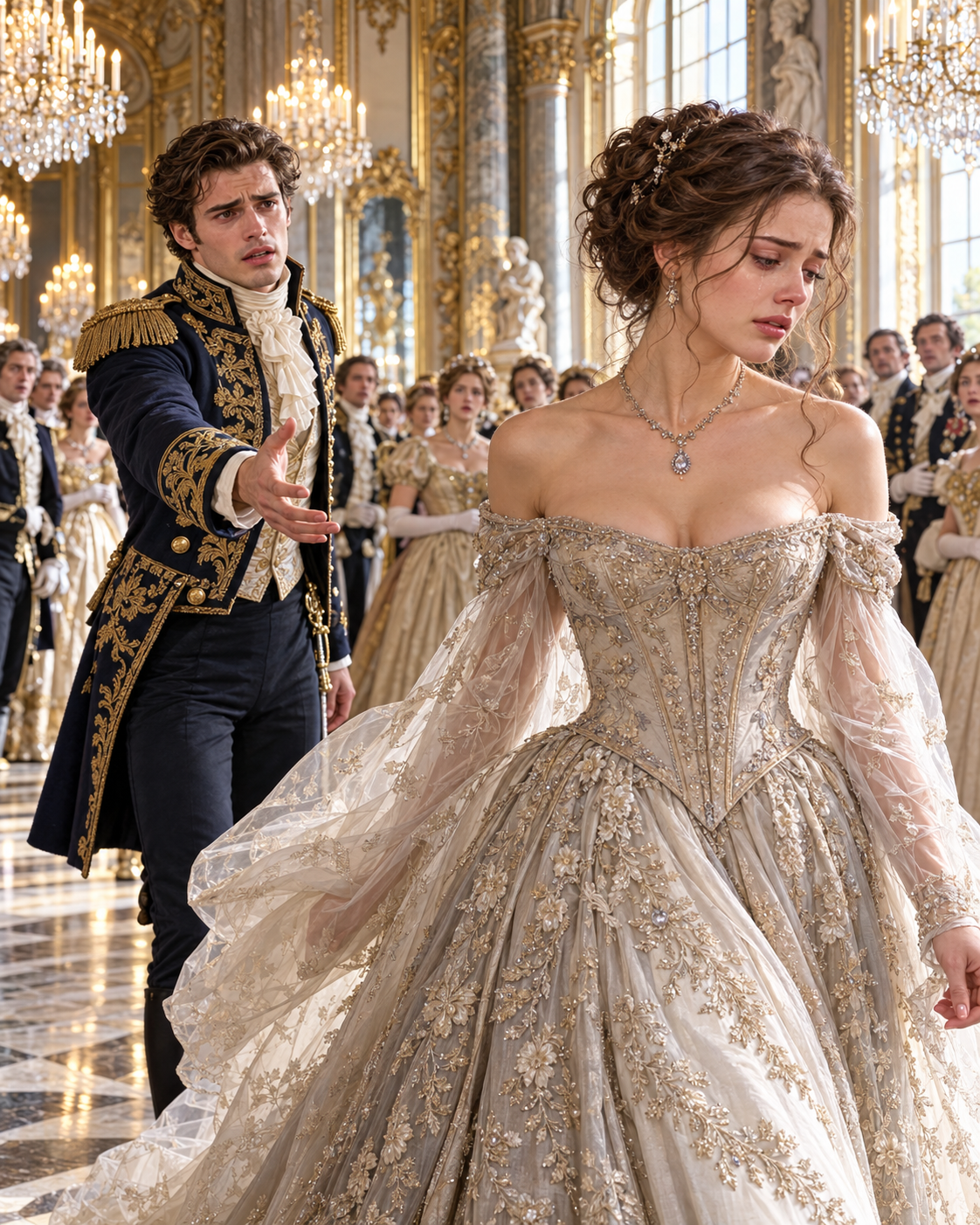
The Duke of Northwick had just humiliated his future bride in front of half of England.
The words on the envelope seemed to grow heavier the longer Josephine stared at them.
To Josephine, when she discovers who she is.
The handwriting belonged unmistakably to her grandmother, Lady Eleanor Ashcroft, who had died six years earlier.
Josephine recognized the elegant slant of every letter, the careful pressure of the pen, and the small flourish beneath her name.
But the message made no sense.
“I know perfectly well who I am,” she said quietly.
Mr. MacLeod stood beside the covered portrait, his face unusually pale in the candlelight.
“I sincerely hope, miss, that you will still feel that way after reading it.”
Josephine broke the seal.
Inside were three folded pages and a smaller envelope bearing a date from twenty-two years ago.
She unfolded the first page.
My dearest Josephine,
If you are reading this, you have reached Glen Mara without the permission of those who spent your childhood deciding what you should know.
I had hoped to tell you everything myself, but there are truths that become dangerous when spoken too early.
You were never meant to inherit merely a house.
You were meant to inherit a choice.
Josephine paused.
Outside, the wind struck the windows with enough force to make the candle flames bend.
She continued.
Your father has always believed that protecting a family means preserving its name, whatever the cost.
I believed otherwise.
When you were three years old, I watched him make a decision that would have taken your future from you before you were old enough to understand what freedom meant.
I stopped him once.
I could not be certain I would always be there to stop him again.
The paper trembled slightly in Josephine’s hands.
The child in the portrait is you, my darling.
The gentleman beside us was Malcolm Fraser, the last hereditary keeper of Glen Mara and the man who ensured this estate could never become your father’s property.
He was also your mother’s brother.
Josephine lowered the letter.
“My mother had a brother?”
Mr. MacLeod nodded.
“She did, miss.”
“My father told me she was an only child.”
“Your father told you many things that were convenient for him.”
Josephine looked again at the painting.
The small girl stood between her grandmother and a tall gentleman with dark hair, her fingers clasped around a silver locket.
She could not remember the moment.
Yet something about the man’s expression unsettled her.
He had been looking at the child rather than the painter, with the grave attention of someone trying to memorize a face.
“Why would my father conceal my uncle?”
Mr. MacLeod glanced toward the letter.
“Lady Eleanor thought it best that you hear the rest from her.”
Josephine read on.
Your uncle Malcolm never married and had no children of his own.
Your mother, Margaret, was his closest remaining relative, and he loved her dearly.
When Margaret died, he intended Glen Mara to pass eventually to you.
Your father objected.
He had already borrowed heavily against his own inheritance and believed that Glen Mara might rescue him from the consequences.
Malcolm refused to allow the castle to become another stake upon a gambling table.
With my assistance, he placed the property into a legal arrangement that would transfer full ownership to you upon your twenty-first birthday.
Nothing your father could sign, promise, or surrender would alter it.
Josephine closed her eyes.
For years, her father had spoken of her mother’s family as though they were a collection of distant, unimportant relations.
She had never questioned him.
Children rarely question the shape of the world when every adult around them insists it has always looked the same.
“Why didn’t my grandmother tell me?”
Mr. MacLeod pulled out a chair beside the fire.
“Please sit, miss.”
Josephine remained standing.
“Why?”
The steward studied her for a long moment.
“Because your father threatened to take you out of England if she interfered in your upbringing.”
The room seemed suddenly colder.
“He couldn’t have done that.”
“He was your legal guardian after your mother’s death. Lady Eleanor believed he was capable of carrying out the threat.”
Josephine looked down at the letter once more.
There was more.
I could not give you the childhood I wanted for you, Josephine.
But I could ensure that one day, if the world tried to make you small, there would be somewhere it could not follow without your consent.
Glen Mara is yours.
Not because you bear a distinguished name.
Not because some gentleman considers you worthy.
Because I wished you to possess something that could never be taken merely because you disappointed someone.
There are further papers in Malcolm’s old study.
Read them before you make any promises concerning the estate.
And remember this above all: gratitude is not obedience, and love should never require the surrender of your dignity.
Your loving grandmother,
Eleanor.
Josephine stood without moving.
The fire burned steadily behind her.
Somewhere in the upper rooms, a door creaked upon its hinges.
For six years, she had carried the memory of her grandmother as a woman who smelled of lavender, wore dark green silk, and always warmed her hands before touching Josephine’s face.
Now she understood that the same woman had spent years quietly building a refuge.
Not from poverty.
From the people who believed Josephine belonged to them.
“Show me the study,” she said.
Mr. MacLeod hesitated.
“It is very late, miss.”
“Then we had better not waste another minute.”
For the first time, a faint smile touched his face.
“Very good, my lady.”
Josephine turned.
“Please don’t call me that.”
“As you wish, Miss Ashcroft.”
He took a candle from the table and led her toward the staircase.
The study occupied the western tower, beyond a corridor lined with old hunting tapestries.
Its windows overlooked a black ribbon of water far below the cliffs.
Books crowded every wall.
A large desk stood beneath the window, its polished surface bare except for a brass lamp and a narrow wooden box.
Mr. MacLeod unlocked a drawer and withdrew a thick packet bound with blue cord.
“Mr. Fraser instructed me to keep these until you came.”
Josephine untied the cord.
There were deeds, maps, account books, and letters from solicitors in Edinburgh.
Everything appeared meticulously organized.
But one document made her stop.
It was an offer to purchase Glen Mara, dated only four months earlier.
The purchaser was listed as the Northwick Land and Development Company.
Josephine read the name twice.
“Northwick?”
Mr. MacLeod’s jaw tightened.
“Yes, miss.”
“The Duke of Northwick?”
“The company is controlled by his family’s trustees.”
Josephine stared at the figures.
The proposed price was enormous.
Enough to pay her father’s debts several times over.
Enough to make the Ashcroft family wealthy again.
And beneath the offer lay a handwritten note.
Purchase dependent upon the prospective marriage between His Grace and Miss Ashcroft.
Josephine slowly sat down.
The engagement ball returned to her in sharp, disjointed fragments.
The Duke’s cold expression.
The laughter.
His careless assessment of her as merely adequate.
And her father’s frantic insistence that she apologize.
Her marriage had never been simply a marriage.
It had been the doorway through which two men intended to reach her inheritance.
“Did the Duke know?” she asked.
Mr. MacLeod considered the question carefully.
“I cannot say how much he understood, miss. But someone acting for his family certainly knew the castle was valuable.”
Josephine turned another page.
A survey described the estate’s ancient timber holdings, grazing lands, mineral rights, and water access.
The numbers were astonishing.
Her father had called Glen Mara a worthless lodge.
Yet here was an entire working estate, with farms, cottages, forests, and families whose livelihoods depended upon it.
A sharp knock interrupted them.
Mr. MacLeod looked toward the door.
“Come in.”
A young housemaid entered, breathless.
“Forgive me, sir, but there’s a gentleman at the gate.”
“At this hour?”
“Yes, sir. He says he’s ridden from Inverness with urgent business.”
Josephine looked up.
“Who is he?”
The maid swallowed.
“His Grace, the Duke of Northwick.”
For several seconds, nobody spoke.
Then Josephine folded the purchase offer and placed it carefully inside the drawer.
“Bring him to the drawing room,” she said.
Mr. MacLeod stepped forward.
“Miss Ashcroft, you are under no obligation to receive him.”
“I know.”
She rose and smoothed her traveling dress.
“That is precisely why I intend to.”
The Duke was standing beside the fireplace when Josephine entered.
His immaculate evening clothes from the engagement ball had been replaced by a dark riding coat, damp at the shoulders.
He looked tired.
It was the first time Josephine had ever seen him without the invisible armor of perfect composure.
“Miss Ashcroft.”
“Your Grace.”
His eyes traveled briefly over the room.
“I see you found the property.”
“Apparently I did.”
“I came as soon as I learned you had arrived.”
“How fortunate that your information travels faster than your courtesy.”
A faint movement crossed his face.
He accepted the rebuke without answering.
Then he removed his gloves.
“I owe you an apology.”
Josephine remained beside the doorway.
“For which occasion?”
His gaze settled on hers.
“The engagement ball.”
“That was rather public, Your Grace. An apology here seems considerably more convenient.”
He looked toward the empty chairs, then back at her.
“You are right.”
She had expected an argument.
His agreement irritated her more than she wished to admit.
“Why are you here?”
The Duke withdrew a folded paper from his coat.
“Because your father has offered Glen Mara to my trustees.”
Josephine felt a strange, almost peaceful clarity.
“Then he has offered something he does not own.”
“Yes.”
“You knew that?”
“I learned it yesterday.”
She watched his expression.
“Then you must also have learned that my father was expecting our marriage to make the transfer possible.”
The Duke looked away.
That was answer enough.
Josephine crossed to the fireplace and held out her hand.
“Give me the paper.”
He surrendered it.
Her father’s signature occupied the bottom of the page.
The document promised the sale of Glen Mara immediately following the marriage settlement.
Below it was an advance payment, large enough to satisfy several urgent creditors.
Josephine looked up.
“The money has already changed hands.”
“Some of it.”
“And now that there will be no wedding?”
“Your father must repay it.”
She folded the paper.
“Then I imagine he has a difficult week ahead.”
The Duke moved closer.
“Miss Ashcroft, there are matters you do not understand.”
She raised her eyes.
“That sentence has become remarkably popular since I arrived.”
He stopped.
For a moment, only the fire moved between them.
Then he said, “My family’s trustees arranged this transaction before I understood the full circumstances.”
“But you understood that you were marrying a woman whose property interested your family.”
“Yes.”
“And you never thought to mention it.”
His silence was brief, but complete.
Josephine handed back the paper.
“Then we have nothing further to discuss.”
He did not move.
“I did not come to persuade you to restore the engagement.”
“Then you may leave with a clear conscience.”
“I came to warn you.”
Her hand tightened around the mantel.
“About what?”
“Your father has creditors who believe Glen Mara is already his to sell.”
Josephine glanced toward the window.
“And?”
“One of them is a man named Sir Edmund Vale.”
The name meant nothing to her.
But behind the Duke, Mr. MacLeod suddenly straightened.
Josephine noticed.
“Who is he?”
The steward answered before the Duke could.
“A man who tried to ruin your uncle Malcolm twenty years ago.”
The Duke turned.
“You know him?”
“I know what he is capable of.”
The following morning, Josephine learned that Sir Edmund Vale had been involved in a disputed mining venture on land bordering Glen Mara.
Malcolm Fraser had refused him access to the estate’s watercourses.
Without that access, the venture had failed.
Vale lost a considerable fortune.
Several years later, he emerged as one of Lord Ashcroft’s most persistent gambling creditors.
Josephine listened while Mr. MacLeod explained the history over breakfast.
A silver teapot stood between them, its surface reflecting the gray morning light.
“Do you believe Vale encouraged my father’s debts to get Glen Mara?”
“I believe he has wanted this land for a long time.”
“Then he will be disappointed.”
Mr. MacLeod’s expression remained troubled.
“There is something else, miss.”
He slid a ledger across the table.
The estate’s income had been managed carefully for years, but recent expenditures were unusual.
Payments had been made to repair fencing destroyed overnight.
Several sheep had disappeared.
A cottage near the northern boundary had suffered a suspicious fire.
And two estate workers had received anonymous threats.
Josephine stared at the entries.
“Why wasn’t I told?”
“Because until a week ago, we had no reliable way of reaching you without your father’s interference.”
She stood.
“Then I should like to meet the people who live here.”
By noon, Josephine was riding through the valley beside the estate’s head keeper, Andrew Kerr.
He was a broad-shouldered man with a weathered face and a manner entirely uninterested in titles.
At the first tenant cottage, an elderly woman opened the door and examined Josephine from head to foot.
“So you’re the young mistress.”
“I am Josephine.”
The woman’s eyebrows rose.
“We’ll see.”
Josephine almost smiled.
Inside, the cottage smelled of peat smoke and freshly baked bread.
A young boy sat near the hearth with his leg wrapped in clean cloth.
His mother explained that he had been injured while helping repair a damaged sheepfold.
Josephine crouched beside him.
“Does it hurt?”
“Only when everyone asks.”
She laughed softly.
“An understandable complaint.”
The boy grinned.
For the next two hours, Josephine visited farms, spoke with tenants, and listened to complaints about broken roads and overdue repairs.
Nobody asked about her broken engagement.
Nobody cared whether a duke considered her beautiful, accomplished, or adequate.
They cared whether their roofs would withstand winter.
Whether their animals were safe.
Whether the woman who owned the valley intended to remain.
By late afternoon, Josephine understood something her father had never considered.
Glen Mara was not merely valuable because of its land.
It mattered because people had built their lives upon it.
That evening, she summoned Mr. MacLeod to the study.
“I want the damaged cottages repaired first.”
He nodded.
“And the road to the northern farms?”
“Have Mr. Kerr prepare an estimate.”
“The expense will be considerable.”
“Then we shall examine the estate’s income and decide what is possible.”
He studied her for a moment.
“Your grandmother would have approved.”
Josephine looked toward the rain-darkened window.
“I hope she would have told me if I were being foolish.”
“Oh, she most certainly would.”
For the first time since arriving, Josephine laughed without restraint.
The sound was still in the room when a servant knocked.
A letter had arrived from London.
Her father’s seal marked the envelope.
Josephine opened it.
You have caused sufficient embarrassment.
Return immediately.
Sir Edmund Vale has agreed to settle the outstanding obligations if you sign the enclosed authorization transferring Glen Mara into my management.
Failure to comply will leave me no choice but to explain publicly how your reckless conduct destroyed this family.
Josephine laid the letter beside the fire.
Attached was another document.
A power of attorney granting her father complete authority over the estate.
She read every line.
Then she asked Mr. MacLeod for a pen.
“Are you going to answer him?”
“Yes.”
She wrote three sentences.
Father, Glen Mara is not yours to bargain with.
I will not sign the authorization.
Please do not mistake my silence in childhood for consent in adulthood.
She sealed the letter.
“Send that tomorrow.”
Mr. MacLeod bowed.
But the next morning, the northern sheepfold was found burning.
The fire was contained before it reached the nearby cottages, though several animals were lost.
Andrew Kerr discovered two sets of unfamiliar bootprints beside the river.
Josephine rode to the site despite the steward’s objections.
Blackened beams lay scattered across the wet grass.
The smell of smoke clung to the air.
A farmworker approached her, holding a twisted piece of iron.
“Found this near the gate, miss.”
It was a broken fastening from a lantern.
Josephine turned it over in her gloved palm.
“Do you recognize it?”
Kerr nodded grimly.
“Not from our estate.”
That afternoon, the Duke returned.
This time, he arrived without servants or ceremony.
Josephine received him in the study.
“Has your father written?” he asked.
“Yes.”
“Did he mention Vale?”
“He offered to exchange my property for his debts.”
The Duke’s expression hardened.
“I feared as much.”
Josephine placed the broken lantern fitting on the desk.
“Someone burned one of my sheepfolds last night.”
He examined the iron.
“May I?”
She nodded.
The Duke held it toward the window, studying a faint stamped mark along the metal.
“I have seen this before.”
“Where?”
“Among supplies purchased by one of Vale’s companies.”
Josephine felt the room narrow around them.
“Can you prove it?”
“Not from this alone.”
“Then it is of little use.”
“Perhaps not.”
He placed the object down.
“But Vale has made mistakes before.”
She watched him.
“You sound unusually familiar with his affairs.”
The Duke drew a slow breath.
“My father invested with him.”
“And?”
“He lost money. A great deal of it.”
Josephine looked at him carefully.
“So Northwick is in financial trouble as well.”
“Not ruined. But vulnerable.”
“And my estate was meant to solve the problem.”
“Yes.”
There it was again.
The truth, spoken plainly, after so many months of polite deception.
Josephine moved toward the desk.
“Why tell me now?”
The Duke looked at his hands.
“Because I knew the marriage negotiations were advantageous, and I allowed myself to treat that as sufficient reason to proceed.”
His voice lowered.
“At the ball, I spoke as though your feelings were irrelevant because I had already persuaded myself they were.”
Josephine said nothing.
“I was cruel,” he continued. “There is no more flattering word for it.”
She looked toward the window, where rain moved across the courtyard.
“An apology doesn’t undo what happened.”
“I know.”
“Nor does helping me make you entitled to anything.”
“I know that too.”
For the first time, she believed him.
Not entirely.
But enough to listen.
“What do you propose?”
“Vale keeps his business records through a solicitor in Edinburgh. I know someone who may be able to obtain evidence of the illegal arrangements.”
“Then do it.”
His eyebrows rose.
Josephine sat behind the desk.
“And, Your Grace, I expect to see everything you discover.”
A small, unexpected smile appeared.
“As you wish.”
Three days later, a carriage approached Glen Mara beneath a sky swollen with rain.
Lord Ashcroft stepped out first.
Sir Edmund Vale followed.
Vale was tall, elegantly dressed, and carried a silver-headed cane.
His smile arrived before his eyes did.
Josephine received them in the great hall.
Her father looked around in astonishment.
For one fleeting moment, she saw the extent of his deception reflected in his face.
He had known the castle was substantial.
But perhaps he had never expected to see it so carefully maintained.
“Josephine,” he began, “you have behaved disgracefully.”
“Good afternoon, Father.”
He stiffened.
“You will return to London with me.”
“No.”
Sir Edmund lifted a placating hand.
“Let us not make this unpleasant.”
Josephine turned toward him.
“You must be Sir Edmund Vale.”
“At your service, Miss Ashcroft.”
“I rather doubt that.”
His smile thinned.
They entered the drawing room.
Lord Ashcroft immediately began speaking of debts, family honor, and the duty of a daughter to support her father.
Josephine listened without interruption.
When he finished, she placed the unsigned authorization on the table.
“I will not surrender Glen Mara.”
Vale leaned forward.
“Perhaps you misunderstand the seriousness of your father’s position.”
“I understand it perfectly.”
“His debts are considerable.”
“Yes.”
“His creditors are not patient men.”
“Then he should have been more careful with their money.”
Her father struck the arm of his chair.
“You ungrateful girl!”
Josephine did not flinch.
“Grandmother protected this estate because she knew you would try to sell it.”
He stared at her.
“She filled your head with nonsense.”
“She left documents.”
“Documents can be challenged.”
Vale’s voice was soft.
Josephine looked at him.
“Are you threatening litigation?”
“I am suggesting that an inexperienced young woman should hesitate before challenging gentlemen who understand such matters.”
“How fortunate,” Josephine said, “that I have already engaged a solicitor.”
The lie was a small one.
She had written to a reputable Edinburgh firm that morning but had yet to receive its confirmation.
Still, Vale’s expression changed.
And Josephine saw it.
He had expected her to be frightened.
Instead, he was beginning to calculate.
Before he could reply, the drawing room doors opened.
The Duke of Northwick entered with a middle-aged gentleman carrying a leather case.
Josephine rose.
“Your Grace.”
The Duke bowed.
“Miss Ashcroft. May I present Mr. James Fenwick, solicitor of Edinburgh.”
Fenwick placed his case upon the table.
“I have examined the relevant documents, Miss Ashcroft, and I believe there are matters your guests should hear.”
Vale stood abruptly.
“This is an outrage.”
“Then you may wish to sit down,” Fenwick replied.
From his case, the solicitor withdrew a collection of correspondence and bank records.
The evidence showed that Vale had arranged several of Lord Ashcroft’s loans through intermediaries while deliberately encouraging increasingly reckless wagers.
Worse, the agreements included private correspondence outlining a plan to gain control of Glen Mara through Josephine’s marriage settlement.
The Duke’s family trustees had been offered a profitable investment once the property was transferred.
But the most damaging document was a letter bearing Vale’s own signature.
It directed an agent to create “sufficient inconvenience” among the estate’s tenants to persuade its new owner that independent management was impossible.
Josephine read the line slowly.
Then she looked up.
“You ordered the fires.”
Vale’s face hardened.
“You cannot prove what that phrase means.”
“Perhaps not by itself,” Fenwick said.
He produced a second paper.
“But your agent was detained near the northern boundary this morning.”
For the first time, Vale lost his composure.
The solicitor continued.
“He has given a statement identifying the payments he received, including those for the destruction of estate property.”
Lord Ashcroft stared at Vale.
“You told me no one would be harmed.”
Silence followed.
Josephine turned toward her father.
The admission hung between them.
“You knew?”
Lord Ashcroft opened his mouth.
Nothing came.
“You knew he intended to threaten the people living here?”
“I was assured it would only encourage a sale.”
Josephine looked at the man who had raised her.
For years, she had feared disappointing him.
Now she saw how little he had feared disappointing her.
Vale seized his cane.
“This conversation is finished.”
He moved toward the door.
Andrew Kerr stepped into the doorway with two local constables.
The Duke remained beside the fireplace.
No one attempted to stop Vale when the constables escorted him away.
There was no need.
The evidence would speak for itself.
Lord Ashcroft remained seated, his shoulders suddenly bowed.
“Josephine,” he whispered.
She waited.
“I had no idea matters would go so far.”
“But you knew they had begun.”
He looked down.
A lifetime of excuses seemed to gather behind his lips.
For once, none emerged.
Josephine approached him.
“I will not allow you to lose your life over a debt, Father.”
His face lifted with desperate hope.
“But I will not give you mine to settle it.”
She placed a sheet of paper before him.
Mr. Fenwick had prepared a plan under which Lord Ashcroft could surrender his remaining personal assets, negotiate with legitimate creditors, and face the consequences of his spending without touching Glen Mara.
It would mean selling the London house.
Dismissal from several fashionable clubs.
A smaller life.
A quieter one.
Perhaps, for the first time, an honest one.
Her father’s hand trembled as he examined the proposal.
“You would let the Ashcroft name fall so low?”
Josephine looked at him for a long moment.
“A name that survives only through dishonesty is already ruined.”
He lowered his head.
The following weeks brought difficult work.
Sir Edmund Vale’s activities became the subject of a formal investigation.
Several fraudulent agreements were challenged, and the claims against Glen Mara were rejected.
The Duke’s trustees withdrew their purchase proposal.
Lord Ashcroft returned south to confront the financial disaster he had spent years concealing.
Josephine remained in Scotland.
She learned the estate’s accounts by lamplight, rode the northern boundaries with Andrew Kerr, and attended meetings with tenants who had never before been asked for their opinions by an owner.
She discovered that independence was not a single dramatic gesture.
It was a hundred ordinary decisions.
Paying a carpenter fairly.
Refusing a dishonest contract.
Listening when an exhausted farmer explained why a repair could not wait.
Admitting when she did not know something.
Asking again until she understood.
Winter settled across Glen Mara.
Snow gathered upon the battlements, and the loch became a sheet of dark glass beneath the mountains.
One evening, Josephine found Mr. MacLeod standing before her grandmother’s portrait.
“I think she would have liked seeing you here,” he said.
Josephine studied the painted little girl with the silver locket.
“I wish I remembered that day.”
“You were frightened of the horses,” he recalled. “Mr. Fraser promised that if you stood still for the portrait, he would show you the smallest pony in the stables.”
“Did he?”
“He did. You refused to leave it afterward.”
Josephine smiled.
For a moment, the castle seemed less like a discovery and more like a place that had been waiting patiently for her memories to return.
In early spring, another visitor arrived.
The Duke of Northwick.
He came on horseback, without announcement, carrying a small parcel wrapped in brown paper.
Josephine found him in the courtyard, speaking with Andrew Kerr about the repaired northern bridge.
“Your Grace,” she said.
He removed his hat.
“Miss Ashcroft.”
She noticed the mud on his boots.
It was an improvement.
“I was passing through the district,” he said.
“How convenient.”
He allowed himself a brief smile.
“Not particularly. It required a substantial detour.”
She looked at the parcel.
“Another contract?”
“No.”
He offered it to her.
Inside was a small book of botanical illustrations, its pages filled with carefully drawn Highland flowers.
“I remembered you once mentioned wanting to learn their names.”
Josephine looked up.
He had remembered something she had said months earlier, during a dinner when she had assumed he was not listening.
“Thank you.”
He stood quietly while the wind stirred the loose strands of hair around her face.
Then he said, “I have resigned my position with the family trustees.”
Josephine studied him.
“Because of Glen Mara?”
“Partly.”
“And the rest?”
“Because I discovered how easy it is to become respectable without becoming decent.”
She closed the book.
“That sounds like a difficult lesson.”
“It has been.”
Neither spoke for a moment.
From the stables came the sound of horses shifting in their stalls.
Finally, the Duke looked toward the castle.
“Would you permit me to visit again?”
Josephine considered him.
She remembered the ballroom and the laughter.
She remembered the silence that followed her refusal.
But she also remembered the man who had brought evidence without demanding forgiveness, and who had learned to offer help without treating it as a purchase.
“Perhaps,” she said.
His expression softened.
“Perhaps is more than I expected.”
She turned toward the entrance.
“Come inside, Your Grace. You must be cold.”
He followed.
And for once, he allowed her to lead the way.
Two years later, Glen Mara was no longer a property being quietly preserved for an absent heiress.
Its cottages had new roofs.
Its farms were prosperous.
A schoolroom had been established in an unused wing of the castle, and the children of the valley filled the ancient corridors with footsteps and laughter.
Josephine had also established a small fund in her grandmother’s name to help young women receive an education or learn a trade.
Her father lived modestly in southern England.
His letters arrived occasionally.
They were shorter now.
Less commanding.
Sometimes they contained simple questions about the estate or the weather.
Josephine answered when she wished.
She had not forgotten what he had done.
But she had stopped allowing his mistakes to decide the shape of her days.
As for the Duke, his visits became familiar without ever becoming expected.
They walked the grounds.
Argued over books.
Disagreed about improvements.
Sometimes they sat together by the fire without speaking, comfortable enough to leave a silence unfilled.
One clear autumn evening, he found Josephine on the western terrace overlooking the valley.
The sun was sinking behind the mountains, turning the windows of the cottages below into tiny points of gold.
“I have something to ask you,” he said.
Josephine glanced sideways.
“That sounds ominous.”
“It may be.”
He withdrew a small velvet box.
She looked at it, then at him.
“Northwick.”
“I know.”
He did not open it immediately.
“I once believed marriage was an arrangement between families, and that affection was an optional luxury.”
Josephine waited.
“I was wrong.”
He took a breath.
“I love you, Josephine. Not because you own Glen Mara. Not because you have become admired or successful.”
His eyes remained steady upon hers.
“I love the woman who can argue with a council of men twice her age, comfort a frightened child, and still admit when she is uncertain.”
He opened the box.
Inside lay a simple ring, set with a small Highland sapphire.
“I would be honored if you would consider marrying me.”
Josephine looked at the ring.
Then she looked beyond him, toward the castle rising against the evening sky.
Once, she had believed that being chosen by a duke would give her life meaning.
Now her life already had meaning.
It had work she loved, people she cared for, and a home that no one could take from her.
She turned back.
“I will marry you on one condition.”
He raised an eyebrow.
“Only one?”
“One rather important one.”
“Then I shall listen carefully.”
She stepped closer.
“I will never surrender Glen Mara, and I will never be a woman whose opinions exist merely to flatter her husband.”
The Duke closed the ring box.
For an instant, Josephine wondered whether she had misjudged him.
Then he took her hand.
“I would not recognize you if you did.”
She searched his face.
There was no calculation in it.
No expectation that she should become smaller to make room for him.
Only a man standing before her, asking rather than assuming.
Josephine smiled.
“Then yes.”
He opened the box again.
As he slipped the ring onto her finger, she laughed softly at the absurdity of how far they had traveled since the night she returned his first.
Their wedding took place the following spring in the small chapel overlooking Glen Mara.
There were no elaborate displays of wealth.
No ballroom crowded with strangers waiting to judge the bride.
The tenants attended beside old friends, and Mr. MacLeod wept so openly that Andrew Kerr offered him a handkerchief without a word.
Josephine wore a simple ivory gown.
Around her neck hung her grandmother’s silver locket.
Before the ceremony, she stood alone for a moment in the castle gallery.
The portrait of Lady Eleanor watched over the quiet corridor.
Josephine approached it and touched the wooden frame.
“You were right,” she whispered.
She had once thought freedom meant never needing anyone.
But Glen Mara had taught her otherwise.
Freedom meant being able to choose whom to trust, whom to help, whom to love, and when to walk away.
It meant understanding that kindness did not require submission.
That forgiveness did not erase responsibility.
And that love, when it was worthy of the name, did not ask a person to abandon herself.
Footsteps sounded behind her.
The Duke stood at the end of the corridor, waiting.
“Are you ready?” he asked.
Josephine glanced once more at her grandmother’s portrait.
Then she smiled.
“Entirely.”
She took his hand.
Together, they walked toward the chapel doors, where sunlight fell across the ancient stones.
Years earlier, Josephine had left a glittering ballroom with nothing but her dignity and an uncertain future.
She had believed she was walking away from the life she was supposed to have.
In truth, she had been walking toward the life she was brave enough to choose.
And Glen Mara, with all its towers, storms, and secrets, had never been the greatest inheritance her grandmother left her.
The greatest gift was the knowledge that her worth had never depended on being wanted by someone powerful.
It had always belonged to her.
And this time, when the doors opened, Josephine stepped forward not because anyone had summoned her, but because she was ready to enter a future of her own making.
THE END.