The Duke of Hawthorne had promised to marry Eleanor Whitfield for three years.
The name written beneath the words Certificate of Marriage was one Eleanor Whitfield had never expected to see.
Lady Beatrice Hawthorne.
And beside it, in the same faded brown ink, stood the name of the man London had buried eleven years earlier.
Thomas Whitfield.
Her father.
For several seconds, Eleanor could hear nothing except the wind dragging across the terrace and the distant thunder of waves breaking against the cliffs.
She looked from the document to her mother.
Margaret had gone so pale that the small silver cross at her throat seemed almost luminous against her skin.
“Tell me this is a forgery.”
Her mother opened her mouth, but no words came.
Lord Edmund Hawthorne reached toward the certificate.
Eleanor pulled it away.
“Not another step.”
Something in her voice stopped him.
The man who had once commanded one of England’s oldest households stood perfectly still beneath the gray sky.
“Eleanor,” Margaret whispered, “we must go inside.”
“No. You have spent eleven years telling me my father was an honest man who died of a fever. Now I discover he married another woman, and that woman belonged to the family of the man who promised to marry me.”
She looked down at the certificate again.
“Was I ever supposed to know?”
Margaret pressed a hand against her mouth.
Edmund answered.
“Your father was an honest man, Miss Whitfield. That is precisely why he is dead.”
The words settled between them.
Eleanor felt the paper bend beneath her fingers.
“Then I suggest you begin telling me everything.”
Inside the house, the fire had burned low.
Rain tapped against the drawing-room windows, and the familiar scent of lavender polish clung to the furniture Eleanor remembered from childhood.
Nothing appeared changed.
The blue porcelain vase still stood upon the mantelpiece.
Her mother’s embroidery remained unfinished beside the window.
A small portrait of Thomas Whitfield hung above the writing desk.
Yet Eleanor could no longer look at any of it without wondering how much of her childhood had been carefully arranged around a lie.
Margaret sat near the hearth, her hands clasped so tightly that her knuckles whitened.
Edmund remained standing.
“Lady Beatrice was my younger sister,” he began. “She was twenty-one when she met your father.”
Eleanor lowered herself into the chair opposite him.
“Was he already married to my mother?”
“No,” Margaret said.
Her voice was barely audible.
“I married Thomas after Beatrice died.”
Eleanor turned sharply.
Margaret’s eyes filled, but she did not look away.
“Your father and Beatrice married secretly. Her family considered him unsuitable because he had no title. He was a solicitor’s son who worked in maritime accounts, and she was the daughter of a duke.”
Edmund approached the fireplace.
“My father threatened to disinherit her. Beatrice refused to abandon Thomas.”
A log collapsed in the grate.
“Then she discovered something about our family finances.”
Eleanor looked toward the packet resting on her lap.
“What?”
Edmund hesitated.
“That the Hawthorne fortune was not what the family claimed.”
He explained that generations earlier, the Hawthorne estates had become heavily indebted. A wealthy merchant family had rescued the dukedom through a private financial settlement.
The agreement permitted the Hawthornes to continue managing the estates, but the underlying capital and certain properties were held in trust for the merchant family’s descendants.
Over time, those descendants had disappeared from public knowledge.
The dukes continued living as though everything belonged to them.
“The original agreement was hidden,” Edmund said. “Later generations altered the estate records. Your father discovered the discrepancy while examining shipping investments connected to the trust.”
Eleanor studied him.
“And Beatrice?”
“She helped him obtain the documents.”
Margaret lowered her head.
“She believed the truth should be restored before another generation inherited the deception.”
Eleanor unfolded the marriage certificate.
“Then why is her marriage to my father important?”
Neither answered immediately.
Finally, Margaret rose from her chair and approached the portrait above the desk.
“Because Beatrice was the last surviving direct descendant of the family that established the trust.”
Eleanor looked at the faded ink.
“And she married my father.”
“Yes.”
“Did they have children?”
Margaret closed her eyes.
The silence was answer enough.
Eleanor stood.
The chair scraped against the floor.
“No.”
Margaret turned toward her.
“Eleanor—”
“No. I remember my childhood. I remember you teaching me to read. I remember Father carrying me through the garden when I was ill. You are my mother.”
“I am,” Margaret said, tears gathering along her lashes. “In every way that has ever mattered to me.”
Eleanor stared at her.
“Then who was Beatrice?”
Margaret’s voice broke.
“The woman who gave birth to you.”
Outside, a wave struck the rocks with enough force to send spray against the lower windows.
Eleanor remained standing, unable to move.
She had imagined betrayal in a ballroom.
She had imagined humiliation, disappointment, perhaps even a future without the man she loved.
She had not imagined that the foundations of her entire life would disappear within a single afternoon.
Margaret reached toward her.
Eleanor stepped away.
“Why did you never tell me?”
“Because your father begged me to protect you.”
“From whom?”
Edmund answered quietly.
“From my brother.”
Eleanor turned.
“The duke’s father?”
“Yes.”
The room seemed to grow colder.
Edmund explained that Beatrice had died shortly after Eleanor’s birth. Officially, her death had been attributed to complications following childbirth.
Thomas Whitfield had initially accepted the explanation.
Then he discovered that the physician attending Beatrice had received a large payment from the duke’s private accounts.
Thomas began investigating.
What he found convinced him that Beatrice’s death had not been accidental.
“Can you prove that?” Eleanor asked.
Edmund looked toward the fire.
“Not yet.”
Eleanor noticed the distinction.
Not yet.
“Then continue.”
Thomas had taken his infant daughter away from London and entrusted her to Margaret, a young widow who had once served as Beatrice’s companion.
Margaret had loved the child from the moment she held her.
When Thomas eventually married her, they raised Eleanor under Margaret’s name, keeping Beatrice’s identity hidden.
For several years, they lived quietly.
Then Thomas found the original trust documents.
He intended to challenge the duke’s control over the estates.
Before he could act, he died.
“A fever,” Eleanor said.
Margaret shook her head.
“He was found unconscious beside the harbor. The physician said he had suffered a sudden illness.”
“And you believed him?”
“I wanted to.”
The admission was so small that Eleanor almost missed it.
Margaret looked toward the portrait.
“I had a little girl sleeping upstairs. Men from Hawthorne House had already come asking questions. I was afraid that if I challenged them, you would disappear too.”
Eleanor looked at the woman who had raised her.
For the first time, she saw not merely a mother who had concealed the truth, but a frightened young widow standing alone against a powerful family.
Her anger did not vanish.
But it changed shape.
“Why tell me now?”
Edmund reached into his coat and withdrew a folded newspaper.
He placed it upon the table.
The society column carried an announcement concerning the Duke of Hawthorne and Lady Victoria.
Their engagement was expected to be formally declared within the week.
“Because my nephew is about to marry the daughter of the man who controls the trust’s remaining records.”
Eleanor looked up.
“Victoria’s father?”
“Lord Ashcombe.”
The name was familiar.
Lord Ashcombe had attended nearly every gathering at Hawthorne House.
He had always treated Eleanor with excessive politeness.
Once, during a summer dinner, she had caught him examining a miniature portrait she wore around her neck.
He had asked where she obtained it.
She had told him it belonged to her father.
He had gone strangely quiet.
Now Eleanor understood why.
“The engagement is not about affection,” Edmund continued. “Ashcombe possesses the financial records. My nephew possesses the family title. Together they can conceal the trust’s history.”
Eleanor looked at the marriage certificate.
“And I possess the claim.”
Edmund nodded.
“Potentially. The documents must be authenticated, and the courts will have to determine what remains enforceable. But your existence threatens everything they have arranged.”
A sound came from the entrance hall.
Footsteps.
Then the front door closed.
Margaret turned toward the doorway.
The housekeeper appeared, her expression troubled.
“Miss Whitfield, a gentleman has arrived.”
Eleanor already knew.
The housekeeper swallowed.
“His Grace, the Duke of Hawthorne.”
For one moment, no one moved.
Then Eleanor folded the certificate and slipped it into her bodice.
“Show him in.”
Edmund stepped forward.
“That would be unwise.”
Eleanor looked at him.
“I have spent three years allowing that man to decide when I may speak, where I may stand, and what I am permitted to understand.”
She straightened the cuffs of her traveling gown.
“He may listen for once.”
The duke entered carrying the cold air of the coast with him.
His dark riding coat was damp, his hair disordered by the wind.
Eleanor had never seen him look so tired.
His gaze found her immediately.
“Eleanor.”
She did not answer.
He looked toward Margaret, then Edmund.
The change in his expression was immediate.
“Uncle.”
Edmund remained beside the fireplace.
“Good afternoon, Julian.”
The duke’s face hardened.
“You were instructed to remain abroad.”
“And you were instructed to stop courting Miss Whitfield.”
Eleanor felt the words strike harder than she expected.
She turned toward Edmund.
“You knew?”
He said nothing.
Julian removed his gloves.
“Whatever he has told you, Eleanor, you must understand that he has his own reasons for returning.”
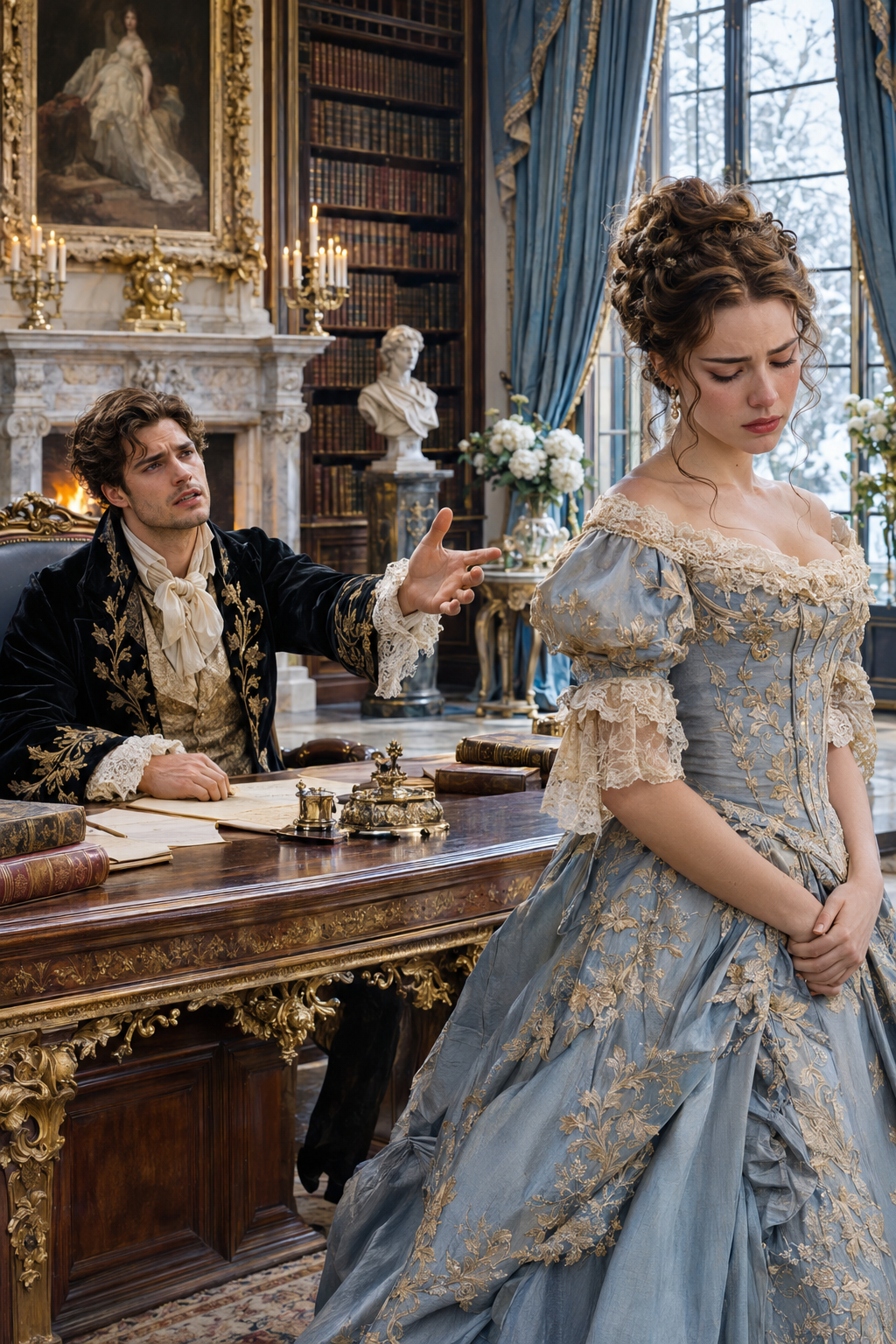
“Then perhaps you can explain why you spent three years promising to marry me.”
Julian looked at her.
For a brief moment, something unguarded appeared in his eyes.
“I intended to.”
“Until Lady Victoria?”
“Until circumstances changed.”
Eleanor gave a small, humorless smile.
“How convenient.”
Julian approached.
“I came because you are in danger.”
“From whom?”
He glanced at Edmund.
“From people who will use your name to destroy this family.”
Eleanor held his gaze.
“Your family seems perfectly capable of destroying itself.”
His expression tightened.
“You do not understand what is at stake.”
“Then explain it.”
He hesitated.
That hesitation told her more than his words.
Eleanor reached into her reticule and withdrew the old marriage certificate.
Julian went still.
“Where did you get that?”
“An interesting question. Your uncle asked me the same thing.”
He stepped closer.
“Eleanor, give it to me.”
“No.”
“You have no idea what that document means.”
“I am beginning to.”
His eyes moved toward Margaret.
“She told you.”
“She told me who my mother was.”
Julian closed his eyes briefly.
When he opened them, Eleanor saw something she had never noticed before.
Fear.
Not embarrassment.
Not irritation.
Fear.
“How long have you known?” she asked.
He did not answer.
“Julian.”
“Since last winter.”
The room became painfully quiet.
Eleanor remembered last winter.
A snow-covered garden.
His hand warming hers beneath a wool cloak.
The night he had promised they would marry before the following Christmas.
He had already known.
“Since last winter,” she repeated.
“I was trying to find a way.”
“A way to do what?”
“Protect you.”
She looked at him for a long moment.
“By allowing me to believe you loved me?”
His jaw tightened.
“I did love you.”
The past tense settled between them.
Eleanor lowered her eyes.
She had spent months wondering when his affection began to fade.
Now she understood that the real betrayal had happened while he was still holding her hand.
“You knew who I was,” she said. “And you let me walk into that ballroom.”
Julian’s expression changed.
“I never intended for Victoria to display the ring.”
“But you gave it to her.”
He looked away.
That was enough.
Eleanor placed the certificate back inside her reticule.
“You may leave.”
Julian stepped forward.
“Listen to me. Ashcombe has men searching for the original trust ledger. If he discovers you possess it—”
A sudden crash interrupted him.
Glass shattered somewhere toward the rear of the house.
The housekeeper screamed.
Edmund moved first.
“Stay here.”
But Eleanor was already following him.
They reached the study to find the window broken and the curtains whipping in the wind.
The writing desk had been forced open.
Drawers lay scattered across the carpet.
A dark figure disappeared beyond the garden wall.
Julian rushed toward the window.
Edmund caught his arm.
“Don’t. He may not be alone.”
Eleanor looked at the desk.
A small wooden box stood open beside the inkstand.
Her father’s box.
She had seen it hundreds of times.
Margaret had always insisted it contained nothing but old correspondence.
Now its velvet lining had been torn apart.
Something was missing.
Margaret entered behind them.
The moment she saw the box, she staggered against the doorframe.
“The key.”
Eleanor turned.
“What key?”
Margaret looked toward Edmund.
“The harbor strongbox.”
Edmund’s expression darkened.
Julian swore under his breath.
Eleanor moved between them.
“Someone will explain this immediately.”
Margaret gripped the back of a chair.
“Your father kept the original ledger in a secure box at the harbor office. I believed the key had been destroyed.”
Edmund examined the broken window.
“Then Ashcombe has found out where it is.”
Julian reached for his coat.
“We must get there before his men.”
Eleanor caught his sleeve.
“No.”
He looked down at her hand.
She released him.
“You will not take another document from me.”
“Eleanor, there is no time.”
“Then we had better stop wasting it.”
She turned toward Margaret.
“Where is the harbor office?”
Her mother hesitated.
Eleanor’s voice softened.
“Please.”
Margaret gave the address.
Twenty minutes later, they were traveling through the coastal village in two carriages.
Eleanor rode with Margaret and Edmund.
Julian followed behind.
The road descended between stone cottages and narrow gardens, eventually opening toward a harbor crowded with fishing boats.
Rain had begun falling again.
The harbor office stood near the end of the quay, a weathered building with green shutters and a brass plate beside the door.
Its windows were dark.
Edmund knocked.
No answer.
He tried the handle.
Locked.
Eleanor looked toward the water.
A small boat was moving away from the far side of the quay.
Two men sat inside.
One held a leather case beneath his coat.
“Over there.”
Julian had already seen them.
He ran toward the edge of the harbor.
The boatman pushed away from the quay.
“Stop!” Julian shouted.
The men ignored him.
A pistol appeared briefly beneath one man’s coat.
Julian stopped.
Eleanor caught his arm before he could move closer.
“Don’t.”
The boat disappeared into the rain.
Edmund examined the harbor office door.
The lock had been damaged.
Inside, the office smelled of damp paper and salt.
A metal strongbox stood open beneath the clerk’s desk.
Empty.
Margaret sank into a chair.
Edmund stared at the box.
“Thirty years of evidence.”
Julian struck the desk with his palm.
“Ashcombe has it.”
Eleanor approached the strongbox.
Its interior was lined with dark blue felt.
She noticed a small tear along one corner.
Beneath it, something pale protruded.
She knelt and carefully lifted the fabric.
A folded sheet of paper lay hidden underneath.
Her father’s handwriting covered its surface.
Eleanor unfolded it.
At the top were three words.
For my daughter.
She read silently.
Thomas Whitfield had anticipated that someone might eventually discover the strongbox.
He had therefore removed the most important records years earlier.
The ledger kept at the harbor was a duplicate.
The original documents were hidden elsewhere.
At the bottom of the letter was a single instruction.
Ask Margaret about the blue room.
Eleanor looked up.
Her mother had begun to cry.
“The blue room,” Eleanor said.
Margaret pressed a hand over her eyes.
“I promised him I would never open it.”
Eleanor knelt beside her.
“Mother, look at me.”
Margaret lowered her hand.
“Father left these documents because he wanted the truth known. Not because he wanted us to spend our lives hiding.”
Margaret’s lips trembled.
“I was afraid of losing you.”
Eleanor took her hand.
“You have not lost me.”
For the first time since arriving home, Margaret allowed herself to hold her daughter.
They remained together for several moments while rain tapped against the harbor windows.
Then Margaret whispered, “The room is beneath the east staircase.”
They returned to the house before dusk.
The blue room had been locked throughout Eleanor’s childhood.
Margaret had always said the floorboards were unsafe.
Now Eleanor stood before its narrow door, holding a brass key her mother had taken from a hidden compartment in her sewing cabinet.
The lock turned reluctantly.
Inside, dust covered the furniture.
A faded blue curtain hung across the window.
There was a small desk, a rocking chair, and a wooden cradle.
Eleanor stopped.
The cradle.
Margaret stood behind her.
“Beatrice brought you here when you were three weeks old.”
Eleanor approached the cradle.
A tiny embroidered blanket lay folded inside.
She touched its edge.
For years, she had imagined her birth mother as a distant, unknowable figure.
Now she could see the room where that woman had held her.
A room kept untouched by someone who had loved them both.
On the desk stood a small portrait.
A young woman with dark hair and gray eyes smiled faintly beneath a lace bonnet.
Eleanor lifted it.
The resemblance was unmistakable.
“She looks like me.”
Margaret nodded.
“Especially when you are determined to be difficult.”
Eleanor gave a fragile smile.
Then she noticed the desk drawer.
Its brass handle was shaped like a seashell.
She pulled it open.
Inside lay a thick leather ledger, several sealed letters, and a small velvet pouch.
Edmund approached.
“That is Beatrice’s handwriting.”
He opened the first letter.
As he read, his face changed.
Eleanor took the page.
The letter described Beatrice’s discovery that the Hawthorne family had concealed the trust’s true ownership.
It also revealed that her father, the previous duke, had arranged payments to suppress witnesses and alter financial records.
But the final paragraph contained something worse.
Beatrice had written that she feared for her safety.
She believed her brother had ordered the household physician to administer medication she did not require.
Eleanor read the words twice.
Then she turned to Edmund.
“Your brother knew she suspected him.”
Edmund nodded slowly.
“I believe so.”
“Did you know?”
His eyes filled.
“I suspected. And I did nothing.”
The confession seemed to age him.
“I was young. I wanted my father’s approval. When Beatrice died, I convinced myself there had been no crime because the alternative was unbearable.”
Eleanor looked at him.
“And when my father died?”
“I finally understood.”
“Yet you remained silent.”
“Yes.”
She placed the letter on the desk.
“Then your silence helped them.”
Edmund lowered his head.
“I know.”
There was no forgiveness in the room.
Not yet.
Only the beginning of accountability.
Julian stood near the doorway, listening.
Eleanor turned toward him.
“Did you know your grandfather may have arranged Beatrice’s death?”
He shook his head.
“No.”
She believed him.
That surprised her.
Then she noticed another envelope beneath the ledger.
It bore Julian’s name.
She handed it to him.
He opened it.
Inside was a letter from his late father.
Julian read it slowly.
His expression became unreadable.
“What does it say?” Edmund asked.
Julian folded the page.
“My father knew the truth.”
Eleanor waited.
“He knew Eleanor was Beatrice’s daughter. He knew the estate was held under a trust. And he ordered the family solicitor to ensure she never learned of her inheritance.”
His voice grew quieter.
“He also arranged for me to meet her.”
Eleanor felt the floor shift beneath her.
“What?”
Julian looked at her.
“Our first meeting at Lady Pembroke’s garden party was not accidental.”
The room seemed to narrow.
Eleanor remembered that afternoon vividly.
She had been standing beside a fountain when Julian approached and asked whether she preferred roses or lilies.
He had listened as though every answer mattered.
For three years, she had treasured the memory.
Now she understood it had been arranged.
“Why?”
Julian looked sick.
“My father believed that if I married you, the claim could be contained within the Hawthorne family.”
Eleanor stepped backward.
“So I was never merely a woman you loved.”
“Eleanor—”
“I was a solution.”
He did not deny it.
She turned toward the window.
Outside, the sea had darkened beneath the approaching night.
She thought of every letter, every dance, every promise.
She had believed herself chosen.
Instead, powerful men had been moving her across their carefully arranged board.
Julian approached slowly.
“I did not know when I first met you.”
She remained silent.
“I learned the truth last winter. By then, I loved you.”
“Yet you chose Victoria.”
“Ashcombe threatened to expose everything and destroy the estate. Hundreds of families depend upon Hawthorne lands.”
Eleanor turned.
“And you believed sacrificing me would save them?”
Julian lowered his eyes.
“I believed I could find another way.”
“You had a year.”
He said nothing.
Eleanor looked at the letter in his hand.
“You could have told me.”
“I was afraid you would leave.”
She nodded once.
“And so you made certain I would.”
The following morning, Eleanor traveled to London.
Not as the duke’s abandoned companion.
Not as a frightened woman seeking an explanation.
She traveled with Margaret, Edmund, the original ledger, and copies of every letter they had discovered.
Before leaving, she instructed the housekeeper to send a second set of copies to a solicitor recommended by her father in his final correspondence.
The solicitor, Mr. Nathaniel Price, received them in his chambers near Lincoln’s Inn.
He was an elderly gentleman with silver spectacles and a careful manner.
After examining the documents, he removed his glasses.
“Miss Whitfield, these papers may establish a substantial claim. But we must proceed properly. A family secret is not the same as a legal judgment.”
Eleanor nodded.
“What must we do?”
“Authenticate the marriage, establish your parentage, examine the trust instruments, and seek an accounting of the estate.”
“And the deaths?”
“Those allegations must be investigated separately.”
Eleanor looked toward Margaret.
Her mother squeezed her hand.
“Then begin.”
Within days, formal notices were delivered to Hawthorne House and Lord Ashcombe.
The response was immediate.
A newspaper published a cruel account of Eleanor’s supposed attempt to extort the duke.
Anonymous letters questioned her birth.
Former acquaintances stopped calling.
At a fashionable gathering, Lady Victoria reportedly described Eleanor as a disappointed woman inventing a scandal.
Eleanor read the article at breakfast.
Then she folded the newspaper and placed it beside her plate.
Margaret watched her.
“Does it hurt?”
Eleanor looked toward the window.
“Yes.”
She poured another cup of tea.
“But I will not allow their version of my life to become the only one.”
Mr. Price arranged for the marriage certificate to be examined.
The parish register confirmed Thomas Whitfield’s marriage to Lady Beatrice Hawthorne.
A surviving midwife provided a signed statement concerning Eleanor’s birth.
Financial records corroborated the concealed trust.
The evidence was growing.
Then, one evening, a visitor arrived at Mr. Price’s chambers.
Lady Victoria.
She entered wearing a dark green traveling dress, her face unusually pale.
Eleanor stood when she appeared.
Victoria glanced toward the solicitor.
“I would prefer to speak privately.”
Eleanor remained beside the desk.
“Whatever you have to say may be said before Mr. Price.”
Victoria hesitated.
Then she removed a small leather notebook from her reticule.
“My father has been keeping records of payments made to certain officials.”
Mr. Price leaned forward.
“How did you obtain this?”
Victoria’s fingers tightened around the notebook.
“From his study.”
Eleanor studied her.
“Why bring it here?”
Victoria looked down.
“Because I heard him tell someone that your mother should never have survived the winter.”
Margaret, seated near the fireplace, went completely still.
Victoria continued.
“He said the same mistake must not happen twice.”
Silence filled the room.
Eleanor approached her.
“Does your father know you are here?”
“No.”
“Then you have placed yourself in danger.”
Victoria gave a small, exhausted smile.
“I know.”
For the first time, Eleanor saw the woman beneath the expensive gowns and carefully rehearsed manners.
Not a rival.
Another daughter whose future had been arranged without her consent.
Victoria removed the diamond ring from her finger.
“I never wanted to marry Julian.”
Eleanor looked at the ring.
“Then why did you accept?”
“Because my father told me refusal would ruin our family.”
She placed the ring on the desk.
“I believed him until I saw what he was prepared to do.”
Mr. Price opened the notebook.
His expression sharpened.
Among the entries were payments to the physician who had attended Beatrice, transfers connected to Thomas Whitfield’s final journey, and recent sums paid to men employed near the coastal harbor.
One entry carried a date from three nights earlier.
The night Eleanor received the packet.
Beside it were the words Recover documents. Silence messenger.
Eleanor’s hands grew cold.
“The servant who brought me the packet.”
Victoria nodded.
“My father ordered him found.”
Mr. Price closed the notebook.
“We must take this to the authorities.”
Before he could rise, a knock sounded at the door.
A clerk entered.
“Sir, Lord Ashcombe is downstairs. He insists upon seeing his daughter.”
Victoria went pale.
Eleanor looked toward Mr. Price.
“Is there another exit?”
The solicitor nodded.
He led Victoria through a rear passage while Eleanor remained in the office.
Moments later, Lord Ashcombe entered.
He was a broad-shouldered man with immaculate silver hair and a smile that never reached his eyes.
“Miss Whitfield.”
“Lord Ashcombe.”
He glanced around the room.
“I understand my daughter has been visiting.”
“Many people visit solicitors.”
His smile thinned.
“You have caused considerable distress.”
Eleanor folded her hands.
“Then perhaps you should stop giving people reasons to be distressed.”
Ashcombe approached the desk.
“You are a young woman with no understanding of the responsibilities attached to great estates.”
“I understand that they should not be financed through theft.”
His eyes hardened.
“Be careful.”
Eleanor did not move.
“Is that advice or a threat?”
He leaned closer.
“Your father failed to understand when to stop.”
The room fell silent.
Eleanor looked directly at him.
“What happened to my father?”
Ashcombe’s expression changed.
Only slightly.
But enough.
“He made unfortunate choices.”
“And Lady Beatrice?”
For the first time, he looked toward the door.
Eleanor understood.
He had expected fear.
Instead, he had walked into a room where his own words could condemn him.
Mr. Price appeared in the doorway with two officials.
“Lord Ashcombe,” he said, “I believe these gentlemen would appreciate an explanation.”
Ashcombe turned.
His face lost its color.
The investigation that followed shook London society.
Financial examinations uncovered falsified accounts, concealed transfers, and improper payments extending across decades.
The physician who had attended Beatrice was long dead, but surviving correspondence and financial records supported further inquiry into her death.
A retired harbor employee testified that Thomas Whitfield had been followed on the evening he collapsed.
The servant who delivered Eleanor’s packet was found alive in a lodging house outside London, frightened but willing to testify.
His evidence helped establish how the documents had been concealed and why they had suddenly become dangerous.
Lord Ashcombe was arrested on charges connected to fraud, conspiracy, and intimidation while the authorities continued investigating the older deaths.
The duke’s family faced a separate legal reckoning.
The trust records were authenticated.
After lengthy proceedings, Eleanor’s status as Beatrice’s daughter was legally established, and the court ordered an accounting of the property and assets covered by the trust.
Not every estate belonged to her.
Not every historical wrong could be repaired.
But the Hawthornes could no longer pretend the trust did not exist.
Julian cooperated with the proceedings.
He surrendered records, dismissed officials implicated in the concealment, and accepted the financial consequences of the court’s findings.
Months passed before Eleanor saw him again.
They met in the garden of her mother’s house.
Spring had arrived along the coast.
White flowers grew beside the stone path, and the sea glittered beneath the afternoon sun.
Julian stood near the old fountain.
He looked thinner than she remembered.
There was no arrogance in his posture.
Only exhaustion.
“I came to apologize,” he said.
Eleanor remained a few steps away.
“You have already written.”
“I know.”
He looked toward the sea.
“I wanted to say it without hiding behind paper.”
She waited.
Julian drew a slow breath.
“I loved you. But when loving you required courage, I chose the easier path. I told myself I was protecting the estate, protecting the people who depended upon it.”
He looked at her.
“I was protecting myself.”
Eleanor said nothing.
“I am sorry.”
The wind moved gently through the garden.
For a moment, she remembered the man she had loved.
The warmth of his hand.
The quiet conversations.
The future she had imagined.
She did not hate him.
That was perhaps the most difficult truth of all.
“I believe you,” she said.
Hope flickered across his face.
Then she continued.
“But believing your apology does not mean I can return to the woman I was before you betrayed me.”
His expression softened with resignation.
“I understand.”
“Do you?”
He nodded.
“I think I am beginning to.”
Eleanor looked toward the house.
“My father spent his life trying to restore what had been stolen. My mother spent hers protecting me from the consequences. And I spent three years believing my future depended upon your decision.”
She turned back to him.
“I will not spend another year waiting for you to become the man you should have been.”
Julian lowered his eyes.
There was no argument left.
He bowed.
“Then I wish you happiness, Eleanor.”
She watched him walk toward the waiting carriage.
When he disappeared beyond the gates, she felt grief.
But beneath it was something quieter.
Relief.
The months that followed brought responsibilities Eleanor had never expected.
The trust’s recovered funds required careful management.
Several properties were in disrepair.
Tenants had endured years of neglect while money disappeared into private accounts.
Eleanor traveled to the villages, listened to their concerns, and worked with Mr. Price to establish transparent management.
She arranged repairs to cottages damaged by winter storms.
She supported a school near the harbor.
And in memory of her father, she established a fund to assist families who had lost their livelihoods at sea.
The work was neither glamorous nor simple.
Some decisions angered people.
Others required patience she did not always possess.
But every evening, she returned home knowing the choices had been hers.
Margaret remained beside her.
Their relationship had changed.
There were difficult conversations about the years of silence.
There were questions Margaret could not answer.
There were moments when Eleanor still felt the ache of everything she had been denied.
Yet slowly, they learned to speak without fear.
One evening, while sorting through Beatrice’s remaining letters, Eleanor found a small envelope tucked beneath the lining of the velvet pouch.
It contained a single page.
The handwriting was delicate and slightly uneven.
It was addressed to the daughter Beatrice had barely lived long enough to know.
Eleanor sat beside the window as the evening light faded.
She unfolded the letter.
My dearest Eleanor,
If you are reading this, then you have grown into a woman I was not given the years to know.
I cannot tell you what your life will become. I cannot promise that the world will treat you kindly simply because you deserve kindness.
But I hope you will never mistake obedience for goodness, or silence for peace.
There will be people who offer you beautiful things in exchange for surrendering the parts of yourself they find inconvenient.
Do not accept such bargains.
You are not an inheritance to be claimed, a name to be protected, or a promise someone else may break without consequence.
You are my daughter.
And whatever life asks of you, I hope you will remember that you were loved before anyone knew what you might become.
Eleanor lowered the letter.
Outside, the sea stretched toward the horizon, bright beneath the last gold of sunset.
Margaret entered quietly carrying two cups of tea.
She stopped when she saw the paper.
“Beatrice?”
Eleanor nodded.
Margaret sat beside her.
For a while, neither spoke.
Then Eleanor reached for her mother’s hand.
“She loved me.”
Margaret smiled through her tears.
“Very much.”
Eleanor looked at the letter again.
“And so did you.”
Margaret’s fingers tightened around hers.
The following summer, Eleanor hosted a gathering at the coastal house.
There were no elaborate invitations, no grand announcement, and no fashionable society column waiting to record the event.
The guests were teachers, fishermen, estate workers, neighbors, and friends who had remained loyal when her name became a subject of gossip.
Victoria attended as well.
She had left her father’s household and begun helping establish a charitable school for girls whose families could not afford private instruction.
The two women stood together on the terrace, watching children race across the lawn.
Victoria smiled.
“Do you ever think about the ballroom?”
Eleanor considered the question.
“Sometimes.”
“Do you regret what you said?”
Eleanor looked toward the sea.
“No.”
Victoria followed her gaze.
“I used to think that evening ruined everything.”
Eleanor smiled faintly.
“Perhaps it ruined what needed to end.”
Behind them, laughter rose from the garden.
Margaret stood beneath the apple trees speaking with Mr. Price.
The old house was filled with voices, sunlight, and the ordinary warmth of people who had come without expecting anything in return.
Eleanor touched the sapphire ribbon now tied around the handle of a small wooden keepsake box.
She had kept it.
Not because she still longed for Julian.
But because she no longer needed to destroy every reminder of the woman she had once been.
That woman had loved sincerely.
She had trusted.
She had hoped.
There was no shame in any of it.
The shame belonged to those who had used her trust against her.
As evening settled over the coast, Eleanor walked alone toward the cliffs.
The wind lifted a few strands of hair from her face.
Far below, waves folded against the rocks, just as they had on the day she returned home carrying a sealed packet and a broken promise.
She remembered the ballroom, the diamond, the duke’s dismissive voice.
She remembered how frightened she had been when she walked away.
At the time, she had believed she was abandoning the future she had spent three years building.
Now she understood that she had been leaving a future someone else had designed for her.
She stood beside the stone wall until the last light faded.
Then she turned toward the house.
Through the windows, she could see Margaret laughing at something Victoria had said.
The front door stood open.
Eleanor walked toward it without hesitation.
She had inherited wealth, recovered a name, and uncovered truths powerful people had spent decades concealing.
But none of those things was the greatest gift her journey had given her.
That gift had arrived on the night she returned a dance card and refused to be silenced.
She had discovered that dignity did not depend upon being chosen by someone powerful.
Love did not require surrendering the truth.
And forgiveness did not demand returning to the person who caused the wound.
Sometimes the bravest decision was not to fight for a place in another person’s life.
Sometimes it was to walk away, even while still loving them, and build a life in which honesty was no longer something to be begged for.
Inside the house, Margaret called her name.
Eleanor smiled.
“I’m coming, Mother.”
And as she crossed the threshold, she realized that for the first time in her life, she was not waiting for a promise to be fulfilled.
She was living the life she had chosen.
THE END.