The Duke of Hallamere found his housekeeper packing her belongings before sunrise.
The solicitor, Mr. Edmund Whitmore, placed the ledger on a wooden table beside the open sack of sawdust.
Garrow recovered his composure almost immediately.
“I fail to understand why everyone is making such a fuss over a delivery mistake.”
“A delivery mistake?” the Duke repeated.
“Suppliers occasionally send the wrong goods, Your Grace. I shall have the matter corrected.”
Rose watched him carefully. His voice remained steady, but his right hand had disappeared into his coat pocket.
Mr. Whitmore opened the ledger.
“Over the past eighteen months, Hallamere House has made considerable payments to a merchant named Arthur Bell. Coal, timber, flour, and various agricultural supplies.”
“A respectable merchant,” Garrow replied.
“Indeed? Then perhaps you can explain why his business address belongs to an abandoned cottage.”
For the first time, Garrow had no immediate answer.
The Duke looked down at the figures. The amount was far greater than he had imagined.
“Nearly four thousand pounds?”
“And that is only what we have identified so far,” Whitmore answered.
Garrow gave a dismissive laugh.
“Surely Your Grace does not intend to take the word of a housekeeper over that of a man who has managed your estate for fourteen years.”
Rose felt the insult, but she remained silent.
The Duke closed the ledger.
“Mrs. Calder has presented evidence. You have presented excuses.”
Garrow’s expression changed.
“Evidence can be manufactured.”
“Then you should have nothing to fear from an investigation.”
The steward straightened his coat.
“Very well. Examine whatever you please. But when this unpleasant business is concluded, I shall expect an apology.”
He turned and walked out.
The Duke started after him, but Whitmore blocked his path.
“Allow him to believe he still has room to maneuver.”
“He has stolen from me, threatened my life, and insulted the most trustworthy woman in this household!”
“And if you strike him now, he will become the injured party. We need the law on our side.”
Rose nodded.
“He wants you angry, Your Grace. An angry man makes mistakes.”
The Duke looked toward the doorway through which Garrow had disappeared.
“Then I shall disappoint him.”
By evening, news of the confrontation had spread throughout Hallamere House.
Servants whispered in the corridors. The kitchen maids fell silent whenever Rose entered. Even the footmen seemed uncertain whether they should address her as their former housekeeper or the Duke’s new investigator.
But the most troubling development came shortly before dinner.
A young maid named Elsie knocked on Rose’s door.
“Mrs. Calder, may I speak with you?”
“Of course.”
The girl stepped inside, twisting her apron between her fingers.
“Mr. Garrow says you have been stealing.”
Rose slowly lowered the papers she was holding.
“Does he?”
“He says you altered the household accounts and blamed him because you were afraid of being discovered.”
Rose had expected retaliation, but hearing the accusation spoken aloud still hurt.
“Do you believe him, Elsie?”
The girl shook her head immediately.
“No, ma’am. But some of the others do. He says he has proof.”
“What kind of proof?”
“Money. He says there’s money hidden in your belongings.”
Rose stood.
“Where is my suitcase?”
“In your old room, ma’am.”
Rose hurried upstairs.
Her suitcase remained beside the bed, exactly where she had left it. She opened it and searched beneath her clothing.
At the bottom, wrapped in a handkerchief she had never seen before, lay a collection of banknotes.
She stared at them.
Fifty pounds.
Enough money to destroy her reputation.
Before she could touch the bundle, footsteps sounded in the corridor.
Garrow appeared in the doorway with the Duke and two senior servants.
“There, Your Grace,” he announced. “Exactly as I told you.”
Rose turned toward the Duke.
“I have never seen this money before.”
Garrow folded his arms.
“How unfortunate that stolen money should find its way into your luggage without your knowledge.”
The Duke approached the suitcase.
“Who has access to this room?”
“Any number of servants,” Rose replied.
“Then finding money here proves very little.”
Garrow’s face tightened.
“Your Grace cannot seriously intend to overlook this.”
“I intend to overlook nothing.”
The Duke summoned Whitmore, who examined the banknotes without removing them from the handkerchief.
Then he asked a question that nobody expected.
“Mr. Garrow, how did you know precisely where this money would be found?”
The steward hesitated.
“One of the servants informed me.”
“Which servant?”
“I shall not expose an innocent employee to Mrs. Calder’s anger.”
Whitmore looked almost amused.
“How convenient.”
The Duke ordered the money secured and instructed everyone to leave Rose’s room.
When they were alone, Rose sat heavily on the edge of her bed.
“Perhaps I should go.”
The Duke turned.
“Go where?”
“Anywhere away from Hallamere. My presence is causing trouble for everyone.”
“Your presence is uncovering trouble that was already here.”
Rose looked at her hands.
“I have spent eleven years earning the trust of this household. He may destroy it in a single afternoon.”
“Then we shall restore it.”
She looked up.
“You cannot command people to believe me, Your Grace.”
“No,” he admitted. “But I can ensure that they hear the truth.”
The following morning, Whitmore and Rose resumed their examination of the accounts.
They worked through hundreds of invoices, comparing dates, quantities, signatures, and delivery records.
By midday, Rose noticed something peculiar.
Several payments had been authorized on days when the Duke had been away from Hallamere.
One document carried his signature on the very afternoon he had attended a funeral in London.
Another supposedly bore his approval while he was visiting his sister in Scotland.
“These cannot be genuine,” Rose said.
Whitmore examined the signatures.
“They are remarkably similar.”
“Too similar.”
She placed three documents side by side.
Every curve, every stroke, and every small mark appeared in precisely the same position.
Whitmore leaned closer.
“A copied signature.”
Rose nodded.
“Someone has been tracing it.”
The discovery was important, but they still needed evidence connecting Garrow directly to the false documents.
That afternoon, Rose visited the estate gatekeeper, Thomas Briggs.
Thomas was an elderly man who had worked at Hallamere longer than anyone could remember. He lived in a small cottage beside the main entrance with his wife.
When Rose asked about the missing deliveries, he became visibly uncomfortable.
“I keep the records as instructed, ma’am.”
“I know you do, Thomas.”
“Then you’ve no reason to question me.”
Rose noticed his hands trembling.
“Has someone threatened you?”
He looked toward his cottage.
“My wife isn’t well. We depend upon my wages.”
Rose understood immediately.
“What did Mr. Garrow ask you to do?”
Thomas closed his eyes.
“He told me to enter deliveries that never arrived.”
“How many?”
“Dozens.”
“Did you?”
“At first, I refused. Then he said he’d have me dismissed for sleeping at my post.”
Thomas’s voice broke.
“I couldn’t lose the cottage. Not with Margaret so ill.”
Rose sat beside him.
“Did you keep any record of the real deliveries?”
The old man looked at her for a long moment.
Then he reached beneath a loose board inside his gatehouse and withdrew a small notebook.
“I started keeping this when things became strange.”
Rose opened it.
Every wagon, every merchant, every arrival and departure had been carefully recorded.
Unlike the official gate books, Thomas’s private notebook contained no false entries.
“This could help us enormously.”
“Will I lose my position?”
“I cannot promise what the Duke will decide. But I can promise that I shall tell him why you did what you did.”
Thomas handed her the notebook.
“I’m tired of being frightened, Mrs. Calder.”
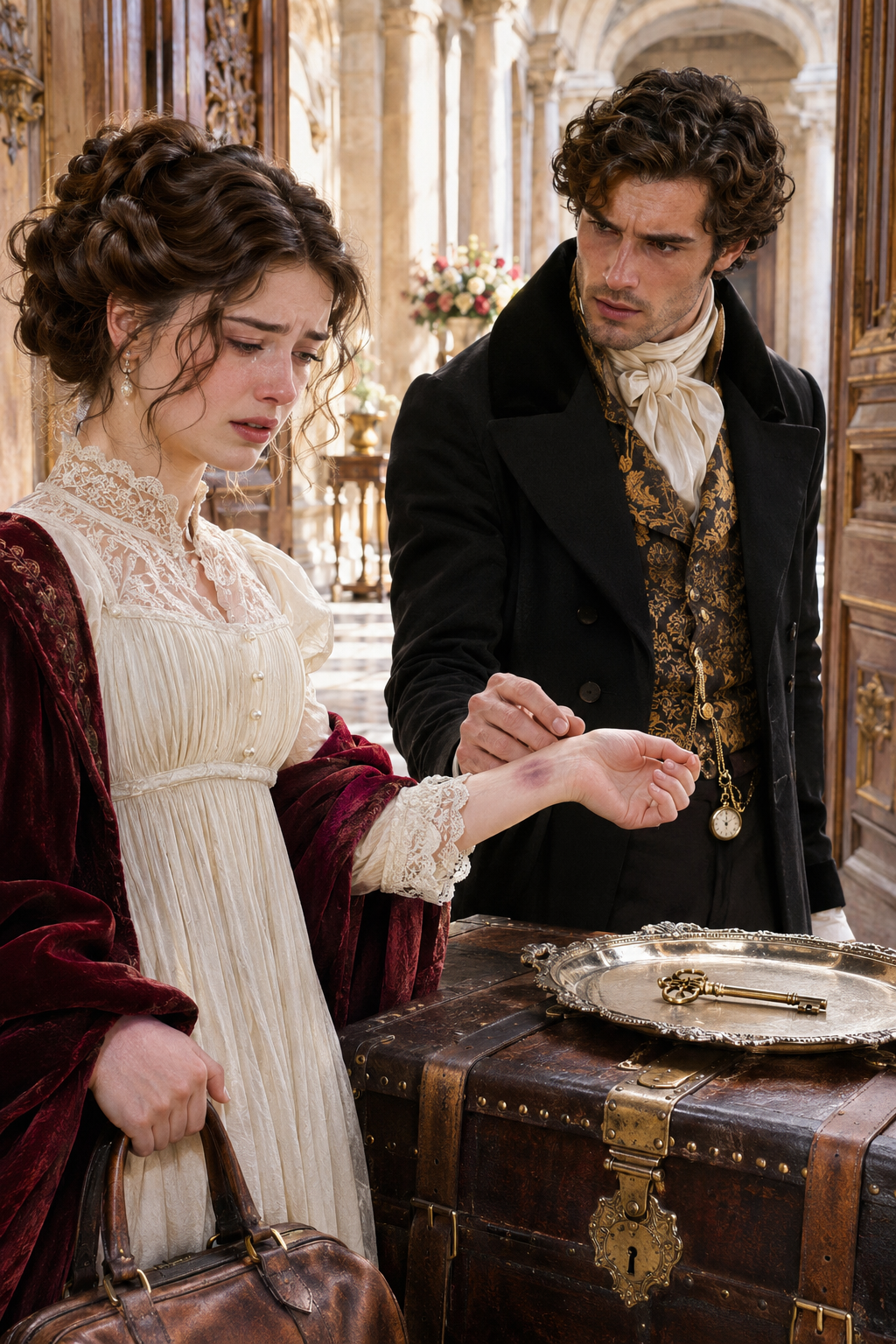
Rose understood that feeling better than he knew.
As she returned to the house, she noticed a carriage waiting near the servants’ entrance.
Garrow was speaking quietly with the driver.
The moment he saw Rose, he ended the conversation and disappeared inside.
She hurried to Whitmore.
“He may be preparing to leave.”
The solicitor examined Thomas’s notebook.
“Then we must move quickly.”
But Garrow had no intention of leaving empty-handed.
That evening, the Duke announced that he would not take his usual morning ride until the investigation was complete.
Rose felt relieved.
Her relief lasted only until the stable boy came running into the kitchen.
“Mrs. Calder! Something’s happened to His Grace’s saddle!”
Rose followed him to the stables.
The head groom held a damaged leather strap.
“This was sound yesterday,” he explained. “Someone has cut into it.”
Rose felt a chill.
Had the Duke ridden that morning, the strap might have failed at full speed.
“Who entered the stables last night?”
The groom hesitated.
“Mr. Garrow came to inspect the horses.”
Rose carried the damaged strap directly to the Duke.
He listened without interrupting.
When she finished, he walked to the window.
For several moments, he said nothing.
Then he asked, “How long has that man been planning to kill me?”
“I don’t know, Your Grace.”
“And all because you discovered missing coal?”
“Because missing coal was only the beginning.”
The Duke turned toward her.
“Find the rest.”
That night, Rose and Whitmore searched the estate’s older records.
They discovered payments for repairs that had never been completed, wages for workers who did not exist, and purchases of timber supposedly used to rebuild cottages that remained in terrible condition.
The money had not simply been taken from the Duke.
It had been taken from families who depended upon the estate.
Rose remembered a tenant’s child who had fallen ill during the previous winter because rain poured through the roof of their cottage.
According to Garrow’s accounts, that roof had been repaired twice.
She felt sick.
“How could anyone do this?”
Whitmore removed his spectacles.
“Men like Garrow rarely see the people behind the numbers.”
Rose looked at the growing pile of documents.
“Then we must make certain everyone else does.”
The next morning, Whitmore traveled to the county magistrate with copies of the evidence.
The original documents remained secured in the Duke’s study.
At least, they were supposed to.
Shortly after midnight, Rose awoke to the smell of smoke.
She threw on her dressing gown and opened her door.
A servant was shouting downstairs.
“Fire! Fire in the west wing!”
Rose ran toward the staircase.
Smoke was pouring from beneath the study door.
The Duke appeared behind her.
“Get everyone outside!”
“The accounts!” Rose cried.
He seized her arm before she could approach the door.
“No document is worth your life.”
Servants formed a line carrying buckets of water. The fire was eventually brought under control, but the study suffered considerable damage.
When the smoke cleared, the Duke’s desk was blackened, and the cabinet containing the original records had been forced open.
Rose stared at the ruined papers scattered across the floor.
Garrow had made his final move.
Or so he believed.
Whitmore returned shortly after dawn.
When he saw the damage, he smiled grimly.
“Fortunately, I persuaded His Grace to move the most important originals yesterday afternoon.”
Rose turned toward the Duke.
“You knew?”
“I suspected he might attempt something desperate.”
The solicitor opened his leather case.
“The magistrate has seen the evidence. A constable will arrive before noon.”
But before the constable reached Hallamere, Garrow requested a private audience with the Duke.
He entered the drawing room dressed for travel.
“I believe it would be best if I resigned, Your Grace.”
The Duke remained seated.
“An interesting suggestion.”
“These accusations have made my position impossible. I shall leave immediately and spare this household further embarrassment.”
“You will remain here.”
Garrow’s eyes narrowed.
“Am I a prisoner?”
“Not yet.”
Rose entered with Whitmore.
The steward looked from one face to another.
Then he reached into his coat and withdrew a document.
“Before you make any foolish decisions, Your Grace, you should read this.”
The Duke accepted it.
It was an agreement supposedly authorizing Garrow to manage several private commercial investments on his behalf.
The signature at the bottom was unmistakably the Duke’s.
“You see,” Garrow continued, “every payment was made under your authority. If this matter reaches the magistrate, your own conduct will be questioned.”
Whitmore took the document.
“An impressive forgery.”
Garrow laughed.
“Prove it.”
Rose stepped forward.
“Arthur Bell.”
The steward’s laughter stopped.
“What about him?”
“He does not exist as a merchant. But we found something interesting when we examined the payments.”
Whitmore opened his case and removed a bundle of correspondence.
“The bank drafts were collected through an account maintained by a man named Silas Arthur Bell.”
The Duke looked sharply at Garrow.
“Your mother’s maiden name was Bell, was it not?”
Garrow said nothing.
Whitmore continued.
“The bank clerk remembers you quite clearly. You opened the account yourself.”
The color drained from the steward’s face.
Rose placed Thomas’s notebook on the table.
“We have the genuine delivery records, the forged invoices, the false repair expenses, and witnesses who are prepared to speak.”
“And the saddle,” the Duke added.
Garrow suddenly moved toward the door.
The Duke rose.
For one dangerous moment, Rose thought he might seize the steward and strike him.
Instead, he stepped aside.
Two constables were waiting in the hallway.
Garrow stopped.
“You cannot do this to me!”
The Duke’s voice was calm.
“I am not doing anything to you, Garrow. I am allowing you to answer for what you have done.”
As the constables approached, Garrow turned toward Rose.
“You miserable woman! You should have kept your mouth shut!”
Rose met his gaze.
“That is what you were counting on.”
He was taken away.
The silence that followed felt almost unreal.
For days, Rose had imagined this moment. Yet she felt no desire to celebrate.
Too much damage had been done.
Over the following weeks, the county magistrate heard testimony from merchants, servants, bank employees, and estate workers.
Thomas Briggs admitted altering the official gate books under pressure.
The stable boy described Garrow’s visit before the damaged saddle was discovered.
Elsie testified that she had seen the steward entering Rose’s former bedroom on the morning the money was found.
Even the carriage driver came forward. Garrow had hired him to transport several trunks containing documents and valuables to another county.
The evidence against him became overwhelming.
The magistrate committed Garrow for trial, and he was eventually convicted of fraud and forgery. Further proceedings addressed the attempts to destroy evidence and endanger the Duke’s life.
Much of the stolen money was recovered from the accounts and property Garrow had concealed.
But the Duke knew that recovering money was not enough.
One afternoon, he summoned every member of the Hallamere household to the great entrance hall.
Rose stood near the back, uncertain why she had been called.
The Duke addressed the assembled servants.
“An injustice has been committed beneath this roof. Not only against me, but against the woman who had the courage to expose it.”
Everyone turned toward Rose.
“Mrs. Calder was accused of dishonesty because she refused to remain silent. Her reputation was attacked because her integrity threatened a dishonest man.”
He paused.
“I regret that anyone in this household was given reason to doubt her.”
Rose felt tears rising in her eyes.
“Let it be understood that she leaves this investigation with my complete confidence and deepest gratitude.”
Thomas Briggs was permitted to retain his position, and the Duke arranged medical care for his wife.
The neglected cottages were repaired. Workers received wages that had been withheld, and new procedures were established to ensure that no single employee could control the estate’s finances without oversight.
As for Rose, the Duke offered her a position supervising the household and reviewing its expenditures.
The salary was considerably greater than her previous wages.
“You have earned it,” he told her.
Rose considered the offer.
“I have one condition, Your Grace.”
He raised an eyebrow.
“Only one?”
“Every servant must be allowed to report wrongdoing without fear of dismissal.”
The Duke smiled.
“Agreed.”
Months later, on a cold winter morning, Rose walked through the village belonging to the Hallamere estate.
Smoke rose from newly repaired chimneys. Children played outside cottages that were finally warm and dry.
An elderly woman approached her.
“Mrs. Calder, I wanted to thank you.”
“For what?”
“My grandchildren haven’t been cold once this winter.”
Rose looked toward the little cottage.
Its roof was new, its windows repaired, and its coal shed properly filled.
She remembered the false invoices that had first caught her attention.
Such ordinary pieces of paper.
Yet behind every dishonest entry had been a real person paying the price.
That evening, the Duke found Rose reviewing the household accounts beside a warm fire.
“Do you ever regret opening that first ledger?” he asked.
Rose smiled.
“There were certainly moments when I wished I hadn’t.”
“And now?”
She closed the book.
“Now I think about what would have happened if nobody had.”
The Duke nodded slowly.
He had inherited wealth, land, and a respected title. Yet it had taken a housekeeper to teach him one of the most important lessons of his life.
Authority meant little without accountability. Loyalty did not mean obedience at any cost. And sometimes the person who appeared to be causing trouble was the only person brave enough to prevent a disaster.
Rose Calder never became famous beyond the county.
Her name appeared in no grand history books, and no statue was built in her honor.
But generations of servants at Hallamere House would hear the story of the housekeeper who stood against a powerful man when silence would have been easier.
They remembered her not because she had never been afraid, but because she had refused to let fear decide what was right.
And Hallamere House became a better place because one ordinary woman understood something that extraordinary men often forget.
Honesty is not measured by what we say when the truth costs us nothing. It is measured by what we are willing to risk when telling the truth could cost us everything.
Five years later, a letter arrived at Hallamere House that brought the past unexpectedly back into Rose Calder’s life.
It came from the county prison.
Rose recognized the name at the bottom before she had finished reading the first sentence.
Silas Garrow.
He was seriously ill, and the prison physician did not expect him to survive the winter. He had asked to see her.
The Duke was against the idea.
“You owe that man nothing,” he said.
“I know, Your Grace.”
“He tried to destroy your reputation. He threatened my life. Why should you grant him any kindness?”
Rose folded the letter.
“Because his actions need not determine mine.”
Two days later, she traveled to the prison.
The man waiting for her scarcely resembled the confident steward who had once controlled Hallamere House. His hair had turned gray, his cheeks were hollow, and his hands shook as he struggled to rise.
“Mrs. Calder.”
“Mr. Garrow.”
He looked down.
“I wasn’t certain you would come.”
“Neither was I.”
For several moments, neither spoke.
Then Garrow reached beneath his blanket and withdrew a sealed envelope.
“There is something I never told the magistrate.”
Rose accepted it cautiously.
“More stolen money?”
He nodded.
“Before my arrest, I entrusted a sum to a relative. She knew nothing of its origins. The details are in that letter.”
“Why tell me now?”
Garrow’s eyes filled with tears.
“Because I have spent five years remembering the people I harmed. And because you were the only person who gave me an opportunity to stop before everything was lost.”
Rose remembered their first conversation about the missing coal.
He could have admitted his wrongdoing then. Instead, he had chosen threats, lies, and violence.
“I cannot change what happened,” he whispered.
“No,” Rose answered. “But you can still choose what you do today.”
He struggled to meet her eyes.
“Can you forgive me?”
Rose considered the question.
“I have no wish to carry hatred for the rest of my life. But forgiveness does not erase responsibility.”
Garrow nodded slowly.
For the first time since she had known him, he offered no excuse.
“I’m sorry, Mrs. Calder.”
Rose left the prison with the envelope in her hands.
The remaining money was eventually recovered through Mr. Whitmore’s efforts. At Rose’s suggestion, the Duke used it to establish a small school for the children of estate workers.
Many of those children would otherwise have spent their lives unable to read or write.
Among the school’s first pupils was Thomas Briggs’s granddaughter.
On opening day, the Duke invited Rose to address the families gathered outside the new building.
She declined at first.
“I am hardly accustomed to making speeches.”
“Then speak as you always have,” he replied. “Plainly and truthfully.”
Rose stood before the crowd.
She looked at the children holding their new books and remembered the years when a dishonest man had believed that nobody beneath him mattered.
“Learn to read,” she told them. “Learn to ask questions. Never allow anyone to convince you that your voice is unimportant simply because they possess more money or a grander title.”
The Duke applauded first.
Everyone else followed.
Years passed, and Hallamere House continued to prosper.
When Rose finally retired, the household gathered to present her with a gift.
It was a beautiful leather-bound ledger.
Inside, however, there were no accounts.
Instead, every page contained handwritten messages from servants, tenants, and families whose lives she had touched.
Elsie, now the housekeeper herself, had organized the surprise.
Thomas’s granddaughter, who had become a schoolteacher, had written the final message.
“Because you had the courage to speak, others learned that they could speak too.”
Rose pressed a hand against her mouth.
Of all the rewards she had received, none meant more than those simple words.
The Duke escorted her to the carriage waiting outside.
“Hallamere will not be the same without you,” he said.
Rose smiled.
“That is precisely what I hoped, Your Grace.”
He laughed, then took her hand.
“Thank you, Rose.”
It was the first time he had addressed her by her given name.
She understood the affection and respect behind it.
As the carriage traveled through the estate, Rose watched the familiar cottages disappear behind her. She passed the school, the repaired farms, and the gatehouse where Thomas had once hidden his notebook.
She had arrived at Hallamere as a woman whose duty was to keep everything in order.
She departed knowing that sometimes true duty required disturbing the very order one had been hired to protect.
And although her years of service had ended, the changes she had inspired would remain.
The greatest legacy Rose Calder left behind was not the money she recovered or the criminal she exposed.
It was a household where people no longer believed that silence was the price of survival.
She had proven that courage does not require wealth, influence, or a powerful name.
It requires a conscience strong enough to stand against wrongdoing, even when standing alone seems inevitable.
And sometimes, one honest voice is all it takes to give a hundred frightened voices the courage to be heard.
THE END.