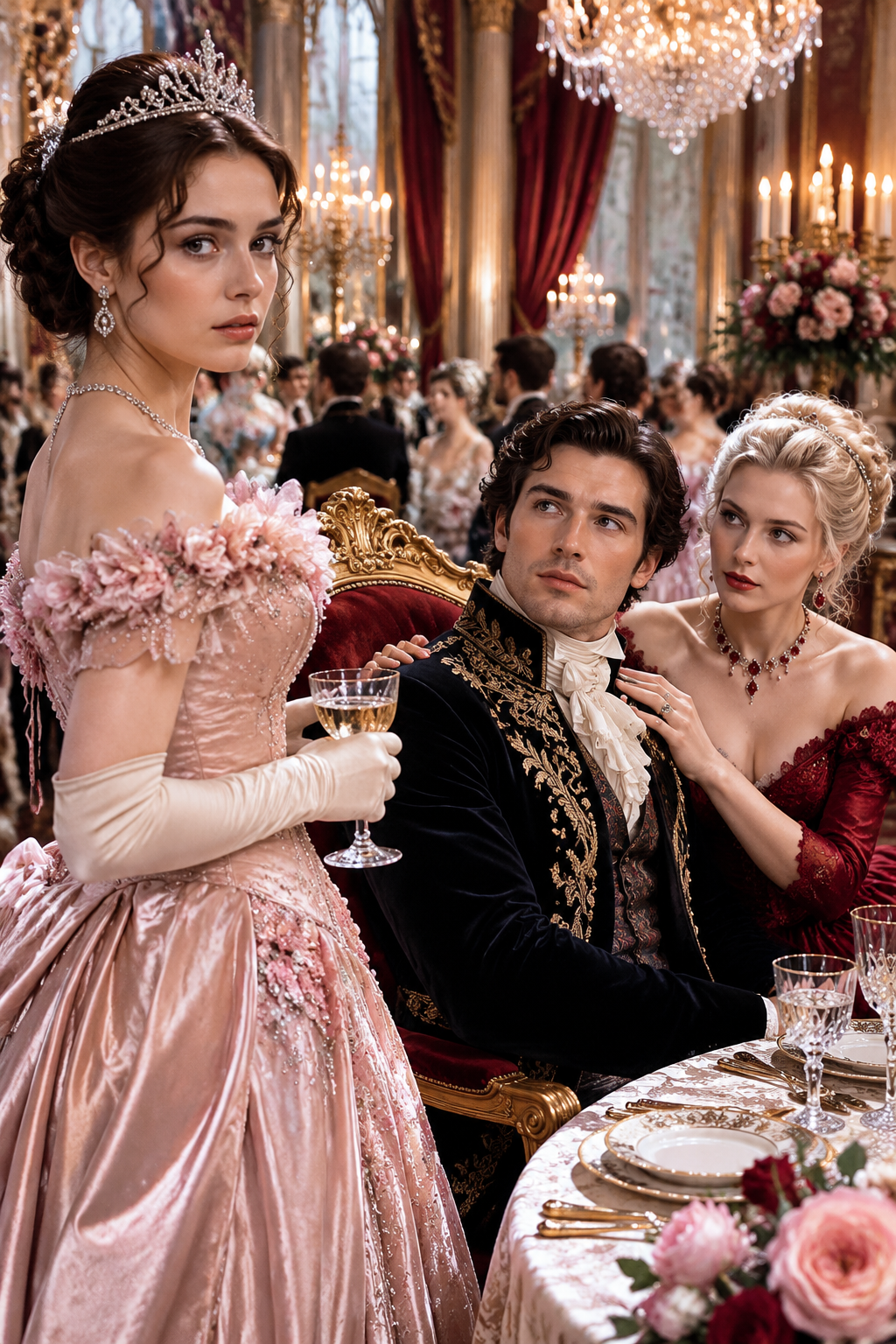
The Duke of Greyhaven invited his mistress to his own wedding reception.
The words settled over the ballroom with such terrible stillness that Charlotte could hear the rain beginning against the tall windows of Greyhaven Hall.
For a moment, the duke appeared to forget the three hundred guests surrounding him. His attention remained fixed on the document in Mr. Ashcombe’s hands.
“Put that away.”
The solicitor did not move.
Charlotte looked from one man to the other. The sapphire necklace glittered beneath the chandeliers, its blue stone resting against the trembling throat of the woman who had arrived at her wedding dressed as a bride.
“Who is your wife?” Charlotte asked.
The duke took a step toward her.
“Charlotte, you must understand that certain arrangements are more complicated than they appear.”
She looked at his outstretched hand.
“That was not my question.”
A chair scraped against the marble. Somewhere behind the assembled guests, an elderly countess whispered a prayer.
Mr. Ashcombe carefully unfolded the second page.
“Her name is Miss Evelyn Hartwell. The marriage was solemnized at St. Bartholomew’s Chapel on the seventeenth of October last year.”
Charlotte turned toward the woman in white.
Evelyn’s face had gone almost colorless.
The duke’s mother closed her eyes.
And Charlotte understood something that made the room seem suddenly colder.
Everyone nearest the duke had known.
Everyone except the woman who had stood beside him at the altar that morning.
“Is this true?” Charlotte asked Evelyn.
The younger woman looked toward the duke, waiting for some indication of what she should say.
He gave her none.
Finally, she nodded.
“Yes.”
The answer was scarcely audible, but Charlotte heard it clearly.
She looked down at her wedding gown. The delicate embroidery had taken six seamstresses nearly four months to complete. Her mother had helped fasten the pearl buttons that morning, smiling through tears as she spoke of the happiness awaiting her daughter.
Charlotte remembered the weight of her father’s hand as he escorted her down the aisle.
She remembered the duke’s confident voice repeating his vows.
And she remembered how firmly he had held her fingers while promising to forsake all others.
She raised her eyes.
“Then there was no wedding today.”
The duke’s expression tightened.
“Do not be absurd.”
Mr. Ashcombe spoke before Charlotte could answer.
“If this marriage record is authentic and the earlier marriage remains valid, Your Grace, today’s ceremony cannot establish another lawful marriage.”
A ripple of alarm moved through the guests.
The duke turned sharply.
“You are my solicitor. I suggest you remember that.”
Mr. Ashcombe folded the document with deliberate care.
“I am also an officer of the court, Your Grace.”
For the first time, Charlotte saw genuine fear in her husband’s eyes.
It lasted only a moment.
Then he straightened his shoulders and addressed the room with the easy authority that had persuaded so many people to trust him.
“Ladies and gentlemen, I apologize for this unfortunate misunderstanding. A private legal matter has been brought forward at a particularly inappropriate moment.”
Charlotte almost smiled.
A misunderstanding.
As though he had accidentally ordered the wrong flowers.
As though another wife were an inconvenience rather than a human being.
She walked toward Mr. Ashcombe.
“May I see the document?”
He handed it to her.
The paper was old enough to have softened at the folds. The signatures were unmistakable.
Adrian William Greyhaven.
Evelyn Margaret Hartwell.
Charlotte examined the witness’s name.
Then she looked toward the dowager duchess.
“You signed this.”
The older woman said nothing.
Charlotte turned the page slightly, allowing the light to fall across the ink.
“Your Grace, you witnessed your son’s marriage.”
The dowager’s lips parted.
“Charlotte, there are matters concerning this family that you cannot possibly understand.”
“Then explain them.”
The dowager looked toward her son.
He shook his head once.
It was a small gesture.
Charlotte saw it.
So did Mr. Ashcombe.
And suddenly the older woman’s silence seemed less like loyalty and more like fear.
Charlotte returned the document.
“I should like a copy delivered to my father’s solicitor.”
“Of course, Lady Charlotte.”
The duke moved between them.
“No documents will leave this house.”
Mr. Ashcombe met his gaze.
“The original is already registered. Preventing this copy from leaving will accomplish very little.”
The duke’s face darkened.
Charlotte turned toward the ballroom doors.
She had almost reached them when Evelyn spoke.
“Please.”
Charlotte stopped.
Evelyn had removed the sapphire necklace. It lay coiled in her hands, the enormous stone catching the light like a fragment of winter sky.
“I never wanted it to happen this way.”
Charlotte regarded her quietly.
“Yet you came.”
Evelyn’s fingers tightened around the jewels.
“He told me you knew.”
The words drew Charlotte’s attention.
“He told you what?”
“That your marriage was an arrangement. That you understood everything. That you were marrying him for the title, and that I would remain his wife in every way that mattered.”
Charlotte felt the first genuine tremor pass through her hands.
Not because Evelyn had spoken cruelly.
Because she sounded as though she believed every word.
The duke stepped forward.
“Evelyn, be quiet.”
But the younger woman was watching Charlotte now.
“He said you had agreed to it.”
Charlotte studied her face.
The expensive gown.
The nervous fingers.
The desperate need to believe she had not deliberately destroyed another woman’s happiness.
“Did he tell you why he needed to marry me?”
Evelyn hesitated.
The duke’s voice sharpened.
“That is enough.”
Charlotte ignored him.
“Evelyn?”
The younger woman looked down at the necklace.
“He said Greyhaven needed money.”
The dowager made a faint sound.
The duke seized Evelyn’s wrist.
She flinched.
Charlotte saw it immediately.
“Release her.”
The command was quiet.
He looked at Charlotte in disbelief.
She did not repeat herself.
After a moment, his fingers opened.
Evelyn stepped away.
And Charlotte realized the truth was larger than an unfaithful husband.
She had not simply been deceived about his affections.
She had been selected.
Her inheritance, her father’s investments, her family’s reputation—everything she possessed had been weighed and measured long before the duke asked for her hand.
The marriage had been a transaction.
And the bride had never been told the price.
Outside, thunder rolled across the Yorkshire hills.
Charlotte turned to Mr. Ashcombe.
“I should like to know what documents I signed before the ceremony.”
The solicitor’s expression changed.
“Lady Charlotte, I strongly advise that we discuss that matter privately.”
The duke moved toward him.
“You will discuss nothing.”
Charlotte watched the solicitor’s face.
Then she understood.
There was something worse.
“Show me.”
Mr. Ashcombe opened his case again.
From beneath the marriage certificate, he withdrew a thin packet tied with green ribbon.
Charlotte recognized it immediately.
Her marriage settlement.
She had signed it three weeks earlier in her father’s library while the duke stood beside the fireplace, smiling as he assured her the provisions were entirely customary.
She remembered asking whether she ought to have her own solicitor examine it.
Adrian had kissed her forehead.
“My darling, do you truly believe I would ever take advantage of you?”
Now Mr. Ashcombe placed the packet in her hands.
“The settlement contains provisions transferring control of certain funds to a trust administered by His Grace upon the marriage taking legal effect.”
Charlotte slowly untied the ribbon.
“How much?”
The solicitor hesitated.
“One hundred and eighty thousand pounds in securities, together with the income from your maternal estate.”
Several guests gasped.
The duke stood perfectly still.
Charlotte looked at the figures.
The sum represented nearly everything her mother had left her.
Money intended to give Charlotte independence, regardless of whom she married.
She lifted her eyes.
“And if the marriage was never valid?”
“Then the transfer should not take effect under those provisions.”
A strange calm settled over her.
The duke had tried to acquire her fortune through a marriage he knew he could not lawfully enter.
But the same deception that exposed his character might also defeat his claim.
Charlotte carefully retied the ribbon.
“Then I believe these papers belong with my solicitor.”
The duke’s composure finally broke.
“You have no idea what you are doing.”
She looked at him.
“On the contrary. I believe I am beginning to understand.”
He lowered his voice.
“Greyhaven supports nearly two hundred families. Farms, cottages, servants, tradesmen. If this estate collapses, they will suffer because you chose to make a spectacle of a private matter.”
Charlotte felt the accusation land exactly where he intended.
She had visited the tenants.
She knew their names.
She remembered the little boy at the mill cottage who had proudly shown her the wooden horse his father carved.
Adrian knew she remembered.
That was why he had mentioned them.
She held his gaze.
“How long have you known the estate was in danger?”
He said nothing.
“Before you proposed?”
Still nothing.
“Before you married Evelyn?”
His silence answered her.
Charlotte looked around the ballroom.
The musicians.
The footmen.
The families who had traveled across England to witness a celebration built upon deliberate falsehood.
Then she spoke clearly.
“The people who depend upon Greyhaven deserve better than a man who uses their welfare to excuse his own dishonesty.”
She turned toward the doors.
This time, no one tried to stop her.
The rain had strengthened by the time Charlotte reached the entrance hall.
Her father’s carriage waited beneath the stone portico, its lamps glowing through the gray afternoon.
Her mother stood beside it.
Lady Pembroke had followed her daughter from the ballroom without speaking.
Now she held out a dark wool cloak.
Charlotte allowed her mother to settle it around her shoulders.
For a moment, neither woman moved.
Then Lady Pembroke gently touched her daughter’s cheek.
“Are you hurt?”
Charlotte looked back at the great doors of Greyhaven Hall.
“Not in the way he intended.”
Her mother nodded once.
“Then come home.”
Charlotte climbed into the carriage.
As it rolled down the long avenue of chestnut trees, she watched the grand house disappear behind the rain.
Only then did she remove the pearl pins from her hair.
One by one.
She placed them in her lap.
And finally, with no one but her mother beside her, she began to cry.
Not loudly.
Not dramatically.
The tears came without permission, slipping down her cheeks while she stared at the wet countryside.
Her mother did not tell her to be strong.
She simply took Charlotte’s hand and held it until they reached Pembroke House.
By the following morning, the scandal had spread across Yorkshire.
By the end of the week, it had reached London.
Newspapers printed conflicting accounts of the reception. Some described Charlotte as courageous. Others called her impulsive, suggesting a lady of proper breeding ought to have endured her husband’s indiscretion privately.
One particularly unkind column accused her of humiliating an ancient family over a romantic misunderstanding.
Charlotte read it at breakfast.
Then she folded the paper and placed it beside her untouched toast.
Her father watched her from across the table.
Lord Pembroke had aged visibly since the wedding. His shoulders seemed heavier, and he had developed the habit of staring through the window whenever he believed no one was looking.
“I should have investigated him more carefully,” he said.
Charlotte shook her head.
“He deceived you as thoroughly as he deceived me.”
“I encouraged the match.”
“You believed he was honorable.”
Her father looked down.
“That is a poor defense.”
Charlotte reached across the table and covered his hand.
“It is the truth.”
That afternoon, Mr. Ashcombe arrived with a second solicitor, a reserved gentleman named Mr. Bellamy who had represented Charlotte’s maternal family for decades.
They met in the library.
A fire burned quietly in the grate.
Outside, the November wind rattled the bare branches against the windows.
Mr. Bellamy arranged several documents across the desk.
“The good news,” he began, “is that the settlement’s principal transfer provisions depended upon a valid marriage. We have notified the relevant trustees and institutions that the marriage is disputed and instructed them not to release the assets.”
Charlotte listened carefully.
“And the bad news?”
Mr. Bellamy glanced toward Mr. Ashcombe.
“The duke has considerable debts. Some creditors appear to have been told that your fortune would soon become available.”
Charlotte looked at the list.
Bankers.
Merchants.
Private lenders.
One name appeared repeatedly.
Sir Lionel Vane.
She touched it with one finger.
“Who is he?”
Mr. Ashcombe shifted in his chair.
“A financier who has acquired several of Greyhaven’s outstanding obligations.”
“How much does Adrian owe him?”
“Enough that Sir Lionel may soon be able to force the sale of substantial estate property.”
Charlotte considered the information.
“Then Adrian did not merely want my inheritance. He needed it before his creditors acted.”
“That appears likely.”
Mr. Bellamy withdrew another letter.
“There is also a matter concerning Mrs. Greyhaven.”
Charlotte looked up.
“Evelyn?”
“She has requested an interview with you.”
Her father immediately objected.
“Absolutely not.”
Charlotte continued looking at the letter.
“Why?”
“She claims to possess information concerning the duke’s financial arrangements.”
Lord Pembroke shook his head.
“That woman deliberately attended your wedding wearing the family jewels.”
“Yes,” Charlotte replied.
“And I should like to know why.”
Two days later, Evelyn arrived at Pembroke House in a plain gray traveling dress.
Without the sapphire necklace, without the elaborate hairstyle, she looked younger than Charlotte remembered.
Her gloves were worn at the fingertips.
Charlotte received her in the morning room.
A maid brought tea, then withdrew.
For several minutes, the women sat opposite each other, listening to the ticking of the mantel clock.
Finally, Evelyn spoke.
“I did not know he had told you nothing.”
Charlotte poured tea into two cups.
“That does not explain why you came dressed as a bride.”
Evelyn lowered her eyes.
“He asked me to.”
Charlotte’s hand paused above the sugar bowl.
“Why?”
“He said it would prove that he had not forgotten me. That I must be patient until the financial arrangements were completed.”
Charlotte placed the spoon down.
“He intended to humiliate me.”
Evelyn looked up.
“I think he intended to remind me who controlled everything.”
The answer was unexpected.
Charlotte studied her more closely.
Evelyn’s left wrist bore a faint bruise, partly concealed beneath her cuff.
Charlotte remembered Adrian gripping her arm in the ballroom.
She said nothing.
Evelyn reached into her handbag and withdrew a folded letter.
“He wrote this six weeks before your wedding.”
Charlotte accepted it.
The handwriting was unmistakably Adrian’s.
The letter instructed Evelyn to remain at a cottage near York until the ceremony. It promised that once Charlotte’s inheritance had been secured, Evelyn would be provided with a house in London and an allowance.
But the final paragraph was what made Charlotte read it twice.
Adrian had written that Evelyn must never mention their marriage to anyone associated with the Pembroke family.
Charlotte looked up.
“You knew he was hiding your marriage.”
Evelyn’s eyes filled.
“Yes.”
The admission remained between them.
Charlotte did not soften it with comforting words.
Evelyn continued.
“He told me your father had already agreed to the arrangement. He said you wanted the title and would prefer that I remain out of sight.”
“And you believed him?”
“I wanted to.”
Charlotte looked at the letter.
There was a difference between being deceived and refusing to examine a convenient lie.
Evelyn seemed to understand that difference now.
“I came to your wedding because I was angry,” she whispered. “I wanted you to see me. I wanted him to be ashamed.”
Charlotte folded the letter.
“Instead, you helped him shame us both.”
Evelyn nodded.
A tear fell onto her glove.
“I know.”
For a long moment, Charlotte said nothing.
Then she asked the question that had troubled her since the reception.
“Why did you tell the truth?”
Evelyn stared at the floor.
“Because when he told me to be quiet, I realized he had never intended to let either of us speak.”
Charlotte looked toward the rain-streaked windows.
She had no wish to become Evelyn’s friend.
Forgiveness could not be demanded merely because two people had suffered at the hands of the same man.
But she could recognize a useful truth.
“Will you give this letter to my solicitor?”
Evelyn nodded.
“And will you testify to what you know?”
The younger woman’s fingers tightened around her cup.
“He will ruin me.”
Charlotte considered the words.
“Perhaps he will try.”
Evelyn looked at her.
Charlotte continued.
“But he has relied upon our silence for long enough.”
The legal proceedings began the following month.
Adrian’s representatives initially attempted to prevent the earlier marriage certificate from being examined. They suggested irregularities in the parish register and questioned the competence of the clergyman who had performed the ceremony.
Mr. Bellamy responded by obtaining certified parish records and statements from witnesses.
The ceremony had been lawful.
The marriage remained valid.
And Adrian had known it.
When the matter reached the ecclesiastical authorities, the evidence established that Charlotte’s purported marriage had been invalid from the beginning.
The financial settlement could not operate as Adrian had intended.
Charlotte’s inheritance remained under the protection of her own trustees.
The decision should have ended the matter.
Instead, it brought another danger.
One cold morning in January, Mr. Bellamy arrived at Pembroke House carrying a newspaper.
Sir Lionel Vane had begun proceedings against Greyhaven’s estate.
Several farms were threatened.
Tenants had received notices warning that their leases might be reviewed following the sale of the properties.
Charlotte read the report in silence.
She remembered Adrian’s words in the ballroom.
Two hundred families.
He had used them as a shield.
Now those same families were facing consequences for decisions they had never made.
Her father entered the library and found her studying the estate map.
“What are you considering?”
Charlotte traced the boundary of a small farm near the northern ridge.
“How much of Greyhaven is mortgaged?”
“Charlotte.”
“How much?”
He sighed.
“Most of the agricultural land, I believe.”
She looked up.
“Then someone may purchase it.”
Her father studied her.
“You cannot mean to rescue that man.”
“I have no intention of rescuing Adrian.”
“Then what?”
Charlotte looked again at the map.
“The tenants have done nothing wrong.”
Over the following weeks, she met with Mr. Bellamy, land agents, and several independent financial advisers.
She learned the difference between buying an estate and purchasing debts secured against it.
She learned how tenants could be protected through properly drafted leases.
And she learned that Sir Lionel Vane cared very little who owned the land, provided his investments were repaid.
Charlotte did not have enough ready money to purchase all of Greyhaven.
Nor did she wish to risk the entirety of her inheritance.
Instead, with the support of her trustees, she arranged to acquire selected secured debts covering several of the most vulnerable farms.
The transaction was complicated.
It required weeks of negotiation.
And it remained entirely unknown to Adrian.
Until the morning Sir Lionel informed him that a new creditor had acquired the rights to a substantial portion of the northern estate.
Adrian arrived at Pembroke House before noon.
He entered the drawing room without waiting to be announced.
Charlotte was seated beside the fireplace, reviewing a letter.
She did not rise.
“You have purchased my debts.”
His voice was tight with disbelief.
Charlotte placed the letter aside.
“Some of them.”
“You had no right.”
“I believe the agreements say otherwise.”
He stood before her, rainwater dripping from his coat onto the carpet.
For several seconds, he seemed unable to decide whether anger or persuasion would serve him better.
Finally, he lowered his voice.
“Charlotte, we need not continue this hostility.”
She regarded him calmly.
“There is nothing between us that requires continuing.”
His expression shifted.
“I was wrong.”
She waited.
“I behaved disgracefully.”
Still she said nothing.
He stepped closer.
“I have lost nearly everything.”
Charlotte looked at the man she had once expected to spend her life beside.
The familiar features remained.
The same dark hair.
The same elegant posture.
The same voice that had once made ordinary promises sound extraordinary.
But she no longer felt compelled to interpret his words generously.
“Have you apologized to Evelyn?”
He frowned.
“This has nothing to do with her.”
“It has everything to do with her.”
Adrian looked away.
Charlotte stood.
“The farms will remain occupied under their existing leases, subject to the law and the terms of the new agreements. I have instructed my agents to review the tenants’ circumstances before making any changes.”
His eyes narrowed.
“And what do you expect in return?”
“Nothing from you.”
He stared at her.
“Then why?”
Charlotte moved toward the window.
Beyond the gardens, the winter fields stretched beneath a pale sky.
“Because those families should not pay for your decisions.”
For a moment, Adrian said nothing.
Then he gave a bitter laugh.
“You enjoy this.”
Charlotte turned.
“No.”
The simplicity of her answer seemed to unsettle him.
“I enjoyed believing I was marrying a decent man. I enjoyed imagining that the promises you made were sincere. I would have preferred never to discover how wrong I was.”
His face tightened.
She continued.
“But I will not spend the rest of my life trying to punish you. That would give you far more of my time than you deserve.”
He stood motionless.
Then he looked toward the door.
“Goodbye, Charlotte.”
She inclined her head.
“Goodbye, Adrian.”
He left without another word.
Charlotte watched his carriage disappear beyond the gates.
For the first time since her wedding, she felt no urge to follow it with her eyes.
Spring arrived slowly in Yorkshire.
The fields turned green.
The hedgerows filled with blossom.
And life at Pembroke House settled into a rhythm Charlotte had once thought impossible.
She continued overseeing the properties she had helped protect.
She visited tenants, listened to their concerns, and learned more about farming accounts than any duchess was generally expected to know.
Her father occasionally watched her working at the library desk with an expression of quiet astonishment.
One afternoon, he found her examining a proposal to repair the mill bridge.
“You have become rather formidable,” he remarked.
Charlotte looked up.
“Is that a complaint?”
He smiled.
“Not in the least.”
She returned to the figures.
After a moment, he added, “Your mother would like to know whether you intend to attend Lady Wexford’s garden party.”
Charlotte sighed.
“I suspect everyone will spend the afternoon pretending not to discuss my wedding.”
“Undoubtedly.”
She considered the invitation.
Then she smiled.
“Very well. I shall give them something else to discuss.”
At the garden party, Charlotte arrived wearing a simple blue silk gown and no jewels except her mother’s pearl earrings.
Conversation faltered when she entered.
Several ladies watched her with expressions carefully arranged between sympathy and curiosity.
Charlotte greeted them pleasantly.
She spoke of the weather.
She admired the roses.
And when an elderly baroness ventured to ask whether she regretted leaving Greyhaven Hall, Charlotte answered without hesitation.
“I regret that I had reason to leave. I do not regret leaving.”
The baroness blinked.
Then, unexpectedly, she smiled.
“Quite right, my dear.”
By midsummer, Charlotte had established a small educational fund for the daughters of tenant families.
She had met too many intelligent young women whose opportunities ended at the boundaries of their villages.
Some wanted to become teachers.
Others hoped to train as nurses.
A few simply wished to learn enough mathematics to manage a business without depending entirely upon a husband or father.
Charlotte understood that desire more deeply than she could have imagined a year earlier.
She named the fund after her mother.
The first five recipients arrived at Pembroke House on a bright July morning.
They stood nervously in the entrance hall, clutching their hats.
Charlotte welcomed them personally.
One girl, scarcely seventeen, looked at the portraits lining the walls.
“Are you truly the lady who walked out of her own wedding?”
The others looked horrified.
Charlotte smiled.
“Yes.”
The girl swallowed.
“Were you frightened?”
Charlotte considered the question.
She remembered the ballroom.
The sapphire.
The weight of three hundred pairs of eyes.
And the terrible loneliness of realizing that the future she had trusted no longer existed.
“Very,” she answered.
The girl looked surprised.
“But you did it anyway.”
Charlotte nodded.
“Being frightened does not always mean you should stay where you are.”
The young woman lowered her eyes thoughtfully.
Charlotte led them into the library, where their scholarship papers waited on the desk.
Later that afternoon, a letter arrived from Evelyn.
Charlotte recognized the handwriting before breaking the seal.
Evelyn had left Greyhaven.
She had obtained independent legal advice and was living with a widowed aunt near Bath while she pursued a formal separation and financial provision.
Her letter contained no elaborate apologies.
Only a few carefully written paragraphs.
She thanked Charlotte for ensuring that her evidence had been heard and for refusing to let Adrian’s lies define either woman’s future.
At the bottom, she had added one final sentence.
I hope one day we shall both remember that afternoon without feeling ashamed of ourselves.
Charlotte read the sentence twice.
Then she folded the letter and placed it in her desk.
She did not immediately reply.
Some wounds required distance before kindness could become sincere.
But several weeks later, she sent Evelyn a short note wishing her peace and independence.
It was enough.
As autumn approached, news arrived that Adrian had withdrawn from much of public society.
Greyhaven Hall remained in his possession, but several properties had been sold, and the family’s extravagant entertainments had ceased.
The dowager duchess moved to a smaller residence.
Sir Lionel recovered much of his investment.
The estate survived in diminished form.
Charlotte heard these details without satisfaction.
She had once imagined that justice would feel like watching Adrian lose everything.
Instead, justice had proved quieter.
Her inheritance was secure.
The tenants under her protection remained in their homes.
Evelyn had begun making decisions for herself.
And Charlotte could enter a room without wondering whether everyone inside knew something she did not.
On the first anniversary of the wedding, Charlotte traveled alone to the northern farms.
The morning was bright and cool.
A light breeze moved through the wheat stubble, and the distant hills were softened by autumn sunlight.
She stopped beside the old stone bridge that had recently been repaired.
Below it, the stream moved steadily over smooth rocks.
A farmer’s wife approached carrying a basket covered with linen.
“Lady Charlotte.”
Charlotte turned.
“Mrs. Turner. How is your husband?”
“Much improved, thank you. The doctor says he’ll be back in the fields before winter.”
The woman hesitated, then lifted the basket.
“I brought you something.”
Inside lay a freshly baked loaf of bread.
Charlotte smiled.
“You needn’t have.”
“I know.”
Mrs. Turner looked toward the cottages beyond the bridge.
“But when those notices came, we thought we’d lose everything. My husband was born in that house. So was his father.”
Her voice grew unsteady.
Charlotte gently closed the basket.
“I am glad you were able to remain.”
Mrs. Turner nodded.
Then she said something Charlotte would remember for years.
“My husband says you saved our home. But I think you did something more important.”
Charlotte looked at her.
“You showed my daughters that a lady needn’t endure anything simply because a gentleman tells her she must.”
Charlotte felt her throat tighten.
She thanked the woman and continued walking.
At the far side of the bridge, she stopped beneath an old oak tree.
The countryside stretched before her, open and quiet.
A year earlier, she had stood in a ballroom wearing a wedding gown, believing that her future depended upon a man who had never truly intended to honor her.
She had imagined happiness as a house, a title, a husband, and the approval of everyone around her.
Now she possessed something she had never thought to ask for.
The freedom to decide what her life would become.
She remained beneath the tree for a long time, listening to the stream.
Then she reached into her coat pocket and withdrew a small velvet pouch.
Inside lay the wedding ring she had removed at Greyhaven Hall.
Mr. Ashcombe had returned it with the other personal belongings recovered from the reception.
Charlotte had kept it without quite knowing why.
For months, she had imagined throwing it into the river.
But standing there, she realized the ring itself had done nothing wrong.
It was merely gold.
The promises attached to it had been false.
And those promises no longer belonged to her.
She closed the pouch and placed it back in her pocket.
She would have the ring melted down.
Perhaps into a simple pendant.
Perhaps into something she could give away.
It no longer needed to remain a symbol of what she had lost.
Behind her, carriage wheels sounded along the road.
Her father had come to collect her.
He stepped down and approached with his familiar walking stick.
“Your mother says supper will be late if we don’t return soon.”
Charlotte smiled.
“Then we mustn’t keep her waiting.”
He offered his arm.
As they walked toward the carriage, Lord Pembroke glanced at his daughter.
“Are you happy, Charlotte?”
She considered the question.
Not every day had been easy.
There were mornings when she still remembered the humiliation.
Evenings when she wondered whether she would ever trust another person as completely as she once had.
And moments when loneliness arrived unexpectedly, without warning or explanation.
But there were also mornings filled with purpose.
Letters from young women beginning their studies.
Tenants who greeted her without fear.
The quiet pleasure of making decisions that belonged entirely to her.
“Yes, Papa,” she said at last. “I believe I am.”
He squeezed her hand.
They climbed into the carriage as the afternoon light turned golden across the hills.
Far behind them, Greyhaven Hall stood beneath its ancient towers, still impressive from a distance.
But Charlotte no longer looked toward it.
Her life was not waiting there.
It was moving forward along a narrow country road, toward a home where she was loved without conditions and a future she would choose for herself.
And if anyone ever asked why Lady Charlotte Pembroke had walked out of her own wedding before three hundred guests, she would never say it was because another woman wore the sapphire necklace intended for her.
Nor because the duke had humiliated her.
Nor even because the marriage had been built upon lies.
She had walked away because, at the moment the truth became undeniable, she understood that dignity was not something a husband could bestow upon his wife.
It was something she had possessed all along.
The duke had offered her a title, a grand house, and a place in his family.
But he had expected her to surrender her judgment, her independence, and her voice in exchange.
Charlotte had chosen to keep them.
And in doing so, she discovered that losing the future someone else had promised her was not the same as losing her own.
Sometimes the bravest thing a person can do is refuse to remain in a life that requires them to betray themselves.
And sometimes the most beautiful beginning comes after the wedding that never should have happened.
THE END.