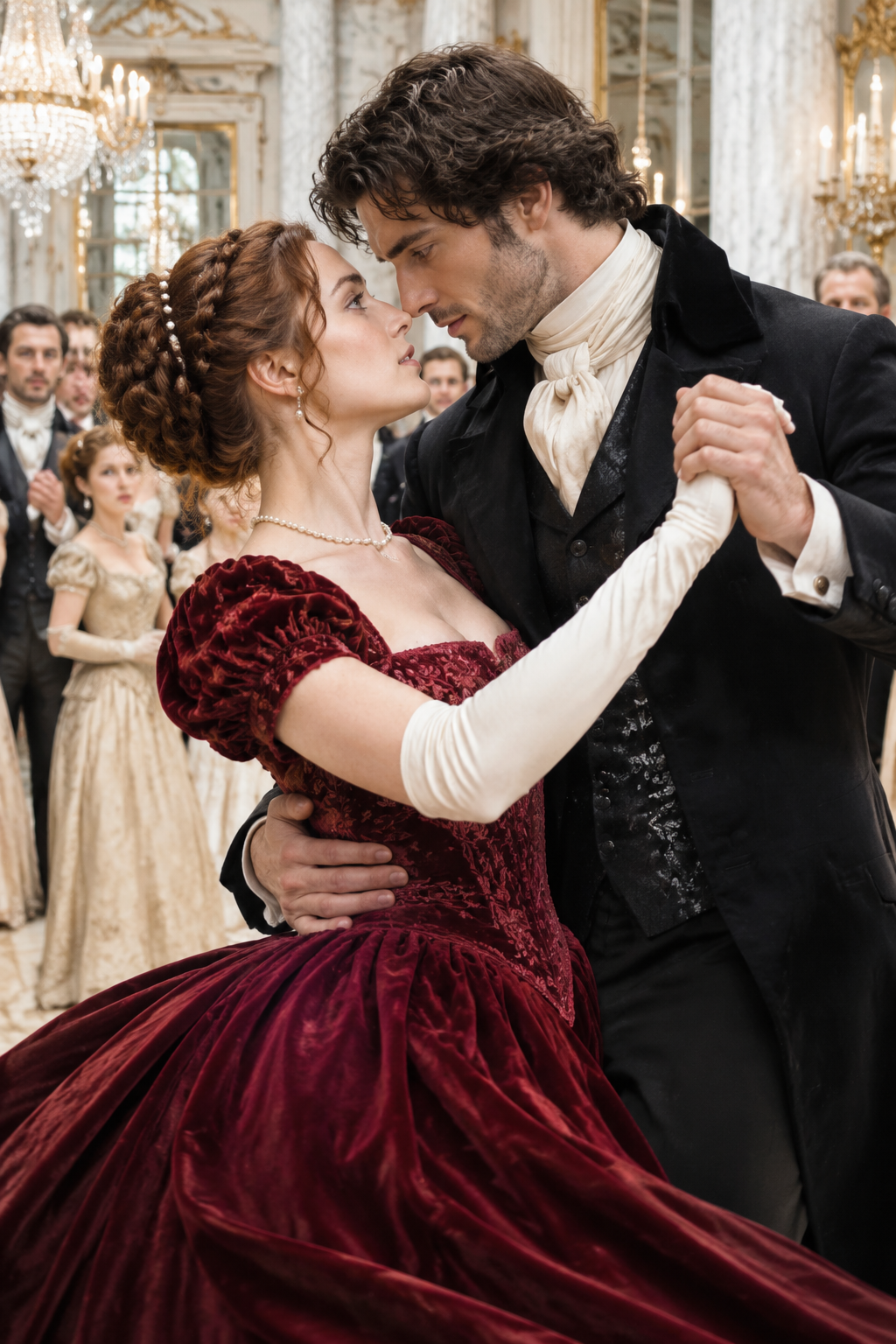
The Duke of Foscliff had not danced with a woman in seven years.
The Duke of Foscliff stood motionless beside the fireplace, staring at the faded envelope bearing his father’s name. For several seconds, nobody spoke. The only sound came from the rain striking the tall windows and the faint ticking of the French clock above the mantel.
Sidwell looked from the letter to the dowager duchess, whose hands had finally stopped trembling.
“Why would your father write to my mother?” she asked.
The old woman lowered her eyes.
“Because he was the last person to see her before she left Foscliff.”
The duke’s expression hardened.
“My father died believing he had never met the Glanville family.”
“He died believing many things, Edmund.”
Sidwell turned toward him. It was the first time she had heard his grandmother address him by his Christian name. Somehow, that small intimacy made the room feel even more uncomfortable.
The dowager reached for the envelope, but Sidwell placed her hand over it.
“No,” she said quietly. “You have arranged enough of my life without asking permission. This belongs to me.”
For a moment, the old woman’s face tightened. Then she withdrew her hand.
Sidwell broke the brittle seal.
Inside were two sheets of paper, folded together so carefully that their edges had become almost inseparable.
The first was a letter written in her mother’s familiar, elegant handwriting.
The second was a legal document.
She began reading.
My dearest Margaret,
I have kept my promise to your husband. The papers have been secured, and no one at Foscliff will trouble you again. Whatever my father intended, I will not allow his mistake to become your daughter’s punishment.
You must leave before the trustees return. I cannot protect you once they discover what has been signed.
Forgive me for what this family has taken from you.
Arthur Foscliff.
Sidwell read the letter twice.
Her mother’s name had been Margaret.
The duke’s father had been Arthur.
And the document beneath the letter bore a heading that made her fingers go cold.
DEED OF TRUST — GLANVILLE SETTLEMENT.
“What settlement?” she whispered.
The dowager duchess leaned back in her chair.
“Your grandfather, Miss Glanville, was not the impoverished gentleman your father led you to believe.”
Sidwell felt a sharp tightening beneath her ribs.
“My grandfather died before I was born.”
“Yes. But before his death, he helped my husband save this estate.”
The duke looked up.
“Save it from what?”
“Bankruptcy.”
The word seemed absurd inside a room filled with priceless paintings and furniture older than either of them.
The dowager continued.
“Thirty years ago, Foscliff was nearly ruined. Your grandfather possessed considerable wealth from shipping investments. My husband needed money, and the banks would no longer lend to him.”
Sidwell glanced at the document.
“Then my grandfather gave him a loan?”
“He entered into a partnership. A legitimate one. He was entitled to a substantial share of the estate’s income until the debt was repaid.”
The duke moved toward the window.
“Why have I never heard of this?”
“Because your grandfather died before the accounts were settled. His executors disputed the arrangement, and your father inherited a financial catastrophe.”
Sidwell looked down at the yellowed pages.
“And my family?”
The dowager’s voice grew quieter.
“Your father was offered a settlement in exchange for relinquishing the claim.”
“How much?”
The old woman hesitated.
“Twenty thousand pounds.”
Sidwell stared at her.
Twenty thousand pounds would have transformed her family’s existence. It would have paid every debt, secured her sister’s future, and spared her father years of humiliation.
“We never received that money.”
“I know.”
The duke turned sharply.
“Grandmother.”
The old woman closed her eyes.
“Your father discovered that the trustees had diverted the settlement into accounts controlled by his uncle, Lord Harrowden. He tried to recover it. Before he could, he fell ill.”
Sidwell remembered the winter her father had sold his books.
She remembered her mother sitting beside a candle, mending gloves that had already been repaired too many times.
She remembered the careful way her parents avoided discussing money whenever the children entered the room.
All those years, the answer had been hidden behind the walls of a house that seemed to possess everything.
“Why didn’t you tell us?” she asked.
The dowager opened her eyes.
“Because I was afraid.”
It was such an ordinary answer that Sidwell almost laughed.
Instead, she stepped away from the table.
“Afraid of losing your reputation?”
“Afraid of losing the estate. Harrowden controlled the trustees. He threatened to expose the debts and force a sale if I challenged him.”
“And so you let my family suffer.”
The old woman accepted the accusation without protest.
“Yes.”
The duke’s face had become unreadable.
“You knew this when you arranged the waltz.”
“I knew that Harrowden intended to destroy the remaining evidence. He has been pressing me for access to your grandfather’s private papers.”
“Then you could have told me.”
“Would you have listened?”
The duke gave a short, humorless laugh.
“You might have tried.”
The dowager looked toward Sidwell.
“I believed that if you became part of this family, Edmund would have reason to examine the old accounts. I thought I could protect you while putting matters right.”
Sidwell slowly removed the small orange blossom she had tucked inside her sleeve that morning.
It had begun to wilt.
“You used my feelings, my family’s poverty, and your grandson’s sense of honor to arrange something neither of us wanted.”
The dowager’s lips parted, but no defense emerged.
Sidwell placed the blossom beside the letter.
“I should like to leave.”
Edmund crossed the room immediately.
“Sidwell, please.”
She looked at him, and the concern in his face almost undid her composure.
“You have done nothing wrong,” she said.
“Then allow me to help.”
“You cannot help me while I am standing inside a house where everyone seems to know more about my life than I do.”
He stopped.
For the first time since their strange courtship began, he did not attempt to solve her problem.
He simply stepped aside.
“I’ll have the carriage prepared.”
Sidwell nodded, grateful and miserable in equal measure.
She left Foscliff before sunset.
By the following morning, the first rumors had reached London.
The Duke of Foscliff’s intended bride had abandoned his estate.
Some claimed she had discovered another woman.
Others suggested the duke had finally realized the impropriety of marrying beneath his station.
Within three days, invitations disappeared from the Glanville mantelpiece.
Sidwell’s younger sister, Caroline, returned from a musical afternoon with tears she refused to explain.
Their father spent an entire evening examining accounts that had not improved since the previous week.
Sidwell watched him from the doorway of his study.
He had grown thinner over the years, his shoulders bending beneath burdens he rarely acknowledged.
“Papa,” she said, “did Grandfather ever lend money to the Foscliff family?”
The pen slipped from his fingers.
For several seconds, he stared at the ink spreading across the page.
Then he closed his eyes.
“Who told you?”
Sidwell entered the room.
“Is it true?”
Her father rose slowly.
“I hoped you would never have to know.”
“Why?”
“Because I made a terrible bargain.”
He opened the bottom drawer of his desk and removed a small wooden box.
Inside lay a tarnished watch, several letters, and a receipt bearing the Foscliff seal.
“I was twenty-seven when your grandfather died. I inherited his business interests and his claim against the estate. Lord Harrowden approached me with an offer.”
“Twenty thousand pounds?”
Her father shook his head.
“Five thousand immediately, with the remainder promised within six months.”
Sidwell felt sick.
“Did you receive it?”
“Only the first payment.”
He looked toward the window.
“Your mother was expecting you. We had debts of our own. Harrowden told me the partnership would be declared invalid unless I accepted his terms.”
“And you believed him?”
“I was young. I believed that a man who sat in Parliament and dined with princes would not risk his reputation over a dishonest agreement.”
Sidwell sat down.
Her father placed the watch beside her.
“Your mother begged me to challenge him. She believed Arthur Foscliff would help us. But Arthur died before the matter could be resolved, and I could not afford another solicitor.”
He paused.
“I told myself that keeping the family together mattered more than fighting for money we might never recover.”
Sidwell reached for his hand.
“You were trying to protect us.”
“I was also ashamed.”
His voice broke on the final word.
“Every year I waited, the truth became harder to explain.”
That evening, Sidwell wrote to Edmund.
She did not ask him to renew their courtship.
She asked whether he would help her obtain copies of the original trust accounts.
His reply arrived the following morning.
I have already begun.
Three words.
No elaborate assurances.
No attempt to persuade her to return.
Yet she found herself reading the note several times before placing it in her desk.
At Foscliff, Edmund had spent the night examining his grandfather’s cabinet.
The brass key opened a compartment concealed behind a row of leather-bound ledgers.
Inside were correspondence, financial statements, and a second deed bearing the signatures of the original partners.
The documents confirmed that the Glanville family had possessed a legitimate financial interest in the estate.
They also revealed something worse.
For twenty-seven years, payments had been recorded as though they had been delivered to the Glanvilles.
Each entry bore a receipt.
Each receipt carried a signature resembling that of Sidwell’s father.
Edmund recognized the handwriting immediately.
It belonged to Lord Harrowden’s former secretary.
He summoned his solicitor before breakfast.
By noon, they had uncovered a pattern of falsified payments, diverted income, and forged acknowledgments.
The missing money had not vanished.
It had been transferred through several accounts into investments controlled by Harrowden.
And those investments were now worth considerably more than the original settlement.
Edmund stared at the figures.
His solicitor adjusted his spectacles.
“Your Grace, if these records are authentic, Lord Harrowden has committed a very serious fraud.”
“Can we prove it?”
“With the original ledgers and testimony from the secretary, possibly.”
“Then find him.”
The solicitor hesitated.
“There’s another difficulty.”
Edmund looked up.
“Go on.”
“Lord Harrowden remains one of the estate’s trustees. He has the authority to demand an inspection of these records.”
“Not for much longer.”
Edmund reached for a fresh sheet of paper.
He began writing before the solicitor had finished speaking.
Three days later, Lord Harrowden arrived at Foscliff.
He was a broad-shouldered gentleman with silver hair, expensive gloves, and the practiced smile of a man accustomed to being welcomed.
The dowager received him in the morning room.
Edmund stood beside the fireplace.
“Edmund,” Harrowden said warmly, “I hear you’ve been having difficulties with your little engagement.”
Edmund did not offer his hand.
“I hear you’ve been having difficulties with the estate accounts.”
The smile disappeared.
“I beg your pardon?”
Edmund placed a ledger on the table.
Harrowden glanced at it.
His expression changed so briefly that another man might have missed it.
“Old financial matters,” he said. “Hardly worth disturbing your grandmother over.”
“Then you won’t object to explaining them.”
Harrowden removed his gloves.
“Your grandfather trusted me.”
“My grandfather trusted the wrong people.”
Silence settled between them.
Then Harrowden laughed.
“Be careful, boy. A family name can be ruined much more easily than it can be restored.”
Edmund approached the table.
“Is that what you told Mr. Glanville?”
Harrowden’s eyes narrowed.
“I see that girl has been filling your head with nonsense.”
“Miss Glanville has asked for nothing except the truth.”
“And you intend to sacrifice your family’s standing to satisfy her?”
Edmund considered the question.
A month earlier, he might have feared precisely that.
He had spent years protecting Foscliff from scandal, avoiding society, and keeping his private life beyond the reach of gossip.
Now he thought of Sidwell standing beside the conservatory window, touching a struggling orange tree with unexpected tenderness.
He thought of her father selling his books.
He thought of Caroline returning home in tears.
Then he looked at Harrowden.
“If our standing depends upon concealing theft, it deserves to be sacrificed.”
Harrowden’s expression hardened.
“You have no idea what you’re doing.”
“Then perhaps you should explain it to the magistrate.”
For the first time, the older man appeared uncertain.
Edmund opened the door.
His solicitor stood outside with two witnesses.
Harrowden looked from one face to another.
“You cannot possibly believe that forged documents from thirty years ago will be enough.”
Edmund’s solicitor stepped forward.
“Not alone, my lord. But your former secretary has agreed to provide a sworn statement.”
Harrowden went very still.
The silence lasted long enough for the dowager’s clock to strike three.
Then he reached for his gloves.
“This is not finished.”
Edmund stepped aside.
“No. It isn’t.”
Within a week, the matter had reached the courts.
Harrowden’s secretary, now an elderly man living quietly in Bath, confirmed that he had been instructed to prepare false receipts.
He produced copies of letters ordering the payments to be redirected.
The financial evidence was substantial.
Yet the proceedings brought precisely the scandal the dowager had feared.
Newspapers printed the Foscliff name beside accusations of fraud.
Society divided itself into factions.
Some praised Edmund for exposing the deception.
Others whispered that the duke had been manipulated by a penniless woman determined to acquire his fortune.
Sidwell read the reports in silence.
She had expected cruelty.
She had not expected how deeply it would wound her to see Edmund’s name dragged through the same mud that had covered her family for years.
One afternoon, she arrived at his London residence without sending word.
The butler showed her into the library.
Edmund stood at his desk, surrounded by correspondence.
He looked exhausted.
When he saw her, something softened in his expression.
“Sidwell.”
She removed her gloves slowly.
“I’ve come to ask you to stop.”
He frowned.
“Stop what?”
“Risking everything for my family.”
Edmund placed his pen down.
“The money belongs to you.”
“This is no longer about money.”
“Then what is it about?”
She looked at the letters scattered across his desk.
“Your reputation. Your estate. Your grandmother. Every newspaper in London has found a new reason to despise you.”
He came around the desk.
“Do you?”
The question caught her unprepared.
“Of course not.”
“Then I find the newspapers considerably less troubling.”
Sidwell looked away.
“You cannot make light of this.”
“I’m not.”
His voice was quiet.
“I have spent most of my life believing that honor meant keeping the family name untouched. I was wrong.”
He moved closer.
“Honor is what remains when protecting your name becomes less important than doing what is right.”
Sidwell felt her carefully maintained composure begin to weaken.
“You should never have had to choose.”
“Perhaps not. But I have.”
For a moment, neither spoke.
The afternoon light fell across his face, revealing the weariness beneath his eyes.
Sidwell reached toward him, then stopped.
Their agreement still existed.
Three months.
A courtship that would end without regret.
Edmund noticed the movement.
“Sidwell, there’s something I must tell you.”
Before he could continue, the library door opened.
His solicitor entered, pale and breathless.
“Your Grace, forgive the interruption. Lord Harrowden has petitioned to challenge the Glanville settlement.”
Edmund turned.
“On what grounds?”
The solicitor looked toward Sidwell.
“He claims that the original partnership was fraudulent and that Mr. Glanville’s father knowingly concealed liabilities from the estate.”
Sidwell felt the floor shift beneath her.
“That’s impossible.”
“I’m afraid he has produced a witness.”
Edmund’s expression tightened.
“Who?”
The solicitor hesitated.
“Your grandmother.”
The next morning, the dowager duchess was summoned to give evidence.
Sidwell sat beside her father in the crowded courtroom, her hands clasped tightly in her lap.
Edmund stood near the front, speaking quietly with his solicitor.
He had not looked at her since the proceedings began.
She knew why.
He was afraid that whatever his grandmother said might destroy everything they had fought to recover.
When the dowager entered, the room grew silent.
She walked slowly, leaning upon her cane.
Lord Harrowden watched her with unmistakable confidence.
His counsel began with a series of questions concerning the original partnership.
The dowager answered carefully.
Yes, her husband had borrowed money.
Yes, the Glanville family had invested in the estate.
Yes, there had been disagreements concerning the accounts.
Then the barrister produced a document.
“Your Grace, did your husband ever accuse Mr. Glanville of falsifying financial statements?”
The dowager examined the paper.
“Yes.”
A murmur passed through the courtroom.
Sidwell’s father lowered his head.
The barrister continued.
“And did you believe that accusation?”
The dowager looked toward Harrowden.
For several seconds, she said nothing.
Then she raised her chin.
“No.”
The barrister blinked.
“I beg your pardon?”
“I did not believe it then, and I do not believe it now.”
Harrowden shifted in his seat.
The dowager continued before anyone could interrupt.
“My husband was persuaded to sign that accusation by Lord Harrowden. I was present when the document was prepared.”
The courtroom became utterly still.
The barrister glanced toward his client.
“Your Grace, are you suggesting that Lord Harrowden knowingly misrepresented the facts?”
“I am stating that he did.”
Harrowden rose.
“This is outrageous!”
The judge ordered him to sit.
The dowager’s voice remained steady.
“I remained silent because I feared the consequences of exposing him. My silence allowed an innocent family to suffer for nearly three decades.”
She looked toward Sidwell.
“And when I finally attempted to correct my mistake, I manipulated two young people instead of simply telling them the truth.”
Her eyes filled, but she did not lower her head.
“I have spent a lifetime confusing control with protection. I will not make that mistake again.”
Edmund watched his grandmother from across the courtroom.
He had never seen her appear so old.
Nor had he ever respected her more.
The proceedings continued for several weeks.
Harrowden’s testimony unraveled under examination.
The former secretary’s evidence established the forged receipts, while the original ledgers confirmed the diverted payments.
Eventually, the court upheld the Glanville claim and ordered the recovery of the misappropriated funds, with the final amount to be determined through an accounting.
Separate proceedings against Harrowden followed.
The newspapers that had once mocked Sidwell now described her family as victims of a longstanding injustice.
Invitations began arriving again.
Caroline received three offers to attend fashionable musical evenings.
Their father wept when the solicitor informed him that the recovered settlement would be sufficient to clear their debts and provide lasting security.
Sidwell should have felt entirely happy.
Instead, she found herself standing in the drawing room one evening, holding the original courtship agreement.
The three months were almost over.
The purpose of their arrangement had disappeared.
There was no longer any reason for Edmund to pretend.
And she had heard nothing from him for eleven days.
She told herself that he was occupied with estate matters.
She told herself that his silence was kindness.
She told herself many things.
None made the empty space beside her feel smaller.
On the twelfth morning, a parcel arrived from Foscliff.
Inside was a small wooden box.
Sidwell opened it carefully.
Resting upon dark velvet was a delicate orange blossom preserved beneath glass.
Beside it lay a folded note.
The tree survived.
I thought you would wish to know.
E.
Sidwell pressed the note against her lips before she realized what she was doing.
Then she laughed at herself.
The duke had sent her a flower.
Not a declaration.
Not a proposal.
A flower.
It was entirely like him.
That afternoon, she took the carriage to Foscliff.
The house looked different beneath the early summer sun.
The windows stood open, and the gardens were filled with roses.
She found Edmund in the conservatory.
He was kneeling beside the orange tree, examining its new leaves.
There was soil on his fingers.
Again.
He looked up when she entered.
For a moment, he seemed unable to move.
“Sidwell.”
She smiled faintly.
“I came to inspect your gardening.”
He rose.
“I’m afraid the tree has become rather independent.”
“How inconsiderate of it.”
They stood facing one another, surrounded by warm sunlight and the scent of damp earth.
Edmund wiped his hands on a cloth.
“I wasn’t certain you would come.”
“Neither was I.”
He nodded slowly.
“The settlement is secure. Your family will receive everything owed to them.”
“I know.”
“And your father’s reputation has been restored.”
“Yes.”
He glanced toward the orange tree.
“Then I suppose our arrangement has served its purpose.”
Sidwell felt the words settle painfully between them.
“I suppose it has.”
Edmund reached into his coat and withdrew a folded paper.
Their agreement.
The original one they had written together after he tore up his solicitor’s proposal.
He held it toward her.
“I thought you should have this.”
Sidwell accepted it.
For a moment, she stared at their signatures.
Then she tore the document in half.
Edmund blinked.
She tore it again.
The pieces fluttered into the basket beside the gardening bench.
“There,” she said. “Now neither of us is obliged to continue pretending.”
He watched her carefully.
“Is that what you want?”
Sidwell looked at him.
She had imagined this conversation a hundred times.
In every version, she had been composed, clever, and perfectly capable of protecting herself.
But standing before him now, she found that wit offered very little shelter.
“No,” she whispered.
Edmund’s expression changed.
“Sidwell.”
“I don’t want another agreement. I don’t want a courtship arranged to satisfy society, or a marriage designed to repair an injustice.”
She stepped closer.
“I want to know whether the man who brought me breakfast when I was ill, who listened when I spoke, and who nearly destroyed his own reputation to defend my family, might possibly care for me without being instructed to do so.”
Edmund stood perfectly still.
Then he laughed softly.
Not because he found her amusing.
Because something inside him had finally loosened.
“Sidwell, I have spent the past eleven days attempting to convince myself that leaving you alone was the honorable thing to do.”
“And have you succeeded?”
“Not remotely.”
She smiled through sudden tears.
He approached slowly.
“I fell in love with you somewhere between your first insult and the afternoon you told me my orange tree needed encouragement.”
“That was a very sensible observation.”
“It was.”
His voice softened.
“And I have been hopelessly in love with you ever since.”
Sidwell lowered her eyes.
“You might have mentioned it.”
“I was afraid you would think I was offering marriage out of obligation.”
“And I was afraid you would think I wanted your title.”
Edmund reached for her hand.
“Then perhaps we have both been remarkably foolish.”
“Only moderately,” she whispered.
He smiled.
“Would you permit me to ask you something without an audience, a grandmother, or an orchestra conspiring against us?”
Sidwell looked up.
“I should be delighted.”
Edmund took both her hands.
“Will you marry me?”
She studied him with exaggerated seriousness.
“That depends.”
“On what?”
“Whether you intend to continue gardening.”
“I fear I do.”
“And whether I may continue disagreeing with you.”
“I should be deeply disappointed if you stopped.”
She leaned closer.
“Then yes, Edmund. I will marry you.”
He kissed her gently.
There was no applause.
No announcement.
No orchestra.
Only the quiet rustle of orange leaves above them and the distant sound of summer birds beyond the glass.
For Sidwell, it was infinitely better than the grandest ballroom in England.
Their wedding took place six weeks later.
It was a small ceremony by the standards of the aristocracy, attended by family, a handful of close friends, and several servants who had quietly become dear to them.
Caroline stood beside Sidwell, radiant in a pale blue gown.
Their father walked his eldest daughter down the aisle with tears shining in his eyes.
The dowager duchess sat in the front pew.
She had asked Sidwell’s forgiveness privately, without excuses or expectations.
Sidwell had not offered it immediately.
Some wounds required more than an apology.
But over the following weeks, the old woman had made genuine efforts to repair what she could, including providing every remaining document concerning the Glanville settlement and withdrawing from the estate’s financial management.
Trust returned slowly.
That, Sidwell had discovered, was how it ought to return.
After the ceremony, the dowager approached the newly married couple.
“I suppose,” she said, “that I should congratulate myself for arranging such a successful match.”
Edmund raised an eyebrow.
“Grandmother.”
She smiled faintly.
“Yes, yes. I know. I shall never interfere again.”
Sidwell exchanged a glance with her husband.
“Never?”
The dowager considered.
“Perhaps only when absolutely necessary.”
Edmund sighed.
Sidwell laughed.
And for the first time in many years, the laughter inside Foscliff House felt entirely natural.
The recovered Glanville fortune transformed more than one family’s circumstances.
Sidwell’s father reopened a modest investment business, determined to rebuild his life with honesty rather than bitterness.
Caroline continued her music lessons and eventually performed at a charitable concert attended by several members of the royal household.
Sidwell herself established a fund to assist widows and daughters whose inheritances had been withheld or mismanaged.
She insisted that every application be reviewed fairly, regardless of social position.
Edmund supported the work without attempting to control it.
He had learned that love did not require managing another person’s choices.
Sometimes it required standing beside them while they made those choices themselves.
A year after their wedding, Sidwell returned to the conservatory one quiet afternoon.
The orange tree had grown considerably.
Its branches were strong, its leaves glossy, and several small fruits had begun to form.
Edmund found her standing beneath it.
“What are you thinking?” he asked.
She touched one of the leaves.
“About how close we came to never knowing each other.”
He slipped an arm around her waist.
“I would have found you eventually.”
“How very confident.”
“I am a duke.”
“An unfortunate condition.”
He laughed and kissed her temple.
Sidwell leaned against him, watching the sunlight move across the glass.
She thought of the ballroom where everyone had watched her dance with a man she barely knew.
She thought of the agreement they had signed to protect themselves from scandal.
She thought of the secrets that had nearly destroyed both their families.
And she thought of the strange, imperfect path that had brought them here.
Her life had not become beautiful because she had married a duke.
It had become beautiful because she had learned that her worth had never depended upon wealth, reputation, or the approval of people who knew nothing of her heart.
Edmund had learned something equally important.
A noble title could be inherited.
A fine estate could be purchased.
But integrity had to be chosen, especially when choosing it came at a cost.
He took her hand.
“Would you care to dance, Duchess?”
Sidwell looked around the empty conservatory.
“There’s no music.”
“Then we’ll have to manage without it.”
He offered his hand.
She placed hers in it.
And beneath the branches of the orange tree, they began to waltz.
No one watched.
No one whispered.
No one decided what their future should be.
They moved together slowly, sometimes laughing when their steps went wrong, sometimes falling silent simply because words were unnecessary.
The woman who had once feared she was not worthy of a duke now stood beside a man who had learned that his title made him no more worthy of love than anyone else.
Outside, the gardens stretched beneath a golden evening sky.
Inside, the last sunlight caught the small orange blossoms scattered across the floor.
Sidwell rested her head against Edmund’s shoulder.
“Do you ever regret that first dance?” she asked.
He considered the question.
“I regret that you were given no choice.”
She lifted her head.
“And the rest?”
He smiled.
“Not a single moment.”
Sidwell kissed him.
Their first waltz had been a trap, arranged by someone who believed she knew what was best for them.
Their second had been an act of necessity.
But this one belonged entirely to them.
And that was the difference between being bound to someone by circumstance and choosing, freely and wholeheartedly, to build a life together.
For love was never meant to be a debt repaid, a reputation rescued, or a promise extracted beneath the watchful eyes of society.
It was something quieter and far more courageous.
It was the decision to remain when leaving was possible.
To tell the truth when silence was easier.
To offer trust without demanding surrender.
And to recognize that the most precious inheritance anyone could leave behind was not a fortune, a title, or an ancestral home, but the courage to live with honesty and love without fear.
As the evening light faded over Foscliff, Edmund drew Sidwell a little closer, and they continued dancing beneath the flowering branches, with nothing left to prove and an entire lifetime still waiting to be shared.
THE END.