The Duke of Blackthorn had owned Rosewood Manor for six months when he discovered a stranger playing its piano on Christmas night. But it wasn’t the trespasser who unsettled him.
Clara read the warning again, her mother’s words catching the pale winter light as the letter trembled between her fingers.
“Do not trust the person who tells you your father’s debts destroyed Rosewood.”
For several seconds, no one spoke.
Beyond the windows of Blackthorn Abbey, snow slipped from the branches of an ancient cedar. Somewhere in the corridor, a clock struck eleven.
Alexander was the first to move.
“Clara, may I see the letter?”
She hesitated before placing it in his hand.
He examined the nearly invisible writing, turning the page carefully toward the window. His expression tightened as he read the final sentence.
“My solicitor told me Rosewood had been surrendered because of debts,” he said.
Clara looked at him.
“Your solicitor?”
“Mr. Edmund Harcourt. He handled the purchase on behalf of my estate.”
Eleanor made a small sound.
Alexander turned toward her.
“Mother?”
The dowager duchess lowered herself into the nearest chair. Her face had lost its color.
“Edmund Harcourt was also the solicitor who assisted Margaret’s husband during the final years of their marriage.”
The room seemed to grow colder.
Clara remembered a tall gentleman with silver-rimmed spectacles standing outside her father’s study. She remembered how he always removed his gloves before entering, folding them precisely into his coat pocket.
And she remembered something else.
Her father had once told her never to be alone with him.
At fourteen, she had assumed it was an ordinary warning about unfamiliar gentlemen.
Now she was no longer certain.
“Did Mr. Harcourt tell you my father owed money?” she asked.
Alexander nodded.
“He supplied the financial records.”
“Did you examine the original documents?”
“My agent inspected copies. The transfer had passed through several owners before I purchased the property.”
Clara looked down at the silver key lying in her palm.
For ten years, she had blamed her father’s financial troubles for the loss of Rosewood.
She had watched strangers carry furniture through the front doors.
She had seen her mother’s favorite paintings disappear into covered wagons.
And on the day she was sent away to live with a distant relative, Mr. Harcourt had stood beside the carriage and told her that everything had been settled.
Everything.
The word suddenly felt unbearable.
“I need to return to Rosewood,” she said.
Alexander folded the letter.
“Then we shall go together.”
Eleanor reached for Clara’s hand.
“Before you leave, there’s something I must tell you.”
Her voice was thin, but steady.
“When Margaret visited me eleven years ago, she was frightened. Not of losing the house. Of someone discovering what she knew.”
Clara turned.
“Why didn’t she tell you?”
“She said she had already endangered one person by asking questions.”
Eleanor looked toward the fire.
“I begged her to remain here. She refused. She said her husband was waiting for her, and that she would return when everything was resolved.”
A tear gathered at the corner of the older woman’s eye.
“She never came back.”
Clara knelt beside her chair.
“She loved you very much.”
Eleanor touched her cheek.
“I know. But love doesn’t make regret any easier.”
By noon, Alexander’s carriage was traveling through the snow-covered countryside toward Rosewood Manor.
Clara sat opposite him, her mother’s notebook resting on her knees.
She had opened it several times during the journey, searching for anything that might explain the concealed compartment.
Most pages contained music.
A few held small observations written between the staves.
December 12. The third variation must never be forgotten.
December 16. The old mechanism still works.
December 21. Clara remembers melodies better than words.
Alexander studied her as she turned the pages.
“Your mother trusted you with something important.”
“She trusted a child who didn’t understand what was happening.”
“Perhaps she knew you would understand one day.”
Clara closed the notebook.
“My parents died believing they had lost everything. I spent ten years believing the same.”
Alexander leaned forward.
“We don’t yet know what happened.”
“No,” she said quietly. “But someone does.”
The carriage crossed the stone bridge leading to Rosewood.
Clara looked through the window.
In daylight, the manor seemed smaller than it had the previous night.
Its gardens had grown wild, and ivy climbed the eastern wall. The fountain in the courtyard had stopped working years before.
Yet the sight still tightened something beneath her ribs.
Alexander helped her down.
At the entrance, the housekeeper, Mrs. Bell, waited with two servants.
“Your Grace,” she said, dipping into a curtsy. “We weren’t expecting you until next week.”
“There’s a matter requiring my attention.”
Mrs. Bell glanced at Clara.
Then her expression changed.
“Miss Ashbourne?”
Clara stopped.
The housekeeper’s eyes filled.
“Oh, my dear child.”
Mrs. Bell had worked at Rosewood before Clara was born. Clara remembered her flour-dusted apron, her warm hands, and the little sugared biscuits she used to hide beside the nursery fireplace.
“Mrs. Bell?”
The older woman approached slowly, as though afraid Clara might vanish.
“I thought I should never see you here again.”
Clara embraced her.
For a moment, the mystery could wait.
The familiar scent of lavender soap brought back memories of childhood mornings, clean sheets, and a household that had once felt impossible to lose.
When they separated, Mrs. Bell wiped her eyes.
Alexander watched them without speaking.
Then he asked, “Was the piano ever moved from the drawing room?”
“Never, Your Grace. Her late ladyship wouldn’t allow it.”
Clara looked up.
“My mother?”
Mrs. Bell nodded.
“Even when the furniture was sold, she insisted the piano remain.”
“Why?”
The housekeeper hesitated.
“She said it belonged to the house.”
Clara exchanged a glance with Alexander.
They went directly to the drawing room.
The piano stood beneath the tall windows, exactly where Clara had left it the night before.
In the afternoon light, its polished surface revealed fine scratches, faded varnish, and a delicate carved rose beneath the music stand.
Clara laid her mother’s notebook on the instrument.
“The key must fit somewhere.”
Alexander examined the legs and lower panels while Clara searched along the edges of the keyboard.
For nearly twenty minutes, they found nothing.
Then Clara noticed a tiny brass circle beneath the carved rose.
It was almost invisible.
She inserted the key.
Nothing happened.
She tried turning it.
It resisted.
Alexander crouched beside her.
“Perhaps the mechanism is damaged.”
Clara withdrew the key and looked at the notebook.
The third variation must never be forgotten.
She stared at the words.
Then at the piano.
“My mother used to make me practice a particular melody.”
Alexander straightened.
“The one you played last night?”
“No. A different arrangement.”
She opened the notebook to a page marked with a small ink drawing of a rose.
The music was familiar, though she had not played it in years.
Clara sat down.
Her fingers hovered above the keys.
Then she began.
The first notes sounded uncertain, but the melody slowly returned to her hands.
She remembered her mother sitting beside her, correcting her posture, smiling whenever she played the final passage correctly.
At the third variation, Clara heard a faint metallic click.
She stopped.
Alexander looked toward the carved rose.
“Again.”
Clara repeated the passage.
Another click.
A narrow seam appeared beneath the music stand.
Alexander carefully pressed the wooden panel.
It opened.
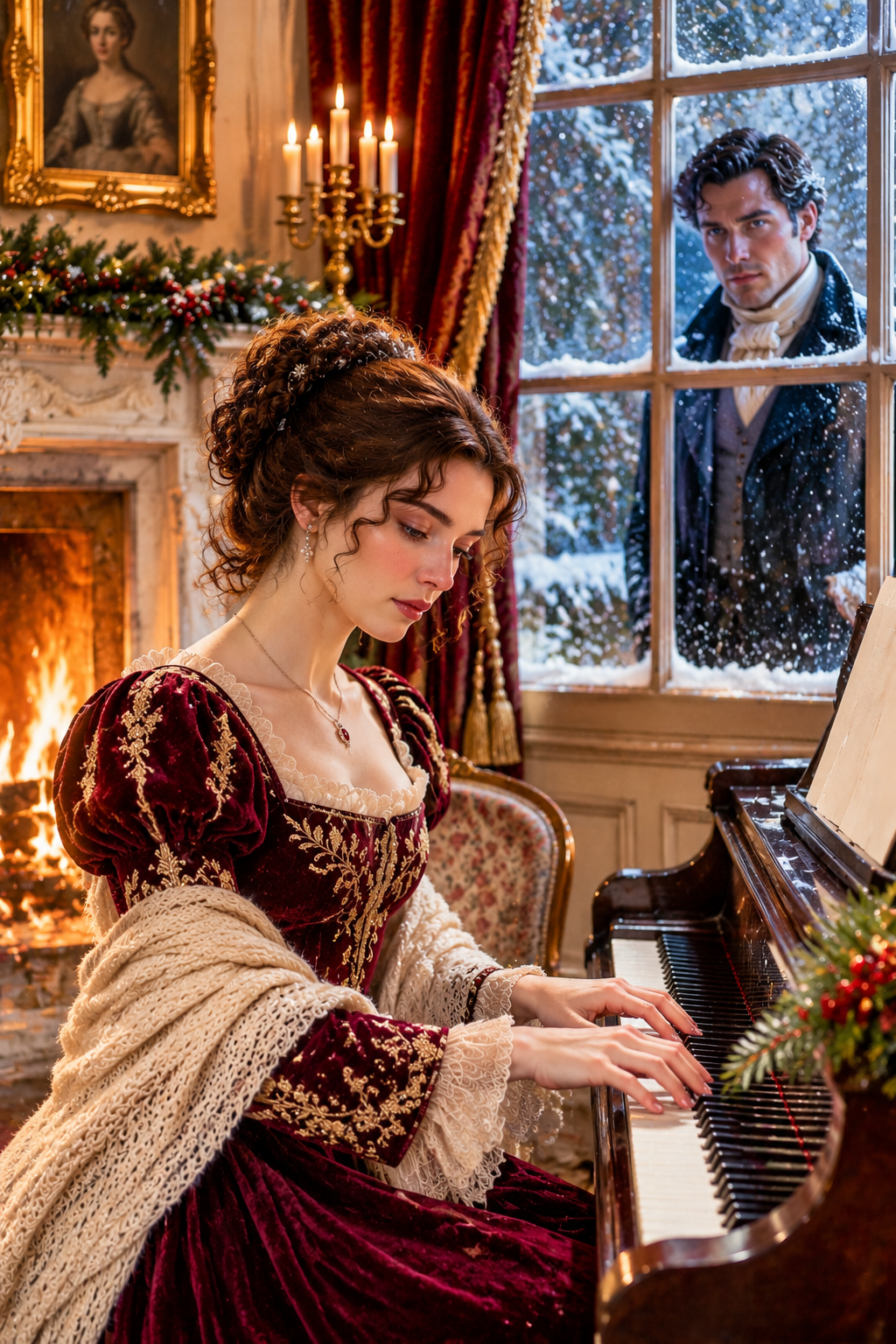
Inside was a shallow compartment lined with dark green velvet.
Clara stood so quickly that the piano bench shifted behind her.
A leather document case rested inside.
Beside it lay a folded handkerchief embroidered with the initials M.A.
Clara recognized it immediately.
Her mother had carried that handkerchief every Sunday.
She picked it up, holding it against her lips for a moment.
Alexander gave her time.
Then she opened the case.
Inside were property records, correspondence, several financial statements, and a small sealed packet bearing her father’s handwriting.
At the bottom lay a formal document with a red ribbon.
Alexander lifted it carefully.
His expression changed as he examined the first page.
“What is it?” Clara asked.
“A trust deed.”
She waited.
“Your grandfather placed Rosewood Manor in a trust for your mother’s lifetime, with the remainder passing to her children.”
Clara stared at him.
“Meaning?”
Alexander looked directly at her.
“Meaning your father may never have had the authority to sell Rosewood to satisfy his personal debts.”
The silence that followed was broken only by the ticking clock.
Clara sank into the piano bench.
For ten years, she had believed her parents had lost their home through misfortune.
Now she was holding evidence that the house might never have been legally taken from them at all.
Alexander continued reading.
“The deed names two trustees. One was your grandfather’s solicitor, who died years ago.”
“And the other?”
He hesitated.
“Edmund Harcourt.”
Clara closed her eyes.
Outside, a carriage approached along the gravel drive.
Mrs. Bell appeared in the doorway moments later.
“Your Grace, Mr. Harcourt has arrived.”
Alexander looked toward the hall.
“Did you send for him?”
“No, sir. He says he received word that you had returned unexpectedly.”
Clara slowly stood.
Alexander placed the documents back into the leather case.
“Keep these with you,” he said.
“What are you going to do?”
“Find out why a man who should have no reason to fear an old piano has arrived at my house without an invitation.”
Edmund Harcourt entered the drawing room carrying a black leather portfolio.
He was older than Clara remembered, his hair nearly white, but his movements had the same measured precision.
He removed his gloves.
Folded them.
Placed them inside his coat.
Then he saw Clara.
His smile disappeared.
“Miss Ashbourne.”
She held his gaze.
“Mr. Harcourt.”
Alexander stepped forward.
“I wasn’t expecting you.”
“I received information that someone had entered Rosewood last night. I thought it prudent to ensure nothing had been disturbed.”
His eyes moved toward the piano.
Clara noticed.
So did Alexander.
“An unusual concern for a solicitor,” the duke replied.
Harcourt gave a small smile.
“Old properties contain valuable objects, Your Grace.”
“Indeed.”
Alexander gestured toward a chair.
“Perhaps you can help us with a question.”
Harcourt remained standing.
“Certainly.”
“Who authorized the sale of Rosewood Manor after Lord Ashbourne’s death?”
“The estate was burdened by substantial liabilities. Its disposal was unavoidable.”
“That wasn’t my question.”
Harcourt’s fingers tightened around his portfolio.
Clara watched the man’s face.
For the first time, she saw something she had never noticed as a child.
He was afraid.
Alexander continued.
“I have examined a deed suggesting that Rosewood was held in trust for Lady Ashbourne and her descendants.”
Harcourt’s expression hardened.
“That document was superseded.”
“By what?”
“A subsequent agreement.”
“Where is it?”
“In the appropriate archives.”
“Then you won’t object to providing it.”
A long pause followed.
Harcourt turned toward Clara.
“Miss Ashbourne, I understand returning here must be distressing. Your father left complicated affairs, and reopening them will accomplish little.”
Clara felt the familiar pressure of his voice, the calm authority he had used when she was fourteen.
But she was no longer standing beside a carriage with nowhere to go.
“My father left more than complicated affairs,” she replied.
Harcourt’s eyes narrowed.
“What do you mean?”
“Enough to make me question what you told me.”
The solicitor glanced again toward the piano.
Alexander stepped between them.
“I think this conversation should continue in the presence of independent counsel.”
Harcourt closed his portfolio.
“Very well. But I advise you against making accusations based on incomplete records.”
He turned toward the door.
Then Clara spoke.
“Mr. Harcourt?”
He stopped.
“Did you know my mother composed music?”
His back stiffened.
“Your mother had many accomplishments.”
“Did you ever hear her play?”
He did not answer immediately.
“No.”
Clara looked toward the piano.
“How strange.”
Harcourt turned.
“Why?”
“Because you haven’t stopped looking at that instrument since you entered.”
For one brief moment, his carefully controlled expression vanished.
Then he bowed.
“Good afternoon.”
Alexander waited until the solicitor’s footsteps had disappeared.
“That man knows something.”
Clara looked at the open notebook.
“He knows exactly what my mother hid.”
That evening, Alexander returned to Blackthorn Abbey with Clara and the recovered documents.
Eleanor was waiting in the library.
When she saw the leather case, she brought one hand to her mouth.
“Margaret’s.”
Clara nodded.
“We found it inside the piano.”
Alexander spread the papers across a large oak table.
He had already sent for his family’s independent solicitor, Mr. Frederick Vale, a meticulous gentleman who had served the Blackthorns for nearly twenty years.
Vale arrived shortly after dinner.
For two hours, he examined the records beneath the green light of a reading lamp.
Clara sat beside Eleanor, her untouched tea growing cold.
At last, Vale removed his spectacles.
“Your Grace, these documents suggest a serious breach of trust.”
Alexander leaned forward.
“Can the sale be challenged?”
“Potentially. But we must establish the chain of transfers and determine whether the trustees had lawful authority to dispose of the property.”
Clara listened carefully.
“Was my father truly in debt?”
Vale looked at the financial statements.
“Some debts were genuine. But several entries are suspicious.”
He pointed to a series of payments.
“These amounts were allegedly advanced to Lord Ashbourne shortly before his death. Yet the receipts contain signatures that do not appear consistent.”
Alexander examined them.
“Forged?”
“Possibly.”
Vale opened another document.
“And here is something more troubling.”
It was a letter from a bank informing the trustees that a substantial investment account remained active in Margaret Ashbourne’s name.
Clara frowned.
“My mother never mentioned an investment account.”
“According to this,” Vale said, “the funds were sufficient to settle your father’s legitimate debts several times over.”
Eleanor gripped Clara’s hand.
“Margaret told me she believed someone was stealing from the estate.”
Clara turned toward her.
“Why didn’t you say that before?”
“Because she never told me whom she suspected. I thought she meant an employee or an dishonest agent. I had no proof.”
Vale examined the letter’s date.
“Three months after this was written, the bank account was closed.”
“Who authorized the withdrawal?” Alexander asked.
“The bank’s notation identifies Mr. Harcourt acting as trustee.”
Clara felt a cold sensation spread through her chest.
For ten years, she had worked to pay rent, repaired her shoes rather than replacing them, and sometimes gone without supper so her students could continue their lessons.
All while money that might have supported her had disappeared.
Alexander noticed her trembling hands.
He quietly moved a glass of water closer.
She accepted it without looking away from the documents.
“What happened to the money?”
Vale closed the file.
“That is what we must discover.”
Three days later, the investigation took an unexpected turn.
A former clerk from Harcourt’s office arrived at Blackthorn Abbey carrying a bundle of papers wrapped in newspaper.
His name was Thomas Reed.
He was a thin, nervous man in his forties, with reddened hands and a habit of glancing over his shoulder.
“I heard the duke was examining the Ashbourne estate,” he said.
Alexander invited him into the library.
Clara remained beside the fireplace.
Reed recognized her at once.
“You look like your mother.”
Clara stiffened.
“You knew her?”
“I worked in Mr. Harcourt’s office when your parents were alive.”
He looked down.
“I should have come forward years ago.”
Alexander pulled out a chair.
“Then perhaps you can begin now.”
Reed explained that Harcourt had controlled the Ashbourne family’s accounts after Clara’s grandfather died.
At first, nothing appeared unusual.
Then investments were transferred.
Loans appeared against the property.
Payments were redirected through companies Reed had never heard of.
When Lord Ashbourne began questioning the transactions, Harcourt insisted the discrepancies were clerical errors.
“But your father wouldn’t stop asking,” Reed told Clara.
“He began collecting copies of everything.”
Clara remembered the locked study.
The unfamiliar carriages.
The arguments behind closed doors.
“What happened to those copies?”
“I don’t know. But Lady Ashbourne came to the office one afternoon and demanded to see the trust records.”
Reed swallowed.
“Mr. Harcourt was furious.”
Eleanor pressed a hand against her chest.
“What did he do?”
“He told her the documents were unavailable. After she left, he ordered me to destroy several files.”
Alexander’s expression hardened.
“Did you?”
“Some.”
Reed reached for the bundle.
“But I kept these.”
Inside were carbon copies of ledger entries, correspondence with a private bank, and a memorandum bearing Harcourt’s signature.
Vale examined them immediately.
His eyes narrowed.
“This records the transfer of trust funds to a company called Westmere Holdings.”
Reed nodded.
“Mr. Harcourt controlled it through another gentleman.”
“Who?”
“Sir Lionel Mercer.”
Alexander slowly straightened.
He knew the name.
Mercer was a businessman with extensive property interests, a man who had attended several gatherings at Blackthorn Abbey.
More importantly, he had been one of the intermediate purchasers of Rosewood.
Clara looked at Alexander.
“Was he involved when you bought the house?”
“His company sold it to me.”
Reed lowered his head.
“Then you should know something else.”
The room became silent.
“Mr. Harcourt and Sir Lionel met two days after Lord Ashbourne died. I heard them discussing how quickly the estate could be transferred.”
Clara felt her breath catch.
“My father had only just been buried.”
Reed nodded.
“I know.”
She turned away.
For a moment, she could see her younger self standing beside her mother’s grave, clutching a white rose and believing the adults around her were trying to help.
Instead, some had been calculating the value of what remained.
She pressed her palms against the windowsill.
Alexander approached, but stopped a respectful distance away.
“Clara.”
She shook her head.
“Please. Just a moment.”
He remained silent.
Outside, snow was beginning to fall again.
She watched it gather along the stone ledge until she could trust her voice.
“Did my parents know?”
Reed looked toward the floor.
“I believe they knew enough to be frightened.”
The following morning, Vale began formal proceedings to protect the Ashbourne trust’s remaining assets and challenge the transactions.
He also delivered the recovered evidence to the appropriate authorities.
But before the investigation could proceed further, another letter arrived.
It was addressed to Clara.
There was no signature.
Inside, a single sentence had been written in dark ink.
If you wish to learn how your parents truly died, come to the eastern chapel at Rosewood before midnight.
Alexander read it twice.
“Absolutely not.”
Clara stood beside the library table.
“Someone knows something.”
“Someone wants you alone in an abandoned chapel.”
“I understand that.”
“Then understand the danger.”
She met his eyes.
“For ten years, everyone made decisions about my life without telling me the truth. I won’t allow it to happen again.”
Alexander fell silent.
Then his expression softened.
“I’m not trying to decide for you.”
“Then help me.”
He studied her for a moment.
“Very well. But we won’t go alone.”
That night, the estate lay beneath a thin layer of fresh snow.
The eastern chapel stood beyond the old orchard, its stone walls dark against the moonlit fields.
Clara approached along the frozen path, Alexander walking beside her.
Two trusted estate servants remained at a discreet distance, while a local constable waited near the carriage with instructions to intervene if necessary.
The chapel door stood slightly open.
Inside, a single lantern burned beside the altar.
Clara stepped through the entrance.
The air smelled of cold stone and damp wood.
A figure stood near the far window.
“Miss Ashbourne.”
Edmund Harcourt turned toward her.
Alexander moved half a step forward.
“Mr. Harcourt.”
The solicitor’s face tightened.
“I asked her to come alone.”
“That was never going to happen,” Alexander replied.
Harcourt looked exhausted.
His immaculate appearance had begun to unravel. His collar was crooked, and his hands shook as he gripped the back of a pew.
Clara remained near the entrance.
“You wrote the letter.”
“Yes.”
“Then tell me about my parents.”
Harcourt stared at her for a long moment.
“Your father was a stubborn man.”
Clara said nothing.
“He discovered irregularities in the trust. He threatened legal action. I tried to negotiate, but he refused.”
“You mean he refused to let you steal from us.”
Harcourt flinched.
Alexander watched him closely.
“Where is Sir Lionel Mercer?”
The solicitor gave a bitter laugh.
“Preparing to abandon me, I imagine.”
Clara stepped forward.
“What happened to my parents?”
Harcourt looked away.
“Your father’s death was an accident.”
“That’s what everyone told me.”
“It was.”
“Then why did you summon me here?”
Harcourt swallowed.
“Because your mother did not believe it.”
The chapel seemed to hold its breath.
Clara gripped the edge of a wooden pew.
“Explain.”
“Your father was traveling to meet a magistrate. His carriage overturned on the northern road.”
Clara remembered.
The overturned carriage.
The mud-covered messenger arriving at Rosewood.
Her mother’s silence when she heard the news.
“Margaret discovered that one of the carriage wheels had been tampered with,” Harcourt continued.
Alexander’s expression changed.
“By whom?”
“I don’t know.”
Clara stared at him.
“You expect me to believe that?”
Harcourt’s voice sharpened.
“I knew Mercer had ordered someone to delay your father. I did not know what that man would do.”
The words fell heavily between them.
Alexander stepped forward.
“Are you admitting Mercer arranged interference with Lord Ashbourne’s carriage?”
Harcourt closed his eyes.
“Yes.”
Clara’s hands went cold.
“And my mother?”
Harcourt opened his eyes.
“She found out. She confronted Mercer. Afterward, she became ill.”
Clara remembered her mother’s final weeks.
The physician arriving repeatedly.
The curtains drawn against the daylight.
Her mother’s hand growing thinner each day.
“Was she poisoned?” Clara whispered.
Harcourt shook his head.
“I don’t know. I never saw evidence of it.”
“Then what do you know?”
“She was already suffering from a serious illness. The physician believed it had been progressing for months.”
His voice broke.
“But Mercer threatened her. He said if she accused him without proof, he’d ensure you lost everything.”
Clara pressed her lips together.
“He did ensure that.”
Harcourt lowered his head.
“Yes.”
From beneath his coat, he withdrew a folded document.
“Mercer kept records of the payments. I obtained this copy before he realized I intended to cooperate.”
Alexander took it carefully.
Harcourt looked at Clara.
“I cannot undo what I did. I helped him conceal the theft. I allowed a child to be turned out of her home.”
Clara watched him without moving.
“Why tell me now?”
“Because Mercer believes he can place all the blame on me. And because I have spent ten years hearing your mother’s voice every time I pass a piano.”
For an instant, his eyes filled.
Clara did not offer forgiveness.
She simply asked, “Will you tell the authorities everything?”
Harcourt nodded.
“I will.”
Alexander opened the chapel door and called for the constable.
Harcourt did not resist when he was escorted away.
Clara remained inside after the others had gone.
The lantern burned low.
Alexander stood beside her.
“Are you all right?”
She looked toward the altar.
“No.”
He waited.
“But I think I will be.”
The investigation continued through the remaining winter months.
Harcourt’s testimony, Reed’s records, and the documents hidden inside the piano provided the foundation for a case against Sir Lionel Mercer.
Additional bank records revealed that Mercer had used Westmere Holdings to receive trust funds diverted from the Ashbourne estate.
Investigators also located payments to a former coachman shortly before Lord Ashbourne’s fatal accident.
The coachman was questioned and eventually admitted he had been paid to interfere with the carriage.
He insisted he had been told merely to prevent Lord Ashbourne from reaching his appointment, not to cause his death.
Nevertheless, his actions had contributed to the fatal crash.
Mercer denied giving the order.
But correspondence recovered from his offices contradicted his account.
The proceedings were lengthy.
Clara attended whenever she was permitted.
She listened as men discussed her family’s ruin in the language of contracts, balances, and legal obligations.
Sometimes she felt strangely detached, as though they were speaking about another household entirely.
Other times, a single detail would bring her close to tears.
An invoice for her mother’s piano repairs.
A receipt for Christmas decorations.
A letter in her father’s handwriting requesting that the nursery windows be fixed before winter.
Evidence that ordinary life had continued while danger approached.
When the court finally found that the trust had been unlawfully administered, Vale began the difficult work of recovering its assets.
Mercer and Harcourt faced criminal consequences for their roles in the fraud, while the carriage interference was addressed through separate proceedings.
Not every question could be answered.
The physician who had attended Margaret was dead.
Some records had disappeared permanently.
And the precise extent of Mercer’s knowledge concerning the carriage accident remained contested.
But the central truth was established.
The Ashbourne family had not lost Rosewood because they were careless or incapable.
They had been betrayed by men entrusted with protecting their property.
One afternoon in early spring, Vale arrived at Blackthorn Abbey carrying the final documents concerning Rosewood Manor.
Alexander invited Clara into the library.
Eleanor sat nearby, working on a piece of embroidery.
Vale placed the papers on the desk.
“The court has approved the restoration of Rosewood to the Ashbourne trust, subject to the necessary conveyances.”
Clara stared at him.
“Restoration?”
Alexander nodded.
“When I purchased Rosewood, I believed the title was sound. Now that we know otherwise, I’ve agreed to the arrangements required to return it to its rightful beneficiary.”
Clara looked at him.
“You would give up the house?”
“It was never truly mine to keep.”
“But you paid for it.”
“That matter is being addressed through the recovery proceedings.”
She looked down at the documents.
For years, she had imagined returning to Rosewood.
She had pictured opening the front doors, lighting the fireplaces, and hearing music in the drawing room again.
Yet now that the possibility stood before her, she felt something unexpected.
Fear.
“What if I can’t manage it?”
Alexander smiled faintly.
“Then you’ll learn.”
“What if the roof leaks?”
“It does.”
She almost laughed.
“And the gardens?”
“An absolute wilderness.”
“And the servants?”
“Mrs. Bell has already informed me that she intends to remain.”
Eleanor set aside her embroidery.
“My dear, a home doesn’t require perfection. It requires people willing to care for it.”
Clara looked from Eleanor to Alexander.
The duchess rose and embraced her.
“Your mother would be proud.”
Clara held her tightly.
“I wish she were here.”
“So do I.”
They stood together in the quiet library, surrounded by books and afternoon sunlight.
Then Eleanor stepped back.
“Perhaps it’s time we did something with that music notebook.”
Clara looked at her.
“What do you mean?”
“The unfinished composition.”
Clara glanced toward Alexander.
He was smiling.
“Mother has been rather insistent that Rosewood should host a Christmas gathering.”
“It’s only April,” Clara said.
“One must plan ahead,” Eleanor replied.
For the first time in many years, Clara laughed without immediately feeling guilty for it.
The months that followed brought work, frustration, and unexpected happiness.
Rosewood Manor required more repairs than anyone had anticipated.
The western roof needed replacing.
Several windows had warped.
The old fountain was beyond repair, and the orchard had become so overgrown that the gardeners could barely locate its original paths.
Clara refused to rush.
She spent mornings teaching music to local children and afternoons working alongside the household staff.
She kept careful accounts.
She learned which repairs were urgent and which could wait.
She also established a small music school in the former morning room.
At first, only six pupils attended.
Then twelve.
Then twenty.
Some came from families that could pay.
Others arrived with nothing but worn shoes and an eagerness to learn.
Clara welcomed them all.
Alexander visited frequently.
Sometimes he brought architectural plans or advice from his estate steward.
Sometimes he arrived with books he thought might interest her.
And sometimes he came without any particular reason.
One afternoon, Clara found him standing in the doorway of the music room while a group of children practiced a simple arrangement.
He watched a small boy struggle with the same three notes.
Clara patiently guided the child’s fingers.
When the lesson ended, Alexander approached.
“You have an extraordinary amount of patience.”
“Only with children.”
He raised an eyebrow.
“Should I be concerned?”
“That depends. Have you learned to distinguish a quarter note from a half note?”
“Not yet.”
“Then I’m afraid your education remains incomplete.”
He laughed.
She had grown accustomed to that sound.
It was warm and unguarded, different from the carefully measured voice he used in formal company.
Over the summer, their friendship deepened.
They walked through the restored gardens.
They discussed books, music, and the strange responsibilities of inherited property.
Alexander spoke of his father, a distant and demanding man who had taught him that duty mattered more than affection.
Clara spoke of the years she had spent moving between rented rooms, learning to avoid becoming attached to anything she could not afford to lose.
One evening, they stood beside the newly repaired fountain.
The sky was turning gold above the orchard.
Alexander looked toward the house.
“You’ve changed this place.”
Clara smiled.
“Only repaired it.”
“No.”
He turned toward her.
“When I first saw Rosewood, it was beautiful but empty. I thought restoring the building would be enough.”
“And now?”
“Now I understand that buildings are the least important part.”
Clara lowered her gaze.
For a moment, neither spoke.
Then she said quietly, “You helped me find my way back.”
Alexander shook his head.
“You found it yourself. I simply happened to be standing in the doorway.”
She looked at him.
Their eyes met.
He took a breath, as though preparing to say something important.
But footsteps sounded behind them.
Mrs. Bell approached carrying a message from Blackthorn Abbey.
Eleanor had taken ill.
Alexander left immediately.
Clara followed.
They found the dowager duchess resting in bed, pale but alert.
Her physician assured them that she was suffering from exhaustion and a mild fever, made worse by the damp weather.
She needed rest.
Eleanor was displeased.
“I have survived seventy winters,” she informed the physician. “I don’t intend to be defeated by a draft.”
Clara sat beside her bed.
“Then you must stop arguing and follow his instructions.”
Eleanor gave her a look.
“You sound exactly like your mother.”
Clara smiled.
Over the following days, she remained at Blackthorn Abbey, reading aloud, bringing tea, and keeping Eleanor company while Alexander attended to estate matters.
One afternoon, the duchess asked Clara to bring her the old music notebook.
Clara opened it beside the bed.
“The unfinished piece?”
Eleanor nodded.
“Margaret always meant to finish it.”
Clara studied the pages.
The melody began gently, gathered strength through the middle section, then ended abruptly.
For years, she had avoided completing it.
The thought of adding notes to her mother’s work seemed almost disrespectful.
Eleanor watched her.
“Margaret used to say that music belonged to the person who listened as much as the person who wrote it.”
Clara ran her fingers along the faded ink.
“I don’t know how she would have wanted it to end.”
“Neither do I.”
Eleanor smiled.
“Perhaps that is why she left it unfinished.”
That night, Clara sat at the piano in the abbey’s music room.
Rain tapped softly against the windows.
She played the composition from the beginning.
When she reached the unfinished passage, she stopped.
Then she tried something new.
The first attempt was clumsy.
The second felt too elaborate.
The third was closer.
She continued until the candles burned low.
At last, a simple melody emerged.
It echoed the opening theme but moved gently forward, changing just enough to suggest that something lost had been found in another form.
Clara played it again.
And again.
When the final note faded, she realized Alexander was standing near the doorway.
“How long have you been there?”
“Long enough.”
She looked at the music.
“I finished it.”
He approached slowly.
“Will you play it once more?”
She did.
When she finished, Alexander stood beside the piano.
“Your mother would have loved that.”
Clara smiled faintly.
“You can’t know.”
“No,” he admitted. “But I know what it feels like to hear something beautiful and recognize that someone has put a great deal of love into it.”
She turned toward him.
The room was quiet.
Alexander reached for her hand.
“Clara, there’s something I’ve wanted to tell you for months.”
She felt his fingers close gently around hers.
“I know our lives began in very different places. I know what society expects of someone in my position.”
Clara looked down.
“Alexander—”
“Please let me finish.”
She waited.
“When I first found you at Rosewood, I thought I was protecting my property from a stranger.”
A small smile touched his face.
“Instead, you taught me what I had been missing.”
He paused.
“I don’t want to be merely the man who helped you recover your home.”
Clara looked up.
“What do you want?”
“To be someone you choose to share it with.”
Her eyes filled.
She had imagined love many times during her lonely years, but she had never imagined it arriving so quietly, without grand promises or demands.
She tightened her hand around his.
“I was afraid,” she whispered.
“Of what?”
“That if I allowed myself to love something again, I might lose it.”
Alexander gently brushed a loose strand of hair from her cheek.
“I can’t promise that life will never bring sorrow.”
“I know.”
“But I can promise that you won’t face it alone if you’ll have me.”
Clara looked at the piano, at her mother’s notebook, at the rain moving across the windows.
Then she turned back to him.
“Yes.”
Alexander drew her into his arms.
And for the first time in ten years, Clara did not feel that happiness was something she needed to apologize for.
By December, Rosewood Manor had become a different place.
The gardens were trimmed.
Fresh curtains hung in the drawing room.
The old fountain had been replaced with a modest stone basin, and the orchard paths were clear again.
But the most important changes could not be seen from the outside.
The music room was filled with children.
The kitchen was busy.
The corridors echoed with conversation.
And every Friday afternoon, Clara hosted free lessons for families who could not afford private instruction.
Alexander supported the school through a permanent charitable fund, established with Clara’s oversight, while Eleanor insisted on attending every recital.
Their engagement had been announced in autumn.
The wedding would take place the following spring.
Yet Clara found that the most meaningful celebration of the year would be Christmas.
Exactly one year after she had entered Rosewood in secret, she opened its doors to the entire village.
Snow fell softly over the courtyard.
Candles glowed in every window.
Inside, the drawing room was crowded with children, parents, servants, neighbors, and friends.
Mrs. Bell stood near the doorway, smiling through tears.
Eleanor sat in the place of honor beside the fireplace, a white rose pinned to her gown.
Alexander waited beside the piano.
Clara approached carrying her mother’s restored music notebook.
She looked around the room.
A year earlier, she had entered this house believing she had no right to remain.
Now every corner was filled with people who had come because they felt welcome.
She sat at the piano.
For a moment, she rested her fingers on the keys.
Then she began to play.
The melody filled the room, gentle and familiar.
It moved through the passages Margaret Ashbourne had written so many years before, carrying the tenderness of a mother who had once sat beside her daughter in this very place.
Then came the unfinished section.
Clara took a breath.
Her hands moved into the new melody.
The music rose quietly, gathering warmth before settling into a final, peaceful phrase.
When the last note faded, nobody spoke.
Then Eleanor began to applaud.
Others followed.
The children rose from their chairs.
Mrs. Bell pressed a handkerchief against her eyes.
Alexander approached the piano.
“Beautiful,” he said softly.
Clara looked at him.
“It finally has an ending.”
He glanced toward the notebook.
“Perhaps.”
She smiled.
“Perhaps?”
“Or perhaps it’s a beginning.”
Later that evening, when the guests had gone and the candles were burning low, Clara walked alone through the drawing room.
She stopped beside the piano.
On its polished surface stood a small framed portrait of her parents.
Her father looked serious, as he always had in photographs.
Her mother wore the gentle smile Clara remembered from childhood.
Clara touched the frame.
For years, she had believed that honoring their memory meant remaining faithful to the sorrow they had left behind.
But now she understood something different.
Her parents had not preserved the music, the letters, and the hidden documents merely so she could mourn what had been taken.
They had wanted her to have a future.
A life filled with choices.
A home that could belong to her without fear.
She looked toward the windows.
Snow drifted gently across the gardens, just as it had on the night she returned.
But the house was no longer silent.
From the corridor came Alexander’s voice, speaking with Eleanor.
Then laughter.
Clara closed the piano lid and walked toward the sound.
At the doorway, she paused for one last look.
The room seemed to hold the warmth of every Christmas she had ever known.
The childhood she had lost.
The truth she had found.
The love she had allowed herself to accept.
Alexander appeared beside her.
“Ready?”
She took his hand.
“Yes.”
Together, they walked into the lighted hall.
And Rosewood Manor, once a place of grief and unanswered questions, became what Margaret Ashbourne had always hoped it would remain.
A home.
Not because its walls had survived.
Not because its name had been restored.
But because the people within it had chosen kindness over bitterness, truth over silence, and love over fear.
Clara had spent ten years believing that losing her home meant losing the person she had once been.
In the end, she discovered that belonging was not something another person could grant or take away.
It was something she could rebuild through courage, memory, and the willingness to open her heart again.
And whenever winter returned, bringing snow against the windows and candlelight into the drawing room, Clara would sit at her mother’s piano and play the melody they had finished together across the years.
The final notes were always the same.
Soft.
Certain.
Full of peace.
For the girl who once entered Rosewood Manor as a stranger had finally learned the most important lesson her mother could leave her.
A home is not simply the place where your happiest memories were made. It is the place where you find the courage to make new ones.
The following spring, Rosewood Manor awakened beneath a sky the color of pale blue silk.
The snow had vanished from the gardens, leaving behind tender green shoots and the first white roses of the season. Sunlight spilled across the windowsills, and the scent of fresh flowers traveled through the corridors where silence had once lingered.
It was Clara Ashbourne’s wedding day.
She stood before the mirror in her mother’s former bedroom, wearing an ivory silk gown with delicate lace at the sleeves. Around her neck rested a small pearl pendant that had belonged to Margaret Ashbourne.
Eleanor stood behind her, carefully fastening the final button.
For a long moment, the older woman said nothing.
Then she touched Clara’s shoulder.
“Your mother wore those pearls on her wedding day.”
Clara looked at their reflections.
“I wish she could see this.”
Eleanor smiled gently.
“My dear, I believe she would be far more interested in seeing how happy you are than in how beautiful your dress looks.”
Clara laughed softly, though tears gathered in her eyes.
On the dressing table lay the little silver key that had opened the hidden compartment in the piano.
She had decided to keep it.
Not as a reminder of betrayal, but as a reminder that some doors could only be opened when a person was finally ready to face what waited behind them.
A gentle knock sounded at the door.
Mrs. Bell entered carrying a small parcel wrapped in cream-colored paper.
“This arrived for you, Miss Clara. The messenger said it must be delivered before the ceremony.”
Clara frowned.
There was no name on the parcel.
Only her initials, written in a handwriting she recognized immediately.
Thomas Reed.
She carefully removed the wrapping.
Inside was a small wooden music box, its surface decorated with carved roses.
Beneath it lay a folded note.
Miss Ashbourne, during the investigation, I found this among the possessions recovered from Mr. Harcourt’s office. It belonged to your mother. I believe it should have been returned to you long ago. May your future hold the peace your parents were denied.
Clara lifted the music box.
Its mechanism was stiff, but when she turned the little brass handle, a familiar melody filled the room.
Her mother’s Christmas song.
Not the unfinished composition.
An older melody.
One Margaret had played when Clara was very small.
Clara covered her mouth.
She remembered falling asleep beside the fireplace while that gentle music drifted through the house.
For years, she had believed those memories were disappearing.
Yet here they were, returning in the smallest of objects.
Eleanor placed an arm around her.
“Are you all right?”
Clara nodded.
“Yes.”
She listened until the final note faded.
“More than all right.”
Outside, the church bells began to ring.
Alexander stood near the altar of the little stone chapel where generations of Blackthorns had been married.
He had faced difficult negotiations, angry landowners, and the accusations of powerful men without losing his composure.
But now, waiting for Clara, he could scarcely keep his hands still.
His closest friend noticed.
“You’re nervous.”
Alexander adjusted his cuffs.
“Apparently.”
“I never thought I’d see the Duke of Blackthorn frightened of anything.”
Alexander looked toward the chapel doors.
“Neither did I.”
Then the music began.
The doors opened.
Clara appeared beneath the stone archway, sunlight falling across her veil.
For a moment, Alexander forgot the people gathered around him.
He saw only the young woman who had once stood trembling beside an old piano, apologizing for entering a house that should never have been taken from her.
Now she walked toward him without fear.
When she reached the altar, he offered his hand.
She took it.
“You’re smiling,” she whispered.
“I’ve been attempting not to.”
“Why?”
“Because I suspect I look rather foolish.”
Clara’s eyes warmed.
“Then we shall look foolish together.”
The ceremony was simple and beautiful.
Eleanor cried quietly into her handkerchief.
Mrs. Bell cried rather less quietly.
And when Alexander promised to love and honor Clara through whatever years awaited them, his voice remained steady, though his fingers tightened gently around hers.
Clara answered with equal certainty.
There were no grand speeches.
No elaborate declarations.
Only two people who understood what it meant to lose something precious, promising not to take their shared happiness for granted.
Afterward, the wedding guests gathered at Rosewood Manor.
Long tables stood beneath flowering branches in the garden.
Children raced across the lawn, laughing as they chased drifting petals.
Musicians played near the fountain, while the servants carried trays of tea and pastries through the warm afternoon.
Clara moved among the guests with Alexander beside her.
She greeted neighbors who had known her parents.
Former pupils approached to congratulate her.
Several elderly villagers recalled Christmas celebrations at Rosewood when she had been a little girl.
And slowly, Clara understood that the restoration of the manor had accomplished something larger than recovering a family inheritance.
It had restored a gathering place.
A place where people could meet, learn, celebrate, and feel welcome.
Late in the afternoon, Eleanor asked everyone to join her in the drawing room.
Clara followed the guests inside.
The old piano stood beneath the windows, polished until its mahogany surface reflected the sunlight.
Beside it was a framed portrait of Margaret and her husband.
Eleanor approached the instrument.
“Many years ago,” she began, “my dearest friend Margaret told me that music was the closest thing we possess to keeping a moment alive.”
Clara lowered her eyes.
“She believed that when words failed us, a melody could still carry the things we needed to say.”
Eleanor turned toward her.
“Today, I should like to hear the composition you finished for her.”
Clara hesitated.
Then Alexander gently touched her hand.
“Only if you wish.”
She looked at the piano.
For so long, she had associated its keys with everything she had lost.
But now she saw the children gathered beside it, the faces of people she loved, and the sunlight moving across the polished floor.
She sat down.
Her fingers found the opening notes.
The room fell silent.
The melody unfolded gently, carrying her mother’s familiar phrases into the new passages Clara had written.
There was sadness in it.
There always would be.
But sadness no longer defined the entire piece.
The music grew warmer, stronger, until the final notes settled into a quiet, hopeful conclusion.
When Clara lifted her hands, she looked toward her mother’s portrait.
For the first time, she did not feel that the woman in the painting belonged only to the past.
Margaret’s kindness lived in Eleanor’s friendship.
Her courage lived in the truth that had finally been uncovered.
And her love of music lived in every child Clara taught.
Alexander approached and helped her stand.
“That was beautiful.”
Clara smiled.
“She would have liked this day.”
“I’m certain she would.”
As evening approached, the guests began to depart.
The sun sank behind the orchard, turning the manor’s stone walls golden.
Alexander and Clara walked together through the garden, following the path toward the old fountain.
For several minutes, neither spoke.
Then Clara stopped.
“There’s something I want to do.”
Alexander turned.
“What is it?”
“I want to establish a permanent school here. Not merely lessons in the morning room, but a proper school for children who have no other opportunity to study music.”
Alexander considered her words.
“Then we should find suitable teachers.”
Clara looked at him.
“You don’t object?”
“Why would I?”
“Some people might think a duchess has better things to occupy her time.”
Alexander smiled.
“Then some people will have to become accustomed to being disappointed.”
She laughed.
He drew her hand through his arm.
“Rosewood belongs to you, Clara. Its future should reflect the things you believe matter.”
She looked back toward the house.
A single candle had been lit in the drawing room.
Through the window, she could see the piano.
“I spent years wondering why my mother hid those documents instead of destroying them.”
Alexander waited.
“I think she wanted to make certain that, whatever happened to her, I would still have a chance to choose my own life.”
He nodded.
“And what life do you choose?”
Clara looked around the garden, at the trees beginning to flower, at the home restored through patience and courage.
Then she looked at him.
“This one.”
Alexander kissed her hand.
“An excellent choice.”
Years passed.
Rosewood Manor became known throughout the surrounding villages for its music school, its winter concerts, and the generosity of the young Duchess of Blackthorn.
Children who had never touched a piano learned to play.
Young women who could not afford private instruction found opportunities to study.
Families gathered every Christmas beneath the same roof where Clara had once sat alone in darkness.
Eleanor lived to see the first great concert held in Margaret Ashbourne’s memory.
On that evening, nearly forty students performed before a crowded drawing room.
The oldest was seventeen.
The youngest was barely six.
When the final performance ended, Eleanor took Clara’s hands and whispered, “Margaret would never have imagined how far her music could travel.”
Clara smiled through her tears.
“Perhaps she did.”
And when Eleanor eventually passed away peacefully several years later, Clara grieved for her as deeply as she had once grieved for her own mother.
But this time, she did not face sorrow alone.
Alexander stood beside her.
Their children filled the nursery with laughter.
The rooms of Rosewood remained warm and bright.
And on the first Christmas after Eleanor’s death, Clara placed a white rose beneath her portrait, beside the painting of Margaret.
Two women.
Two friends.
Separated for years, yet reunited through the life of the daughter they had both loved.
That night, after the children had gone to bed, Clara returned to the drawing room.
Snow was falling beyond the windows.
The fireplace burned low.
She sat at the old piano and opened the familiar leather-bound notebook.
Its pages had grown fragile.
The ink had faded.
But the music remained.
Alexander appeared quietly in the doorway.
“Clara?”
She turned.
“Do you remember the night we met?”
He smiled.
“Rather clearly. I discovered a young woman trespassing in my drawing room.”
“Your drawing room?”
“At the time, I believed it was.”
She laughed softly.
He crossed the room and sat beside her.
“I was terribly frightened of you,” she admitted.
“I was rather frightened of you myself.”
“Why?”
“Because you looked at that piano as though it were the only thing in the world that mattered. And I realized I had purchased a house without understanding what made it valuable.”
Clara rested her head against his shoulder.
For a while, they listened to the fire.
Then their youngest daughter appeared in the doorway, holding a small woolen blanket.
“Mama?”
Clara turned.
“Yes, darling?”
“Will you play Grandmother Margaret’s song?”
Clara opened her arms.
The little girl climbed onto the piano bench between her parents.
“Of course.”
She guided her daughter’s fingers toward the keys.
The child played the first three notes, slowly and carefully.
Then Clara joined her.
The familiar melody filled the room once more.
And as Alexander watched them, he understood that the most remarkable thing about Rosewood was not that its rightful owner had returned.
It was that the love once thought lost within its walls had continued into another generation.
Clara looked at her daughter, at the small hands resting beside her own, and remembered the night she had entered the manor believing she had nothing left.
She had been wrong.
There had been letters waiting.
Truth waiting.
Friendship waiting.
And a future she could not yet imagine.
She had simply needed the courage to open the door.
Outside, snow settled softly upon the gardens.
Inside, the piano continued to play.
And Rosewood Manor was finally, completely, home.
THE END.