The Duke of Ashmir had broken Rosalind Farley’s heart with a letter two years ago. Now, standing in his ancestral home, she was about to discover that he had never written it.
The woman standing beyond the library doorway wore a traveling gown of pale blue silk, its embroidered hem still damp from the evening rain. Lady Sabrina Vain had entered Ashmir Court less than twenty minutes earlier, yet she appeared entirely untroubled by the discovery of three private letters among her belongings.
Rosalind Farley stared at her, unable to move. The elderly footman held the silver tray between them, his hands trembling beneath the weight of a secret that had survived two years.
Julian was the first to speak.
“Then perhaps you would care to explain why you kept them.”
Sabrina stepped into the library, her gloved fingers resting lightly against the pearls at her wrist. She was strikingly beautiful, with golden hair arranged beneath a delicate traveling bonnet and the composed expression of a woman who had rarely been required to defend herself.
“I believe that conversation would be better conducted privately.”
“It is private,” Julian replied. “The only people present are those whose lives have been affected.”
Her gaze flickered toward Rosalind.
“Not everyone understands the consequences of certain attachments.”
The words were delivered gently, almost sympathetically, but Rosalind felt their intention as distinctly as a slap.
She had spent two years wondering what deficiency had made Julian abandon her. Her fortune had been modest, her family respectable but hardly influential, and she had often imagined that someone more suitable had eventually persuaded him to reconsider.
Now, looking at Sabrina, she understood that her humiliation might have been carefully arranged.
Julian took the letters from the footman and examined their seals. Two remained intact. The third had been opened and folded again with considerable care.
“Who gave these to you?”
Sabrina’s composure faltered.
“Your mother believed—”
She stopped.
Julian’s expression changed.
“My mother believed what?”
Sabrina lowered her eyes, realizing too late that she had said enough.
Rosalind turned toward the fireplace. She could not bear to watch another woman discuss the destruction of her happiness as though it were an unfortunate household arrangement.
The fire had burned down to a cluster of glowing embers. Above the mantelpiece hung a portrait of Julian’s grandfather, a formidable man whose painted gaze seemed fixed upon the small gathering.
“Please,” Rosalind said quietly. “If there is an explanation, I would prefer to hear it without another performance.”
Sabrina looked at her for the first time without smiling.
“You were never intended to become Duchess of Ashmir.”
Julian went perfectly still.
For a moment, the only movement came from the rain sliding down the dark windows.
Then he crossed the library and opened the door.
“Mr. Bell,” he said to the footman, “please ask my mother to join us.”
Sabrina drew a sharp breath.
“Julian, that is unnecessary.”
“I disagree.”
The footman disappeared into the corridor.
Rosalind remained beside the fireplace, one hand resting against the cool marble. She had imagined confronting the woman who took Julian from her countless times, but in those imaginings she had always felt triumphant.
Instead, she felt terribly tired.
There had been birthdays when she had waited for a letter that never came, mornings when she had awakened believing she heard his voice, and evenings when she had accepted invitations merely to prevent her family from noticing how thoroughly her hopes had collapsed.
No explanation could return those days.
Julian approached her, stopping at a respectful distance.
“Rosalind, I am sorry.”
She looked at him.
“For what you did, or for what you did not know?”
His face tightened.
“Both, perhaps.”
Before she could answer, the duchess entered.
Lady Ashmir paused when she saw Sabrina standing near the writing desk and the letters spread across its polished surface.
The change in her expression was slight, but unmistakable.
Julian waited until the door had closed behind her.
“I have discovered Rosalind’s letters in Lady Sabrina’s possession. I would like to know how they came to be there.”
His mother removed her gloves with deliberate care.
“I should have thought the answer obvious.”
“Then tell me.”
The duchess folded the gloves together.
“Your father left this estate burdened with obligations you have never properly appreciated. The Vain family offered an alliance that would have secured our position for another generation.”
Julian watched her without interrupting.
“Lord Vain’s investments would have benefited the tenants, the farms, and everyone dependent upon this house. You were prepared to discard that opportunity for a young woman without fortune or connections.”
Rosalind felt her cheeks warm, but she did not lower her eyes.
“That young woman is standing here, Your Grace.”
The duchess turned toward her.
“And I am perfectly aware of it.”
Julian placed one of the letters on the desk.
“So you intercepted her correspondence.”
His mother did not answer immediately.
“I made arrangements to prevent an unsuitable marriage.”
“And the farewell letter?”
A silence followed.
Then Sabrina spoke.
“I wrote it.”
Rosalind stared at her.
Sabrina’s voice remained controlled, although the fingers holding her reticule had gone white.
“Your mother supplied a specimen of your handwriting. I composed the letter, copied your signature, and sealed it with the family signet.”
Julian looked toward his mother.
“How did you obtain my seal?”
The duchess lifted her chin.
“I have managed this household since before you could walk.”
For the first time, something close to anger passed across Julian’s face.
“You managed my household. You did not have the right to manage my heart.”
The duchess’s mouth tightened.
“Love does not maintain an estate.”
“Neither does dishonesty.”
Sabrina stepped forward.
“You must understand that we believed we were protecting your future.”
Julian turned to her.
“Then why were Rosalind’s letters still in your possession?”
Sabrina hesitated.
The answer came from the duchess.
“Because I instructed her to keep them.”
Rosalind looked between the two women.
A strange calm settled over her. The mystery that had tormented her for two years was finally beginning to take shape, and its cruelty was almost ordinary.
No dramatic betrayal. No sudden loss of affection.
Only two women who had considered her happiness an inconvenience.
“And you allowed him to believe I had gone abroad?” she asked.
The duchess regarded her steadily.
“I was informed that you had withdrawn from society.”
“After receiving the letter you arranged.”
“Your circumstances were unfortunate.”
Rosalind took a slow breath.
“No, Your Grace. They were manufactured.”
For the first time, the duchess looked away.
Julian moved toward the door and summoned his steward.
“Have Lady Sabrina’s belongings removed to the east guest suite. She will depart tomorrow morning. Until then, she is not to be admitted to the private family rooms.”
Sabrina’s eyes widened.
“You cannot mean to dismiss me in this manner.”
“I might have treated you differently had you shown any concern for the woman whose letters you concealed.”
The words landed quietly.
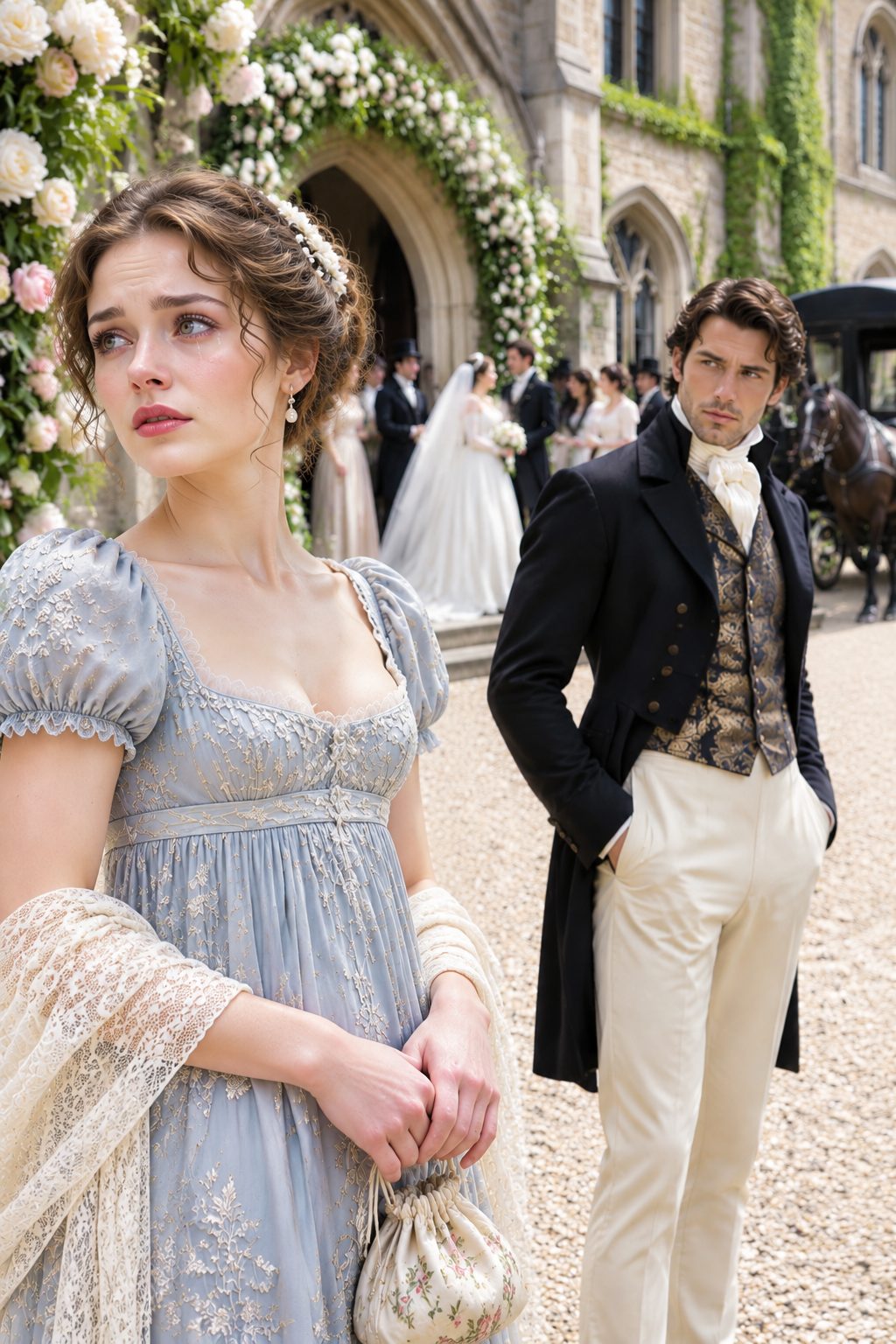
Sabrina looked toward Rosalind, perhaps expecting her to intervene.
Rosalind said nothing.
At last, Sabrina gathered her reticule and left without another word.
The duchess remained.
“You are making a dangerous mistake, Julian.”
He faced her.
“The mistake was made two years ago.”
“You have responsibilities beyond yourself.”
“I know precisely what my responsibilities are. Tomorrow, I shall ask Mr. Harcourt to examine the estate accounts and every outstanding agreement with Lord Vain.”
His mother’s face changed.
Only slightly.
But Rosalind noticed.
Julian did too.
“Is there something else I should know?”
Lady Ashmir drew herself upright.
“You have already embarrassed this family sufficiently for one evening.”
She left before he could ask another question.
When the door closed, Julian remained standing beside the desk, his mother’s unfinished warning hanging between them.
Rosalind should have felt relief.
Instead, she found herself looking at the opened letter, at the familiar shape of her own handwriting, and wondering how many decisions had been made around her without anyone considering her a person entitled to choose.
“I should retire,” she said.
Julian turned.
“May I speak with you tomorrow?”
She looked toward the dark windows.
“I cannot promise you anything.”
“I am not asking for a promise.”
“Then what are you asking?”
He hesitated.
“A chance to tell you what happened to me.”
Rosalind studied him.
For two years, she had imagined his indifference. Now she saw the exhaustion beneath his eyes, the restrained anger in his expression, and the uncertainty of a man discovering that his own home had been used against him.
“Tomorrow,” she said at last.
Then she left the library before either of them could mistake the small concession for forgiveness.
By breakfast, the atmosphere at Ashmir Court had become almost unbearably polite.
Lady Sabrina’s departure was explained as a sudden family obligation. The duchess presided over the morning meal with the same flawless manners she had displayed the previous evening, although her coffee remained untouched.
Cecilia noticed everything.
When Rosalind returned to her room after breakfast, she found her younger sister waiting beside the window.
“You have been avoiding me.”
Rosalind removed her gloves.
“I have been occupied.”
“With Julian?”
There was no accusation in Cecilia’s voice, only concern.
Rosalind sat at the dressing table.
“Did Edmund tell you something?”
“No. But Lady Sabrina left before breakfast, Julian has canceled his morning appointments, and the duchess looks as though she would rather dismiss the entire wedding party.”
Despite herself, Rosalind smiled.
Cecilia approached.
“Rosalind, what happened?”
For a moment, Rosalind considered telling her nothing. Cecilia’s wedding was only twelve days away, and she deserved to enjoy every remaining moment without inheriting another person’s unhappiness.
But Cecilia knelt beside her chair and took her hand.
“You have protected me since we were children. Please do not protect me from the truth.”
Rosalind looked at her sister’s familiar face.
Then she told her.
Not every painful detail. Not every night spent waiting.
Enough.
By the time she finished, Cecilia’s eyes were bright with tears.
“They forged his letter?”
Rosalind nodded.
“And kept yours?”
“Yes.”
Cecilia sat back on her heels.
For several moments, she said nothing.
Then she rose.
“I am going to speak to Edmund.”
“Cecilia, no.”
Her sister turned.
“Why should you be the only person expected to remain quiet?”
“Because this is your wedding.”
“And you are my sister.”
The simplicity of the answer left Rosalind without a reply.
Cecilia crossed the room and embraced her.
“I would rather marry Edmund in a village church with six witnesses than celebrate in a palace where my sister is treated as something shameful.”
Rosalind closed her eyes.
For the first time since arriving at Ashmir Court, she allowed herself to lean against someone.
That afternoon, Julian found her in the winter garden.
Sunlight spilled through the tall glass panels, illuminating the pale roses that still bloomed along the southern wall. Beyond them, the lawns stretched toward a line of ancient trees, their autumn leaves drifting across the gravel paths.
Rosalind stood beside a stone fountain, examining a cluster of late chrysanthemums.
Julian stopped several feet away.
“May I join you?”
She nodded.
He approached without attempting to take her hand.
For a while, they walked in silence.
Then Julian began.
“Two years ago, I was summoned to the northern estates because of a dispute concerning the leases. My mother insisted that the matter required my immediate attention.”
Rosalind listened.
“Before I left, I wrote to you. I asked whether I might visit your father upon my return.”
She stopped walking.
“You intended to propose?”
“Yes.”
The word was quiet and unadorned.
Rosalind looked away.
Julian continued.
“When I returned three weeks later, my mother told me your family had gone abroad. She said you had requested that I make no further inquiries.”
“And you believed her?”
“At first.”
The admission hurt more than she expected.
Julian looked down at the path.
“I wrote to your father’s house. My letter was returned unopened, accompanied by a note stating that you wished our acquaintance to end.”
Rosalind turned toward him.
“I never received it.”
“I know that now.”
“Why did you not come?”
He was silent long enough for a leaf to fall between them.
“Because I was proud. Because I believed you had rejected me. And because I thought appearing at your door after such a refusal would dishonor you.”
Rosalind looked toward the fountain.
“I thought the same of you.”
Their eyes met.
Neither smiled.
How easily two people who had loved one another could be persuaded that silence was dignity.
Julian reached inside his coat and withdrew a folded sheet of paper.
“I kept the note.”
Rosalind accepted it.
The handwriting was unfamiliar, but the message was unmistakable. It declared that Miss Rosalind Farley wished to end all communication and requested that the duke respect her decision.
Beneath the words appeared her father’s name.
She examined the signature.
Then she looked up sharply.
“My father did not sign this.”
Julian watched her.
“Are you certain?”
“He injured his right hand the winter before. For almost a year, he signed with his left. This signature has the old upward flourish he could no longer make.”
Julian took the letter back.
A new understanding passed between them.
Whoever had forged the note had relied upon an older example of her father’s handwriting.
Rosalind felt a chill despite the sunlight.
“Your mother had access to my father’s correspondence?”
“She did. They discussed Cecilia’s marriage settlement long before Edmund formally proposed.”
Rosalind stared at the paper.
The deception had required planning, patience, and more than one carefully chosen document.
Julian folded the note.
“I shall not ask you to trust me because we have discovered the truth.”
She looked at him.
“Then what will you ask?”
“That you judge me by what I do from this moment.”
Rosalind said nothing.
But when they resumed walking, she did not move farther away.
Three days later, the first financial irregularities emerged.
Mr. Harcourt, the family solicitor, arrived from London shortly after luncheon carrying a leather case and an expression that made Julian dismiss the servants from his study.
The estate accounts revealed that Lord Vain had advanced substantial sums to the late duke during the final years of his life.
Several debts had been settled.
Others had not.
More troubling was an agreement signed eighteen months earlier, after Julian had inherited the title.
The document pledged the income from three Ashmir farms as security for a private obligation to Lord Vain.
Julian stared at his signature.
“I never executed this.”
Mr. Harcourt adjusted his spectacles.
“The signature appears authentic, Your Grace, but the witnessing clause is irregular.”
“Who witnessed it?”
“Lady Ashmir and Mr. Peter Sloane, formerly employed as secretary to Lord Vain.”
Julian felt the blood leave his face.
His mother had not merely attempted to arrange his marriage.
She had used his position to obtain money without his consent.
“How much?”
Mr. Harcourt named the sum.
It was large enough to threaten the repairs urgently needed at the northern farms and to jeopardize the livelihoods of families who had lived on Ashmir land for generations.
Julian stood beside his desk, looking toward the fields visible beyond the window.
“What happens if the agreement is enforced?”
“That depends upon whether Lord Vain can establish its validity.”
“And if he cannot?”
“Then we must determine who received the funds and under what authority.”
A quiet knock interrupted them.
Edmund entered, carrying a small packet.
“I thought you should see this.”
He placed the packet on the desk.
Inside were copies of correspondence between Lady Ashmir and Lord Vain, discovered among papers delivered to Edmund for the wedding arrangements.
One letter referred to a proposed union between Julian and Sabrina.
Another mentioned that the Farley connection must be brought to a conclusion before the Vain arrangement could proceed.
The final letter contained a sentence that made Julian read it twice.
The remaining advance will be released once the duke’s matrimonial intentions have been satisfactorily redirected.
Edmund watched his cousin’s expression.
“I had no idea.”
Julian folded the papers.
“Neither did I.”
For several moments, the two men remained silent.
Then Edmund spoke.
“Rosalind must be told.”
Julian looked at him.
“I know.”
The following evening, Rosalind learned the full extent of the scheme in the same library where the first deception had been uncovered.
She listened as Julian explained the debt, the forged agreement, and his mother’s attempt to secure a marriage that would satisfy Lord Vain’s conditions.
When he finished, she remained seated beside the fire.
“So Lady Sabrina was not simply considered suitable.”
“No.”
“She was part of an arrangement intended to protect the estate.”
“An arrangement I never agreed to.”
Rosalind looked at the papers spread across the table.
“And if you refuse?”
“Then Lord Vain may attempt to enforce the debt.”
“Would you lose Ashmir Court?”
“Not immediately. But the damage could be considerable.”
She studied his face.
“And you would still refuse?”
Julian met her eyes.
“I would rather spend the next twenty years restoring these lands than purchase their security with another person’s freedom.”
Rosalind lowered her gaze.
For the first time, she began to understand that Julian’s love for his home was not simply attachment to ancestral stone and inherited prestige.
It was responsibility to the people who depended upon him.
Yet she also saw the danger gathering around him.
Lord Vain was powerful, the duchess was desperate, and the wedding celebrations had brought dozens of influential guests into a house already divided by secrets.
The next morning, those secrets began to spread.
A folded note appeared beneath Rosalind’s bedroom door.
There was no signature.
Only one sentence.
Leave Ashmir before the wedding, or your sister will suffer for your stubbornness.
Rosalind read it twice.
Then she took it directly to Julian.
He was examining invoices in his study when she entered.
She placed the note before him.
His expression hardened.
“Who delivered this?”
“I do not know.”
He rang for the housekeeper.
Within an hour, it became clear that the note had been written on paper kept in the duchess’s private sitting room.
The household grew tense.
Servants whispered in corridors. Invitations were reconsidered. The duchess began taking her meals alone.
But Rosalind refused to leave.
When Julian suggested that she might feel safer returning temporarily to her father’s house, she looked at him with quiet disbelief.
“I have spent two years allowing other people to determine where I belong.”
“That was not my intention.”
“I know. But I shall remain for Cecilia.”
Julian inclined his head.
“Then I shall see that no one troubles you.”
Rosalind looked at him carefully.
“Do not promise what you cannot control.”
He accepted the correction.
“Then I promise to listen when you tell me what you need.”
It was a smaller promise.
And for that reason, she believed it.
Four days before the wedding, Lord Vain arrived.
His carriage was black, his horses immaculate, and his manner so polished that even the servants seemed uncertain whether they were welcoming a guest or an adversary.
He requested a private meeting with Julian.
Rosalind was crossing the entrance hall when she saw him remove his gloves beneath the great chandelier.
Lord Vain was a broad-shouldered gentleman in his late fifties, with silver hair and watchful gray eyes.
He recognized her immediately.
“Miss Farley. How pleasant.”
Rosalind curtsied.
“My lord.”
“I understand you have become rather attached to Ashmir Court.”
She held his gaze.
“I am here for my sister’s wedding.”
“Of course.”
His smile widened.
“Family celebrations can sometimes inspire inconvenient loyalties.”
Rosalind did not answer.
Lord Vain moved past her toward Julian’s study, leaving behind the faint scent of expensive tobacco.
She watched him disappear.
Then she went to find Cecilia.
That afternoon, Lord Vain presented his demands.
He would suspend any attempt to enforce the disputed financial agreement if Julian announced his intention to marry Sabrina before the wedding guests departed.
In return, Lord Vain would cancel the outstanding obligation and provide further funds for the estate.
Julian listened without interrupting.
When Lord Vain finished, he pushed the papers back across the desk.
“No.”
Lord Vain regarded him.
“You have not considered the consequences.”
“I have.”
“Your tenants may suffer for your pride.”
Julian stood.
“My tenants have already been used as an excuse for conduct I cannot defend.”
Lord Vain’s expression chilled.
“Your mother understands necessity better than you do.”
“Then perhaps you should have proposed marriage to her.”
For the first time, Lord Vain lost his smile.
He rose slowly.
“You will regret speaking to me in that manner.”
Julian opened the study door.
“I regret only that this conversation was necessary.”
Lord Vain departed before dinner.
But his final threat remained.
The following morning, Mr. Harcourt received notice that Lord Vain intended to commence proceedings concerning the disputed agreement.
Julian instructed him to prepare a formal challenge, preserve the relevant documents, and contact the witnesses.
Then he did something his mother had never expected.
He invited the senior tenants of the affected farms to Ashmir Court.
Rosalind watched from an upstairs window as the men arrived, removing their hats beneath the portico and looking uneasily toward the grand entrance.
Julian received them personally.
He explained that a disputed financial arrangement might affect the estate and that he intended to contest it. He would not conceal the possibility of hardship, nor would he allow their families to discover it through rumor.
The meeting lasted nearly two hours.
When the tenants emerged, their expressions remained serious, but several stopped to shake Julian’s hand.
Rosalind met him afterward in the courtyard.
“You told them everything?”
“Everything I was entitled to tell them.”
“Was that difficult?”
“More difficult than threatening Lord Vain.”
She smiled faintly.
Julian looked at her.
“I have spent most of my life being taught that authority means never admitting uncertainty.”
“And what do you believe now?”
“That people cannot place their trust in a man who values his appearance more than their welfare.”
Rosalind considered his answer.
Then, almost without thinking, she placed her hand upon his sleeve.
It was the first voluntary touch between them since their separation.
Julian looked down at her hand but did not cover it with his own.
The restraint moved her more than any declaration could have done.
On the eve of the wedding, the duchess requested an audience with Rosalind.
The invitation arrived through the housekeeper shortly before sunset.
Rosalind considered refusing.
Then she put aside her embroidery and went.
Lady Ashmir received her in a sitting room overlooking the western gardens. The curtains had been drawn against the falling light, and a silver tea service stood untouched between two upholstered chairs.
The duchess appeared older than she had a fortnight earlier.
She gestured toward the opposite chair.
“Thank you for coming.”
Rosalind sat.
For a long moment, neither spoke.
Then Lady Ashmir removed a small key from a chain around her neck and placed it on the table.
“This opens a cabinet in my private study. Inside are the original financial papers, including correspondence Lord Vain believed I had destroyed.”
Rosalind looked at the key.
“Why are you giving it to me?”
“Because Julian will not accept anything from my hands.”
“You could give it to Mr. Harcourt.”
“I intend to. But there is something I must say to you first.”
The duchess folded her hands.
“When my husband died, I discovered that he had concealed the true condition of the estate for years. I was frightened. Not merely of losing this house, but of admitting that everything I had spent my life preserving could disappear.”
Rosalind listened without softening.
“Lord Vain offered assistance. At first, I believed the arrangement reasonable. His daughter was accomplished, wealthy, and suitable in every respect.”
“Except that Julian did not love her.”
The duchess lowered her eyes.
“I believed affection could be acquired.”
“And mine could be discarded.”
A shadow crossed the older woman’s face.
“Yes.”
The admission was almost inaudible.
Rosalind sat very still.
Lady Ashmir continued.
“I had the letter written. I intercepted your correspondence. When Julian asked questions, I allowed him to believe you had rejected him.”
“And you watched him grieve?”
The duchess looked toward the darkening window.
“He did not speak of it.”
“Neither did I.”
The words settled between them.
At last, the duchess turned back.
“I have no right to ask your forgiveness.”
“No,” Rosalind replied. “You do not.”
The older woman’s eyes glistened.
Rosalind stood.
“But you may still choose to tell the truth.”
She took the key and left.
That night, Julian and Mr. Harcourt opened the cabinet.
Inside were ledgers, receipts, drafts of agreements, and letters bearing Lord Vain’s signature. Together they showed that the alleged obligation had been concealed from Julian and that payments had been directed through accounts controlled by his mother.
Among the documents was an earlier memorandum revealing that Lord Vain knew Julian had never authorized the security agreement.
It did not erase the debt incurred during the late duke’s lifetime.
But it exposed the later transaction as something far different from the straightforward financial claim Lord Vain had presented.
Mr. Harcourt examined the papers carefully.
“This will strengthen our position considerably.”
Julian leaned against the desk.
“Enough to stop him?”
“Enough to contest his demands on substantial grounds. The rest will require proper proceedings.”
Rosalind, standing near the doorway, watched Julian absorb the answer.
There would be no miraculous rescue before morning.
No sudden restoration of every lost pound.
Only evidence, uncertainty, and the work necessary to repair what others had damaged.
Julian looked toward her.
“Thank you.”
She shook her head.
“Your mother chose to give me the key. I merely brought it to you.”
“You could have refused.”
Rosalind considered that.
“So could you,” she said. “Two years ago, we both believed silence was the honorable choice.”
Julian approached, stopping close enough that she could see the exhaustion around his eyes.
“I shall never make that mistake again.”
Rosalind did not answer immediately.
Then she offered him her hand.
He took it gently.
Neither spoke of marriage.
Neither demanded an assurance.
For that evening, the simple act of standing together was enough.
The morning of Cecilia’s wedding arrived bright and cold.
Sunlight poured across the eastern lawns, catching on the frost that silvered the hedges. Church bells sounded from the village beyond the estate, and Ashmir Court awoke in a rush of footsteps, flowers, and whispered instructions.
Rosalind helped Cecilia fasten the final pearl buttons of her wedding gown.
Her sister turned toward the mirror.
“Am I trembling?”
“Only slightly.”
“I am terrified.”
Rosalind smiled.
“Of Edmund?”
“Of being so happy.”
Rosalind met her sister’s eyes in the reflection.
“Then be happy while the moment is yours.”
Cecilia turned and embraced her.
“You deserve the same.”
Rosalind held her close.
For once, she did not make a clever answer.
The wedding took place in the village church, beneath arches decorated with white roses and winter greenery.
Edmund waited at the altar, his expression changing when Cecilia appeared on her father’s arm.
Julian stood beside him.
When Rosalind entered, Julian looked toward her.
There was no attempt to conceal his affection.
But he did not approach.
He simply inclined his head, giving her the freedom to decide what the gesture meant.
During the ceremony, Rosalind watched Edmund take Cecilia’s hand.
The vows were spoken without hesitation.
For better or worse.
For richer or poorer.
Words that could sound ceremonial until life demanded they be honored.
When the newly married couple emerged into the sunlight, the churchyard filled with laughter and congratulations.
Rosalind stood near the stone wall, watching Cecilia’s veil lift in the breeze.
Then she noticed a familiar figure waiting beyond the gate.
Lord Vain.
He had not attended the ceremony.
He stood beside his carriage, speaking quietly with a gentleman carrying a leather document case.
Julian saw him moments later.
Their eyes met across the churchyard.
Lord Vain lifted his hat in a gesture that contained no warmth.
Julian excused himself from the gathering and approached.
Rosalind followed at a distance.
The gentleman beside Lord Vain presented a folded notice.
Mr. Harcourt, who had accompanied the wedding party, stepped forward to examine it.
His expression remained unreadable.
Lord Vain smiled.
“I trust this will encourage a more reasonable discussion.”
Julian glanced at the paper.
“You have chosen an extraordinary occasion.”
“Business does not observe sentimental calendars.”
Rosalind stepped beside Julian.
“Nor, apparently, does courtesy.”
Lord Vain turned toward her.
“Miss Farley. Still involved in matters beyond your understanding?”
Julian moved slightly, but Rosalind raised one hand.
She looked directly at Lord Vain.
“I understand that you offered financial assistance in exchange for a marriage the duke did not consent to. I understand that documents were executed without his authority. And I understand that you have chosen my sister’s wedding day to deliver a threat.”
Lord Vain’s smile vanished.
“Be careful what you accuse me of.”
“I am being careful. That is why I have accused you of nothing you cannot answer before the proper authorities.”
Mr. Harcourt folded the notice.
“And we shall respond through the appropriate legal channels, my lord.”
For several seconds, Lord Vain examined their faces.
Then he replaced his hat.
“You are all making a very expensive mistake.”
He entered his carriage.
The horses moved away, their hooves striking the frozen road.
Julian watched until the carriage disappeared.
Then he turned to Rosalind.
“You did not have to involve yourself.”
She looked toward the church, where Cecilia and Edmund were laughing beneath a shower of flower petals.
“I am beginning to think that the things worth protecting are rarely convenient.”
Julian smiled.
It was the first unguarded smile she had seen from him since her arrival.
The wedding breakfast passed without further disturbance.
The guests filled the great dining hall with conversation and music, while Cecilia and Edmund moved among them looking almost astonished by their own happiness.
Lady Ashmir appeared briefly, offered her congratulations, and withdrew.
Rosalind watched her leave.
There would be consequences for what the duchess had done, and some wounds would require far more than an admission to heal.
But the older woman had finally chosen to surrender the papers rather than destroy them.
It was not redemption.
It was a beginning.
Late that evening, after the final guests had departed and the newlyweds had retired, Rosalind returned to the winter garden.
The glass panes reflected the pale moon, and the fountain murmured softly beneath the surrounding roses.
Julian found her there.
“I thought you might be here.”
She turned.
“You remembered.”
“I remember a great many things.”
He approached carrying a small velvet case.
Rosalind’s expression changed.
Julian noticed and stopped.
“It is not what you think.”
He opened the case.
Inside lay a delicate silver locket.
Rosalind recognized it immediately.
She had lost it during her last visit to Ashmir Court, shortly before their separation.
Inside were miniature portraits of her parents.
“I believed it was gone,” she whispered.
“I found it beneath the library window seat after you left.”
“You kept it?”
“I intended to return it.”
She looked up.
“Why didn’t you?”
Julian’s expression softened.
“Because every time I prepared to send it, I could not bear the thought of receiving another letter saying you wished me gone.”
Rosalind took the locket.
For several moments, she examined the familiar silver clasp.
Then she looked at the man before her.
“I loved you very much, Julian.”
He stood still.
“I know.”
“No. I do not think you do.”
Her voice remained steady, although her fingers tightened around the locket.
“When your letter arrived, I thought there must have been something in me that you had finally seen clearly. Something insufficient. I spent months searching every conversation for the moment I might have disappointed you.”
Julian’s face tightened.
“Rosalind—”
“Please let me finish.”
He fell silent.
“I learned to be composed because I did not know what else to do. Everyone praised my dignity. They said I had borne the disappointment admirably.”
She glanced toward the moonlit windows.
“But dignity is a poor comfort when it becomes another name for suffering alone.”
Julian took a slow breath.
“I am sorry I did not come to you.”
She nodded.
“I know.”
“I should have questioned what I was told.”
“Yes.”
He accepted the answer without defending himself.
Rosalind closed the locket.
“I cannot return to the person I was before that letter.”
“I would not ask you to.”
“And I cannot promise that loving you again will be simple.”
Julian looked at her.
“Then let it be difficult.”
She smiled faintly through the tears gathering in her eyes.
“That is a peculiar declaration.”
“I have never been particularly gifted at declarations.”
“You were once.”
“I was younger then. And considerably more certain of myself.”
Rosalind laughed softly.
The sound seemed to surprise them both.
Julian reached for her hand, giving her time to refuse.
She did not.
“I love you,” he said. “I loved you when I believed you had rejected me, and I love you now that I know how terribly we were deceived.”
Rosalind looked down at their joined hands.
Outside, wind moved through the bare branches.
“I still love you,” she whispered.
Julian closed his eyes briefly.
Then he lifted her hand and kissed her fingers.
He did not ask for marriage that night.
Instead, he asked whether he might court her again, openly and without anyone else deciding what their future should be.
Rosalind considered him for a moment.
“Properly this time?”
“With your permission.”
“And no mysterious correspondence?”
“Every letter delivered by my own hand, if necessary.”
She smiled.
“Then you may begin tomorrow.”
Spring arrived slowly at Ashmir Court.
The winter rains softened the fields, and new leaves appeared along the avenues leading toward the house.
The legal dispute with Lord Vain continued for several months.
Mr. Harcourt used the recovered correspondence and financial records to challenge the disputed agreement. Faced with evidence concerning the unauthorized signatures and the conditions attached to the advances, Lord Vain eventually withdrew his claim under that document.
The legitimate debts remaining from the late duke’s administration still required settlement.
Julian sold several unused properties, reduced household expenses, and introduced a careful program of improvements to the farms.
It was not the easy restoration his mother had once imagined.
But the estate survived without a marriage purchased through deception.
Lady Ashmir withdrew from the management of Ashmir Court and took up residence at a smaller family property near Bath.
Before leaving, she requested one final conversation with her son.
No one knew precisely what passed between them.
When Julian returned, he was quiet for the remainder of the afternoon.
Rosalind did not question him.
Later, he told her that his mother had admitted how deeply fear had governed her decisions.
“She says she believed she was saving the family,” he said.
Rosalind looked toward the garden.
“Perhaps she did believe it.”
“Does that make it easier to forgive?”
“No. But it may help you understand.”
Julian sat beside her.
“Have you forgiven her?”
Rosalind considered the question.
“I no longer wish to carry what she did into every day of my life. That is as far as I have come.”
He nodded.
Neither demanded more.
Throughout the following months, Julian courted Rosalind with a patience that gradually transformed the familiar rooms of Ashmir Court.
They walked through the gardens. They visited the tenant families. They read together in the library, sometimes exchanging only a few words over the course of an entire afternoon.
He learned when she wanted to speak and when she preferred silence.
She learned that he was capable of admitting mistakes without disguising them as noble intentions.
They disagreed occasionally.
Once, over the proposed reconstruction of a tenant cottage, Rosalind challenged his plan to postpone necessary repairs until autumn.
Julian explained the financial constraints.
She listened, then suggested a less expensive method of improving the roof before the summer storms.
He considered the proposal.
The following day, the work began.
When Rosalind thanked him, he looked genuinely puzzled.
“You were right.”
“That has not always persuaded gentlemen before.”
“Then you have known unfortunate gentlemen.”
She laughed.
And the laughter remained with him long after she had left the room.
By early summer, Cecilia wrote from her new home with Edmund, announcing that she had never been happier and insisting that Rosalind visit before the roses faded.
Rosalind was reading the letter in the library when Julian entered.
He carried no flowers.
No extravagant gift.
Only a small envelope.
“I have something for you.”
Rosalind looked up with amusement.
“Another letter?”
“One I wrote myself.”
She accepted it.
Inside was a single sheet of paper.
The handwriting was unmistakably his.
My dearest Rosalind,
I once believed love was proved by grand promises and unwavering certainty. I now know that it is proved in smaller things: by listening when words are difficult, by remaining when circumstances are uncertain, and by trusting another person enough to tell them the truth.
I cannot return the years we lost.
But I would be honored to spend the years ahead ensuring that neither of us must face life’s difficulties alone.
If you will consent, I should like to ask you a question in person.
Rosalind lowered the letter.
Julian was standing beside her chair.
He looked more nervous than she had ever seen him.
She rose slowly.
“Well?” she asked.
He took her hand.
“Rosalind Farley, will you marry me?”
She studied his face.
There were faint lines beside his eyes that had not been there two years earlier. His expression held none of the confident certainty of the young duke she had once adored.
Instead, he waited.
Not as a man demanding an answer, but as someone who understood that love could only be offered freely.
Rosalind smiled.
“Yes, Julian.”
His breath escaped in a quiet laugh.
“Yes?”
“Must I repeat myself?”
“Possibly.”
She stepped closer.
“Yes. I will marry you.”
He drew her gently into his arms.
For a long moment, neither moved.
Beyond the windows, the gardens shone in the afternoon sunlight, and somewhere in the courtyard a servant called to another across the gravel.
Life continued around them.
Ordinary, imperfect, and wonderfully real.
Their wedding took place that autumn in the same village church where Cecilia had married Edmund.
There were no extravagant displays and no elaborate attempts to impress society.
Rosalind wore an ivory gown trimmed with delicate lace, and her mother’s silver locket rested against her heart.
Cecilia stood beside her, smiling through tears.
Julian waited at the altar.
When Rosalind reached him, he offered his hand.
She placed hers in it without hesitation.
The vows were spoken clearly.
This time, nothing stood between their words and their intentions.
After the ceremony, as the guests gathered outside beneath a sky bright with autumn sunlight, Rosalind noticed Lady Ashmir standing near the church gate.
She had attended quietly and remained apart from the celebrations.
For a moment, their eyes met.
The duchess inclined her head.
Rosalind returned the gesture.
It was not a declaration of complete forgiveness, nor a pretense that the past had disappeared.
It was an acknowledgment that the future need not remain imprisoned by it.
Julian approached and offered Rosalind his arm.
“Are you ready?”
She looked once more toward the church, the assembled guests, and the familiar road leading back to Ashmir Court.
Then she turned to him.
“Yes.”
Years later, Rosalind would sometimes find the forged farewell letter among the papers Julian had preserved from the legal dispute.
He had once asked whether she wished it destroyed.
She had considered the question carefully.
Then she had shaken her head.
“Keep it.”
Julian had looked surprised.
“Why?”
“Because I never want us to forget how easily silence can be mistaken for truth.”
They kept it in a sealed box, not as a monument to suffering, but as a reminder.
Their marriage was not without disagreement.
There were difficult seasons, financial worries, and days when exhaustion made tenderness harder to find.
But they learned to ask questions rather than assume answers, to speak when pride urged them toward silence, and to remember that trust was not a feeling that existed without effort.
Sometimes, on quiet evenings, they returned to the library where their lives had begun to change.
Julian would read beside the fire while Rosalind sat near the window, writing letters to Cecilia or watching the sunset settle over the gardens.
And whenever one of them had something difficult to say, the other would put aside whatever occupied their hands and listen.
Because the greatest cruelty they had endured had not been the forged letter itself.
It had been the belief that love could survive without honesty, that pride could replace courage, and that silence was somehow kinder than a painful truth.
They had lost two years to those mistakes.
But they refused to lose the rest of their lives.
And in the end, Rosalind discovered something far more valuable than the romantic certainty she had possessed as a young woman.
She discovered a love that did not demand her silence, diminish her dignity, or ask her to become smaller for the comfort of others.
A love freely chosen.
A love willing to be questioned.
A love strong enough to tell the truth.
And when Julian reached across the library table one autumn evening, taking her hand as naturally as though it had always belonged in his, Rosalind understood that happiness was not the absence of sorrow.
It was finding someone who would face the sorrow beside you, without turning away.
THE END.