The Duke of Ashford had refused every eligible lady in London.
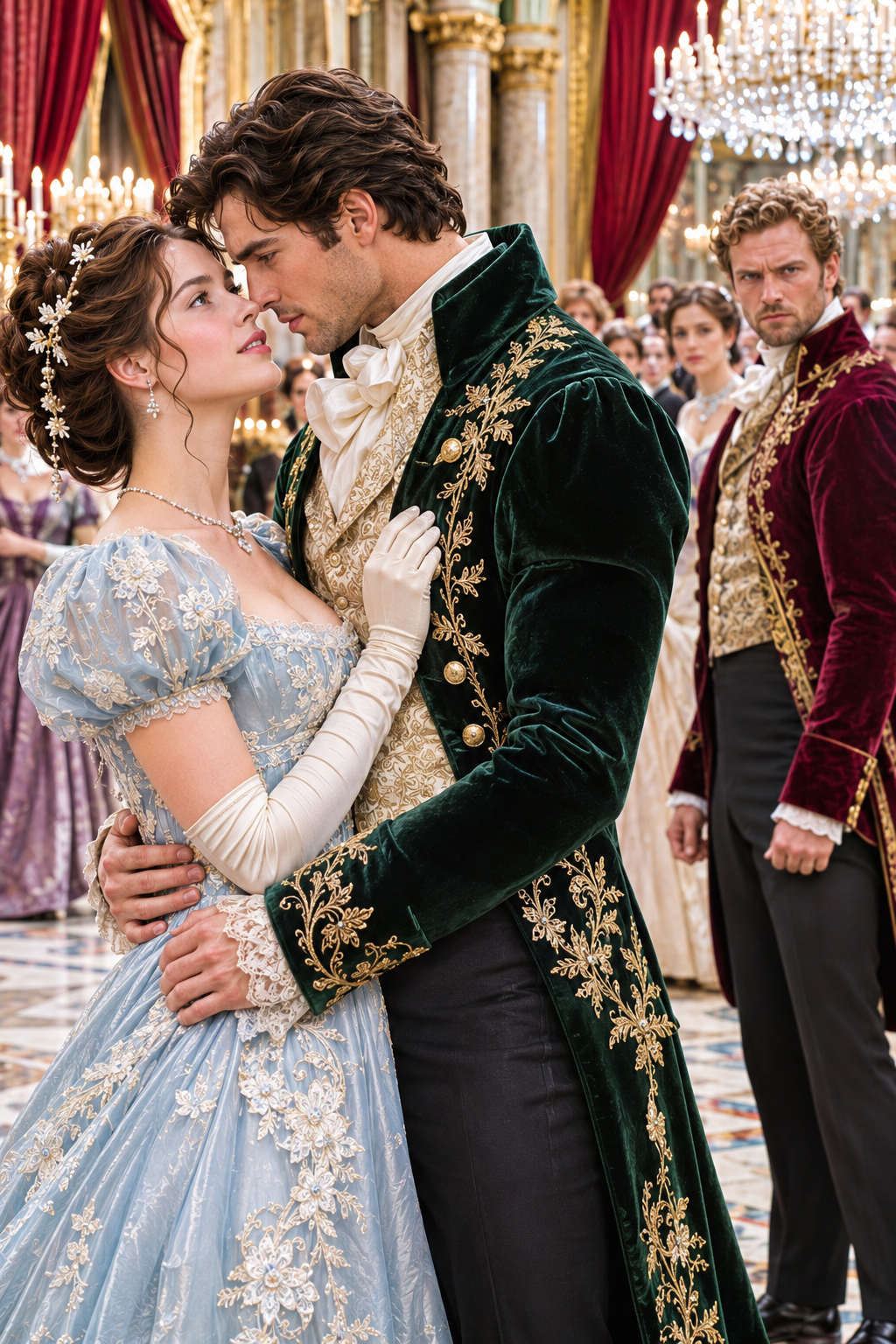
Charlotte stared at Julian, her fingers growing cold beneath his hand. Around them, the ballroom continued its glittering performance of music, laughter, and whispered speculation, but the words he had just spoken seemed to have silenced everything else.
“My father’s debts?” she repeated. “What do you know about my father’s debts?”
Julian glanced toward the departing Whitmores. Lord Whitmore had stopped near the entrance to exchange a few words with a gentleman in a dark waistcoat. Lady Arabella stood beside him, watching Charlotte over the edge of her ivory fan.
“Not here,” Julian said quietly.
Charlotte withdrew her hand.
“You have asked me to trust you in front of half of London, Your Grace. I think I am entitled to an answer.”
Something shifted in his expression. He looked less like the unapproachable Duke of Ashford and more like a man who had discovered, too late, that a carefully considered decision had consequences he could not control.
“Your father borrowed money against the income of his living three years ago,” he said. “The original lender sold the obligation to another creditor.”
“Lord Whitmore?”
Julian nodded.
Charlotte remembered her father’s increasingly frequent headaches, the unopened letters beside his breakfast plate, and the winter evening when he had insisted they sell her mother’s silver candlesticks. He had called it an unnecessary luxury.
She had believed him.
“How much?” she asked.
“Eight hundred pounds originally. Whitmore now claims nearly twice that amount.”
Her lips parted.
It was more money than her father could have saved in a lifetime.
“And you knew?”
“I learned of it last Thursday.”
“Before you approached me tonight?”
“Yes.”
The answer struck harder than she expected.
Charlotte looked down at the Duke’s immaculate gloves. Only minutes earlier, those hands had offered her protection from a man who believed poverty entitled him to obedience. Now she wondered whether Julian had simply chosen a more elegant method of exercising the same power.
“Was our arrangement your idea,” she asked, “or Lord Whitmore’s?”
Julian’s face tightened.
“Mine.”
“Then why did you not tell me?”
“Because I wanted to establish the facts before frightening you.”
Charlotte gave a small, disbelieving laugh.
“You wished to spare me the truth while asking me to participate in a deception.”
“Charlotte—”
“Please do not use my Christian name.”
He fell silent.
The orchestra began another dance. Couples moved past them in sweeping circles of silk and black wool, their reflections trembling across the polished floor.
Charlotte stepped back.
“I believe I should return to my hostess.”
Julian did not attempt to stop her.
“Will you allow me to call upon your father tomorrow?”
“You may do as you please, Your Grace. I am beginning to understand that gentlemen of your position generally do.”
She turned before he could answer.
For the first time that evening, Julian Ashford stood alone while the entire ballroom pretended not to notice.
By morning, London had already decided that Miss Charlotte Vance was either the most fortunate young woman in England or the most calculating.
The gossip reached her before breakfast.
Mrs. Bellamy, the distant cousin with whom Charlotte was staying, entered the dining room carrying three calling cards and an expression of considerable alarm.
“My dear, the Duchess of Pembroke has invited you to tea.”
Charlotte looked up from the letter she had been attempting to write to her father.
“How extraordinary.”
“And Lady Fenwick wishes you to attend her musicale. Lady Pembroke’s sister has requested an introduction.”
Mrs. Bellamy lowered herself into a chair.
“Charlotte, what precisely happened last night?”
Charlotte folded her letter.
“I danced with a gentleman.”
“That gentleman owns four estates and has refused proposals from families who could purchase half of London.”
“Then I fear he has made a very poor investment in my company.”
Mrs. Bellamy did not smile.
Before she could reply, the housekeeper appeared with another card.
The Duke of Ashford was waiting downstairs.
Charlotte stared at the embossed name.
“Tell His Grace I am unavailable.”
The housekeeper hesitated.
“He anticipated that possibility, miss. He asked me to give you this.”
She placed a sealed envelope beside Charlotte’s untouched toast.
Inside was a single sheet.
Your father is safe. I have arranged for no action to be taken against him until the debt is properly examined. I owe you an explanation, not an obligation. If you permit me ten minutes, I shall give you the former without asking for the latter.
Charlotte read it twice.
Then she stood.
“Ten minutes,” she told the housekeeper.
Julian was waiting in Mrs. Bellamy’s modest drawing room, where the furniture had been polished so frequently that the wood had acquired a permanent shine. He looked almost uncomfortable beneath the low ceiling.
He rose when Charlotte entered.
“Miss Vance.”
“Your Grace.”
She remained standing.
He glanced toward the open doorway, where Mrs. Bellamy had discreetly positioned herself with a book.
“I shall be brief.”
“That would be appreciated.”
Julian removed a folded document from his coat.
“Whitmore’s claim is irregular. Your father borrowed eight hundred pounds from a private lender after the parish school roof collapsed. The lender subsequently died, and the debt passed through several hands before Whitmore acquired it.”
Charlotte frowned.
“The school roof?”
“Your father paid for its reconstruction when the parish funds proved insufficient.”
She remembered that winter. Her father had spent weeks visiting families whose children were being taught in cold, damp cottages.
He had never mentioned borrowing money.
“Whitmore is claiming compound interest that does not appear in the original agreement,” Julian continued. “He has also added charges for delays your father disputes.”
“Why would Lord Whitmore concern himself with a village clergyman?”
“Because the living is in the gift of a family trust whose affairs Whitmore has been attempting to influence.”
Charlotte studied him.
“Your family trust?”
“My mother’s.”
The room seemed to contract.
Julian placed the document on a small table.
“My late father appointed Whitmore one of the trustees overseeing certain properties and charitable obligations. I inherited the title, but several arrangements remained under joint administration until my thirtieth birthday.”
“And you turned thirty?”
“Last month.”
Charlotte understood.
“Lord Whitmore is losing control.”
“Yes.”
“And he believes a marriage between you and his daughter would restore it.”
Julian looked at her steadily.
“Among other things.”
She moved toward the window.
Outside, a delivery boy was struggling to control a cart horse on the narrow street. The ordinary sight made the conversation feel more unsettling.
“Why my father?”
“That is what I intend to discover.”
Charlotte turned.
“Then I shall help you.”
Julian blinked.
“I beg your pardon?”
“My father is the person being threatened. I know his habits, his handwriting, and the parish accounts. You have influence, Your Grace, but you do not know everything.”
For a moment, Julian seemed inclined to argue.
Then he looked at the stubborn set of her chin.
“No,” he admitted. “I certainly do not.”
Their investigation began that afternoon.
Julian’s solicitor, Mr. Pritchard, arrived with a leather case containing copies of the disputed documents. Mrs. Bellamy insisted upon remaining in the room, though she eventually became so absorbed in the evidence that she forgot to maintain her appearance of disinterest.
Charlotte recognized her father’s signature immediately.
But beneath it was another mark.
A small cross, written in faded brown ink.
“My father never uses that mark,” she said.
Pritchard adjusted his spectacles.
“It appears beside several amendments.”
“Then someone added them.”
“Possibly.”
Charlotte leaned closer.
“The ink is different.”
Julian moved beside her.
Their shoulders nearly touched.
She became suddenly aware of the clean scent of his coat and the warmth of his presence, details she found deeply inconvenient.
Pritchard examined the page.
“The amendments may have been entered after the original agreement was signed.”
“Can you prove it?” Julian asked.
“Not without the original.”
“And Whitmore possesses it.”
“Precisely.”
Charlotte studied the document again.
One amendment referred to a payment supposedly missed in October, three years earlier.
She frowned.
“That cannot be correct.”
Both gentlemen looked at her.
“My father was ill that October. I managed his correspondence and household accounts. He paid the quarterly interest on the fifteenth. I remember because I carried the receipt home through the rain and ruined my shoes.”
Pritchard leaned forward.
“Do you still have the receipt?”
Charlotte closed her eyes, searching her memory.
“My father keeps every financial paper in a blue ledger.”
Julian’s expression sharpened.
“Then we must obtain it.”
Charlotte shook her head.
“Not by sending another gentleman to frighten him. I shall write to him myself.”
The letter went out that evening.
Three days later, her father arrived in London.
Reverend Thomas Vance looked older than Charlotte remembered. His coat had been carefully brushed, but the cuffs were frayed, and he held his hat with the nervous determination of a man entering a place where he feared he did not belong.
Charlotte met him in Mrs. Bellamy’s hallway.
“Papa.”
He opened his arms.
For a moment, she was a little girl again, safe against the familiar smell of wool, soap, and the lavender her father kept among his books.
Then she drew back.
“Why did you not tell me?”
His smile faded.
“I hoped to settle the matter before you learned of it.”
“You sold Mama’s candlesticks.”
He looked down.
“Yes.”
“And your watch?”
“That too.”
Charlotte pressed her lips together.
“Papa, you should have trusted me.”
Thomas touched her cheek.
“I wanted you to have a future unburdened by my mistakes.”
Before she could answer, Julian entered the hallway.
The Reverend straightened immediately.
“Your Grace.”
Julian bowed.
“Mr. Vance. Thank you for coming.”
Charlotte watched the exchange carefully.
There was no condescension in Julian’s manner. He took her father’s worn coat himself when the housekeeper was occupied, then guided him into the drawing room with the courtesy he might have shown an archbishop.
It unsettled her more than any extravagant compliment could have done.
The blue ledger revealed everything Charlotte had suspected.
Every interest payment was recorded. Several entries were accompanied by receipts. One was signed by a clerk who had since left Whitmore’s employment.
But there was another discovery.
Tucked between the pages was a letter from Julian’s mother, written six years earlier.
Charlotte unfolded it carefully.
The late Duchess had thanked Reverend Vance for helping establish a small school for children whose parents worked on the Ashford estate. She had promised continued support through a charitable fund.
At the bottom, in elegant handwriting, she had added a personal note.
My son believes kindness must always be accompanied by grand gestures. I hope he may one day understand that the quietest acts often matter most.
Julian read the words without speaking.
His mother had died the following spring.
Charlotte watched his face change.
He touched the edge of the paper with one finger.
“She wrote this shortly before she became ill.”
Thomas nodded.
“Her Grace visited the school twice. She was very fond of the children.”
Julian folded the letter with extraordinary care.
“Whitmore was responsible for administering that fund.”
Pritchard, seated nearby, looked up sharply.
“Your Grace, we should examine those accounts.”
The investigation changed direction.
Within a week, Pritchard discovered that money intended for the parish school had been transferred repeatedly between accounts controlled by Whitmore’s associates. The records were incomplete, but the pattern was troubling.
The disputed loan appeared to have been used to conceal the missing funds.
Thomas had borrowed money only after the promised charitable payment failed to arrive. Whitmore later acquired the debt and used it to pressure him into signing a statement that the school had received its full allocation.
Thomas had refused.
That refusal had made him dangerous.
When Julian learned the truth, he stood beside the library fireplace at Ashford House for several minutes without moving.
Charlotte had come with her father and Mrs. Bellamy to review the evidence.
She watched the Duke stare at his mother’s portrait above the mantel.
“I should have examined the accounts years ago,” he said.
“You trusted the trustees appointed by your father,” Charlotte replied.
“I trusted that the institutions bearing my family’s name were being properly managed.”
She approached him.
“Trusting someone is not a crime, Julian.”
He turned at the sound of his name.
Charlotte realized what she had said.
A faint warmth rose into her cheeks.
“I beg your pardon.”
“Please don’t.”
His voice was quiet.
For a moment, neither moved.
Then the library door opened.
Pritchard entered carrying a note.
“Your Grace, Lord Whitmore has requested a private meeting tomorrow.”
Julian took the paper.
His expression hardened.
“He has also invited Miss Vance.”
Charlotte stepped forward.
“Then I shall attend.”
“No.”
She raised an eyebrow.
Julian exhaled.
“I mean that I would prefer you did not.”
“That is a more agreeable way of expressing yourself.”
Despite everything, he smiled.
The meeting took place at Whitmore House beneath a painted ceiling crowded with mythological figures.
Lady Arabella was present, seated beside a window in a pale blue gown. Her father stood near a writing desk, holding a glass of brandy despite the early hour.
Charlotte arrived with Julian and Pritchard.
Lord Whitmore barely acknowledged her.
“You have been asking questions, Ashford.”
“Questions that should have been answered years ago.”
Whitmore set down his glass.
“You are allowing yourself to be influenced by a young woman whose family has every reason to resent mine.”
Charlotte remained still.
Julian did not.
“Miss Vance has provided evidence. That is rather different.”
Whitmore opened a drawer and removed a packet of letters.
“Evidence can be interpreted in many ways.”
He placed the packet on the desk.
“Your father’s correspondence. Private arrangements. Financial decisions that might prove embarrassing if made public.”
Julian glanced at the papers.
“Are you threatening me?”
“I am reminding you that great families survive by exercising discretion.”
Arabella looked toward Charlotte.
There was no triumph in her expression now.
Only fatigue.
Whitmore continued.
“The understanding concerning my daughter can still be honored. Your mother’s trust remains protected. The unfortunate business involving the Reverend disappears.”
Charlotte felt Julian become very still beside her.
“And if I refuse?” he asked.
Whitmore’s smile returned.
“Then the Reverend may discover that poverty is not the most uncomfortable consequence of opposing powerful men.”
Charlotte stepped forward before Julian could answer.
“Did you threaten my father because he refused to sign a false statement?”
Whitmore looked at her as though she were an insect that had landed on his sleeve.
“Young lady, you would be wise to remain silent.”
“Did you?”
“Charlotte,” Julian said softly.
But she did not retreat.
Whitmore’s face darkened.
“Your father was offered a perfectly reasonable solution. He chose to be obstinate.”
The room fell silent.
Pritchard quietly opened his notebook.
Whitmore noticed too late.
“You have no right—”
“I have every right to record a statement made in my presence,” Pritchard replied.
Whitmore seized the packet of letters.
“You will regret this.”
Then Arabella rose.
“No, Father.”
Her voice was so quiet that everyone turned.
Whitmore stared at her.
“Sit down.”
She remained standing.
“I will not.”
For the first time, Charlotte saw the young woman without the protection of her practiced smile.
Arabella’s hands trembled, but she kept them at her sides.
“You told me the Duke had promised to marry me.”
Whitmore’s expression changed.
“Arabella, this is not the time.”
“You told me his mother had wished it.”
Julian looked at her.
“My mother never made such a request.”
Arabella swallowed.
“I know.”
She crossed to a small writing cabinet and withdrew a narrow envelope.
“I found these in Father’s correspondence last week.”
Whitmore moved toward her.
“Give those to me.”
Julian stepped between them.
Arabella handed the envelope to Pritchard.
Inside were copies of transfer instructions, account summaries, and a letter directing a clerk to alter the parish school’s financial records.
The letter bore Whitmore’s signature.
Pritchard examined it carefully.
“This will require verification, but it provides a very useful starting point.”
Whitmore’s face had turned gray.
“You foolish girl.”
Arabella flinched.
Charlotte moved beside her.
“No,” Charlotte said. “She has done something brave.”
Arabella looked at her with startled eyes.
For a moment, the two women stood together while the men who had attempted to arrange their futures confronted the consequences of their own decisions.
The meeting ended without reconciliation.
But the danger had not passed.
Three evenings later, a note arrived at Mrs. Bellamy’s house.
It was written in Charlotte’s father’s hand.
My dear Charlotte, I must speak with you urgently. Come to St. Martin’s churchyard at seven. Do not bring the Duke.
Charlotte read it twice.
Something was wrong.
Her father had never addressed her as my dear Charlotte in a note. Since childhood, he had called her Lottie.
She carried the letter directly to Julian.
He examined it beneath the library lamp.
“Your father is at Ashford’s country estate,” he said. “He arrived there this afternoon with Pritchard.”
“Then someone wants me at the churchyard.”
Julian rang for his carriage.
“We shall discover who.”
Charlotte caught his sleeve.
“Together.”
He looked at her.
Then nodded.
“Together.”
They reached St. Martin’s shortly before seven.
Rain had begun to fall, turning the narrow streets silver beneath the lamps. Julian instructed his coachman to remain nearby while Charlotte entered the churchyard through the iron gate.
He followed at a discreet distance.
A figure stood beneath the stone archway.
Edmund Harcourt.
Charlotte stopped.
“Mr. Harcourt.”
He emerged from the shadows, his coat damp at the shoulders.
“I was beginning to think you would disappoint me again.”
“Where is my father?”
“Quite safe, I imagine.”
He smiled.
“Unlike you, if you continue making difficulties.”
Charlotte’s fingers tightened around the folded note.
“You wrote this.”
“With assistance.”
“What do you want?”
“A signed statement. You will declare that the Duke encouraged your father to fabricate accusations against Lord Whitmore.”
Charlotte stared at him.
“And if I refuse?”
Harcourt’s expression hardened.
“Then certain letters concerning your conduct with His Grace will be delivered to every respectable household in London.”
“What letters?”
“Invented ones, naturally. But society rarely troubles itself with such distinctions.”
Charlotte heard a faint movement behind the archway.
She forced herself not to look.
“You expect me to ruin an innocent man because you threaten to ruin me?”
“I expect you to behave sensibly.”
He produced a document.
“Sign.”
Charlotte accepted the paper.
Her eyes moved across the carefully prepared accusations.
Then she tore it in half.
Harcourt lunged forward.
Before he could seize her arm, Julian stepped from the shadows.
“That will be quite enough.”
Harcourt froze.
Behind the Duke appeared Pritchard and two constables who had been waiting near the church entrance.
For a moment, only the rain could be heard.
Harcourt looked toward the gate.
Julian moved aside.
“Mr. Harcourt, I suggest you remain where you are.”
The constables approached.
Harcourt’s face twisted.
“You think this ends with me? Whitmore has friends who will destroy you.”
Julian regarded him steadily.
“Then they would be wise to reconsider their friendships.”
Harcourt was taken away.
Charlotte stood beneath the archway, rain dripping from the brim of her bonnet.
Julian approached slowly.
“Are you hurt?”
She shook her head.
He looked at the torn document lying on the wet stones.
“You might have waited until we intervened.”
“I was rather enjoying tearing it.”
A surprised laugh escaped him.
Then he reached for her hand.
Charlotte let him take it.
Neither spoke as the carriage carried them back through the rain.
But something between them had altered.
Their arrangement had begun as a convenient fiction. Now Charlotte knew the exact pressure of his fingers when he was worried, the way he listened before answering, and how his expression softened whenever her father spoke about the parish children.
Julian, meanwhile, had discovered that Charlotte disliked excessive compliments, preferred books with worn pages, and possessed an alarming ability to identify every occasion on which he attempted to make decisions for her.
He had also discovered that he looked for her whenever he entered a room.
That realization frightened him more than Whitmore’s threats.
The evidence against Lord Whitmore was submitted to the appropriate authorities, and the trustees began formal proceedings to recover the missing charitable funds. His financial influence diminished rapidly as former associates distanced themselves from the scandal.
Harcourt’s attempted coercion became part of a separate investigation.
Within a month, the false charges against Reverend Vance had been withdrawn, the disputed interest declared unenforceable, and arrangements made to repay the legitimate balance from recovered charitable funds, subject to final accounting.
The parish school would reopen under independent trustees.
Charlotte should have been relieved.
She was.
Yet the morning after the settlement, she received a letter from Julian requesting a meeting.
He was waiting in the gardens behind Ashford House.
The November air was cold, and the last leaves clung stubbornly to the branches. A gardener worked near the far wall, gathering fallen roses from the gravel.
Julian stood beside a stone bench.
When Charlotte approached, he removed his hat.
“Miss Vance.”
She stopped.
The formality hurt more than she expected.
“Your Grace.”
He looked toward the empty paths.
“The matter involving your father is nearly concluded.”
“Yes.”
“And the Whitmores no longer have any influence over my personal affairs.”
“I am glad.”
He drew a breath.
“Our arrangement has therefore served its purpose.”
Charlotte felt the words settle between them.
Of course.
This was what they had agreed.
A pretend courtship. A temporary understanding. No promises.
She had insisted upon those conditions herself.
“Then I suppose we must congratulate one another,” she said.
Julian’s jaw tightened.
“I suppose we must.”
A gust of wind scattered leaves across the path.
Charlotte looked down at her gloves.
“I shall return to my father next week.”
“So soon?”
“The school requires attention. And Mrs. Bellamy has been extraordinarily patient.”
Julian nodded.
He appeared to be searching for something to say.
Charlotte waited.
Nothing came.
At last she offered him her hand.
“Thank you for everything you have done.”
He took it.
For one impossible moment, she thought he might ask her to stay.
Instead, he bowed.
“You owe me nothing, Charlotte.”
She withdrew her hand.
“I know.”
Then she walked away before he could see her eyes fill.
For the next four days, Julian discovered that Ashford House had become intolerably quiet.
He attended meetings, reviewed estate accounts, and dismissed three invitations to dinner. His secretary found him standing in the library with an open book he had not turned a page of in nearly an hour.
On the fifth morning, his aunt, Lady Margaret Ashford, arrived unannounced.
She found him examining the same document for the third time.
“You look dreadful,” she announced.
“Good morning to you too, Aunt.”
“Have you quarreled with Miss Vance?”
Julian put down the document.
“No.”
“Then you have been particularly foolish.”
He sighed.
“She is returning to the country.”
“And you are allowing her?”
“She has every right to choose where she lives.”
Margaret studied him.
“At last, a sensible observation. Unfortunately, you appear to have mistaken respecting her freedom for concealing your feelings.”
Julian looked toward the window.
“I cannot ask her to marry me out of gratitude.”
“Then don’t.”
“Nor can I allow her to believe I consider her an obligation.”
“Then tell her what you actually feel.”
He was silent.
Margaret removed her gloves.
“Julian, your mother once told me that you were so determined never to be disappointed that you preferred refusing happiness before it had an opportunity to refuse you.”
His eyes moved to the portrait above the fireplace.
Margaret’s voice softened.
“She hoped you would grow out of it.”
That afternoon, Julian rode to the parish.
He arrived shortly before sunset.
The school stood beside the church, its repaired roof catching the last pale light. Through the windows, he could see children arranging books along newly painted shelves.
Charlotte was inside, standing on a small wooden stool while attempting to hang a map.
One corner refused to remain straight.
Julian watched through the doorway.
She stepped back, frowned, climbed up again, and adjusted the frame with determined concentration.
He cleared his throat.
Charlotte turned.
For a moment, neither moved.
“Your Grace.”
“Miss Vance.”
She climbed down carefully.
“What brings you here?”
Julian glanced at the crooked map.
“An urgent matter requiring my attention.”
Her eyes narrowed.
“Indeed?”
“Your map is hanging at a most unfortunate angle.”
Charlotte looked at it.
Then back at him.
Despite herself, she smiled.
“Then I am fortunate you have arrived.”
He crossed the room and straightened the frame.
When he turned, Charlotte was watching him with an expression he could not read.
“Is that all?” she asked.
“No.”
The single word changed the room.
Julian removed his gloves slowly.
“I came because I made a mistake.”
Charlotte folded her hands.
“Which one?”
“Several, I suspect. But the most serious was allowing you to leave London believing our arrangement had meant nothing to me.”
She looked away.
“That was the understanding.”
“I know.”
“You were very clear about it.”
“I was a coward.”
Charlotte’s eyes returned to his face.
Julian gave a small, humorless smile.
“I have faced Parliament, creditors, and men who threatened to ruin my family. Yet I could not bring myself to tell one woman that I loved her.”
The schoolroom became very still.
Outside, a church bell began to ring.
Charlotte’s fingers tightened around the edge of a desk.
“You must not say that because you feel responsible for me.”
“I don’t.”
“Or because my father is grateful.”
“He has already informed me that gratitude is a poor foundation for marriage.”
A startled laugh escaped her.
Julian stepped closer.
“I love you because you tell me when I am wrong. Because you defend people who have no one to defend them. Because you look at me and see a man rather than a title.”
His voice lowered.
“And because every room I enter feels emptier when you are not there.”
Charlotte stared at him.
The last bell faded.
“Julian…”
He stopped an arm’s length away.
“I have spent years protecting myself from people who wanted what I possessed. I never considered that I might meet someone who wanted nothing from me except the truth.”
Her eyes glistened.
“And you have come to offer it?”
“All of it.”
She drew a careful breath.
“Then you should know that I have been terribly unhappy since leaving London.”
Julian’s expression changed.
Charlotte looked down, smiling faintly through her tears.
“I told myself it was foolish. That I had mistaken kindness for affection. That a duke could not possibly wish to marry a vicar’s daughter with no fortune and very little talent for behaving sensibly.”
He reached for her hand.
“Charlotte, you have demonstrated a remarkable talent for making me behave sensibly.”
She laughed.
Then he grew serious.
“I cannot promise that society will always be kind. I cannot promise we shall never disagree. But I can promise never again to make decisions about your future without asking what you want.”
Charlotte studied him for a long moment.
“And if what I want is to continue teaching at this school?”
“Then I shall make certain the roof never leaks.”
“And if I disagree with you in public?”
“I suspect you will.”
“And if I refuse to become the sort of duchess who spends her afternoons discussing ribbons?”
Julian smiled.
“Then London will be considerably more interesting.”
Charlotte looked at their joined hands.
“What if I simply want to be your wife?”
The question was barely a whisper.
Julian became very still.
Then he lowered himself onto one knee.
Not before an audience of fashionable strangers.
Not beneath a thousand glittering candles.
But on the worn wooden floor of a little schoolroom, with chalk dust on his coat and the smell of fresh paint in the air.
“Charlotte Vance,” he said, “will you marry me?”
She pressed her free hand against her mouth.
For several seconds, she could not speak.
Then she nodded.
“Yes.”
Julian rose and drew her gently into his arms.
Their first kiss was quiet and unhurried, carrying none of the performance that had begun their acquaintance.
When they finally separated, Charlotte rested her forehead against his.
“I should warn you,” she whispered, “that I intend to continue correcting you.”
“I should be disappointed if you stopped.”
Their engagement was announced the following week.
London reacted exactly as Charlotte expected.
Some called it romantic. Others called it reckless. A few insisted that the Duke must have been bewitched.
Julian read one particularly unkind remark over breakfast and set the newspaper aside.
Charlotte glanced up.
“What does it say?”
“Nothing of importance.”
She held out her hand.
“Julian.”
He surrendered the paper.
She read the offending paragraph, raised one eyebrow, and calmly returned to her toast.
“How disappointing.”
“What is?”
“They have made me sound far more calculating than I actually am.”
Julian laughed so loudly that the footman nearly dropped the coffee pot.
Lady Arabella did not attend their wedding.
Instead, she sent Charlotte a small parcel containing a silver bookmark and a letter.
I spent many years believing that being chosen by an important man would make me important too. You taught me that there are other ways to live. I have accepted a position helping administer a charitable school in Bath. I hope one day we may meet without the expectations of our families standing between us.
Charlotte kept the letter.
She replied that very afternoon.
Their wedding took place in the village church the following spring.
Charlotte wore a simple gown of ivory silk. Her father’s hands trembled as he placed hers into Julian’s, but his smile remained steady.
Mrs. Bellamy cried openly.
Lady Margaret pretended not to.
The parish children had gathered outside with baskets of flowers, and when the newly married couple emerged, they scattered petals so enthusiastically that several landed inside Julian’s collar.
Charlotte laughed as he attempted to remove them.
For once, the Duke of Ashford did not appear concerned about maintaining his dignity.
Years later, the school expanded into a larger building funded through an independently managed charitable trust. Charlotte remained closely involved, visiting classrooms, reviewing accounts, and insisting that children from the poorest households receive the same opportunities as those born into comfortable circumstances.
Julian supported her work, though she never allowed him to forget that financial generosity was no substitute for listening to the people a charity intended to serve.
Reverend Vance lived long enough to see his grandchildren running through the school garden, where a small stone bench had been placed beneath an old apple tree.
One autumn afternoon, Charlotte found Julian sitting there with their youngest daughter asleep against his shoulder.
The child had fallen asleep clutching a battered storybook.
Julian looked up as Charlotte approached.
“You are late.”
“The trustees insisted upon discussing the roof repairs.”
“Again?”
“Apparently, roofs remain troublesome even when one marries a duke.”
He smiled.
Charlotte sat beside him.
For a while, they watched the afternoon light move across the garden.
Then Julian reached into his coat and produced a small, carefully folded piece of paper.
Charlotte recognized it immediately.
The original agreement they had written together during their pretend courtship, complete with her rules concerning propriety, honesty, and the absolute prohibition of romantic expectations.
She laughed softly.
“You kept that?”
“Naturally.”
“Why?”
Julian unfolded it.
At the bottom, beneath their signatures, he had added a sentence in his own handwriting.
The most important promises are sometimes the ones we never thought to make.
Charlotte read it twice.
Then she rested her head against his shoulder.
Once, she had believed that security meant never needing anyone, that dignity required refusing every kindness which might place her in another person’s debt.
Julian had believed that power meant remaining beyond the reach of disappointment.
They had both been mistaken.
Love had not rescued Charlotte from an insignificant life, because her life had never been insignificant. Nor had marriage transformed Julian into a better man simply because he possessed a title.
What changed them was the daily choice to treat one another as equals, to speak honestly when silence would have been easier, and to offer help without demanding surrender in return.
As the church bells sounded across the village, Julian kissed Charlotte’s forehead.
“Do you ever regret accepting that first dance?” he asked.
She looked at the sleeping child between them, the school beyond the garden wall, and the man who had once offered her a false courtship only to discover that his own heart was the one thing he could not command.
“Only one thing,” she replied.
Julian raised an eyebrow.
“And what is that?”
Charlotte smiled.
“That I wasted so much time pretending I did not love you.”
He took her hand, his thumb brushing gently across the place where another man’s fingers had once left a bruise.
That mark had vanished years ago.
What remained was something neither wealth nor influence could have purchased.
A life freely chosen.
A love freely given.
And the quiet certainty that a person’s worth had never depended upon the fortune they possessed, the family into which they were born, or the title another person might bestow upon them.
For the Duke of Ashford, who had once believed himself the most powerful man in any room, the greatest happiness of his life came from learning that love was not something to command, bargain for, or possess.
It was something to deserve, protect, and choose again every morning.
And for Charlotte, the penniless vicar’s daughter who had once stood alone beneath the chandeliers of a London ballroom, the greatest victory was not becoming a duchess.
It was discovering that she had never needed a crown, a fortune, or a noble name to be worthy of being loved.
The years that followed did not pass without difficulty, but Charlotte and Julian discovered that the strength of their marriage lay not in avoiding hardship, but in facing it without turning against one another.
One winter morning, nearly ten years after their wedding, a letter arrived at Ashford House bearing the seal of a London solicitor. Julian opened it beside the breakfast table while Charlotte helped their youngest daughter spread jam across a piece of toast.
His expression changed as he read.
Charlotte noticed immediately.
“Is something wrong?”
Julian folded the letter.
“Lord Whitmore has died.”
Charlotte set down her teacup.
For a moment, the past seemed to return: the crowded ballroom, the threatening letters, her father’s frightened silence, and the man who had tried to use another family’s poverty to preserve his own influence.
“Has he left debts?” she asked.
“Considerable ones. But there is something else.”
Julian handed her the letter.
Among Whitmore’s private papers, his solicitor had discovered a sealed document concerning the charitable funds once administered by Julian’s mother. It contained instructions for the return of several properties that had never been properly transferred to the trust.
One of those properties included the land upon which Charlotte’s beloved parish school stood.
Charlotte read the final paragraph twice.
“Does this mean the school belongs to his estate?”
“His representatives may attempt to establish a claim.”
She looked toward the garden, where their children were gathering fallen leaves.
“After everything?”
Julian reached across the table.
“We shall examine the documents before deciding what they mean.”
Charlotte gave him a faint smile.
“You have become remarkably sensible, Your Grace.”
“I have had an excellent teacher.”
The following weeks brought unwelcome visitors, difficult correspondence, and renewed speculation among families who had long considered the Whitmore affair settled.
But Charlotte was no longer the frightened young woman who had once stood beneath a ballroom chandelier wondering whether a powerful man could destroy her future with a few carefully chosen words.
She was the Duchess of Ashford.
More importantly, she was a woman who understood exactly how much could be accomplished with patience, evidence, and the courage to refuse an unjust demand.
When Whitmore’s executors proposed a private settlement that would have required the school to surrender part of its grounds, Charlotte declined.
Instead, she asked Pritchard, now considerably older but no less meticulous, to examine the original trust records.
For three days, the solicitor worked through dusty correspondence and forgotten ledgers.
On the fourth afternoon, he arrived at Ashford House carrying a narrow leather folder.
“I believe Her Grace will wish to see this.”
Charlotte opened it.
Inside was the original deed establishing the school property as a permanent charitable holding, executed under the authority of Julian’s mother and properly witnessed before her death.
Whitmore had concealed the document.
He had never possessed the right to reclaim the land.
Charlotte remained silent as she studied the familiar signature at the bottom.
Julian stood beside her.
“My mother,” he murmured.
“She protected the school before either of us understood what it would become.”
He touched the paper gently.
“She would have liked you, Charlotte.”
Charlotte looked at him.
“I think I would have liked her very much.”
The claim was withdrawn soon afterward, and the trustees registered the deed securely so that no future dispute could threaten the school.
That spring, Charlotte organized a gathering to celebrate the opening of its new library.
Among the guests was Lady Arabella, who had traveled from Bath with several teachers and a collection of books donated by her own charitable association.
Time had softened the careful severity of her expression.
She approached Charlotte beneath the apple tree.
“I wondered whether you would invite me.”
Charlotte smiled.
“I wondered whether you would come.”
Arabella looked toward the school, where children were laughing through the open windows.
“My father spent his life believing that everything worth having could be controlled.”
“And you?”
Arabella considered the question.
“I think I have finally learned that being useful is much more satisfying than being admired.”
Charlotte took her hand.
“Then we have both been fortunate.”
Later that afternoon, Julian found Charlotte standing alone in the newly completed library.
Sunlight fell across rows of polished shelves. A little girl sat near the window, reading aloud to her younger brother.
Charlotte watched them quietly.
“Are you pleased?” Julian asked.
She turned toward him.
“Very.”
He stepped beside her.
“I have been thinking about something.”
“That sounds dangerous.”
He smiled.
“Do you remember the evening we first met?”
“I remember a gentleman who invented an engagement without consulting the lady involved.”
“A courtship,” he corrected.
“A highly improper courtship.”
“Which ended rather well.”
Charlotte laughed softly.
Julian took her hand.
“I thought I was saving you that evening.”
“You did help me.”
“But I understand now that you were never waiting for someone to give you courage. You already possessed it.”
Charlotte’s expression softened.
“And you were never as cold as you wished everyone to believe.”
Outside, the church bells began their familiar afternoon song.
Julian looked toward the children reading beneath the window.
“We have made something good here.”
Charlotte leaned against him.
“Yes. But not because we were powerful enough to make everyone obey us.”
“No?”
“Because we finally learned to listen.”
He kissed her temple.
As evening settled over the village, the library windows glowed warmly against the gathering dusk. Families returned home along the narrow lanes, children carried borrowed books beneath their coats, and the school bell rang for the last time that day.
Charlotte and Julian walked home together beneath the old trees, their hands joined as naturally as breathing.
There would be other difficulties. Other disagreements. Other moments when pride, fear, or uncertainty threatened to come between them.
But neither mistook love for a promise that life would always be easy.
They understood something far more enduring.
A happy marriage was not built upon grand declarations alone. It was built in the ordinary moments when two people chose honesty over convenience, kindness over pride, and loyalty over fear.
And Charlotte, who had once been told that a penniless vicar’s daughter should be grateful for whatever future a wealthy gentleman offered her, had created a future no one else could have chosen on her behalf.
She had married a duke.
But that was never the most remarkable part of her story.
The remarkable part was that she had never surrendered the woman she was in order to become the woman society expected.
And Julian, who had possessed nearly everything except the courage to love without conditions, had finally discovered that the greatest privilege of his title was not the authority it gave him over others.
It was the opportunity to use what he had been given to make their lives better.
Together, they had turned an arrangement born of necessity into a marriage sustained by choice.
And when their children eventually asked how their parents had fallen in love, Julian always began with the same confession.
“I offered your mother a perfectly sensible arrangement.”
Charlotte would smile from across the room.
“And I spent the rest of my life teaching your father that love is rarely sensible.”
Then Julian would take her hand and answer,
“Perhaps not. But choosing you was the wisest decision I ever made.”
THE END.