The Duke Married Her Fortune to Save His Estate. Then, Before the Queen, He Ordered His Own Wife to Be Silent.
Lady Isabelle stopped beneath the gilded archway, one gloved hand resting against the doorframe. Behind her, the royal guards stood motionless, their polished boots reflecting the candlelight across the marble floor.
For the first time that evening, the woman who had laughed at Clara’s expense appeared uncertain of her place in the room.
Queen Charlotte regarded her without raising her voice.
“Your glove, Lady Isabelle.”
Isabelle glanced toward Duke Henry. He looked away.
“It is merely a personal letter, Your Majesty.”
“Then you will have no objection to showing it.”
The silence that followed seemed to draw every remaining breath from the chamber.
Isabelle slowly removed the narrow strip of blue paper. As she extended it toward the nearest guard, Clara noticed a faint indentation where the document had been folded around something harder.
A small brass token slipped from the glove and struck the floor.
The Chancellor closed his eyes.
Clara recognized the token immediately.
Her father had kept an identical one in his countinghouse, where it had served as proof of authority for collecting sealed commercial deposits.
Queen Charlotte picked up the paper while the guard retrieved the token.
“Read it aloud,” she instructed her secretary.
The young man unfolded the document, hesitated, and began.
“Upon confirmation of the northern customs settlement, the remaining balance shall be transferred before midnight to the account designated by the principal beneficiary.”
He stopped.
The Queen looked up.
“Continue.”
“The beneficiary shall be identified by the corresponding brass token and the original register held at the eastern Treasury archive.”
Clara turned toward the Chancellor.
The silver key remained clenched inside his fist.
There it was.
Not merely an account, but a system carefully divided between documents, tokens, and a locked register. No single person could expose the entire arrangement without possessing all three.
Henry had supplied his title and signature. Isabelle had carried the instructions. The Chancellor controlled the records.
But someone else had designed it.
“Who is the principal beneficiary?” the Queen asked.
Isabelle’s lips parted, but no answer came.
Henry stepped forward.
“Your Majesty, I must insist that my wife has misunderstood these arrangements. Clara has always been excessively suspicious of matters beyond her experience.”
Clara looked at him.
Three years earlier, she might have searched his face for some remaining tenderness. Tonight, she saw only a man attempting to preserve himself with the same words he had used to diminish her.
“Then explain the account, Henry.”
His jaw tightened.
“I am not obliged to defend my private affairs before you.”
“No,” Clara replied. “You are obliged to defend your use of public money before the Queen.”
The distinction settled heavily over the room.
Queen Charlotte turned to her guards.
“Secure the Chancellor’s key. Lady Isabelle and Duke Henry will remain here until I have received a satisfactory explanation.”
The Chancellor finally opened his fist.
The small silver key lay against his palm, leaving a red impression in his skin.
“Your Majesty,” he said quietly, “opening that archive may place certain members of the Crown’s household in considerable difficulty.”
The Queen studied him.
“Then I suggest you begin considering your own.”
Within minutes, the royal dinner had become an investigation.
The remaining guests were escorted from the chamber. Servants extinguished the candles along the outer walls, leaving the central table illuminated beneath the chandeliers.
Clara stood beside the fireplace while the Queen’s private secretary arranged the recovered documents in chronological order.
Henry remained near the windows, watched by two guards.
Isabelle sat with her hands folded in her lap.
The Chancellor refused to speak.
Clara studied the three papers before her.
The first authorized the movement of Crown revenue. The second recorded a transfer from her father’s company. The third directed another payment that very evening.
Each document carried a different date, yet the language was unmistakably similar.
Someone had used the same method for years.
She traced a finger along the faded handwriting on her father’s letter.
Then she noticed something she had overlooked.
A number had been written beneath the shipping guarantee.
Not an amount.
A reference.
Forty-seven.
Her father had once used numbered commercial ledgers to track transactions that could not be reconciled immediately. When an account appeared suspicious, he copied its supporting documents into a separate register.
He called those volumes his exception books.
Clara remembered helping him organize them when she was sixteen.
There had been forty-six.
The final volume had been missing from his countinghouse after his death.
She straightened.
“Your Majesty, I believe there is another record.”
The Queen looked toward her.
“Where?”
“Possibly among my father’s papers. But I cannot be certain.”
Henry gave a brittle laugh.
“Are we now to search every drawer in England because my wife remembers a childhood notebook?”
Clara did not answer.
The Queen did.
“If the Duchess remembers something relevant, Duke Henry, I intend to hear it.”
She turned back to Clara.
“Can you find it?”
Clara considered the question carefully.
“My father’s former countinghouse was sold after his death. His personal records were transferred to my estate before our marriage.”
Henry’s expression altered.
It was almost nothing.
A slight movement of his eyes toward the fireplace.
But Clara saw it.
“Henry,” she said, “what happened to the trunks from my father’s office?”
He folded his arms.
“They were placed in storage.”
“Where?”
“At the estate.”
“Which room?”
He hesitated.
“The old library.”
Clara remembered the library being cleared two years earlier, supposedly because damp had damaged the walls.
She also remembered Henry ordering several trunks burned.
At the time, he had called them worthless business papers.
Now the memory returned with a sharpness that made her fingers cold.
“You destroyed them.”
Henry looked away.
“I disposed of unnecessary clutter.”
Clara turned toward the Queen.
“Then the archive must be opened tonight.”
The Chancellor’s face drained of color.
For the first time, he spoke without being addressed.
“That would be extremely unwise.”
Queen Charlotte rose.
“Secretary, prepare an order for the Treasury archive to be secured immediately. No records are to be removed without my authority.”
The secretary bowed.
“And send a second order to the northern customs offices. All transfers are suspended until further notice.”
The Chancellor took an involuntary step forward.
“Your Majesty, the interruption could destabilize several major commercial houses.”
“Then we shall discover which houses have been depending upon money that was never theirs.”
Clara watched the Queen sign the orders.
The movement was precise, almost ordinary.
Yet with those strokes of the pen, years of concealed transactions had begun to unravel.
Before the secretary could leave, Isabelle rose from her chair.
“Your Majesty, may I speak?”
The Queen considered her.
“You may.”
Isabelle’s gaze moved toward Henry, then settled on Clara.
“I was told the account belonged to the Duke.”
Henry spun toward her.
“Isabelle!”
She flinched, but continued.
“He said the payments were connected to his family’s restoration. I carried the instructions because he promised my brother’s debts would be settled.”
Clara studied the young woman’s face.
The arrogance displayed at dinner had disappeared. Beneath it was fear, but also the unmistakable desperation of someone who had entered an arrangement without understanding its full cost.
“Who gave you the brass token?” Clara asked.
Isabelle swallowed.
“The Chancellor.”
The Chancellor stared at her.
“That is a lie.”
“He gave it to me yesterday. He said the beneficiary would recognize it.”
“Where were you supposed to deliver it?”
“To a gentleman waiting at the eastern archive.”
“His name?”
Isabelle hesitated.
“I was never told.”
Clara stepped closer.
“Did you see him?”
“Once. At the Duke’s estate.”
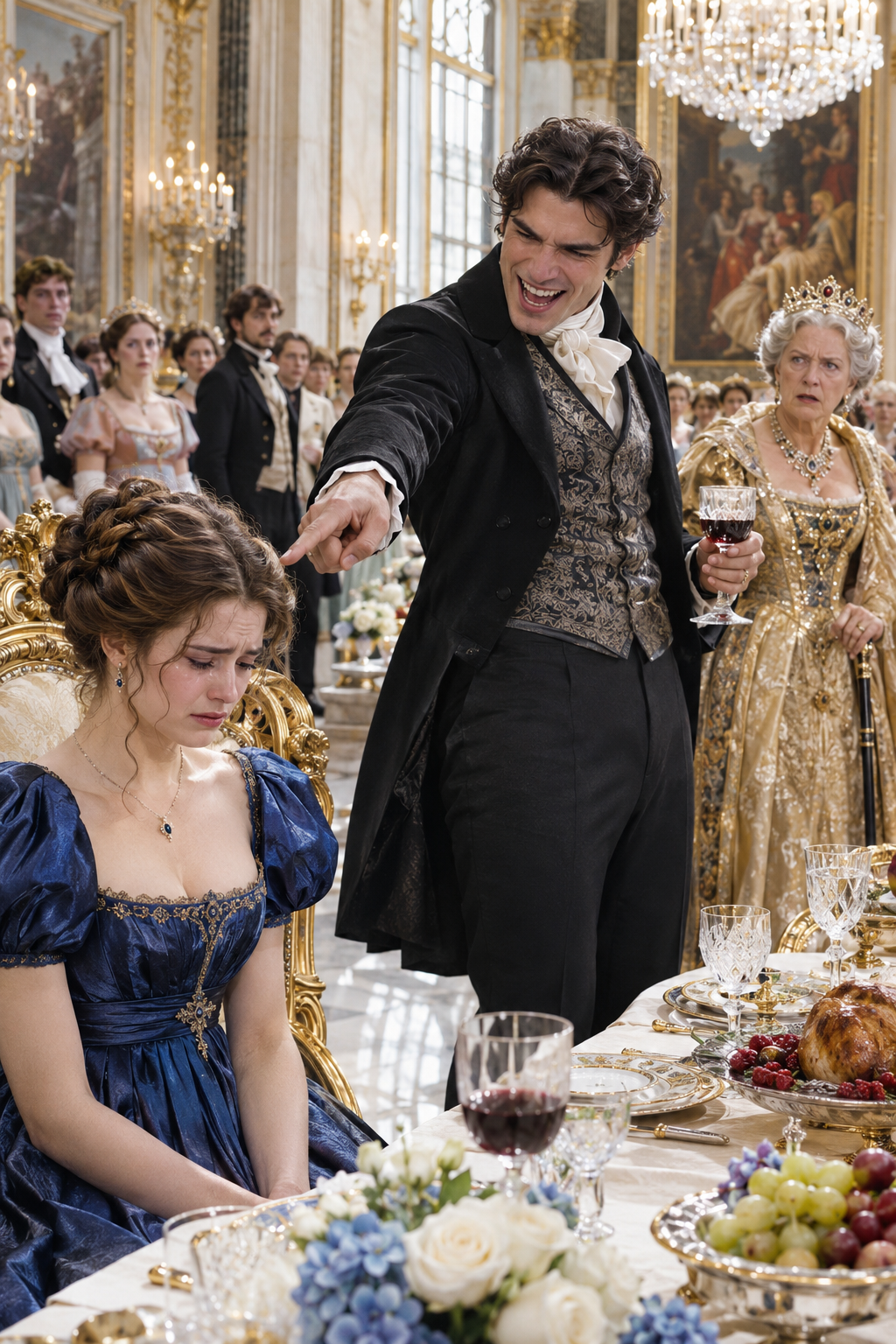
Henry lowered his head.
The Queen’s voice remained controlled.
“Describe him.”
Isabelle looked toward the fireplace.
“An older gentleman. Silver spectacles. A scar beside his left eyebrow.”
Clara felt the room shift beneath her.
She knew that description.
For nearly twenty years, the man had been her father’s most trusted financial adviser.
Mr. Edmund Vale.
He had attended her father’s funeral.
He had stood beside Clara while she signed the documents transferring her inheritance into her own name.
And he had recommended Henry as a suitable husband.
Clara gripped the back of a chair.
The Queen noticed.
“You recognize him?”
“Yes, Your Majesty.”
Her voice emerged quietly.
“He arranged my marriage.”
Henry looked up sharply.
Clara stared at him.
For three years, she had believed Henry had married her because he wanted her fortune.
That much had been obvious.
But suddenly she understood that their marriage might have served another purpose.
Someone had needed access to her father’s records.
Someone had needed his daughter inside a household where her possessions could be searched, her correspondence intercepted, and her questions dismissed.
“Henry,” she said, “did Edmund Vale introduce you to me?”
Henry’s silence answered before his words did.
“He advised me that your family was financially secure.”
“And what did you promise him?”
“Nothing.”
Clara stepped toward him.
“What did you promise?”
Henry’s shoulders sagged.
“He said he could arrange favorable terms with my creditors.”
“In exchange for what?”
Henry stared at the floor.
“My cooperation.”
The Queen approached.
“Be specific.”
Henry drew a slow breath.
“He wanted access to certain documents belonging to Clara’s father. He said they contained evidence of improper commercial dealings and that recovering them would protect her family’s reputation.”
Clara’s fingers tightened.
“You believed him?”
Henry did not meet her eyes.
“I believed he could save the estate.”
“And when he told you to burn the trunks?”
Henry said nothing.
Clara turned away.
There was no sudden collapse, no dramatic accusation.
Only the terrible simplicity of understanding.
Her husband had not merely taken her fortune.
He had helped destroy the evidence her father had left behind.
The Queen ordered Henry and the Chancellor confined separately while the investigation continued.
Isabelle was placed under supervision, with instructions that she remain available for questioning.
Clara was offered a chamber for the night.
She declined.
“Your Majesty, there is something I must retrieve before morning.”
The Queen studied her.
“You believe your father’s missing ledger survived?”
“I believe he would never have trusted all his evidence to one place.”
“Then you shall have an escort.”
Clara bowed.
“Thank you.”
Before leaving, she glanced toward Henry.
He stood between the guards, his elaborate evening coat suddenly looking like a costume he no longer knew how to wear.
“Clara,” he said.
She stopped.
“I never intended for your father to be involved.”
She looked at him for a long moment.
“My father was involved before you ever met me.”
Henry’s face tightened.
“And you knew enough to help the people who used him.”
She walked away before he could answer.
By dawn, Clara had returned to her father’s former country residence.
The house stood beneath a pale autumn sky, its windows shuttered and its gardens overgrown.
She had not visited since the property was sold.
The current owner, a retired naval officer, admitted her after examining the Queen’s authorization.
Inside, the old counting room smelled of cold stone and furniture polish.
Clara stood beneath the narrow windows where her father had worked for thirty years.
She remembered the sound of his pen scratching across paper.
The careful way he balanced columns.
His habit of tapping a ledger twice before closing it.
And something else.
Whenever a transaction troubled him, he had written its reference number on a small card and placed the card inside the hollow base of his brass desk lamp.
Clara turned toward the desk.
The lamp was gone.
Her stomach tightened.
“Was there a brass lamp here when you purchased the house?” she asked.
The naval officer frowned.
“I believe so. My wife considered it rather ugly.”
“Do you still have it?”
“It may be in the attic.”
Twenty minutes later, a servant carried down a dusty brass lamp wrapped in an old blanket.
Clara placed it on the desk.
Her hands were steady as she examined the base.
There was a small screw beneath the decorative rim.
She loosened it with a borrowed knife.
The bottom opened.
Inside lay a folded card, yellowed at the edges.
Forty-seven.
Beneath the number was a sentence in her father’s handwriting.
“When the accounts no longer agree, examine the people who insist they do.”
Clara closed her eyes briefly.
Then she turned the card over.
An address had been written on the reverse.
A private warehouse near the Thames.
Beside it were two words.
Original register.
The naval officer watched her carefully.
“Is it important?”
Clara folded the card.
“More than I can explain.”
By midday, the Queen’s officers had secured the warehouse.
Its doors were locked with heavy iron chains, and the windows had been boarded from within.
Inside, beneath rows of ordinary shipping crates, they discovered a narrow office concealed behind a false wall.
The room contained account books, correspondence, and sealed packets bearing the names of prominent merchants and landowners.
Clara entered behind the officers.
Her eyes moved across the shelves.
There were dozens of ledgers.
Then she saw a familiar binding.
Dark green leather.
A brass clasp.
Her father’s initials embossed near the spine.
She reached for it.
The clasp opened with a soft click.
Inside, the handwriting was unmistakable.
Her father had recorded years of unauthorized transfers, identifying the officials who approved them and the commercial houses that received them.
Some entries were accompanied by copies of receipts.
Others contained private correspondence.
And several referred directly to Edmund Vale.
Clara turned the pages slowly.
Her father had discovered that Crown revenue was being diverted through fictitious shipping contracts into accounts controlled by Vale and his associates.
The money financed speculative investments and private loans.
When those ventures failed, the losses were concealed through additional transfers.
The resulting shortages were then blamed on declining trade and used to justify higher duties.
Ordinary merchants had paid for the mistakes of men who never appeared on the tax rolls.
Clara reached the final entries.
Her father had attempted to expose the arrangement.
He had written to a senior Treasury official.
The letter had been intercepted.
A week later, his principal warehouse had been destroyed by fire.
Two months afterward, he died following a sudden illness.
Clara stared at the dates.
She had never questioned the illness.
Her father had been exhausted after the fire, and the physician had attributed his death to a fever aggravated by strain.
Now she wondered how much of that explanation had been true.
She found one final folded letter tucked into the back cover.
It was addressed to her.
“My dearest Clara,” it began.
She sat down before reading further.
Her father wrote that he had discovered a financial conspiracy involving men of considerable influence.
He feared his attempts to expose it had placed his business and household in danger.
He had hidden copies of the records because he could no longer trust the officials responsible for investigating them.
Then came the sentence that made Clara press her hand against her mouth.
“If these papers reach you, remember that wealth is only useful when it allows us to refuse what is wrong.”
She read the words twice.
Outside, carts rattled over the cobblestones.
The world continued moving.
But for Clara, the room had become very still.
Her father had not left her merely an inheritance.
He had left her a responsibility.
That evening, Edmund Vale was arrested at his London residence.
He had been preparing to leave the country.
Officers found travel documents, several bags of gold, and correspondence instructing foreign agents to liquidate investments before the Treasury could intervene.
Vale initially denied everything.
Then he learned that the original register had been recovered.
His confidence faltered.
The investigation widened rapidly.
The Chancellor was removed from office and charged with corruption and conspiracy.
Several Treasury officials were suspended.
Commercial houses connected to the fraudulent accounts were placed under examination.
Funds were frozen, records seized, and witnesses summoned.
Yet the greatest confrontation still awaited Clara.
Three days after the royal dinner, Queen Charlotte requested her presence at a private audience.
Clara entered the chamber wearing a simple dark-blue gown.
There were no diamonds at her throat.
No elaborate ornaments in her hair.
The Queen sat beside a window overlooking the gardens.
A small stack of documents rested on the table.
“Duchess Clara,” she said, “the investigators have confirmed much of what your father recorded.”
Clara bowed.
“And Edmund Vale?”
“He has admitted organizing the transfers. He claims the arrangement began as a temporary effort to conceal losses from unsuccessful investments.”
Clara looked toward the documents.
“Temporary arrangements rarely require twenty years of secrecy.”
The Queen’s mouth tightened.
“Indeed.”
She motioned for Clara to sit.
“Your husband has submitted a statement.”
Clara remained still.
“He acknowledges permitting Vale to examine your father’s papers and authorizing transfers connected to his estate. He insists he did not understand the full scheme.”
“Do you believe him, Your Majesty?”
The Queen considered the question.
“I believe he understood enough to know he should have asked more questions.”
Clara lowered her eyes.
For years, she had excused Henry’s arrogance as the product of upbringing, his coldness as disappointment, and his humiliations as the price of a marriage without affection.
But ignorance did not explain every choice.
He had accepted her money.
He had destroyed her father’s possessions.
He had signed documents without caring who might suffer.
And when the truth emerged, he had attempted to silence her.
“What will happen to him?” she asked.
“That will depend upon the evidence and the judgment of the proper authorities. His title will not shield him from inquiry.”
Clara nodded.
The Queen opened another document.
“There is also the matter of your marriage.”
Clara looked up.
“Henry’s estate remains heavily indebted despite the money you provided. Investigators believe portions of your inheritance were transferred without your informed consent.”
The Queen paused.
“You have grounds to seek the recovery of those assets and petition for a legal separation.”
Clara stared at the garden beyond the window.
Three years earlier, she had stood in a church wearing ivory silk while Henry promised to honor and protect her.
She remembered how carefully she had searched his expression for sincerity.
Now she understood that the promise had meant less to him than the estate awaiting rescue.
“I will pursue the separation,” she said.
The Queen inclined her head.
“And your fortune?”
“I intend to recover whatever the law permits.”
“To restore your father’s business?”
“Partly.”
Clara hesitated.
“There are merchants whose businesses failed because of the duties imposed to conceal these losses. Some lost their homes. Others were imprisoned for debts they could never reasonably repay.”
The Queen listened.
“I would like to establish a fund to help those families rebuild, using recovered assets and a portion of my own inheritance.”
The Queen studied her.
“You have already lost a great deal.”
Clara’s gaze remained steady.
“Then I know what it means to need a second chance.”
For several moments, neither woman spoke.
Finally, the Queen reached for her pen.
“I shall authorize a commission to review the affected trade districts. You will be invited to advise it.”
Clara blinked.
“Your Majesty?”
“You have demonstrated a better understanding of the kingdom’s financial difficulties than several men entrusted with solving them.”
A faint smile touched the Queen’s face.
“I see no reason to waste that understanding.”
Clara bowed her head.
“Then I will serve as faithfully as I can.”
The months that followed were neither easy nor quiet.
Clara faced hostile letters, whispered accusations, and attempts to discredit her father’s records.
Some aristocrats claimed she had betrayed her husband.
Others suggested a woman who understood commercial accounts could not possibly understand the delicate responsibilities of government.
Clara answered none of them publicly.
Instead, she worked.
She traveled to market towns where warehouses stood empty and merchants counted their remaining coins beneath leaking roofs.
She listened to farmers describe tolls that consumed their profits before their produce reached the cities.
She examined shipping registers, customs receipts, and local debt records.
Her recommendations were precise.
Reduce unnecessary internal duties.
Publish clearer Treasury accounts.
Require independent verification of major transfers.
Review exemptions that allowed powerful estates to escape obligations imposed upon smaller businesses.
Not every proposal was accepted.
Several encountered fierce resistance.
But the commission’s first reforms began to restore confidence, and merchants who had abandoned certain routes gradually returned.
Recovered funds were directed toward compensation and debt relief where claims could be verified.
The work took time.
Clara preferred it that way.
She had seen what happened when powerful men promised easy solutions without examining their consequences.
One winter afternoon, a letter arrived from Henry.
He was living under restrictions while the proceedings against him continued.
His estate had been placed under financial supervision, and much of its remaining property was being sold to satisfy creditors.
The letter was brief.
He wrote that he had been foolish.
He acknowledged that Clara had deserved better.
Then he asked whether she might visit him.
Clara read it beside the same window where she had once waited for him to return from evenings spent with Isabelle.
She folded the paper.
For several minutes, she watched snow settle across the garden.
Then she wrote a reply.
“Henry,
I hope you learn to live with the consequences of your decisions without searching for someone else to carry them.
I have spent enough years doing that for you.
Clara.”
She sealed the letter and returned to her work.
There was no satisfaction in his downfall.
Only relief that his future no longer determined her own.
Isabelle’s circumstances had changed as well.
Her testimony had helped investigators reconstruct several transfers, and she had been required to surrender gifts purchased with misappropriated funds.
When Clara encountered her months later outside a solicitor’s office, Isabelle looked very different from the woman who had occupied Clara’s chair at the royal dinner.
Her dress was modest.
Her hands were bare.
She stopped when she recognized Clara.
“I owe you an apology.”
Clara waited.
Isabelle looked down.
“I knew Henry was married. I knew I was hurting you. I told myself it was harmless because he never seemed to care.”
Clara regarded her quietly.
“It was not harmless.”
“I know.”
For a moment, Isabelle seemed about to say more.
Then she simply nodded.
Clara returned the gesture and continued walking.
Forgiveness, she had discovered, did not require pretending the past had been acceptable.
Nor did it require inviting those who had caused the harm back into her life.
By the following spring, the first public report of the financial commission was complete.
Clara presented its findings before a gathering of ministers, merchants, and royal advisers.
The room was crowded.
Several of the gentlemen who had laughed at her during the royal dinner were present.
This time, no one asked her to sit elsewhere.
She stood beside a large table covered with financial records.
Her presentation was measured, supported by figures and testimony collected over months of investigation.
She explained how poorly designed duties could destroy the trade they were intended to support.
She demonstrated how concealed exemptions shifted the burden toward those least able to bear it.
And she proposed safeguards to make future abuses more difficult.
When she finished, the room remained silent.
Then an elderly merchant rose.
His hands were rough, and his coat had been carefully repaired at the elbows.
“My lady,” he said, “my sons and I reopened our warehouse last month. We had been closed for nearly two years.”
Clara inclined her head.
“I am pleased to hear it.”
The man hesitated.
“We thought no one in London knew what was happening to us.”
Clara felt a familiar ache beneath her ribs.
“My father used to say that a ledger should never make us forget the people behind the figures.”
The merchant nodded slowly.
“He sounds like a good man.”
“He was.”
After the meeting, Queen Charlotte approached Clara near the windows.
“You have accomplished something unusual, Duchess.”
Clara smiled faintly.
“I have made several gentlemen very uncomfortable, Your Majesty.”
The Queen allowed herself a quiet laugh.
“That is hardly unusual.”
She looked toward the merchants gathering their papers.
“You have persuaded people who rarely agree with one another to examine the same evidence.”
Clara considered the distinction.
“It is easier to argue about appearances than to dispute a properly balanced account.”
“Then perhaps the kingdom requires more balanced accounts.”
The Queen offered her hand.
Clara curtsied.
As she rose, she caught sight of her reflection in the tall window.
She wore a simple emerald gown, chosen because she liked its color rather than because it satisfied anyone else’s expectations.
There were faint shadows beneath her eyes from long evenings spent working.
A loose strand of hair had escaped its pins.
She looked nothing like the polished aristocratic women who had once made her feel invisible.
For the first time, she did not wish to.
That summer, Clara purchased her father’s former countinghouse and restored it.
The old brass lamp returned to its place on the desk.
The green leather ledger was preserved among the records that had helped expose the fraud.
But the building did not become a monument to the past.
Instead, Clara opened its doors to young people who wished to learn bookkeeping, commercial mathematics, and practical finance.
Women were admitted on the same terms as men.
The decision provoked predictable objections.
One visiting gentleman suggested that teaching young women to manage money might make them difficult to marry.
Clara looked at him over the rim of her teacup.
“Then perhaps it will encourage gentlemen to become more agreeable husbands.”
The remark traveled through London faster than any formal announcement she had made.
Clara found that mildly amusing.
She preferred the quieter achievements.
A widow learning to manage the accounts of her late husband’s shop.
A merchant’s daughter discovering that she could negotiate contracts herself.
A young clerk identifying an error that saved his employer from bankruptcy.
Small victories.
Real ones.
On the anniversary of her father’s death, Clara visited his grave.
The morning was clear, with sunlight moving through the branches of the old yew trees.
She carried no elaborate wreath.
Only a small bundle of white flowers from the garden of the house where she now lived.
She knelt beside the stone and brushed away a fallen leaf.
For a long time, she said nothing.
Then she placed a copy of the commission’s first report beneath her hand.
“I found the ledger, Father.”
Her voice was barely audible.
“And I found out what they did.”
A breeze stirred the flowers.
She looked down at the final page of the report, where her recommendations had been recorded alongside the names of the commissioners.
There had been a time when she believed her father’s greatest gift was the fortune he left her.
That fortune had attracted Henry.
It had made her useful to men who valued her wealth but dismissed her judgment.
And it had nearly been consumed by their ambitions.
But her father had left something more enduring.
He had taught her to question convenient explanations.
To examine evidence before accepting authority.
To understand that every figure represented a human decision, and every decision carried consequences.
Most importantly, he had taught her that respect could never be purchased by surrendering one’s dignity.
Clara rose, smoothing her skirts.
Beyond the churchyard, the village was waking.
A baker opened his shutters.
A cart passed along the road.
Children hurried toward the schoolhouse.
Life continued in its ordinary, imperfect way.
She walked toward her waiting carriage.
That evening, a royal invitation arrived at her residence.
Queen Charlotte was hosting another formal dinner.
The invitation requested Clara’s presence as an honored adviser to the financial commission.
Clara examined the elegant lettering.
For a moment, she remembered the previous dinner.
Henry’s dismissive smile.
Isabelle’s laughter.
The untouched wine.
The chair placed six seats away from the man she had married.
Then she handed the invitation to her secretary.
“Please send my acceptance.”
On the appointed evening, Clara entered the royal dining chamber beneath the same magnificent chandeliers.
The marble floor gleamed.
The silverware shone.
The air carried the familiar fragrance of roses and polished wood.
Several guests turned as she approached.
Some recognized her immediately.
Others whispered her name.
Clara continued walking.
At the head of the table, Queen Charlotte rose slightly from her chair.
“Duchess Clara. We have been expecting you.”
A servant stepped forward and pulled out a chair.
It stood beside the Queen.
Clara paused.
For one brief moment, she remembered Henry telling her that the royal court expected a certain standard of presentation.
Then she took her seat.
The Queen leaned toward her.
“I understand the new commercial schools are progressing well.”
“They are, Your Majesty. We have more applicants than places.”
“Then we must consider expanding them.”
Clara smiled.
“I was hoping you might say that.”
Across the table, a senior nobleman cleared his throat.
“Your Majesty, if I may, there remains some concern that educating women in financial affairs will disturb the traditional order of society.”
The Queen turned toward him.
“Does the traditional order require financial ignorance?”
The gentleman hesitated.
“Not precisely, Your Majesty.”
“Then I suggest we concern ourselves with competence rather than custom.”
Clara lowered her eyes to conceal a smile.
Dinner continued.
There were discussions of trade, agriculture, shipping, and the approaching harvest.
Clara spoke when she had something useful to contribute.
She listened when others knew more.
And when someone disagreed with her, she asked for evidence rather than demanding submission.
It was a very different evening from the one that had begun her public life.
Near the end of dinner, Queen Charlotte raised her glass.
“To those who serve the kingdom with integrity, whether or not the world expects them to.”
The guests followed her example.
Clara lifted her glass.
She did not think of Henry.
She did not think of Isabelle.
She thought of her father sitting beneath the brass lamp, patiently showing a young girl how to reconcile two columns of figures.
She remembered asking him why the work mattered so much.
And she remembered his answer.
“Because truth is often hidden in the things people hope you will never examine.”
Years later, Clara finally understood the full meaning of those words.
Her fortune had once made her desirable to a man who did not love her.
Her silence had made her convenient to people who did not respect her.
But her knowledge, courage, and refusal to look away had given her something no title or marriage could provide.
A life directed by her own judgment.
As the Queen’s guests rose from the table, Clara remained beside the window for a moment, watching the moonlight settle over the palace gardens.
A young maid approached to collect an empty glass.
The girl hesitated.
“My lady, may I ask you something?”
Clara turned.
“Of course.”
The maid glanced toward the departing aristocrats.
“Is it true that you learned all those things from books and ledgers?”
Clara smiled.
“From books, ledgers, mistakes, and a very patient father.”
The girl looked at her hands.
“I should like to learn, too.”
Clara considered her for a moment.
“Can you read?”
“Yes, my lady.”
“Then come to the countinghouse on your next afternoon free. Ask for Mrs. Bennett. She will help you begin.”
The maid’s face brightened.
“Thank you, my lady.”
Clara watched her hurry away.
There was no applause.
No royal announcement.
No grand declaration.
Only a young woman who had been given permission to imagine a different future.
And Clara realized that this quiet moment mattered as much as anything she had accomplished before the Queen.
She had spent years being treated as though her value lay in what she could give to others.
Now she understood that her greatest legacy would be what she helped others discover within themselves.
When Clara finally stepped into her carriage, the palace doors closed softly behind her.
The road ahead was illuminated by the carriage lamps, their warm light stretching across the cobblestones.
She settled against the seat and opened the small notebook resting in her lap.
Tomorrow there would be new accounts to examine, new objections to answer, and new problems that could not be solved with a single clever speech.
She was ready for them.
Because the woman once dismissed as a plain, wealthy wife had never needed to become someone else to deserve respect.
She had only needed the freedom to be fully herself.
And in the end, the greatest humiliation Duke Henry suffered was not losing his fortune, his influence, or the admiration of the royal court.
It was discovering that the woman he had considered beneath him possessed the very qualities he had spent his entire life pretending to have.
Wisdom.
Integrity.
And the courage to stand for something greater than herself.
Clara closed her notebook as the carriage turned toward home.
She had entered her marriage as the answer to another person’s debts.
She would spend the rest of her life proving that no woman should ever be reduced to the price someone else placed upon her.
Her father had left her money, but the most valuable inheritance had never appeared in any ledger.
It was the ability to recognize her own worth, even when everyone around her refused to see it.
And that was a fortune no one could ever take away.
viết tiếp đến kết thúc truyện
Three years after the royal dinner that had exposed the corruption within the Treasury, Clara received a letter bearing the seal of the Court of Chancery. She was seated in her father’s restored countinghouse when it arrived, reviewing the accounts of a small textile cooperative established by twelve widows from the northern counties.
She recognized the official handwriting immediately.
The proceedings concerning her marriage had finally reached their conclusion.
Duke Henry had been found responsible for authorizing unlawful transfers, concealing financial information, and knowingly assisting Edmund Vale in destroying records relevant to the investigation. Although the court had not established that Henry understood every part of the conspiracy, his deliberate participation had been sufficient to bring serious consequences.
Much of his estate had been sold to repay creditors and recover misappropriated funds. His remaining property was placed under supervision, and he was stripped of several honorary positions that had once defined his place in society.
Clara’s legal separation had been granted, together with an order restoring the assets that could be traced to her inheritance.
She read the judgment twice.
Then she folded it and placed it beside her father’s old brass lamp.
For years, Henry’s name had followed hers everywhere. It had appeared on invitations, legal documents, household accounts, and letters addressed to a woman whose accomplishments were routinely attributed to her husband.
Now the court had formally recognized her right to manage her own affairs independently.
The realization brought no sudden burst of triumph.
Instead, Clara experienced something quieter.
Peace.
Outside her window, the streets were busy with merchants preparing for the spring markets. A delivery boy hurried past carrying a basket of bread, while two young women entered the countinghouse with exercise books tucked beneath their arms.
Life had continued while the legal proceedings unfolded.
And Clara had built something worth protecting.
Her secretary, Mrs. Bennett, appeared in the doorway.
“My lady, there is another letter.”
Clara looked up.
“From whom?”
Mrs. Bennett hesitated.
“His Grace, Duke Henry.”
Clara’s expression remained composed.
“Leave it here, please.”
The envelope was plain, without the elaborate crest Henry had once insisted upon using for even the smallest correspondence.
Clara opened it.
The handwriting was familiar, though less confident than she remembered.
Henry wrote that he had spent the previous winter in a modest rented house outside Bath. Most of his former acquaintances had disappeared after the investigation. The gentlemen who once praised his judgment no longer returned his letters.
He had discovered, he admitted, how little he understood about managing money when no one else was available to rescue him.
He described learning to keep his own accounts, negotiating with creditors, and selling possessions he had once considered essential to his dignity.
Then he wrote about Clara.
He acknowledged that he had mistaken her patience for weakness and her generosity for an obligation.
He admitted that he had deliberately humiliated her because her competence reminded him of his own dependence.
Near the bottom of the page, one sentence stood apart from the others.
“I spent three years trying to make you feel small because I could not bear the knowledge that you were greater than I was.”
Clara rested the letter against the desk.
For a long moment, she looked toward the window.
She had once imagined that hearing Henry admit the truth would heal something inside her.
Now she understood that the healing had already happened.
His apology mattered because it acknowledged what he had done.
But she no longer needed his understanding to believe her own experience.
She took out a sheet of paper.
“Henry,
I have received your letter and accept that you now recognize the harm you caused.
I hope the life ahead of you is guided by better judgment than the life behind you.
There is nothing more I wish to settle between us.
Clara.”
She sealed the reply without hesitation.
That afternoon, she traveled to the northern district where her charitable fund had helped restore several struggling businesses.
The first stop was a small weaving workshop.
Inside, the rhythmic clatter of looms filled the air. Sunlight entered through high windows, illuminating shelves of neatly folded fabric.
A woman named Margaret Ellis approached her.
Three years earlier, Margaret had been facing imprisonment for debts accumulated after her husband’s business collapsed under excessive transport duties.
Now she employed fourteen workers.
“My lady,” Margaret said, smiling, “we have something to show you.”
She led Clara toward the back of the workshop, where several young apprentices were gathered around a table.
On it lay a beautifully woven length of emerald-green silk.
“We made this for you.”
Clara touched the fabric.
“It is extraordinary.”
Margaret shook her head.
“It is only cloth. But every woman who worked on it has a wage of her own now.”
Clara looked around the room.
She saw women measuring thread, recording orders, checking finished garments, and laughing together as they worked.
Their independence had not arrived through a royal proclamation or a grand speech.
It had been built through opportunity, training, and the steady dignity of paid work.
Clara turned back to Margaret.
“Then this is the finest gift I have ever received.”
Several weeks later, Queen Charlotte invited Clara to Windsor for a private audience.
The Queen was older now, and the demands of court had begun to show in the lines around her eyes. Yet her attention remained sharp as Clara presented the latest report from the commercial education schools.
Enrollment had increased substantially.
Several graduates had established businesses of their own, while others had obtained positions as bookkeepers and commercial advisers.
The Queen studied the figures.
“You have done more than expose a crime, Duchess.”
Clara smiled faintly.
“I have had considerable assistance, Your Majesty.”
“That does not diminish your work.”
The Queen closed the report.
“I am told the schools require additional funding.”
“They do. We have applicants from counties where no similar instruction is available.”
“Then we shall discuss an expansion.”
Clara inclined her head.
The Queen regarded her thoughtfully.
“Do you ever regret what happened at that dinner?”
Clara considered the question.
She remembered the humiliation, the laughter, the coldness in Henry’s voice, and the terrible discovery that her marriage had been part of a larger deception.
“I regret the years I spent believing I had to earn the kindness of someone who had already decided to withhold it.”
The Queen listened without interruption.
“But I do not regret speaking.”
“Even knowing what followed?”
“Especially knowing what followed.”
A small smile appeared on the Queen’s face.
“Then perhaps that evening was not quite the disaster your husband imagined.”
Clara returned the smile.
“No, Your Majesty. I believe it was the beginning of something better.”
When Clara left the palace, she did not return immediately to her carriage.
Instead, she walked through the gardens, where the first roses of summer had begun to bloom.
She stopped beside a fountain and watched the water catch the afternoon light.
For so long, she had measured her life against the expectations of others.
A dutiful daughter.
A wealthy bride.
An obedient duchess.
A woman expected to remain grateful for a title purchased with her inheritance.
Now those descriptions seemed strangely distant.
She was still her father’s daughter.
She still carried the responsibilities of her fortune.
But she was also a teacher, an adviser, a businesswoman, and a woman who had learned that dignity was not something granted by a husband, a court, or a title.
It was something she could refuse to surrender.
Years passed.
The countinghouse expanded into a respected commercial academy, and its graduates established businesses across the kingdom.
Clara continued her work with the financial commission, though she gradually devoted more time to education and charitable investment.
She never married again.
Not because she had ceased to believe in love, but because she had learned that companionship without respect was merely another form of loneliness.
Her life was full of friendships, meaningful work, lively conversations, and the quiet pleasures she had once been made to feel foolish for enjoying.
One autumn evening, long after the scandal had faded from fashionable conversation, Clara stood before a classroom of young women preparing to complete their studies.
The room was warm with lamplight.
Account books lay open across the desks.
One student raised her hand.
“Lady Clara, may I ask something that has nothing to do with our examination?”
Clara smiled.
“Of course.”
The girl hesitated.
“How did you find the courage to speak before the Queen when everyone expected you to remain silent?”
Clara looked at the faces before her.
Some were daughters of merchants.
Others had grown up in households where money was scarce and education had once seemed impossible.
All were waiting for her answer.
She thought carefully before speaking.
“I was afraid.”
The students exchanged surprised glances.
Clara continued.
“My hands were cold. I knew my husband would be furious. I knew the gentlemen at that table would resent being corrected by a woman they had already decided was insignificant.”
“Then why did you speak?”
Clara rested her hand on the old green ledger she had brought from her father’s countinghouse.
“Because the figures were wrong, and people were suffering because of them.”
She paused.
“Courage does not always arrive as confidence. Sometimes it is simply deciding that the truth matters more than the comfort of remaining silent.”
The room grew still.
A young woman in the front row slowly closed her notebook.
Clara looked toward the window, where the evening sun had turned the sky a soft shade of gold.
She remembered her father’s patient voice, the sound of his pen, and the lessons he had taught her without ever imagining how much they would matter.
Then she turned back to her students.
“Never confuse someone’s refusal to recognize your worth with proof that you have none. Learn everything you can. Examine what you are told. Protect your independence. And never allow another person’s pride to determine the limits of your life.”
When the lesson ended, the students gathered their books and departed, their voices drifting down the corridor.
Clara remained behind to extinguish the lamps.
On the wall near the entrance hung a small framed inscription.
It contained no royal title, no family crest, and no reference to the scandal that had once made her famous.
Only a sentence she had chosen herself.
“Knowledge gives us the power to question. Integrity gives us the courage to act.”
Clara looked at the words for a moment.
Then she closed the classroom door and walked into the evening.
Somewhere beyond the academy walls, another young woman was being told that she was too ordinary, too inexperienced, or too insignificant to make a difference.
Clara hoped that one day the girl would discover what she herself had learned beneath the chandeliers of a royal palace.
That the people who laugh the loudest at your silence are often the ones most frightened of what you might say.
And that a life built upon self-respect is worth more than any fortune, marriage, or title the world can offer.
The Duke had married Clara for her money, dismissed her intelligence, and tried to silence her before a Queen.
But he had never understood the woman sitting beside him.
In the end, Clara did not defeat him by becoming crueler, wealthier, or more powerful than he was.
She defeated the life he had chosen for her by refusing to remain inside it.
And the greatest victory of all was that, long after his name had faded into the records of a disgraced aristocracy, hers continued to appear in the lives of people who had been given a chance to build something better.
Not because she had once been a duchess.
Not because she had stood before a Queen.
But because, when the moment came to choose between protecting her comfort and defending the truth, Clara had stood up.
And she had never sat down in silence again.
THE END.