The Duke had given his wife one rule:
“Now,” she said, “you’re ready to hear what happened to my father.”
Arthur did not move.
The fire behind him cracked softly, throwing a thin line of orange across the dark room.
For months, he had imagined that Evelyn’s silence was obedience.
Now he understood.
It had been restraint.
“Tell me,” he said.
Evelyn stepped inside and closed the door.
“You remember the Harrington collapse?”
“My father said your family ruined him.”
Arthur’s expression hardened.
“He said Harrington investments failed because of reckless speculation. He said your father borrowed against properties he could not afford to keep.”
“He lied.”
The words landed quietly.
Arthur looked at her.
“My father was already in debt,” Evelyn continued, “but not because of speculation. He discovered that someone had been moving money from several Rothford accounts into private companies.”
Arthur’s eyes narrowed.
“Whose companies?”
“Reginald’s.”
The room seemed to grow colder.
Evelyn walked toward the desk.
“My father found the transfers three years before our marriage. He confronted Lord Reginald privately. Reginald denied everything, of course. Then, two weeks later, one of my father’s largest creditors demanded immediate payment.”
Arthur said nothing.
“He could not pay. His accounts were frozen. His business partners abandoned him. Newspapers began calling him a fraud.”
“My uncle controlled the newspapers.”
“Yes.”
Arthur’s fingers curled against the edge of the desk.
“And my father?”
“He tried to fight.”
Evelyn’s voice became softer.
“That was when Reginald threatened me.”
Arthur looked up sharply.
“He told my father that if he continued investigating, I would be accused of stealing from one of his charities. He had forged documents ready. He would have destroyed my reputation before I was old enough to defend it.”
Arthur stared at her.
“He was willing to sacrifice his own niece?”
“He never considered me family.”
A long silence followed.
“Then why the marriage?”
Evelyn’s eyes moved toward the window.
“Because Reginald needed your name.”
Arthur frowned.
“My father still possessed one thing Reginald could not take from him. Evidence. Copies of financial records. Letters. Payment orders.”
“Where?”
“With me.”
Arthur rose.
“You had them?”
“I still do.”
“Why didn’t you tell me?”
Evelyn looked at him.
“Because I did not know whether you were part of it.”
Arthur flinched.
“You thought I was?”
“I thought you might be.”
She did not soften the accusation.
“When my father’s fortune collapsed, Reginald came to us with an offer. He said he could prevent the Harrington name from being erased entirely.”
Arthur already knew the answer.
“By marrying you to me.”
“Yes.”
“And he arranged the contract.”
“He arranged the circumstances around it.”
Arthur walked slowly toward the fireplace.
“My uncle told me your father had nearly ruined your family.”
“He made sure you believed that.”
“He told me you wanted the marriage.”
“I wanted to protect my father.”
Arthur closed his eyes.
“And my first fiancée?”
Evelyn touched the silver locket at her throat.
“That is the part you were never meant to discover.”
Arthur turned.
“Tell me.”
Evelyn took the locket off.
She opened it.
Inside was not a portrait.
There was a tiny folded piece of paper.
Arthur stared at it.
“Your first fiancée gave this to my father,” Evelyn said.
“Her name was Clara.”
“I know.”
“She discovered the same accounts.”
Arthur’s breath caught.
“Clara knew?”
“She found evidence that Reginald had been stealing from the Rothford estate. She planned to tell you.”
Arthur remembered.
The last night he had seen Clara alive.
Her frightened expression.
Her insistence that she needed to speak with him.
His own impatience.
Reginald had told him she was emotional.
That she had gone to meet someone secretly.
That the carriage accident afterward was a tragic consequence of reckless behavior.
Arthur had believed him.
Because believing him had been easier than questioning the man who had raised him after his father’s death.
“Clara never reached me,” Arthur whispered.
“No.”
“Who stopped her?”
Evelyn’s eyes filled with something Arthur had never seen in them before.
Pity.
“Reginald.”
Arthur stepped backward.
“The man blamed for her death?”
“He was a coachman. He was paid to drive her to the estate. Reginald arranged for him to be accused of causing the accident.”
“And the payment?”
“The document you found.”
Arthur stared at the locket.
“Why did Clara give this to my father?”
“Because she knew something was wrong. She trusted your father.”
Arthur’s voice broke.
“My father was already dead.”
“Yes.”
The room fell silent again.
Evelyn folded the paper and returned it to the locket.
“My father kept it hidden. After he died, I took it.”
Arthur looked at her.
“When did your father die?”
“Three months before our wedding.”
Arthur froze.
“Your father did not die of illness.”
“No.”
“Reginald killed him.”
“I cannot prove that.”
“But you believe it.”
“I know that the night before he died, Reginald visited him.”
Arthur’s face went pale.
“What happened?”
“My father told me to leave the house. He told me never to trust your uncle.”
She swallowed.
“The next morning, he was dead.”
Arthur turned away.
For several moments, he could not speak.
Then Evelyn said something that made him look back.
“But that is not why I stayed silent.”
“What is?”
“Because I needed time.”
“For what?”
“To find the missing ledger.”
Arthur frowned.
“What ledger?”
“The original record of every payment Reginald made.”
“And you believe it still exists?”
“I know it does.”
“Where?”
Evelyn hesitated.
“Inside Rothford House.”
Arthur stared at her.
“You have searched the estate?”
“For months.”
“And you never told me?”
“I was following the evidence.”
“Alone?”
“Yes.”
“You could have been killed.”
“So could you.”
Arthur had no answer.
Then a sound came from the corridor.
A faint click.
Both of them turned.
The door was still closed.
Arthur crossed the room and opened it.
The corridor was empty.
But on the carpet lay a black glove.
Arthur picked it up.
There was a small silver crest stitched into the wrist.
The Rothford crest.
His uncle’s private household servants wore it.
Arthur’s expression changed.
“He knows.”
Evelyn nodded.
“He has always known.”
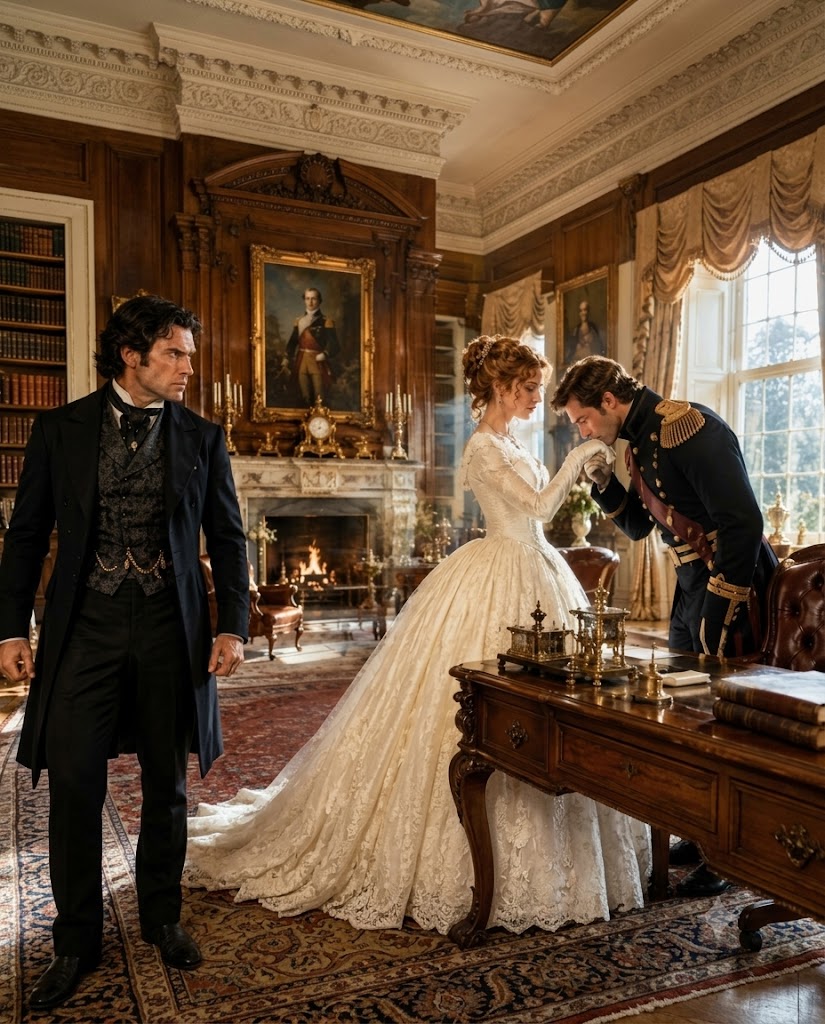
A bell rang somewhere downstairs.
Then another.
The sound of hurried footsteps followed.
Arthur extinguished the lamp.
“Stay here.”
Evelyn caught his arm.
“No.”
He looked down at her hand.
For months, she had never touched him.
Not once.
“Whatever happens,” she said, “we find the ledger first.”
Arthur nodded.
For the first time since their marriage, they left the room together.
They moved through the dark corridor toward the old west wing.
Evelyn led him to a narrow staircase hidden behind a tapestry.
Arthur stared.
“I didn’t know this existed.”
“Most of Rothford House was designed to keep servants invisible.”
“And secrets.”
“Yes.”
They descended.
The air became colder.
At the bottom was a stone passage.
Evelyn produced a small key.
Arthur recognized it.
“Where did you get that?”
“From Reginald.”
His eyes widened.
“You stole it?”
“I borrowed it.”
Despite everything, a faint smile almost appeared on Arthur’s face.
They entered a small archive room.
Dust covered the shelves.
Evelyn moved directly toward a cabinet.
“The ledger was here.”
“Was?”
“The drawer was empty yesterday.”
Arthur examined the lock.
“It has been forced.”
A noise came from behind them.
The door slammed shut.
Arthur turned.
Smoke began creeping beneath it.
“Evelyn.”
She ran toward the door.
Locked.
Arthur kicked it.
Nothing.
Again.
The smoke thickened.
“There’s another exit,” Evelyn said.
“Where?”
“Behind the shelves.”
Arthur pushed the cabinet aside.
Nothing.
“Not that one.”
She pointed to another.
He shoved it.
A narrow opening appeared.
They slipped through just as flames caught the archive curtains.
They emerged into the old chapel.
Arthur slammed the hidden door behind them.
For several seconds, neither spoke.
Then Evelyn coughed.
Arthur removed his coat and placed it around her shoulders.
She looked at him.
“You shouldn’t have done that.”
“Why?”
“It breaks the rules.”
Arthur almost laughed.
“The rules are finished.”
But someone was waiting in the chapel.
Lord Reginald stood beside the altar.
He was holding a book.
The ledger.
Arthur stepped in front of Evelyn.
Reginald smiled.
“You always were your father’s son.”
Arthur’s voice was cold.
“And you always were a coward.”
Reginald sighed.
“How disappointing.”
He opened the ledger.
“You have no idea how much effort it took to keep this family standing.”
“You stole from it.”
“I preserved it.”
“You murdered Clara.”
Reginald’s expression did not change.
“Careful.”
“You arranged her death.”
“She was going to destroy everything.”
“You destroyed the coachman’s life.”
“He was insignificant.”
“And my father?”
Reginald smiled faintly.
“Your father was weak.”
Evelyn stepped forward.
“My father trusted you.”
“And that was his mistake.”
Arthur’s hands tightened.
Reginald looked between them.
“You see, Evelyn, this is precisely why I arranged your marriage.”
Arthur turned.
“What?”
Reginald chuckled.
“You thought it was about money.”
Evelyn’s face had gone still.
“It was about control.”
Reginald continued.
“Arthur was grieving. Angry. Distrustful. He needed someone to blame for his losses. Your family needed protection. It was perfect.”
“You wanted me trapped,” Evelyn said.
“I wanted both of you trapped.”
Arthur stared at him.
“Why?”
“Because your marriage made the Harrington evidence useless.”
Evelyn frowned.
“If I accused him, I would be accusing your wife’s family. If you accused him, you would destroy the name you had sworn to protect.”
Reginald smiled.
“And I knew you would never speak to her.”
Arthur looked at Evelyn.
The rule.
The silence.
It had never been an arbitrary cruelty.
It had been a cage.
Reginald had designed it.
“You were afraid that if we spoke, we would discover the truth.”
“Precisely.”
A distant clock began striking midnight.
Reginald closed the ledger.
“Now you understand.”
“No,” Arthur said.
“I understand everything.”
Reginald’s smile disappeared.
Arthur stepped forward.
“You made one mistake.”
“And what was that?”
“You assumed silence meant obedience.”
Evelyn looked at him.
Arthur reached for her hand.
This time, she let him take it.
Reginald’s expression hardened.
“You have no proof.”
Arthur looked at the ledger.
“You brought it here.”
“You cannot use it.”
“Why?”
“Because half the entries are encoded.”
Evelyn smiled for the first time.
“Not all of them.”
Reginald looked at her.
She reached into her dress and withdrew several folded papers.
“Your handwriting samples.”
His face changed.
“You copied the entries.”
“I copied everything.”
Arthur understood.
She had not merely been repairing the estate.
She had been building a case.
Reginald moved suddenly.
He threw the ledger toward the fireplace.
Arthur lunged.
The book struck the stone hearth but did not burn.
Evelyn caught it.
Reginald reached for the door.
Arthur blocked him.
For the first time, the older man looked afraid.
“You will regret this.”
“No,” Arthur said.
“I regretted trusting you.”
Reginald tried to push past him.
Arthur caught his wrist.
“You’re finished.”
The household guards arrived minutes later.
But they did not come for Arthur.
They came because Evelyn had already sent a servant to fetch the magistrate.
She had prepared for the possibility that Reginald would attempt exactly this.
By dawn, the Duke’s uncle was under arrest.
The ledger was delivered to the magistrate.
The payments were traced.
The forged documents were discovered.
The coachman who had been imprisoned for Clara’s death was still alive.
His conviction was overturned.
And the truth about Clara finally reached the newspapers.
But the story did not end with Reginald’s arrest.
It ended several weeks later, when Arthur stood outside a small cottage at the edge of the estate.
An elderly man opened the door.
The former coachman looked at Arthur for a long time.
“You came.”
“I should have come years ago.”
The man looked away.
“You were told I killed her.”
“Yes.”
“And you believed it.”
Arthur lowered his head.
“Yes.”
The man was silent.
Then he said, “Believing a lie is easy when the truth asks something painful of you.”
Arthur felt the words settle inside him.
“I am sorry.”
The coachman studied him.
“Sorry does not return years.”
“No.”
“But perhaps it can return a name.”
Arthur handed him a document.
The man unfolded it.
His exoneration.
His name restored.
His eyes filled with tears.
“Thank you.”
Arthur nodded.
As he walked away, he realized that justice did not always look like punishment.
Sometimes it looked like returning something that had been stolen.
A name.
A truth.
A life.
When he returned to Rothford House, Evelyn was waiting in the library.
The same library where she had once sat alone beneath a dying lamp.
Arthur stopped at the doorway.
For a moment, neither spoke.
Then he smiled.
“You changed the estate.”
Evelyn looked down at the ledgers.
“You noticed?”
“I noticed everything.”
She gave a quiet laugh.
“You were very slow.”
“I was.”
He walked closer.
“I owe you an apology.”
“You owe me several.”
“I know.”
She looked at him.
“And the first?”
“For making silence a condition of our marriage.”
Evelyn said nothing.
Arthur continued.
“I thought if I kept everyone at a distance, no one could betray me again.”
“And did it work?”
“No.”
He looked at her.
“It only meant I almost lost the one person who never betrayed me.”
Her expression softened.
“Arthur—”
“I know I have no right to ask anything from you.”
He took the silver locket from his pocket.
She had left it in the library earlier that day.
“But if you are willing, I would like to hear your voice for the rest of my life.”
Evelyn smiled.
“That sounds exhausting.”
Arthur laughed.
The sound was unfamiliar in the old house.
Warm.
Almost young.
“Then perhaps we should begin slowly.”
“With what?”
He thought for a moment.
“Tea.”
Evelyn smiled.
“Tea sounds reasonable.”
They walked toward the door together.
But before they left, Evelyn stopped.
“There is something else.”
Arthur turned.
“What?”
She opened the locket.
Inside, beneath Clara’s old note, was another piece of paper.
Arthur looked at it.
“What is that?”
“My father’s final letter.”
“You never opened it?”
“I was afraid to.”
Arthur waited.
Evelyn unfolded it.
The handwriting was faded, but still legible.
She read it silently first.
Then she handed it to Arthur.
There were only a few lines.
He read them.
Your worth is not determined by the fortune you inherit, the name you carry, or the person who chooses to stand beside you.
When power asks you to remain silent, ask yourself who benefits from your silence.
And when fear tells you that speaking will destroy everything, remember that truth does not destroy what is good.
It only reveals what was never worthy of being preserved.
Arthur read the words twice.
Then he handed the letter back.
“Your father knew.”
“He knew something was coming.”
“He was right.”
Evelyn folded the paper carefully.
Outside, winter sunlight spilled across the snow-covered grounds.
For years, Rothford House had seemed like a monument to everything Arthur had lost.
Now, for the first time, it looked different.
Not smaller.
Not warmer.
Simply open.
The repairs Evelyn had ordered were beginning to show.
New roofs covered the cottages.
The stable workers had proper coats.
The estate accounts were honest.
And the old west wing, once filled with hidden passages and darker secrets, had been opened to the household.
Arthur and Evelyn did not suddenly become a perfect couple.
There were still wounds.
There were still nights when Arthur woke remembering Clara.
There were mornings when Evelyn found herself expecting betrayal.
Trust did not return because one criminal had been arrested.
It returned slowly.
Through conversations.
Through disagreements.
Through apologies that were followed by changed behavior.
Through the simple decision to tell each other the truth.
Months later, Rothford House hosted another ball.
The same chandeliers shone above the ballroom.
The same musicians played.
But Evelyn stood beside Arthur this time.
Not across the room.
Not as a stranger.
Together.
Captain Theodore St. James approached them.
Arthur greeted him with a smile.
“You still owe my wife a dance.”
Theodore laughed.
“I was beginning to think you had forgotten.”
Arthur looked at Evelyn.
“Never again.”
Evelyn raised an eyebrow.
“That sounds like a promise.”
“It is.”
Theodore offered his hand.
Evelyn accepted.
Arthur watched them move onto the floor.
He did not feel jealousy.
He felt something far more unfamiliar.
Trust.
When the dance ended, Evelyn returned to him.
Arthur held out his hand.
“My turn.”
“You dance terribly.”
“I know.”
“And yet you insist?”
“Absolutely.”
She placed her hand in his.
They stepped onto the floor.
For the first time, Arthur understood something he had spent years avoiding.
Love had never been the thing that made people weak.
Fear was.
Fear made men control.
Fear made families lie.
Fear made good people remain silent because they believed silence was safer than truth.
But truth, once spoken, had a strange power.
It did not erase the past.
It did not bring Clara back.
It did not return Evelyn’s father.
It did not restore the years stolen from the innocent.
What it did was prevent the lie from stealing anything else.
As the music slowed, Evelyn rested her hand in Arthur’s.
“You know,” she whispered, “you gave me one rule when we married.”
Arthur smiled.
“I remember.”
“Never speak to you.”
“And you obeyed it.”
“For a very long time.”
Arthur looked into her eyes.
“I’m glad you broke it.”
Evelyn smiled.
“So am I.”
Outside, snow began falling again over Rothford House.
But inside, there was music.
There was laughter.
And there were two people who had once believed silence could protect them, finally learning that sometimes the bravest thing a person can do is speak.
Not because speaking guarantees happiness.
Not because truth makes the past disappear.
But because a life built on silence can be controlled by anyone willing to write the story for you.
And once you find the courage to tell the truth yourself, the story finally becomes yours.
The first snow of the year fell quietly over Rothford House.
By midnight, the gardens had disappeared beneath a silver blanket, and the ballroom windows reflected only the warm glow of candles and the moving shadows of dancers.
Evelyn rested her hand in Arthur’s as they moved across the floor.
For once, neither of them was afraid of what the other might say.
They had learned that silence could hide a wound.
But words, when spoken honestly, could begin to heal one.
The music ended.
Applause filled the ballroom.
Arthur leaned closer.
“Come with me.”
“Where?”
“There is something I want you to see.”
Evelyn followed him through the side doors and down the corridor.
They passed the library.
The portrait gallery.
The old west wing.
Finally, Arthur stopped before a large painting covered with a white cloth.
Evelyn looked at him suspiciously.
“What have you done?”
“You’ll see.”
He pulled the cloth away.
Evelyn stopped breathing.
It was a portrait of her father.
Not the stern portrait that had once hung in the Harrington house.
This one showed him standing beside the estate workers, one hand resting on the shoulder of a young stable boy.
He was smiling.
Actually smiling.
Evelyn’s eyes filled with tears.
“Arthur…”
“I found the original in storage.”
She stepped closer.
“I thought it had been destroyed.”
“So did I.”
Arthur looked at the painting.
“Your father helped more people than anyone ever knew.”
Evelyn reached out and touched the frame.
“He never wanted anyone to know.”
“I know.”
Arthur’s voice softened.
“That is why I had it restored.”
For a moment, Evelyn could not speak.
Then she turned toward him.
“Why?”
“Because the truth shouldn’t only be used to punish the guilty.”
He looked at the portrait.
“It should also be used to remember the good.”
A tear slipped down Evelyn’s cheek.
Arthur gently wiped it away.
But before either of them could say more, the ballroom doors burst open.
A servant hurried inside.
“My lord.”
Arthur turned.
“What is it?”
“There is a carriage at the main gate.”
“At this hour?”
The servant nodded.
“The magistrate is here.”
Arthur’s expression changed.
“Bring him in.”
Minutes later, the magistrate entered the library carrying a leather case.
His face was grim.
“I apologize for disturbing the evening.”
Arthur closed the door.
“What happened?”
The magistrate placed the case on the desk.
“We found another document.”
Evelyn’s heart sank.
“Another document?”
The magistrate nodded.
“It was hidden inside the old bank archives.”
Arthur opened the case.
Inside was a letter bearing Reginald’s seal.
He read it silently.
Then his expression hardened.
Evelyn watched him.
“What does it say?”
Arthur handed her the letter.
She read the first paragraph.
Then the second.
Her hands began to tremble.
It was a confession.
Not to Clara’s death.
Not directly.
But to something else.
Something that explained the final missing piece.
Reginald had not merely stolen money from the Rothford estate.
He had been planning to seize control of several neighboring estates.
He had deliberately driven their owners into debt, then purchased their properties through intermediaries.
Rothford had been his final target.
If Arthur had died without an heir, Reginald would have controlled the estate through a legal trust.
The marriage between Arthur and Evelyn had been part of that plan.
But there was one name in the letter that neither of them expected.
Arthur’s own mother.
Evelyn looked up.
“Your mother knew.”
Arthur stared at the page.
“My mother died when I was twelve.”
“She knew about the money.”
“She knew about Reginald.”
The magistrate nodded.
“We found correspondence between them.”
Arthur sat down.
For years, he had believed his mother had died believing his father was the only man she had ever trusted.
Now he wondered how much of his childhood had been a lie.
Evelyn sat beside him.
Arthur looked at her.
“I don’t know who I am anymore.”
She took his hand.
“You don’t have to become someone else because you discovered the truth.”
“What if everything I believed about my family was false?”
“Then you choose what remains.”
Arthur looked at her.
“What remains?”
“You.”
The answer was simple.
It was also enough.
The investigation continued for months.
Names appeared.
Bankers.
Lawyers.
Land agents.
Men who had quietly benefited from Reginald’s schemes.
Some fled.
Others were arrested.
Several families recovered properties they had believed lost forever.
But Reginald’s power disappeared almost as quickly as it had been built.
He had spent decades convincing people that wealth meant authority.
He had forgotten that authority depended upon trust.
Once the truth was known, no one trusted him anymore.
His trial lasted nearly six months.
Arthur attended only once.
Reginald looked older.
Smaller.
Almost ordinary.
When their eyes met across the courtroom, Reginald smiled bitterly.
“You could have had everything.”
Arthur stared at him.
“I already did.”
Reginald laughed.
“You married a woman who had nothing.”
Arthur glanced toward Evelyn.
“She had something you never possessed.”
“And what was that?”
“Courage.”
The smile disappeared from Reginald’s face.
Arthur turned away.
He never spoke to his uncle again.
Years later, people would tell different versions of what happened at Rothford House.
Some said the Duke had defeated a powerful enemy.
Others said the Duchess had saved two families from ruin.
Some romanticized their marriage, claiming they had fallen in love at first sight.
They were wrong.
Their love had not begun with a glance across a ballroom.
It had begun with distrust.
It had grown through suspicion.
It had survived anger.
And it had finally become real only after both of them had learned to speak honestly.
One spring morning, Evelyn stood on the terrace overlooking the estate.
The snow had disappeared.
The gardens were blooming again.
Children from the village were playing near the fountain.
The cottages had new roofs.
The workers had better wages.
The old chapel had been restored.
And the west wing had become a school for the children of estate workers.
Arthur approached from behind.
“You’re thinking again.”
“I am always thinking.”
“I know.”
He stood beside her.
For several moments, they watched the children.
Then Evelyn said, “Do you ever regret the rule?”
Arthur smiled.
“The one where I ordered my wife never to speak to me?”
“Yes.”
“Every day.”
She laughed.
“You should.”
He turned toward her.
“But I learned something.”
“What?”
“A rule is only powerful when both people believe they must obey it.”
Evelyn looked at him.
“And what did you learn about silence?”
Arthur thought for a moment.
“That silence can protect you from an uncomfortable truth.”
He paused.
“But it can also protect the person who is hurting you.”
Evelyn nodded.
“That is true.”
He took her hand.
“And I learned something else.”
“What?”
“That love isn’t proven by how much pain you are willing to endure in silence.”
His thumb brushed over her fingers.
“It is proven by whether you are willing to tell the truth when telling it is difficult.”
Evelyn smiled.
“That is a better rule.”
Arthur raised an eyebrow.
“Should we make it official?”
She laughed.
“No more rules.”
He smiled.
“Agreed.”
That afternoon, a letter arrived from the former coachman.
He had started a new life in the north.
He had remarried.
His daughter had recently given birth to a son.
At the bottom of the letter was a single sentence.
I finally sleep peacefully.
Evelyn read it twice.
Then she folded the letter.
Arthur watched her.
“Good news?”
“Yes.”
She handed it to him.
He read the words.
Neither spoke for a while.
Then Arthur said quietly, “Perhaps that is what justice is supposed to do.”
“What?”
“Allow someone to sleep peacefully again.”
Evelyn looked toward the gardens.
“Then perhaps we did something right.”
Arthur smiled.
“We did.”
Years passed.
The story of Rothford House slowly became legend.
But Evelyn never allowed anyone to turn it into a romantic tale of a cold duke and a beautiful wife who magically changed him.
Whenever someone asked her how their marriage had survived, she always gave the same answer.
“We stopped pretending.”
And that was the truth.
Arthur had stopped pretending that control was the same as strength.
Evelyn had stopped pretending that silence was the same as safety.
They both learned that forgiveness did not mean forgetting.
It meant refusing to allow the past to decide every future choice.
On the anniversary of their wedding, Arthur took Evelyn back to the ballroom.
The chandeliers were lit.
The musicians played softly.
The same polished floor reflected the candlelight.
Arthur offered his hand.
“One dance?”
Evelyn looked at him.
“You still dance terribly.”
“I have improved.”
“Barely.”
“Then you must guide me.”
She accepted his hand.
They stepped onto the floor.
Halfway through the dance, Arthur whispered, “Do you remember the first time you spoke to me?”
Evelyn smiled.
“Yes.”
“You said one word.”
“Don’t.”
“And I was terrified.”
“You deserved to be.”
Arthur laughed.
The music carried them beneath the chandeliers.
For a moment, Evelyn closed her eyes.
She remembered the girl she had once been.
A daughter trying to save her father.
A young woman entering a cold house under a cruel contract.
A wife who had believed that surviving meant saying nothing.
That girl seemed very far away now.
But she did not regret her.
Because that girl had survived long enough to become the woman standing here.
When the music ended, Arthur did not let go of her hand.
“Evelyn.”
“Yes?”
“If I could go back to the day we married…”
She waited.
“I would change everything.”
She smiled.
“You cannot.”
“I know.”
“So what would you do?”
Arthur looked at her.
“I would speak.”
Her eyes softened.
“And I would listen.”
Outside, the first drops of spring rain began tapping against the windows.
The ballroom slowly emptied.
Candles burned lower.
The musicians packed away their instruments.
But Arthur and Evelyn remained for a little longer.
Not because they were afraid of leaving.
Because neither of them wanted to rush the moment.
Eventually, Evelyn leaned her head against his shoulder.
Arthur held her close.
The house that had once been filled with secrets was quiet.
But it was no longer the silence of fear.
It was the peaceful silence of two people who no longer needed to hide anything from one another.
And perhaps that was the greatest victory of all.
Not wealth.
Not revenge.
Not even justice.
Truth.
Because the cruelest thing about a lie is not that it changes what happened.
It is that, if believed for long enough, it begins to change what people believe they deserve.
Evelyn had once believed she deserved a marriage without a voice.
Arthur had once believed he deserved a life without trust.
Together, they discovered something different.
No person should have to surrender their voice to earn love.
No person should have to accept control in exchange for protection.
And no family name, however old or powerful, was worth preserving at the cost of truth.
Years later, when people asked about the strange marriage that had begun in the winter of 1884, they often remembered the scandal.
The hidden ledger.
The corrupt uncle.
The ruined families.
The dead heiress.
The Duke who had nearly lost everything.
But Evelyn remembered something else.
She remembered the first night she broke the rule.
One word.
“Don’t.”
That word had been small.
Almost insignificant.
Yet it had opened the first crack in a wall built from fear, grief, pride, and lies.
Through that crack came the truth.
And after the truth came freedom.
So whenever the story of Rothford House was told, Evelyn insisted on one final detail.
The Duke had once given his wife one rule:
Never speak to him.
But the rule that changed their lives was the one she created for herself.
Never again remain silent when the truth needs a voice.
And that was how the marriage that began in silence finally became a love built on truth.
Not a perfect love.
Not an easy one.
But a real one.
And sometimes, that is the greatest ending a story can have.
THE END.