The Duke had cast his wife out for stealing. Months later, he found her feeding an entire town—and discovered she no longer needed him.
The Duchess Who Refused to Return
Rodiran stared at the envelope in his mother’s hand, but it was Elian who noticed the dark stain along its folded edge.
The Duchess Dowager of Morgan House had never appeared in public with anything less than perfect composure. Yet now, standing beneath the pale evening sky of Bramblewick, her fingers trembled around a piece of paper that seemed almost too heavy for her to hold.
“Who took it?” Elian asked.
Lady Margaret Morgan glanced toward the workers gathered outside the bakery.
“This is a private family matter.”
Elian did not move.
“It stopped being private when your family accused me before half the county.”
A silence settled over the square.
Rodiran stepped toward his mother.
“Give her the letter.”
Margaret’s eyes narrowed.
“You have no idea what this will cost us.”
“Then perhaps,” he said, “it’s time we found out.”
For the first time since arriving in Bramblewick, Lady Margaret looked uncertain of her son’s obedience.
She held out the envelope.
Elian accepted it without a word.
The seal had already been broken.
Inside was a handwritten confession, dated just four days after her departure from Morgan House.
She recognized the handwriting immediately.
Clara Whitmore.
Her husband’s cousin.
A young widow who had lived at Morgan House for nearly three years, always impeccably dressed, always smiling at the appropriate moments.
And always close enough to hear conversations that were not meant for her.
Elian unfolded the letter beneath the bakery’s yellow light.
The first sentence made her stop breathing for a moment.
I cannot allow an innocent woman to carry the blame for what I have done.
She read on.
Clara had taken the missing sapphire necklace from the family cabinet.
She had secretly pledged it to a private lender to cover debts left by her late husband.
When the household discovered the disappearance, she had panicked.
But the confession revealed something worse.
Clara had told Margaret the truth before the accusation against Elian had ever been made public.
Elian slowly lifted her eyes.
“You knew.”
Margaret’s expression remained rigid.
“Clara was desperate.”
“You knew I hadn’t stolen anything.”
“She would have been ruined.”
The bakery door opened behind Elian, releasing the smell of warm bread into the cold street.
Nobody spoke.
Margaret tightened her grip on her gloves.
“Clara had nowhere else to go. Her husband’s debts would have destroyed her. I intended to resolve the matter quietly.”
Elian looked down at the letter.
“And I was the price.”
Margaret did not answer.
Rodiran took the paper from Elian’s outstretched hand.
As he read, the color gradually disappeared from his face.
“Mother,” he whispered.
She turned toward him.
“I did what I believed necessary to protect this family.”
“You told me Elian had refused to explain herself.”
“She was already leaving.”
“Because I ordered her to leave.”
Margaret looked away.
Rodiran’s voice hardened.
“You let me believe my wife was guilty.”
“I expected you to bring her back once the gossip faded.”
Elian gave a small, almost disbelieving breath.
For six months, she had carried the memory of that final morning through every difficult day in Bramblewick.
She had wondered whether Rodiran had truly believed the accusation.
Whether he had been frightened.
Whether he had simply chosen not to look closely enough.
Now the answer stood before her, dressed in black silk.
And somehow, the truth felt colder than the lie.
Margaret had known.
Rodiran had chosen not to investigate.
And everyone had expected Elian to wait until being wanted again.
A gust of wind swept loose flour across the cobblestones.
Elian carefully folded the confession.
“Thank you for bringing this.”
Margaret looked relieved.
“Then we can finally put this unfortunate business behind us.”
Elian raised her head.
“No.”
The single word stopped her.
Margaret blinked.
“I beg your pardon?”
“You have brought me proof of my innocence. You have not brought me an apology.”
Margaret’s face tightened.
“Surely you understand that families sometimes make difficult decisions.”
“Yes,” Elian replied. “I understand that very well.”
She turned toward the bakery.
“I’ve made one myself.”
Rodiran moved after her.
“Elian, please.”
She paused at the doorway.
His mother was watching, but he no longer looked at her.
“I didn’t know,” he said.
Elian studied his face.
“I believe you.”
For a moment, something like hope returned to his eyes.
Then she continued.
“But you never tried to find out.”
The hope disappeared.
She went inside and closed the door.
By midnight, rain was striking the windows of the old boardinghouse.
Elian sat at the small wooden desk in her room, Clara’s confession spread beneath the light of a single candle.
Beside it lay the newspaper announcing her supposed reconciliation.
Two documents.
One truth.
One lie.
Both written without her consent.
Downstairs, the boardinghouse owner, Mrs. Fenwick, was closing the shutters when a knock sounded at the door.
Elian heard the familiar creak of the staircase a few moments later.
“There’s a gentleman asking for you,” Mrs. Fenwick said.
Elian set down her pen.
“Tell him I’m not receiving visitors.”
“He said he isn’t here as a husband.”
Mrs. Fenwick hesitated.
“He said he’s here as the man who owes you an explanation.”
Elian stared at the candle flame.
Then she rose.
Rodiran stood in the narrow hallway, soaked from the rain.
His expensive coat was dark with water, and his usually immaculate hair had fallen across his forehead.
For once, he looked like someone who had arrived without knowing what to say.
“I won’t stay long,” he promised.
Elian stepped aside.
He entered the small room and stopped.
There was no velvet furniture.
No silver mirror.
No expensive ornaments.
Only a narrow bed, several books, a chipped washbasin, and a desk covered with papers about grain deliveries and mill repairs.
His eyes rested on a pair of work gloves drying beside the fireplace.
“You’ve been living here?”
“Yes.”
“All this time?”
“Yes, Rodiran.”
He looked at the ceiling, where a faint water stain spread across the plaster.
“I could have sent money.”
“You could have sent a letter asking whether I was safe.”
He lowered his eyes.
Rain tapped steadily against the glass.
“I thought you hated me.”
Elian pulled out the chair beside the desk.
“I did, for a while.”
He sat slowly.
“And now?”
She looked at the confession.
“Now I have other things to do.”
The answer seemed to hurt him more than anger would have.
Rodiran reached into his coat and placed a folded document on the desk.
It was a formal declaration bearing his signature.
He had acknowledged that the accusation against Elian was false and that he had wrongfully dismissed her from Morgan House.
Copies were being prepared for the newspapers.
His mother’s objections, he said, no longer mattered.
Elian read the document carefully.
“This is what you should have done six months ago.”
“I know.”
“Will your mother sign her own statement?”
“She has agreed.”
Elian looked up.
“Agreed willingly?”
Rodiran’s mouth tightened.
“Not entirely.”
She handed the paper back.
“Then she still doesn’t understand.”
Rodiran leaned forward.
“She may never understand. But I do.”
His voice was rough now.
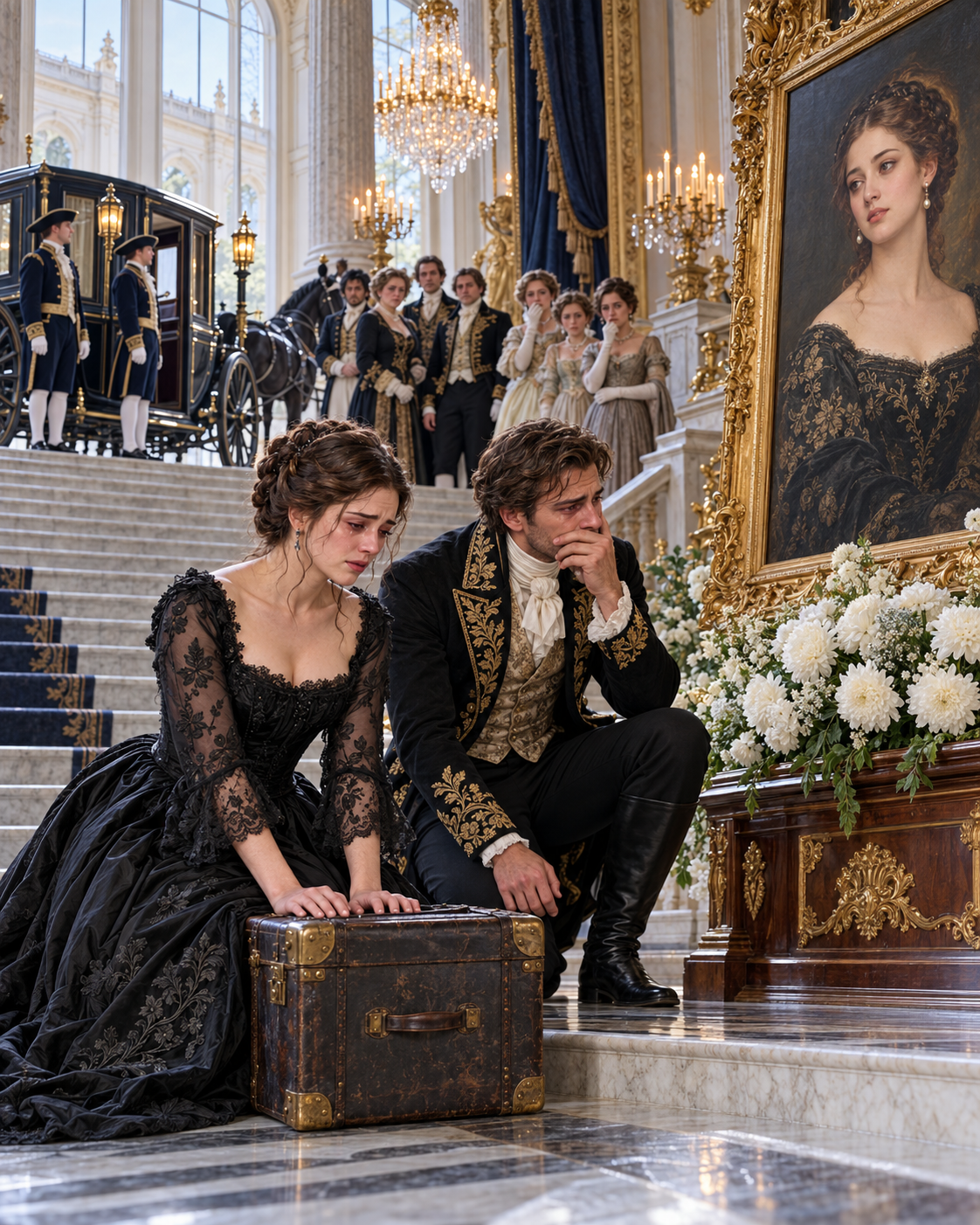
“I stood in that hall and watched you beg me to believe you. And I thought of the guests, the newspapers, the family name.”
He rubbed a hand over his face.
“I knew you. I knew the kind of woman you were. Yet I acted as though that mattered less than what strangers might say.”
Elian remained silent.
“I don’t expect you to forgive me tonight.”
He glanced toward the wedding ring lying in its velvet box beside him.
“But I had to ask whether there was any chance.”
Elian walked to the window.
Across the street, a lantern swayed above the baker’s door.
She remembered the first night she had arrived in Bramblewick.
She had sat alone in this same room, listening to strangers laugh downstairs, afraid to leave because someone might recognize her.
She had been a duchess with nowhere to go.
Now there were people expecting her at sunrise.
Children waiting for lessons.
Workers waiting for a decision about the mill.
A town slowly learning to stand again.
“Rodiran,” she said, “when I married you, I thought love meant building my life around yours.”
He looked up.
“I waited for your approval before making decisions. I stopped visiting people you disliked. I learned when to speak and when silence would make an evening easier.”
She turned from the window.
“I became very good at being your wife.”
Her voice remained calm.
“But somewhere along the way, I stopped knowing who Elian was.”
He swallowed.
“And now you do?”
“Not completely.”
A faint smile touched her face.
“But I intend to find out.”
Rodiran looked at the ring for a long time.
Then he closed the box.
“I understand.”
Elian watched him.
“No,” she said gently. “I don’t think you do yet.”
Three days later, Bramblewick awoke to a problem that threatened everything the townspeople had rebuilt.
A notice had been nailed to the mill gates.
The grain supplier from Westhaven was terminating his agreement.
All outstanding debts were due within fourteen days.
Failure to pay would result in seizure of the remaining equipment and storage buildings.
By breakfast, nearly every worker in town had heard.
By noon, a crowd had gathered outside the bakery.
Mr. Vale stood beside Elian, his face gray.
“Without those supplies, we can’t keep the ovens running.”
“And without the mill,” another man added, “half the town won’t have wages when winter comes.”
Elian examined the notice.
The supplier’s name was familiar.
Harwick Trading Company.
She had negotiated with its representatives during the shortage.
They had been difficult, but fair enough once she established regular payments.
Why would they suddenly withdraw?
“Has anyone spoken to Mr. Harwick?” she asked.
“He left for Westhaven yesterday,” said a worker.
“Who delivered this?”
“A solicitor.”
Elian turned the notice over.
A second signature appeared beneath the printed terms.
Morgan Estate Holdings.
Her fingers went cold.
She read it again.
The company holding the mill’s oldest secured debt was controlled by a Morgan family investment trust.
For a moment, the entire square seemed to recede.
Then Elian folded the notice.
“Find Mr. Vale’s account books. Every invoice, every repayment, every agreement.”
The workers exchanged uncertain looks.
“Miss Elian?”
“We’re going to find out exactly who believes this town belongs to them.”
By evening, Elian had the answer.
The mill had borrowed money years earlier to expand its machinery.
The loan had changed hands several times.
Eventually, it had been purchased by a Morgan family trust, whose officers had rarely taken any interest in Bramblewick.
Until now.
Three weeks before Rodiran arrived, the trust had begun demanding repayment.
The timing was too precise to ignore.
Elian brought the documents to the small office above the bakery.
Rodiran was waiting there with his solicitor, having arranged to remain nearby until the public statements were complete.
When Elian entered, he rose immediately.
“What’s happened?”
She placed the notice on the desk.
“Your family owns the debt on our mill.”
His solicitor adjusted his spectacles.
“The trust holds a number of industrial securities.”
“Then perhaps you can explain why this particular debt has suddenly been called.”
Rodiran read the notice.
His expression darkened.
“I knew nothing about this.”
“I believe you,” Elian said. “But I need more than that.”
The solicitor examined the signature.
“Lady Margaret retains authority to instruct the trust’s agents on certain investments.”
Rodiran closed his eyes briefly.
“Mother.”
The solicitor hesitated.
“There may be another explanation.”
“Find it,” Rodiran said.
Within an hour, they discovered the truth.
Margaret had ordered the trust to enforce its rights after learning that Elian intended to stay in Bramblewick.
She had not instructed anyone to burn the mill or destroy the town.
She had done something more ordinary.
She had used a debt to put pressure on people who could least afford it.
The strategy was simple.
If Bramblewick could no longer provide Elian with a livelihood, perhaps she would return to Morgan House.
Rodiran pushed back his chair so sharply that it struck the wall.
“She wouldn’t.”
His solicitor looked uncomfortable.
“The instructions are quite clear, Your Grace.”
Elian stood very still.
She thought of the children carrying firewood through the rain.
The elderly workers sorting damaged equipment by hand.
The families who had already endured months without steady wages.
All of it being used to force her back into a marriage.
Rodiran turned toward her.
“I’ll stop this.”
“You’ll need to do more than stop it.”
He nodded.
“Tell me what you need.”
Elian opened the account books.
“First, no gifts. No secret payments that leave us indebted to you.”
He looked surprised.
“Elian—”
“The town needs control of its future, not another person to whom it must bow.”
She pointed toward the figures.
“We can repay the legitimate debt over time if the terms are fair. We can establish a workers’ cooperative and secure the mill property permanently.”
Rodiran studied the calculations.
“That would require a great deal of money.”
“Yes.”
“And legal assistance.”
“Yes.”
“You’ve already thought this through.”
Elian looked at him.
“These people have been planning their future while your family has been planning mine.”
He lowered his gaze.
Then, quietly, he said, “Have your solicitor draw up the terms. I’ll see that the trust honors them.”
The confrontation took place the following morning.
Lady Margaret sat in the best room of the village inn, surrounded by trunks and silver-handled luggage.
She looked up as her son entered.
“You should have informed me you were coming.”
Rodiran closed the door.
“Did you order the mill debt called?”
Margaret’s teacup stopped halfway to her lips.
She set it down.
“That property has been a poor investment for years.”
“Did you order it?”
“Rodiran, you are letting your emotions—”
“Answer me.”
His voice was not loud.
That made it more difficult to dismiss.
Margaret straightened.
“Yes.”
He stared at her.
“You would ruin an entire town to bring Elian back?”
“I would do what is necessary to preserve this family.”
Rodiran walked toward the window.
For years, he had accepted his mother’s judgments as wisdom.
She had managed the estates after his father’s death.
Protected their social position.
Corrected every mistake before it became visible.
He had never noticed how often her solutions required someone else to suffer.
“Elian won’t return,” he said.
Margaret’s mouth tightened.
“She’s enjoying the attention. Once this little adventure becomes difficult enough, she’ll remember her responsibilities.”
Rodiran turned.
“She hasn’t forgotten her responsibilities.”
He paused.
“She simply stopped accepting ours.”
Margaret rose.
“You cannot seriously intend to choose that village over your own mother.”
“No.”
His expression remained steady.
“I’m choosing not to make the same mistake twice.”
He placed a document beside her untouched tea.
It revoked her authority to issue instructions through the family trust where his consent was legally required, and directed an immediate suspension of enforcement against Bramblewick.
Margaret stared at the papers.
“You would humiliate me before our own solicitors?”
Rodiran remembered Elian standing beneath the chandeliers, asking him to speak.
His answer came without hesitation.
“If necessary, yes.”
For a long moment, his mother looked at him as though she no longer recognized the boy she had raised.
Then she whispered, “She has turned you against me.”
Rodiran shook his head.
“No, Mother. She finally made me look at what I was defending.”
He left before she could answer.
The next weeks were difficult.
Legal documents had to be reviewed.
Creditors had to be persuaded.
New investors demanded guarantees.
Some townspeople feared that the Morgan name was simply taking control through another door.
Elian listened to every objection.
When an older mill worker accused her of inviting danger by involving her husband’s family, she did not silence him.
“You’re right to be careful,” she said. “That’s why no agreement will be signed without the workers seeing it first.”
The meetings grew longer.
Arguments sometimes lasted past midnight.
But gradually, something remarkable began to take shape.
A cooperative.
The workers would hold a controlling interest in the rebuilt mill.
Families could purchase small shares through affordable installments.
A separate reserve would protect grain purchases during future shortages.
And no single investor would have the power to close the mill simply because someone displeased them.
Rodiran helped arrange the lawful restructuring of the old debt, but he did not ask for a seat on the cooperative board.
When the final agreement was prepared, he signed the documents and stepped back.
Elian noticed.
She did not thank him immediately.
Some things deserved time before they were called redemption.
Then, on the morning the cooperative agreement was to be signed, the grain warehouse caught fire.
A thick column of smoke rose above the rooftops shortly after dawn.
The alarm bell rang wildly.
Elian was already in the square when a boy came running.
“The storage building! Someone’s inside!”
She dropped the documents she had been carrying.
“Who?”
“Mr. Vale!”
The baker had gone to inspect the newly delivered flour and had not returned.
Flames climbed the warehouse doorframe.
Workers formed a line from the water pump while others dragged sacks away from the spreading heat.
Elian ran toward the entrance.
Rodiran caught up with her.
“Elian, don’t.”
She pulled a damp cloth over her mouth.
“He may be unconscious.”
“Then we go together.”
Before she could protest, he soaked his coat beneath the pump and pushed through the doorway.
Inside, smoke pressed against them.
Burning beams cracked overhead.
Elian heard a faint cough near the rear storeroom.
“This way!”
They found Mr. Vale beneath a fallen shelf, one leg trapped under a heavy wooden support.
His face was pale.
“Leave me,” he rasped.
Elian knelt beside him.
“That isn’t how we do things here.”
Rodiran braced both hands beneath the timber.
“Help me lift.”
They pushed together.
The wood shifted.
Only a few inches.
Enough for Elian to pull the baker’s leg free.
Outside, someone shouted that the roof was failing.
Rodiran hauled Mr. Vale upright.
“Go!”
Elian helped guide the injured man toward the doorway.
Behind them, a beam collapsed with a violent crash.
The heat struck like an open furnace.
Rodiran stumbled.
Elian turned and caught his arm.
For one instant, he stared at her through the smoke.
“Don’t stop,” she ordered.
They reached the street seconds before part of the roof fell inward.
The crowd pulled them away.
Mr. Vale was carried to the doctor’s house.
Elian sank onto the cobblestones, coughing into her sleeve.
Rodiran knelt beside her.
His hands were burned, and a dark mark spread across his cheek.
“Are you hurt?”
She shook her head.
Then she saw his hands.
“You’re bleeding.”
“It’s nothing.”
“Rodiran.”
He fell silent.
She took a clean cloth from a nearby worker and wrapped his injured palm.
Neither mentioned the last time she had cared for him.
Neither needed to.
Across the street, the warehouse roof collapsed.
The sound echoed through Bramblewick.
Elian looked toward the smoke, knowing that much of their carefully purchased grain had been lost.
Mr. Vale’s bakery could not survive another winter without supplies.
The cooperative’s reserves were already stretched.
And someone had started a second fire just when the town was finally recovering.
By afternoon, the local constable discovered an oil-soaked rag beneath the rear warehouse window.
A lantern had been broken nearby.
The fire had not started accidentally.
Elian stood with Rodiran outside the damaged building while the constable examined the evidence.
“Someone wanted the grain destroyed,” she said.
Rodiran looked toward the narrow alley.
“Or wanted you frightened enough to leave.”
The constable approached.
“We’ve found a witness.”
A young stable boy had seen a man near the warehouse before dawn.
He described a dark coat, a leather satchel, and a horse tied behind the old tannery.
Rodiran asked one question.
“Did the man have a silver-handled walking stick?”
The boy nodded.
Elian turned toward him.
“You know who it was.”
Rodiran’s face hardened.
“I know who carries one.”
The man was Arthur Bellamy, a private agent occasionally employed by Morgan Estate Holdings.
The constable found him that evening attempting to leave Bramblewick.
Inside his satchel were travel papers, a receipt for lamp oil, and a letter bearing instructions from an intermediary connected to the family trust.
Margaret’s seal appeared on the covering correspondence authorizing Bellamy’s visit to Bramblewick.
But the instruction to set the fire was not there.
Bellamy, frightened by the possibility of imprisonment, admitted he had been ordered to make the warehouse unusable.
He claimed he had been told it would be empty.
His employer had promised payment once Elian abandoned the town.
The investigation uncovered the intermediary’s involvement, though it did not establish that Margaret had ordered the arson or even known of it.
That distinction mattered to Elian.
She refused to accuse anyone of a crime without evidence.
She remembered too clearly what it meant to be condemned by a convenient assumption.
When Margaret heard that Bellamy had been arrested, she came to the damaged warehouse herself.
Elian stood beside the charred remains of the doorway.
“You were willing to threaten this town’s livelihood,” Elian said. “Now someone has tried to destroy it.”
Margaret’s face had lost its familiar confidence.
“I never ordered a fire.”
“Then you should help the constable understand who acted in your name.”
The older woman looked toward the ruined building.
A worker was carrying a scorched wooden crate toward a cart.
A little girl followed him, holding one broken handle.
Margaret watched them for a long time.
“I thought you would come home,” she said at last.
Elian’s expression did not soften.
“You thought I would have nowhere else to go.”
Margaret closed her eyes.
“Perhaps.”
It was the first admission Elian had ever heard from her.
But it was not enough to erase what had happened.
Nor did Elian expect it to.
“Tell the truth about Clara,” she said. “Not in a private room. Not through a carefully chosen announcement. Tell the people who heard you accuse me.”
Margaret opened her eyes.
“And afterward?”
“Afterward, you live with what you’ve done.”
The public statement appeared in the county newspapers five days later.
Lady Margaret acknowledged that she had known Clara Whitmore was responsible for the missing necklace and had allowed Elian to be falsely accused.
Clara’s signed confession was formally recorded.
Rodiran issued his own statement, accepting responsibility for having banished his wife without proof or a fair hearing.
There was gossip, of course.
Invitations disappeared.
Old acquaintances suddenly discovered urgent reasons not to visit Morgan House.
Yet the world did not end.
The family estate remained standing.
The chandeliers still shone.
The gardens were still tended.
Only the carefully maintained illusion of an honorable household had been broken.
And Rodiran began to understand how small that loss was compared with what Elian had endured.
Winter arrived early in Bramblewick.
Frost settled on the roofs before sunrise, and the river began to freeze along its shallow edges.
The fire had destroyed more grain than the town could easily replace, but the cooperative was finally secure.
With donations from neighboring communities, emergency credit from independent merchants, and careful rationing, the bakery continued operating.
The rebuilding began again.
Elian worked beside the townspeople, keeping records, arranging deliveries, and helping establish a small schoolroom for children whose parents labored long hours.
One evening, Mrs. Fenwick found her sitting alone in the boardinghouse kitchen.
A cup of tea rested untouched beside her.
“You’ve been quiet today,” the older woman said.
Elian smiled faintly.
“Just tired.”
Mrs. Fenwick sat opposite her.
“That husband of yours came by earlier.”
Elian looked up.
“He brought the signed papers from Westhaven. Left them on the table and went away.”
She nodded.
“He said he didn’t want to disturb you.”
Mrs. Fenwick stirred her tea.
“Do you still love him?”
The question hung between them.
Elian watched the fire shift inside the stove.
For a long moment, she said nothing.
“Some days, I remember how he used to bring me flowers from the east garden because he knew I preferred them to the roses.”
Mrs. Fenwick listened.
“Other days, I remember him standing in that hall while everyone watched me leave.”
She rubbed a finger along the edge of her cup.
“Both memories belong to the same man.”
“And what will you do?”
Elian looked toward the window, where fresh snow had begun to fall.
“I don’t know what I’ll feel years from now.”
Then she drew a slow breath.
“But I know I won’t make a decision out of fear of being alone.”
Mrs. Fenwick reached across the table and squeezed her hand.
“That’s a good place to begin.”
On the first clear morning of spring, Bramblewick’s mill reopened.
The repaired roof gleamed beneath the sunlight.
New windows reflected the river.
Inside, machinery that had stood silent for months began turning again.
Families gathered along the street carrying flowers, bread, and small handmade banners.
Children raced between the carts while workers in clean shirts stood beside their wives and husbands.
Elian watched from the edge of the square.
She wore a simple green dress.
There were no jewels at her throat.
No elaborate hat.
Only a small silver pin given to her by the women who had organized the town’s food kitchen.
Mr. Vale approached carrying a folded speech.
“You’re supposed to stand at the front.”
Elian laughed softly.
“I’m quite comfortable here.”
“Well, the rest of us aren’t.”
He offered his arm.
“Come along.”
When they reached the platform, the crowd began to applaud.
Elian stopped.
For a moment, she could only look at them.
The workers who had carried her supplies through snow.
The mothers who had volunteered at the kitchens.
The children who had brought scraps of firewood when winter had been cruel.
People who had seen her exhausted, frightened, impatient, and uncertain.
People who had trusted her anyway.
Mr. Vale raised his hand.
“Before we reopen these doors, the committee has an announcement.”
Elian glanced at him.
He smiled.
“The cooperative has voted unanimously to establish a permanent community relief fund.”
Applause rose from the crowd.
“It will be named the Elian Fund, in honor of the woman who helped this town discover what it could do when everyone stood together.”
Elian shook her head.
“Mr. Vale, that’s far too generous.”
He leaned toward her.
“Then consider it repayment for all the times you wouldn’t let us give up.”
She looked away quickly, blinking against the unexpected sting in her eyes.
When she finally spoke, her voice was steady.
“I came here believing I had lost everything.”
The square became quiet.
“I thought losing a title meant losing my place in the world.”
She looked toward the newly repaired mill.
“But you showed me that a place isn’t something another person gives you.”
A breeze moved through the banners.
“It’s something we make, through the work we do and the way we treat one another.”
She paused.
“Please don’t remember this as something I accomplished alone. I couldn’t have rebuilt a single wall without you.”
The workers began applauding again.
This time, she let herself smile.
Rodiran stood at the back of the crowd.
He had arrived quietly and remained near the old stone bridge.
When the ceremony ended, Elian found him there.
For several moments, they watched the river together.
“The mill looks beautiful,” he said.
“It does.”
“Your speech was good.”
She smiled.
“You always said I spoke too softly.”
His expression changed.
“I was wrong about a great many things.”
Elian turned toward him.
He looked older than he had six months earlier.
Not physically, perhaps.
But the certainty that had once surrounded him had been replaced by something quieter.
He no longer seemed to expect the world to rearrange itself around his wishes.
“I came to tell you I’ve accepted the separation agreement,” he said.
Elian’s fingers tightened around the folded document she was carrying.
He continued before she could speak.
“My solicitor will finalize everything. Your income and property will be protected. There will be no conditions requiring you to return.”
She looked at him.
“And your mother?”
“She has withdrawn from managing the trust. She’s gone to stay with my aunt.”
He paused.
“She wrote you a letter.”
Elian waited.
“I told her she could send it if she wished, but I wouldn’t ask you to read it.”
The distant mill machinery hummed through the spring air.
Rodiran reached into his coat.
For one moment, Elian thought he might take out the velvet ring box again.
Instead, he handed her a small packet.
Inside were several letters she had written during the early years of their marriage.
Letters sent while he had been away on estate business.
She recognized her handwriting immediately.
“I found them in my study,” he said.
“I thought you might want them.”
Elian turned one over.
The paper had yellowed slightly.
On the back, in her younger handwriting, were the words she had once written without hesitation.
I hope one day we have a home where no one is afraid to speak honestly.
She stood very still.
Rodiran looked at the river.
“I didn’t give you that home.”
Elian carefully returned the letter to its envelope.
“No.”
He nodded.
Then he took a breath.
“I loved you, Elian.”
She met his eyes.
“I know.”
“I still do.”
A cart crossed the bridge behind them.
For a while, neither spoke.
Then Elian said, “I loved you too. Perhaps part of me always will.”
Rodiran looked at her, but she continued before hope could take shape.
“Love was never the only thing we needed.”
He lowered his eyes.
“I understand that now.”
She studied him for a moment.
This time, she believed he did.
Not because he had rescued her.
Not because he had signed documents or challenged his mother.
But because he had finally stopped asking her to reward his remorse with the future he wanted.
He had learned to let her choose.
“Take care of yourself, Rodiran,” she said.
“You too, Elian.”
He held out his hand.
She took it.
They stood that way for a moment, two people acknowledging the tenderness that had once existed between them without pretending it could undo the damage.
Then he released her.
Rodiran walked toward his waiting carriage.
He did not turn around.
Elian watched until it disappeared beyond the bridge.
There were tears in her eyes.
She let them fall.
Some endings were painful even when they were right.
Years later, travelers passing through Bramblewick would hear stories about the woman who helped rebuild the mill.
They would find a thriving town with a busy bakery, a cooperative grain store, and a small school beside the river.
They would see the relief fund’s name carved into a modest stone plaque near the square.
And sometimes, if they asked about Duchess Elian Morgan, a local resident would smile and point toward a woman in a simple dress, walking along the market street with a basket over her arm.
They might be surprised to discover that she still lived in Bramblewick.
She had purchased a small cottage overlooking the river, with a garden full of herbs and a study filled with books.
She served on the cooperative’s advisory council, taught reading at the school, and spent her evenings among friends who had never cared whether she wore diamonds.
Children continued to call her Miss Elian.
Older residents simply called her their friend.
One afternoon, a young woman arrived at her cottage.
She was newly married and had traveled from a neighboring village.
Her hands twisted nervously around the straps of her handbag.
“I hope you don’t mind my visiting,” she said.
Elian invited her inside.
They sat near the open window while sunlight moved across the wooden floor.
The visitor hesitated for a long time before speaking.
“My husband says I should be grateful for the life he gives me.”
Elian listened.
“He doesn’t like it when I disagree with him. And when I try to explain, he says I make everything difficult.”
The young woman’s voice grew smaller.
“Perhaps I do.”
Elian set down her teacup.
“May I ask you something?”
The woman nodded.
“When you imagine the person you hope to become, is she allowed to speak?”
The visitor looked startled.
Then her eyes filled with tears.
“I don’t know anymore.”
Elian reached for her hand.
“Then begin there.”
They spoke for nearly two hours.
Elian did not tell the young woman to abandon her marriage.
She did not promise that every difficult relationship could be repaired.
Instead, she listened, helped her consider what safety and respect should look like, and reminded her that a person’s worth did not depend on another person’s approval.
When the visitor finally rose to leave, her shoulders seemed a little straighter.
At the doorway, she turned.
“Did you ever regret not going back?”
Elian looked toward the garden.
The late afternoon sun rested on the flowers beside the stone path.
She thought of Morgan House.
Of the chandeliers.
Of the ring.
Of a younger woman who had once believed that being chosen by a powerful man was the greatest security life could offer.
Then she thought of Bramblewick.
Of the fire.
Of cold mornings spent carrying flour.
Of strangers who had become family.
And of the quiet, imperfect life she had built with her own hands.
“I regretted that we couldn’t become the people we needed to be while we were together,” she said.
“But I have never regretted learning that I could stand on my own.”
The young woman nodded.
After she left, Elian remained in the doorway for a few moments.
A familiar voice called from the garden gate.
“Miss Elian! Mrs. Fenwick says you’re late for supper!”
It was Mr. Vale’s grandson, now nearly grown.
Elian laughed.
“Tell her I’m coming.”
She closed the cottage door and walked toward the village.
The streets were bright with lanterns.
Warm voices drifted from open windows.
The mill turned steadily beside the river, its great wheel moving with the patient rhythm of work that belonged to everyone.
At the corner, two children ran up to take her hands.
Elian let them lead her toward the square.
She had once walked away from a magnificent house carrying a single trunk, believing that everything precious had been taken from her.
She had not known how much of herself she would find beyond its gates.
And perhaps that was the lesson Bramblewick remembered most clearly.
Dignity cannot be granted by a title, and love cannot survive on affection while trust is withheld.
An apology may deserve to be heard, but forgiveness does not create an obligation to return.
Sometimes people truly change, yet the life they once shared has already reached its end.
That does not make their growth meaningless.
It simply means that redemption and reconciliation are not the same thing.
Rodiran had found the courage to face his mistakes.
Elian had found the courage to stop building her future around them.
Neither journey erased the past.
But both allowed something better to begin.
That evening, as she entered the crowded dining room and heard her friends calling her to the table, Elian smiled.
Nobody stood because she was a duchess.
Nobody bowed.
Someone pulled out a chair.
Someone passed her a plate.
And a little girl leaned against her shoulder, asking whether she would come to the school tomorrow.
“Of course,” Elian said.
Outside, the last sunlight faded over Bramblewick.
Inside, there was laughter, warm bread, and room enough for everyone.
The woman who had once been banished from a palace had finally found a home where she never had to earn the right to stay.
And this time, she was there because she chose to be.
THE END.