The Duke had been told he could never father a child.
The Duchess stared at the document, her fingers growing cold around her husband’s letter.
“Who would lose everything?” she asked.
The gentleman hesitated, as though the answer required a delicacy he had not expected to need.
“Lord Edmund Vale, Your Grace. Your husband’s cousin.”
She knew the name.
Edmund Vale had been a frequent visitor to Ashcombe during the first year of her marriage. Charming, attentive, and unfailingly courteous, he had possessed the easy confidence of a man who belonged wherever he chose to stand.
Then, without explanation, his visits had ceased.
“What has Lord Edmund to do with my child?”
“Rather more than you might imagine.”
The gentleman placed the document upon the small writing table.
“Twenty-three years ago, after your husband’s illness, the late Duke executed a private settlement. Believing his son incapable of producing an heir, he arranged for a substantial portion of the Ashcombe properties to pass to Lord Edmund upon certain conditions.”
“What conditions?”
“That the present Duke should die without legitimate issue.”
The Duchess frowned.
“Then the arrangement is hardly unusual.”
“Ordinarily, no. But Lord Edmund was granted immediate control over several properties, together with their revenues, in anticipation of that inheritance.”
He paused.
“Your child’s birth would terminate those rights.”
She looked down at the papers.
“Then he must surrender what was never permanently his.”
“If the settlement were lawful, yes.”
Something in his tone disturbed her.
“And if it was not?”
The gentleman closed his document case.
“Then a great many people have been living comfortably upon money they were never entitled to receive.”
Before she could question him further, he withdrew a small card.
“My name is Nathaniel Harcourt. I represent the trustees of the original settlement. I would advise you to keep your pregnancy from public knowledge until the matter is resolved.”
The Duchess regarded him steadily.
“Is that advice intended for my protection, Mr. Harcourt?”
“For everyone’s protection.”
“That is not the same thing.”
For the first time, his polished expression faltered.
“No, Your Grace. It is not.”
After he departed, the Duchess remained standing beside the table.
She had entered marriage believing she would never be required to give Ashcombe an heir.
Now the child she carried threatened a fortune, exposed a deception, and had already cost her the trust of her husband.
Her maid, Mrs. Finch, approached quietly.
“Shall I send a reply to His Grace?”
The Duchess looked again at the letter.
She could almost hear her husband’s voice in its carefully measured sentences.
An apology.
A confession.
And a warning.
“Yes,” she said at last. “Tell him I will see him.”
Mrs. Finch reached for the writing paper.
“But not at Ashcombe,” the Duchess added. “And not until I know who has been watching me.”
At Ashcombe, the Duke had reached the second page of the settlement when he discovered the first unmistakable evidence of his father’s dishonesty.
An annual payment of twelve thousand pounds had been assigned to Edmund Vale.
The sum was enormous.
More troubling was a clause permitting Edmund to borrow against the revenues of three estates, provided the present Duke remained without legitimate children.
The Duke looked up.
“How much has he borrowed?”
The solicitor, Mr. Whitmore, appeared suddenly older.
“I cannot say precisely.”
“Then estimate.”
“Perhaps forty thousand pounds.”
The Duke slowly lowered the paper.
“Perhaps?”
Whitmore swallowed.
“The accounts have not been independently examined for several years.”
“Because my father forbade it?”
“Because Lord Edmund insisted that the arrangement was private.”
The Duke gave a short, humorless laugh.
“My cousin has been living upon my inheritance while I was taught that I could never have a child.”
Whitmore said nothing.
“And now that my wife is pregnant, the arrangement threatens to collapse.”
“Yes, Your Grace.”
The Duke walked toward the window.
His reflection stared back at him, pale and unfamiliar.
“When did my father learn that the diagnosis was uncertain?”
“Immediately after your illness.”
“And he nevertheless told me it was certain.”
“Yes.”
“Why?”
Whitmore’s silence stretched until the Duke turned around.
“Answer me.”
“Your father was deeply indebted after the disastrous investments of his younger years. Lord Edmund’s father offered to relieve those debts in exchange for the settlement.”
The Duke stared.
“My father sold the possibility of my children.”
Whitmore lowered his eyes.
“He believed that possibility did not exist.”
“No,” the Duke replied. “He chose to believe it did not exist because the alternative would have made his bargain inconvenient.”
He returned to the desk.
“And you helped him.”
The old solicitor’s expression tightened with shame.
“I drafted none of the original provisions. But I witnessed their execution, and I remained silent afterward.”
“For twenty-three years.”
“Yes.”
The Duke studied him for a long moment.
“Did anyone ever consider telling the boy whose life they had arranged?”
Whitmore’s voice was barely audible.
“No, Your Grace.”
The Duke turned away.
He remembered his father standing beside his childhood bed, speaking of duty with the solemnity of a judge pronouncing sentence.
You must never expect what other men expect.
You must learn to live without certain comforts.
He had obeyed.
He had trained himself not to dream of children.
And when he married, he had chosen a woman he believed would be spared disappointment by his condition.
Yet somewhere between their quiet dinners and shared silences, he had begun to want more.
He had simply been too frightened to admit it.
A knock interrupted his thoughts.
His secretary entered with a telegram.
“From London, Your Grace.”
The Duke unfolded it.
His wife’s reply contained only eleven words.
“I will meet you tomorrow. Come alone. I require the truth.”
He read it once.
Then handed Whitmore the settlement.
“Prepare a complete accounting of every payment made to Edmund Vale.”
“Your Grace, if Lord Edmund learns—”
“He will learn.”
The Duke reached for his coat.
“But this time, he will not be the first to know.”
The following afternoon, the Duchess waited in the drawing room of her rented London residence.
She had chosen a dark blue gown, the same one she had worn during their first winter at Ashcombe.
Her husband had once remarked that the color suited her.
It was one of the very few compliments he had offered without seeming embarrassed afterward.
When the door opened, she rose.
The Duke stopped just inside.
For a moment, neither moved.
He looked exhausted.
There were shadows beneath his eyes, and the immaculate composure she had come to associate with him had disappeared.
“Elizabeth.”
She had not heard him speak her name so gently in months.
“Your Grace.”
He flinched.
“I suppose I deserve that.”
“I did not invite you here to discuss what you deserve.”
“No.”
His gaze dropped briefly toward her waist.
She noticed, and her expression cooled.
“Please do not look at our child as though you are still deciding whether it belongs to you.”
The words struck him visibly.
“I know the child is mine.”
She remained silent.
“I know,” he repeated. “And I know that I have no right to expect you to believe my apology.”
“Then why have you come?”
He took a breath.
“Because you deserve an explanation. And because I am afraid.”
That surprised her.
Her husband had always treated fear as something to be concealed.
“Of what?”
“That my father’s lies may have placed you in danger.”
He told her everything.
The false certainty surrounding his childhood diagnosis.
The secret settlement.
Edmund’s financial interests.
The properties that would revert to their child upon birth.
She listened without interruption.
Only when he finished did she ask, “Did you marry me because you believed I could never give you an heir?”
He looked down.
“Yes.”
Her face changed.
He stepped forward, then stopped himself.
“But not for the reason you think.”
“Then tell me.”
“I thought I was offering you freedom.”
She gave a faint, wounded smile.
“Freedom from what?”
“From the expectations that destroyed my mother’s happiness. From being valued only for the children you might produce.”
He hesitated.
“I thought that if we expected nothing of each other, neither of us could be disappointed.”
“And were you disappointed?”
“Every day.”
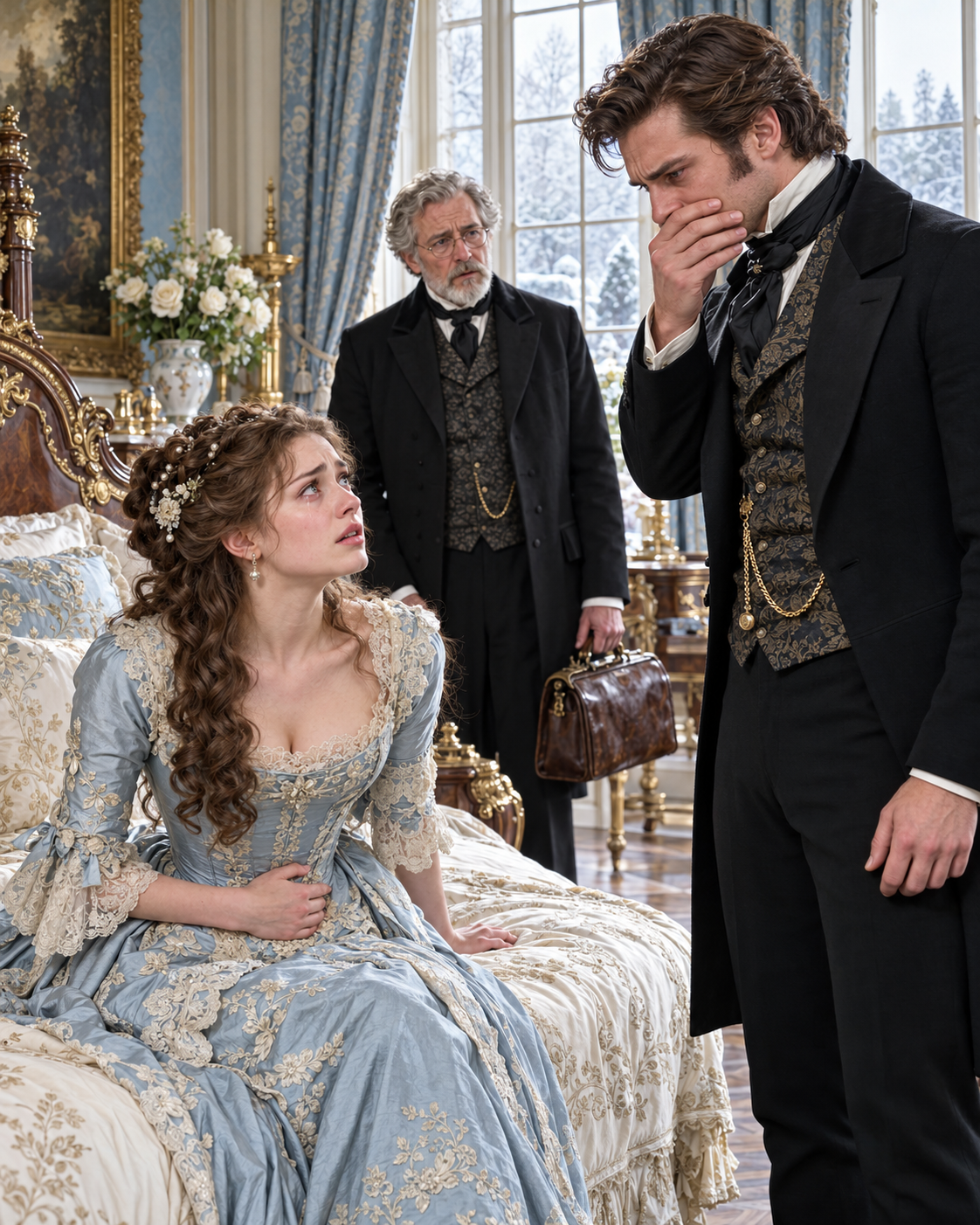
She stared at him.
“Not in you,” he said quickly. “In myself.”
His voice roughened.
“I wanted to speak to you at breakfast. I wanted to know what made you laugh when you read in the evenings. I wanted you to stay in the library after the fire had burned low.”
He looked at her with an honesty she had never seen before.
“And I was terrified that if I asked you to love me, you would discover there was nothing in me worth loving.”
Elizabeth turned toward the window.
For three years, she had mistaken his reserve for indifference.
Perhaps he had mistaken her patience for contentment.
But understanding did not erase the cruelty of his accusation.
“When I told you about the baby,” she said quietly, “I was frightened.”
He closed his eyes.
“I know.”
“No. You do not.”
She turned back.
“I had rehearsed the words for two days. I wondered whether you might smile. Whether you might take my hand. Whether, for once, we might share something without first agreeing on the proper way to behave.”
Her voice trembled.
“Instead, you made me feel ashamed of the happiest news of my life.”
He had no defense.
“I cannot undo that,” he said.
“No.”
“But I can spend the rest of my life refusing to repeat it.”
She looked away.
A long silence followed.
Finally, she said, “A gentleman came to see me yesterday. Nathaniel Harcourt.”
The Duke stiffened.
“What did he want?”
“He warned me that our child would ruin Edmund Vale.”
“Did he threaten you?”
“Not openly.”
The Duke’s expression darkened.
“Then he was careful.”
Elizabeth studied him.
“Do you believe Edmund capable of harming us?”
“I do not know.”
She rested a hand against her stomach.
“Then we must find out.”
He looked at her.
“We?”
“For the moment,” she said, “we have a common responsibility.”
He accepted the distinction without protest.
“And our marriage?” he asked.
She regarded him for several seconds.
“That will require more than one honest afternoon.”
Edmund Vale arrived at Ashcombe three days later, smiling as though he had been invited to a garden party.
The Duke received him in the library.
“My dear cousin,” Edmund began, extending his hand. “I hear congratulations may be in order.”
The Duke did not take it.
“Who told you?”
Edmund’s smile remained.
“London has always been a city of gossip.”
“The pregnancy has not been announced.”
“Then perhaps your servants are less discreet than you imagine.”
The Duke gestured toward a chair.
“Sit down.”
Edmund glanced at the papers arranged across the desk.
His smile faded.
“Ah.”
“Indeed.”
The Duke remained standing.
“I have examined my father’s settlement.”
“Then you understand how unpleasant this situation may become.”
“For you, certainly.”
Edmund crossed his legs.
“Do not be melodramatic, Ashcombe. The arrangement was legal.”
“The borrowing was not.”
For the first time, Edmund’s composure slipped.
“I beg your pardon?”
“Forty-six thousand pounds. Secured against properties you were never entitled to mortgage without the trustees’ approval.”
Edmund’s eyes narrowed.
“Your father understood my position.”
“My father is dead.”
“And he left obligations you cannot simply ignore.”
The Duke leaned forward.
“I can ignore no lawful obligation. I can, however, demand the return of money obtained through deception.”
Edmund stood.
“You think a child solves everything?”
“No.”
“Then consider what happens if the child is not born.”
The silence that followed was absolute.
The Duke spoke softly.
“Explain yourself.”
Edmund appeared to recognize his mistake.
“I meant that pregnancies are uncertain. Any prudent man would hesitate before dismantling an arrangement of such consequence.”
“Leave my house.”
“Ashcombe—”
“Now.”
Edmund’s face hardened.
“You have always been a fool where your father was concerned. He understood that affection is an expensive weakness.”
The Duke walked to the door and opened it.
“My father understood very little.”
Edmund paused beside him.
“Be careful. You have more to lose than money.”
When the carriage disappeared down the drive, the Duke summoned his secretary.
“Send word to London. Her Grace must not travel without someone she trusts.”
He hesitated.
“And find out everything you can about Nathaniel Harcourt.”
Two evenings later, Elizabeth discovered that the most dangerous man in the affair might not be Edmund.
Mrs. Finch entered her bedroom carrying a visiting card.
“Mr. Harcourt has returned, my lady.”
“I did not invite him.”
“He says he has evidence concerning the settlement.”
Elizabeth considered refusing him.
Then she remembered Edmund’s warning.
“Show him into the morning room. Leave the door open.”
Harcourt was waiting beside the fireplace when she arrived.
He seemed less assured than before.
“I owe you an apology,” he said.
“For intruding?”
“For not telling you everything.”
Elizabeth remained standing.
“That is becoming a familiar failing among gentlemen connected with Ashcombe.”
He accepted the rebuke.
“I do not represent the trustees.”
She went still.
“Then whom do you represent?”
“Lord Edmund.”
Her hand tightened upon the back of a chair.
“Why tell me now?”
“Because he has instructed me to obtain your signature upon a document relinquishing any claim your child might possess under the settlement.”
“An unborn child cannot simply be deprived of lawful rights by my signature.”
“Precisely.”
Harcourt opened his case.
“He knows that. The document is worthless without further proceedings. Its purpose is to create the appearance of uncertainty surrounding your child’s legitimacy.”
Elizabeth felt the blood drain from her face.
“Legitimacy?”
“He intends to revive the physician’s old diagnosis and argue that your husband cannot be the father.”
For a moment, the room seemed to tilt.
Her husband’s accusation, spoken in anger, was about to become a weapon in someone else’s hands.
“Why are you telling me this?”
Harcourt looked exhausted.
“Because I have a daughter, Your Grace.”
She waited.
“She is seven. My wife died bringing her into the world. Lord Edmund holds the mortgage on our home, and he offered to forgive it if I assisted him.”
“And now?”
“Now he has asked me to obtain copies of your private medical records.”
Elizabeth stared at him.
“I refused.”
“Why?”
“Because I imagined someone doing the same to my daughter one day.”
He withdrew a folded letter.
“This contains his instructions, written in his own hand.”
Elizabeth did not immediately accept it.
“Why should I trust you?”
“You should not.”
The answer startled her.
“But you should preserve the evidence.”
At that moment, a sharp noise sounded from the hallway.
Mrs. Finch appeared at the open door, pale and breathless.
“My lady, there is a gentleman downstairs asking for you. He says he comes from Ashcombe.”
Elizabeth glanced toward Harcourt.
“Did you bring anyone?”
“No.”
Mrs. Finch swallowed.
“He says His Grace has been injured.”
Elizabeth’s heart lurched.
“What?”
“He insists you must come immediately.”
Harcourt moved toward the window.
Outside, an unmarked carriage waited at the curb.
Its horses were restless.
He turned sharply.
“Do not go downstairs.”
A heavy footstep sounded beyond the hallway.
Then another.
Harcourt seized his document case.
“Mrs. Finch, lock the door.”
But before the maid could move, a man’s voice called from below.
“Your Grace, I have orders to bring you to your husband.”
Elizabeth stepped backward.
Harcourt spoke urgently.
“Lord Edmund does not intend to contest the inheritance in court.”
The Duchess stared at him.
“He intends to prevent there being an heir.”
The man on the staircase had scarcely reached the landing when Mrs. Finch slammed the morning-room door.
Harcourt pushed a chair beneath the handle.
“Is there another exit?”
“The servants’ stairs,” Elizabeth answered.
“Go.”
A violent blow shook the door.
She did not hesitate.
Mrs. Finch took her arm, guiding her through the narrow passage behind the drawing room.
They descended into the kitchens as the sound of splintering wood echoed above.
The cook stared at them.
“Good heavens—”
“Send for the constables,” Harcourt ordered. “And secure the front entrance.”
He led Elizabeth through the rear courtyard.
Cold rain struck her face.
A hired cab stood beside the neighboring house.
Harcourt raised his arm.
“Take these ladies to Bow Street,” he called to the driver.
Elizabeth stopped.
“What about you?”
He glanced toward the house.
“I intend to ensure those men do not follow.”
“Mr. Harcourt—”
“Tell your husband I am prepared to testify.”
Then he turned back.
Elizabeth climbed into the cab with Mrs. Finch.
Only when the horses began moving did she notice that she was trembling.
She pressed a hand against her stomach.
The child had not moved yet.
At twelve weeks, there was nothing she could feel.
Still, she whispered, “We are going to be all right.”
She did not know whether she was promising the baby or herself.
The Duke arrived in London shortly before midnight.
Elizabeth was waiting in the private sitting room of a magistrate’s residence, wrapped in a woolen shawl.
When she saw him, she stood.
He crossed the room so quickly that he nearly collided with the table.
“Are you hurt?”
“No.”
“Did they touch you?”
“No.”
His eyes moved over her face, searching for injuries.
Then his gaze fell to her hands.
They were shaking.
He stopped.
“May I?”
She understood.
After a moment, she nodded.
He took her hands between his own.
Neither spoke.
The magistrate had already received Harcourt’s statement. Two hired men had been arrested attempting to flee the residence, and a third had escaped.
The Duke listened as the evidence was explained.
Edmund’s instructions.
The forged appearance of a medical inquiry.
The attempt to remove Elizabeth from London under a false pretense.
At last, the magistrate said, “There is sufficient cause to investigate Lord Edmund, Your Grace. Whether he can be convicted will depend upon the evidence.”
The Duke’s expression remained cold.
“Then you shall have all of it.”
Later, when they were alone, Elizabeth sat beside the fire.
“I thought you had been injured,” she said.
The Duke looked at her.
“That was how they intended to make me leave.”
He lowered himself into the chair opposite her.
“I am sorry.”
She gave a weary sigh.
“You cannot apologize for every wicked thing your cousin does.”
“No.”
He looked toward the flames.
“But I must answer for the wicked thing I did.”
Elizabeth was silent.
“When you told me you were carrying our child, I treated you as an enemy. Today, a man attempted to use the same suspicion against you.”
His voice faltered.
“I gave him a weapon before he ever thought to reach for one.”
She studied him.
“Then take it away.”
He raised his eyes.
“How?”
“Stand beside me publicly. Tell the truth. Do not allow my honor to become a question men debate while I wait outside the room.”
He nodded.
“You have my word.”
For the first time since the morning in his study, she believed he understood what she had lost.
Not security.
Not position.
But the right to be trusted without first proving herself innocent.
The hearing began six weeks later.
By then, Elizabeth’s pregnancy could no longer be concealed beneath the careful folds of her gowns.
The Duke entered the chamber with her hand resting upon his arm.
Several gentlemen turned to stare.
He did not look away.
Edmund sat across the room beside his legal counsel.
His expression was confident until Nathaniel Harcourt entered carrying the original correspondence.
Whitmore testified first.
He admitted the uncertainty of the childhood diagnosis and explained the terms of the settlement.
Then the physician’s surviving records were introduced.
There had never been a conclusive finding of infertility.
Edmund’s counsel attempted to challenge the pregnancy.
The Duke rose before the man had finished his question.
“My wife has already endured an accusation that should never have been made,” he said.
The magistrate motioned for him to sit.
But the Duke continued.
“I made it myself.”
A murmur passed through the chamber.
Elizabeth turned toward him.
He faced the magistrate.
“I believed a statement my father had presented as certainty. When my wife told me she was expecting our child, I questioned her fidelity.”
His expression tightened.
“I was wrong.”
The room fell silent.
“And if any gentleman here believes my error entitles him to repeat that cruelty, he may direct his questions to me.”
The magistrate waited until the murmurs subsided.
Then he instructed the counsel to proceed only upon relevant evidence.
Harcourt’s testimony followed.
He produced Edmund’s written instructions.
A bank ledger confirmed unauthorized borrowing against the settled properties.
Finally, one of the hired men testified that he had been paid to remove the Duchess from her residence and hold her until she signed certain papers.
Edmund sprang to his feet.
“Lies!”
The man looked directly at him.
“You told us the lady must not be harmed unless she resisted.”
The chamber erupted.
The magistrate demanded silence.
Edmund’s face had turned an ugly shade of red.
“You cannot prove I intended violence.”
Harcourt calmly produced another letter.
“No,” he said. “But we can prove you authorized the abduction.”
By evening, Edmund had been committed for further criminal proceedings, and the disputed estate revenues had been placed under independent supervision.
It was not yet a conviction.
Nor did it repair the years of deception.
But the truth had finally been given a voice.
Outside the chamber, Elizabeth paused beside the carriage.
“You did not need to confess what happened between us,” she told her husband.
“Yes,” he replied. “I did.”
“Why?”
“Because I spent years allowing another man’s shame to govern my life. I will not allow my own shame to govern yours.”
She looked at him for a long moment.
Then she offered her hand.
He took it.
The following months were quieter.
Edmund was eventually convicted of fraud and conspiracy, while the remaining disputes over the settlement were resolved in favor of the Ashcombe estate.
The financial losses were substantial.
The Duke sold two properties and dismissed several men who had knowingly profited from the arrangement.
He also established a separate trust for his child, administered by individuals unconnected with his father’s household.
Yet the greatest change within Ashcombe House was not recorded in any account book.
The Duke began joining Elizabeth for breakfast.
At first, their conversations were awkward.
They spoke of the weather, the gardens, and the tenants.
Then, gradually, of things they had never dared mention.
Her childhood.
His mother’s loneliness.
The books she loved.
The music he had stopped playing after his father’s death.
One evening, she found him sitting at the pianoforte in the drawing room.
He played badly.
She laughed.
He stopped, looking startled.
“I was attempting something rather more impressive.”
“Then I fear you have failed.”
He smiled.
It was not a polite smile.
It reached his eyes.
She sat beside him.
“Try again.”
He did.
And when he struck the wrong note, she laughed once more.
This time, he joined her.
Their daughter was born in the early hours of a bitter January morning.
The labor was long.
By dawn, the Duke had worn a path across the corridor outside Elizabeth’s room.
Every cry from within made him stop breathing.
When the physician finally appeared, he rose so abruptly that his chair overturned.
“Your Grace.”
“Is she alive?”
The physician blinked.
“Both mother and child are well.”
The Duke gripped the back of the chair.
“A daughter, Your Grace.”
For a moment, he could not move.
Then he entered the bedroom.
Elizabeth lay against the pillows, pale and exhausted.
In her arms was a tiny bundle wrapped in white linen.
She looked up.
“Would you like to meet her?”
He approached slowly.
The child had dark hair and a solemn little face.
One miniature hand rested against her mother’s gown.
The Duke stared.
“She’s very small.”
Elizabeth smiled faintly.
“Most babies are.”
He laughed, though his eyes had filled with tears.
“May I hold her?”
Elizabeth placed the child carefully in his arms.
He stood motionless, terrified of moving.
The baby’s fingers opened against his hand.
Something in him gave way.
For twenty-three years, he had believed this moment impossible.
For months, he had feared he did not deserve it.
Now his daughter slept against his chest, entirely unaware of the fortune that had nearly been stolen from her, the lies that had threatened her life, or the pride that had once divided her parents.
“What shall we call her?” he whispered.
Elizabeth watched him.
“Grace.”
He looked up.
“Grace?”
“Because I think this family has been given more of it than we earned.”
The Duke bowed his head over his daughter.
“Grace Ashcombe,” he murmured.
Then he turned toward his wife.
“I love you.”
Elizabeth’s expression softened.
He had never spoken the words before.
“I know,” she said.
He swallowed.
“I should have told you sooner.”
“Yes.”
“And trusted you sooner.”
“Yes.”
He looked down, accepting both answers.
Elizabeth reached for his hand.
“But you are here now.”
He sat beside her, their daughter sleeping between them.
Outside, the winter sun rose over the gardens.
Years later, when Grace was old enough to ask why her father kept an old physician’s letter locked in his study, the Duke took it from the drawer and showed it to her.
“Was it important?” she asked.
“Very.”
“Did it make you happy?”
He considered the question.
“No. At first, it made me ashamed.”
“Then why do you keep it?”
He looked across the garden, where Elizabeth stood beneath the apple trees.
“To remind myself that a person can be certain and still be wrong.”
Grace frowned thoughtfully.
“Even you?”
“Especially me.”
She considered this extraordinary possibility.
Then she slipped her small hand into his.
“Mother says people should listen before they decide.”
The Duke smiled.
“Your mother is wiser than I am.”
Grace nodded solemnly.
“I know.”
He laughed and lifted her into his arms.
From the garden, Elizabeth turned toward the sound.
For a brief moment, sunlight caught the gold wedding band upon her finger.
She had taken it off once, believing her marriage might never recover.
She wore it now not because duty required her to remain, but because trust had been rebuilt through patient, deliberate acts of love.
The Duke watched her approach.
He had inherited a title, an estate, and generations of carefully preserved secrets.
But the most valuable thing he would leave his daughter was none of those.
It was the knowledge that truth matters more than pride, that an apology means little without changed behavior, and that love cannot survive where trust is denied.
His father had spent a lifetime fearing the child who might one day inherit Ashcombe.
The Duke had nearly lost that child through the same fear.
Now, with his daughter laughing in his arms and his wife walking toward him, he understood something his father never had.
An inheritance is not merely what we leave behind.
It is what we teach those who remain.
And the greatest legacy a father can give his children is not the certainty that he was always right, but the courage to admit when he was wrong.
THE END.