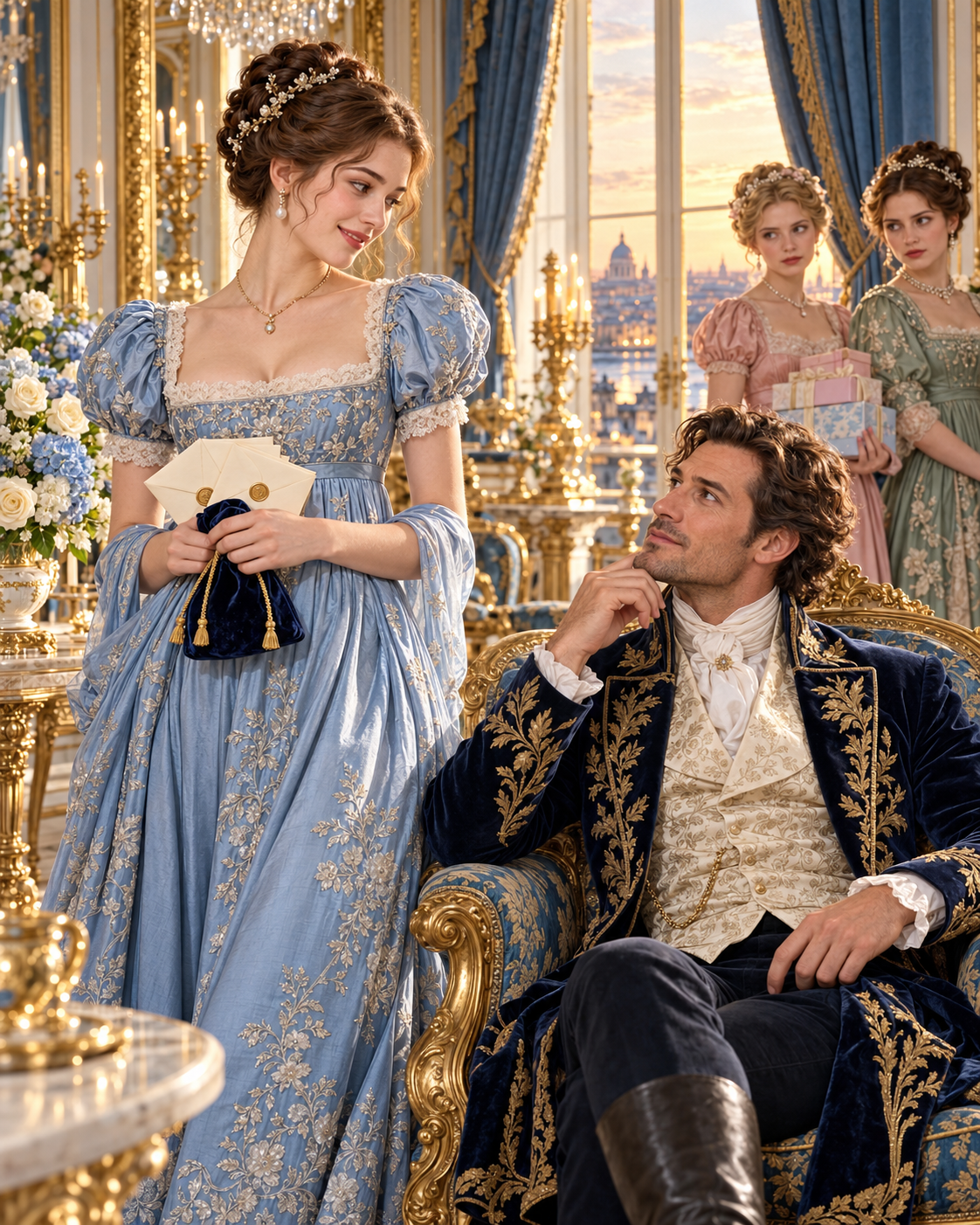
The duke gave three impoverished sisters £100 each to discover which one deserved to become his duchess.
The key turned slowly in the lock, and Clara felt Adrien’s hand close around her wrist.
Neither of them spoke.
Beyond the tall windows, rain swept across the courtyard, blurring the figures standing beside the waiting carriage.
Helena remained motionless beneath her umbrella, staring directly at the drawing-room window.
Then she raised one hand and pressed two fingers against her lips.
A warning.
Adrien moved toward the door and tested the handle.
It did not turn.
“Who has a key to this room?” Clara asked.
“Every senior servant in the house,” he replied, his voice dangerously quiet.
The elderly butler stood beside the fireplace, his silver tray trembling slightly.
“Mr. Whitcomb,” Adrien said, “did you know my mother intended to return tonight?”
The old man lowered his eyes.
“I was instructed not to discuss Her Grace’s movements, Your Grace.”
“By whom?”
Whitcomb hesitated.
Adrien took a step toward him.
“For once, I would appreciate an answer that doesn’t protect somebody else’s interests.”
“Your mother, sir.”
Outside, Helena suddenly moved.
She hurried toward the house, but the veiled woman caught her arm.
The wooden box slipped between them.
Clara saw something metallic flash beneath its loosened lid.
Then the carriage lantern went out.
“Adrien,” she whispered.
He was already crossing toward the bellpull.
He pulled it sharply.
Nothing happened.
The cord hung loose in his hand.
Someone had cut it.
For the first time since Clara had known him, the Duke of Blackmir looked genuinely uncertain inside his own home.
Then Whitcomb spoke.
“There is another way out, Your Grace.”
Adrien turned.
The butler approached the fireplace and pressed his palm against a carved wooden panel beside the mantel.
A narrow section of the wall shifted inward.
Clara stared at the dark passage beyond it.
“How long has that been there?”
“Longer than any of us,” Whitcomb answered.
Adrien looked from the passage to the old servant.
“And how long have you been keeping secrets from me?”
Whitcomb’s face tightened.
“Long enough to regret them, sir.”
The passage smelled of damp stone and extinguished candles.
Adrien took a lamp from the mantel, shielding its flame with his hand as Clara followed him inside.
Behind them, Whitcomb closed the hidden door.
Their footsteps echoed along the narrow corridor.
Somewhere overhead, a woman’s voice rose sharply.
Then came the sound of breaking glass.
Clara quickened her pace.
“Helena wouldn’t come here without a reason.”
“No,” Adrien said. “And my mother never acts without one.”
They emerged behind a tapestry near the western staircase.
The entrance hall below was empty.
The front doors stood open, allowing rain to blow across the polished marble floor.
The carriage remained outside.
But Helena and the veiled woman had disappeared.
A faint scraping sound came from the west wing.
Clara turned toward it.
Adrien caught her arm.
“Stay behind me.”
She looked at his hand until he released her.
“Walk beside me,” she said.
He held her gaze for a moment.
Then he nodded.
Together, they crossed the hall.
The west wing had been neglected for years.
Its windows were covered with heavy curtains, and the corridor smelled of wet plaster.
Water dripped steadily into a copper basin beneath the damaged ceiling.
Clara recognized the repairs Helena had paid for with Adrien’s hundred pounds.
Fresh timber supported one section of the wall.
New locks had been fitted to the doors.
And beneath the nearest window lay a strip of pale blue ribbon.
Helena’s ribbon.
Clara picked it up.
From behind the last door came a muffled voice.
“Please. You promised.”
Beatatrice.
Clara stopped.
Adrien reached for the handle.
Before he could turn it, another voice answered.
“Promises are useful only while everyone remembers their place.”
The voice belonged to his mother.
Adrien pushed the door open.
The Dowager Duchess of Blackmir stood beside a long oak table, her black veil lifted away from her face.
Helena occupied a chair near the window.
Beatatrice stood behind her, both hands clasped tightly around the backrest.
Between them sat the narrow wooden box.
The dowager duchess turned toward her son without the slightest sign of surprise.
“Adrien,” she said. “You were supposed to remain downstairs.”
He glanced at Helena.
“Are you being kept here against your will?”
Helena opened her mouth.
His mother spoke first.
“Nobody is being kept anywhere. We are discussing a private family matter.”
“Then perhaps everyone should be free to leave.”
A muscle moved in the older woman’s jaw.
Clara noticed it.
For all her composure, the duchess had not expected that answer.
Beatatrice took a step forward.
“Clara, I can explain.”
“Then explain.”
Her sister looked at the dowager duchess.
The older woman gave the smallest shake of her head.
Clara saw it.
So did Adrien.
“Mother,” he said, “sit down.”
The command settled over the room.
The dowager duchess looked at her son as though he had spoken in a foreign language.
“I beg your pardon?”
“You’ve spent years directing every conversation in this house. Tonight, you can listen.”
For a moment, she did not move.
Then she lowered herself into the nearest chair.
Clara approached Helena.
Her sister’s face was pale, but her eyes were clear.
“Are you hurt?”
“No.”
“Then why did you warn us away?”
Helena glanced at the wooden box.
“Because I found something I wasn’t meant to find.”
She lifted its lid.
Inside lay several folded letters, a tarnished silver key, and a narrow leather ledger.
Clara recognized the handwriting on the first envelope.
Their father’s.
The sight of it made her fingers go cold.
Their father had died four years earlier, leaving behind debts, unpaid rent, and a house the three sisters had struggled to keep.
He had been a quiet man who rarely discussed his business affairs.
Clara remembered him sitting by candlelight, reading documents with a troubled expression.
She remembered asking whether something was wrong.
He had smiled and told her not to worry about grown-up matters.
Now his handwriting lay before her in the house of a duke.
“Where did you get these?” Clara asked.
Helena touched the ledger.
“The western roof wasn’t the only thing that needed repairing.”
She explained how the workmen had discovered a sealed compartment behind the damaged wall.
Its wooden panel had loosened when they removed the rotten beams.
Inside was the box.
At first, Helena had thought it contained estate records.
Then she opened the ledger.
“Father worked for the Blackmir family,” she said.
Clara stared at her.
“What?”
“Before we were born. He managed several land purchases for Adrien’s grandfather.”
Adrien stepped closer.
“I’ve never heard his name mentioned.”
“That was rather the point,” the dowager duchess replied.
Everyone turned toward her.
She sat perfectly upright, her gloved hands resting in her lap.
“Your father discovered irregularities in the estate accounts,” she continued, addressing Clara. “He believed certain payments had been concealed.”
“Had they?”
The duchess looked away.
Adrien opened the ledger.
The entries were written in neat columns, with dates, amounts, and signatures.
Several pages carried his grandfather’s initials.
Others were marked with the name of a legal firm he recognized.
Then he saw the same sum repeated across six consecutive months.
£100.
The amount he had given each sister.
He looked toward his mother.
“Why this figure?”
She said nothing.
“Mother.”
Her fingers tightened.
“Because it was the monthly allowance your grandfather promised their father in exchange for his silence.”
The room became very still.
Clara looked down at the ledger.
One hundred pounds.
A sum she had refused because she believed it was being used to measure her worth.
A sum that had once been offered to purchase her father’s silence.
Adrien seemed to understand at the same moment.
“Did you know?” he asked his mother. “When I arranged the test?”
“I knew you were considering those girls as potential brides.”
“That’s not what I asked.”
The dowager duchess raised her chin.
“I suggested the amount.”
Adrien stepped back.
For several seconds, he could not speak.
Clara watched him look at the notebook page still folded in his hand.
His mother’s handwriting.
The warning beside Clara’s name.
The money.
The carefully managed introductions.
What had appeared to be his own foolish experiment had been shaped by someone who understood exactly what he feared.
“The test was your idea,” he said at last.
“Not entirely. You were already determined to judge them.”
“And you encouraged me.”
“I encouraged you to protect yourself.”
“From what?”
The duchess looked at Clara.
“From a family that might have reason to despise ours.”
Beatatrice made a small, wounded sound.
“That’s not what you told me.”
Clara turned toward her.
Beatatrice stood beside Helena, her beautiful gown creased at the sleeves.
For the first time, she looked younger than her years.
“What did she tell you?” Clara asked.
Beatatrice swallowed.
“She said our father had dishonored himself. That he accepted money from the Blackmirs and then tried to demand more.”
The dowager duchess closed her eyes briefly.
“Beatatrice, this is neither the time nor the place.”
“No,” Beatatrice replied. “You don’t get to decide that anymore.”
Her voice trembled, but she did not sit down.
“She said if Adrien married one of us, people might begin asking questions about our father. She told me to make certain he chose somebody else.”
Clara felt the words settle slowly.
“Somebody else?”
Beatatrice nodded.
“Anyone but you.”
Adrien looked sharply at his mother.
“Why Clara?”
The duchess remained silent.
Helena reached into the box and removed a second envelope.
“Because Clara is mentioned in these letters.”
She handed it to her youngest sister.
The paper had yellowed along the folds.
Clara opened it carefully.
The letter was addressed to a solicitor in London.
It described an agreement between her father and the late Duke of Blackmir concerning a parcel of land on the northern boundary of the estate.
Clara read the paragraph twice.
Then she looked at Adrien.
“The land wasn’t sold.”
He took the letter.
Their father had transferred the property to the Blackmir family under an agreement that certain proceeds would be held in trust for his children.
Those proceeds had never been paid.
Instead, the arrangement had disappeared from the estate records.
Clara looked again at the dates.
The agreement had been signed shortly before her birth.
She was named as one of the beneficiaries.
So were her sisters.
“This isn’t just about my father,” she said.
“No,” Helena replied. “It’s about what happened after he tried to recover what was owed.”
Adrien opened another letter.
It was dated six months before their father’s death.
The handwriting was shaky.
The letter described repeated requests for payment, unanswered correspondence, and a warning that further inquiries would damage his family’s reputation.
At the bottom was a sentence underlined twice.
I have no wish to expose anyone, but my daughters should not be left to suffer because I trusted the wrong man.
Clara pressed her lips together.
She remembered her father’s final winter.
The cold rooms.
The unpaid coal merchant.
The way he had pretended not to notice when Beatatrice divided one small loaf into four portions.
All those years, Clara had believed their hardship was simply an unfortunate turn of life.
Now she could see the outline of another possibility.
Her father had asked for something he believed belonged to his daughters.
And powerful people had made him afraid to ask again.
Adrien lowered the letter.
“Mother, who ordered the payments stopped?”
The dowager duchess looked toward the window.
Rain traced thin lines down the dark glass.
“Your grandfather died before the matter was resolved.”
“That wasn’t my question.”
She turned back.
“I did.”
The words were almost inaudible.
Beatatrice covered her mouth.
Helena stared at the floor.
Clara stood very still.
Adrien looked at his mother for a long time.
“Why?”
“Because the estate was in danger.”
“The estate?”
“Your grandfather left debts, Adrien. There were creditors everywhere. If the terms of that trust became public, other claimants might have demanded their share. We could have lost the house.”
He glanced around the neglected room.
The cracked ceiling.
The expensive furniture hidden beneath dust.
The generations of wealth preserved behind locked doors.
“And their family lost nearly everything instead.”
His mother did not answer.
“Did you know their father died still waiting?”
Her composure finally broke.
“I knew he was ill.”
Adrien’s face tightened.
“And you did nothing.”
“I was protecting your inheritance.”
He placed the ledger on the table.
“You were protecting a name.”
The duchess looked at him with an expression Clara had never seen before.
Not anger.
Fear.
“Everything I did,” she whispered, “was so you would never have to live as I once did.”
Adrien’s expression softened for an instant.
Then he shook his head.
“Then you should have taught me what it cost other people.”
Silence followed.
Somewhere beyond the walls, a distant clock began striking nine.
Clara folded her father’s letter.
She wanted to be furious.
Part of her was.
But anger did not seem large enough to hold the memory of all those small humiliations her family had endured.
The borrowed dresses.
The creditors.
Helena secretly selling their mother’s jewelry.
Beatatrice teaching herself to smile through invitations they could barely afford to accept.
And herself, refusing a hundred pounds without knowing how desperately that money had once been needed.
She looked at Beatatrice.
“Why didn’t you tell us?”
Her sister’s eyes filled.
“Because I thought I was helping.”
“By keeping me away from Adrien?”
“By keeping us out of a scandal.”
Beatatrice removed one glove and twisted it between her fingers.
“The duchess promised that if I behaved as she asked, she would introduce me to families who could help us. I thought I could secure our future without making you or Helena pay for it.”
Helena rose from her chair.
“You should have come to us.”
“I know.”
Beatatrice’s voice cracked.
“I was ashamed.”
Clara crossed the room.
For a moment, Beatatrice seemed to expect a reprimand.
Instead, Clara took the ruined glove from her trembling hands.
“You don’t have to earn your place beside us,” she said.
Beatatrice looked away, but not before Clara saw the tears gathering along her lower lashes.
Adrien turned toward Whitcomb, who had remained near the doorway.
“Send for Mr. Ellery.”
The butler hesitated.
“The family solicitor, sir?”
“No. Mr. Ellery represents my mother.”
Adrien thought for a moment.
“Send for an independent solicitor from London. Someone with no connection to this estate.”
His mother stood abruptly.
“Adrien, these documents must remain private.”
“Not if privacy is what allowed this to happen.”
“You could destroy everything your father built.”
He met her eyes.
“My father inherited this house. He didn’t build the truth beneath it.”
The dowager duchess seemed to shrink inside her black silk dress.
Adrien did not raise his voice.
He simply took the ledger and handed it to Clara.
“These belong to your family.”
Clara looked at the leather binding.
“And what happens now?”
“Now we find out exactly what you’re owed.”
She studied his face.
There was no performance in his expression.
No polished assurance that he could make everything right by morning.
Only a man beginning to understand the damage a family could conceal beneath generations of privilege.
“Not as a favor,” she said.
“No.”
“And not because of whatever exists between us.”
“Not because of that either.”
Clara nodded.
“Then we’ll speak again when the accounts have been examined.”
Adrien looked as though he wished to say more.
He didn’t.
That restraint mattered.
The following weeks were difficult.
The house at Blackmir became a place of unfamiliar visitors, sealed documents, and uncomfortable conversations.
An independent solicitor examined the ledger.
A second accountant reviewed the estate’s historical records.
Their findings confirmed that the sisters’ father had been entitled to payments under the trust arrangement and that substantial sums had remained unpaid.
The exact amount took months to establish.
Interest, missing records, and disputed valuations complicated the work.
Adrien insisted the investigation continue.
His mother withdrew from the household’s financial affairs.
For the first time in decades, decisions at Blackmir House were being made without her approval.
There were rumors.
Of course there were.
People who had once praised Adrien’s generosity began speaking of the scandal with carefully disguised pleasure.
Some suggested that the sisters had manipulated him.
Others whispered that Clara had planned the entire affair.
Adrien heard every version.
He answered none of them with excuses.
Instead, he placed the necessary documents before the proper authorities and instructed his advisers to cooperate.
The money owed to the sisters was eventually restored, together with the additional compensation agreed through the legal process.
But Clara refused to allow the settlement to become another elegant gesture from a powerful man.
Her family retained independent legal counsel.
Every document was read.
Every condition was questioned.
And when the final papers were signed, no promise of marriage appeared anywhere among them.
Helena used part of her share to restore their family home.
She also established a small fund to help repair cottages belonging to the poorest tenants on their former estate.
Beatatrice made a different choice.
She returned several expensive gifts she had received from acquaintances who had suddenly become interested in their renewed fortunes.
Then she began helping a dressmaker whose business was failing.
What began as a practical arrangement slowly became a partnership.
For the first time, Beatatrice discovered that beautiful clothes could be something she helped create, not merely something she wore to convince others of her importance.
Clara kept her portion of the inheritance largely untouched.
Not because she feared spending money.
Because she no longer wanted urgency to make decisions on her behalf.
She had lived too many years under the shadow of what her family could not afford.
Now she wanted to discover what she might choose without that fear.
And Adrien gave her the space to do it.
He continued writing.
Sometimes she answered immediately.
Sometimes several weeks passed.
His letters became quieter over time.
He wrote about the estate workers whose names he was learning, the books he had abandoned halfway through, and the uncomfortable discovery that many people had been agreeing with him simply because they depended upon his approval.
Clara replied with observations of her own.
She told him about Helena’s stubbornness, Beatatrice’s unexpected talent for business, and the small garden she had begun cultivating behind their restored house.
She also disagreed with him.
Frequently.
When he proposed funding a new village school entirely through the estate, she asked who would decide what the children were taught.
When he suggested replacing a row of tenants’ cottages, she asked whether he had spoken to the families living there.
At first, his replies contained explanations.
Later, they contained questions.
It was a change Clara noticed.
One autumn afternoon, nearly a year after the night in the west wing, Adrien arrived at her family’s home.
He came in a modest carriage, without servants in attendance.
Clara was in the garden, kneeling beside a stubborn rosebush.
Her gloves were covered in soil.
She looked up when his shadow crossed the path.
“Your Grace.”
“Miss Clara.”
“You’ve chosen an inconvenient hour.”
“I was beginning to suspect there would never be a convenient one.”
She smiled.
“That sounds suspiciously like impatience.”
“It probably is.”
He removed his coat and folded it over a garden bench.
“May I help?”
Clara looked at his immaculate shirt sleeves.
“You’ll ruin those.”
“I’ve ruined more expensive things.”
She handed him a small spade.
“Then start with the weeds.”
For nearly an hour, they worked side by side.
They spoke little.
The afternoon sunlight moved slowly across the garden wall.
A robin settled on the fence and watched them disturb the earth.
At one point, Adrien pulled up a young flower by mistake.
Clara examined it in his hand.
“That was meant to stay.”
He looked genuinely dismayed.
“Can it be saved?”
“Probably.”
She took it from him and gently returned its roots to the soil.
“Some things recover if they’re given enough care.”
Adrien watched her press the earth around the fragile stem.
“Clara.”
She looked up.
He had stopped working.
There was something in his expression she had seen before, on the evening he first apologized to her.
But this time he wasn’t standing behind an enormous desk.
There was no notebook.
No audience.
Only a man kneeling in the dirt, struggling to find the right words.
“I love you,” he said.
Clara’s hands became still.
Adrien glanced down briefly.
“I didn’t come here expecting an answer. I only thought you deserved to hear it plainly.”
She studied his face.
Once, she might have wondered whether he was sincere.
Now she knew how he looked when he was embarrassed, when he was angry with himself, and when he wanted to say something he feared she might refuse.
She also knew that love did not erase the past.
But perhaps it could grow somewhere beyond it.
“Adrien,” she said softly, “do you remember the first question I asked you?”
He smiled faintly.
“Whether I always put a price on a woman’s dignity.”
“And do you?”
“Not anymore.”
She brushed the soil from her gloves.
“Good.”
He waited.
Clara stood and held out her hand.
“Because I love you too.”
Adrien looked at her as though he had not quite understood.
Then he rose.
He took her hand carefully, his fingers warm despite the autumn chill.
For a moment, neither spoke.
The wind stirred the roses behind them.
Somewhere inside the house, Beatatrice laughed at something Helena had said.
Adrien lifted Clara’s hand and pressed his lips gently against her knuckles.
“Would you consider marrying me?” he asked.
Clara tilted her head.
“Are you asking the woman who refused your hundred pounds?”
“No.”
His answer came without hesitation.
“I’m asking the woman who taught me that affection cannot be purchased, and that respect means accepting an answer you may not like.”
She watched him for a moment.
“Then yes.”
He released a breath he seemed to have been holding for a very long time.
“But,” she added.
Adrien smiled.
“I rather expected that.”
“No grand announcement before we’ve told my sisters.”
“Agreed.”
“No extravagant wedding simply because society expects one.”
“Agreed.”
“And I intend to continue making decisions about my own inheritance.”
“Clara, I wouldn’t dream of suggesting otherwise.”
She raised an eyebrow.
He corrected himself.
“Not anymore.”
She laughed.
It was the first time Adrien had heard her laugh without holding something back.
They married the following spring.
The ceremony took place in a small church surrounded by flowering hawthorn.
There were no crowds of curious aristocrats, no elaborate displays of wealth, and no newspaper announcements listing the value of the bride’s inheritance.
Helena stood beside Clara.
Beatatrice adjusted her veil with shaking fingers, then stepped back to admire her work.
The dowager duchess attended quietly.
She sat near the rear of the church, her silver brooch pinned beneath a plain dark collar.
She had written to Clara several months earlier.
The letter contained no excuses.
Only an acknowledgment of what she had done, an apology, and the understanding that forgiveness might never be offered.
Clara had not replied immediately.
When she eventually did, she wrote that an apology mattered most when it was followed by different choices.
The dowager duchess had begun making them.
She had surrendered control of the remaining family accounts and contributed her own funds toward correcting other old estate obligations uncovered during the investigation.
It did not undo the suffering.
Nothing could.
But it was a beginning.
After the ceremony, Adrien and Clara walked through the churchyard together.
The spring air carried the scent of damp grass.
Their guests were gathering near the gate, where Beatatrice was already directing everyone toward the waiting carriages.
Adrien glanced at his wife.
“Do you ever regret returning that envelope?”
Clara considered the question.
“No.”
“Not even after discovering what the money represented?”
“Especially then.”
He looked curious.
She stopped beside the low stone wall.
“That money was never the measure of who I was, Adrien. And our inheritance was never a gift your family had the right to offer or withhold.”
He nodded.
“I know.”
She smiled gently.
“But I might have spent a little of it on something beautiful, had you simply given it without turning the day into an examination.”
Adrien laughed.
“What would you have bought?”
Clara looked toward the churchyard, where Helena was helping an elderly guest into a carriage.
“A new coat for Helena. She wore the same one through three winters.”
“And for yourself?”
Clara pretended to think.
“Perhaps a book.”
“Only one?”
“A very expensive book.”
He smiled and slipped his hand into hers.
They continued down the path as the bells began to ring.
Years later, the people of Blackmir would remember Clara not for the money she had inherited or the title she had acquired, but for the changes that followed her arrival.
Estate workers were given fairer agreements.
Tenants were consulted before decisions affected their homes.
Young women without fortunes received opportunities to learn trades and support themselves.
Adrien remained a duke, but he no longer mistook authority for wisdom.
And Clara remained the woman who would ask difficult questions when everyone else preferred silence.
Their marriage was not without disagreements.
Some evenings ended with doors closing a little too firmly.
Some decisions took longer than either wished.
But they learned to return to the same table, listen without preparing a defense, and remember that loving someone did not mean always being right.
On the tenth anniversary of their wedding, Adrien found Clara sitting by the library window with a familiar leather notebook resting on her lap.
He recognized it immediately.
The notebook from his disastrous matchmaking experiment.
“I thought that had disappeared,” he said.
“It nearly did.”
She opened it to the first page.
His old observations remained there, faded but legible.
Beatatrice: concerned with appearances.
Helena: practical and responsible.
Clara: difficult to assess.
Adrien winced.
“I was insufferable.”
“Quite.”
She turned the page.
Several sheets had been removed, leaving only their rough edges near the binding.
“Do you know why I kept it?” she asked.
“To remind me of my foolishness?”
“That has never required written assistance.”
He laughed and sat beside her.
Clara placed the notebook between them.
“I kept it because it reminds me how easily people mistake a single choice for an entire character.”
She ran a finger over her sisters’ names.
“Beatatrice wanted to be respected. Helena wanted to protect the people depending on her. I wanted the freedom not to participate.”
Adrien listened.
“None of us was wrong to want those things,” she continued. “We were simply frightened of different things.”
He looked down at the page.
“And I was frightened someone would love my fortune instead of me.”
“Yes.”
She closed the notebook.
“So you tried to make love something you could control.”
Adrien took her hand.
“And nearly lost the woman who would never allow it.”
Clara rested her head against his shoulder.
Outside, the first rain of the evening began to fall.
It sounded much like the rain that had struck the windows of Blackmir House on the night she returned his hundred pounds.
But there was no locked door.
No hidden listener.
No test waiting to be passed.
Only the quiet warmth of a room where neither needed to prove their worth.
Adrien reached for the notebook.
“What should we do with it?”
Clara looked at the fire.
For a moment, he thought she might suggest burning it.
Instead, she rose and returned it to the shelf.
“Keep it,” she said.
“Why?”
“Because people forget how they used to think when their lives become comfortable.”
Adrien stood beside her.
“And you think I need reminding?”
“We both do.”
She slipped her hand into his.
“Not of the mistakes themselves, but of what we chose to do after them.”
He kissed her forehead.
Together, they turned toward the window, watching the rain darken the garden paths.
The rosebush they had tended that autumn afternoon had grown tall against the stone wall.
Each spring, it produced more flowers than either of them could count.
It had never grown because someone demanded that it bloom.
It had grown because its roots were given room, its branches were tended, and its seasons were respected.
And perhaps that was the quiet lesson of their story.
Wealth could purchase comfort, influence, and the appearance of devotion.
It could open doors that poverty kept closed.
But it could not reveal the whole truth of a person’s heart.
A woman who bought a beautiful dress might be fighting to preserve her dignity.
A woman who repaired a broken roof might be carrying responsibilities nobody else could see.
And a woman who refused a gift might simply be asking to be treated as someone whose worth had never depended on accepting it.
Love was not the reward for passing another person’s test.
It began when the tests were put away, when pride gave way to listening, and when two people were finally free to meet without pretending.
For Adrien and Clara, the greatest fortune had never been the hundred pounds on his desk, the inheritance restored, or the estate that would one day pass to another generation.
It was the ordinary freedom to choose each other, again and again, without fear, obligation, or a price attached.
And in a house once governed by appearances and silence, that freedom became the most valuable inheritance of all.
THE END.