The duke discovered his wife was carrying his heir on the same morning she placed her wedding ring beside the divorce papers.
Cecilia’s fingers tightened around Adrienne’s sleeve, but the duke barely seemed to notice. He was staring at her with an expression she had never seen before, not even during the funeral of his first wife twelve years earlier. There was no confusion left in his eyes. Only a terrible, deliberate understanding.
“What did you mean by that?”
Cecilia glanced toward Edmund, who stood motionless beside the study door. For the first time in their long acquaintance, her brother offered her no assistance.
“Adrienne, you must understand that everything we did was intended to protect your family.”
“From whom?”
She swallowed.
“From the women who would have destroyed it.”
The duke slowly removed her hand from his arm.
“Rosalie has never harmed anyone.”
“She was never supposed to become your wife.”
The words escaped before Cecilia could stop them.
A silence settled over the corridor. Behind Adrienne, Mrs. Bell stood holding the message from the stable boy, her face pale beneath her neatly pinned gray hair.
Adrienne turned toward the footmen.
“Confine Lord Fairmont to the morning room. Send for the magistrate and my solicitor. Lady Cecilia is not to leave this house.”
Edmund took a step forward.
“You cannot detain us without evidence.”
Adrienne held up the intercepted letters.
“I have seventeen reasons to begin asking questions. The magistrate may decide whether the others are sufficient.”
Then he turned to Mrs. Bell.
“Have my horse saddled.”
“Your Grace, the roads are dangerous.”
“So is the woman who knows where my wife has gone.”
Within minutes, Adrienne was riding through the rain, accompanied by two trusted grooms and the estate’s head gamekeeper, Thomas Reed.
He had not ridden toward Fairmont House in twelve years.
The last time he had seen its gates, he had been a young husband grieving a woman he believed had died in her sleep.
Now every mile brought another memory into focus.
His first wife, Eleanor, had been gentle but unusually quiet during the final months of their marriage. She had stopped attending dinners. She had refused visits from Cecilia. Once, Adrienne had discovered her crying beside the library window, clutching a letter she refused to show him.
When he asked what troubled her, Eleanor had answered with a question.
“Do you trust the people who speak for you?”
He had laughed softly and kissed her forehead.
“Of course. Why shouldn’t I?”
She had looked away.
Three weeks later, he suffered a riding accident.
When he awakened, Eleanor was supposedly dead.
He had never questioned the physician’s explanation.
Until now.
At Fairmont House, Rosalie stood beside the drawing-room window, watching three riders dismount beneath the dripping trees.
The woman who had welcomed her into the house extinguished the final lamp.
“Move away from the window.”
Rosalie obeyed, although her eyes remained fixed on the approaching men.
“Are they here for you?”
“For both of us.”
The stranger crossed the room and opened a narrow cupboard concealed behind the paneling. Inside lay a leather satchel, a loaded pistol, and several bundles of documents tied with string.
Rosalie stared at the weapon.
“Who are you?”
The woman hesitated.
Then she removed the silver brooch from her dress and placed it in Rosalie’s palm.
The engraved initials were almost worn away.
E.W.
“My name is Eleanor Witcom.”
Rosalie felt the floor shift beneath her.
For several seconds, she could only stare.
“Adrienne’s first wife?”
Eleanor nodded.
“But he buried you.”
“He buried an empty coffin.”
Outside, a horse snorted sharply.
Eleanor moved toward the door.
“There is much I must explain, but first we need to survive the next ten minutes.”
Rosalie caught her wrist.
“Why did you bring me here?”
Eleanor looked at the younger woman’s hand resting protectively against her stomach.
“Because I know what happens when the Fairmonts discover a woman is carrying a child they cannot control.”
The words struck Rosalie with a force she could not immediately understand.
Before she could ask another question, someone knocked at the front entrance.
Three measured blows.
Then a man’s voice called through the door.
“Lady Witcom, we have been sent by His Grace to escort you home.”
Rosalie glanced at Eleanor.
“He doesn’t know where I am.”
“Precisely.”
The knocking came again.
Eleanor reached for the pistol.
“Take the documents. There is a servants’ passage behind the fireplace. It leads to the old kitchens and then to the orchard.”
“What about you?”
“I have spent twelve years running from these people. I am finished running.”
Rosalie looked at the woman’s scarred wrist, the gray strands hidden among her dark hair, and the remarkable steadiness of her hands.
Then she shook her head.
“No.”
Eleanor stared at her.
“Rosalie, you do not understand.”
“I understand enough. They separated you from your husband. They have done the same to me. And now they intend to decide whether my child lives.”
A heavy impact shook the front door.
Rosalie gathered the documents.
“We leave together.”
For a moment, Eleanor looked as though she might argue.
Instead, she reached for Rosalie’s hand.
They crossed the drawing room just as the front lock splintered.
The first man entered carrying a short hunting gun.
He saw the open cupboard and shouted to someone behind him.
“They’re still here!”
Eleanor pushed Rosalie through the concealed doorway.
They hurried down a narrow stone staircase, their footsteps muffled by the damp walls.
The passage smelled of earth and rotting timber. Somewhere overhead, boots struck the floorboards.
Rosalie held the satchel against her chest.
Her breathing had become uneven.
Eleanor noticed immediately.
“Are you in pain?”
“No. Only frightened.”
“Then keep looking at me. One step at a time.”
They reached the old kitchens, where a broken window admitted a narrow strip of gray daylight.
Eleanor pushed against the orchard door.
It did not move.
She tried again.
A chain rattled on the other side.
Someone had secured it.
Rosalie turned toward the staircase.
The footsteps were growing louder.
Eleanor examined the window.
It was narrow, but the lower frame had rotted.
“If we remove the wood, you may be able to climb through.”
Rosalie set down the satchel and helped her pull at the frame.
A nail tore the fabric of her glove.
Neither woman stopped.
Then a voice sounded behind them.
“That will be unnecessary.”
Edmund Fairmont stood at the kitchen entrance.
Rosalie froze.
He was carrying no weapon, but two armed men stood behind him.
His expression was almost apologetic.
“My dear Duchess, you have caused everyone considerable trouble.”
Eleanor stepped between him and Rosalie.
“Leave her alone.”
Edmund’s smile faded.
“Eleanor. I had hoped you would have learned something during your years of solitude.”
“I learned exactly what kind of man you are.”
He glanced at the satchel.
“Give me the papers.”
Rosalie tightened her grip.
“What is in them?”
Edmund studied her for a moment.
Then he sighed.
“Proof of a misunderstanding that should have remained buried.”
Eleanor gave a short, bitter laugh.
“Tell her about the inheritance.”
Edmund’s eyes hardened.
“Be quiet.”
“Tell her why you needed me declared dead.”
Rosalie looked between them.
Eleanor spoke before Edmund could intervene.
“When Adrienne’s father died, he left a considerable portion of the family investments under the protection of his son’s future wife. The money was intended to secure the duchess and any children born to the marriage.”
Rosalie frowned.
“Why would that concern the Fairmonts?”
“Because Edmund had borrowed against those investments using forged guarantees. Once I discovered the discrepancies, I intended to inform Adrienne.”
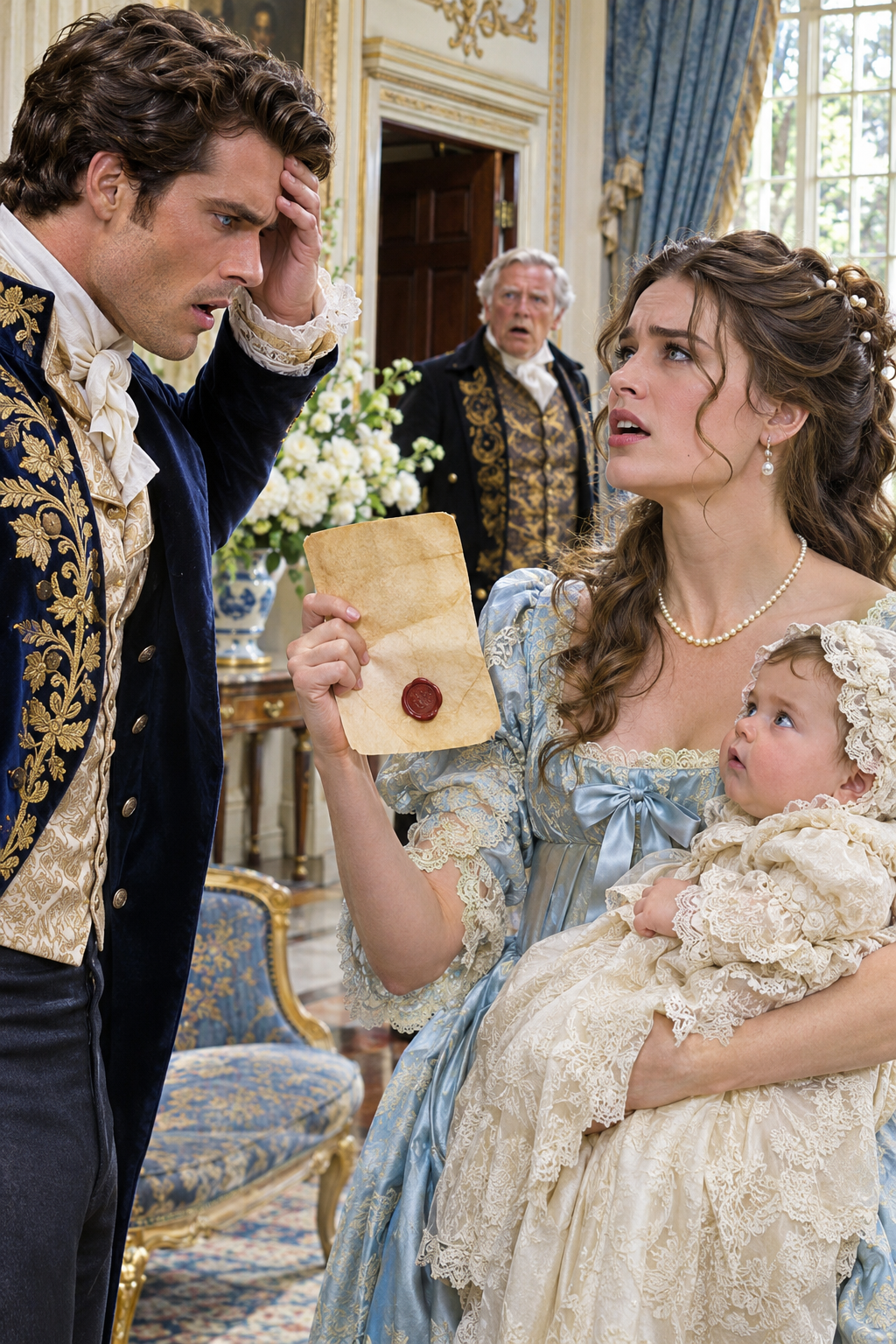
Edmund’s jaw tightened.
“You knew nothing of the circumstances.”
“I knew enough to recognize my husband’s signature had been copied.”
Eleanor turned toward Rosalie.
“Adrienne’s riding accident was arranged. While he lay unconscious, they produced a false death certificate and removed me from the estate.”
Rosalie stared at Edmund.
“Where did they take you?”
“To a private institution in the north. They claimed I was suffering from delusions and had become dangerous.”
Eleanor lifted her scarred wrist.
“I spent seven years trying to convince someone that I was not insane.”
For the first time, Edmund looked uncomfortable.
“Your condition was considered serious.”
“My condition was that I knew what you had stolen.”
The kitchen fell silent.
Rain struck the broken window.
Rosalie looked down at the satchel.
“And when Eleanor escaped?”
Edmund did not answer.
Eleanor did.
“They needed another duchess.”
Rosalie’s stomach tightened.
“Cecilia.”
“Yes. She expected Adrienne to marry her once his mourning ended. But he refused every proposal and withdrew from society.”
Eleanor glanced toward the window.
“Then you appeared.”
Rosalie remembered the strange circumstances of her engagement.
Adrienne had been courteous but reserved. Their marriage had been arranged after her father helped settle a longstanding dispute over the Witcom estates.
Cecilia had attended the wedding wearing pale silver.
She had embraced Rosalie afterward and whispered that the duke was a difficult man to love.
At the time, Rosalie had mistaken the warning for kindness.
“She never intended us to be happy,” Rosalie said.
Edmund adjusted his cuffs.
“Your marriage was inconvenient, certainly. But it might have been tolerated had you remained childless.”
Rosalie’s hand moved to her stomach.
Eleanor stepped closer.
“Do not listen to him.”
Edmund’s gaze settled on the younger woman.
“The arrival of an heir changes the distribution of the trust. Certain accounts become subject to an independent review.”
“And that would expose the money you stole,” Rosalie said.
His silence confirmed it.
A sudden noise came from the courtyard.
Hooves.
Shouting.
Then the unmistakable sound of Adrienne’s voice.
“Rosalie!”
Edmund turned sharply.
One of his men hurried toward the doorway.
A moment later, the crack of a gunshot echoed through the house.
Rosalie flinched.
Eleanor caught her shoulders.
“Stay here.”
But Rosalie was already moving.
She pushed past Edmund and ran toward the staircase, the satchel clutched beneath her arm.
Edmund caught her cloak.
The fabric tightened around her throat.
She twisted, struggling to free herself.
“Give me those papers!”
Rosalie pulled against him.
The clasp snapped.
Her cloak fell to the floor.
She stumbled backward into the stone wall.
A sharp pain spread through her side.
Eleanor struck Edmund’s arm with a heavy iron candlestick.
He released Rosalie with a cry.
The two armed men turned toward Eleanor.
Before either could move, Adrienne appeared at the kitchen entrance, followed by Thomas Reed.
His coat was soaked. Blood marked one sleeve, though he seemed unaware of it.
He saw Rosalie against the wall.
Then Edmund standing over her.
Something changed in his face.
“Step away from my wife.”
Edmund raised both hands.
“Adrienne, this is not what it appears.”
The duke crossed the kitchen in three strides.
He seized Edmund by the collar and forced him against the wall.
“Did you order those men to kill her?”
Edmund struggled.
“You cannot prove anything.”
Adrienne’s grip tightened.
“Answer me.”
“Adrienne.”
The voice came from behind him.
Soft.
Uncertain.
He turned.
Eleanor stood beside the broken window.
For several seconds, neither moved.
The duke stared at her as though the years between them had suddenly become visible in the air.
“Eleanor?”
She nodded.
His hand loosened around Edmund’s collar.
The man slipped to the floor, coughing.
Adrienne took one step toward Eleanor.
Then stopped.
“I saw your coffin.”
“I know.”
“They told me—”
“I know what they told you.”
He looked at the scar on her wrist.
His face drained of color.
“Where have you been?”
Eleanor’s eyes filled, but her voice remained steady.
“Waiting for someone to believe I was alive.”
Adrienne closed his eyes.
For twelve years, he had carried grief like a private obligation.
Now the woman he mourned stood before him, older and wounded, watching him with a sadness he could not begin to repair.
Behind them, Rosalie made a small sound.
Adrienne turned immediately.
She had lowered herself onto a wooden bench, one hand pressed against her abdomen.
He hurried toward her.
“Rosalie?”
“I’m all right.”
But her face had gone pale.
He knelt before her.
“You’re hurt.”
“Only my side.”
He reached for her hand.
She hesitated before allowing him to take it.
The hesitation hurt him more than any accusation could have.
“I am taking you home.”
Rosalie looked at him.
“That is no longer my home.”
He lowered his eyes.
For a moment, the duke seemed unable to speak.
Then he nodded.
“Then I will take you wherever you wish to go.”
Thomas Reed appeared at the doorway.
“The men have been disarmed, Your Grace. One attempted to flee, but the others are holding him outside.”
Adrienne stood.
“Secure Lord Fairmont as well. No one is to leave before the magistrate arrives.”
Edmund laughed bitterly.
“You think this ends with my arrest?”
Adrienne turned toward him.
“No. It begins there.”
By evening, Fairmont House was surrounded by constables.
The magistrate arrived with Adrienne’s solicitor, Mr. Ashcombe, who examined the documents Eleanor had preserved.
The evidence was extensive.
There were forged medical certificates, altered financial records, letters bearing counterfeit signatures, and a private ledger documenting payments made to the physician who had declared Eleanor dead.
Most damning was a letter written by Cecilia herself.
It instructed the institution’s director to ensure Eleanor remained isolated, regardless of any improvement in her supposed condition.
Ashcombe read the letter twice.
Then he removed his spectacles.
“This is sufficient to begin a criminal prosecution.”
Eleanor sat quietly beside the fire.
She had not spoken since giving her statement.
Rosalie watched her from across the room.
The older woman’s hands were folded in her lap, but her fingers trembled whenever someone mentioned the institution.
Adrienne approached Eleanor.
“I should have found you.”
She looked up.
“You were told I was dead.”
“I should have questioned it.”
“Perhaps.”
He sat opposite her.
“I don’t know how to apologize for twelve years.”
Eleanor studied the fire.
“Then don’t attempt to fit them into an apology.”
The words were not cruel.
They were simply true.
After a long silence, she continued.
“You were not the man who imprisoned me, Adrienne. But you were a man who allowed other people to decide what was true.”
He looked toward Rosalie.
Eleanor followed his gaze.
“Do not make the same mistake twice.”
That night, Rosalie was examined by a physician summoned from a nearby village.
The child appeared unharmed, but she had bruised her side and needed rest.
Adrienne waited outside the bedroom while the examination took place.
He did not enter without permission.
When the physician finally emerged, he looked visibly relieved.
“Her Grace and the child are stable. She must avoid further strain.”
Adrienne thanked him.
Then he remained beside the closed door.
An hour passed.
At last, Rosalie called softly from within.
“You may come in.”
He entered carrying a tray of tea.
She was sitting against the pillows, her hair loosened over one shoulder.
The room smelled of lavender and damp wood.
He placed the tray on a small table.
“I thought you might want something warm.”
“Thank you.”
He stood awkwardly beside the bed.
Rosalie watched him.
“You look as though you’ve forgotten how to sit.”
A faint smile touched his mouth.
“Perhaps I have.”
She gestured toward the chair.
He sat.
For a while, neither spoke.
Then Adrienne reached into his coat and withdrew a small bundle tied with blue ribbon.
Her letters.
“I read them.”
Rosalie’s expression changed.
“All of them?”
“Every one.”
She looked toward the window.
“I wish you had read them when I wrote them.”
“So do I.”
He placed the letters on the table.
“I cannot ask you to forget what those two years were like.”
“No.”
“And I cannot pretend that Cecilia’s interference excuses everything.”
Rosalie turned toward him.
He continued quietly.
“She prevented your letters from reaching me. But she did not prevent me from coming to your room, asking whether you were happy, or noticing when you stopped smiling.”
Rosalie’s fingers tightened around the blanket.
Adrienne looked down.
“I allowed silence to become a habit because it was easier than risking another loss.”
She studied his face.
“Did you ever love me?”
He took a long breath.
“I admired you from the beginning. I wanted to know you. But every time I began to care, I remembered Eleanor, and I convinced myself that affection would only lead to grief.”
Rosalie’s eyes glistened.
“So you made certain I grieved instead.”
He accepted the words without protest.
“Yes.”
The fire shifted in the hearth.
She looked at the letters.
“I spent two years wondering what was wrong with me.”
“Nothing was wrong with you.”
“I know that now.”
Her answer was quiet, but it carried a certainty he had never heard from her before.
Adrienne nodded.
“I have instructed Ashcombe to prepare the separation papers properly. Whatever settlement you request will be granted.”
Rosalie looked surprised.
“You won’t contest them?”
“No.”
“Even with the child?”
His eyes moved toward her stomach.
For a moment, she saw the pain he was trying to conceal.
“Our child deserves two parents who act with kindness. I will not begin by forcing its mother to remain where she is unhappy.”
Rosalie looked away.
She had prepared herself for anger, threats, and arguments over the heir.
She had not prepared herself for the possibility that Adrienne might finally listen.
Three days later, Cecilia Fairmont was brought before the magistrate.
She arrived wearing a dark green gown and a veil that concealed much of her face.
Her composure lasted until Eleanor entered the chamber.
Then Cecilia gripped the edge of the witness bench.
“You.”
Eleanor stopped several feet away.
“Yes.”
Cecilia looked toward Adrienne.
“She is lying. You know what she was like.”
Adrienne did not answer.
Eleanor stepped forward.
“Tell them why you paid Dr. Harrow to sign my death certificate.”
Cecilia’s mouth tightened.
“I paid him for medical services.”
“And why did you send money to the institution every quarter for seven years?”
“Charity.”
Eleanor nodded.
“Then perhaps you can explain this.”
She handed the magistrate a small notebook.
Its pages contained dates, amounts, and names.
Cecilia’s eyes widened.
Edmund, seated beside his solicitor, suddenly leaned forward.
“Where did you find that?”
Eleanor looked at him.
“Your father kept better records than you realized.”
The notebook had belonged to the late Lord Fairmont.
He had discovered the financial fraud shortly before his death and had begun recording suspicious transactions.
Eleanor had obtained it through an elderly servant who once worked at Fairmont House.
The servant had hidden the notebook inside a false-bottomed sewing box.
For years, Eleanor had protected it, waiting for a chance to bring the evidence before someone beyond the Fairmonts’ influence.
The magistrate turned several pages.
Then he looked at Cecilia.
“Lady Fairmont, I suggest you consider your next answer carefully.”
Cecilia stared at the notebook.
Her expression slowly collapsed.
“It was supposed to be temporary.”
Edmund turned toward her.
“Cecilia.”
She ignored him.
“Adrienne was supposed to marry me. Our families had discussed it for years. Then Eleanor arrived, and everything changed.”
Eleanor stood motionless.
Cecilia’s voice sharpened.
“She discovered Edmund’s financial arrangements. She threatened to expose him. Do you understand what that would have done to our family?”
“It would have exposed a crime,” the magistrate replied.
Cecilia looked toward Adrienne.
“We only needed time. Once Eleanor was gone, you would have recovered. You would have married me.”
Adrienne’s face remained still.
“And Rosalie?”
Cecilia looked away.
“She was never meant to matter.”
The words seemed to drain the remaining warmth from the room.
Rosalie, seated near the rear beside Mrs. Bell, lowered her eyes.
Adrienne turned toward her.
For the first time, he understood how easily a person could disappear while still standing directly in front of someone.
The proceedings continued for several hours.
Cecilia and Edmund were committed for trial on charges arising from the forged documents, unlawful confinement, financial fraud, and the attack at Fairmont House.
Their secretary, Hargreaves, agreed to cooperate after investigators discovered payments deposited into an account held in his sister’s name.
Dr. Harrow was arrested two days later.
The private institution’s surviving records confirmed Eleanor had been confined under a false identity.
Yet one legal problem remained.
Eleanor was alive.
And her marriage to Adrienne had never been lawfully dissolved.
When Ashcombe explained the consequences, Adrienne felt the weight of another injustice settle upon him.
His marriage to Rosalie, solemnized in good faith, was legally invalid.
The news reached Rosalie in the garden of the small country house where she had chosen to recover.
She was sitting beneath a bare apple tree when Adrienne arrived.
He had asked permission to visit.
She had agreed.
Now he stood before her holding the solicitor’s opinion.
“I wanted you to hear it from me.”
Rosalie listened without interrupting.
When he finished, she looked at the ring she had once worn.
It rested in a small velvet box beside her chair.
“So I was never truly your wife.”
Adrienne’s expression tightened.
“You were my wife in every way that mattered to me.”
She looked up.
“Was I?”
He had no immediate answer.
The silence stretched between them.
Then he said, “I am beginning to understand that a title means very little when the person carrying it feels alone.”
Rosalie closed the box.
“What will happen to Eleanor?”
“She has requested a legal dissolution of our marriage. Ashcombe believes the circumstances provide strong grounds, though the process will take time.”
“And what does she want?”
Adrienne glanced toward the garden wall.
“Her freedom. Her name restored. Her property returned.”
Rosalie nodded.
“Then help her obtain them.”
“I intend to.”
She studied him for a moment.
“And afterward?”
He looked at her.
“That depends on what you want.”
Rosalie rested a hand on her stomach.
“I want peace. I want my child to grow up without wondering whether love must be earned by remaining silent.”
Adrienne swallowed.
“And if I wished to become part of that life?”
“Then you would have to learn how to be present without being asked.”
He nodded slowly.
“I can try.”
“Trying is a beginning, Adrienne. It is not a promise fulfilled.”
For the first time, he understood that she was not asking him to convince her.
She was asking him to change.
The following months were not simple.
Eleanor’s legal proceedings exposed years of concealed corruption. The Fairmont estates were placed under financial supervision, and money wrongfully taken from the Witcom trust was gradually recovered.
Eleanor testified publicly about her confinement.
Her voice trembled at first, but she did not withdraw a single accusation.
When the court formally restored her identity and recognized the grounds for dissolving her marriage, she stepped outside into the spring sunlight without a veil.
Adrienne was waiting near the courthouse steps.
“I have arranged for the property at Westhaven to be transferred into your name,” he told her.
Eleanor looked surprised.
“That house belonged to your mother.”
“She was fond of you.”
Eleanor’s eyes softened.
“She was.”
He hesitated.
“I cannot give you back the years.”
“No,” she said gently. “But you can stop allowing them to decide the years ahead.”
She offered him her hand.
He took it.
Their farewell was quiet.
There were no declarations, no promises to recover what had been lost.
Only two people acknowledging that affection could survive without demanding possession.
Eleanor moved to Westhaven and began helping women who had been confined or deprived of their property through fraudulent legal arrangements.
For the first time in twelve years, she made decisions without asking anyone’s permission.
Adrienne returned to Witcom Manor alone.
He dismissed the servants who had knowingly assisted Hargreaves and reorganized the household so that no private secretary could again control his personal correspondence.
He began visiting the tenants personally.
He listened to their concerns.
He answered letters in his own handwriting.
And every Sunday, he traveled to Rosalie’s country house.
Sometimes she invited him inside.
Sometimes they walked through the garden.
Sometimes she was tired and asked him to return another day.
He always respected her answer.
One afternoon, he arrived carrying a small wooden cradle.
Rosalie stood in the doorway, watching two footmen carefully unload it.
“What is that?”
“A cradle.”
“I can see that.”
Adrienne looked almost embarrassed.
“I made it.”
She stared at him.
“You?”
“The carpenter helped with the joints.”
Rosalie approached the cradle.
Its surface was smooth but imperfect, and a small flower had been carved into one side.
She touched the carving.
“A violet?”
Adrienne nodded.
“There was one pressed inside your fifth letter.”
Rosalie looked up.
He remembered.
Not merely the words.
The flower.
For a moment, she could not speak.
Then she said, “You may put it in the nursery.”
It was the first time she had invited something of his into the child’s room.
Adrienne did not mistake the gesture for forgiveness.
But he carried the cradle upstairs himself.
Their daughter was born on a clear September morning.
Rosalie named her Clara Eleanor.
Adrienne arrived shortly after the birth, having ridden through the night when the message reached him.
He stopped at the bedroom threshold.
Rosalie was resting against the pillows, a small bundle in her arms.
“May I come in?”
She smiled faintly.
“Yes.”
He approached slowly.
When she placed the child in his arms, he looked down at the tiny face and seemed to forget how to breathe.
Clara opened one hand.
Her fingers closed around his.
Adrienne sat beside the bed, tears gathering silently in his eyes.
“Hello, little one.”
Rosalie watched him.
He did not speak of heirs or titles.
He did not mention the future of the duchy.
He simply held his daughter.
Over the following weeks, he learned to change her linen, warm her milk when Rosalie needed rest, and recognize the small sounds that meant she was hungry or uncomfortable.
He made mistakes.
Once, he fastened a blanket so awkwardly that Mrs. Bell had to intervene.
Rosalie laughed for the first time in his presence without immediately looking away.
Adrienne looked at her.
The sound seemed to astonish him.
“What?”
“Nothing,” he said.
But he smiled for the rest of the afternoon.
Winter came again.
The trees around the country house stood bare beneath a pale sky.
One evening, Rosalie found Adrienne sitting beside Clara’s cradle, reading aloud from a book of children’s stories.
The baby was asleep.
He continued reading softly anyway.
Rosalie leaned against the doorway.
“She cannot understand you yet.”
“I know.”
“Then why continue?”
He closed the book.
“Because I want her to grow up knowing that when someone speaks to her, I will be there to listen.”
Rosalie remained silent.
Adrienne rose.
“I should leave before the roads freeze.”
She looked toward the window.
Snow had begun to fall.
“You could stay for supper.”
He turned.
“Are you certain?”
“Yes.”
He smiled.
It was a small invitation.
But it was hers to give.
By the following spring, the legal questions surrounding Adrienne’s marriages had been resolved, and Clara’s rights and financial security had been formally protected.
Rosalie had no need to marry him for her daughter’s sake.
She had her own home, her own income, and the freedom to make her own choices.
Adrienne knew this.
He had come to value it.
One afternoon, they walked together through the orchard while Clara slept in a carriage beneath Mrs. Bell’s watchful eye.
The apple trees were beginning to blossom.
Adrienne stopped beside the oldest tree.
“I have something to ask you.”
Rosalie looked at him.
He reached into his coat.
For an instant, she thought he might produce the old wedding ring.
Instead, he held out a small velvet box containing a simple gold band.
No family crest.
No elaborate jewels.
Just a ring.
“I loved you badly,” he said.
Rosalie’s eyes filled.
He continued before she could answer.
“I confused distance with protection. I thought silence would keep me from losing someone again. Instead, I nearly lost you because I refused to see you.”
He opened the box.
“I am not asking you to return to the marriage we had. I am asking whether you would consider building a different one with me.”
Rosalie looked at the ring.
Then at the man holding it.
“Would you still want me if I never became Duchess of Witcom again?”
Adrienne answered without hesitation.
“Yes.”
“If I wanted to remain here?”
“Then I would come here.”
“If I disagreed with you?”
“I would listen.”
She studied him carefully.
“And if one day I decided I needed to leave?”
His expression softened.
“Then I would ask why. And I would hear your answer.”
Rosalie looked toward the orchard, where sunlight moved across the grass.
For two years, she had believed love meant enduring loneliness without complaint.
Now she understood something different.
Love did not require her to surrender the life she had fought to reclaim.
She turned back to Adrienne.
“Then ask me again tomorrow.”
He blinked.
“Tomorrow?”
“Yes.”
A smile touched her lips.
“And the day after, if you still mean it.”
Adrienne laughed softly.
“I believe I shall.”
She took his hand.
They walked back toward the house together.
There was no grand reconciliation that afternoon.
No sudden erasure of the past.
Only a woman who had learned her own worth and a man who had finally learned that love was not proven by promises made in desperate moments, but by kindness repeated when no one was watching.
Three months later, they married in the small chapel near Rosalie’s home.
Eleanor attended with flowers from her garden.
Mrs. Bell cried throughout the ceremony.
Clara slept peacefully in her cradle beside the front pew.
When Adrienne placed the ring on Rosalie’s finger, he did not promise to protect her from every sorrow.
He promised to stand beside her, to tell her the truth, and to listen even when the truth was difficult.
Rosalie made her promises freely.
And when they stepped outside, the afternoon sun broke through the clouds, illuminating the wet stone path.
Adrienne offered his arm.
Rosalie took it.
But before they reached the carriage, she stopped.
“Adrienne?”
“Yes, my love?”
She looked at him with a quiet smile.
“I wrote you another letter this morning.”
He turned toward her.
“Where is it?”
“On your desk.”
He laughed.
“Then I shall read it the moment we arrive.”
Rosalie shook her head.
“No. You may read it tonight.”
“Why tonight?”
She leaned closer.
“Because for once, I already know what your answer will be.”
That evening, Adrienne found the letter waiting beside a vase of fresh violets.
He opened it carefully.
There were only four lines.
My dear Adrienne,
I no longer write because I am afraid you will not hear me.
I write because I know you will.
And I am glad we found our way to a life where neither of us must remain silent to be loved.
Adrienne folded the letter and placed it inside the drawer where he kept Rosalie’s first seventeen letters.
He would never destroy them.
They were reminders of what silence had cost them, and of the responsibility that came with being trusted again.
Then he went upstairs.
Rosalie was sitting beside Clara’s cradle, watching their daughter sleep.
Adrienne approached and rested his hand gently over hers.
“Did you read it?” she whispered.
“Every word.”
“And?”
He kissed her forehead.
“I am here.”
Rosalie smiled and leaned against his shoulder.
Outside, the wind moved softly through the apple trees.
Inside, their daughter slept between two people who had learned that love was not the absence of mistakes, but the courage to acknowledge them, repair what could be repaired, and never again mistake possession for devotion.
And the woman who had once placed her wedding ring on a cold desk, prepared to walk away from everything, finally understood the most important truth of all.
She had not saved her marriage by learning to endure more.
She had saved herself by refusing to endure less than she deserved.
Only then had love been given the chance to become something worthy of her.
THE END.