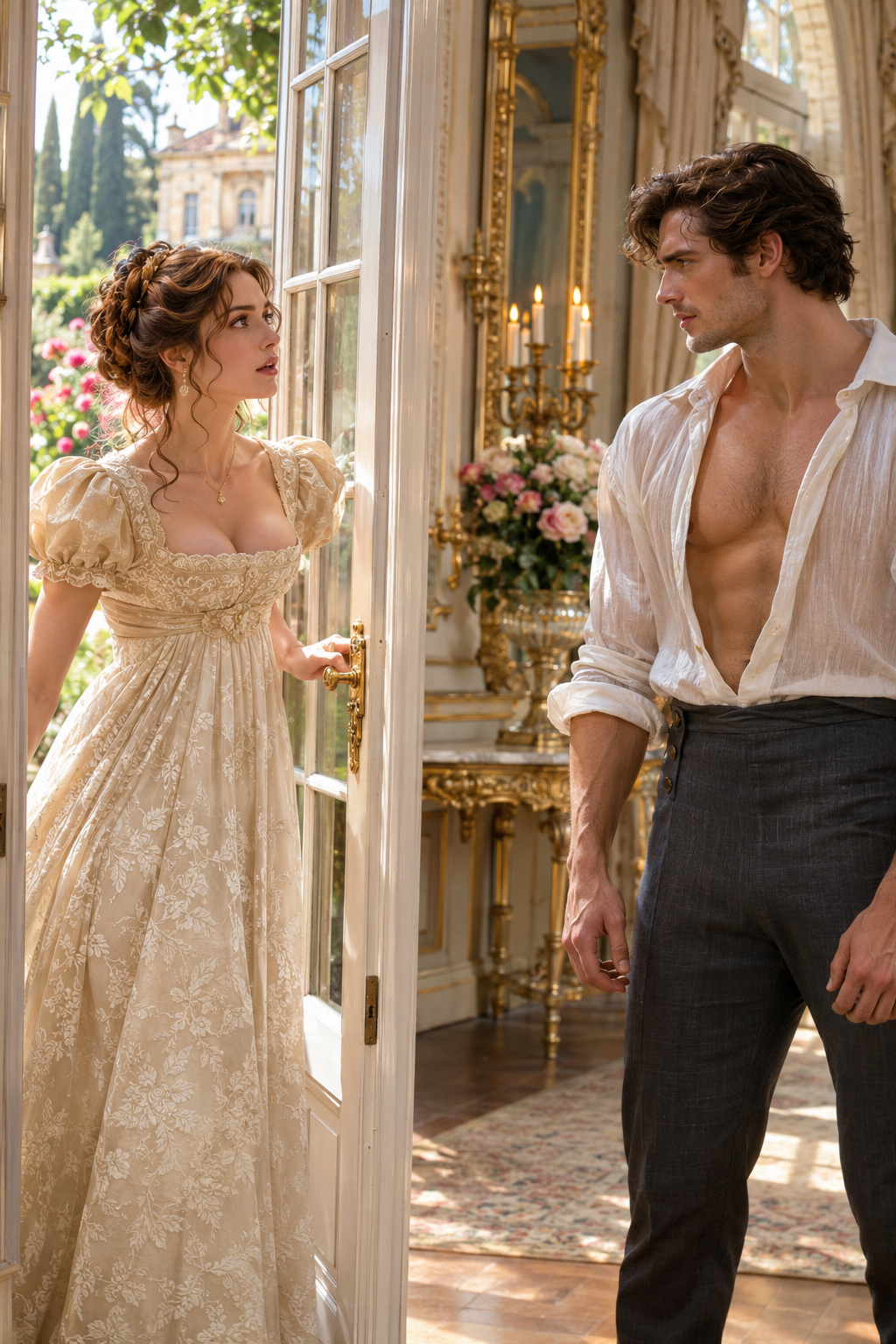
The Duke caught my wrist just as I reached for the locked door. His face went pale, and for the first time since our wedding, I saw genuine fear in his eyes.
I stared at the severed edge of the portrait, my fingers trembling against the faded paper.
The missing person had been deliberately removed.
Not torn away by accident, but cut with such precision that only a slender hand remained, resting possessively upon Eleanor’s shoulder.
On the third finger was a ring.
A silver serpent curled around a dark red stone.
I had seen that ring before.
Lord Adrian Vale, Sebastian’s younger brother, wore it at our wedding.
And suddenly, the mystery of the West Gallery seemed far more dangerous than a duke mourning a lost love.
I turned the portrait over again.
The date written beneath the warning was October seventeenth, six years earlier.
I remembered that date because my father had once mentioned it.
It was the night a terrible fire destroyed the old hunting lodge on the northern edge of Haramir’s estate.
According to the newspapers, three servants had perished.
But no woman named Eleanor had been mentioned.
I slipped the portrait into my writing desk just as someone knocked.
“Come in.”
Mrs. Whitcomb entered carrying fresh linens.
She glanced at my face, then at the drawer I had hastily closed.
“Your Grace,” she said quietly, “some questions are better asked outside these walls.”
I studied her.
“Do you know what happened to Eleanor?”
Her hands tightened around the linens.
“I know what happened to those who tried to discover it.”
Before I could press her, footsteps sounded in the corridor.
Mrs. Whitcomb immediately straightened.
“His Grace’s brother has arrived,” she announced in a louder voice. “Lord Adrian requests the pleasure of your company at luncheon.”
My stomach tightened.
Adrian had visited Haramir twice since our wedding.
Both times, I had found him charming in the way certain poisonous flowers were beautiful.
He smiled too easily, touched people’s shoulders too familiarly, and possessed an unsettling talent for making compliments sound like threats.
At luncheon, he greeted me with a kiss upon my gloved hand.
“My dear sister,” he said. “You look pale. Is marriage proving less delightful than expected?”
“Quite the opposite.”
“How fortunate. Sebastian has always been rather difficult to know.”
Sebastian sat at the opposite end of the table, his expression unreadable.
Adrian poured himself wine.
“I passed through the West Gallery this morning,” he remarked casually.
Sebastian’s knife stopped moving.
“Did you?”
“Such a gloomy place. I cannot imagine why you insist upon keeping it closed.”
“Then do not go there.”
Adrian laughed.
“Good heavens, brother. One might think you were hiding a corpse.”
The silence that followed was unbearable.
I looked at Sebastian.
His face had drained of color.
Adrian noticed.
And smiled.
That evening, I discovered my writing desk had been opened.
The portrait was gone.
In its place lay a single white rose.
Its stem had been wrapped with black ribbon.
Beneath it was a note.
Curiosity killed Eleanor. Do not let it kill you.
I carried the note directly to Sebastian’s study.
He was examining estate accounts when I entered.
“Someone has been in my room.”
He rose immediately.
I placed the note before him.
As he read, something frightening changed in his expression.
Not surprise.
Recognition.
“Where did you find this?”
“In my desk. Someone stole the portrait.”
He looked up sharply.
“What portrait?”
I described it.
When I mentioned Adrian’s ring, Sebastian gripped the edge of his desk so tightly that his knuckles whitened.
“Listen to me carefully, Rosalind. Until I can make certain arrangements, you must not be alone with my brother.”
“Then tell me why.”
He turned away.
I felt something inside me harden.
“Do you know what is cruel, Sebastian? It is not that you loved another woman. It is that you ask me to trust you while refusing to trust me.”
He faced me.
“I trust you more than anyone.”
“Then prove it.”
For a long moment, I thought he would.
Instead, he said, “Give me three days.”
I shook my head.
“Truth should not require an appointment.”
I left before he could answer.
That night, sleep refused to come.
Near midnight, I heard a sound outside my bedroom.
Three soft knocks.
Then footsteps retreating.
I opened the door.
A small brass key lay on the carpet.
Attached to it was a strip of paper bearing two words.
Before dawn.
I knew immediately which door it opened.
The house was silent when I entered the West Gallery.
Rain struck the windows, and the portraits of long-dead dukes seemed to watch my progress.
At the final door, I hesitated.
Sebastian’s warning returned to me.
You may never look at me the same way again.
Then I turned the key.
The room beyond was not what I expected.
There were no bloodstains, no chains, no hidden corpse.
It was a nursery.
A beautiful nursery, preserved beneath a thin veil of dust.
A white cradle stood beside the fireplace.
Small wooden animals lined a shelf.
An unfinished embroidery hoop rested upon a chair.
Above the cradle hung a painting of a little girl with dark curls and solemn blue eyes.
Beneath the painting was a name.
Clara Eleanor Vale.
I approached slowly.
On the mantelpiece stood a silver-framed photograph.
Sebastian.
Eleanor.
And a baby.
I covered my mouth.
He had been a father.
And someone had erased his child from the history of this house.
Behind me, the door creaked.
I spun around.
A woman stood in the doorway.
She wore a plain gray dress, her dark hair pulled severely back.
She was thin, with a pale scar stretching from her temple to her jaw.
But I recognized her immediately.
The woman from the portrait.
“Eleanor?” I whispered.
She stared at me.
Then she began to cry.
“Please,” she said. “You must help me find my daughter.”
My heart seemed to stop.
“You’re alive.”
She nodded.
“Though someone has spent six years ensuring the world believes otherwise.”
I stepped toward her.
“Does Sebastian know?”
Her expression twisted.
“He knows I survived. But he believes I abandoned Clara.”
“Where is she?”
Eleanor looked toward the cradle.
“That is what I came to discover.”
I struggled to understand.
“Sebastian told me you were someone he failed.”
“He did fail me,” she whispered. “But not in the way you think.”
She crossed the room and lifted a small wooden horse from the shelf.
“Six years ago, Sebastian and I were engaged. We were young, foolish, and convinced love could protect us from everything.”
She smiled sadly.
“Then Clara was born.”
I stared at her.
“Before your marriage?”
“Yes. Sebastian intended to marry me immediately, but his father refused to recognize our child. I was a merchant’s daughter. To the old duke, I was an embarrassment.”
She lowered the toy.
“Adrian was different. He pretended to be our friend.”
My blood chilled.
“Until the night of the fire?”
Eleanor nodded.
“Sebastian had discovered that Adrian was stealing money from the estate and selling land belonging to the tenants. He intended to expose him.”
“What happened?”
“Adrian invited me to the hunting lodge. He claimed Sebastian was waiting there with a priest so we could finally marry.”
Her voice shook.
“When I arrived, Sebastian was nowhere to be found. Adrian demanded that I sign papers declaring Clara illegitimate and surrendering all claim to Sebastian’s estate.”
“Why?”
“Because Clara’s existence threatened his inheritance if anything happened to Sebastian.”
I felt sick.
“When I refused, he struck me. I remember falling. I remember fire. Then nothing.”
“Who saved you?”
“A stable boy named Thomas. He dragged me through a rear window. My injuries were terrible. For months, I could barely speak.”
“Why didn’t you return?”
“I tried.”
She looked directly into my eyes.
“Someone sent me a letter in Sebastian’s handwriting saying Clara had died, and that he never wished to see me again.”
I swallowed.
“And Sebastian?”
“He was told I had taken Clara and fled abroad.”
The room seemed to tilt.
“Then where is Clara?”
Eleanor’s face crumpled.
“I don’t know.”
A sudden sound echoed from the gallery.
Footsteps.
Eleanor seized my arm.
“You must leave. He knows I’m here.”
“Who?”
Before she could answer, the door slammed shut.
A key turned in the lock.
Then a familiar voice spoke from the other side.
“How touching,” Adrian said. “The dead have finally learned to speak.”
Eleanor backed away.
I rushed to the door.
“Adrian! Open this immediately!”
He laughed softly.
“I am afraid that would be inconvenient.”
A sharp smell drifted beneath the door.
Oil.
Then came the unmistakable scrape of a match.
Eleanor screamed.
I seized the fireplace poker and struck the door with all my strength.
Once.
Twice.
The wood shuddered but held.
Smoke began curling through the gap.
“Adrian!” I shouted. “Sebastian will find out!”
“Oh, my dear Rosalind,” he replied, “Sebastian is presently on his way to the northern bridge. He received a rather urgent message concerning his wife’s safety.”
My heart plunged.
“You sent him away.”
“Of course. My brother has always been predictable where the women he loves are concerned.”
Flames flickered beneath the door.
Eleanor grabbed my shoulders.
“The window!”
We ran toward it.
Three stories below lay the stone courtyard.
There was no balcony, no ledge wide enough to stand upon.
Only a narrow rain gutter.
The flames climbed the doorframe.
I tore the curtains down and knotted them together.
“We can lower ourselves.”
Eleanor stared at me.
“You’ll be killed.”
“Then we had better not fall.”
I fastened one end to the heavy bedpost in the adjoining nursery alcove.
Smoke thickened.
My eyes burned.
Eleanor climbed onto the windowsill first.
I held the fabric as she lowered herself into the darkness.
The makeshift rope stretched.
Then a knot slipped.
She cried out.
I wrapped the curtain around my wrists and pulled with everything I possessed.
For one terrible moment, I thought we would both fall.
Then her feet found the stone ledge of the floor below.
“Go!” I shouted.
She disappeared through a window.
I climbed onto the sill.
Behind me, the nursery erupted in flames.
I had barely lowered myself when the burning curtain snapped.
I fell.
The world became rain, stone, and a terrible flash of pain.
Then darkness.
When I opened my eyes, Sebastian was holding me.
We were in the courtyard.
Rain soaked his hair, and blood stained the sleeve of his coat.
“Rosalind.”
His voice broke.
“Please. Look at me.”
I tried to speak.
Pain tore through my ribs.
“Eleanor,” I whispered.
He went still.
“What?”
“She is alive.”
For a heartbeat, he seemed unable to breathe.
Then I saw Eleanor emerge from the servants’ entrance.
She stopped when she saw him.
“Sebastian.”
He stared at her as though the earth had opened beneath his feet.
“Eleanor?”
She nodded.
He took one step forward.
Then another.
And suddenly they were embracing, both weeping.
I watched them through a haze of pain.
I had imagined jealousy would destroy me if I ever saw Sebastian holding the woman he had once loved.
Instead, I felt only a profound, terrible sadness.
Six years had been stolen from them.
And somewhere in that darkness, a little girl had disappeared.
Sebastian turned back toward me.
“Rosalind, stay awake.”
I caught his hand.
“Adrian set the fire.”
His expression hardened.
“Where is he?”
Eleanor answered.
“He’s gone.”
Sebastian looked toward the burning gallery.
Then he shouted for the guards.
“Find my brother. Alive.”
I lost consciousness again.
When I woke, sunlight filled my bedroom.
A physician stood beside the bed.
My left arm was bandaged, two ribs were broken, and my ankle had been badly sprained.
Sebastian sat in a chair, looking as though he had not slept in days.
When he saw my eyes open, he stood so quickly that the chair fell backward.
“Rosalind.”
I tried to smile.
“You look dreadful.”
He gave a broken laugh.
Then he knelt beside my bed and pressed his forehead against my hand.
“I nearly lost you.”
“You should have told me.”
He closed his eyes.
“I know.”
For the first time, he did not attempt to defend himself.
Instead, he told me everything.
After the fire, Adrian had produced letters supposedly written by Eleanor, declaring she had taken Clara overseas.
Months later, another letter arrived, claiming the child had died of fever.
Sebastian had searched for them, but every trail ended in silence.
“Why keep the nursery?” I asked.
“Because it was the only place where I could remember them as they had been.”
“And why forbid anyone from entering?”
His eyes filled.
“Because I could not bear anyone seeing how completely I had failed them.”
I looked at him for a long moment.
“You didn’t know.”
“I should have.”
“Sebastian, grief is not proof of guilt.”
He bowed his head.
Then I asked the question that had been haunting me.
“Why did you marry me?”
He hesitated.
“Your father once saved my life.”
I stared at him.
“What?”
“Seven years ago, I was injured in a carriage accident near your family’s estate. Your father took me in. He paid for the physician and cared for me when others believed I would die.”
Tears burned my eyes.
“He never told me.”
“He refused any reward. But he made me promise something.”
“What?”
“That if his daughter ever found herself alone in the world, I would not turn away.”
My throat tightened.
“So our marriage was a debt?”
“At first, I thought I was simply honoring a promise.”
He lifted my hand.
“Then you came to Haramir. You argued with my steward about the tenants’ wages. You laughed at my terrible piano playing. You filled rooms I had forgotten could contain happiness.”
His voice softened.
“And I fell in love with you.”
I could barely breathe.
“Sebastian—”
“I was afraid to tell you. Afraid that if you learned about Eleanor, you would believe you were merely a replacement.”
“Was I?”
“No.”
He looked at me steadily.
“Eleanor was my first love. You are the woman I wish to spend the rest of my life with. Both truths can exist without diminishing the other.”
I touched his cheek.
“Then no more secrets.”
“Never again.”
For one fragile moment, I believed the worst was over.
Then Mrs. Whitcomb entered.
Her face was ashen.
“Your Graces, Lord Adrian has escaped the estate.”
Sebastian rose.
“Where?”
“We believe he has gone to Blackthorn Abbey.”
Eleanor appeared behind her.
At the mention of the abbey, she went completely still.
“Blackthorn?” she whispered.
Mrs. Whitcomb nodded.
Eleanor gripped the doorframe.
“There was a name,” she said. “In the letters I received after the fire. A woman named Sister Margaret.”
Sebastian turned.
“What letters?”
“Someone sent money for my recovery. The payments came through Blackthorn Abbey.”
I sat upright despite the pain.
“Then perhaps Clara was never taken overseas.”
The room fell silent.
Eleanor covered her mouth.
Sebastian’s expression changed.
Hope.
Terrible, dangerous hope.
Within an hour, he had assembled a party of guards.
I insisted upon accompanying them.
He refused.
I reminded him of his wedding-night promise.
He looked at my bandaged arm.
“That promise did not include allowing you to kill yourself.”
“Then stop treating me like a porcelain ornament and listen.”
I explained that Adrian had tried to murder me because I had discovered the truth. If he reached the abbey first, anyone who could identify Clara might be silenced.
Sebastian listened.
Then he sighed.
“You are the most stubborn woman I have ever met.”
“And you married me.”
“God help me, I did.”
We departed before noon.
Blackthorn Abbey stood beyond the eastern hills, surrounded by ancient yew trees.
By the time we arrived, clouds had gathered overhead.
The abbess received us in a cold stone chamber.
She was elderly, with sharp eyes and trembling hands.
When Sebastian mentioned Clara, her face changed.
“I know no child by that name.”
Eleanor stepped forward.
“Please. She would be six years old now. Dark hair. Blue eyes.”
The abbess looked away.
I noticed something on the desk beside her.
A child’s drawing.
Three figures stood beneath a yellow sun.
A woman.
A man.
And a little girl.
Above them, written in uneven letters, were the words:
One day they will come.
I reached for the paper.
“Who drew this?”
The abbess snatched it away.
“An orphan.”
“What is her name?”
She hesitated.
“Mary.”
Eleanor began trembling.
“May we see her?”
“No.”
Sebastian stepped forward.
“Madam, I am the Duke of Haramir. I must insist.”
The abbess looked toward the door.
And suddenly I understood.
She was not protecting a secret.
She was afraid.
“Adrian is here,” I said.
Her silence answered me.
A man’s voice sounded from the corridor.
“How perceptive of you, Rosalind.”
Adrian entered with two armed men.
He looked almost amused.
“My brother brings an entire procession to a quiet religious house. How very theatrical.”
Sebastian moved in front of me.
“Where is my daughter?”
Adrian’s smile faded.
“Your daughter?”
“Clara.”
For the first time, I saw genuine panic in his eyes.
Then he laughed.
“You cannot prove she exists.”
Eleanor stepped forward.
“I can.”
Adrian stared at her scarred face.
“You should have died in that fire.”
The abbess gasped.
And Adrian realized his mistake.
Sebastian’s voice became deadly quiet.
“You have just confessed to knowing what happened.”
Adrian drew a pistol.
One of the guards moved.
“Stay where you are!”
The room froze.
Adrian aimed directly at Sebastian.
“You were always Father’s favorite,” he hissed. “The honorable son. The rightful heir. Everything handed to you while I received scraps.”
Sebastian did not move.
“You had an allowance larger than most families earned in ten lifetimes.”
“And still I had nothing that was mine!”
“You had a brother.”
Adrian’s face twisted.
“A brother who would have watched me hang.”
“You stole from people who trusted us.”
“I did what was necessary.”
He glanced toward Eleanor.
“And then this woman gave you an heir. Suddenly even the possibility of inheriting Haramir disappeared.”
Eleanor whispered, “Where is my child?”
Adrian’s eyes flickered toward the abbess.
I saw it.
So did Sebastian.
But before either of us could move, a small voice spoke from the doorway.
“Mother?”
A little girl stood there.
She wore a simple blue dress and held a battered wooden rabbit.
Her dark curls framed a pale, solemn face.
The same blue eyes from the nursery portrait.
Eleanor made a sound I shall never forget.
It was not quite a sob.
Not quite a scream.
It was the sound of six years of grief breaking open.
“Clara?”
The girl stared.
“Are you my mother?”
Eleanor fell to her knees.
“Yes, darling. Yes, I am.”
Clara took one uncertain step.
Then another.
And ran into her arms.
Adrian turned the pistol toward them.
Everything happened at once.
Sebastian lunged.
The weapon fired.
The sound shattered the room.
I screamed.
Sebastian staggered backward.
Blood spread across his waistcoat.
Adrian tried to raise the pistol again, but Mrs. Whitcomb, who had accompanied us, struck his arm with a heavy brass candlestick.
The pistol fell.
The guards seized him.
He fought wildly, shouting curses.
Then Sebastian collapsed.
I dropped beside him.
“Sebastian!”
His eyes found mine.
“Are they safe?”
I looked toward Eleanor, who held Clara tightly against her chest.
“Yes.”
He smiled faintly.
“Good.”
Then his eyes closed.
For three days, I lived beside the edge of despair.
The bullet had passed beneath Sebastian’s shoulder and lodged dangerously close to his lung.
The physician removed it, but fever followed.
I sat beside his bed, changing cold cloths and whispering every prayer I knew.
Eleanor remained at Haramir with Clara.
The little girl was frightened by the great house, but each morning she came to Sebastian’s door.
“Is Papa awake?”
And each morning, I forced myself to smile.
“Not yet, sweetheart.”
On the fourth night, Sebastian’s fever finally broke.
He opened his eyes and found me sitting beside him.
“You look dreadful,” he whispered.
I burst into tears.
He smiled weakly.
“I believe that is my line.”
I leaned forward and kissed him.
Not carefully.
Not politely.
But with every ounce of love and terror I had carried through those endless days.
When I finally pulled away, he touched my face.
“Rosalind.”
“Yes?”
“Will you stay?”
I stared at him.
“Where else would I go?”
He swallowed.
“I have given you so many reasons to leave.”
I took his hand.
“You gave me reasons to be angry. You gave me reasons to demand the truth. But you also gave me kindness when I had nothing, respect when I expected obedience, and love when I had forgotten how to hope.”
His eyes shone.
“I love you,” I whispered.
He closed his eyes.
“And I love you more than I know how to say.”
Several weeks later, Adrian was tried for attempted murder, arson, fraud, and the abduction of a child.
The evidence was overwhelming.
The abbess confessed that Adrian had brought Clara to Blackthorn as an infant, claiming her mother had died and her father wished to conceal her existence.
He had paid generously for the child’s silence and anonymity.
But Sister Margaret, who had cared for Clara, had secretly preserved the records.
She had also arranged Eleanor’s recovery through charitable funds, unaware that Adrian had intercepted the letters between Eleanor and Sebastian.
When Sister Margaret died, the abbess discovered the truth.
By then, Adrian’s threats had frightened her into silence.
Her testimony, together with the preserved records, destroyed his defense.
He was sentenced to life imprisonment.
I attended the final day of the trial.
Adrian looked at Sebastian with hatred.
“You have taken everything from me.”
Sebastian regarded him quietly.
“No, Adrian. You surrendered everything worth having long before we discovered what you had done.”
For once, Adrian had no answer.
Winter arrived gently that year.
The West Gallery was restored, though Sebastian insisted the nursery remain unchanged until Clara decided what she wished to do with it.
Eleanor moved into a cottage on the estate, where she could raise her daughter in peace.
Some people whispered that her presence was improper.
I found those people remarkably easy to ignore.
Sebastian and Eleanor had loved one another once.
That history could not be erased, nor should it be.
But the years had changed them.
Eleanor had survived unimaginable cruelty and wanted a life that belonged to her, rather than one shaped by the expectations of a noble family.
Sebastian respected her choice.
They agreed to raise Clara with honesty, affection, and no more secrets.
One afternoon, I found Eleanor standing in the nursery, holding the little wooden horse.
“I used to hate you,” she admitted quietly.
I looked at her in surprise.
“Me?”
“When I first learned Sebastian had married, I thought he had forgotten us.”
She smiled sadly.
“Then I saw the way he looked at you in the courtyard. Even while he believed I might have returned from the dead, he never stopped reaching for your hand.”
I swallowed.
“Eleanor—”
She shook her head.
“I am glad he found you.”
I took her hand.
“And I am glad Clara found you.”
She looked toward the window, where her daughter was playing beneath the bare branches.
“For years, I thought happiness meant getting back everything I had lost.”
“And now?”
“Now I think it means learning that life can still give us something beautiful after taking so much away.”
I never forgot those words.
By spring, Haramir had changed.
Sebastian opened the estate accounts to independent inspection, restored the lands Adrian had stolen from the tenants, and established a school for children whose families could not afford private instruction.
Eleanor helped oversee the school.
Clara became its most enthusiastic visitor, though she was far more interested in the garden than her lessons.
And I discovered that being a duchess did not require me to become the silent, decorative woman society expected.
I could be useful.
I could be heard.
I could build something that mattered.
One evening, almost a year after our wedding, Sebastian found me in the West Gallery.
The door at its far end stood open.
Sunlight streamed across the polished floor.
Inside, Clara was arranging wooden animals beside the cradle.
She looked up when Sebastian entered.
“Papa, may I ask you something?”
“Anything, darling.”
“Why did you keep this room locked?”
He glanced at me.
Then he knelt beside her.
“Because I was very sad, and I thought that if I kept the door closed, I would not have to remember how much I had lost.”
Clara considered this.
“But you remembered anyway.”
“Yes.”
She placed the wooden rabbit in his hand.
“Then perhaps you should have opened it sooner.”
Sebastian looked at her for a long moment.
Then he laughed softly, though his eyes were wet.
“Perhaps I should have.”
Clara ran off to find her mother.
I stood beside Sebastian in the doorway.
He slipped his arm around my waist.
“Do you remember what I said the first time you tried to open this room?”
“That I might never look at you the same way again.”
“And do you?”
I turned toward him.
“Yes.”
His smile faded slightly.
I touched his cheek.
“I used to see a powerful duke who had rescued me from ruin. Then I saw a frightened man hiding from his past. Now I see someone who has suffered, made mistakes, and finally found the courage to face them.”
He rested his forehead against mine.
“Is that better or worse?”
“Infinitely better.”
Outside, the gardens were beginning to bloom.
For so long, I had believed that love meant finding someone without shadows, someone whose past contained nothing painful enough to threaten the present.
I had been wrong.
Love was not the absence of darkness.
It was the willingness to stand beside another person when the darkness was finally brought into the light.
But I had learned something else as well.
Trust could not survive on tenderness alone.
A person might love you deeply and still wound you by withholding the truth.
Forgiveness mattered, but so did accountability.
And courage was not merely facing an enemy with a weapon.
Sometimes it was admitting you were afraid.
Sometimes it was opening a door.
Sometimes it was choosing honesty when a comforting lie would have been easier.
Sebastian kissed my forehead.
“What are you thinking?”
I looked around the nursery, at the toys, the sunlight, and the small wooden horse that had survived six years of silence.
“That locked doors do not protect us from pain,” I answered. “They only prevent us from discovering what might be waiting on the other side.”
He smiled.
“Then shall we leave this one open?”
I took his hand.
“Always.”
And we did.
Years later, when our own children raced through the corridors of Haramir Court alongside their beloved older sister Clara, they knew the West Gallery as the brightest place in the house.
They never understood why anyone would have feared it.
Perhaps that was the greatest victory of all.
Not that we had uncovered every secret, punished every wrong, or recovered every stolen year.
Some losses could never be undone.
Some wounds would always leave scars.
But the children would grow up knowing that mistakes could be confessed, difficult truths could be spoken, and love did not have to depend upon silence.
They would know that a family was not defined only by blood, titles, or the perfect arrangement of its past.
It was defined by the people who chose, again and again, to protect one another without imprisoning one another in fear.
And whenever I passed the nursery, I remembered the desperate young woman who had arrived at Haramir believing she had sold her future to save her father’s memory.
She had expected security.
She had hoped, secretly, for kindness.
She had never imagined she would find a family hidden behind a locked door.
Nor had she imagined that the most precious thing she would gain was not a title, a fortune, or even the love of a duke.
It was the knowledge that she could face the truth, however painful, and remain standing.
For the greatest love stories are not those in which nothing terrible ever happens.
They are the ones in which people refuse to let terrible things have the final word.
And in our home, where silence had once ruled and fear had guarded every doorway, the final word belonged to something far stronger.
Hope.
The years that followed were not without sorrow, but they were filled with something I had once believed impossible: peace.
Sebastian and I grew older together, learning that marriage was not built upon grand declarations alone, but upon a thousand quiet choices made each day.
He still remembered how I liked my tea.
I still teased him about his dreadful piano playing.
And whenever we disagreed, as all married couples inevitably do, we made one promise to each other.
We would never allow silence to become a wall between us again.
Clara grew into a remarkable young woman, possessing her father’s determination and her mother’s extraordinary courage.
On her eighteenth birthday, she asked Sebastian to accompany her to the West Gallery.
There, beneath the portrait of her childhood, she placed a small brass key into his hand.
“What is this?” he asked.
“The key you kept for so many years.”
He examined it, confused.
“I thought it had been lost.”
“I found it among the old nursery things.”
She smiled.
“I want you to keep it, Papa. Not because the door should ever be locked again, but because I want you to remember that you opened it.”
Sebastian’s eyes filled with tears.
Clara embraced him.
“You spent so many years believing you had failed me. But you gave me something more important than a perfect childhood.”
“What was that, darling?”
“A father who taught me that even when we cannot change the past, we can choose what kind of people we become afterward.”
I watched them from the doorway, my heart overflowing.
Later that evening, Sebastian found me standing beside the garden fountain.
He slipped his hand into mine.
“Do you ever regret marrying me?” he asked.
I turned toward him in surprise.
“After all these years, you still ask?”
“Sometimes I wonder what your life might have been without all the trouble I brought into it.”
I smiled.
“Perhaps quieter.”
He laughed.
“Certainly quieter.”
“But not nearly as meaningful.”
He drew me close.
Above us, the first stars appeared.
“Then I suppose I owe your father another debt,” he murmured.
“No,” I answered gently. “You honored that debt long ago. Everything afterward was our choice.”
He kissed me beneath the evening sky.
And as I rested against him, I understood something I wished I could have told my younger self.
A happy ending is not a life in which nothing is ever lost.
It is a life in which loss does not destroy our capacity to love.
It is finding the courage to begin again, even when yesterday has left us wounded.
It is discovering that forgiveness does not erase the past, but can free us from living forever inside it.
And above all, it is understanding that love becomes strongest not when two people hide their imperfections, but when they allow themselves to be fully known.
That night, before retiring, Sebastian placed the old brass key in a small wooden box beside our wedding portrait.
He left the box open.
Just as we had left the West Gallery open.
For there were no longer any secrets worth protecting at the expense of our happiness.
And when he took my hand and led me upstairs, I looked back once at the long corridor illuminated by candlelight.
The place that had once frightened me had become the heart of our home.
I smiled, remembering the day I had reached for a forbidden door and nearly lost everything.
I had believed I was searching for the truth about another woman.
Instead, I had discovered the truth about love, courage, and the extraordinary power of second chances.
And if I could return to that rainy afternoon, knowing every danger that awaited me, I would still reach for the handle.
Because some doors must be opened, not to destroy the life we know, but to reveal the life we were always meant to live.
THE END.