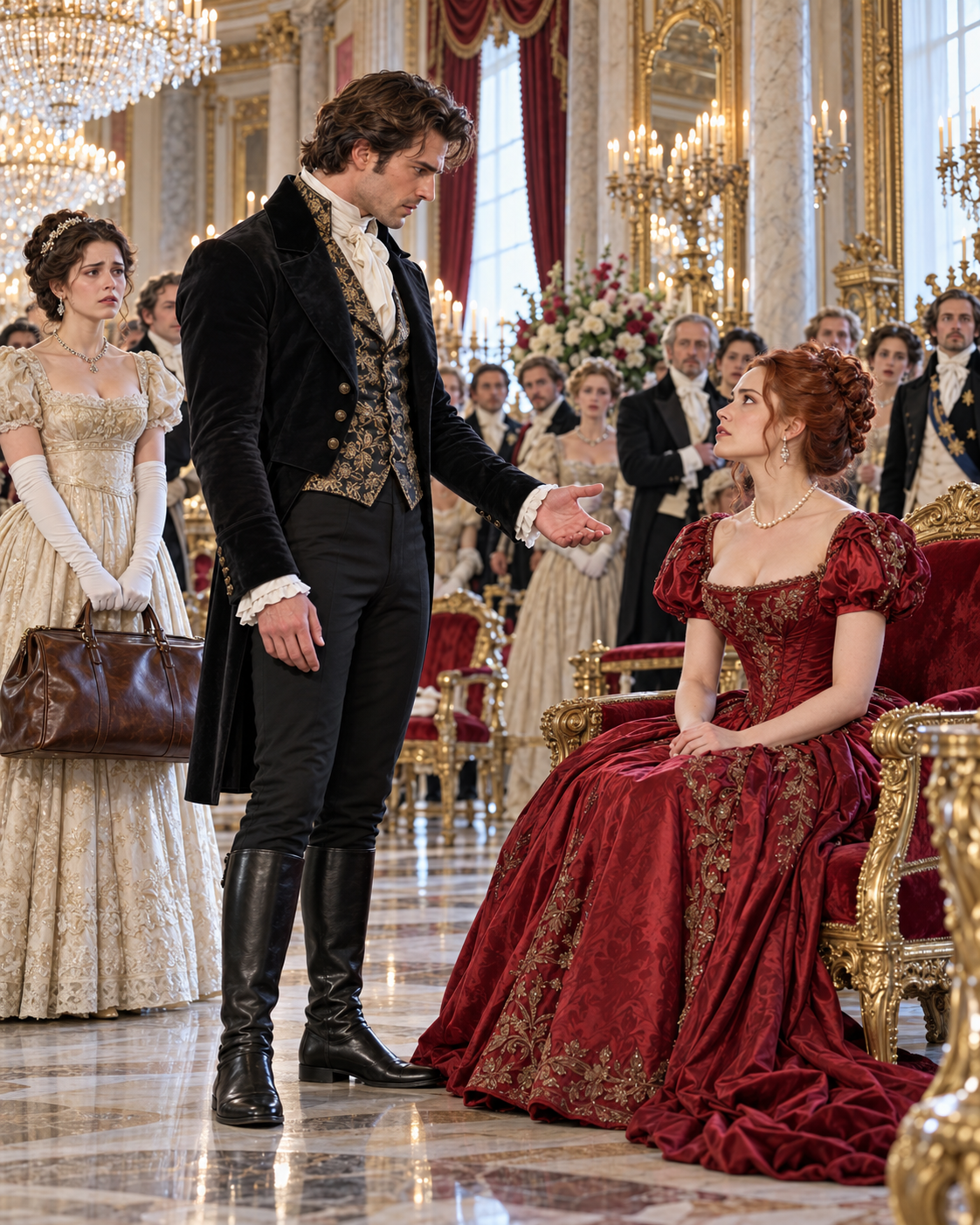
The Duchess of Westmere was invited to her own husband’s celebration—only to discover that the woman standing beside him was wearing her place in his life.
“Why does this say my father arranged the payments?”
Anastasia’s voice was barely above a whisper, yet the question seemed to drain every sound from the room.
Alexander stood beside the desk, his gaze fixed on the document in her hands.
Outside, rain began striking the windows, blurring the gardens beyond the glass.
“Anastasia,” he said carefully, “there may be an explanation.”
She looked at him.
“Then I suggest you find it.”
He moved toward her, but she stepped away, placing the desk between them.
The letter trembled slightly in her fingers.
Her father had been dead for six years.
He had been a quiet man, respected for his honesty, though he had never possessed the wealth of Westmere.
He had taught Anastasia that a person’s word was worth more than any title.
And now his name appeared beside payments connected to Edmund’s fraud.
“There must be a mistake,” Alexander said.
Anastasia turned the paper toward him.
“His signature is here.”
Alexander examined it beneath the lamplight.
For several seconds, he said nothing.
Then he reached into his coat and withdrew a pair of spectacles.
“May I?”
She handed him the document.
He studied the signature, following the faded ink with his eyes.
“This was signed before your father died.”
“That much is obvious.”
“No,” Alexander said, looking up. “Look at the date above it.”
Anastasia leaned closer.
The document was dated seven years earlier.
A full year before her father’s death.
And almost two years before Edmund had begun advising Alexander on the duchy’s finances.
Her eyes moved slowly across the page.
Something about the document was wrong.
The handwriting changed halfway through the agreement.
The first paragraphs had been written in neat, measured strokes.
The final instructions appeared darker, cramped into the remaining space.
“Someone added this later,” she said.
Alexander nodded.
“And whoever did it wanted your father to appear responsible.”
Anastasia lowered herself into the chair.
For the first time that evening, she seemed uncertain of where to look.
Alexander remained standing.
He had learned, painfully, that concern did not give him the right to crowd her.
“There’s something else,” he said.
She raised her eyes.
“When Edmund’s accounts were seized, one of his private ledgers disappeared.”
“Who took it?”
“We never knew.”
Anastasia glanced at the letter bearing Victoria’s signature.
“Perhaps we do now.”
By morning, the rain had stopped.
A thin mist covered the fields beyond Westmere, and the gravel paths glistened beneath a pale sky.
Anastasia had not slept.
She sat at the breakfast table with the documents arranged before her, untouched tea cooling beside her elbow.
Alexander entered carrying another folder.
“I contacted the solicitor in London,” he said.
“And?”
“Victoria has been living under another name.”
Anastasia looked up.
“Where?”
“A boardinghouse near Bath.”
He hesitated.
“She requested protection from Edmund six months ago.”
The room fell quiet.
Anastasia remembered Victoria standing beneath the chandeliers, smiling as Alexander publicly humiliated his wife.
She remembered the woman’s confident hand resting on his arm.
There had been nothing frightened about her that night.
But confidence could be a carefully practiced disguise.
“Why would she need protection from Edmund?” Anastasia asked.
Alexander placed the folder on the table.
“Because she knew how the money moved.”
Anastasia opened it.
Inside was a copy of an old bank transfer.
The amount was enormous.
Enough to purchase several village properties.
Enough to ruin the duchy if repeated.
The money had passed through an account bearing her father’s name.
Then it had been transferred to a private company controlled by Edmund.
Alexander watched as she traced the figures.
“Your father never received those funds,” he said.
“How can you be certain?”
“Because the account was opened three months after his death.”
Anastasia went completely still.
The clock above the fireplace ticked steadily.
Someone had used a dead man’s identity.
And that person had been moving money through Westmere long before anyone suspected a crime.
She closed the folder.
“We’re going to Bath.”
The journey took most of the day.
Alexander sat opposite Anastasia in the carriage, his hands resting on his knees.
Neither spoke much.
They passed wet fields, narrow bridges, and villages where smoke rose from cottage chimneys.
Once, the carriage struck a deep rut.
Alexander instinctively reached across to steady her.
His hand stopped halfway.
Anastasia noticed.
After a moment, she placed her fingers briefly over his.
It was a small gesture.
He did not attempt to turn it into anything more.
By late afternoon, they reached the boardinghouse.
Its faded blue door stood between a bakery and a shuttered tailor’s shop.
An elderly woman answered.
When Alexander asked for Victoria, her expression changed.
“She’s not receiving visitors.”
“Tell her the Duchess of Westmere is here,” Anastasia said.
The woman’s eyes widened.
A moment later, footsteps sounded above them.
Victoria appeared at the top of the stairs.
For several seconds, no one moved.
She looked nothing like the woman from the ballroom.
Her once-perfect curls were pinned hastily beneath a plain ribbon.
Dark shadows rested beneath her eyes.
Her dress was modest, its sleeves worn at the cuffs.
Then she saw Alexander.
Her face hardened.
“You shouldn’t have come.”
Anastasia stepped forward.
“We found the letter.”
Victoria gripped the banister.
“Which one?”
“The one with my father’s name.”
The color drained from Victoria’s face.
She looked toward the street.
Then she descended the stairs.
“Come inside,” she whispered. “Before someone sees you.”
Victoria’s room was small and cold.
A coal fire burned weakly beneath the mantel.
Beside the window stood a packed traveling trunk.
Anastasia noticed it immediately.
“Leaving?”
Victoria closed the curtains.
“I was.”
Alexander remained near the door.
“Where is Edmund?”
Victoria gave a short, humorless laugh.
“If I knew that, I wouldn’t still be alive.”
Anastasia studied her.
“Tell us what happened.”
Victoria’s fingers tightened around a handkerchief.
For a moment, she looked toward Alexander.
Then away.
“Edmund approached me before the ball,” she began.
“He told me Westmere was nearly bankrupt and that Alexander would soon need someone with money and connections.”
Alexander’s expression tightened.
“You told me you had inherited a fortune.”
“I told you what Edmund wanted you to hear.”
The words remained between them.
Anastasia said nothing.
Victoria swallowed.
“He promised me security if I helped separate you from your wife.”
Anastasia’s gaze did not shift.
“And you agreed.”
Victoria lowered her head.
“Yes.”
Alexander turned toward the window.
The silence that followed was more painful than an accusation.
“But Edmund lied to me too,” Victoria continued.
“He said the arrangement would end once Anastasia left Westmere.”
“What arrangement?” Anastasia asked.
Victoria crossed to the traveling trunk.
From beneath its lining, she removed a narrow leather notebook.
The cover was cracked.
Its corners had been worn smooth by years of handling.
“Edmund wasn’t simply stealing from the duchy,” she said.
“He was buying control of it.”
Anastasia opened the notebook.
It contained lists of properties, names, debts, and payments.
Beside several names appeared a small black cross.
“What does that mark mean?”
Victoria’s hands began to shake.
“It means the person refused.”
Alexander took a step forward.
“Refused what?”
“To sell.”
Anastasia turned another page.
She recognized three names.
Village farmers who had lost their homes during the financial crisis.
One had died before the estate accounts were restored.
Another had moved away with his family.
The third had been forced into work at a distant quarry.
Edmund had not merely taken money.
He had deliberately created hardship, then purchased land from people who could no longer afford to keep it.
“Why?” Alexander asked.
Victoria looked directly at him.
“Because the land beneath those properties was worth more than the houses standing on it.”
Anastasia studied the locations.
They formed a narrow line across the northern boundary of Westmere.
A line leading directly toward the old stone bridge.
“What is beneath that land?”
Victoria hesitated.
Then she said, “The route to the eastern quarry.”
Alexander frowned.
“The quarry was abandoned decades ago.”
“Not because it was empty.”
Victoria opened another compartment in the trunk and removed a folded survey.
“Because someone wanted everyone to believe it was.”
The survey showed extensive deposits of valuable stone beneath the northern hills.
Enough to bring immense wealth to whoever controlled the surrounding land.
Edmund had spent years acquiring the necessary properties through deception.
He had used Westmere’s own money to finance the scheme.
And he had placed the blame on Anastasia’s dead father.
But one question remained.
“Why involve my father?” Anastasia asked.
Victoria looked down.
“Because he discovered the original survey.”
Anastasia felt the room narrow around her.
“My father?”
“He was working with the estate surveyor before his death. They realized the quarry had never been properly assessed.”
Alexander’s face changed.
“Why wasn’t I told?”
Victoria looked at him without sympathy.
“Would you have listened?”
He had no answer.
She continued.
“Your cousin convinced everyone that the northern land was worthless. Anastasia’s father questioned the figures and refused to sign the revised documents.”
Anastasia glanced at the black crosses in the notebook.
“Was my father marked?”
Victoria closed her eyes.
“Yes.”
A cold silence followed.
The weak fire snapped.
Anastasia looked at the notebook again.
She searched until she found her father’s name.
Beside it was a black cross.
And beneath it, one word.
Resolved.
Her fingers went numb.
“What happened to him?”
Victoria’s eyes filled, but she did not cry.
“I don’t know.”
“Don’t lie to me.”
“I’m not.”
Anastasia stood so quickly that her chair struck the wall.
“My father died after falling from his horse. Everyone said it was an accident.”
Victoria pressed the handkerchief to her mouth.
“Edmund told me the same thing.”
Anastasia looked toward Alexander.
He seemed as shaken as she was.
For the first time, the scandal that had destroyed their marriage felt small beside the possibility now taking shape.
Her father might not have died by accident.
And Edmund might have spent seven years ensuring no one asked why.
They returned to Westmere after dark.
Anastasia refused supper.
Instead, she went directly to the small library where her father’s letters had been stored since their marriage.
Alexander followed but stopped at the doorway.
“Let me help.”
She lifted a box onto the table.
“Find everything he wrote about the northern boundary.”
For hours they searched.
Letters.
Old maps.
Receipts.
A faded notebook filled with household expenses.
The candle burned lower.
At last, Alexander found a narrow envelope hidden between two pages of an estate directory.
It had never been sealed.
Inside was a letter addressed to Anastasia.
Her father’s handwriting filled the page.
She recognized the way he formed the capital A in her name.
For several seconds, she could not bring herself to read.
Alexander quietly moved the candle closer.
Then she unfolded the letter.
My dearest Anastasia,
There are matters at Westmere that trouble me deeply.
I have placed certain documents where they cannot be altered.
If anything prevents me from explaining them to you, remember the place where you learned that even the smallest light can guide someone home.
Anastasia read the final sentence twice.
Then she looked toward the window.
“The old chapel.”
Alexander frowned.
“The chapel by the orchard?”
She nodded.
“When I was a child, Father took me there during a storm. We found shelter inside, and he showed me a lantern that had been kept burning for travelers.”
Her voice softened.
“He said light was useful only when someone was willing to carry it.”
She folded the letter carefully.
“We need to go there.”
Alexander looked at the clock.
It was nearly midnight.
“Then I’ll have the carriage prepared.”
The chapel stood beyond the southern orchard, half concealed by ivy and overgrown yew trees.
Moonlight touched its broken stone steps.
Alexander carried a lantern as they approached.
The wooden door opened with a long, reluctant groan.
Inside, dust covered the pews.
A narrow altar stood beneath a cracked window.
The air smelled of damp stone and old timber.
Anastasia moved slowly down the aisle.
She remembered standing there as a little girl, her hand enclosed in her father’s.
She remembered the storm and the lantern glowing beside the altar.
“The light was kept here,” she murmured.
Alexander raised his lantern.
A rusted iron bracket projected from the wall.
Beneath it stood a narrow stone shelf.
Anastasia touched the surface.
One corner shifted.
She looked at Alexander.
Together, they lifted the loose stone.
Inside was a small tin box wrapped in oilcloth.
Anastasia knelt.
Her hands were trembling now.
Alexander set the lantern beside her.
She opened the box.
There were three documents inside.
The original quarry survey.
A signed statement from the former estate surveyor.
And a letter bearing Edmund’s handwriting.
Anastasia unfolded the letter.
It contained a demand that her father withdraw his objections to the property transfers.
The final paragraph was unmistakable.
You have a daughter approaching marriageable age. It would be unfortunate if your insistence on honesty damaged her future.
Anastasia stared at the page.
Edmund had threatened her through her father.
And her father had refused.
Alexander crouched beside her.
“I’m sorry,” he said.
She kept looking at the letter.
“Don’t apologize for him.”
“I’m apologizing because I allowed him to remain close enough to do this.”
Anastasia turned toward him.
For once, his expression held no attempt to defend himself.
Only grief and the knowledge of what his carelessness had permitted.
She looked back at the letter.
“We have to find Edmund.”
By sunrise, the household had been awakened.
A trusted magistrate was summoned.
The solicitor arrived from London with two assistants.
The documents were examined, copied, and secured.
But before the authorities could issue instructions to locate Edmund, a messenger arrived at Westmere.
His horse was lathered with sweat.
He carried a sealed envelope addressed to Anastasia.
There was no signature.
Inside lay a single sheet of paper.
Bring the original survey to the northern quarry before sunset.
Come alone.
If you wish to know how your father died, you will receive your answer there.
Alexander read the message over her shoulder.
“No.”
Anastasia folded it.
“I haven’t said anything.”
“You don’t need to.”
She looked at him.
“You cannot expect me to ignore this.”
“And I won’t allow you to walk into a trap.”
Her expression cooled.
“Allow?”
The word stopped him.
He closed his eyes briefly.
Then he stepped back.
“I spoke badly.”
“Yes.”
He took a breath.
“I’m afraid for you.”
Anastasia studied him.
That, at least, was true.
She glanced toward the magistrate waiting near the doorway.
“Then we make sure I don’t go unprotected.”
Alexander nodded slowly.
For the first time, he understood that standing beside her meant trusting her judgment, even when fear urged him to take control.
The northern quarry lay beyond a stretch of woodland where the road narrowed between steep banks.
Anastasia arrived shortly before sunset.
She wore a dark traveling coat.
The original survey was concealed beneath her cloak.
Unknown to Edmund, the magistrate and several constables waited along the wooded approach.
Alexander remained near an abandoned shepherd’s shelter, close enough to intervene but far enough to avoid being seen.
The quarry appeared deserted.
Wind moved through the tall grass.
Loose stones rattled along the slope.
Anastasia stepped onto the old loading platform.
“Edmund.”
Her voice carried across the empty excavation.
For a moment, nothing answered.
Then a figure emerged from the shadow of the storage shed.
Edmund looked thinner than she remembered.
His coat was dirty.
One sleeve had been roughly repaired.
But his smile was unchanged.
“My dear cousin.”
Anastasia did not return it.
“You wanted the survey.”
He held out his hand.
“First, we should talk.”
“About my father?”
His smile faded.
“Your father was an inconvenient man.”
Anastasia kept her face still.
“What happened to him?”
Edmund glanced toward the tree line.
“You came alone?”
“Does it matter?”
“It matters very much.”
She withdrew the folded survey but did not approach.
“You’ll have it when you’ve answered me.”
Edmund’s eyes narrowed.
For years, he had relied on other people’s fear, pride, and ignorance.
Now he faced a woman who knew precisely what he had done.
“Your father found documents he had no right to examine,” Edmund said.
“He was an estate adviser,” Anastasia replied. “Examining documents was his work.”
“He could have retired comfortably.”
“He refused your money.”
Edmund looked away.
“He refused to understand.”
Anastasia felt her pulse beating in her wrists.
“Did you kill him?”
The question hung between them.
Edmund’s jaw tightened.
“I arranged for someone to frighten him.”
She did not move.
“Who?”
“A stable hand. A foolish young man who needed money.”
“What did you tell him to do?”
Edmund swallowed.
“Loosen the fastening on his saddle. Make the ride unpleasant. Nothing more.”
Anastasia stared at him.
The wind lifted a loose strand of hair against her cheek.
“You knew he rode along the ridge.”
Edmund said nothing.
“You knew the path was dangerous.”
“It wasn’t supposed to happen that way.”
Her father had fallen from a horse whose saddle had been deliberately damaged.
For six years, she had believed the rain-slick stones were responsible.
She looked at Edmund, and her voice became remarkably steady.
“You had him killed.”
Edmund took a step toward her.
“It was an accident.”
“An accident you arranged.”
Something changed in his face.
The practiced charm vanished.
“You have no idea what your father cost me.”
Anastasia held the survey tighter.
“He cost you the chance to steal from people who trusted you.”
Edmund’s eyes flashed.
“That estate was dying long before I intervened. Alexander was too weak to manage it.”
“And you used his weakness.”
“I used an opportunity.”
He reached toward the survey.
Anastasia stepped back.
“One more question.”
His expression hardened.
“Be quick.”
“Did you plan what happened at the ball?”
A faint smile returned.
“Victoria was surprisingly cooperative.”
“And Alexander?”
Edmund shrugged.
“I gave him every reason to believe you were undermining his authority. A proud man can be guided easily when he thinks his wife is making him look foolish.”
Anastasia remembered the ballroom.
The laughter.
The silence.
Alexander’s unwillingness to defend her.
Edmund had manipulated the circumstances.
But Alexander had made his own choices.
She knew the difference now.
Edmund held out his hand.
“The survey.”
Anastasia looked past his shoulder.
Near the ridge, a small movement disturbed the grass.
One of the constables had reached his position.
She let the silence stretch.
Then she said, “You’ve confessed to enough.”
Edmund turned sharply.
A whistle sounded from the trees.
The magistrate emerged with two armed constables.
Edmund lunged toward Anastasia.
His hand caught her wrist.
The survey fell between them.
“Don’t move!” the magistrate shouted.
Edmund pulled her backward toward the edge of the loading platform.
Loose gravel shifted beneath her boots.
For one terrible instant, she felt empty space behind her.
Then another pair of hands seized Edmund’s coat.
Alexander.
He had crossed the quarry before anyone could stop him.
The three struggled near the broken railing.
Wood cracked.
Edmund lost his footing.
He caught the edge of the platform with both hands.
Below him, the quarry dropped into a dark pit filled with rainwater and jagged stone.
Alexander dropped to his knees.
He grabbed Edmund’s wrist.
“Hold on!”
Edmund looked up, panic replacing every trace of arrogance.
“Alexander!”
Anastasia stood frozen for a heartbeat.
Then she knelt beside her husband.
Together, they pulled Edmund far enough from the edge for the constables to seize him.
The magistrate secured his wrists.
Edmund struggled once.
Then he saw Anastasia watching him.
“Why?” he whispered.
She looked at the man who had threatened her father, ruined families, and nearly destroyed her marriage.
“Because my father taught me that justice and revenge are not the same thing.”
The constables led him away.
Edmund’s trial lasted several weeks.
The evidence was extensive.
Financial records proved the theft and fraudulent property transfers.
The original survey established the value of the land he had tried to acquire.
Victoria testified about the payments and forged accounts.
A former stable hand, located after the quarry confrontation, confirmed that Edmund had paid him to interfere with Anastasia’s father’s saddle.
The man admitted his part through tears.
He had believed the damage would cause only a minor fall.
His testimony did not undo the death.
But it ended the uncertainty that had followed Anastasia for six years.
Edmund was convicted of fraud, conspiracy, and offenses connected to the fatal sabotage.
The court imposed a lengthy prison sentence.
The stolen properties were placed under legal supervision until ownership could be restored.
For many people in Westmere, the judgment brought relief.
For Anastasia, it brought something quieter.
One afternoon, she visited her father’s grave.
The cemetery lay beside an old church, shaded by chestnut trees.
She carried no flowers.
Only his final letter.
She knelt before the stone and brushed away a few fallen leaves.
“I know now,” she whispered.
A breeze moved through the branches.
There was no answer.
She had never expected one.
After a while, she placed her palm against the weathered inscription.
Her father had died because he refused to surrender his principles.
But his final act had not been an accusation.
It had been an attempt to protect the truth until she was ready to find it.
Anastasia folded the letter and returned it to her pocket.
Then she stood.
At the cemetery gate, Alexander waited beside the carriage.
He did not ask what she had said.
He simply opened the door.
The months that followed were difficult.
Recovering the stolen funds required patience.
Families who had lost their homes needed legal assistance.
Some properties had deteriorated so badly that they could not be occupied.
Alexander spent long days meeting tenants, reviewing accounts, and working alongside the men repairing the northern cottages.
Anastasia took responsibility for the restitution fund.
She insisted that every family affected by Edmund’s scheme be heard.
Not merely the wealthy landowners.
Not only those with influential names.
Everyone.
One morning, an elderly widow arrived carrying a bundle of documents tied with string.
Her husband had died after losing the farm his family had occupied for generations.
She stood before Anastasia’s desk, twisting the edge of her shawl.
“I don’t want charity, Your Grace.”
Anastasia rose.
“Then we won’t call it that.”
The woman looked uncertain.
“What should we call it?”
Anastasia took the documents gently.
“What was owed to you.”
Within three months, the widow’s property was returned.
Other families received compensation.
A portion of the recovered quarry land was placed into a trust that protected local tenants from forced sales.
Alexander supported the arrangement even though it reduced the income the duchy might have earned.
When the solicitor questioned the decision, Alexander answered without hesitation.
“Westmere has taken enough from these people.”
Anastasia heard him from the doorway.
She said nothing.
But that evening, when they sat together near the fire, she reached for his hand.
There was still the matter of Victoria.
She had testified against Edmund, knowing that doing so would expose her own deception.
The court considered her cooperation, though it did not erase her responsibility.
For weeks afterward, she remained in Bath, uncertain where she could go.
One day, Anastasia received a letter.
Victoria asked for a meeting.
Alexander was uneasy when Anastasia told him.
“You don’t owe her anything.”
“I know.”
“Then why see her?”
Anastasia folded the letter.
“Because there are things she may need to hear without you in the room.”
They met in a quiet garden behind a small inn.
Victoria arrived wearing a plain gray dress.
She stopped several feet away.
“Thank you for coming.”
Anastasia gestured toward the bench.
They sat with a careful distance between them.
For a while, neither spoke.
Finally, Victoria said, “I know an apology changes nothing.”
Anastasia watched a sparrow searching beneath the hedge.
“It cannot change what happened.”
“I was jealous of you.”
Anastasia turned.
Victoria’s expression was painfully composed.
“You had a place in the world that I thought would protect me from everything I feared.”
“Did you love Alexander?”
Victoria lowered her eyes.
“I loved what I believed he could give me.”
Anastasia considered that.
“And when Edmund offered it?”
“I stopped asking what it would cost someone else.”
A long silence followed.
Victoria’s fingers twisted together in her lap.
“I don’t expect forgiveness.”
“Then don’t make it something you need from me.”
Victoria looked up.
Anastasia continued gently.
“If you regret what you did, build a life that no longer requires another woman to lose hers.”
Victoria’s eyes filled.
She nodded once.
They parted without an embrace.
Months later, Anastasia learned that Victoria had taken work as a companion to an elderly woman in another county.
It was a modest beginning.
But it was hers.
One evening, nearly a year after Edmund’s arrest, Alexander found Anastasia standing on the balcony overlooking Westmere’s gardens.
The sunset had turned the windows of the village houses amber.
Beyond the trees, workers were finishing the last repairs to the old school.
Alexander approached carrying two cups of tea.
She accepted one.
For several minutes, they watched the fading light.
Then he said, “I spoke to the trustees today.”
“About the quarry?”
He nodded.
“They’ve approved the final agreement.”
Anastasia smiled faintly.
“Good.”
“The land will remain under community protection.”
She looked toward the hills.
Her father would have been pleased.
Alexander rested his cup against the stone railing.
“There’s something I want to ask you.”
She turned toward him.
His expression was serious.
Not frightened, exactly.
But careful.
“I know we renewed our vows,” he began. “And I know we’ve spent this past year rebuilding what was damaged.”
Anastasia waited.
He continued.
“But I don’t want you to feel that staying here means surrendering the life you created when you left.”
She watched him closely.
“What are you asking?”
“I want you to keep the house you purchased after our separation.”
Anastasia blinked.
Alexander reached into his coat and produced a folded legal document.
“The property was included in Edmund’s fraudulent transfers. Its ownership has now been corrected.”
She opened the paper.
Her name appeared clearly.
As sole owner.
No conditions.
No connection to the duchy.
No expectation of repayment.
“Alexander…”
He shook his head.
“You built something there when I gave you every reason to believe you had nothing.”
His voice grew quieter.
“I won’t ask you to give it up simply because you chose to come home.”
Anastasia looked at the document for a long time.
Then she folded it carefully.
“Do you know what frightened me most about returning?”
He waited.
“That one day, after all your efforts, you would begin to believe I owed you forgiveness.”
Alexander lowered his eyes.
“I was afraid of that too.”
She reached for his hand.
“But you never asked me to repay you for becoming a better man.”
He looked at her.
A small smile touched her mouth.
“That is why I stayed.”
Alexander closed his fingers around hers.
Neither spoke for a while.
Below them, the first lamps began glowing in the village.
The following spring, Westmere held a gathering to celebrate the completion of the school and the restoration of the northern cottages.
There was music in the courtyard.
Children ran between tables decorated with wildflowers.
Families who had once faced eviction now stood beside neighbors who had helped rebuild their homes.
Alexander wore a simple dark coat.
Anastasia stood beside him, greeting guests beneath the flowering trees.
At one point, a young girl approached carrying a small handmade lantern.
It had been fashioned from wood and colored glass.
She held it out to Anastasia.
“My grandfather says you helped us keep our house.”
Anastasia knelt.
“What is your name?”
“Clara.”
“It’s beautiful, Clara.”
The girl smiled shyly.
“Grandfather says the lantern is for remembering.”
“Remembering what?”
Clara considered the question.
“That people shouldn’t be left in the dark.”
Anastasia felt something tighten gently in her throat.
She took the lantern.
“Your grandfather is very wise.”
Clara hurried back toward her family.
Alexander watched her go.
Then he looked at the lantern in Anastasia’s hands.
“Your father would have loved that.”
Anastasia nodded.
“Yes.”
She looked toward the village, where sunlight touched the newly repaired roofs.
For years, she had imagined healing as the moment when the past stopped hurting.
Now she understood that some losses never disappeared.
They became part of the way a person chose to live.
Her father was still gone.
The humiliation at the ball had still happened.
Alexander’s betrayal remained a part of their history.
But none of those truths had to dictate the rest of their lives.
Later that evening, when the guests had departed, Anastasia returned to the ballroom.
The chandeliers glowed above the polished floor.
Fresh flowers stood where the champagne glasses had once been arranged.
She stopped beside the marble table near the entrance.
It was the exact place where she had removed her wedding ring years earlier.
Alexander entered quietly behind her.
“I thought I’d find you here.”
She turned.
“Do you remember this table?”
He looked at it.
His expression changed.
“Every detail.”
Anastasia touched the smooth marble.
“I used to think that night was the end of everything.”
Alexander approached slowly.
“For a long time, I believed it should have been.”
She looked at him.
“Perhaps it was.”
He frowned slightly.
“The end of what?”
“The marriage we had before.”
Alexander considered her words.
Then he nodded.
“It wasn’t one worth preserving.”
Anastasia studied him.
There had been a time when such honesty would have wounded his pride.
Now he spoke without hesitation.
She offered him her hand.
“Would you dance with me?”
Alexander looked toward the empty ballroom.
“There’s no music.”
Anastasia smiled.
“Then we’ll have to manage.”
He took her hand.
They moved slowly across the floor, guided only by the faint sounds drifting from the gardens.
There was no audience.
No mistress waiting beside the doors.
No cousin whispering poisonous advice.
Only two people who had hurt each other, lost their way, and chosen—with open eyes—to begin again.
At the center of the room, Alexander stopped.
“Anastasia.”
She looked up.
“I need you to know something.”
His voice was steady.
“Even if you had never forgiven me, changing the way I lived would still have been worth it.”
For a moment, she said nothing.
Then she placed her hand against his cheek.
“That’s how I know your change was real.”
He closed his eyes briefly.
When he opened them, she was smiling.
Not because the past had vanished.
But because it no longer controlled them.
Years passed.
The quarry trust became one of the most important sources of support for the surrounding villages.
Its income funded scholarships, medical care, and repairs to homes damaged by harsh winters.
The school expanded.
A small library was built beside the chapel.
Children who might once have been forced into work were given the chance to study.
Anastasia continued to oversee the community fund, refusing repeated suggestions that she should leave such matters entirely to the estate administrators.
Alexander never asked her to.
Instead, he learned to work beside her.
They still disagreed.
Sometimes sharply.
But disagreements no longer ended in humiliation or silence.
They learned to apologize before resentment had time to settle.
They learned that trust was not a promise made once before witnesses.
It was a thousand ordinary choices, made when no one was watching.
One autumn afternoon, Anastasia visited the restored chapel near the orchard.
The old iron bracket had been repaired.
A lantern now burned beside the altar.
Beneath it hung a small inscription dedicated to her father.
To a man who believed that truth was worth protecting, even when it demanded courage.
Anastasia stood reading the words.
Behind her, footsteps sounded on the stone floor.
Alexander approached with their young daughter, Eleanor, holding his hand.
The little girl carried a bundle of autumn leaves.
“Mama,” she asked, pointing toward the lantern, “why do we keep that light burning?”
Anastasia knelt beside her.
“Because someone once used it to help people find their way home.”
Eleanor considered this.
“Even when they were lost?”
“Especially then.”
The child looked at the flame.
“Does everyone find their way?”
Anastasia glanced at Alexander.
He smiled gently but offered no answer for her.
She turned back to her daughter.
“Not everyone, darling. Sometimes people are too frightened to admit they’ve taken the wrong road.”
Eleanor frowned.
“What should they do?”
Anastasia brushed a leaf from the girl’s coat.
“They should tell the truth, turn around, and begin walking in the right direction.”
The little girl nodded solemnly, satisfied.
Then she took Alexander’s hand and hurried toward the chapel doors.
Anastasia remained beside the lantern for a moment longer.
The flame moved softly behind the glass.
She remembered her father’s hand guiding hers through the storm.
She remembered leaving Westmere alone, certain she would never return.
And she remembered the day Alexander had finally understood that love could not survive where respect was absent.
Behind her, Eleanor laughed.
Alexander called her name.
Anastasia turned toward them.
The chapel doors stood open, revealing the golden fields beyond.
She walked into the afternoon light.
That winter, a severe storm swept across Westmere.
Snow buried the northern roads, and several families became stranded in the outlying cottages.
Alexander organized rescue parties.
Anastasia opened the great hall to anyone needing shelter.
Servants carried blankets and hot food through rooms once reserved for noble guests.
Near midnight, an elderly farmer arrived with his grandson.
The boy was shivering badly.
Anastasia wrapped him in a blanket while Alexander helped the old man toward the fire.
The farmer looked around the crowded hall.
“I never thought I’d see this room filled with ordinary people.”
Alexander glanced at Anastasia.
“Neither did I.”
The old man studied him.
Then he said, “Your Grace, my father used to work these lands. He always said a great house was only as good as the people it sheltered.”
Alexander looked toward the sleeping families.
“He was right.”
Later, when the storm had eased, Anastasia found her husband standing alone near the ballroom windows.
He was watching snow settle over the gardens.
She approached and slipped her hand into his.
“Tired?”
“A little.”
“You should rest.”
He smiled faintly.
“So should you.”
They stood together, listening to the quiet breathing of those sleeping beyond the doors.
After a while, Alexander said, “I used to believe being Duke of Westmere meant having the power to decide how everyone else lived.”
Anastasia leaned her head lightly against his shoulder.
“And now?”
He watched a servant place another blanket over a sleeping child.
“Now I think it means being responsible for what happens when people trust me.”
She tightened her fingers around his.
Outside, the snow continued falling.
Inside, the great house was warm.
Many years later, people would speak of the Duke and Duchess of Westmere with admiration.
They would remember the schools they built, the families they helped, and the land they returned to those who had lost it.
Some would tell stories of Edmund’s trial.
Others would remember the scandal that had once shaken the duchy.
But those who knew Anastasia best understood that her greatest achievement was not saving an estate or forgiving a husband.
It was refusing to let betrayal decide the kind of woman she would become.
She had walked away when remaining would have required her to surrender her dignity.
She had uncovered the truth when silence would have been easier.
And when she chose to forgive, she did so freely, without denying the pain that had brought her there.
Alexander, too, had learned that remorse was not measured by the beauty of an apology.
It was measured by what a person did afterward.
He had not earned Anastasia’s return by asking for it.
He had become someone capable of honoring her choice, whether that choice included him or not.
Their marriage endured not because the past had been forgotten, but because neither of them demanded that it be.
And on quiet evenings, when the house settled around them and the last light faded beyond the orchard, they sometimes returned to the little chapel.
The lantern remained burning.
Its flame was small.
It could not illuminate the entire countryside or prevent every storm.
But it was enough to show the next few steps.
Anastasia often thought that this was what her father had wanted her to understand.
A person did not need to see the whole road to choose the right direction.
Only enough light to take the next honest step.
One evening, Alexander found her standing before the lantern.
He approached and gently took her hand.
“Ready to go home?”
Anastasia looked at him, then toward the open doorway where Eleanor waited in the fading sunlight.
For a moment, she remembered another doorway, long ago, when she had walked away from a man who could not see her worth.
That woman had believed she was leaving everything behind.
But she had been carrying something far more important than a title, a marriage, or an estate.
She had been carrying herself.
Anastasia smiled and slipped her hand into Alexander’s.
“Yes,” she answered. “Let’s go home.”
And together, they stepped into the evening, leaving the lantern burning for anyone who might still be searching for the way.
THE END.
Some wounds cannot be undone, and forgiveness does not make betrayal acceptable. But when truth is faced, responsibility is taken, and respect is restored, people can build something better than what was lost. Love deserves a second chance only when both people are free to choose it—and when the change that makes it possible is real.