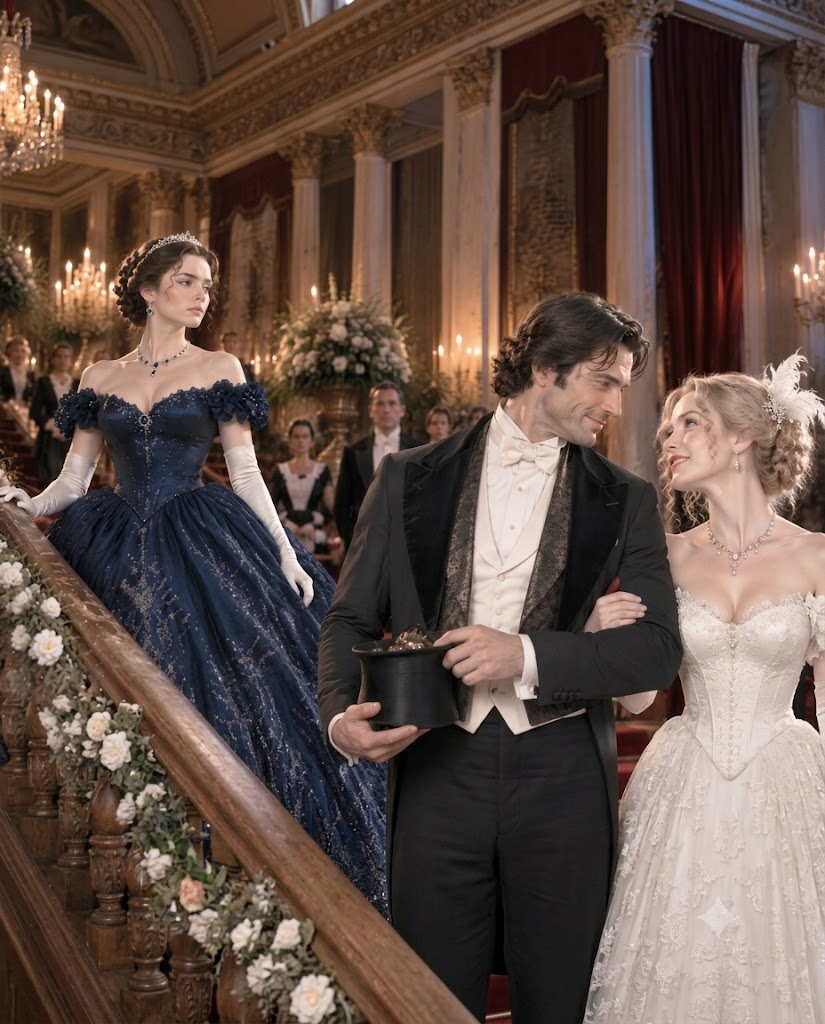
The Duchess of Ravensmeir was expected to prepare a bedroom for her husband’s mistress.
Sebastian stared at his wife’s hand resting over the document.
For several seconds, the only sound in the room was the quiet crackling of the fire.
Then he laughed.
It was not a pleasant laugh.
“Catherine, surely you cannot be serious.”
“Entirely.”
“You cannot accuse me of stealing from my own household.”
“I haven’t accused you of anything.”
She lifted the document, folded it once, and placed it inside her writing desk.
“Not yet.”
The final two words unsettled him more than any accusation could have.
Sebastian stepped forward.
“That settlement was arranged twelve years ago. Whatever technicalities your father insisted upon are hardly relevant now.”
Catherine regarded him with an expression he could not interpret.
“My father was a cautious man.”
“He was an interfering old fool.”
“Perhaps.”
She turned the small brass key in her desk.
“But he appears to have understood you rather better than I did.”
Sebastian’s face darkened.
“I will not be spoken to like this in my own house.”
Catherine rose.
“Then perhaps you should consider how this house has remained yours.”
He opened his mouth.
She continued before he could speak.
“Over the last seven years, I have paid thirty-six thousand pounds toward repairs, mortgages, and outstanding obligations attached to Ravensmeir. Another eleven thousand covered debts you neglected to mention. And during those same years, you withdrew money from accounts established exclusively for my benefit.”
Sebastian’s expression changed.
Not to remorse.
To calculation.
“How much do you believe is missing?”
Catherine watched him carefully.
“Enough.”
“Give me the figures.”
“Mr. Harcourt has them.”
“Then I shall speak to Harcourt myself.”
“You may certainly try.”
For the first time, Sebastian looked uncertain.
He had expected tears, perhaps an unpleasant argument, followed by the familiar return to peace.
Instead, he had found himself standing before a woman who seemed to have made decisions without consulting him.
And he had never considered that possibility.
The following morning, Lady Isabelle discovered that her allowance had stopped.
Her maid brought the news shortly after breakfast.
“The dressmaker has declined to send the gowns, my lady.”
Isabelle turned from her mirror.
“Declined?”
“She says the account requires settlement.”
“Then tell His Grace.”
“I have, my lady. His Grace says there must be some misunderstanding.”
Isabelle dismissed the maid and went immediately to Sebastian’s study.
She found him examining a stack of correspondence with an expression of growing irritation.
“Sebastian, what is happening?”
“Nothing of consequence.”
“The dressmaker is refusing my order. My London housekeeper writes that the household accounts have been frozen. And the jeweler has requested payment for the emerald necklace.”
Sebastian looked up sharply.
“Keep your voice down.”
“Have you lost control of your own money?”
His silence was answer enough.
Isabelle approached the desk.
“You promised I would be provided for.”
“And you shall be.”
“How?”
He pushed back his chair.
“Catherine has decided to be difficult.”
Isabelle’s eyes narrowed.
“Then make her stop.”
Sebastian looked toward the window.
For the first time, he did not immediately answer.
That afternoon, Catherine received a visitor.
Sir Lionel Ashcombe had been an old acquaintance of her father, a retired magistrate whose stern appearance concealed a surprisingly gentle disposition.
He arrived without ceremony and was shown into the east wing.
“My dear Duchess,” he said, taking her offered hand, “Harcourt tells me you have discovered something most unpleasant.”
Catherine gestured toward the chair beside the fireplace.
“I fear unpleasantness is only the beginning.”
Sir Lionel settled himself.
“Then we must ensure it does not become a disaster.”
From her desk, Catherine retrieved a leather folder.
Inside were copies of transactions, signed instructions, and correspondence recovered from the estate office.
Sir Lionel examined the pages.
His expression grew increasingly grave.
“This is not merely improper accounting.”
“No.”
“These signatures authorize withdrawals from capital protected by your settlement.”
“They do.”
“And your husband had no independent authority to make them.”
Catherine said nothing.
Sir Lionel removed his spectacles.
“If these documents are genuine, His Grace may be facing allegations of fraud.”
The word hung between them.
Fraud.
Such an ugly word for something Sebastian had accomplished with such elegant handwriting.
Catherine looked toward the portrait of her father hanging above the mantel.
“I do not wish to destroy him.”
Sir Lionel’s expression softened.
“Then what do you wish?”
She considered the question.
“I wish to stop him from destroying everything else.”
Three days later, Sebastian attempted his first serious negotiation.
He entered Catherine’s sitting room without knocking, carrying a small velvet box.
“I have been thinking,” he began.
Catherine continued writing.
“How encouraging.”
He ignored the remark and placed the box on her desk.
Inside lay a diamond bracelet.
She recognized it immediately.
It had belonged to his grandmother.
“A peace offering,” he said.
Catherine closed the box.
“Did you purchase this?”
“Of course not. It is a family heirloom.”
“Then it does not belong to you to offer as repayment.”
His smile vanished.
“I am attempting to be reasonable.”
“Are you?”
“You have made your point. Isabelle’s London arrangements can be reduced. I shall instruct the bankers to correct any discrepancies.”
“By returning the money?”
“In time.”
“How much time?”
Sebastian shifted.
“These things cannot be accomplished overnight.”
Catherine leaned back.
“Then I suggest you begin today.”
He stared at her.
“Do you intend to humiliate me?”
She looked at him steadily.
“No, Sebastian. I intend to hold you accountable.”
He struck the desk with his palm.
“Enough!”
The sound echoed through the room.
Catherine did not flinch.
After a moment, she reached for the bell.
Mrs. Bell appeared almost immediately.
“Your Grace?”
“Would you ask Mr. Whitmore to escort His Grace to his study?”
Sebastian looked incredulous.
“You are dismissing me?”
Catherine returned to her correspondence.
“I am asking you to leave.”
The footman stood quietly by the door.
Sebastian left.
But humiliation, Catherine would soon discover, could make a careless man dangerous.
The trouble began with a letter.
It arrived from London on a cold Thursday morning, sealed in dark green wax.
Mr. Harcourt’s handwriting appeared across the envelope.
Catherine opened it beside the breakfast-room window.
By the second paragraph, her fingers had tightened around the paper.
A petition had been filed questioning her competence to manage her independent property.
The grounds were vague.
Emotional instability.
Excessive suspicion.
An unhealthy fixation upon financial matters.
Most troubling of all, the petition included statements supposedly provided by members of her household.
Catherine read the names.
Two servants recently employed at Ravensmeir.
And Lady Isabelle Marlo.
She lowered the letter.
For a moment, she felt something colder than anger.
Sebastian was not merely trying to regain the accounts.
He was attempting to establish that his wife could no longer be trusted with them.
Mrs. Bell entered carrying fresh tea.
“Your Grace?”
Catherine folded the letter.
“Please send for Mr. Harcourt. And ask the senior servants to attend me in the library at noon.”
Mrs. Bell noticed her expression.
“Is something wrong?”
Catherine looked toward the corridor leading to Sebastian’s apartments.
“Something is about to become very wrong.”
At noon, six servants stood before the library fireplace.
Among them were the two whose names appeared in the petition.
A young footman named Thomas.
And a recently appointed secretary, Mr. Pritchard.
Catherine placed the document on the table.
“Certain statements have been attributed to members of this household.”
Thomas went pale.
Pritchard kept his eyes lowered.
“I would like to know whether either of you has witnessed me behaving irrationally.”
Neither answered.
Catherine waited.
Then Thomas suddenly spoke.
“Your Grace, I never said any such thing.”
Pritchard turned sharply toward him.
“Mind yourself, boy.”
Catherine raised one hand.
“Continue, Thomas.”
The young man swallowed.
“Mr. Pritchard gave me a paper. He said it was a record of the household wages. I signed because he told me everyone had to.”
Catherine looked at Pritchard.
“And was it?”
The secretary hesitated.
“I was acting under His Grace’s instructions.”
Mrs. Bell made a quiet sound of disgust.
Catherine rose.
“You will surrender your keys and all household records immediately, Mr. Pritchard. Until this matter has been examined, you are relieved of your duties.”
“You cannot simply dismiss me!”
“I have done so.”
He looked toward the other servants.
No one moved.
When he finally left, Thomas began to tremble.
“I’m sorry, Your Grace.”
Catherine approached him.
“You were deceived, Thomas. That is not the same as being dishonest.”
The young man’s eyes filled with tears.
She returned to her desk.
“Mrs. Bell, please ensure no document leaves this house without your knowledge.”
The housekeeper inclined her head.
“With pleasure, Your Grace.”
That evening, Isabelle entered Catherine’s private apartments.
She arrived without announcement, wearing a pale silk gown quite inappropriate for the season.
The mourning clothes had disappeared.
“So,” Isabelle said, closing the door, “you have discovered Sebastian’s petition.”
Catherine sat beside the fire.
“I have.”
“Then perhaps you finally understand the seriousness of your position.”
Catherine studied the younger woman.
“Do you?”
Isabelle smiled.
“You may have your precious accounts, but Sebastian is still your husband. Society will believe him before it believes a bitter wife.”
“Will it?”
“A Duchess who accuses her husband of theft while threatening innocent guests is hardly an attractive figure.”
Catherine rose slowly.
“You have mistaken my silence for helplessness.”
“And you have mistaken your title for affection.”
The words struck with more force than Catherine expected.
Not because they were clever.
Because once, long ago, she had feared they were true.
Isabelle saw the brief change in her expression and pressed forward.
“Sebastian loves me.”
Catherine looked at her.
“Does he?”
“Of course.”
“Then why are you here speaking on his behalf?”
Isabelle blinked.
Catherine stepped closer.
“Why must you threaten his wife to secure promises he has already made you?”
The younger woman’s smile vanished.
“You know nothing about us.”
“I know he brought you into a house maintained by my money. I know he promised you rooms that were never his to give. And I know the home he established for you was purchased with funds he had no right to touch.”
Isabelle’s cheeks flushed.
“He said those funds belonged to him!”
Catherine went still.
There it was.
Not a confession.
But the first fracture.
“Then perhaps,” Catherine replied quietly, “you should ask him what else he has told you.”
Isabelle left with her head high.
Yet Catherine noticed that her hands were shaking.
The next morning brought an unexpected discovery.
Mrs. Bell arrived carrying a narrow wooden box recovered from Pritchard’s abandoned desk.
Inside were several papers, an unused seal, and a packet of letters tied with blue ribbon.
The letters were addressed to Isabelle.
But they were not written by Sebastian.
They bore the signature of Lord Marlo, her deceased husband.
Catherine hesitated before opening them.
Then she saw the date on the final envelope.
It had been written just six weeks before Lord Marlo’s death.
The first letters were affectionate.
The later ones were increasingly distressed.
Lord Marlo spoke of debts he could not understand, investments he had never authorized, and documents presented for his signature during an illness.
One passage caused Catherine to stop reading.
“If the accounts are true, Sebastian has deceived us both. I cannot believe he would use your name to conceal what he has taken.”
Catherine read the sentence twice.
Sebastian.
Isabelle.
The missing money.
Suddenly, the affair appeared far more complicated than wounded pride.
She sent immediately for Harcourt.
When he arrived, she handed him the letters.
He read them beside the window.
“This changes matters considerably.”
“Explain.”
“Lord Marlo seems to have suspected financial manipulation before his death. Your husband may have been concealing losses through accounts connected to both households.”
Catherine felt a chill.
“And Isabelle?”
“Possibly involved. Possibly deceived.”
Outside, the first snow of the season began drifting across the lawn.
Catherine looked toward the white garden.
“Then we need the truth before anyone else can bury it.”
The opportunity arrived sooner than expected.
Two nights later, Isabelle came to Catherine’s door.
She wore no jewelry.
Her face was pale, and her eyes were red.
“May I speak with you?”
Catherine stepped aside.
Isabelle entered and remained standing.
For several moments, she seemed unable to begin.
Finally, she whispered, “He lied.”
Catherine waited.
“Sebastian told me my husband had left enormous debts. He said he had arranged everything to protect my reputation.”
“Did he?”
Isabelle shook her head.
“I went through the papers he kept in his study. There are transfers from my husband’s estate into accounts I never knew existed.”
Catherine felt her pulse quicken.
“Do you have copies?”
Isabelle removed a packet from beneath her shawl.
“These.”
Catherine examined the first page.
The account numbers matched those in her own ledgers.
But there was another signature.
A name she did not recognize.
“Who is Frederick Vale?”
Isabelle’s expression darkened.
“Sebastian’s business partner.”
Catherine remembered the name vaguely.
A charming London financier.
A man who had visited Ravensmeir twice and spoken endlessly of railway shares and foreign investments.
“He helped Sebastian manage my husband’s affairs,” Isabelle continued. “After Arthur became ill.”
Catherine looked up.
“Arthur trusted him?”
“No.”
A tear slipped down Isabelle’s cheek.
“Arthur wanted him dismissed.”
For a moment, neither woman spoke.
Then Isabelle said something Catherine had not expected.
“I loved Sebastian because I believed he had saved me.”
Catherine set the papers down.
“And now?”
Isabelle’s voice broke.
“Now I don’t know whether I have ever known him at all.”
Catherine regarded her for a long moment.
She could have enjoyed this.
She could have reminded Isabelle of every insult, every assumption, every contemptuous smile.
Instead, she remembered herself twelve years earlier, believing Sebastian’s charming promises because she wanted desperately to be loved.
“Sit down,” Catherine said.
Isabelle looked surprised.
“Why?”
“Because we have a great deal to discuss.”
The next week unfolded with astonishing speed.
Harcourt obtained bank records through lawful inquiries and prepared applications for further disclosure.
Sir Lionel arranged for independent witnesses to examine the disputed signatures.
And Isabelle, now frightened by the possibility that her husband’s fortune had been misappropriated, supplied correspondence she had previously concealed.
Together, the documents revealed a pattern.
Sebastian and Frederick Vale had invested heavily in a speculative shipping venture.
When the venture collapsed, they had concealed the losses by transferring money between estates and private accounts.
Catherine’s protected inheritance had replenished Marlo investments.
Lord Marlo’s funds had covered Sebastian’s debts.
And Isabelle’s expensive London residence had been maintained through accounts designed to disguise the movement of money.
But the greatest shock came when Harcourt uncovered a newly prepared mortgage.
Ravensmeir Hall itself had been pledged as security for another substantial loan.
Without Catherine’s knowledge.
Against income the lender had been falsely assured Sebastian controlled.
Catherine sat very still while Harcourt explained.
“If the lender’s claim is pursued without challenge, there may be proceedings against the estate.”
“Can the mortgage be disputed?”
“Certain representations are plainly questionable. But His Grace has created a considerable legal difficulty.”
Catherine looked around her sitting room.
At the familiar curtains.
The books she had collected.
The fireplace before which she had spent so many evenings waiting for Sebastian to return.
For twelve years, she had called Ravensmeir home.
Now she understood how carelessly he had gambled with it.
“What happens to the tenants?” she asked.
Harcourt paused.
“Your Grace?”
“The families on the estate. The cottages. The farms.”
“We must examine which holdings are affected.”
Catherine rose.
“Then that is where we begin.”
The confrontation took place on a Sunday evening.
Sebastian had invited Frederick Vale to dine, apparently believing that a display of ordinary hospitality might restore his authority.
He entered the dining room and found Catherine already seated.
Beside her sat Mr. Harcourt.
Sir Lionel Ashcombe.
And Lady Isabelle Marlo.
There were no servants present.
Sebastian stopped in the doorway.
“What is this?”
Catherine gestured toward the empty chair.
“A discussion you can no longer avoid.”
Frederick Vale appeared behind him.
The moment he saw the documents on the table, his expression tightened.
Sebastian looked at Isabelle.
“What have you been telling them?”
She raised her chin.
“The truth, as far as I know it.”
“You foolish girl.”
“Careful, Sebastian,” Catherine said.
He turned furiously.
“You have no right to summon me before a gathering of conspirators!”
Harcourt opened his leather case.
“Your Grace, serious questions have arisen concerning transactions made under your signature.”
Vale moved toward the door.
Sir Lionel spoke calmly.
“I would advise you to remain, Mr. Vale. You are not detained, but leaving will not prevent these matters from being investigated.”
The financier stopped.
Harcourt spread several documents across the table.
“There are unexplained transfers, disputed authorizations, and evidence of false representations to creditors. I suggest you both obtain independent legal advice.”
Sebastian looked at the papers.
Then at Catherine.
“You would expose your husband to scandal?”
She met his eyes.
“You exposed us all to ruin.”
“Everything I did was for this family!”
“For which family?” Isabelle demanded.
Sebastian wheeled toward her.
“Do not begin.”
She stood.
“My husband died believing he had failed me. You told me he had squandered our money. You allowed me to despise him for losses he may never have caused!”
Sebastian’s face drained of color.
“I was protecting you.”
“No,” Isabelle whispered. “You were protecting yourself.”
Vale suddenly spoke.
“Sebastian, this is absurd. We agreed the Marlo accounts would remain confidential.”
The room went silent.
Harcourt slowly lifted his head.
“We?”
Vale realized his mistake.
Sebastian stared at him with naked fury.
“Be quiet.”
But the damage was done.
Harcourt closed the folder.
“I believe we have enough to proceed.”
Sebastian turned toward Catherine.
For an instant, she saw the man she had married.
Not as he truly was.
But as he had appeared when they were young.
Handsome.
Confident.
Certain that charm could overcome every obstacle.
“Catherine,” he said softly, “surely you will not allow this.”
She felt an old instinct stir.
The urge to soothe him.
To solve the problem.
To make his fear disappear at the expense of her own peace.
Then she remembered Thomas trembling in the library.
The tenants whose cottages might be threatened.
The forged statements concerning her sanity.
The money taken without permission.
And the twelve years she had spent saving a man who had never once thought to save her.
“I cannot protect you from the consequences of your choices,” she answered.
Sebastian looked as though she had struck him.
But Catherine did not look away.
Winter settled heavily over Northumberland.
The legal proceedings moved slowly, as such matters often did, but their consequences were immediate.
Vale’s financial business collapsed under scrutiny.
Creditors demanded explanations.
A disputed portion of Lord Marlo’s estate was placed under formal examination.
And Sebastian discovered that noble rank could not silence bankers who feared their own losses.
Harcourt secured protective orders concerning Catherine’s settlement funds and challenged the unauthorized transactions.
The threatened estate holdings remained under careful supervision while the mortgage dispute was addressed.
Catherine worked tirelessly with the steward to ensure wages were paid and the tenants protected.
She sold several unnecessary household luxuries.
Closed unused guest rooms.
Reduced extravagant entertainments.
And, for the first time in years, Ravensmeir began to live within its means.
Sebastian despised the changes.
He particularly despised that they worked.
One bitter January morning, he appeared in the library carrying a letter from his solicitors.
“They say I must resign management of the remaining estate revenues.”
Catherine looked up from her accounts.
“Yes.”
“And you have agreed?”
“I have.”
He stood before her desk.
“Do you understand what you are taking from me?”
She closed the ledger.
“Something you were never entitled to take from me.”
He looked suddenly older.
The elegant confidence had deserted him.
His clothes remained impeccable, but his eyes were shadowed by sleepless nights.
“I have nothing left.”
Catherine regarded him.
“You have your title. Your private possessions. And the opportunity to begin repairing what you have done.”
He laughed bitterly.
“You speak as though redemption were merely another household account.”
“No,” she replied. “An account can be balanced with money. What you owe cannot.”
For a moment, he seemed ready to argue.
Instead, he lowered himself into a chair.
“Did you ever love me?”
The question surprised her.
She looked at the man before her and felt the quiet ache of a grief she had been too busy to acknowledge.
“Very much.”
He lifted his eyes.
“Then how can you do this?”
Catherine’s voice remained gentle.
“Because loving you did not make what you did right.”
Sebastian bowed his head.
And for the first time, he had no answer.
By spring, the first major settlements had been reached.
Properties acquired through unauthorized withdrawals were sold, and substantial sums were returned to the affected estates.
Vale faced criminal proceedings over his role in the fraudulent transactions.
Sebastian, advised that further concealment would only deepen his difficulties, acknowledged several improper authorizations and agreed to restitution terms under close legal supervision.
Not every loss could be recovered.
Not every wrong could be repaired.
But the immediate threat to Ravensmeir’s tenants had been lifted.
Catherine’s independent inheritance remained protected, and the remaining estate obligations were placed under an arrangement she could supervise.
Sebastian withdrew to a modest family property in the south, pending the resolution of further legal matters.
He did not ask Catherine to accompany him.
And she did not offer.
Their separation was formalized with the assistance of their solicitors, leaving Catherine free to reside in her own property and manage her affairs independently.
On the morning he departed, Sebastian stood beside his carriage for several minutes.
Catherine came to the entrance hall.
He looked at the staircase behind her.
The very staircase where he had once arrived with Isabelle.
“I thought you would always be here,” he said.
Catherine considered his words.
“I was.”
He looked at her.
“For twelve years, I was here.”
He lowered his eyes.
Then he entered the carriage.
She watched until it disappeared beyond the gates.
She expected triumph.
Instead, she felt sadness.
Not for the man leaving.
But for the years she had spent believing that loyalty required her to disappear inside someone else’s life.
She turned toward the house.
Mrs. Bell stood waiting.
“Shall I have the drawing room prepared, Your Grace?”
Catherine glanced at the sunlight crossing the marble floor.
“Yes, Mrs. Bell.”
She smiled.
“And open the curtains.”
Lady Isabelle remained in Northumberland until the questions surrounding her husband’s estate were resolved.
Her relationship with Catherine never became simple.
There were wounds too deep for convenient friendship.
But bitterness slowly gave way to a cautious understanding.
One afternoon, Isabelle visited Catherine in the garden.
The roses were beginning to bloom.
“I have accepted a position assisting my late husband’s sister with her charitable work,” Isabelle said.
Catherine looked up.
“That sounds worthwhile.”
“It is not the life I imagined.”
“Few worthwhile lives are.”
Isabelle hesitated.
“I owe you an apology.”
Catherine waited.
“I entered your home believing that because Sebastian had chosen me, I had somehow won.”
She looked down at her gloves.
“I thought your silence meant you were weak.”
Catherine studied the roses.
“For a time, I thought so too.”
Isabelle’s eyes filled.
“You could have ruined me.”
“Perhaps.”
“Why didn’t you?”
Catherine considered the younger woman before answering.
“Because I had spent enough years allowing Sebastian’s choices to determine the kind of woman I became.”
Isabelle wiped her cheek.
“Will you ever forgive me?”
Catherine looked at her.
“I hope so. But forgiveness is not something I can promise merely because we both wish the past were different.”
Isabelle nodded slowly.
It was not the answer she wanted.
But it was an honest one.
And honesty, she had learned, was worth more than comfort purchased with lies.
By autumn, Ravensmeir had changed.
The neglected cottages were restored.
The farms began returning modest profits.
A schoolroom was established for the children of estate workers, funded through a portion of Catherine’s personal income.
She created a small fund offering practical assistance to widows who had been left without secure means.
It was not grand charity.
There were no elaborate ceremonies.
No flattering newspaper accounts.
Only roofs repaired before winter, children learning to read, and women who no longer had to depend entirely upon promises they could not enforce.
One October afternoon, Harcourt arrived with the final papers confirming the protection and administration of her settlement.
He found Catherine in the library.
The same room where she had once discovered the first suspicious entry.
“Everything is in order, Your Grace.”
She accepted the documents.
“And Ravensmeir?”
“Secure under the present arrangements, provided the remaining obligations continue to be met.”
Catherine smiled.
“I shall see that they are.”
Harcourt glanced toward the shelves.
“Your father would have been proud.”
For a moment, her composure wavered.
She looked at the little brass key resting beside her inkstand.
The key to the writing desk Sebastian had once tried to open.
“My father believed I deserved a life that was truly my own.”
“Then he was correct.”
After Harcourt departed, Catherine remained by the window.
Beyond the glass, autumn leaves drifted across the lawn.
Servants moved between the stables and the gardens.
From the distant schoolroom came the faint sound of children’s laughter.
She thought of the woman who had stood at the staircase a year earlier.
A woman who had answered humiliation with perfect courtesy because she had not yet realized that courtesy could coexist with refusal.
She had believed courage would arrive like thunder.
With shouting.
With declarations.
With some magnificent moment in which fear vanished entirely.
Instead, courage had arrived quietly.
In the turning of a key.
In the copying of a ledger.
In the decision to ask a solicitor one simple question.
And in the strength to say no when someone had grown accustomed to hearing yes.
That evening, Mrs. Bell entered with a message.
“A letter has arrived from His Grace.”
Catherine glanced at the sealed envelope.
Sebastian’s handwriting was unmistakable.
For a moment, she considered leaving it unopened.
Then she took it.
The letter was brief.
He wrote of the consequences of his conduct, of his diminished circumstances, and of the lonely realization that he had squandered the one person who had remained loyal to him without calculation.
There was no request for money.
No demand that she return.
Only one final sentence.
I mistook your patience for permission, and by the time I understood the difference, I had lost the right to ask for either.
Catherine folded the letter.
She did not weep.
Nor did she smile.
She placed it inside the drawer with the other records of a life she no longer intended to inhabit.
Then she crossed the room and opened the window.
Cool evening air entered, carrying the scent of rain and fallen leaves.
Behind her lay twelve years of marriage, betrayal, sacrifice, and hard-won truth.
Before her lay something less certain.
A life without the familiar burden of rescuing Sebastian.
A future in which she would have to discover what she wanted, rather than merely what others required.
For the first time, the uncertainty did not frighten her.
It felt like freedom.
Mrs. Bell returned to announce dinner.
“Shall I lay two places, Your Grace?”
Catherine looked toward the empty chair beside the fireplace.
Once, she would have considered an empty chair evidence of failure.
Now she understood that a table could be peaceful without being full.
“One place tonight, Mrs. Bell.”
The housekeeper nodded.
“And tomorrow?”
Catherine smiled.
“Tomorrow, we shall invite the schoolmistress and the families from the restored cottages. I believe we have something worth celebrating.”
Mrs. Bell’s face brightened.
“Indeed we do, Your Grace.”
As the housekeeper departed, Catherine turned once more toward the garden.
The last light of evening touched the stone walls of Ravensmeir.
The house was quieter now.
But it no longer felt empty.
It felt awake.
And Catherine Wikliffe, Duchess of Ravensmeir, finally understood something her younger self had never been taught.
A woman’s worth was not measured by how much humiliation she could endure without complaint.
Loyalty was not the same as surrender.
Forgiveness did not require the abandonment of justice.
And love, no matter how deeply felt, could never demand the sacrifice of one’s dignity as proof of devotion.
She had spent twelve years keeping a house standing for a man who believed it belonged entirely to him.
In the end, she had saved something far more precious than its walls.
She had saved the woman living inside them.
And this time, she intended to remain her own.
THE END.