The day Walter Briggs dumped my homemade stew onto the Dust Creek Ranch floor and called me worthless, I discovered the secret behind his stolen fortune.
I stared at the message until the words blurred together, unable to understand how a dead man could still be watching me.
Daniel had been gone for three years, and I had spent every one of those years learning how to survive without him.
Now a stranger was telling me that the man I had buried might still be breathing somewhere beneath the same Wyoming sky.
Cord reached for my phone, but I pulled it against my chest.
“Don’t touch it until you tell me everything you know.”
His expression changed, and for the first time, I saw something darker than concern in his eyes.
Guilt.
Above us, heavy footsteps crossed the kitchen floor, followed by the unmistakable sound of Walter Briggs opening drawers.
Cord gently closed the cellar door and turned the rusty lock.
“Daniel trusted me with that box because I helped him investigate the missing shipments.”
I stared at him in disbelief, remembering all the quiet breakfasts when he had watched me from the other end of the dining hall.
“You knew who I was the day I arrived.”
“Yes.”
“And you let me believe my husband died in an accident?”
Cord lowered his head.
“I believed he was dead too, Vera.”
Before I could answer, something heavy struck the cellar door.
Walter’s voice echoed through the wood.
“Come out, Mrs. Callaway, because hiding will only make things worse.”
Cord grabbed an old lantern and pointed toward a narrow passage behind the shelves.
The tunnel smelled of damp earth and rotting timber, and every step sent dust drifting from the ceiling.
I followed him through the darkness, clutching Daniel’s letter so tightly that its edges cut into my palm.
Behind us, the cellar door shattered.
A man’s voice shouted, “Find the woman before she gets off the property!”
Cord pushed open a wooden hatch beneath an abandoned feed shed.
Cold night air struck my face as we climbed into the open, with the ranch lights glowing like distant stars.
His truck was parked behind the barn, but before we reached it, headlights swept across the yard.
We dropped behind a row of hay bales as Richard Voss’s black truck rolled slowly past.
I could see his face clearly through the windshield.
He looked ordinary, almost respectable, which somehow made him more terrifying.
The truck disappeared toward the south pasture, and Cord finally released the breath he had been holding.
“We need to get you somewhere safe.”
I shook my head.
“Not until I know whether Daniel is alive.”
Cord looked at me with an expression I couldn’t read.
“Sometimes the truth costs more than people are prepared to lose.”
I thought about my husband’s empty chair, the unpaid bills, and the nights I had whispered his name into a cold pillow.
“I’ve already paid enough.”
We drove without headlights along an old service road until the ranch vanished behind the hills.
Cord took me to a small hunting cabin beside a frozen creek, where he lit a fire and handed me a wool blanket.
While he checked the windows, I opened Daniel’s letter again.
Several lines had been smudged, but near the bottom, I noticed something I had missed.
“If anything happens, find the blue ledger beneath the flour scale, because the numbers will tell you who betrayed us.”
I read the sentence twice.
The flour scale.
There had been an old blue scale in the Dust Creek kitchen when I arrived, but Walter had ordered me to throw it away.
I had refused because it still worked.
Now I understood why he had been so angry.
“There’s something hidden in my kitchen,” I told Cord.
He turned from the window.
“Then we’ll get it when the ranch is quiet.”
I shook my head.
“Walter already knows about the notebook, and Richard knows about the report.”
“If we go back now, we may not get another chance to leave.”
I looked down at Daniel’s handwriting.
“Then we can’t afford to make a mistake.”
Cord sat across from me while I connected the flash drive to his old laptop.
A folder appeared on the screen, containing bank statements, photographs, shipping documents, and one video file.
My fingers trembled as I opened the video.
Daniel appeared on the screen, sitting in what looked like a motel room.
His hair was longer than I remembered, and dark circles surrounded his tired eyes.
“Vera, sweetheart, if you’re watching this, I’ve failed to keep you out of something dangerous.”
My hand flew to my mouth.
Hearing his voice again hurt more than I could have imagined.
“I took a temporary bookkeeping job for a company supplying Dust Creek Ranch because I thought the extra money would help us open our kitchen.”
He paused and looked toward the motel door.
“But I discovered that someone was using fake suppliers to steal from the ranch, and when I tried to leave, they threatened you.”
I began crying silently.
Daniel swallowed before continuing.
“Richard Voss controls the accounts, but I believe someone else is protecting him.”
The video ended abruptly when a loud knock came from somewhere beyond the camera.
I pressed play again, desperate to hear even one more word.
Cord quietly closed the laptop.
“There’s a date on the file, Vera.”
I looked at the screen.
It had been recorded four days before Daniel’s supposed accident.
For a moment, the only sound inside the cabin was the crackling fire.
Then my phone vibrated.
Another message appeared from the unknown number.
“Stop trusting the cowboy, and ask him what happened on Highway 287.”
I slowly lifted my eyes toward Cord.
His face went pale before I could speak.
“What happened on Highway 287?”
He stared at the flames.
“That was where Daniel’s truck went off the road.”
“I know where my husband died.”
My voice cracked.
“I’m asking what you did.”
Cord pressed his hands together, struggling to find the words.
“I followed Daniel that night because he asked me to make sure nobody was watching him.”
The room seemed to shrink around us.
“Did you see the accident?”
“I saw a black SUV force his truck across the center line.”
My stomach twisted.
“And you never told the police?”
“I did, but the deputy who took my statement said there wasn’t enough evidence.”
“Then why didn’t you tell me?”
Cord looked at me, and tears shone in his eyes.
“Because two days later, somebody left a photograph of my little sister outside my door.”
He reached into his wallet and showed me a faded picture of a smiling young woman standing beside a horse.
“Her name is Lily, and she’s the only family I have left.”
I wanted to hate him.
Part of me did.
But the fear in his voice was painfully familiar.
It was the same fear I had carried every day since Daniel’s death.
“You should have told me anyway,” I whispered.
“I know.”
He didn’t ask for forgiveness.
And somehow, that made his apology feel more honest.
The next morning, I woke to the smell of coffee and the sight of Cord standing beside the window.
An unfamiliar silver sedan was parked outside.
A woman stepped from the driver’s seat wearing a dark coat and carrying a leather briefcase.
Cord opened the door before she could knock.
“Vera, this is Margaret Caldwell.”
I sat upright.
“The ranch owner’s wife?”
She gave me a tired smile.
“His daughter.”
Margaret was in her early forties, with silver-streaked hair and eyes that looked as though they had forgotten how to rest.
“My father received your supply report twelve days ago, Mrs. Callaway.”
I stood so quickly that the blanket fell from my shoulders.
“Then why hasn’t he done anything?”
She glanced toward Cord.
“Because someone intercepted his correspondence, and we only discovered your original report yesterday.”
My heart sank.
“Is your father safe?”
Margaret hesitated.
“He suffered a stroke last winter, and Richard Voss has been managing much of his business ever since.”
She opened her briefcase and removed several documents.
“Your report confirms suspicions I’ve had for months, but suspicion won’t survive a courtroom.”
I told her about Daniel, the photograph, and the strange messages.
When I mentioned the blue ledger, she leaned forward.
“My father kept his original supplier records in a blue accounting book years ago.”
“Why would it be hidden in my kitchen?”
Margaret looked confused.
“It shouldn’t be.”
Then she examined Daniel’s handwritten letter.
Her expression suddenly changed.
“Daniel was working with my father before the accident.”
I felt the floor shift beneath me.
“What?”
“My father hired him privately after noticing irregularities in the ranch accounts.”
She turned the letter toward the light.
“Daniel discovered that Richard had been forging purchase orders, but they couldn’t identify the bank receiving the stolen money.”
I looked at the date beside Daniel’s signature.
For three years, I had believed my husband died trying to earn extra money for our future.
Now I realized he had been trying to protect other people’s livelihoods.
And perhaps mine.
Margaret reached across the table.
“Mrs. Callaway, I think we can expose them, but we have to move carefully.”
Before I could answer, Cord’s phone rang.
He listened for several seconds without speaking.
Then his expression hardened.
“They’ve fired every kitchen worker and ordered the ranch hands to stay in their bunkhouse.”
I stood.
“Then the men won’t have anything to eat.”
Margaret stared at me.
“Vera, this is no longer about dinner.”
I looked at her.
“Those men have families, and some of them haven’t been paid properly in months.”
“They can survive one missed meal.”
I shook my head.
“That’s what people always say when it’s someone else’s hunger.”
Nobody spoke for a moment.
Then Margaret slowly nodded.
“Tell me what you need.”
By afternoon, we had a plan.
Margaret contacted a state investigator who had already begun reviewing suspicious financial transfers involving Richard Voss.
Cord called Eddie, the older ranch hand who had once cried over my biscuits.
And I borrowed an insulated food trailer from the farmer who supplied my vegetables.
We parked on public land outside the ranch’s eastern gate, where the hands could legally meet us after their shifts.
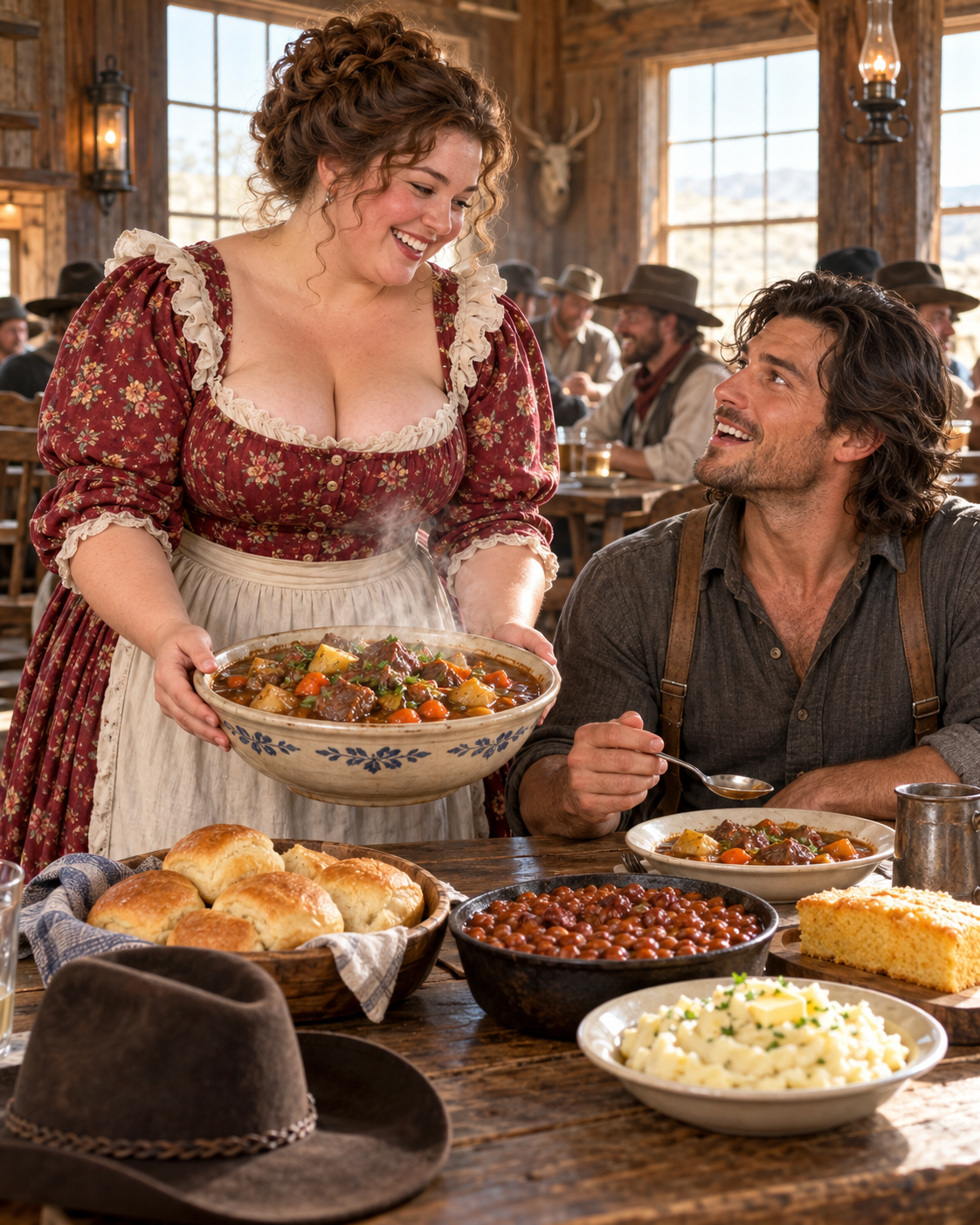
I spent the afternoon cooking beef stew, cornbread, and a pot of beans large enough to feed everyone twice.
My hands remembered every movement, even while fear pressed against my ribs.
At sunset, Eddie arrived with twenty-six tired men walking behind him.
Some looked frightened.
Others looked ashamed.
One young worker carried his lunch pail like a child bringing an empty bowl to a table.
Eddie stopped in front of me.
“Briggs says you’re a thief.”
I wiped my hands on my apron.
“Do you believe him?”
The old man looked toward the trailer, where warm bread was cooling beside the stove.
“Not after everything you’ve done.”
One by one, the men lined up.
I handed out plates until my arms ached.
For the first time in days, I felt something steady beneath the fear.
Purpose.
Then Eddie quietly pulled me aside.
“There’s something you need to know about the night your husband died.”
My breath caught.
Eddie glanced at Cord before speaking.
“I was driving the ranch fuel truck that night, and I saw another vehicle near the accident.”
“Richard’s SUV?”
He shook his head.
“It belonged to the sheriff’s department.”
I stared at him.
“Are you sure?”
“I remember the markings, and I remember the deputy who climbed out.”
“Who was it?”
Eddie swallowed.
“Deputy Nolan Price.”
The name meant nothing to me, but Cord stiffened beside us.
“Price was the officer who took my statement,” he whispered.
Everything suddenly connected in a terrible way.
The missing evidence.
The ignored witness.
The years of silence.
I asked Eddie why he had kept quiet.
He looked toward the men eating by the trailer.
“Briggs told me I’d lose my job, and my wife was going through chemotherapy.”
His voice broke.
“I told myself one lie wouldn’t hurt anybody, but I’ve carried that night around like a stone ever since.”
I took his weathered hand.
“You can still tell the truth.”
He nodded, tears gathering in his eyes.
“I’m ready.”
Margaret called the investigator immediately.
Then we turned our attention to the blue ledger.
According to Eddie, Walter was spending the evening at a livestock auction outside Casper.
Richard had left the ranch earlier that afternoon.
The kitchen’s rear door was usually unlocked for supply deliveries.
I told Cord I could get inside without attracting attention.
He refused at first.
Then I reminded him that the ledger was hidden beneath a scale only I knew how to dismantle.
Margaret arranged for investigators to remain nearby, but they warned us not to confront anyone.
Shortly after nine, Cord and I approached the kitchen through the shadow of the grain silos.
The building was dark.
Inside, everything smelled familiar.
Yeast, coffee, wood smoke, and the faint sweetness of cinnamon.
For one heartbreaking moment, I remembered cooking breakfast while Daniel sat at our old apartment table.
I almost heard him laughing about how I always used too much butter.
Then Cord touched my shoulder.
“We need to move.”
The blue flour scale stood beneath the counter beside the pantry.
I lifted it carefully and felt along the metal base.
Nothing.
My heart began sinking.
Then my finger caught a tiny screw beneath the rear panel.
Cord handed me his pocketknife.
I removed the screw, pulled the panel loose, and discovered a narrow compartment inside.
There was a small blue notebook wrapped in plastic.
And beneath it lay a silver wedding ring.
I recognized the scratches immediately.
Daniel had damaged the ring while repairing our kitchen sink.
My knees gave way.
Cord caught me before I hit the floor.
I held the ring against my lips, unable to stop crying.
“Why would he leave this here?”
Cord’s voice softened.
“Maybe he knew someone would come looking for him.”
I opened the ledger with trembling hands.
Page after page listed fake suppliers, inflated invoices, and bank transfers.
But near the back, Daniel had written one sentence in red ink.
“Voss answers to Caldwell’s legal representative.”
Margaret had told me Richard managed the accounts.
But she hadn’t mentioned a legal representative.
I turned another page.
There was a name.
Samuel Harrow.
I remembered seeing it on the paperwork Margaret had carried into the cabin.
He was her father’s longtime attorney.
Before I could speak, the kitchen lights snapped on.
Walter Briggs stood in the doorway holding a shotgun.
“Put the book down, Vera.”
Cord stepped in front of me.
Walter’s hands trembled around the weapon.
“You don’t understand what you’ve found.”
I rose slowly.
“Then explain it.”
His eyes moved toward the wedding ring in my hand.
For a brief instant, something like regret crossed his face.
“That ring should never have been left here.”
My voice shook.
“Where is my husband?”
Walter looked at Cord.
“She still doesn’t know?”
I felt my heartbeat stop.
“Know what?”
Walter lowered the barrel slightly.
“Daniel survived the crash.”
The words hit me so hard that I forgot how to breathe.
“He was badly injured, and Richard had him taken away before the police arrived.”
I grabbed the counter.
“Where did they take him?”
Walter shook his head.
“I only handled the money and deliveries.”
“You’re lying.”
“Not about this.”
Cord edged toward the office telephone.
Walter raised the shotgun again.
“Don’t.”
Then a voice came from behind him.
“Put it down, Walter.”
Margaret stood in the hallway with two investigators.
Walter stared at them, defeated.
For several seconds, nobody moved.
Then the shotgun slipped from his hands and struck the floor.
The investigators restrained him while Margaret rushed toward me.
I showed her the ledger.
When she saw Samuel Harrow’s name, her face drained of color.
“He’s been my father’s attorney for twenty-eight years.”
I handed her the page.
“And Daniel believed he was protecting Richard.”
Margaret closed her eyes.
“My father trusted that man with everything.”
Walter suddenly began speaking from the doorway.
“Harrow arranged the suppliers, and Voss moved the money through companies registered under false names.”
One investigator stopped him.
“You can explain the details in your formal statement.”
Walter looked directly at me.
“They told me Daniel was dead, Vera.”
I couldn’t find a single word to say.
Then he added something I would remember for the rest of my life.
“But I knew he wasn’t when I saw him last Christmas.”
The room went silent.
My knees nearly buckled again.
“Where?”
Walter swallowed.
“At a private rehabilitation center outside Sheridan.”
Margaret immediately asked for the name.
Walter hesitated.
Then he whispered it.
“Willow Ridge.”
The following morning, investigators obtained records from the facility while officers located Richard Voss at a motel near the Montana border.
He was taken into custody, and Samuel Harrow was detained for questioning after investigators traced payments through several shell companies.
Deputy Nolan Price was placed on leave while authorities investigated his role in the accident.
I should have felt relieved.
Instead, I sat in Margaret’s car staring at a photograph taken six months earlier.
Daniel was standing in the courtyard of Willow Ridge.
He looked older.
Thinner.
But unmistakably alive.
His left hand rested on a walking cane.
A deep scar crossed his forehead.
And beside him stood a young nurse who had been helping him recover.
My husband.
My Daniel.
I touched the picture with trembling fingers.
“Why didn’t he come home?”
Margaret looked at me.
“The records suggest he suffered a serious brain injury.”
I turned toward her.
“What does that mean?”
“He may have lost parts of his memory.”
The words frightened me more than anything Walter had said.
Because I could survive the truth that Daniel had been taken from me.
I didn’t know how to survive a truth in which he no longer remembered our life together.
When we reached Willow Ridge, the facility director met us in a quiet room overlooking a garden.
Her name was Helen Brooks, and she looked exhausted.
She confirmed that Daniel had arrived under another name with severe injuries and incomplete identification records.
According to the documents supplied at the time, he had been a patient requiring long-term neurological rehabilitation.
Helen had recently begun questioning the unusual restrictions placed on his visitors.
“Mr. Harrow claimed to be his legal guardian,” she explained.
Margaret’s face tightened.
“That authority appears to have been obtained through false information.”
Helen nodded.
“We’ve already provided the records to investigators.”
I barely heard them.
“Can I see him?”
Helen studied my face.
“He’s been through a great deal, Mrs. Callaway.”
“So have I.”
She gave a small, sorrowful nod.
“Come with me.”
We walked down a long hallway where sunlight spilled across pale wooden floors.
Somewhere nearby, someone was playing an old country song on the piano.
My chest tightened because Daniel had loved that song.
I stopped outside a room with the door half open.
A man sat beside the window, slowly turning the pages of a cookbook.
His hair was streaked with gray.
He wore a blue sweater.
His left hand trembled slightly as he reached for a glass of water.
I knew the shape of his shoulders before I saw his face.
“Daniel?”
He looked up.
For one terrible second, there was no recognition in his eyes.
Only confusion.
Then his gaze fell on the wedding ring hanging from the chain around my neck.
His lips parted.
“Vera?”
I covered my mouth.
The years disappeared.
The loneliness.
The cold hospital corridor where someone had told me he was dead.
The funeral where I had kissed a closed coffin.
All of it shattered beneath the sound of my name.
I crossed the room, but stopped before touching him.
I was afraid he might vanish.
He reached out first.
His fingers brushed my cheek.
“You’re real.”
I nodded through my tears.
“I’m here.”
Daniel began crying.
“I kept dreaming about a woman who smelled like cinnamon bread.”
A broken laugh escaped my throat.
“That was me.”
He closed his eyes.
“I remembered your voice, but I couldn’t remember where to find you.”
I knelt beside his chair and held his hands.
For three years, I had imagined this reunion a thousand different ways.
I had imagined anger.
Relief.
A thousand questions.
But when the moment finally came, all I wanted was to feel his heartbeat beneath my palm.
Daniel pressed his forehead against mine.
“I’m sorry I couldn’t come home.”
I shook my head.
“You came back to me.”
He cried harder.
And for the first time since his accident, I didn’t feel like a widow.
I felt like a woman standing at the beginning of an unfamiliar life.
But happiness did not erase everything.
Daniel’s recovery had been slow, and some memories remained fragmented.
He remembered our apartment.
He remembered my cooking.
He remembered discovering the stolen money.
But he couldn’t explain every detail of the accident or how the men who took him had kept him hidden.
The authorities continued their investigation, and the evidence from the ledger helped them trace years of fraudulent payments.
Richard eventually agreed to cooperate, providing information about the operation and the people who had protected it.
Walter admitted his part in diverting supplies and falsifying records.
He also acknowledged that he had ignored the suffering of the ranch hands because doing the right thing might have cost him his position.
I didn’t forgive him that day.
I wasn’t sure I ever would.
But I finally understood that greed was not always loud or dramatic.
Sometimes it was a man looking at twenty-seven hungry workers and deciding his comfort mattered more.
When Daniel was discharged, we returned to Whitmore Junction.
Our old apartment had long since been rented to someone else.
Our savings were almost gone.
And the man I had married needed time, patience, and treatment before he could fully regain his strength.
Some mornings, he remembered everything.
Other mornings, simple things frustrated him.
He hated needing help with buttons.
He hated losing his balance.
And sometimes he looked at me with such sadness that my heart ached.
One evening, I found him sitting alone at the kitchen table, staring at an old photograph from our wedding.
“You didn’t sign up for this,” he whispered.
I sat beside him.
“I signed up for you.”
He shook his head.
“I’m not the man I used to be.”
I took his trembling hand.
“Neither am I.”
He looked at me.
“I spent three years learning to survive without you, Daniel, and you spent three years fighting your way back.”
Tears filled his eyes.
“We don’t have to become who we were.”
I kissed his forehead.
“We can learn who we are now.”
The following spring, Margaret visited our little rented house carrying an envelope.
Her father had regained enough strength to begin reclaiming control of Dust Creek Ranch.
The corrupt contracts had been terminated, and the workers had received overdue wages following an independent financial review.
Then Margaret told me something I never expected.
“My father wants to help you open your kitchen.”
I stared at her.
“Why?”
“Because your audit saved the ranch more than money.”
She smiled.
“You reminded everyone that the people doing the work deserve to be treated like human beings.”
Inside the envelope was an offer for a low-interest business loan, equipment assistance, and a catering contract supplying meals to Dust Creek during its rebuilding period.
I read the pages three times.
Then I began crying.
Daniel reached for my hand.
“Looks like we finally get our kitchen, sweetheart.”
Six months later, we opened the doors of Callaway’s Table in Whitmore Junction.
The building wasn’t fancy.
It had white-painted walls, mismatched chairs, and an old bell above the entrance.
But the ovens worked.
The pantry was full.
And every morning, the smell of warm bread drifted onto Main Street.
Daniel helped with ordering and bookkeeping whenever his health allowed.
I cooked.
Cord occasionally drove supplies when the ranch could spare him.
And Eddie came every Friday for biscuits and gravy.
On opening day, twenty-seven ranch hands arrived together wearing their best shirts.
They crowded around the tables, laughing, telling stories, and wiping their eyes when they thought nobody was looking.
Eddie approached the counter carrying a small wooden sign.
He had carved the words himself.
“Nobody Leaves Hungry.”
I stared at it for a long time.
Then I hung it beside the kitchen door.
That evening, after the last customer left, Daniel and I stood together beneath the warm yellow lights.
Our feet hurt.
The sink was full of dishes.
And there were bills waiting on the desk.
But the place was ours.
Daniel slipped his arm around my waist.
“Do you remember what we said when we first dreamed about this?”
I smiled through my tears.
“That good food should make people feel like they matter.”
He nodded.
“And that nobody should have to earn kindness.”
Outside, snow began falling softly across Whitmore Junction.
I looked around at the tables, the clean countertops, and the little sign Eddie had made.
For years, I had thought happiness meant getting back everything life had taken from me.
But standing there beside Daniel, I finally understood something different.
We never get to choose every storm that enters our lives.
We don’t always get justice quickly, and sometimes the people we trust fail us when we need them most.
But we can choose what we build from the pieces left behind.
We can choose courage instead of silence.
Compassion instead of cruelty.
And truth, even when telling it threatens everything we have.
I rested my head against Daniel’s shoulder and listened to the quiet hum of our kitchen.
Three years earlier, I had believed my story ended beside a grave.
Instead, it had led me through grief, betrayal, fear, and the kindness of people who refused to look away.
And somehow, on the other side of it all, I had found a life worth fighting for.
The following morning, a young woman entered our kitchen carrying a small suitcase and an exhausted expression.
She quietly asked whether we needed someone to wash dishes.
I recognized the desperation in her eyes because I had once seen it in my own reflection.
I handed her an apron.
Then I placed a warm plate of breakfast in front of her.
“Eat first,” I said gently.
“We can talk about work afterward.”
She stared at the food, and tears began sliding down her cheeks.
That was when I knew our kitchen had become everything Daniel and I had ever dreamed it could be.
Not simply a business.
Not simply a place to serve meals.
But a place where someone walking through the door could discover that their hardest chapter did not have to be their last.
And whenever someone asked me how a widowed cook with four hundred and eighty dollars had managed to change an entire ranch, I always gave the same answer.
“I didn’t change the world by being fearless.”
I looked toward Daniel, who was smiling at me from behind the counter.
“I changed my little corner of it by refusing to stop caring.”
Because sometimes the greatest victory isn’t bringing down the people who hurt us.
Sometimes it’s making sure the pain they caused never becomes the way we treat somebody else.
THE END.