The day Sheriff Harlan threw my bread into the mud before all of Bitter Creek, he called me worthless, unaware I knew his darkest secret.
Samuel Mercer’s smile widened as his fingers curled around something hidden beneath his coat, and suddenly the freezing street of Bitter Creek felt more dangerous than any mountain wilderness I had ever crossed.
I stood perfectly still, my father’s final warning trembling between my fingers.
“Trust Wyatt, but never trust the man who brings you my journal.”
For six years, I had mourned a father who might still be alive, and now the stranger claiming to help me carried the same silver watch chain as the man who had destroyed our family.
“Wyatt,” I whispered, “something is wrong.”
Samuel’s smile disappeared.
“Give me the letter, Clementine.”
He spoke softly, but his eyes had changed.
The kindness was gone, replaced by something cold and calculating.
Wyatt moved closer, placing himself between Samuel and me.
“Take your hand out of your coat, Mercer.”
Samuel laughed without humor.
“You always were too sentimental, Caldwell.”
Then he pulled a small revolver and aimed it directly at my chest.
The townspeople scattered, screaming as a shot cracked through the snowy street.
Wyatt struck Samuel’s arm just as the gun discharged, sending the bullet through the wooden sign above the general store.
I stumbled backward, clutching my father’s journal against my chest.
Within seconds, Wyatt had Samuel pinned against the wagon, one powerful hand gripping his wrist.
“Who sent you?” Wyatt demanded.
Samuel spat blood onto the snow.
“You know exactly who.”
Before Wyatt could answer, another gunshot echoed from the roof of the abandoned hotel.
The bullet struck the wagon beside my shoulder.
Wyatt dragged me behind a stack of firewood while Samuel twisted free and disappeared between two buildings.
For one terrible moment, all I could hear was the frantic beating of my own heart.
Then Wyatt took my face between his hands.
“Clementine, listen carefully.”
His gray eyes held a fear I had never seen before.
“Whatever happens, don’t let anyone take that journal.”
“Why?”
He swallowed.
“Because your father didn’t just uncover stolen money.”
Another shot shattered the store window behind us.
Wyatt looked toward the distant mountains.
“He uncovered a murder that could destroy half the powerful men in this territory.”
I wanted to ask a thousand questions, but the church bells began ringing again.
Through the drifting snow, I saw a little boy standing alone in the street, crying for his mother.
He couldn’t have been older than five.
The gunfire had frightened him away from the other children.
I didn’t think about my own safety.
I ran.
“Clementine, no!”
Wyatt’s voice vanished beneath the wind as I reached the child and lifted him into my arms.
A bullet struck the frozen ground near my boots.
I turned my body instinctively, shielding him against my chest.
Then Wyatt fired once.
A figure dropped from the hotel roof, and the shooting stopped.
I carried the trembling boy into the bakery, where his mother collapsed around us in tears.
“Thank you,” she sobbed.
I recognized her immediately.
She was Martha Bell, the woman who had once told me that no decent man would ever marry someone my size.
Now she held my hands as though they were the only things keeping her world together.
I wanted to feel victorious.
Instead, I felt terribly tired.
Outside, Wyatt searched the fallen gunman’s coat and discovered a brass railroad token.
His face darkened.
“The Blackstone Mining Company.”
I had heard that name before.
It appeared several times in my father’s journal, always beside figures that seemed impossibly large.
Samuel Mercer had claimed to be a railroad investigator, but the token suggested he was connected to the mining company instead.
And suddenly, a dreadful possibility entered my mind.
“What if Samuel wasn’t searching for my father?” I asked.
Wyatt looked at me.
“What if he was searching for the evidence my father left behind?”
Wyatt said nothing.
His silence answered enough.
We returned to our cabin before nightfall, taking a narrow trail through the mountains to avoid anyone following us.
The journey was miserable.
Snow soaked my skirts, and the cold burned through my gloves until I could barely feel my fingers.
Yet the journal remained dry beneath my coat.
When we finally reached home, Wyatt barred the door and built a fire.
For a long while, neither of us spoke.
The cabin that had once felt like the safest place on earth now seemed full of shadows.
I stood beside the hearth, holding my father’s photograph.
“You knew him.”
Wyatt looked up from cleaning his rifle.
“Yes.”
“You knew him before he disappeared.”
“Yes.”
“And you let me stand beside his grave believing he was dead.”
His hands stopped moving.
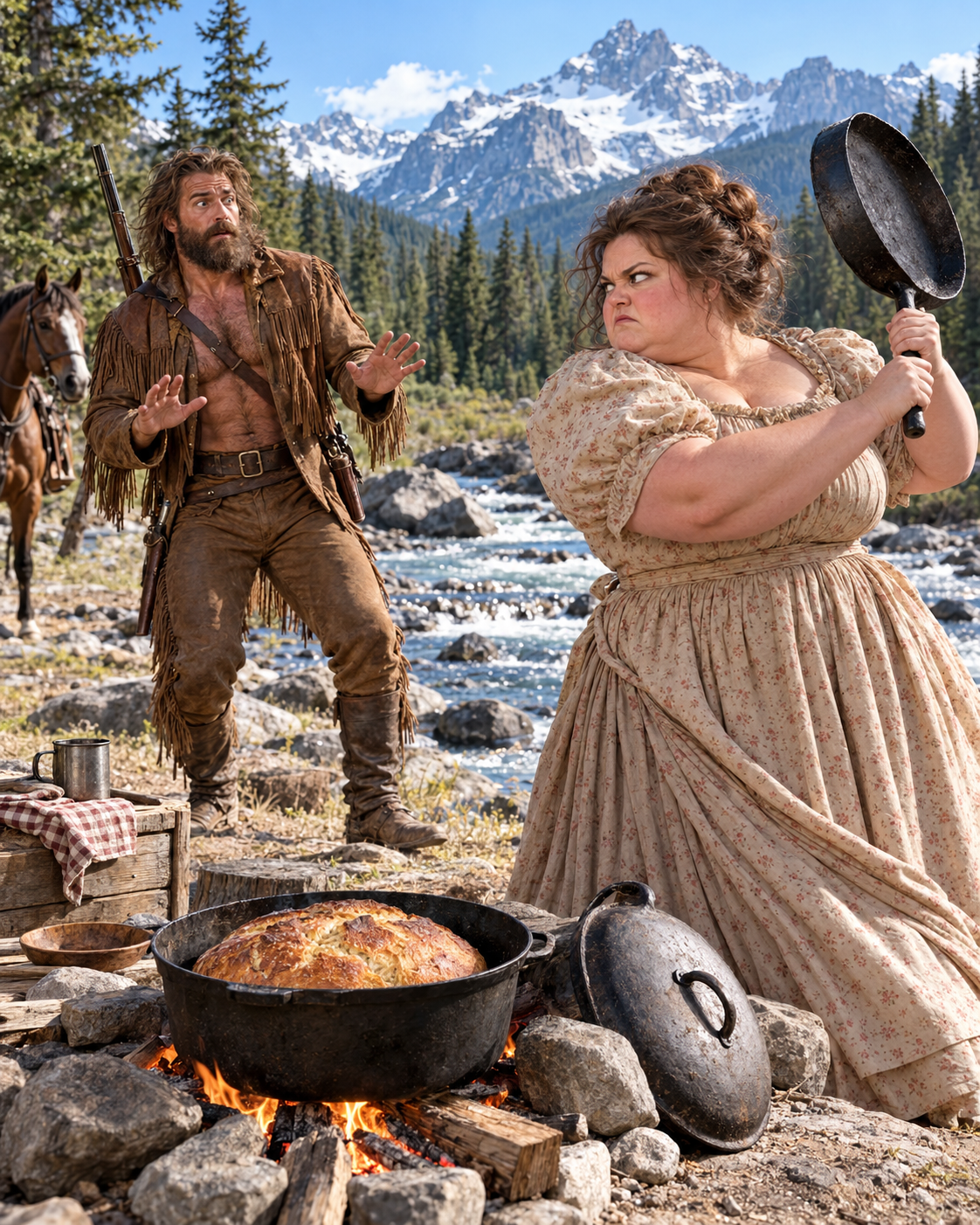
I had never spoken to Wyatt with such bitterness, and the pain in his expression nearly broke my resolve.
But love did not make betrayal hurt less.
“Why didn’t you tell me?”
Wyatt set the rifle aside.
“Because I promised your father I wouldn’t.”
I stared at him.
“Even after you fell in love with me?”
His jaw tightened.
“Especially then.”
I turned toward the window, watching snow collect on the sill.
For months, I had believed Wyatt was the first person who truly saw me.
Now I wondered how much of our happiness had been built upon secrets.
He approached slowly but stopped several feet away.
“Your father saved my life, Clementine.”
I didn’t turn around.
“Tell me everything.”
Wyatt drew a long breath.
“Six years ago, I wasn’t an outlaw.”
He had worked as a scout for mining caravans traveling through the San Juan Mountains.
He knew the passes, the hidden trails, and the dangerous men who controlled them.
My father, Thomas Hughes, had hired him to escort a wagon carrying documents to a territorial judge.
Those papers proved that Sheriff Harlan and several investors had stolen land from settlers, including widows whose husbands had died in suspicious mining accidents.
But there was something worse.
The company had secretly opened a mine beneath a mountain ridge known to flood during spring snowmelt.
Workers had warned that the tunnels were unstable.
Instead of closing them, the owners locked several miners underground after they threatened to report the danger.
Twenty-three men died.
The company called it an accident.
My father discovered that the mine’s entrances had been deliberately sealed.
“Your father was the only man brave enough to gather proof,” Wyatt said.
I remembered my father’s rough hands, the smell of tobacco on his coat, and the way he used to carry me on his shoulders when I was small.
He had always told me that doing the right thing would not necessarily make life easier.
I had never imagined what that belief might cost him.
Wyatt continued.
“The night we were attacked, he told me to protect his daughter if anything happened.”
My throat tightened.
“But you didn’t come.”
“I tried.”
Wyatt’s voice cracked.
“Harlan had men watching your house, and there was a bounty on my head.”
He explained that he had spent years trying to discover whether my father had survived.
Every trail ended in violence or silence.
Then, one autumn evening, he heard rumors about a woman living alone in the mountains who baked bread every morning.
He had recognized my name.
“The first time I knocked on your door, I meant to tell you.”
I remembered his bleeding arm, his exhausted face, and the hungry way he had looked at my sourdough.
“But you stayed,” I whispered.
“I stayed because I loved you.”
Tears burned behind my eyes.
“And did you ever wonder whether I deserved to know the truth?”
Wyatt lowered his head.
“Every single day.”
I wanted to forgive him immediately.
I also wanted to scream.
Instead, I placed the photograph on the table and walked into the bedroom.
That night, Wyatt slept beside the fireplace.
I lay awake listening to the wind claw at our roof, wondering whether love could survive a secret buried for six years.
By morning, I had made a decision.
I would find my father.
And I would not wait for any man to decide how much truth I could bear.
I opened the journal while Wyatt saddled the horses outside.
Most of its pages contained numbers, names, and rough drawings of mining claims.
But near the back, my father had written something strange.
“Where the mountain drinks the spring, the truth waits beneath the broken bell.”
I read it several times.
The words sounded like a riddle, but something about them tugged at an old memory.
When I was a little girl, my father sometimes took me to an abandoned settlement north of Bitter Creek.
There was a ruined chapel there, its bell cracked by lightning years before.
We used to picnic beside a narrow waterfall that emerged from the mountainside.
I remembered laughing as he told me the mountain was drinking the spring.
Suddenly, the answer seemed obvious.
“Wyatt!”
He hurried inside.
I pointed to the journal.
“I know where my father went.”
Before noon, we were riding north toward the ruins of Saint Agnes.
The journey took us through narrow valleys where pine branches groaned beneath heavy snow.
Several times, Wyatt dismounted to lead the horses over icy ground.
We spoke little.
But when my horse slipped near a ravine, he caught my reins without hesitation.
“Careful, sweetheart.”
The familiar tenderness in his voice nearly undid me.
I wanted things to be simple again.
I wanted to return to our cabin, knead bread beside him, and pretend the world had never found us.
But somewhere beyond those mountains, my father might be breathing.
That hope was stronger than fear.
We reached Saint Agnes at dusk.
The settlement had become a graveyard of collapsing buildings and blackened chimneys.
A broken chapel stood near the frozen waterfall, its bell lying half-buried beneath the snow.
Wyatt inspected the ruined buildings while I approached the chapel.
Inside, moonlight filtered through a shattered window.
I brushed snow from the bell and noticed a small iron ring fastened beneath its wooden support.
My heart raced.
I pulled.
A hidden compartment opened in the floor.
Inside lay a tin box wrapped in oilcloth.
With shaking hands, I opened it.
There were letters, property deeds, and a leather pouch containing twenty-three brass identification tags.
Each tag bore the name of a miner who had died underground.
Beneath them rested a folded document covered with signatures.
One belonged to Sheriff Harlan.
Another belonged to Samuel Mercer.
And the third made me gasp.
It belonged to Judge Nathaniel Whitcomb, the very official who had declared my father’s death an accident.
“Wyatt,” I whispered.
But before he could reach me, a voice rose from the darkness.
“Your father always did trust sentimental hiding places.”
Samuel Mercer stepped from behind the chapel door.
Three armed men followed him.
Wyatt immediately raised his rifle.
Samuel pressed a pistol against the back of my head.
“Put it down, Caldwell.”
Wyatt froze.
I could see his mind working, searching for a way to save me without getting us both killed.
Samuel smiled.
“There we are.”
He took the tin box from my hands.
“Six years of searching, and all it took was following a lonely woman who wanted her father back.”
The words struck deeply, but I refused to let him see it.
“Where is he?”
Samuel tilted his head.
“Who?”
“My father.”
For the first time, his expression changed.
Something like uncertainty flickered across his face.
Then he laughed.
“Dead, probably.”
I knew he was lying.
A man who enjoyed cruelty that much would have given me details if he truly knew my father was dead.
Samuel ordered his men to bind Wyatt’s wrists.
Then he seized my arm and dragged me toward the chapel entrance.
“We’re taking these papers to the Blackstone office.”
Wyatt struggled.
“Leave her out of this!”
Samuel struck him across the face with his revolver.
Blood ran down Wyatt’s chin.
I felt anger rise through my fear.
For thirty-two years, people had mistaken my gentleness for helplessness.
They had laughed at my body, dismissed my intelligence, and assumed I would always bow my head.
They had forgotten that the same hands that kneaded bread could split firewood and lift sacks of flour heavier than most men.
When Samuel pulled me forward, I deliberately stumbled.
He cursed and tightened his grip.
I bent as though struggling to stand.
Then I seized a loose stone from the chapel floor and drove it into his knee.
Samuel screamed.
His pistol fired into the ceiling.
I twisted free and threw myself behind the fallen bell.
Wyatt lunged at the nearest gunman.
The two crashed into a pew, breaking it beneath their weight.
Another man raised his rifle toward Wyatt.
I grabbed the heavy iron clapper beside the bell and swung it with everything I had.
It struck the man’s shoulder, sending his rifle skidding across the floor.
A third attacker fled through the chapel door.
Outside, a horse screamed.
Then another gunshot shattered the night.
Everything went still.
I turned toward the doorway.
An old man stood there, holding a smoking rifle.
His beard was white, his shoulders bent, and a dark scar crossed his forehead.
But I knew those eyes.
I had seen them every night in my dreams.
“Papa?”
The old man’s rifle slipped from his hands.
“Clementine?”
I don’t remember crossing the chapel.
One moment, I was standing beside the bell.
The next, I was in his arms, holding him so tightly that I feared he might disappear if I loosened my grip.
He smelled of pine smoke, leather, and the same familiar tobacco I remembered from childhood.
“My little girl,” he whispered.
I sobbed against his chest.
“I’m not little anymore.”
He laughed through his tears.
“No, darling, you’re not.”
Behind us, Wyatt restrained Samuel while my father helped me to my feet.
For several precious minutes, the world outside that chapel ceased to exist.
There were no corrupt sheriffs, no murderous investors, and no ruined years.
There was only a daughter finding her father.
But joy could not erase the questions waiting between us.
“Why didn’t you come home?” I finally asked.
My father looked older than any man I had ever known.
“Because I was afraid they’d kill you.”
“You could have sent a letter.”
“I did.”
His voice broke.
“Every year.”
I stared at him.
He explained that he had entrusted the letters to men who promised to deliver them secretly.
None had reached me.
Samuel laughed bitterly from the floor.
“Those letters paid for plenty of whiskey.”
My father closed his eyes.
I felt something inside me turn cold.
Six birthdays.
Six Christmas mornings.
Six winters standing beside an empty grave.
All because men believed money mattered more than human lives.
Wyatt tied Samuel securely to a support beam, and together we searched the chapel for the missing documents.
My father explained that the papers proved not only the miners’ murders but a much larger conspiracy.
Judge Whitcomb had approved fraudulent claims that allowed Blackstone to seize hundreds of acres from families who could not afford lawyers.
The company had profited while Bitter Creek struggled through poverty and hunger.
Then my father revealed the final piece.
“The original mining maps show a second tunnel running beneath the eastern ridge.”
Wyatt stiffened.
“That’s directly above Bitter Creek.”
My father nodded.
“The mountain is unstable.”
He had discovered fresh cracks in the frozen ground earlier that week.
The unusually heavy snowfall had placed enormous weight above the abandoned mine.
If the tunnels collapsed during the coming thaw, a landslide could bury half the town.
And Sheriff Harlan knew.
I thought of the hungry children we had fed.
I thought of Martha Bell holding her son.
I thought of the people who had humiliated me in the street.
Despite everything, they were still human beings.
“We have to warn them.”
Wyatt studied the darkening sky.
“The storm’s getting worse.”
“Then we leave now.”
My father caught my arm.
“Clementine, those people haven’t treated you kindly.”
I looked into his tired eyes.
“You taught me that kindness isn’t something people earn by being kind first.”
His expression softened.
And for the first time since finding him, I saw the father I remembered.
We left Samuel bound inside the chapel and took the evidence with us.
One of his wounded accomplices remained under guard while Wyatt secured the other man with rope.
We planned to return with the marshal.
But as we mounted our horses, a distant explosion rolled through the mountains.
The ground trembled.
Snow spilled from the branches around us.
Wyatt turned toward the eastern ridge.
“Someone’s blasting the old mine.”
My father went pale.
“Harlan.”
We rode through the night.
The mountain seemed to groan beneath us, and several times small avalanches thundered down the distant slopes.
By dawn, Bitter Creek appeared below us, its rooftops buried beneath white drifts.
Smoke curled weakly from the chimneys.
The people had no idea what was coming.
We reached the main street just as Sheriff Harlan rode into town with four armed men.
He had clearly arrived ahead of us by another trail.
When he saw my father, his face drained of color.
“Thomas Hughes,” he whispered.
My father dismounted.
“You should’ve made sure I was dead.”
The sheriff reached for his pistol.
Wyatt was faster.
“Don’t.”
For a long moment, neither man moved.
Then Harlan smiled.
“You think those papers will save you?”
He gestured toward the mountains.
“The whole ridge is coming down.”
I felt sick.
“You set the charges.”
Harlan shrugged.
“Hard to prove anything when the evidence is buried beneath a thousand tons of rock.”
My father stepped forward.
“There are children in this town.”
The sheriff’s expression remained empty.
“There were children whose fathers died in my mines, too.”
The coldness of his voice frightened me more than his gun.
Then the mountains roared.
A deep, terrible sound rolled across the valley.
People stumbled from their houses, staring toward the eastern ridge.
High above Bitter Creek, a black fracture spread across the white mountainside.
Wyatt looked at me.
“We have minutes.”
I ran toward the church.
The bell rope was frozen, but I pulled until my hands burned.
The bell rang wildly across the town.
“Everyone to the western road!” I screamed.
“Leave your belongings and run!”
Some obeyed immediately.
Others stood frozen in confusion.
I climbed onto an overturned wagon so they could see me.
“THE MOUNTAIN IS FALLING!”
My voice echoed through the street.
Then the first wave of snow broke loose.
It thundered down the distant slope, swallowing trees and sending clouds of white powder into the air.
Panic erupted.
Wyatt and my father organized the horses and wagons.
I hurried into the bakery, where Martha Bell was struggling to carry her elderly mother.
Together, we lifted the old woman into a supply wagon.
A young man who had once mocked me grabbed the reins and drove them toward safety.
Nobody had time for hatred.
We were simply people trying to survive.
As I returned to the street, a little girl called from the schoolhouse.
“Miss Clementine!”
Several children were trapped inside.
Their teacher had fallen while trying to open the frozen door.
I ran toward them, my boots slipping on the ice.
Behind me, Wyatt shouted my name.
The schoolhouse door refused to move.
I threw my shoulder against it.
Pain exploded through my arm.
I tried again.
The wood cracked.
On the third attempt, the door burst open.
Inside, eight terrified children huddled beneath their desks.
I gathered them toward the exit.
“Hold hands and stay together.”
The youngest girl began crying.
I knelt beside her.
“Look at me, sweetheart.”
Her tiny hands trembled.
“Are we going to die?”
I wanted to promise her everything would be fine.
But I had learned that love did not mean lying to spare someone fear.
“I’m going to do everything I can to get you home.”
She wrapped her arms around my neck.
I lifted her and led the others outside.
The mountain thunder grew deafening.
We had almost reached the western road when a massive pine tree crashed across our path.
Snow and broken branches exploded around us.
The children screamed.
I turned toward the narrow alley beside the general store.
“This way!”
We hurried between the buildings, but the alley ended at a high wooden fence.
There was no time to go back.
I handed the little girl to an older boy.
Then I seized a loose board and pulled.
The nails tore through the frozen wood.
I pulled again, screaming with effort.
The fence finally broke open.
One by one, the children crawled through.
I followed last.
A powerful hand caught mine.
Wyatt.
He pulled me into his arms just as a wall of snow swallowed the schoolhouse behind us.
We ran.
The ground shook so violently that I fell twice.
Wyatt refused to release my hand.
At the edge of town, my father waited with the final wagon.
We climbed aboard as the mountain descended like an enormous white beast.
The horses strained against their harnesses.
For several terrifying seconds, I could hear nothing but the roaring snow.
Then the wagon lurched onto higher ground.
We looked back.
Half of Bitter Creek had vanished beneath the avalanche.
The church steeple leaned at an impossible angle.
The schoolhouse was gone.
But along the western ridge stood dozens of families, shivering and crying, alive because someone had warned them.
I collapsed against Wyatt’s shoulder.
He held me as though I were the most precious thing in the world.
When I finally looked up, I saw Sheriff Harlan standing near the edge of the crowd.
He was attempting to escape with a saddlebag full of money.
My father stepped into his path.
“It’s over, Harlan.”
The sheriff drew his pistol.
I screamed.
A shot rang out.
My father staggered backward.
For one horrifying moment, I believed I had lost him again.
Then Wyatt struck Harlan from behind, sending him crashing into the snow.
The pistol flew from his hand.
I rushed to my father.
Blood darkened his coat, but he was still breathing.
The bullet had passed through his upper arm.
He grimaced as I pressed cloth against the wound.
“Still causing trouble, Papa?”
He gave a weak laugh.
“Runs in the family.”
The surviving townspeople surrounded Sheriff Harlan.
Some carried rifles.
Others held shovels and axes.
Anger spread through the crowd like wildfire.
The sheriff had stolen their land, murdered their neighbors, and nearly buried their children.
A man stepped forward with a length of rope.
“Hang him.”
Others shouted their agreement.
I looked at Harlan kneeling in the snow.
He was trembling now.
The powerful man who had humiliated me in front of everyone looked strangely small.
I remembered the bread he had thrown into the mud.
I remembered my father’s empty grave.
I remembered all the nights I had cried because people like him convinced me I was worthless.
For a moment, I wanted him to suffer.
Then I looked at the children standing nearby.
They were watching us.
Learning from us.
I stepped between Harlan and the angry crowd.
“No.”
The man holding the rope stared at me.
“Clementine, after everything he’s done?”
“Especially after everything he’s done.”
My voice shook, but I did not step aside.
“If we become what he is, then he wins one last time.”
I turned toward the sheriff.
“He will answer for his crimes before the law.”
My father nodded.
Wyatt lowered his rifle.
Slowly, the rope disappeared.
The crowd fell silent.
And something changed in Bitter Creek that morning.
Not because everyone suddenly became good.
Not because hatred vanished beneath the snow.
But because, for one moment, people chose justice over revenge.
Three days later, a territorial marshal arrived with deputies and arrested Harlan, Samuel Mercer, and the surviving conspirators.
The documents from the chapel exposed Blackstone’s crimes.
Judge Whitcomb was removed from office and later faced trial.
The stolen properties were returned to their rightful owners wherever the records made that possible.
Families who had spent years living in fear finally learned why their loved ones had died.
Yet justice could not restore every life.
Twenty-three miners remained buried beneath the mountain.
Their widows still carried years of grief.
And Bitter Creek itself lay broken beneath a frozen grave of snow.
Spring came slowly.
When the thaw finally began, the townspeople returned to rebuild.
Something unexpected happened during those difficult months.
People started climbing the trail to our cabin.
At first, they came seeking bread.
Then they came asking for advice, offering lumber, or bringing seeds for the garden.
Martha Bell appeared one morning carrying a basket of fresh eggs.
She stood awkwardly at my doorstep.
“Clementine, I owe you an apology.”
I waited.
She looked down at her hands.
“I was cruel to you because I thought it made me better than you.”
Her voice trembled.
“But you saved my son when I never even gave you kindness.”
I studied her face.
I could have reminded her of every ugly word.
Instead, I opened the door.
“Come inside, Martha.”
She began crying.
That afternoon, we baked bread together.
Forgiveness did not erase the past.
But it gave us somewhere new to begin.
My father eventually moved into a small cabin beside ours.
He spent his mornings carving wooden toys for the children and his evenings telling stories he had carried alone for six years.
Sometimes, I caught him watching me with tears in his eyes.
One evening, he took my hands.
“When you were born, Clementine, I prayed you’d become someone brave.”
I smiled.
“You got a stubborn baker instead.”
He shook his head.
“No, darling, I got something far greater.”
He kissed my forehead.
“A daughter who knows how to fight without forgetting how to love.”
As for Wyatt, our road back to one another was not easy.
I forgave him slowly.
There were difficult conversations, painful silences, and nights when old fears returned.
He never asked me to forget what he had hidden.
Instead, he answered every question, even when the answers hurt.
One morning, while we worked in the garden, he knelt beside me in the soft spring dirt.
For a moment, I thought he had found another stubborn stone.
Then he opened his hand.
Inside lay a simple silver ring.
“I don’t deserve a woman like you,” he whispered.
I looked at the man whose love had helped me see my own worth.
“Wyatt Caldwell, I spent too many years believing I didn’t deserve happiness.”
His eyes filled with tears.
“I’m not going to spend another minute believing love is something we have to earn by being perfect.”
He laughed through his tears.
“Is that a yes?”
I kissed him.
“It certainly is.”
We married beneath the pines that June.
My father walked beside me, his arm healed but still stiff.
Martha decorated the tables with wildflowers.
Children scattered petals along the mountain path.
And Wyatt waited beneath an arch made from fresh pine branches, looking at me as though I were sunrise after the longest winter of his life.
I wore a blue dress that fitted my body exactly as it was.
For once, I did not try to appear smaller.
I did not apologize for the space I occupied.
I simply walked toward the man I loved.
When Wyatt took my hands, he whispered, “You saved my life, Clementine.”
I smiled.
“And you saved mine.”
He shook his head gently.
“No, sweetheart, you saved yourself.”
After the wedding, we built a larger bakery near the rebuilt town.
Above its door, Wyatt carved a wooden sign.
CLEMENTINE’S TABLE — EVERYONE IS WELCOME.
We fed travelers who had no money.
We taught widows how to bake and sell bread.
We gave hungry children warm meals before asking their names.
And every winter, when the mountains turned white, we kept extra flour beside the hearth.
Years passed.
Bitter Creek became a different town, though never a perfect one.
People still quarreled, made foolish judgments, and sometimes forgot the lessons suffering had taught them.
But whenever someone mocked a stranger for being poor, awkward, scarred, or different, an older resident would quietly remind them of the winter Clementine Hughes climbed down the mountain with a wagon full of bread.
One snowy evening, a little girl visited our bakery with her mother.
She was round-faced and shy, with tears shining in her eyes.
Some children had laughed at her size.
She stood near the doorway, trying to hide behind her mother’s skirt.
I recognized that posture.
I had lived inside it for most of my life.
I knelt beside her.
“What’s your name, sweetheart?”
“Rose.”
“That’s a beautiful name.”
She looked at my flour-covered apron.
“My mama says you saved this town.”
I smiled.
“Lots of people helped.”
Rose hesitated.
“Did people laugh at you when you were little?”
I felt the familiar ache of memories that had never entirely disappeared.
“Yes, darling, they did.”
“Did it make you sad?”
“Very.”
She lowered her eyes.
“How did you make them stop?”
I looked through the window.
Wyatt was helping my father stack firewood, and the evening sun painted the mountains gold.
For a moment, I remembered the woman who had fled Bitter Creek believing she was too large, too unwanted, and too ordinary to deserve love.
I wished I could reach backward through time and hold her.
Then I turned to Rose.
“I didn’t make everyone stop.”
Her face fell.
“But I learned something much more important.”
I gently lifted her chin.
“Other people’s cruelty cannot decide how much you’re worth.”
She studied me carefully.
“Even when everyone laughs?”
“Especially then.”
I took a fresh loaf from the oven and placed it in her hands.
“See this bread?”
She nodded.
“It doesn’t become less nourishing because someone calls it ugly, and you don’t become less precious because someone fails to see your beauty.”
Rose smiled for the first time.
It was a small smile.
But I knew how much courage it had taken.
That night, after the bakery closed, Wyatt found me standing outside beneath the stars.
He wrapped his arms around my waist and rested his chin against my shoulder.
“What are you thinking about?”
I watched the warm light glowing through our windows.
“How strange life is.”
He kissed my temple.
“Strange?”
“I once thought leaving Bitter Creek meant losing everything.”
I looked toward the dark mountains where our little cabin still stood.
“But I had to leave a place that made me feel small before I could discover how much love I had to give.”
Wyatt held me closer.
“And you came back.”
“Yes.”
“Why?”
I thought of hungry children, frightened mothers, and neighbors who had once turned their backs on me.
Then I thought of Rose holding her warm bread.
“Because I finally understood that the world doesn’t become kinder when good people hide their hearts.”
Behind us, the bakery door opened.
My father stepped outside, carrying three steaming mugs of coffee.
“Are you two planning to freeze out here?”
Wyatt laughed.
“Just admiring the view.”
Papa handed me a mug.
“Well, admire it with something warm in your hands.”
We stood together beneath the stars, listening to the quiet wind move through the pines.
For years, I had believed happiness meant finding a place where nobody could hurt me.
But happiness had become something different.
It was a home where truth mattered.
A table where nobody needed permission to belong.
A love strong enough to admit mistakes.
And the courage to offer kindness without surrendering the right to be treated with respect.
I never forgot the day Sheriff Harlan threw my bread into the mud.
I never forgot the laughter or the shame.
But those memories no longer owned me.
Because the very hands that once gathered broken bread from a filthy street had eventually fed an entire town.
And the woman they had called worthless had discovered something no sheriff, no cruel neighbor, and no hidden crime could ever take away.
My worth had never been theirs to decide.
As the stars brightened above the San Juan Mountains, I leaned against Wyatt and listened to my father’s gentle laughter.
For the first time in my life, I didn’t wish to be smaller, prettier, quieter, or different.
I was Clementine Hughes Caldwell, a baker, a daughter, a wife, and a woman whose heart had survived everything meant to harden it.
And if my life taught me anything, it was this: Never mistake someone’s gentleness for weakness, or their appearance for the measure of their soul, because sometimes the person the world rejects is the very person who will teach it how to love.
THE END.