The day I arrived at Box Elder Ranch, thirty-three cowboys watched their boss throw my cooking contract into the mud, unaware his bookkeeper was stealing their future.
Thomas stood before me in the freezing Dakota wind, holding another man’s bloodstained pocket watch, and I realized the man I had mourned for seven years might be more dangerous than the man who wanted our ranch.
Behind him, six armed riders waited beneath a sky the color of bruised iron.
I could hear the frightened horses shifting inside the corral, and somewhere behind me, Caleb was quietly loading his revolver.
Thomas looked older than I remembered, with gray at his temples and a long scar cutting through his left eyebrow.
But his eyes were unchanged.
Those same blue eyes had once watched me knead bread in our little Nebraska kitchen.
Those same eyes had filled with tears when we buried our infant daughter.
And now they watched me as though I were a stranger he regretted meeting.
“Where is Jonas?” I asked.
Thomas glanced at the cowboys gathering behind me.
“He’s alive, Ida, but that depends on what you do next.”
I felt something inside me grow terribly still.
“You don’t get to come back from the dead and threaten someone I care about.”
His jaw tightened.
“You don’t understand what you’re involved in.”
“Then explain it.”
He stepped closer, lowering his voice.
“Lyman Thorne owns more than railroads, and the men who try to expose him usually don’t live long enough to regret it.”
I stared at the blood on Jonas’s watch.
“Did you hurt him?”
Thomas didn’t answer.
That silence told me more than any confession could have.
Behind me, Caleb raised his rifle.
“You heard the lady, mister.”
One of Thomas’s riders reached toward his holster.
I lifted my hand before the first shot could be fired.
“Nobody dies in my yard today.”
Thomas looked at me with something resembling admiration.
“You always were stubborn.”
“And you always mistook my patience for stupidity.”
His expression hardened.
He told me Jonas was being held at an abandoned freight depot twelve miles east of the ranch.
If I brought the ledger pages before midnight, Jonas would be released.
If I refused, Box Elder would lose its owner, its cattle, and every acre of land before sunrise.
Then Thomas climbed into his saddle.
As he turned away, I called after him.
“Whose body was in your coffin?”
He stopped.
For several seconds, only the wind answered.
Finally, he looked over his shoulder.
“A good man who trusted the wrong people.”
Then he rode away.
I watched until the riders disappeared beyond the frozen hills.
Only then did my knees begin to shake.
Caleb caught my arm before I fell.
“Miss Ida, you’re not going with him alone.”
I looked toward the blackened remains of the barn.
Thirty-three men had trusted me to feed them.
Jonas had trusted me with his wife’s apron.
And somewhere beyond those hills, the man who had slowly taught me to hope again was waiting for help.
“No,” I whispered, “I’m going to make sure Thorne never owns this ranch.”
Inside the cook shack, I spread Virgil’s stolen ledger pages across the table.
Silas joined us, his wounded arm wrapped in clean linen.
He had worked cattle in Dakota Territory for nearly thirty years and understood the shipping business better than any accountant.
As he examined the entries, his weathered face grew pale.
“These ain’t just stolen cattle, Miss Ida.”
He pointed to a column of numbers beside Thorne’s name.
“These are the brands from half the ranches along the northern trail.”
I leaned closer.
Some entries listed cattle supposedly lost to winter storms.
Others were recorded as diseased animals destroyed before shipment.
Yet every missing herd had been quietly transferred to companies connected to Thorne.
Silas dragged a trembling finger down the page.
“He’s been buying up ranches after bleeding them dry.”
“And Virgil helped him.”
“Virgil kept the accounts, but somebody with access to the shipping office made the whole thing possible.”
I thought of Thomas.
My husband had worked as a freight clerk before his supposed death.
Suddenly, pieces of a terrible puzzle began falling into place.
Seven years earlier, Thomas had told me a wealthy businessman had offered him a position that could change our lives.
I remembered how he had started wearing expensive boots.
How he began locking his desk.
How he returned home smelling of whiskey and strange tobacco.
I had believed he was struggling with grief after our daughter died.
Perhaps grief had only given him a place to hide his secrets.
Caleb watched me silently.
“Do you think your husband was part of it?”
I stared at the signature on the railway receipt.
“I think he knows more than he’s willing to tell.”
That afternoon, I prepared supper as though nothing had happened.
The men needed food, and I needed my hands occupied.
I rolled dough while Caleb cleaned rifles at the kitchen table.
I stirred beans while Silas sent two trusted riders to gather neighboring ranchers.
And beneath the stove, wrapped in oilcloth, I hid something Virgil had overlooked.
The original shipping records contained tiny differences in ink and handwriting.
The false entries were written neatly in Virgil’s hand.
But beside several of them was a second signature.
T. Lingren.
My husband had helped create the trap.
At dusk, I put on Jonas’s late wife’s heavy wool coat.
Its pockets smelled faintly of cedar and lavender.
I remembered the evening Jonas had brought it to me after noticing how badly I shivered while carrying firewood.
“My wife hated seeing anyone cold,” he had said.
He had looked embarrassed when I thanked him.
That small kindness meant more to me than all the beautiful promises Thomas had once made.
Before leaving, I pressed the ledger copies into Caleb’s hands.
“If I don’t return by morning, take these to the territorial marshal in Bismarck.”
Caleb swallowed hard.
“What about you?”
I looked toward the darkness gathering beyond the windows.
“Sometimes saving a home means walking straight toward the thing trying to destroy it.”
He shook his head.
“That sounds like something Jonas would say.”
Despite everything, I smiled.
“Then perhaps he’s been teaching me something.”
The ride east was bitterly cold.
Snow began falling before I reached the abandoned freight depot.
Its broken windows glowed with lamplight, and three horses stood tied beneath the loading platform.
I dismounted slowly.
Thomas stepped from the shadows.
“You came.”
“I said I would.”
“Where are the papers?”
I opened my leather satchel.
He reached inside and pulled out the folded pages.
For a moment, relief softened his expression.
Then he unfolded them.
Blank butcher paper.
His face changed.
“Ida.”
“Where is Jonas?”
Thomas seized my wrist.
“You have no idea what you’ve done.”
I looked him directly in the eyes.
“Neither did you when you left me standing beside an empty grave.”
He released me as though my words had burned him.
Before he could respond, a voice sounded from inside the depot.
“Bring her in, Thomas.”
The door opened, revealing a tall man wearing a dark overcoat and polished leather gloves.
Lyman Thorne looked nothing like the monster I had imagined.
He had silver hair, an elegant walking stick, and the pleasant expression of a banker welcoming an old customer.
“Mrs. Lingren,” he said warmly, “I’ve been looking forward to meeting you.”
I stepped inside.
A coal stove burned near the wall.
Crates of ammunition stood beside sacks of flour marked with the Box Elder brand.
And tied to a wooden chair beneath the depot’s narrow staircase sat Jonas Red Fern.
His face was bruised, and blood had dried along his collar.
But when he saw me, he struggled against the ropes.
“Ida, get out!”
One of Thorne’s guards struck him across the mouth.
I moved forward instinctively.
Thorne lifted his walking stick.
“Please, gentlemen, there’s no need for unpleasantness.”
He studied me with mild curiosity.
“I understand you’ve become rather important to Box Elder.”
“Someone had to make sure the men weren’t starving.”
“Sentiment is expensive, Mrs. Lingren.”
“So is stealing thousands of cattle.”
Thorne smiled.
“Stealing is such an ugly word.”
He approached a desk covered with contracts.
“Business is simply knowing when another man has no choice.”
He explained that Box Elder owed enormous sums to his freight company.
Its cattle could only be shipped through his rail agents.
Its feed and supplies had been purchased on credit from his merchants.
And according to the documents Virgil had prepared, every missed payment allowed Thorne to seize the property.
Jonas stared at the floor.
“I thought I was keeping the ranch alive.”
I looked at him.
“You were, Jonas.”
Thorne chuckled.
“An admirable loyalty, though financially misplaced.”
Then he placed a document before me.
It was the deed transferring Box Elder to his company.
At the bottom was Jonas’s signature.
I examined the ink.
“Jonas never signed this.”
Thorne’s smile remained.
“A court may disagree.”
I noticed a slight tremor in Jonas’s hands.
He had been beaten, threatened, and probably denied water.
Yet he lifted his head.
“Don’t give him anything, Ida.”
Thorne sighed.
“Such stubbornness makes men unnecessarily poor.”
He turned to Thomas.
“Search her.”
My husband’s face tightened.
“She came voluntarily.”
“Then she should have nothing to hide.”
Thomas stood motionless.
Thorne’s pleasant expression disappeared.
“Do I need to remind you what happened to the last man who questioned my instructions?”
I watched Thomas flinch.
Suddenly, I understood.
The dead man in that coffin had not been some unfortunate stranger.
He had been someone Thomas knew.
Someone whose death still haunted him.
“Tell me his name,” I whispered.
Thomas looked away.
“Ida, please.”
“Tell me.”
Thorne tapped his walking stick against the floor.
“His name was Daniel Mercer.”
The sound of that name nearly stopped my heart.
Daniel had been Thomas’s closest friend.
He had visited our home every Sunday, bringing peppermint candies and foolish stories that made me laugh even during the darkest months after our daughter’s funeral.
And I had attended his funeral three weeks before Thomas supposedly died.
I remembered two graves.
Two widows standing beside them.
Two families broken by grief.
Thorne watched the realization spread across my face.
“Daniel became troublesome when he discovered certain irregularities.”
Thomas spoke suddenly.
“He was going to tell the authorities.”
“An unfortunate decision,” Thorne replied.
I turned toward my husband.
“Did you kill him?”
Thomas’s eyes filled with tears.
“No.”
“Did you know they would?”
He didn’t answer.
I felt something inside me break.
For years, I had imagined the last moments of his life.
I had wondered whether he called my name.
Whether he was frightened.
Whether he suffered.
But he had been alive all along, allowing me to endure a grief he could have ended with one letter.
“You let me bury you,” I whispered.
Thomas stepped toward me.
“I thought it would keep you safe.”
“You let me mourn you for seven years.”
“I was trapped.”
“So was I, Thomas, but I didn’t abandon the people who loved me.”
His face crumpled.
For one brief moment, I saw the man I had married.
Then Thorne’s voice cut through the room.
“Enough.”
He ordered his guards to bring a lantern and a metal bucket.
I watched one man empty a bottle of kerosene over the scattered shipping records.
Thorne looked at me.
“You will tell me where the real ledger is, or Mr. Red Fern will die in this building.”
I could smell the kerosene.
I could hear Jonas breathing through his injuries.
And somewhere beyond the depot walls, snow whispered against the prairie.
I thought of Caleb riding toward Bismarck.
I thought of Silas gathering the ranchers.
Neither could reach us in time.
So I did the only thing I knew how to do.
I began talking.
“You know, Mr. Thorne, I used to work in a boardinghouse kitchen.”
He frowned.
“What?”
“Forty hungry men every evening, and an owner who counted every potato.”
Thorne stared at me impatiently.
“I fail to see the relevance.”
I looked at the coal stove.
“When someone spends years working around fire, they learn a few things.”
My eyes moved toward the ventilation pipe above it.
“Especially how quickly smoke travels through an old wooden building.”
Thorne followed my gaze.
For the first time, his confidence wavered.
Earlier, while entering the depot, I had noticed the stove’s draft control was nearly closed.
Its chimney ran through a rotten wooden ceiling.
And beneath my coat, hidden inside my glove, was a small tin of cooking grease.
I had dropped most of it into the stove while everyone watched Thomas search my satchel.
The fire had begun burning hotter.
Now smoke curled from a seam near the ceiling.
Thorne smelled it.
“Put that fire out!”
One guard rushed toward the stove.
At that instant, I kicked the bucket of kerosene across the floor.
Liquid spread beneath the desk.
The guard stumbled backward.
Jonas threw his chair sideways, striking another man behind the knees.
Thomas grabbed Thorne’s arm as the businessman reached for his pistol.
A gunshot exploded.
Glass shattered above us.
I dropped to the floor.
Thorne screamed.
His weapon clattered against the boards.
For one terrible second, I believed Jonas had been shot.
Then Thomas shouted.
“Ida, cut him loose!”
I scrambled toward Jonas and pulled a small kitchen knife from my boot.
It was the same knife I used each morning to trim meat.
My hands shook so badly I could barely cut the rope.
“You’re a terrible cook,” Jonas whispered through swollen lips.
I stared at him.
“What?”
“Never seen a woman ruin a kitchen quite like this.”
Despite the terror closing around us, a laugh escaped my throat.
“Then stop talking and help me.”
The rope snapped.
Jonas caught my hand.
For a moment, his fingers tightened around mine.
Then another gunshot cracked through the depot.
Thomas staggered backward.
Blood blossomed across his shoulder.
Thorne had retrieved a second pistol.
“You ungrateful fool!” he shouted.
Thomas slammed into him, driving both men against the desk.
The lantern fell.
Flames raced across the spilled kerosene.
I felt the sudden heat against my face.
“Jonas, we have to leave!”
But he was already pulling Thomas away from the burning desk.
I grabbed the door handle.
It wouldn’t move.
Someone had barred it from outside.
Smoke thickened around us.
Thorne crawled toward the shattered window, clutching his wounded hand.
One of his guards had fled through a rear passage.
Another lay unconscious beneath a fallen crate.
Jonas threw his shoulder against the door.
The wooden frame groaned but held.
I looked up.
The roof beams were catching fire.
And then I heard something beyond the walls.
Horses.
Many horses.
A voice shouted from outside.
“Miss Ida!”
Caleb.
I screamed his name.
The door shook beneath a tremendous blow.
Once.
Twice.
Then the rotten boards splintered.
Cold air rushed inside.
Caleb stood beyond the flames, holding an iron crowbar.
Behind him were Silas and nearly twenty riders carrying rifles.
They had gathered the neighboring ranchers faster than I thought possible.
Jonas dragged Thomas through the doorway.
I followed, coughing so violently I could barely breathe.
The depot roof collapsed moments later.
Flames rose into the snowy darkness.
Thorne tried to escape through a side window.
But Silas was waiting.
The old cowboy leveled his rifle.
“Evening, Mr. Thorne.”
Thorne stopped.
Silas spat into the snow.
“Reckon you’ve got some explaining to do.”
By sunrise, Thorne and his surviving guards were bound inside a freight wagon.
Virgil Seir had been captured at a nearby telegraph station while attempting to warn Thorne’s eastern partners.
But the victory felt painfully incomplete.
Our evidence was scattered.
The depot had burned.
And the contracts bearing Jonas’s forged signature still threatened everything we had saved.
Thomas lay inside the cook shack while I cleaned the wound in his shoulder.
The bullet had passed through without striking bone.
He watched me silently as I worked.
For seven years, I had imagined what I would say if heaven somehow returned my husband.
Now I had nothing left to ask him.
At last, he whispered.
“I never stopped loving you.”
I kept wrapping the bandage.
“Love isn’t something you claim after leaving someone to suffer.”
He closed his eyes.
“I know.”
“Daniel trusted you.”
His breathing faltered.
“He found the false cattle records before I did.”
“And you let Thorne kill him.”
Thomas looked toward the ceiling.
“I told myself I could save him.”
A tear slipped into his hair.
“But when Thorne’s men came, I was too frightened to move.”
I tied the bandage firmly.
“Then tell the truth now.”
He swallowed.
“Thorne has judges and bankers in his pocket.”
“Then we’ll find someone he hasn’t bought.”
Thomas reached for my wrist.
“There’s something you don’t know.”
He told me that the original records had never been kept at the depot.
Thorne was too careful to leave valuable evidence where angry ranchers might find it.
Instead, he had hidden the true accounts inside a steel lockbox at the rail company’s office in Deadwood.
The box contained every fraudulent cattle transfer, every forged agreement, and the names of men who had accepted payments to look the other way.
I stared at him.
“How do you know?”
Thomas hesitated.
“Because I helped write the records.”
The confession hung between us.
“And I know where Thorne keeps the key.”
He reached beneath his shirt and pulled out a narrow leather cord.
A small brass key rested against his chest.
“I took it the night Daniel died.”
I felt my anger rise again.
“You had seven years to use it.”
“I was afraid.”
I looked into his exhausted eyes.
“So was I, Thomas.”
Then I stood.
“But fear doesn’t give us permission to destroy other people’s lives.”
Three days later, a territorial deputy arrived with two armed men.
He examined the prisoners, listened to the cowboys, and inspected the falsified contracts.
Then he asked a question that chilled everyone in the room.
“Where is your proof that these signatures were forged?”
I placed the ledger copies before him.
He studied them carefully.
Thorne watched from a chair near the stove, his injured hand wrapped in linen.
“Those papers were stolen by a dishonest employee,” he said smoothly.
The deputy frowned.
“Which employee?”
Thorne smiled.
“Mrs. Lingren, naturally.”
I stared at him.
He claimed I had manipulated the ranch accounts after Jonas refused to pay me.
Virgil supported the accusation.
Then Thorne produced a document bearing my name.
It stated that I had accepted money to steal his company’s financial records.
The signature looked painfully convincing.
The deputy turned toward me.
“Mrs. Lingren, did you sign this?”
“No.”
Thorne leaned back.
“A rather convenient denial.”
For the first time since the depot fire, I felt genuine despair.
Thorne did not need to defeat us with guns.
He only needed to make the truth look uncertain.
But as the deputy examined the paper, Jonas stepped forward.
“Ask her what she cooks with.”
Everyone turned.
The deputy blinked.
“Pardon?”
Jonas pointed at the document.
“Ask Ida what she uses to write her kitchen accounts.”
I frowned, confused.
Then I remembered.
For weeks, I had recorded every supply order in a small notebook using a carpenter’s pencil.
Ink froze too easily in the cold cook shack.
My handwriting slanted slightly because of an old injury to my right hand.
But the forged signature on Thorne’s document had been written in smooth black ink.
More importantly, it contained a small mistake.
The signature read Ida Lindgren.
My name was Lingren.
Thorne’s clerk had added a letter that didn’t belong.
I looked at the deputy.
“That isn’t my name.”
Silence fell across the room.
The deputy examined the paper again.
Then he turned toward Thorne.
“Interesting.”
Thorne’s face lost its color.
It wasn’t enough to prove every crime.
But it was enough to stop the deputy from arresting me.
And it gave us the opening we desperately needed.
With the deputy’s permission, Thomas agreed to lead the authorities to Deadwood.
I traveled with them.
Jonas insisted on coming, despite his injuries.
At the rail office, the company manager initially refused to open Thorne’s private safe.
But when the deputy presented the brass key and a written demand for the records, the man’s confidence vanished.
Inside the lockbox lay three thick account books.
Their pages contained years of stolen cattle, manufactured debts, and illegal payments.
Thomas’s signature appeared throughout.
So did Virgil’s.
And beside several entries were payments to officials whose duty had been to protect the ranchers.
The deputy turned the pages without speaking.
Finally, he closed the largest book.
“I believe we have enough to begin.”
The legal battle lasted through the winter.
Some witnesses disappeared.
Others suddenly remembered nothing.
Thorne hired expensive attorneys who tried to dismiss every ledger and discredit every cowboy.
But the evidence survived.
Thomas testified under oath, admitting his own involvement and explaining how Thorne’s companies had manipulated shipping agreements to ruin independent ranches.
He did not ask for forgiveness.
He accepted responsibility for the crimes he had helped conceal.
Virgil eventually confessed when he realized Thorne intended to blame everything on him.
And ranchers from across the territory came forward with their own stolen contracts.
By spring, the fraudulent claims against Box Elder had been set aside, allowing Jonas to keep the ranch while the remaining debts were reviewed.
Thorne faced prosecution, though not every powerful man connected to him would answer for what he had done.
Justice, I discovered, rarely arrives as cleanly as people imagine.
It comes slowly, carrying scars.
Thomas received a prison sentence for his role in the scheme.
I visited him once before he was transferred.
We sat across from each other in a small room that smelled of damp stone.
He looked thinner than the man who had appeared at Box Elder.
“I suppose you’ll never forgive me,” he said.
I thought carefully before answering.
“I hope someday I can remember the good years without feeling angry.”
His eyes filled.
“But that doesn’t mean we can have those years again.”
He nodded.
For the first time, he did not argue.
Before leaving, I placed something on the table.
It was a faded blue ribbon that had belonged to our daughter.
Thomas touched it with trembling fingers.
“She had your eyes,” he whispered.
I felt tears slide down my face.
“Yes, she did.”
Then I walked away.
Not because I had stopped caring about the man he once was.
But because I had finally learned that compassion did not require surrendering my future.
When I returned to Box Elder, the prairie had begun turning green.
New grass pushed through the blackened ground around the rebuilt barn.
The missing horses had been recovered, and the cowboys were repairing fences beneath a bright morning sky.
Caleb greeted me with a grin.
“Miss Ida, we saved you some biscuits.”
I stared at the blackened lumps on his plate.
“Those aren’t biscuits.”
His smile faded.
“What are they, then?”
“Evidence that none of you should enter my kitchen without supervision.”
The men burst into laughter.
Even Silas laughed until he coughed.
Inside the cook shack, I found a fresh sack of flour, a basket of onions, and a small vase holding the first wildflowers of spring.
Jonas stood beside the stove.
He looked nervous.
That frightened me more than the fire ever had.
“Something wrong?” I asked.
He shook his head.
“No.”
Then he cleared his throat.
“I’ve been thinking about your contract.”
I raised an eyebrow.
“The one you threw in the mud?”
His cheeks reddened.
“I deserved that.”
“Yes, you did.”
He took a folded paper from his pocket.
My heart tightened.
For one terrible moment, I expected another agreement filled with hidden conditions.
But this document was different.
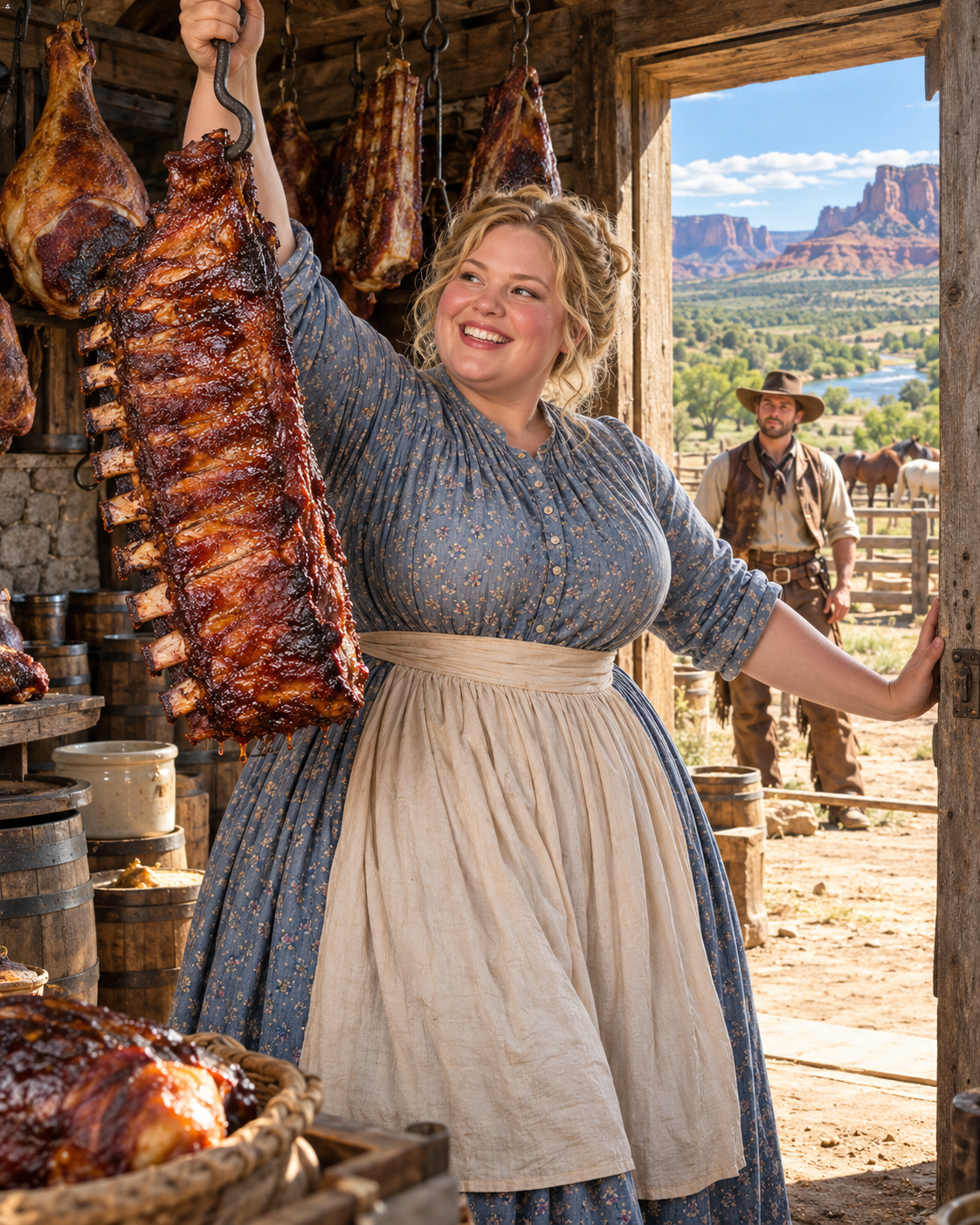
It granted me a permanent position managing the ranch kitchen, a fair salary, and a share of the profits from the cured meat and preserves I had begun selling to neighboring homesteads.
I read it twice.
“Jonas, this is too much.”
He shook his head.
“Thirty-three men were hungry when you arrived.”
I looked up.
“Thirty-four, counting you.”
His expression softened.
“You’re right.”
He glanced toward the window where the men were working.
“You fed us when we had almost nothing, and you kept us together when I couldn’t.”
I folded the paper carefully.
“That’s what people do when they care about one another.”
Jonas stepped closer.
“Then I hope you’ll stay.”
I looked at the weathered walls of the kitchen.
I thought of all the years I had spent believing my life ended beside an empty grave.
I remembered the lonely boardinghouses, the cold train stations, and the strangers who had treated me like a burden.
Then I thought of Caleb’s tears over a biscuit.
Silas risking his life for a friend.
And Jonas riding into danger rather than abandoning the people who depended on him.
“I think,” I whispered, “I’ve finally found somewhere worth staying.”
Jonas reached for my hand.
He did not kiss me.
He did not make some grand promise that life would never hurt again.
He simply held my fingers as though they were something precious.
And after everything I had survived, that was enough.
The following Sunday, I prepared a supper unlike anything Box Elder had seen.
There was roasted beef, fresh bread, potatoes, apple preserves, and a golden pie cooling on the windowsill.
Thirty-three cowboys gathered around the long tables.
Jonas sat at the head, and I stood beside the stove wearing his late wife’s apron.
For the first time, wearing it no longer felt like borrowing another woman’s place.
It felt like honoring the kindness she had left behind.
Before supper, Caleb stood awkwardly.
“I’d like to say something.”
The room grew quiet.
He looked at me, his eyes shining.
“When Miss Ida first came here, I figured she wouldn’t last a week.”
A few cowboys chuckled.
“But my mama used to say a home isn’t made from walls or timber.”
His voice trembled.
“It’s made by the people who notice when somebody’s hungry.”
I covered my mouth.
Caleb raised his tin cup.
“To Miss Ida.”
The cowboys lifted their cups.
And Jonas, who had once thrown my contract into the mud, stood beside me with tears in his eyes.
That evening, after the dishes were washed and the last lanterns extinguished, I stepped outside.
The Dakota stars stretched endlessly above the quiet ranch.
Jonas joined me on the porch.
For a while, neither of us spoke.
Then he asked softly, “Do you ever wish you hadn’t come here?”
I remembered the flames, the betrayal, the bloodstained watch, and the grave that had never held my husband.
I remembered how close we had come to losing everything.
“No,” I said.
“Not even after all that happened?”
I looked through the kitchen window at the empty tables where thirty-three men had shared their supper.
“Especially after all that happened.”
He took my hand.
And in the silence of that spring evening, I finally understood something my suffering had tried to teach me for years.
A person’s worth is not decided by the ones who reject them, deceive them, or walk away.
It is revealed in what they choose to protect when protecting it costs them something.
Thomas had once promised me a beautiful life, then abandoned me when courage was required.
Jonas had never promised me anything.
But when the world caught fire, he had reached for my hand and fought beside me.
I had arrived at Box Elder believing I needed a job.
What I found was something far more valuable.
A place where kindness mattered.
A place where truth was worth defending.
A place where a woman who had lost nearly everything could begin again.
And when Jonas asked, very quietly, whether I might someday consider marrying him, I leaned my head against his shoulder.
“Ask me again when the harvest comes,” I whispered.
He smiled.
“I can wait.”
For the first time in years, I believed someone who said those words.
Because love, I had learned, is not measured by how desperately someone begs you to stay.
It is measured by whether they make staying feel safe.
And sometimes, the greatest thing we can do with a broken life is refuse to let its pain become the ending.
We can build something honest from the ruins.
We can feed the hungry.
We can defend the forgotten.
We can forgive without returning to the people who destroyed our peace.
And we can begin again, even when the world has given us every reason to believe it is too late.
That night, as warm light spilled from the cook shack onto the dark Dakota prairie, I finally understood what home meant.
It wasn’t the place where nobody had ever hurt me.
It was the place where I no longer had to face the hurt alone.
THE END.