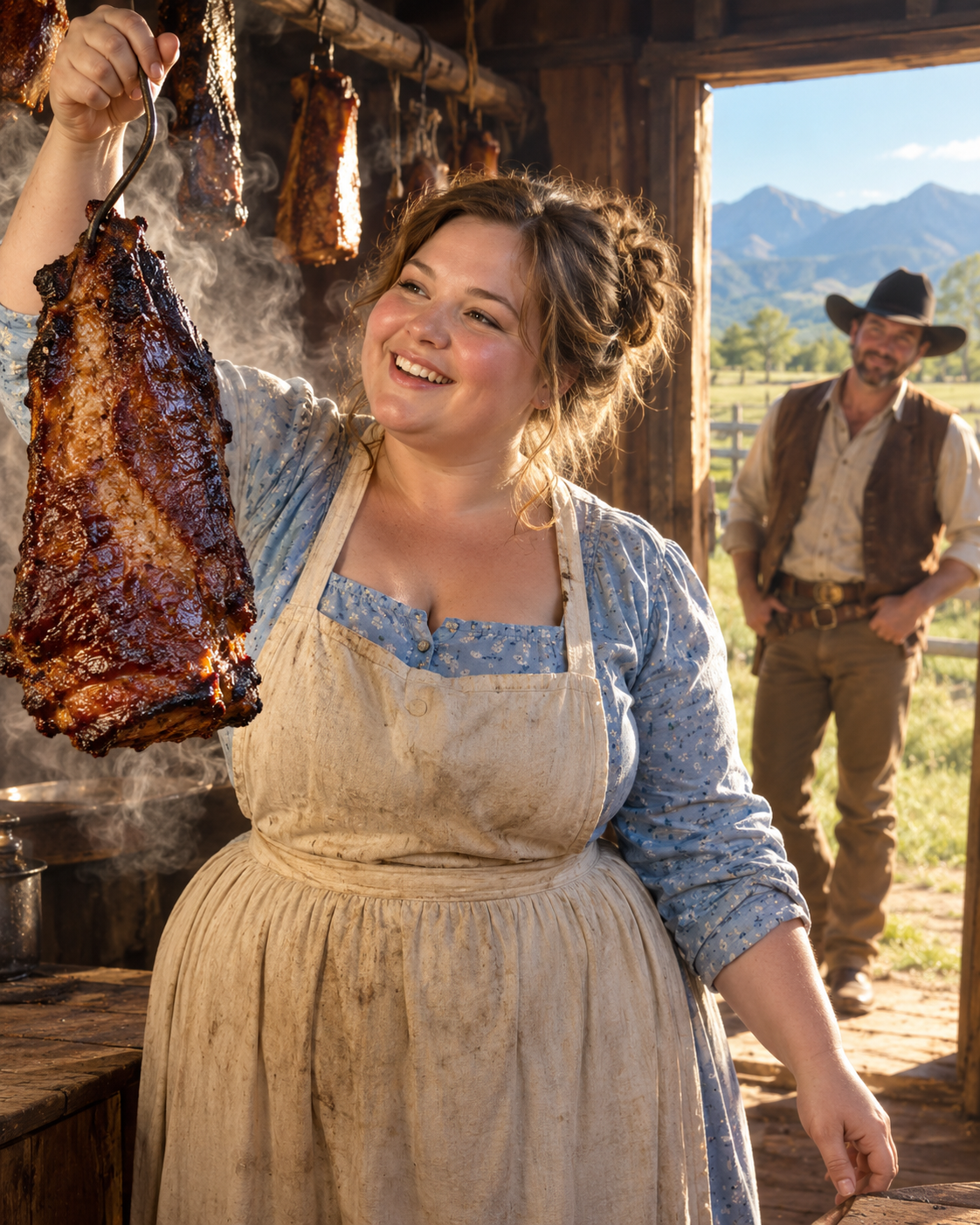
The day Holt Danner threw my flour sack into the mud at Black Hollow Ranch, he called me useless, but he never knew what I had discovered inside his smokehouse.
I stepped through the smokehouse door before Holt could stop me.
The snow swallowed the sound of the footsteps almost immediately, but I could still see a faint trail of disturbed powder leading toward the eastern pasture.
Holt caught my arm.
“Don’t.”
I turned on him.
“Someone was listening to us.”
“I know.”
“Then why are we standing here?”
“Because whoever it was wanted us to follow.”
His words stopped me.
For a few seconds, neither of us moved.
Then a low whistle came from somewhere beyond the barn.
Holt’s expression changed.
He released my arm and drew his revolver.
“Get to the house.”
“What are you going to do?”
“Find out whether we’re being watched.”
“I’m coming.”
“No.”
“Mr. Danner—”
“You’re not a ranch hand, and this isn’t your fight.”
I looked at the letter in my hand.
“Caleb’s last words just became my fight.”
Holt stared at me.
Something passed between us then—not trust exactly, but the beginning of it.
He nodded once.
“Stay behind me.”
We crossed the yard together.
The ranch seemed unnaturally quiet.
The horses shifted nervously in their stalls, their breath rising in pale clouds.
When we reached the eastern fence, we found fresh tracks.
Two sets of boot prints.
One led toward the creek.
The other circled back toward the main road.
Holt crouched and touched the snow.
“These are fresh.”
“Could it be Calder?”
“Maybe.”
“You don’t sound convinced.”
“Calder doesn’t do his own dirty work.”
He stood.
“Someone else does it for him.”
We followed the tracks toward the creek.
Halfway there, we found something caught on a thorn bush.
A strip of dark wool.
Holt pulled it free and stared at it.
“Caleb wore a coat like this.”
My stomach tightened.
“Are you saying the person who was here tonight was the same person who—”
“I don’t know what I’m saying.”
He folded the cloth into his palm.
“And that’s what scares me.”
We returned to the house before midnight.
Holt locked every door.
I placed Caleb’s letter on the kitchen table and lit another lamp.
There were only a few paragraphs left.
I read them aloud.
“Brother, Calder has been buying our cattle through men who claim to be acting for us. He records the sales differently, then uses the missing money to make our debt appear larger. I found the records in the office at the rail station.”
I stopped.
Holt leaned closer.
“Keep reading.”
“Calder says Black Hollow will be his before spring. He has men watching the ranch. I confronted him today. He told me nobody would believe a Danner over a man with money, connections, and friends in the sheriff’s office.”
The final line was written more heavily, as though Caleb’s hand had been shaking.
“If I disappear, look beneath the old water tower.”
Silence filled the kitchen.
Holt stared at the letter.
“The water tower.”
I looked at him.
“Where is it?”
“Three miles north. Abandoned years ago.”
“Then we go there.”
“At dawn.”
“No.”
He looked up.
“We go now.”
Holt shook his head.
“Caleb died trying to uncover this. I’m not taking you into the dark after him.”
“You’ll go alone?”
“Yes.”
“Then you’ll probably miss what he left behind.”
His jaw tightened.
“You think you’re the only one who can solve this?”
“No. I think I’m the only one here who hasn’t spent the last year grieving him.”
The words came out harder than I intended.
Holt flinched.
For the first time, I saw the wound beneath his anger.
He looked away.
“You didn’t know him.”
“No.”
“But I know what it’s like to lose someone and pretend you don’t care because caring makes you weak.”
He looked back at me.
I lowered my voice.
“I won’t pretend for you.”
For several seconds, Holt said nothing.
Then he took the letter.
“We leave in ten minutes.”
The old water tower stood beyond a ridge where the moonlight barely reached.
We tied the horses beneath a stand of pine and walked the rest of the way.
The tower had not been used in years.
Its metal supports were rusted, and one side leaned dangerously over the frozen ground.
Holt searched beneath the platform while I walked around the base.
“Here.”
I found a wooden board that looked newer than the others.
Holt pried it loose with his knife.
Beneath it was a small canvas bag.
Inside were account books.
Receipts.
Names.
Dates.
And a bundle of letters tied with string.
Holt opened the first ledger.
His face hardened.
“These are cattle sales.”
“Look at the amounts.”
He did.
“The numbers don’t match.”
“Exactly.”
Caleb had recorded every animal sold from Black Hollow.
The official records showed fewer cattle and lower prices.
Someone had been stealing the difference.
Page after page showed the same pattern.
For nearly two years.
Enough money to destroy the ranch.
Enough money to make Calder look like the only man capable of saving it.
Holt sat heavily on the frozen ground.
“My brother found all of this.”
“Yes.”
“And I never believed him.”
“You didn’t know.”
“I should have.”
His voice broke.
I crouched beside him.
“You believed the sheriff’s report.”
“I wanted to.”
He looked down at the ledger.
“Because the alternative meant Caleb was murdered.”
Before I could answer, a gunshot cracked through the valley.
The ledger flew from Holt’s hands.
We dropped behind the tower.
Another shot struck the metal above us.
“Someone knows we’re here,” Holt whispered.
“Can you see them?”
“No.”
A third shot came from the ridge.
Holt pointed toward the horses.
“When I say run, we run.”
“What about the evidence?”
He grabbed the canvas bag.
“I have it.”
“Then say it.”
“Run.”
We sprinted downhill.
Bullets tore into the snow behind us.
I slipped, fell hard, and nearly lost the bag.
Holt grabbed my coat and pulled me upright.
“Keep moving!”
We reached the horses.
Holt shoved me into the saddle and mounted his own.
We rode through the trees with the gunman firing behind us.
By the time we reached Black Hollow, the ranch was awake.
Men poured from the bunkhouse.
Amos ran toward us.
“What happened?”
Holt jumped down.
“Get everyone inside.”
“Why?”
“Calder knows.”
The men exchanged glances.
Then Amos saw the blood on my sleeve.
“You’re hurt.”
“It’s only a scratch.”
It wasn’t.
A bullet had grazed my upper arm.
Holt noticed it.
“Inside.”
“I’m fine.”
“That’s an order.”
I almost laughed.
“Since when do I take orders from you?”
“Since someone started shooting at you.”
That silenced both of us.
Inside the kitchen, I cleaned the wound while Holt spread the ledgers across the table.
Amos studied the pages.
“I knew something was wrong.”
Holt looked at him.
“Why didn’t you say anything?”
“Because Caleb told me if anything happened, I should keep quiet until I knew who I could trust.”
Holt stared at him.
“You knew?”
“I knew he was investigating Calder.”
“Why didn’t you tell me?”
Amos swallowed.
“Because Caleb was afraid your anger would get you killed too.”
Holt turned away.
For a moment, the room was completely still.
Then someone knocked on the front door.
Three slow knocks.
Every man in the room reached for a weapon.
Holt motioned for silence.
The knock came again.
Then a voice called from outside.
“Holt Danner.”
The voice belonged to Sheriff Wade.
Holt looked at Amos.
“Stay here.”
He opened the door only halfway.
The sheriff stood beneath the porch light with two armed men behind him.
Snow covered the brim of his hat.
“We need to talk,” Wade said.
“About what?”
“About the murder of Edgar Calder.”
The words struck the room like thunder.
I stepped closer.
“Calder is dead?”
The sheriff’s eyes moved toward me.
His expression hardened.
“He was found outside town less than an hour ago.”
Holt opened the door wider.
“And why are you here?”
“Because witnesses saw you leave Black Hollow tonight.”
“We went to the water tower.”
The sheriff’s gaze sharpened.
“What did you find?”
Holt said nothing.
I realized then that the sheriff already knew.
He wasn’t investigating Calder’s death.
He was looking for the evidence.
Sheriff Wade pushed the door open.
“I have a warrant to search this ranch.”
“Show me.”
The sheriff reached inside his coat.
Before he could pull out the paper, Amos stepped forward.
“You’ve got no right.”
The sheriff smiled.
“Move aside.”
Amos didn’t.
Neither did the others.
The ranch hands formed a line between the sheriff and the kitchen.
For the first time, Black Hollow stood together.
Sheriff Wade’s smile disappeared.
“You’ll regret this.”
Holt answered quietly.
“Maybe.”
The sheriff turned toward me.
“Miss, I suggest you leave town in the morning.”
“Why?”
“Because people around here who ask too many questions tend to disappear.”
He walked away.
We watched until the darkness swallowed him.
Then Holt shut the door.
Nobody spoke for several seconds.
Finally I said, “We can’t stay here.”
Holt nodded.
“You’re right.”
Amos frowned.
“Where do we go?”
“The rail station.”
I looked at him.
“The letters said the original records were there.”
“If Calder has been killed, whoever is left will destroy everything.”
“Then we have until morning.”
“No,” I said.
“We have until dawn.”
We divided the men into pairs.
Two guarded the barn.
Two watched the road.
Amos stayed with Holt and me.
The rest prepared horses.
We left just before three.
The sky was beginning to pale when we reached the station.
The building looked deserted.
Holt forced open the side door.
Inside, dust covered the desks.
Amos searched the office while I checked the filing cabinets.
Holt found a locked drawer.
He smashed the lock with the butt of his revolver.
Inside were contracts.
Payment slips.
And a list of names.
Sheriff Wade was there.
So was the county clerk.
Two cattle buyers.
And Edgar Calder.
But one name made Holt stop breathing.
“Who is that?” I asked.
He handed me the paper.
At the bottom was the signature of a man named Thomas Rusk.
“Caleb’s foreman.”
Holt whispered, “He disappeared the week Caleb died.”
A floorboard creaked behind us.
We turned.
Rusk stood in the doorway.
He held a pistol.
Amos raised his rifle.
“Drop it.”
Rusk laughed bitterly.
“You think you’re going to expose them?”
Holt stepped forward.
“Did you kill my brother?”
Rusk’s face twisted.
“No.”
“Then who did?”
“The sheriff.”
The room went silent.
Rusk lowered his weapon slightly.
“Caleb found the records. He went to Wade because he thought the sheriff would help.”
“And?”
“Wade told Calder.”
Rusk swallowed.
“Caleb was ambushed on the road.”
Holt’s eyes filled with rage.
“You watched?”
“I followed them.”
“Why didn’t you stop them?”
“Because Wade had my wife and daughter.”
He looked at me.
“They threatened to kill my family.”
I believed the fear in his voice.
Not because he was innocent.
Because he was ashamed.
“What happened afterward?” I asked.
“Caleb was still alive.”
Holt froze.
“What?”
“They left him in the ravine.”
My hand went cold.
“Then how did he die?”
“He crawled almost half a mile.”
Rusk looked down.
“I found him.”
Holt’s voice was barely audible.
“Why didn’t you bring him back?”
“I did.”
The words hung in the air.
“I carried him to the barn.”
Holt stared at him.
“He was breathing.”
Rusk wiped his eyes.
“He asked me to find you.”
“Why didn’t you?”
“Because Wade came.”
Rusk closed his eyes.
“He shot Caleb again.”
Holt lunged.
Amos caught him before he could reach Rusk.
“Let him finish.”
Rusk opened his eyes.
“Caleb gave me the letters. He told me to hide the records. He said someday someone would come along who wasn’t afraid of Wade.”
His gaze shifted toward me.
“I didn’t think that person would be a woman.”
I almost smiled.
“Neither did Holt.”
For the first time, Holt did smile.
It lasted only a second.
Then the station windows shattered.
Gunfire exploded through the room.
We dropped to the floor.
Rusk fired toward the doorway.
Amos crawled behind a desk.
Holt pulled me behind the filing cabinet.
“Stay down.”
The shooting stopped.
A voice shouted from outside.
“Give us the ledger!”
Holt looked at me.
“Do we have a way out?”
I pointed toward the back wall.
“There.”
Behind a stack of crates was a narrow maintenance tunnel leading beneath the station.
We crawled through it.
Rusk came last.
The tunnel opened near the freight platform.
By the time we emerged, the sun was rising.
Holt looked toward the town.
Smoke was already curling above Black Hollow.
“What is that?”
Amos whispered.
The ranch.
We rode back as fast as the horses could carry us.
The bunkhouse was burning.
The men were fighting to save the barn.
Sheriff Wade stood near the main gate with six armed riders.
And beside him was Edgar Calder.
Alive.
Holt stopped his horse.
For one stunned moment, nobody moved.
Calder stepped forward.
“Surprised?”
I looked at the man.
His face was bruised, but he was alive.
“The body wasn’t yours,” he said.
“It was a man dressed like me.”
Holt dismounted.
“You killed my brother.”
Calder smiled.
“Your brother was careless.”
Holt raised his revolver.
I grabbed his arm.
“No.”
He looked at me.
“Not like this.”
Calder laughed.
“You’re going to preach mercy now?”
“No.”
I looked toward the ranch hands.
“I’m going to make sure everyone hears the truth.”
I held up Caleb’s ledger.
Calder’s smile disappeared.
The sheriff shouted, “Shoot them!”
But Amos fired first—not at a man, but at the bell above the barn.
The bell rang across the valley.
Again.
And again.
Every ranch hand came running.
Calder’s men hesitated.
They had expected frightened workers.
They found twenty-two men standing shoulder to shoulder.
Then something unexpected happened.
A wagon appeared on the road.
Then another.
Then three more.
The townspeople had followed the sound of the bell.
Among them were the county judge and two deputies.
Rusk had sent a rider ahead.
The judge climbed down from the first wagon.
“Edgar Calder.”
Calder turned pale.
“You have no authority here.”
The judge held up the documents taken from the station.
“I have enough.”
The sheriff tried to flee.
Amos blocked him.
“Going somewhere?”
The sheriff surrendered without a fight.
Calder was arrested moments later.
The evidence was overwhelming.
The false cattle records.
The stolen payments.
The threats.
The letters.
And the testimony of Thomas Rusk.
Black Hollow was no longer facing foreclosure.
But victory did not erase what had happened.
Three weeks later, spring finally touched the valley.
The snow melted from Caleb’s grave.
Holt stood there alone.
I found him holding the old letter.
“He should have lived to see this,” he said.
“Yes.”
“I keep thinking about the day I called you useless.”
I smiled faintly.
“You were wrong.”
“I was.”
He looked at the ranch below us.
The smokehouse roof had been repaired.
New racks stood inside.
Barrels of preserved beef and vegetables were stacked along the walls.
Orders from Denver had begun arriving.
Black Hollow was no longer merely surviving.
It was becoming something new.
Holt folded Caleb’s letter carefully.
“You know, you could leave now.”
I looked at him.
“I suppose I could.”
“You don’t have to.”
“I know.”
He smiled.
Then he offered me his hand.
I took it.
Neither of us said what came next.
We didn’t need to.
Some things begin quietly.
A meal.
A letter.
A question nobody wants to ask.
A woman who refuses to believe she is useless.
A man who finally understands that strength isn’t the same as silence.
Months later, people in town began calling the smokehouse the heart of Black Hollow.
I always corrected them.
“The heart was here before I arrived.”
They would ask what I meant.
I would point toward the ranch hands working together, toward Holt laughing with the men, toward the repaired graveyard where Caleb’s name no longer carried only grief.
Then I would say, “A place survives when its people stop being afraid of the truth.”
That was the lesson Caleb left behind.
Not in the ledger.
Not in the money.
Not even in the letter.
It was in the choice we all made after discovering what had been hidden.
We could have buried it again.
We could have protected ourselves.
We could have pretended the past was too painful to touch.
Instead, we opened the locked doors.
We read the forgotten words.
We listened to the people who had been silenced.
And Black Hollow survived because, at last, nobody was willing to stand alone.
Years later, when someone asked me how I had saved the ranch, I always laughed.
“I didn’t.”
Then I would tell them about the flour sack in the mud.
About the smokehouse.
About a dead man’s letter.
And about the morning twenty-two ranch hands decided they had nothing left to fear.
Because sometimes the person everyone dismisses is the one who notices what everyone else has learned to ignore.
And sometimes the smallest act of courage is simply refusing to walk away.
That was how Black Hollow was saved.
Not by money.
Not by power.
But by the moment ordinary people decided that the truth was worth more than their fear.
But the story of Black Hollow did not truly end with Calder’s arrest.
Some wounds do not close simply because justice finally arrives.
For Holt, the hardest part came afterward.
The ranch was recovering.
The smokehouse was producing more goods than we had ever imagined.
Orders came from Denver, then from towns farther west.
The men worked longer hours, but now they worked with purpose.
Nobody was counting how many days remained before the bank took the land.
Nobody whispered about leaving.
Nobody woke before dawn wondering whether there would be enough food for the next winter.
For the first time in years, Black Hollow felt alive.
Yet Holt became quieter.
I noticed it one evening when I found him sitting alone on the porch, staring toward the mountains.
“You’ve been doing that for an hour,” I said.
“Doing what?”
“Looking at the mountains as if they’re going to answer you.”
He smiled faintly.
“They haven’t yet.”
I sat beside him.
For a while, neither of us spoke.
Then he said, “Caleb should be here.”
I knew.
“I think about that every day.”
Holt rubbed his hands together.
“Everyone keeps telling me I did what I could.”
“Did you?”
He looked at me.
I continued.
“Did you do everything you could?”
He lowered his eyes.
“No.”
The honesty surprised me.
“I should have listened to him.”
“Yes.”
“I should have believed him.”
“Yes.”
“I should have asked questions.”
“Yes.”
He gave a short laugh.
“You don’t make grief very comfortable.”
“Grief isn’t supposed to be comfortable.”
He looked toward the graveyard.
“I’ve spent a year thinking Caleb died because I wasn’t strong enough to protect him.”
“And now?”
“Now I think he died because too many people were afraid to speak.”
I nodded.
“That’s different.”
“It is.”
Holt stood.
“I want to build something.”
“What?”
“A school.”
I stared at him.
“For the children of the ranch hands. And the families in town.”
“Why?”
“Because Caleb was good with numbers. He loved books. He used to say a person who could read couldn’t be easily cheated.”
I smiled.
“That sounds like him.”
“I want his name on the door.”
The school opened the following spring.
We called it the Caleb Danner Schoolhouse.
The first day, fourteen children arrived.
Some came from Black Hollow.
Some came from neighboring farms.
One little girl walked three miles through the snow because she had heard there would be books.
I watched Holt hand her a slate.
She looked up at him.
“Are you the owner?”
He shook his head.
“No.”
“Then who owns this place?”
Holt looked toward me.
I understood immediately.
“Nobody,” he said.
The girl frowned.
“Nobody?”
“It belongs to everyone who is willing to care for it.”
She seemed satisfied with that answer.
Years passed.
The school grew.
The smokehouse grew.
The ranch grew.
And somewhere along the way, I stopped thinking of Black Hollow as a place where I had been hired.
It became home.
But peace never lasts forever.
One autumn evening, a rider came from town carrying a letter.
He handed it to Holt.
I watched his expression change as he read it.
“What is it?”
He folded the paper.
“Calder escaped.”
The room went silent.
Amos stood from the table.
“When?”
“Three days ago.”
“How?”
“During transfer.”
One of the younger ranch hands cursed.
Holt looked at me.
“There’s more.”
“What?”
“He sent a message.”
“What did it say?”
Holt hesitated.
Then he handed me the letter.
There were only seven words.
“You should have left the truth buried.”
I felt the old coldness return.
Not fear.
Something sharper.
Recognition.
Calder had not forgotten us.
That night, we doubled the watch.
The men checked every gate.
The horses were moved closer to the barn.
The schoolhouse remained locked.
Holt kept his revolver beside him.
But three days passed.
Then four.
Nothing happened.
On the fifth morning, I found something hanging from the smokehouse door.
A small piece of black cloth.
I touched it.
Holt came running.
His face went pale.
“That’s Caleb’s coat.”
“No.”
He took the cloth from my hand.
“I know it.”
“Could someone be trying to scare us?”
“Yes.”
“Do you believe that?”
He looked toward the trees.
“No.”
That afternoon, Amos found a dead horse near the northern fence.
Its saddle was marked with a symbol carved into the leather.
A circle crossed by a vertical line.
Holt stared at it.
“I’ve seen this before.”
“Where?”
“In Calder’s ledger.”
He went inside and returned with the old records.
There it was.
Beside several payments.
The same mark.
“An organization?”
“Maybe.”
“Who?”
Holt shook his head.
“I don’t know.”
That was when I realized something terrible.
Calder had never been the entire problem.
He had been one piece of something larger.
The money stolen from Black Hollow was only one part of a system that reached beyond our valley.
And now that we had exposed it, someone wanted the evidence destroyed.
We gathered the original documents and hid them somewhere no outsider would ever think to search.
The schoolhouse.
Not beneath the floor.
Not inside a desk.
Inside the wall behind Caleb’s portrait.
It seemed fitting.
The truth would remain beside his name.
Two nights later, the attack came.
A gunshot shattered the schoolhouse window.
Then another.
The children had gone home hours earlier, but Holt and I were inside sorting books.
He grabbed my arm.
“Down!”
We fell behind the teacher’s desk.
Outside, horses thundered across the yard.
Men shouted.
Then flames appeared near the barn.
“They’re setting the ranch on fire.”
Holt stood.
“No.”
I grabbed his coat.
“If you go outside now, they’ll shoot you.”
“I have to save the horses.”
“Let the horses go.”
He stared at me.
“They’ll burn alive.”
“Then we’ll get them out together.”
We ran toward the barn through smoke and sparks.
The doors were already burning.
Holt kicked one open.
The horses screamed.
We released them one by one.
Amos and the other men joined us.
Within minutes, the animals were running across the pasture.
Then a figure appeared beyond the flames.
Edgar Calder.
He stood beneath the moonlight, watching.
Holt raised his revolver.
Calder smiled.
“You’ve always been predictable.”
Holt started forward.
I stepped beside him.
Calder looked at me.
“And you.”
His smile disappeared.
“You were never supposed to find that letter.”
“You should have hidden it better.”
He laughed.
“You think a ledger will bring down men like me?”
“No.”
I held up something in my hand.
A small brass cylinder.
Calder’s face changed.
“What is that?”
“Your mistake.”
I opened it.
Inside was a wax recording cylinder we had found among the documents at the station.
Calder stared.
His own voice had been recorded.
Threats.
Names.
Payments.
Instructions.
Everything.
“You didn’t know Caleb had a phonograph,” I said.
Calder took a step backward.
“You don’t understand what you’ve done.”
“I understand perfectly.”
Suddenly, a lantern flew from somewhere in the darkness.
Calder’s men scattered.
But the lantern didn’t hit us.
It landed beside him.
Flames erupted across the dry grass.
Calder turned and ran.
Holt chased him.
I followed.
They reached the creek.
Calder slipped on the wet stones and fell.
Holt stood above him with the revolver aimed at his chest.
For a moment, I thought he would pull the trigger.
Calder looked up.
“Do it.”
Holt’s hand trembled.
“Give me one reason.”
“Because you want to be like your brother.”
Holt’s eyes hardened.
“You don’t get to speak his name.”
Calder smiled.
“You think you’re different from me?”
Holt lowered the gun slightly.
“Yes.”
“Why?”
“Because I’m going to let the law judge you.”
Calder laughed.
“You still believe in the law?”
“No.”
Holt glanced toward the road.
“I believe in witnesses.”
Behind us stood the sheriff’s replacement, the county judge, two deputies, and half the town.
Amos had brought them when the fire began.
Calder’s smile disappeared.
He was arrested before sunrise.
This time, there would be no escape.
The trial lasted months.
The evidence from the station was enough to expose the entire operation.
The recording cylinder became the final piece.
Several officials were removed from office.
Others were arrested.
The stolen money was recovered where possible.
And Black Hollow was finally cleared of every false debt Calder had placed against it.
But none of that changed what mattered most.
One morning, I stood before Caleb’s grave with Holt.
He placed a small wooden box at the base of the stone.
“What is that?” I asked.
“His old pocket watch.”
I looked at him.
“Why leave it here?”
“Because he always wanted to know what time it was.”
I smiled.
Holt looked toward the schoolhouse.
Children’s voices drifted across the valley.
“Now I know.”
“What?”
“Time doesn’t stop because someone dies.”
He took a breath.
“It keeps moving.”
I placed my hand over his.
“And so do we.”
That winter, Holt finally asked me to marry him.
He did not make a grand speech.
There were no musicians.
No crowd.
No expensive ring.
He simply came into the kitchen one morning while I was kneading dough and placed a small silver band beside the flour.
I stared at it.
“What’s this?”
“A question.”
“What question?”
“Will you stay?”
I looked at the ranch through the window.
The smokehouse.
The barn.
The schoolhouse.
The mountains.
Then I looked at the man standing in front of me.
“I stayed when you called me useless.”
“I remember.”
“I stayed when someone tried to kill us.”
“I remember that too.”
“I stayed when this place nearly burned.”
Holt smiled.
“So?”
I picked up the ring.
“Looks like you’re stuck with me.”
He laughed.
It was the first time I had heard him laugh without sadness behind it.
We were married in spring.
Amos gave the speech.
It lasted four minutes.
Most of it was about how Holt had been too stubborn to realize he was in love.
Holt denied every word.
Nobody believed him.
The ranch hands laughed.
Even I laughed.
For one afternoon, Black Hollow knew no grief.
Only joy.
Years later, people would tell the story differently.
Some said Holt Danner saved Black Hollow.
Some said Caleb’s evidence saved it.
Others said the judge, the ranch hands, or the townspeople deserved the credit.
But whenever anyone asked me, I gave the same answer.
“The ranch saved itself.”
They never understood.
So I explained.
A ranch isn’t buildings.
It isn’t cattle.
It isn’t land.
It isn’t money.
A ranch is people.
And people can lose everything long before the last dollar disappears.
They can lose hope.
They can lose trust.
They can lose the courage to ask why.
That was what nearly destroyed Black Hollow.
Not debt.
Not Calder.
Not even betrayal.
Fear.
Fear had made good people silent.
Fear had made a grieving brother refuse to look too closely.
Fear had made a man like Rusk obey criminals to protect his family.
Fear had made twenty-two ranch hands believe their voices didn’t matter.
And fear had almost convinced me that a woman with no husband, no fortune, and no powerful name had no place telling men what to do.
But I learned something in that smokehouse.
Being underestimated can be painful.
It can also be freedom.
When people decide you are powerless, they stop watching you carefully.
They stop expecting you to notice.
They stop expecting you to fight.
And sometimes, that is exactly when you discover what you are capable of.
I never became famous.
I never became wealthy.
I never wanted either.
I became something better.
I became certain of my own worth.
So did Holt.
So did the men at Black Hollow.
And so did the children who grew up in that schoolhouse.
Every autumn, we still gathered beside Caleb’s grave.
We brought food.
We brought candles.
We told stories.
Not only stories about his death.
Stories about his life.
That mattered.
Because Caleb was more than the man who discovered a crime.
He was a brother.
A teacher.
A rancher.
A stubborn young man who believed numbers should tell the truth.
A man who was afraid and kept searching anyway.
One evening, many years after the events of that terrible winter, a little boy from the schoolhouse asked me a question.
“Mrs. Danner, is it true you found the letter that saved Black Hollow?”
I smiled.
“That’s what people say.”
“Did you?”
“Yes.”
“Wasn’t it scary?”
I thought about the smokehouse.
The snow.
The gunshots.
Calder standing beside the burning barn.
Holt holding a revolver over a man who deserved his anger.
Then I looked at the children playing in the yard.
“Yes,” I said.
“Then why did you do it?”
I knelt beside him.
“Because being afraid doesn’t mean you stop.”
He considered this.
“What if you’re really scared?”
“You can be scared and still tell the truth.”
“What if nobody believes you?”
“Tell it again.”
“What if they try to stop you?”
I smiled.
“Then find someone who will stand beside you.”
The boy nodded as though he had been given an important secret.
Perhaps I had.
Because that was the real legacy of Black Hollow.
Not the ranch.
Not the smokehouse.
Not the money we eventually earned.
It was the understanding that courage rarely arrives looking like courage.
Sometimes it looks like a woman picking a flour sack out of the mud.
Sometimes it looks like an old ranch hand finally telling the truth.
Sometimes it looks like a grieving man choosing justice instead of revenge.
Sometimes it looks like twenty-two frightened men standing together.
And sometimes it is nothing more than opening a letter everyone else was too afraid to read.
The sun was setting when I walked back toward the house.
Smoke rose gently from the chimney.
Holt was waiting on the porch.
He was older now.
His hair had turned silver.
His hands were rougher.
But when he smiled at me, I could still see the man who had once stood in the mud and told me I was useless.
I sat beside him.
“Do you remember the first thing you said to me?”
He groaned.
“Unfortunately.”
“You called me useless.”
“I was an idiot.”
“Yes.”
He smiled.
“I’ve been trying to make up for that ever since.”
“You have.”
We watched the last light disappear behind the mountains.
The bell at the schoolhouse rang once.
Children were going home.
The horses settled in the barn.
Someone in the bunkhouse began playing a fiddle.
Black Hollow was quiet.
Not the frightening quiet it had known before.
A peaceful quiet.
A living quiet.
Holt reached for my hand.
I held it.
And for the first time, I understood something I had not known when I arrived with one flour sack and eleven years of experience.
Sometimes life does not give you the place you think you deserve.
Sometimes it throws your work into the mud.
Sometimes it calls you useless.
Sometimes it makes you prove your worth to people who were never worthy of judging you.
But your value was never theirs to decide.
That was the truth I carried with me for the rest of my life.
And whenever the wind moved across Black Hollow, carrying the scent of smoke and cedar through the valley, I remembered the old smokehouse where everything had begun.
The hidden letter.
The rusted box.
The secret beneath the floor.
The night we chose not to be afraid.
And I remembered the lesson that saved more than a ranch.
Truth can be buried.
Courage can disappear for a while.
People can lose their way.
But none of those things have to be permanent.
Someone only has to be brave enough to open the door.
And sometimes, on the other side of that door, an entire life is waiting.
THE END.