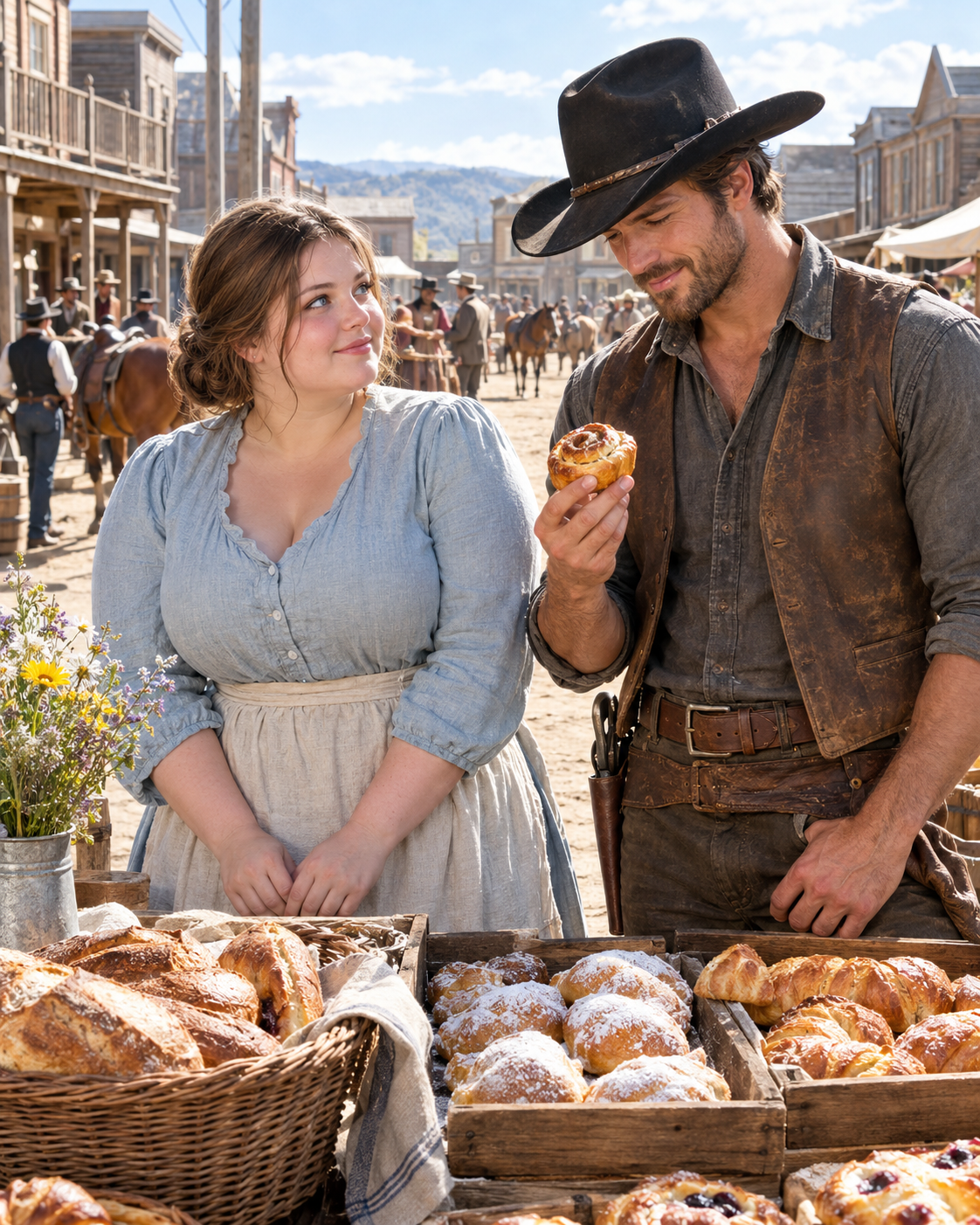
The day Clay Vickers dumped my hand pies into the Colorado mud outside his ranch, he called them worthless, yet I already knew someone had paid him to make me disappear.
The silhouette stood beyond the kitchen window, perfectly still.
For one heartbeat, I could not breathe.
The lantern lifted slightly, and the flame revealed a face I knew.
Not well, but enough.
It was Amos Reed, one of Slade’s hired men.
I had seen him twice before near the northern fence.
I stepped away from the window and reached for the knife I kept beneath the cutting board.
Then the lantern disappeared.
I ran outside.
The night air struck my face, sharp with cold and rain.
“Amos!”
No answer.
I searched the yard, the woodpile, the barn path, even the shallow ditch beside the kitchen.
Nothing.
Only wet ground and a single set of boot prints leading toward the road.
I followed them until the rain erased them.
When I returned inside, Clay was standing in the doorway.
His rifle rested against his shoulder.
“What happened?”
“Someone left this.”
I handed him the note.
He read it once.
Then again.
His jaw tightened.
“Your husband knew about Slade?”
“I don’t know.”
“You never told me he had dealings with him.”
“Because I didn’t know.”
Clay looked at me for a long moment.
“Tell me everything.”
So I did.
I told him about my husband’s last months.
About how he had become increasingly quiet before his death.
About the nights he woke suddenly and checked the locks.
About the time, three weeks before he died, when he came home with mud on his boots and refused to tell me where he had been.
I told Clay about the final conversation we had.
My husband had sat at the kitchen table with his old recipe book open in front of him.
He had touched the worn leather cover and said, “If anything happens to me, don’t trust a man who offers you an easy way out.”
At the time, I thought he was talking about debt.
I had been wrong.
Clay lowered the note.
“What was your husband’s name?”
“Thomas.”
He looked toward the dark window.
“Thomas Hale.”
Clay’s face changed.
“You knew him?”
“Not personally.”
“Then how do you know his name?”
“Because he came to my ranch six months before he died.”
My stomach tightened.
“What did he want?”
Clay hesitated.
“He asked questions about Slade.”
“What kind of questions?”
“Land records. Cattle shipments. Missing freight.”
I stared at him.
“Why didn’t you tell me?”
“Because I didn’t know who to trust.”
His answer angered me more than I expected.
“You could have told me.”
“And what would you have done?”
“Something.”
“Exactly.”
His voice was quiet.
“That’s what I’m afraid of.”
For several seconds, neither of us spoke.
Then someone shouted from the bunkhouse.
“Clay!”
We ran.
Three ranch hands stood outside the building.
One of them pointed toward the northern pasture.
“There!”
A small orange glow flickered beyond the fence.
Fire.
Clay swore and grabbed a horse.
“Get the men up.”
I climbed onto another horse before he could stop me.
“You stay here,” he said.
“No.”
“This isn’t a kitchen fire.”
“I know.”
He looked at me, saw the stubbornness in my face, and cursed again.
“Fine. Stay behind me.”
We rode hard through the rain.
By the time we reached the northern pasture, the glow had become a wall of flames.
The old hay barn was burning.
Men rushed forward with buckets, but the fire had already consumed half the roof.
Then I saw it.
The fire wasn’t spreading randomly.
Someone had poured oil along the side closest to the storage room.
“Clay!”
He turned.
“The records!”
His expression went pale.
He understood immediately.
The storage room contained land deeds, payment records, cattle ledgers, and old correspondence.
Two ranch hands broke the door open.
Smoke poured out.
Clay ran inside.
I followed.
Heat slammed into my face.
“Get out!” he shouted.
But I had already seen the metal cabinet at the back.
“Those are the records!”
We dragged the cabinet away from the flames.
Clay kicked open the bottom drawer.
Inside were papers wrapped in oilcloth.
He grabbed them.
Then part of the ceiling collapsed.
Clay shoved me toward the door.
I fell into the mud as burning timber crashed behind us.
He came out seconds later, coughing, clutching the bundle against his chest.
The men cheered.
But I wasn’t looking at the papers.
I was looking at the edge of the barn.
A figure was running toward the northern fence.
“Someone’s leaving!”
Clay turned.
He handed the records to one of his men and ran after the stranger.
I followed as far as I could.
The man reached the fence, climbed halfway over, and turned.
Lightning flashed.
It was Amos Reed.
Clay caught him before he could jump.
They crashed into the mud.
Amos fought desperately.
Clay pinned him down.
“Who sent you?”
Amos said nothing.
Clay tightened his grip.
“Who?”
“Slade.”
The word came out like a breath.
“Why?”
“He wants the deed.”
“What deed?”
“The original.”
Clay froze.
I did too.
Amos looked at me.
“Your husband found it.”
My heart began pounding.
“Found what?”
“The proof that Slade never owned the northern valley.”
Clay released him just enough for him to breathe.
Amos continued.
“Slade forged the transfer twenty years ago. He took the valley from three families. Your husband found the original survey and the signatures.”
“Where is it?”
Amos shook his head.
“Thomas hid it.”
“Where?”
“I don’t know.”
Clay dragged him toward the barn.
“You’re going to tell us everything you do know.”
Amos laughed bitterly.
“You think I’m the worst man working for him?”
“No,” Clay said.
“I think you’re the first man who’s scared enough to talk.”
We took Amos to the bunkhouse.
The ranch hands gathered around him while Clay questioned him.
I stayed near the stove, listening.
Amos revealed more than I expected.
Slade had been sabotaging Clay’s ranch for nearly a year.
Merchants had been paid to delay deliveries.
A bookkeeper had been bribed to alter accounts.
A judge in the county had been promised land.
And Clay’s ranch hands were being encouraged to leave.
Once the ranch was financially broken, Slade planned to force Clay into selling.
But there was another problem.
The original land survey could destroy Slade’s claim to a much larger stretch of territory.
Including land already occupied by several families.
Thomas had discovered it.
And Slade had learned that Thomas had discovered it.
“How did Thomas die?” I asked.
Amos looked down.
“They said it was an accident.”
“Was it?”
He didn’t answer.
I stepped closer.
“Was it?”
Amos finally raised his eyes.
“No.”
The room went silent.
“His horse was found near the ravine,” Amos said.
“But someone had cut the reins.”
I felt the floor disappear beneath me.
For nearly a year, I had told myself my husband’s death was a terrible accident.
Now I knew someone had killed him.
Not with a gun.
Not with a knife.
With a piece of rope and a lie.
Clay reached for my arm.
I pulled away.
Not because I didn’t want his comfort.
Because if he touched me, I knew I would break.
And I had no intention of breaking in front of them.
“Where is Slade now?” Clay asked.
Amos swallowed.
“Coming here.”
“Tonight?”
“He knows about the fire.”
Clay looked toward the window.
The rain had stopped.
Beyond the glass, the ranch was dark.
Too dark.
“How many men?”
“At least twelve.”
One of the ranch hands cursed.
Clay stood.
“Then we have one advantage.”
“What?” someone asked.
“They think we’re afraid.”
He looked at me.
“We aren’t.”
The next morning, we changed the entire ranch.
We moved the horses.
We hid the surviving records.
We sent two men into town to find the county marshal.
And we turned the kitchen into a command post.
My notebook sat open beside the stove.
For months, I had written down small things because I believed details mattered.
Now those details became weapons.
Every missing sack of flour.
Every delayed wagon.
Every merchant who had changed his story.
Every payment made to a man who claimed he had never been paid.
Together, they formed a pattern.
A pattern that could not be explained away.
Then I found something I had missed.
A delivery receipt.
It was from three months earlier.
The signature belonged to a merchant who had sworn he had never supplied Clay.
But the receipt listed a payment.
And beneath the signature was a strange symbol.
Three short lines crossed by a circle.
I had seen it before.
On Slade’s flour sacks.
On a crate behind the abandoned shed.
And in the corner of an old letter in my husband’s recipe book.
I ran upstairs.
I pulled the book from beneath my mattress.
I had carried it with me everywhere since Thomas died.
I opened the cover.
The recipes filled the first pages.
Flour measurements.
Fruit fillings.
Baking temperatures.
But near the middle, several pages were missing.
I had always assumed Thomas had torn them out for cooking.
Now I realized he had removed them deliberately.
I turned the book over.
The leather spine felt loose.
I pressed my thumb against it.
A hidden compartment opened.
Inside was a narrow strip of paper.
Three words were written on it.
“Under the table.”
I stared at it.
Then I remembered.
Our old kitchen table.
The one Thomas had built himself.
The one I had sold after his death because I couldn’t bear looking at it.
I had sold it to a carpenter in Red Creek.
I ran downstairs.
“Clay!”
He came immediately.
“What?”
“The table.”
“What table?”
“My husband’s.”
I explained.
He listened without interrupting.
Then he called for a horse.
We rode into town.
The carpenter was still there.
When I described the table, he shook his head.
“Sold it six months ago.”
“To whom?”
He hesitated.
“Edgar Slade.”
My blood went cold.
Clay’s hand tightened around the reins.
“Where is it now?”
“Slade’s main house.”
We rode back without speaking.
That afternoon, we received another surprise.
The county marshal arrived with four deputies.
I thought relief would come.
It didn’t.
The marshal listened to our evidence and then looked at me.
“You have allegations,” he said.
“Not proof.”
I opened my notebook.
“We have receipts.”
“Receipts can be forged.”
“Merchant statements.”
“People can be paid to lie.”
“Amos Reed confessed.”
The marshal’s expression hardened.
“Where is he?”
We looked at each other.
Amos was gone.
His bunk was empty.
The window stood open.
Clay rushed outside.
There were hoofprints leading north.
The marshal swore.
“He was working for Slade.”
“No,” I said.
“He was working for himself.”
Everyone looked at me.
“He gave us what he knew because he was afraid. Then someone got to him.”
Clay stared toward the northern hills.
“Slade.”
That evening, the attack came.
Not with gunfire.
With smoke.
A lantern smashed against the barn wall.
Flames climbed the dry wood.
Men shouted.
Horses screamed.
Clay and his ranch hands formed a line with buckets.
I ran to the kitchen.
For one terrifying second, I thought about fleeing.
Then I remembered Thomas.
I remembered his warning.
Don’t trust a man who offers you an easy way out.
I grabbed the notebook.
Then something else caught my eye.
The old iron pan where I baked my first batch of hand pies.
I smiled despite myself.
I knew exactly what to do.
I filled the pan with water and began shouting orders.
“Move the flour sacks!”
“What?”
“Flour catches fire!”
The men moved.
“Open the windows!”
Someone obeyed.
“Get the horses away from the barn!”
The ranch erupted into organized chaos.
And somehow, we held.
By midnight, the fire was out.
The barn was damaged.
The kitchen roof was blackened.
But the ranch still stood.
Clay walked toward me through the smoke.
His face was streaked with soot.
“You saved it.”
“No.”
I looked at the exhausted men around us.
“They did.”
He shook his head.
“You gave them something to fight for.”
Before I could answer, a rider appeared on the road.
The county marshal lifted a hand.
“Don’t shoot!”
The rider stopped.
It was the carpenter.
He was holding something wrapped in cloth.
“The table,” he said.
“Slade’s men were moving it tonight.”
He unwrapped a wooden drawer.
Inside was a packet of papers.
Thomas’s handwriting covered the top page.
My hands trembled as I took it.
There were names.
Dates.
Land transfers.
Payments.
And finally, a statement signed by two former county surveyors confirming that Slade had falsified the boundaries.
But there was more.
Thomas had written a letter to me.
I opened it with shaking fingers.
“My dearest Anna,
If you are reading this, then I was right to be afraid.
I found evidence that Slade stole land from families who could not afford to fight him.
I also learned that he intends to take Clay Vickers’s ranch because it is the last piece of land connecting his properties.
Do not try to avenge me.
Truth is more powerful than revenge, but only if someone is brave enough to carry it into the light.
You have always been stronger than you believe.
Use that strength to protect yourself.
And if you ever find a man who respects your independence instead of fearing it, don’t mistake that respect for weakness.
Your stubborn heart is not a burden.
It is the reason you survived me.”
I couldn’t see the last line through my tears.
Clay took one step toward me.
Then stopped.
He didn’t touch me.
He simply waited.
That mattered.
The next morning, we rode to the county courthouse.
The marshal came with us.
So did every ranch hand.
And half the families from the northern valley.
By noon, the courthouse steps were crowded.
Slade arrived in a black carriage.
He stepped out wearing a fine coat and the expression of a man who had never imagined the world could say no to him.
When he saw the crowd, his smile disappeared.
Clay stood beside me.
Slade looked at him.
“You don’t understand what you’re doing.”
Clay answered calmly.
“No. You don’t understand what we know.”
We entered the courthouse.
For hours, the evidence was examined.
Receipts.
Land surveys.
Witness statements.
Payment records.
The original signatures.
The forged transfers.
Even the merchant who had supplied Slade with stolen goods finally confessed when the marshal threatened to arrest him.
By sunset, the truth was impossible to hide.
Slade tried to leave.
The deputies stopped him.
He looked at me as they placed the handcuffs on his wrists.
“This is because of you.”
I held his gaze.
“No.”
He frowned.
“This is because you believed everyone else was too frightened to speak.”
His face hardened.
“You think this changes anything?”
I looked around the courthouse.
At the ranch hands.
At the families whose land had nearly been stolen.
At Clay.
“It already has.”
Slade was taken away.
The investigation lasted months.
Some merchants lost their businesses.
The judge who had accepted Slade’s money resigned before charges could be brought.
The northern families regained their land.
Clay kept his ranch.
And the men who had once considered leaving stayed.
But the biggest change happened in me.
I stopped selling pies by the roadside.
Not because I was ashamed of them.
Because I no longer needed to survive one coin at a time.
Instead, I opened a small bakery in Red Creek.
The first morning, I placed thirty-two hand pies in the window.
The same number Clay had bought that first day.
He came in just after sunrise.
He looked at the pies.
Then at me.
“How much?”
I smiled.
“You’re paying full price.”
He laughed.
“I expected as much.”
He bought two.
Then he leaned against the counter.
“I have a question.”
“What?”
“Would you consider cooking at the ranch again?”
“Under what terms?”
“Independent contract.”
“Fair pay?”
“Always.”
“Control of my kitchen?”
“Absolutely.”
I pretended to think about it.
“Then maybe.”
He smiled.
But he didn’t ask me to marry him.
Not then.
He understood that some things should not be rushed simply because two lonely people had survived the same storm.
Months passed.
The bakery grew.
The ranch recovered.
The men started bringing their families into town.
Children ran through the streets.
People who had once counted every coin began buying pies without asking the price.
One evening, Clay came into the bakery after closing.
He placed something on the counter.
It was a small wooden box.
I opened it.
Inside was Thomas’s original recipe book.
I stared at it.
“I thought it burned.”
“It didn’t.”
“Where did you find it?”
“In the old barn.”
I touched the cover.
“You kept it?”
“I knew it mattered.”
I looked up at him.
“You knew?”
“I knew it mattered to you.”
That was the moment I understood what Thomas had meant.
A strong woman didn’t need a man to rescue her.
She needed someone who didn’t ask her to become smaller so he could feel larger.
Clay had never tried to own me.
He had never told me what I could or couldn’t do.
He had simply stood beside me when the world tried to push me down.
I closed the box.
“Thank you.”
He nodded.
Then he reached into his coat and pulled out another piece of paper.
“What is that?”
“A contract.”
I raised an eyebrow.
“For the bakery?”
“No.”
He unfolded it.
It was a deed.
A small piece of land beside the ranch.
“What’s this?”
“Yours.”
I stared at him.
“I don’t want charity.”
“I know.”
He pointed to the bottom.
“It’s not charity.”
I read the document.
The land had been purchased in my name.
But there was no gift clause.
There was a partnership agreement.
He was offering me ownership of a small orchard that could supply the bakery.
“Why?”
“Because you said once that wasting what you already have is foolish.”
He smiled.
“I figured we could grow something instead.”
I laughed.
For the first time in a very long time, the sound didn’t feel forced.
It felt like mine.
A year later, the orchard bloomed.
White flowers covered the trees.
The bakery supplied pies to three towns.
The ranch became one of the strongest in the county.
And every spring, the families who had nearly lost everything gathered beneath the orchard trees for a shared meal.
We called it Founders’ Day.
But I always thought the name was wrong.
We hadn’t founded anything.
We had simply refused to disappear.
One evening, as the sun sank behind the mountains, I stood beside Clay at the edge of the orchard.
“You ever regret buying those thirty-two pies?”
He smiled.
“Every day.”
I laughed.
“Why?”
“Because I should have bought thirty-three.”
I looked at him.
“Why?”
“So I could have one more.”
He took my hand.
This time, I didn’t pull away.
Not because I needed him.
Because I wanted him.
There is a difference.
A year earlier, I had been standing beside a dusty road, wondering how I would survive another winter.
I had believed survival meant holding on.
I was wrong.
Sometimes survival means letting go of the fear that taught you to expect loss.
Sometimes it means speaking when silence feels safer.
Sometimes it means writing down every small truth until the lies become impossible to defend.
And sometimes, after everything you loved has been taken from you, life gives you something unexpected.
Not a replacement.
Not a second version of the past.
Something new.
Something earned.
The old recipe book still sits on my kitchen shelf.
Thomas’s handwriting remains between the recipes.
Clay’s contract is framed beside it.
And on the first page, where the paper has faded with age, I wrote one sentence of my own:
Never let someone convince you that your small efforts are worthless.
A hand pie may look small.
A notebook may look harmless.
A frightened voice may sound weak.
But small things become powerful when enough courage is placed behind them.
The day Clay Vickers dumped my hand pies into the Colorado mud, he thought they were worthless.
Perhaps, for a moment, I did too.
But he was wrong.
Those pies became the beginning of a new life.
The notebook became the beginning of justice.
And the stubborn heart I once believed was my greatest weakness became the very thing that saved us all.
Because the truth does not always arrive like thunder.
Sometimes it arrives quietly.
In a recipe book.
In a receipt.
In a frightened confession.
In a woman who refuses to look away.
And when enough small truths are carried into the light, even the strongest lie eventually has nowhere left to hide.
The silhouette stood outside the kitchen window, holding a lantern.
For one second, I couldn’t move.
Lightning flashed again, and the face became clear.
Amos Reed.
One of Slade’s men.
He lifted the lantern toward the glass.
Then he pointed toward the road.
Not threatening.
Warning me.
I reached for the door.
Before I could open it, the lantern dropped.
Amos disappeared into the darkness.
I ran outside.
The rain had started again, cold needles against my face.
“Amos!”
Nothing.
I searched the yard until my boots sank into the mud.
Then I saw something near the kitchen steps.
A small leather pouch.
Inside was a brass key and a folded piece of paper.
My hands shook as I opened it.
“Thomas found the proof. Slade knows. Do not trust anyone in town.”
That was all.
I ran back inside and locked the door.
Clay found me there minutes later.
His rifle was in his hands.
“What happened?”
I gave him the note.
He read it.
Then he looked at the window.
“Where’s Amos?”
“He’s gone.”
“Did he say anything?”
“No.”
Clay studied the key.
“Where did you find this?”
“Outside.”
He turned it over.
There was a tiny number engraved on the metal.
17.
I knew that number.
My husband had written it in the back of his recipe book.
At the time, I had thought it was an old inventory number.
Now I wasn’t so sure.
I went upstairs and brought the book down.
Clay watched as I turned through the pages.
The recipes were written in Thomas’s familiar handwriting.
Apple filling.
Peach filling.
Molasses bread.
Corn cakes.
Then, near the back, I found something I had never noticed.
Several numbers were written beside ingredients.
17.
42.
9.
31.
Clay leaned closer.
“Those aren’t measurements.”
“No.”
I traced the ink with my finger.
“They’re locations.”
He looked at me.
“How do you know?”
“Because Thomas used to hide things in ordinary places.”
I turned to the page for apple pie.
Under the recipe was written:
“Seventeen. Beneath what never moves.”
Clay was already reaching for his coat.
“The old well.”
We left through the back door.
The rain had become a steady curtain over the ranch.
The old stone well stood behind the barn, unused for years.
Clay lifted the wooden cover.
Inside was darkness.
He lowered a lantern.
Nothing.
Then he noticed a metal ring attached to the inner wall.
He reached down.
A hidden compartment opened beneath the stones.
Inside was a tin box.
My heart stopped.
Clay pulled it out.
The lid was sealed with wax.
My husband’s initials were pressed into it.
T.H.
I broke the seal.
Inside were land records.
Bank statements.
Letters.
And one photograph.
Three men stood in front of a surveyor’s office.
One was Thomas.
One was Edgar Slade.
The third man was a county official.
On the back of the photograph, Thomas had written:
“April 14. The day they changed the map.”
I looked at Clay.
“This is what Slade is afraid of.”
Clay picked up one of the documents.
His face hardened.
“This proves the northern valley belonged to those families.”
“And the ranch?”
He turned the paper around.
“Part of mine too.”
I suddenly understood.
Slade didn’t simply want Clay’s ranch.
He needed it.
Clay’s land sat directly between Slade’s eastern holdings and the northern valley.
If he acquired it, he could control the entire stretch of territory.
But why kill Thomas?
Why destroy the records?
Then Clay found the answer.
A letter from Slade to the county official.
The words were blunt.
“Once Hale is removed, the problem will disappear.”
I couldn’t breathe.
Thomas hadn’t died in an accident.
He had been murdered.
And Slade had written it down.
Clay put the letter back into the box.
“We take this to the marshal.”
“We can’t.”
He looked at me.
“Why?”
“Because Amos said not to trust anyone in town.”
“That doesn’t mean the marshal.”
“It might.”
Clay frowned.
I pointed to the letter.
“Look at the name.”
He read it again.
Then his expression changed.
The county official wasn’t just a former official.
He was the current county judge.
The same man who had approved Clay’s debt extensions.
The same man who could issue a foreclosure order.
The same man who had been asking questions about my notebook.
Clay cursed under his breath.
“Then we don’t go to the courthouse.”
“No.”
“We go somewhere else.”
“Where?”
I looked at the box.
“Where Slade can’t destroy the evidence.”
The answer came from an unexpected place.
The railroad.
Two days later, we rode east with the documents hidden beneath sacks of flour.
We were heading toward the federal land office in Denver.
If the records were filed there, Slade couldn’t simply erase them.
But Slade knew we were leaving.
We had barely reached the edge of town when three riders appeared behind us.
Clay looked over his shoulder.
“Keep going.”
I gripped the reins.
“How many?”
“Three.”
Then another rider appeared ahead.
Four.
They had planned it.
Clay pulled his rifle.
“Take the left trail.”
“What about you?”
“I’ll slow them down.”
“No.”
“Anna.”
“I said no.”
He stared at me.
For the first time, I saw fear in his eyes.
Not for himself.
For me.
Then gunfire cracked through the morning.
The horse beneath me reared.
I nearly fell.
Clay grabbed my arm.
“Ride!”
We turned toward the canyon.
Bullets struck the rocks behind us.
We raced through the narrow passage.
The riders followed.
Then one of them shouted.
“Give us the box!”
Clay fired.
The man fell from his horse.
The others slowed.
We kept going.
At the end of the canyon, we found the bridge washed out.
There was no way across.
Clay looked behind us.
The riders were approaching.
He dismounted.
“Take the box.”
“What?”
“If they catch us, you keep riding.”
“I’m not leaving you.”
“Anna.”
I stepped toward him.
“I lost my husband because men like them thought a woman’s life was something they could destroy.”
I held his gaze.
“I won’t lose another man because he thinks protecting me means sending me away.”
For a moment, he said nothing.
Then he smiled.
A strange, tired smile.
“You’re impossible.”
“So I’ve been told.”
The riders emerged from the canyon.
Clay raised his rifle.
Then a shot came from behind them.
One rider dropped.
Another spun around.
Amos Reed stood on the ridge.
He fired again.
The remaining men fled.
Amos lowered his rifle.
Clay stared at him.
“You were supposed to be dead.”
“Almost was.”
Amos rode down slowly.
He looked older than he had the night before.
There was blood on his sleeve.
“Slade knows about the box.”
“How?”
“Someone told him.”
I looked at Clay.
“Who?”
Amos shook his head.
“You don’t want to know.”
“Tell us.”
He looked at me.
“Your neighbor.”
My stomach dropped.
“Mr. Bell?”
Amos nodded.
The old farmer who had brought me eggs.
The man who had asked about my business.
The man who had always seemed harmless.
“He works for Slade?”
“Not exactly.”
Amos dismounted.
“Slade owns his debt.”
That was the difference.
Fear could turn decent people into dangerous ones.
Amos looked at the box.
“There’s another problem.”
“What?”
“The evidence isn’t enough.”
I stared at him.
“What do you mean?”
“Slade will say the documents were stolen.”
Clay frowned.
“The photograph?”
“He’ll say it’s fake.”
“The letter?”
“He’ll say someone forged it.”
Amos pointed toward the box.
“You need the original survey.”
“Where is it?”
“Slade’s house.”
I laughed bitterly.
“Of course it is.”
Amos nodded.
“Thomas hid the copy. Slade has the original.”
“Why would he keep it?”
“Because he thought nobody knew what it meant.”
Clay looked toward the mountains.
“Then we take it.”
Amos shook his head.
“That’s suicide.”
I closed the box.
“Then we’ll have to be very careful.”
That night, we returned to Red Creek.
We did not go to the ranch.
Instead, Amos led us to an abandoned church outside town.
He had been hiding there.
Inside, beneath the floorboards, he had stored supplies and weapons.
There were also two people waiting for us.
A young woman named Clara Bell and her father.
Mr. Bell.
I stared at him.
He looked ashamed.
“I didn’t want to betray you.”
“You told Slade where we were going.”
“I had no choice.”
“There is always a choice.”
He lowered his head.
“My debt was going to take everything.”
I understood then.
Not forgave.
But understood.
Slade had built his power from fear.
He didn’t need everyone to love him.
He only needed enough people to believe resisting him would cost too much.
Clara stepped forward.
“My father told me what he did.”
She looked at me.
“I want to help.”
“Why?”
“Because my family isn’t the only one trapped by him.”
She opened a cloth bag.
Inside were letters.
Dozens of them.
“I collected copies from other families.”
She spread them across the floor.
Every letter showed the same pattern.
Loans.
Threats.
Land transfers.
Promises.
And signatures.
Slade wasn’t simply stealing land.
He was manufacturing desperation.
Then he bought the desperation.
I looked at Clay.
“We have enough.”
“Not yet.”
He pointed to one name.
“Who is this?”
Clara looked down.
“William Crane.”
Amos swore.
“Slade’s bookkeeper.”
“Why is his name everywhere?”
“Because he keeps the real records.”
I understood.
The evidence we had was enough to expose Slade.
But Crane had the ledger connecting every payment to every crime.
Without that ledger, Slade could still claim everything was fabricated.
“Where is Crane?”
Amos answered.
“At Slade’s house.”
I looked toward the dark window.
“Then that’s where we’re going.”
We waited until midnight.
Slade’s house stood on a hill overlooking the valley.
Its windows glowed faintly.
We approached from the back.
Amos knew a servant’s entrance.
Clay stayed outside.
I went in with Clara.
The house smelled of polished wood and expensive tobacco.
We moved silently through the hallway.
Then we found the study.
The door was locked.
Clara pulled a hairpin from her pocket.
“Where did you learn that?”
“My father owed Slade money.”
She smiled sadly.
“I learned many things.”
The lock clicked.
Inside were shelves of books.
A desk.
A safe.
And a large wooden table.
The table.
My husband’s table.
I walked toward it.
For a moment, I couldn’t move.
I placed my hand on the surface.
Thomas had built this.
He had carved tiny initials beneath it.
T.H.
I remembered the evenings we had spent there.
The meals.
The arguments.
The laughter.
The life we thought would last forever.
Then I saw the drawer.
I pulled it open.
Inside was nothing.
But beneath the drawer was a false bottom.
I pressed it.
It opened.
There was a folded map.
The original survey.
And beneath it, a black ledger.
Clara whispered.
“We found it.”
I opened the ledger.
Names filled every page.
Payments.
Dates.
Land parcels.
Bribes.
And beside Thomas’s name was one final entry.
“Accident arranged.”
I closed my eyes.
For a moment, grief swallowed everything.
Then footsteps sounded in the hallway.
Clara grabbed my arm.
We hid behind the curtain.
The door opened.
Slade walked in.
He was not alone.
William Crane followed him.
“I told you the woman would find it,” Crane said.
Slade shook his head.
“She was supposed to be frightened.”
“She’s not.”
“Then we’ll frighten her properly.”
I held my breath.
Slade walked toward the desk.
He opened a drawer.
“Tomorrow morning, Vickers loses the ranch.”
Crane hesitated.
“And the woman?”
Slade’s voice became cold.
“She knows too much.”
I felt Clara’s hand tighten around mine.
Slade continued.
“Thomas made the same mistake.”
That sentence nearly broke me.
Not because it was unexpected.
Because he said it so casually.
As if my husband’s life had been nothing more than an inconvenience.
I stepped from behind the curtain.
“Then you made the same mistake too.”
Slade spun around.
His face went white.
I held up the ledger.
“Now everyone knows.”
For several seconds, nobody moved.
Then Crane pulled a gun.
Clay crashed through the window.
Amos came through the door.
Everything happened at once.
Crane fired.
The bullet struck the ceiling.
Clay tackled him.
Slade ran.
I chased him.
He fled through the hallway and out onto the veranda.
Rain began falling.
He reached the stairs.
I followed.
“Thomas knew.”
He stopped.
“You killed him.”
Slade turned.
“You have no idea what you’re talking about.”
“I have your ledger.”
He laughed.
“Paper doesn’t matter.”
“Then why are you running?”
His smile disappeared.
“You think the law will save you?”
“No.”
I stepped closer.
“The truth will.”
He raised his gun.
Before he could fire, Clay appeared behind him.
“Drop it.”
Slade hesitated.
Then Amos fired into the ground.
The gun fell from Slade’s hand.
The marshal arrived minutes later.
Not the county marshal.
A federal marshal from Denver.
Clara had sent word ahead before we entered the house.
Slade was arrested.
Crane confessed.
The ledger was examined.
The original survey was authenticated.
And within weeks, the entire scheme began to collapse.
People came forward.
One after another.
Families who had been silent for years finally told their stories.
Slade’s properties were seized.
The forged deeds were overturned.
The county judge was arrested.
And Thomas’s death was officially declared a murder.
I attended the hearing alone.
I didn’t want Clay beside me.
Some griefs belong to the person who carries them.
When the judge read Thomas’s name, I closed my eyes.
For nearly a year, I had wondered whether I should have seen the danger.
Whether I should have asked more questions.
Whether I could have saved him.
Now I finally understood.
His death wasn’t my failure.
It was Slade’s crime.
There is a difference.
And sometimes healing begins when you stop carrying blame that never belonged to you.
Months later, the ranch was thriving again.
The men were paid on time.
The northern families had reclaimed their land.
Mr. Bell had repaid his debts.
Clara started working at my bakery.
And Amos left Slade’s employ for good.
He became one of Clay’s most trusted ranch hands.
As for me, I stopped selling pies beside the road.
I opened a bakery in Red Creek.
The sign above the door read:
“Hale’s Hand Pies.”
The first morning, Clay walked in.
He looked at the display.
“How much?”
“For you?”
He nodded.
“Double.”
He laughed.
“I thought you liked me.”
“I do.”
“Then why double?”
“Because you once called them worthless.”
He leaned over the counter.
“I believe I’ve apologized for that.”
“Not enough.”
“How much would be enough?”
I looked at him.
“Buy the whole tray.”
He did.
Thirty-two pies.
Every single one.
Then he carried them outside and handed them to the ranch hands waiting in the street.
The men cheered.
I stood in the doorway and watched.
The same woman who had once feared she would go hungry was now watching thirty-two pies disappear into the hands of people who had come to celebrate with her.
Clay returned.
He stood beside me.
“You changed this town.”
“No.”
I smiled.
“We all did.”
He looked at me for a long moment.
Then he reached into his coat.
He pulled out a folded piece of paper.
I opened it.
It was a business contract.
A partnership.
Half the orchard belonged to me.
Half belonged to him.
“You don’t have to sign it,” he said.
“I know.”
“And if you don’t want it—”
“I’ll sign it.”
He smiled.
“You didn’t even read the terms.”
“I trust you.”
His expression softened.
“That’s a dangerous thing to give someone.”
“Only if they don’t deserve it.”
He folded the contract.
Then he held out his hand.
I took it.
Not because I needed rescuing.
Not because I was afraid of being alone.
Because after everything we had survived, I finally understood that love was not a cage.
It was a hand offered without demanding that you surrender your own.
Years later, people in Red Creek still told the story differently.
Some said Clay Vickers saved the ranch.
Others said the federal marshal did.
Some remembered Amos Reed.
Others remembered Clara Bell.
But whenever anyone asked me what really happened, I always gave the same answer.
It wasn’t one person.
It was every small act of courage that finally became impossible to ignore.
A receipt.
A notebook.
A frightened confession.
A hidden key.
A recipe book.
A woman who refused to stop asking questions.
A man who finally admitted he needed help.
A family that decided fear had taken enough.
That was what defeated Slade.
Not strength.
Not money.
Not revenge.
Truth.
And the truth had survived because ordinary people carried it when it was still fragile.
Years after the trial, I kept Thomas’s recipe book on the shelf above the bakery counter.
His handwriting faded.
The pages became soft at the edges.
But I never replaced it.
On the first page, beneath his old recipe for apple hand pies, I wrote something of my own.
“Never believe that what you do is worthless simply because it is small.”
A pie can feed someone.
A note can warn someone.
A question can expose a lie.
A stubborn woman can change the fate of a ranch.
And one honest voice can give another person the courage to speak.
That was the lesson I carried with me.
Not that evil always loses.
Not that justice always arrives quickly.
It doesn’t.
Sometimes the truth takes years.
Sometimes it costs more than you think you can afford.
Sometimes the people you trust will disappoint you.
Sometimes the people you fear will surprise you.
But silence always charges a price too.
And if you keep paying it, eventually someone else gets to decide what your life is worth.
I had spent too long believing survival meant enduring whatever happened to me.
I learned that survival also meant choosing what happened next.
The morning after the final court hearing, I returned to the same dusty road where I had once sold my pies.
The wooden table was still there.
Broken.
Weathered.
Covered in scratches.
I touched it one last time.
Then I left it behind.
I didn’t need it anymore.
Neither did I need the woman I had been when I first stood there.
She had been afraid.
She had been grieving.
She had been hungry.
But she had kept going.
And because she kept going, she eventually found something better than the life she had lost.
She found purpose.
She found courage.
She found justice.
And, unexpectedly, she found love.
As I walked back toward the bakery, Clay waited beside the wagon.
He held out his hand.
“Ready?”
I looked at the mountains.
The same mountains that had watched my husband die.
The same mountains that had witnessed Slade’s rise and fall.
The same mountains beneath which I had once wondered whether I would survive another winter.
“Yes,” I said.
And I took his hand.
Behind us, the old road disappeared into the morning light.
Ahead of us was the ranch.
The orchard.
The bakery.
The people who had chosen to stay.
And a future that no one had the right to steal.
For the first time in years, I wasn’t afraid of what tomorrow might bring.
Because I had learned something Thomas had tried to teach me long before I understood it.
You cannot always choose what happens to you.
But you can choose whether fear gets the final word.
And sometimes, the smallest thing you refuse to surrender becomes the very thing that saves you.
My husband left me a recipe book.
Clay gave me a partnership.
The town gave me a second chance.
But the courage to begin again was mine.
And that, in the end, was worth far more than thirty-two hand pies ever could be.
THE END.