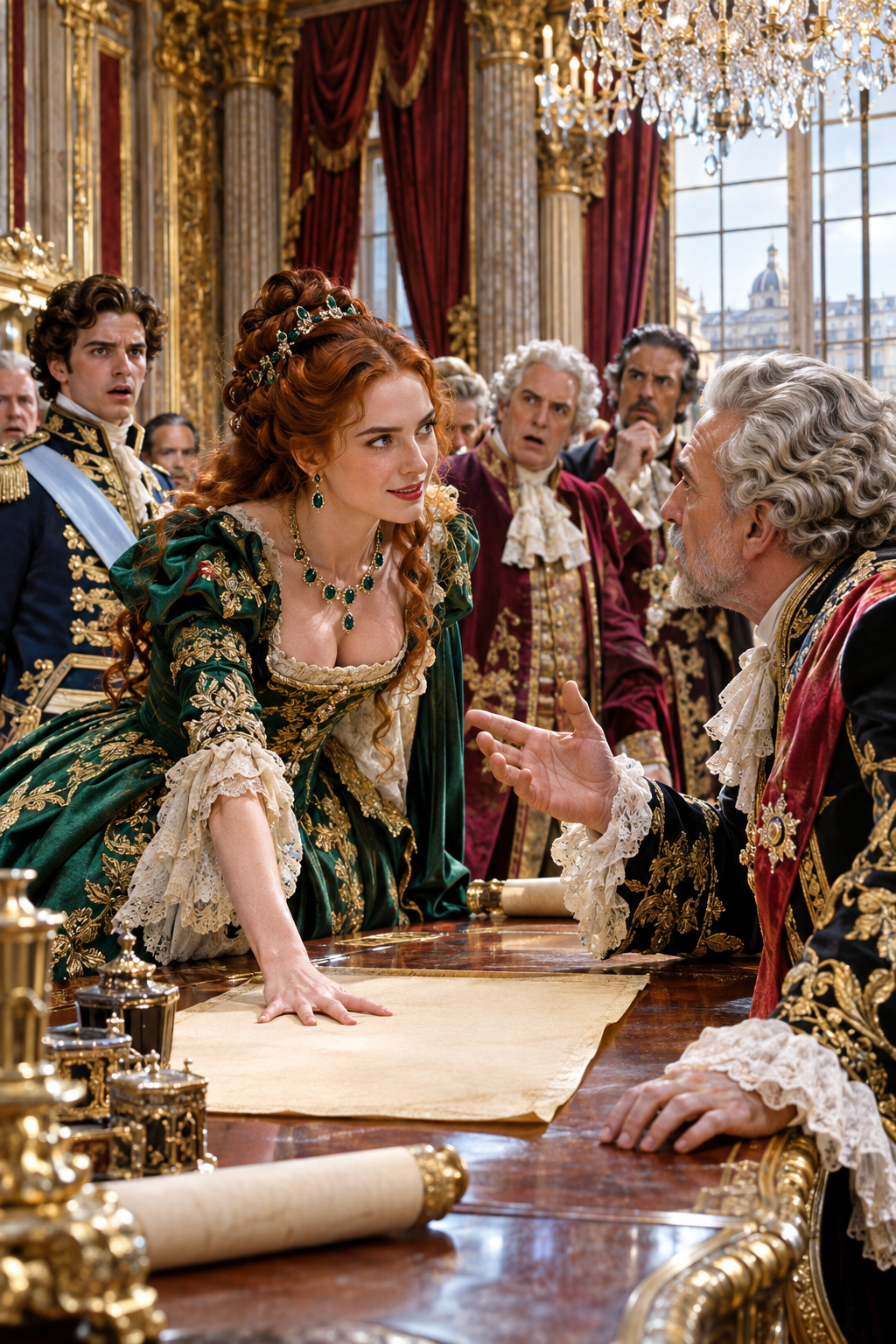
The British envoy ordered his wife to remain silent during the most important treaty negotiation of his career.
Elena stared at the message, recognizing every curve of the handwriting and knowing with absolute certainty that she had never written a single word of it.
The Spanish minister held the paper beneath the afternoon light, his expression growing colder as he examined the signature.
It was hers.
Or rather, it was an imitation so precise that even William, standing beside her, seemed momentarily uncertain.
The message instructed an unnamed intermediary to ensure that the altered treaty reached London before the Spanish government discovered the discrepancies. Beneath the instructions appeared a promise of payment from funds supposedly controlled by Lady Ashford herself.
Elena read the final sentence twice.
The envoy must remain unaware until the agreement is signed.
Someone had not merely forged her handwriting.
Someone had constructed an entire conspiracy around her silence.
“Your Excellency,” William said carefully, “my wife has never participated in official correspondence.”
Elena turned toward him.
Even now, when he meant to defend her, he reached instinctively for the argument that she had no place in political affairs.
“That is precisely what makes the accusation convenient,” she replied.
The minister looked between them.
“Lady Ashford, can you explain this document?”
“Not yet. But I can tell you something about the person who prepared it.”
She placed the forged letter beside the treaty instruction.
Both documents contained the same peculiar abbreviation for the Spanish word señor. It was an outdated convention, rarely used in contemporary diplomatic correspondence.
Her uncle had taught it to her when she was a child.
But so had the tutors he employed.
And one of those tutors had later become a clerk in the British diplomatic service.
Elena remembered a young man sitting at Edmund’s library table, copying letters beneath the yellow light of a winter afternoon.
Thomas Bell.
William’s private secretary.
The man now lying dead inside the embassy archives.
The realization settled over her with uncomfortable clarity.
The conspirators had chosen their scapegoats carefully.
One dead secretary.
One supposedly ignorant wife.
One ambitious envoy whose seal had been stolen.
And a treaty capable of bringing two nations to the edge of war.
Elena raised her eyes toward Rafael Valdés.
He was no longer smiling.
“Your Excellency,” she said, “I believe someone intended this meeting to end with three arrests and a diplomatic disaster.”
The minister folded his hands.
“And who would benefit?”
“Someone who profits when England and Spain cease trusting each other.”
Valdés gave a small, dismissive breath.
“An interesting theory, my lady. Unfortunately, theories do not explain forged documents.”
“No,” Elena answered. “But frightened men often explain themselves.”
For the first time, William did not interrupt her.
The minister ordered Valdés detained until the documents could be examined.
Two guards approached the translator.
He allowed them to take his arms without resistance, but as they led him toward the door, he glanced at Elena.
“You should have remained at home, Lady Ashford.”
His voice was quiet.
Almost regretful.
Then he added something in Spanish.
“Your uncle understood the price of interference.”
Elena felt the blood drain from her face.
“What have you done to him?”
Valdés offered no answer.
The guards took him away.
Outside, the palace bells began striking five.
The sound carried through the chamber, measured and indifferent, while the assembled diplomats waited for someone to restore order.
William approached Elena.
“Your uncle is involved?”
“I don’t know.”
“Then we must contact him immediately.”
She looked at her husband.
“William, the man you trusted to translate an international treaty has been altering its terms for weeks. Your secretary is dead. Someone has forged my handwriting and stolen your seal.”
He lowered his eyes.
“And?”
“And we cannot assume the embassy is safe.”
The minister heard her.
He ordered the chamber secured and sent a trusted officer to the British residence with instructions to protect the diplomatic archives.
Elena requested permission to accompany him.
William immediately objected.
“Absolutely not.”
She turned.
“Why?”
“Because you are already in danger.”
“That danger existed before you knew about it.”
He opened his mouth, then stopped.
There was no anger in her voice.
That seemed to trouble him more than anger would have.
The minister considered them both.
“Lord Ashford, your wife has identified discrepancies that escaped every official in this room. I suggest we listen when she speaks.”
William’s jaw tightened.
Then, slowly, he nodded.
“Very well.”
It was a small concession.
Elena understood how much it cost him.
She also understood that it was long overdue.
The British embassy stood behind iron gates on a quiet Madrid street, its pale stone façade illuminated by the last warmth of the evening sun.
Inside, the atmosphere had changed completely.
Servants whispered in doorways. Two guards stood outside the archives. A dark stain marked the edge of a carpet near the secretary’s desk.
Thomas Bell had been found beside an overturned chair, a wound at the back of his head.
The embassy physician believed he had been struck by a heavy object.
There were no signs of forced entry.
William examined the room in silence.
Thomas had served him for six years.
He had been meticulous, punctual, and almost painfully discreet.
Elena remembered him differently.
A young man who always stood when she entered.
Who had once returned a book she left in the embassy library.
Who spoke Spanish with the careful pronunciation of someone taught by an English tutor rather than raised among native speakers.
She approached his desk.
Three drawers stood open.
One remained locked.
“Did anyone search his belongings?” she asked.
The officer shook his head.
“Only enough to identify missing documents.”
Elena looked at William.
“May I?”
He handed her the secretary’s keys.
She opened the final drawer.
Inside lay a small leather notebook, a broken sealing knife, and several sheets of correspondence.
The notebook contained ordinary appointments.
The letters appeared equally unremarkable.
But beneath them was a folded page covered in Spanish poetry.
Elena recognized the verses immediately.
Her mother had taught them to her when she was seven.
They came from an old collection of Castilian ballads.
At first, she thought the page was another attempt to implicate her family.
Then she noticed the punctuation.
Several commas had been placed where the original verses contained none.
She read the lines again.
The unusual punctuation marked specific words.
Taken together, they formed a sentence.
The second copy travels with the midnight courier.
Elena looked toward the window.
“What time does the diplomatic courier leave?”
William answered.
“Midnight.”
“From where?”
“The northern posting station.”
She folded the paper.
“Then we have less than seven hours.”
William studied her.
“How did you know to read it that way?”
“My mother used the same method when she wanted to send private messages to her sister in Seville.”
“Thomas knew?”
“My uncle taught him.”
William looked toward the dead man’s empty chair.
“Then Thomas may have been trying to warn us.”
Elena nodded.
“And someone killed him before he could.”
The officer approached carrying a small wooden box recovered from beneath a cabinet.
Inside were several broken wax seals and a narrow brass stamp bearing William’s diplomatic insignia.
William stared at it.
“My seal was taken from my office last Thursday.”
“Did you report it missing?”
“I thought I had misplaced it.”
Elena looked at him.
“Who had access?”
“Thomas. Valdés. Several senior clerks.”
“And your visitors?”
William hesitated.
“Your uncle visited the embassy six nights ago.”
The room became very quiet.
Elena slowly turned.
“Edmund was here?”
“He requested a private meeting.”
“You told me he was ill in England.”
“He asked me not to mention his visit until he had concluded his business.”
“What business?”
William looked away.
“He claimed to possess intelligence concerning French efforts to undermine the negotiations.”
Elena felt a familiar ache behind her ribs.
Edmund had always believed that England’s security depended upon knowing more than its enemies.
He had spent decades cultivating informants, arranging introductions, and advising men whose names never appeared in official records.
But he had also taught her that loyalty required judgment.
Had he forgotten his own lesson?
Or had she misunderstood him all along?
“What did he ask you to do?” she said.
“Nothing improper. He wanted access to the preliminary treaty drafts.”
“Did you give it to him?”
William remained silent.
That was answer enough.
Elena placed the notebook on the desk.
“Then we must find him before midnight.”
By eight o’clock, Madrid had settled beneath a cold November rain.
A royal carriage carried Elena, William, and Captain Alonso Herrera through narrow streets toward a private residence near the old city walls.
Herrera was a Spanish officer assigned to protect the negotiations.
He had said little during the journey, but Elena noticed that he kept one hand near the hilt of his sword whenever they passed an unlit alley.
The address came from the palace visitor register.
It belonged to a merchant named Nicolás Serrano.
According to the records, Serrano had hosted several private gatherings attended by foreign traders and diplomatic intermediaries.
Among them was Sir Edmund Harcourt.
The house stood behind a courtyard gate.
No lamps burned in its windows.
Herrera knocked.
No one answered.
He tried again.
A faint movement sounded inside.
Then a woman’s voice called from beyond the door.
“Who is there?”
Elena answered in Spanish.
“Someone looking for Sir Edmund Harcourt.”
The silence lasted several seconds.
A bolt slid back.
An elderly housekeeper opened the door just far enough to reveal one frightened eye.
“He is gone.”
“When?”
“Yesterday.”
“Was he alone?”
The woman glanced toward the street.
“No.”
Elena lowered her voice.
“Was the other man Rafael Valdés?”
The housekeeper’s face changed.
She began closing the door.
Herrera placed his hand against it.
“We are acting under royal authority.”
The woman stepped aside.
Inside, the house smelled of extinguished candles and damp plaster.
Furniture had been moved away from the walls.
A table stood beneath a chandelier, covered with empty glasses and scattered ash.
Elena noticed a small patch of blue sealing wax near the fireplace.
The same color she had seen protruding from Valdés’s pocket.
She picked it up.
The wax bore part of a merchant’s mark.
Three interlocking circles.
Herrera recognized it.
“The mark of the Calderón trading company.”
William frowned.
“They supply naval stores to several European ports.”
“And weapons,” Herrera added.
Elena looked toward the abandoned table.
“Who owns the company?”
“A consortium of merchants. Its principal director is believed to be in Cádiz.”
The housekeeper suddenly spoke.
“Not Cádiz.”
All three turned.
“The gentleman with the silver cane said the ships would be waiting in Cartagena.”
Elena felt the significance immediately.
Cartagena was one of Spain’s most important naval ports.
If the forged treaty granted Britain unrestricted passage, Cartagena could become the site of the first confrontation.
“What gentleman?” she asked.
The woman hesitated.
“The Englishman.”
“Sir Edmund?”
“No. A younger gentleman. He had a scar near his left ear.”
William’s expression tightened.
Elena noticed.
“You know him.”
He nodded reluctantly.
“Charles Mercer. A commercial adviser attached to our delegation.”
“Where is he now?”
“I dismissed him three days ago after discovering irregularities in his expense accounts.”
Herrera looked toward the courtyard.
“Then we have another name.”
A sudden crash came from the upper floor.
Herrera drew his sword.
William moved instinctively in front of Elena.
Footsteps thundered across the ceiling.
Then a window shattered.
By the time Herrera reached the courtyard, a figure had disappeared over the rear wall.
But the intruder had left something behind.
A leather dispatch case.
Inside were copies of shipping manifests, payments to unnamed intermediaries, and a map of the Mediterranean coast.
Several ports were marked in red.
Cartagena.
Gibraltar.
Portsmouth.
And beneath the map lay a list of British naval vessels expected to depart within forty-eight hours.
William read it with mounting disbelief.
“These are confidential fleet movements.”
Elena examined the final page.
One vessel’s name had been circled.
HMS Resolute.
Beside it appeared a single instruction.
Ensure the first shot is fired from the British side.
The meaning was unmistakable.
The conspirators did not intend merely to sabotage a treaty.
They intended to manufacture a naval confrontation that neither government could easily deny.
A single cannon fired at the wrong moment could turn suspicion into war.
And someone had already arranged the ships.
At half past ten, the three returned to the palace.
The Spanish minister listened as Elena presented the documents.
He studied the shipping manifests before calling for his naval adviser.
Within minutes, messengers were dispatched toward Cartagena and Cádiz.
But the most urgent problem remained.
The midnight courier.
If the altered treaty reached London before the corrections, British officials might act upon provisions Spain had never accepted.
Worse, the conspirators could use the forged document to justify the movement of warships already preparing to sail.
“We must stop the courier,” Herrera said.
William nodded.
“I can authorize an immediate suspension.”
Elena looked at the map.
“That may not be enough.”
Both men turned toward her.
“The message in Thomas’s notebook said the second copy travels with the midnight courier. Not the forged copy. The second copy.”
“What distinction are you making?” William asked.
“Someone has prepared more than one version of the treaty. Perhaps the courier is carrying the evidence needed to expose the fraud.”
The minister considered her words.
“Or a second forgery.”
“Yes.”
Elena looked at the clock.
“But if we intercept it without understanding its purpose, the conspirators will know their operation has been discovered.”
Herrera stepped forward.
“Then we let the courier depart under observation.”
William shook his head.
“That is an unacceptable risk.”
Elena met his eyes.
“The risk began when we trusted the wrong people. We cannot solve it by refusing to look beyond the obvious.”
For a moment, William seemed ready to argue.
Then he said quietly, “What do you propose?”
It was the first time he had asked her that question in a room filled with diplomats.
Elena unfolded Thomas’s poem.
“The punctuation tells us where to look. But the verses contain another clue.”
She pointed to the final line.
It referred to a traveler carrying two keys.
Her mother had always used that image to signify a message hidden inside another message.
“The courier may be carrying a document whose purpose is not apparent until it reaches its intended recipient.”
The minister leaned forward.
“Can you identify the recipient?”
Elena examined the shipping manifests.
A payment entry caught her attention.
The initials C.M. appeared beside a sum large enough to purchase a country estate.
Charles Mercer.
And beside the initials was a London address.
The same address listed on the courier’s route.
Elena placed her finger on it.
“Here.”
At eleven forty-five, rain swept across the northern posting station.
A covered carriage waited beneath a lantern, its horses stamping impatiently against the wet cobblestones.
The diplomatic courier stood beside the driver, checking a leather pouch secured with an official seal.
Herrera’s men watched from the surrounding buildings.
William remained inside a nearby carriage with the Spanish minister’s representative.
Elena stood beneath the station awning, her hood drawn over her hair.
She had insisted upon coming.
William had argued.
Then, remembering the events of the afternoon, he had stopped.
The courier approached the waiting carriage.
A second man emerged from the shadows.
He wore a dark traveling coat and carried a narrow walking stick.
Even beneath the poor light, Elena recognized the scar beside his left ear.
Charles Mercer.
He exchanged a few words with the courier.
Then he handed him a small package wrapped in brown paper.
Elena moved closer.
The package bore a familiar seal.
Her uncle’s.
Mercer glanced toward the street.
For one dangerous moment, his eyes passed over Elena.
She lowered her face.
He turned away.
The courier climbed into the carriage.
Herrera raised one hand.
His men stepped forward.
“By order of the Spanish Crown, this dispatch is to be examined.”
Mercer reacted instantly.
He struck the nearest guard with his walking stick and ran toward the stable yard.
Herrera pursued him.
The courier remained frozen beside the carriage.
Elena approached the package.
“Who gave you this?”
The courier swallowed.
“Mr. Mercer, my lady.”
“Did you know what it contained?”
“No.”
She broke the seal.
Inside lay a letter addressed to a senior official in London.
It contained detailed instructions for presenting the altered treaty as legitimate.
Attached were payments promised to several naval officers.
And beneath them was a signed authorization.
Sir Edmund Harcourt.
Elena stared at the signature.
This time, there was no doubt.
It was genuine.
Footsteps sounded behind her.
William approached.
He read the document without speaking.
Then he looked at his wife.
“I’m sorry.”
Elena folded the letter carefully.
“Not yet.”
He frowned.
“What?”
“We still don’t know whether Edmund wrote this willingly.”
A sharp whistle came from the stable yard.
Herrera’s men had captured Mercer.
But the prisoner was laughing.
“You think you’ve stopped anything?” he shouted as they dragged him into the lantern light.
Herrera tightened his grip.
“Explain yourself.”
Mercer looked directly at Elena.
“The ships sailed this morning.”
The palace became a place of urgent movement.
Orders were written, sealed, and dispatched before midnight.
Riders departed for the coast.
Messages were prepared for British naval commanders.
The Spanish minister sent instructions forbidding any local commander from opening fire without direct confirmation from Madrid.
William drafted an emergency declaration suspending the disputed treaty provisions.
But the alliance could not be saved by documents alone.
The conspirators had anticipated official confusion.
Their ships were already at sea.
And one man still held the information needed to identify the planned attack.
Sir Edmund Harcourt.
Mercer refused to reveal his location.
Valdés, brought before the minister under guard, offered a bargain.
He would explain the operation in exchange for protection.
Herrera agreed to hear him.
Valdés sat beneath the council chamber chandelier, his once immaculate coat stained by rain.
“The Calderón company arranged the shipping contracts,” he said. “Mercer secured the British documents. Harcourt provided the intelligence.”
“And you altered the treaty,” Elena replied.
“Yes.”
“Who ordered the attack?”
Valdés hesitated.
“Mercer.”
“That is not what I asked.”
He looked toward the guards.
“Sir Edmund believed the alliance would place Britain at a disadvantage. He thought Spain could not be trusted.”
Elena remained still.
“Did he order the attack?”
“No.”
Valdés swallowed.
“He discovered it.”
The room fell silent.
“Explain,” William said.
Valdés rubbed his hands together.
“Harcourt helped prepare a false treaty intended to force renegotiation. He believed the threat of diplomatic embarrassment would secure better terms for Britain.”
Elena felt a bitter disappointment settle inside her.
Her uncle had indeed betrayed the negotiations.
Not for money, perhaps.
But for the arrogance of believing he alone understood what his country required.
“Then Mercer changed the plan,” Valdés continued. “He wanted war. The trading consortium had already purchased military supplies and arranged contracts that would become enormously profitable if hostilities began.”
“Where is Harcourt?” Elena demanded.
Valdés looked at her.
“Mercer had him taken to a warehouse near the eastern gate.”
Herrera immediately summoned his officers.
Elena reached for her cloak.
William caught her hand.
“This time, please let me go.”
She looked at him.
“Why?”
“Because I don’t want you walking into another trap.”
His voice was different now.
There was no command in it.
Only fear.
Elena studied his face.
“Then come with me.”
He nodded.
They found Sir Edmund shortly before dawn.
The warehouse stood beside an abandoned carriage depot, its doors secured by a heavy iron chain.
Herrera’s men forced the entrance.
Inside, among crates of imported cloth and broken furniture, an elderly man sat bound to a wooden chair.
His silver hair was disordered.
A bruise darkened his cheek.
But when Elena entered, his eyes immediately filled with recognition.
“My dear girl.”
She stopped several feet away.
For a moment, she saw the man who had taught her to read beside the fireplace.
Then she remembered the forged treaty.
The stolen seal.
The dead secretary.
“Did you help them?” she asked.
Edmund lowered his eyes.
“Yes.”
The answer hurt more than any denial could have.
“Why?”
“I believed the agreement endangered England.”
“So you decided to deceive two governments?”
“I intended to prevent a dangerous alliance.”
“And Thomas Bell?”
Edmund’s expression changed.
“Thomas discovered Mercer was preparing an attack. He tried to warn me. I told him to take the evidence to the embassy.”
Elena felt her throat tighten.
“He was killed.”
Edmund closed his eyes.
“I know.”
For several seconds, no one spoke.
Then Elena asked the question she had carried through the night.
“Did you know they were using my name?”
“No.”
He looked at her.
“When Mercer discovered that you understood Spanish, he decided you would make a useful accomplice if the deception failed.”
William stood beside her, silent.
Edmund looked toward him.
“I counted upon your husband’s refusal to listen to her.”
William absorbed the words without protest.
“And I was right,” Edmund added.
Elena felt no satisfaction.
Only the terrible clarity of understanding how easily two men’s assumptions had been used against them.
“Where will the attack happen?” she asked.
Edmund struggled to straighten.
“Near Cartagena. A merchant vessel disguised as a British naval auxiliary will fire upon a Spanish patrol. The conspirators intend to leave enough evidence to implicate the Royal Navy.”
“When?”
“At first light tomorrow.”
Herrera immediately sent a rider toward the palace.
Elena looked toward the warehouse windows.
Dawn was beginning to soften the darkness.
They had barely twenty-four hours.
The following day became a race between messages and ships.
The Spanish government dispatched naval orders by its fastest available vessels.
William sent authenticated warnings through British channels, including the names of the ships and officers suspected of involvement.
Mercer’s financial records provided evidence of the planned deception.
Valdés identified the men responsible for altering the treaty.
Edmund agreed to give a full confession.
But no one knew whether the warnings would reach Cartagena in time.
By late afternoon, Elena stood beside William in the palace’s western gallery.
Rain streaked the windows.
Neither had slept.
William held a letter he had written to London.
It described the conspiracy, acknowledged his failure to verify the translations, and requested an independent investigation into the British delegation.
Elena read the final paragraph.
He had named her as the person responsible for uncovering the fraud.
Not as his wife.
Not as a fortunate observer.
As the individual whose linguistic knowledge and judgment had prevented the treaty from being signed under false terms.
She looked up.
“You understand what this may cost you?”
“My position?”
“Your reputation.”
William folded the letter.
“I built much of that reputation by ensuring no one questioned me.”
He paused.
“Especially you.”
Elena said nothing.
“I cannot undo that,” he continued. “And I won’t ask you to pretend it never happened.”
Outside, a carriage entered the courtyard.
William looked toward it.
“But I can begin by telling the truth.”
Elena returned the letter.
“Then send it.”
He did.
The first report from Cartagena arrived the following evening.
A suspicious merchant vessel had been intercepted near the harbor approaches.
Its captain claimed to be carrying provisions.
But a search revealed concealed cannon, forged British naval papers, and instructions matching the documents recovered from Mercer’s dispatch case.
The vessel had attempted to flee.
A Spanish patrol pursued it.
For several hours, the outcome remained uncertain.
Then a second message arrived.
The ship had been captured without a shot being fired.
Its crew had surrendered after discovering that the British naval authorities had already disavowed its mission.
The planned confrontation had failed.
Elena read the message twice before placing it on the table.
William stood beside her.
Neither spoke immediately.
Beyond the palace windows, the city continued its ordinary evening.
Bells rang.
Carriages passed.
Somewhere in the courtyard, a servant laughed.
The world had come dangerously close to changing, and almost no one outside those rooms knew it.
The investigation lasted six weeks.
Mercer was formally accused of organizing the planned naval provocation, bribery, and conspiracy against the Crown.
Valdés faced charges for falsifying diplomatic documents and participating in the scheme.
Several merchants connected to the Calderón company were detained while their accounts and correspondence were examined.
Edmund confessed to authorizing the initial deception.
He insisted that he had never intended violence.
Elena believed him.
But belief did not excuse what he had done.
When she visited him before his transfer to England, he sat beside a narrow window in a guarded residence.
He looked older than she remembered.
“I thought I was protecting our country,” he said.
Elena sat opposite him.
“You were protecting your idea of it.”
He lowered his gaze.
“I taught you to question appearances.”
“You did.”
“And yet I failed to question my own certainty.”
For a long time, they listened to the rain against the glass.
Then Edmund looked at her.
“Your mother would have been proud of you.”
Elena’s eyes filled, but her voice remained steady.
“She would have wanted you to do better.”
He nodded.
There was nothing more to say.
The treaty was eventually signed in Madrid.
This time, every provision was examined in both languages by independent representatives from each government.
The naval clauses were rewritten to eliminate ambiguity.
The military commitments required mutual consultation and explicit authorization.
The agreement was narrower than William had originally hoped.
But it was honest.
And both kingdoms accepted it.
At the signing ceremony, Elena stood beside the Spanish minister as he thanked her publicly for her contribution.
William watched from the opposite side of the table.
When the minister invited her to review the final Spanish text, she looked toward her husband out of old habit.
He did not speak for her.
Instead, he stepped aside and made room.
Elena took the document.
She read each provision carefully.
Then she signed the certification confirming that the English and Spanish versions expressed the same obligations.
It was a small signature beneath a formal declaration.
Yet for Elena, it marked the first time her knowledge had been recognized without anyone asking her to conceal it.
Spring arrived quietly in Madrid.
Orange blossoms filled the palace gardens, and sunlight returned to the embassy windows.
William’s career survived the investigation, though his authority was reduced while the government reviewed his conduct.
He accepted the decision.
More importantly, he stopped treating every disagreement as a challenge to his dignity.
One morning, Elena found him in the library studying a Spanish grammar book.
His pronunciation was dreadful.
She stood in the doorway, listening as he attempted the same sentence three times.
Finally, she smiled.
“You are placing the emphasis on the wrong syllable.”
William looked up.
“Then perhaps you might teach me.”
She crossed the room.
“Only if you are prepared to listen.”
He closed the book.
“I am.”
Their marriage did not transform overnight.
There were difficult conversations.
Old habits returned occasionally.
Elena no longer ignored them.
William learned that an apology meant little unless followed by different behavior.
And Elena learned that forgiveness did not require surrendering the independence she had finally claimed.
Months later, the Spanish government invited her to assist with a new program for training diplomatic interpreters.
She accepted.
Her work focused on accuracy, accountability, and the dangers of allowing a single voice to control the meaning of another person’s words.
William attended her first public lecture.
He sat near the back.
He did not introduce her.
He did not explain her accomplishments.
He simply listened.
When the lecture ended, the audience rose in applause.
Elena saw him standing among them.
For once, he looked proud without appearing to claim any part of her achievement.
That evening, they walked through the palace gardens beneath the fading light.
William stopped beside a fountain.
“Do you ever wish you had married someone else?”
Elena considered the question.
“I sometimes wish you had understood who you married.”
He looked down.
“And now?”
She watched the water move across the stone.
“Now I think understanding is something people must continue choosing.”
William reached for her hand.
This time, he waited.
Elena placed her fingers in his.
They continued walking.
Behind them, the palace windows glowed gold against the evening sky.
The treaty they had nearly lost remained intact.
The men who had tried to destroy it were facing the consequences of their choices.
And the woman once dismissed as an ornament of diplomatic society had become one of its most respected voices.
Years later, when Elena was asked how she had recognized the deception that so many experienced officials had missed, she never claimed extraordinary intelligence.
She spoke instead about her mother’s lessons, the importance of language, and the danger of assuming that silence meant ignorance.
Then she would add one final observation.
“Truth does not become less important because it is spoken by someone the room has chosen to overlook.”
It was a lesson William eventually learned.
It was one Edmund had understood too late.
And it was the principle Elena carried into every negotiation for the rest of her life.
Because the most dangerous person in a room is not always the one holding power.
Sometimes it is the person who has been listening carefully while everyone else was certain she had nothing worth saying.
THE END.