The Bride Walked Away From a Paralyzed Mafia Boss in Front of 200 Wedding Guests. But What a Plus-Size Maintenance Worker Did Next Left Everyone Speechless…
The name that escaped Salvatore Bellecosta’s lips was one he had hoped never to speak again.
“Dominic.”
Vincent’s face tightened immediately, and his eyes moved toward the ballroom entrance.
For nearly two years, Dominic Rinaldi had been little more than a ghost in the powerful business circles of Western New York.
He had once been Salvatore’s closest adviser, a man who knew every weakness in the Bellecosta empire and nearly every secret Salvatore had buried beneath its polished reputation.
But after a bitter disagreement involving missing company funds and questionable contracts, Dominic had vanished from Buffalo without explanation.
At least, that was what Salvatore had been told.
Now the photograph showed Dominic standing outside Bellecosta Holdings with Richard Caldwell, the company’s chief financial officer.
And the timestamp revealed something even more troubling.
The photograph had been taken three nights before the wedding.
“Someone wanted me to see this today,” Salvatore murmured.
Vincent leaned closer, his voice barely audible.
“Boss, we should leave.”
Salvatore glanced toward Amelia, who was still holding Margo’s hand.
For the first time that afternoon, he understood that the humiliation at the altar might be only one part of something much larger.
Margo noticed the change in his expression.
Whatever was written on that photograph had frightened a man whom everyone else seemed to fear.
Yet she did not ask questions.
Instead, she crouched beside Amelia and gently suggested they find the chocolate cake the little girl had been promised.
Salvatore watched them disappear toward the kitchen.
Then he looked at Vincent.
“Find out who delivered that envelope.”
Vincent nodded.
“And Richard Caldwell?”
Salvatore stared at the photograph again.
“Tomorrow morning, I want to know exactly whose side he’s on.”
By seven o’clock the following morning, the streets of downtown Buffalo were shining beneath a cold October rain.
Inside the thirty-second-floor boardroom of Bellecosta Holdings, twelve executives sat around a long mahogany table.
They had gathered under the excuse of an emergency leadership review.
But the thick folders placed before each director told a different story.
Richard Caldwell stood beside the windows, adjusting his expensive cufflinks.
“Gentlemen,” he began, “yesterday’s unfortunate incident has created significant concern among our investors.”
Salvatore entered before Richard could continue.
His wheelchair moved smoothly across the polished floor, followed by Vincent and the company’s longtime attorney, Eleanor Brooks.
Every conversation stopped.
Salvatore positioned himself at the head of the table.
“Interesting,” he said calmly. “I didn’t realize my wedding vows were listed among our company assets.”
A few directors lowered their eyes.
Richard forced a diplomatic smile.
“This isn’t personal, Salvatore.”
“It became personal when you scheduled this meeting before my wedding was even over.”
Richard’s expression flickered.
Salvatore noticed.
The meeting continued for nearly an hour.
Richard presented charts suggesting declining investor confidence, concerns about executive stability, and the need for temporary leadership restructuring.
Hidden beneath the language of corporate responsibility was a proposal that would strip Salvatore of operational authority.
Someone wanted him out.
And someone had been preparing for weeks.
Salvatore listened without interrupting.
Then Eleanor placed a single photograph on the table.
Richard went pale.
“Care to explain your meeting with Dominic Rinaldi?”
Nobody spoke.
Richard glanced toward the other directors.
“That photograph proves nothing.”
“Then explaining it should be easy.”
Richard straightened.
“Dominic contacted me about a potential acquisition.”
“Dominic has no legitimate business representing anyone connected to this company.”
“That’s your opinion.”
Salvatore leaned forward.
“No, Richard. That’s the part of our history you were hoping I’d forgotten.”
Before anyone could respond, Eleanor interrupted.
“Mr. Caldwell, have you disclosed all outside communications relevant to this proposal?”
Richard hesitated.
And in that hesitation, Salvatore recognized the beginning of a much bigger deception.
Across the city, Margo Fields was having an entirely different morning.
She had arrived at the wedding venue before sunrise, wearing faded jeans, steel-toed work boots, and the navy-blue uniform she had owned for nearly four years.
Her supervisor, Dennis Harper, was waiting beside the maintenance office.
“You caused quite a scene yesterday,” he said.
Margo frowned.
“I was sitting in a chair.”
“You were sitting beside Salvatore Bellecosta.”
“He looked like he needed someone.”
Dennis sighed.
“That man could buy this entire building without checking his bank account.”
“Then I suppose he can afford a chair.”
Dennis tried not to smile.
But the situation was more serious than Margo realized.
An anonymous complaint had arrived overnight, accusing her of behaving unprofessionally around an important client.
The management company was considering disciplinary action.
Margo felt her stomach sink.
She depended on this job.
Her mother’s medical bills had consumed much of her savings, and although she rarely discussed her financial struggles, losing steady work would be devastating.
Still, when Dennis asked whether she regretted what she had done, she shook her head.
“No.”
“Not even a little?”
“People shouldn’t have to earn basic kindness.”
Dennis studied her for a moment.
Then he slid the complaint into his desk drawer.
“Get the heating system checked before noon.”
Margo understood.
For now, she still had her job.
What she did not know was that someone had deliberately filed the complaint to keep her away from the Bellecosta family.
That afternoon, a black Cadillac pulled into the venue’s employee parking lot.
Vincent stepped out carrying a small white envelope.
Margo was repairing a faulty thermostat when he found her.
“Mr. Bellecosta asked me to give you this.”
Inside was a handwritten note.
Amelia would like to know whether you still make people laugh when there isn’t a wedding involved.
Margo smiled despite herself.
Beneath the message was an invitation to dinner at the Bellecosta residence.
She almost declined.
Wealthy families and private estates were not part of her world.
But something about Amelia’s hopeful face stayed with her.
So she agreed.
The Bellecosta estate stood outside Buffalo, surrounded by maple trees turning brilliant shades of red and gold.
Its stone walls, sweeping driveway, and carefully maintained gardens looked more like a luxury hotel than a family home.
Margo arrived wearing a simple green dress and carrying a homemade apple pie.
A housekeeper greeted her with visible surprise.
Most visitors arrived with designer handbags or expensive gifts.
Margo had brought dessert in a cardboard bakery box.
Amelia came running down the hallway before anyone could announce her arrival.
“You came!”
Margo laughed as the child wrapped both arms around her waist.
“I said I would.”
Amelia took her hand.
“Daddy said you might be busy.”
“Your daddy worries too much.”
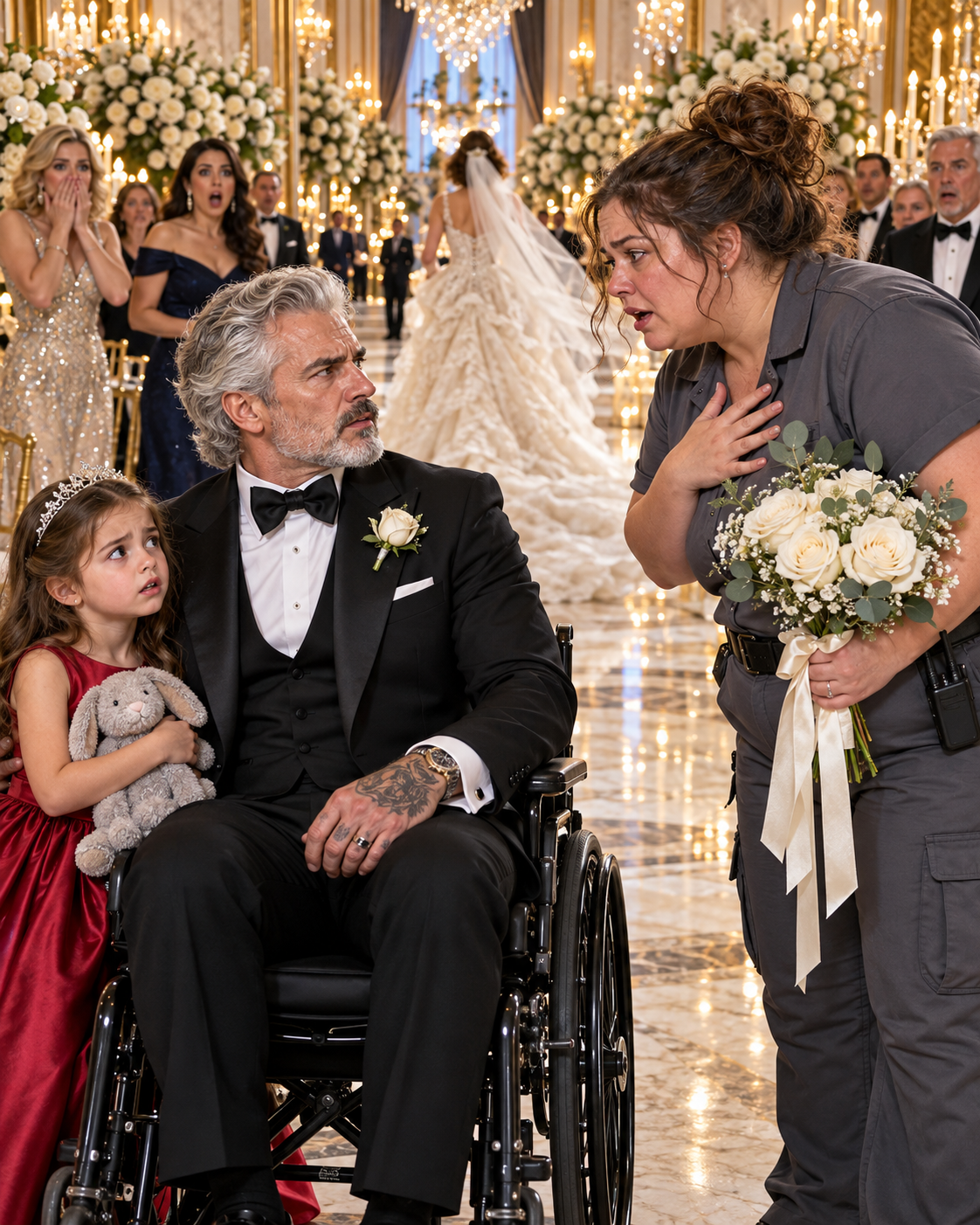
From the doorway of the library, Salvatore watched the exchange.
He wore a charcoal sweater instead of his usual tailored suit.
Without the armor of the boardroom, he seemed different.
Less intimidating.
More tired.
Dinner began awkwardly.
Salvatore asked about Margo’s work, and she answered without trying to make it sound more impressive than it was.
She explained how she repaired electrical panels, replaced broken pumps, and occasionally rescued employees who managed to lock themselves inside storage rooms.
Amelia laughed so hard at one particular story that she spilled water across the table.
Instead of scolding her, Salvatore laughed too.
It surprised everyone, including himself.
Later, while Amelia watched a movie with the housekeeper, Margo and Salvatore sat near the library fireplace.
For several minutes, neither spoke.
Then Salvatore broke the silence.
“Why did you sit beside me?”
Margo looked up.
“At the wedding?”
“Yes.”
She considered the question.
“Because everybody was looking at you, but nobody seemed willing to actually see you.”
Salvatore stared into the fire.
“Most people are uncomfortable with what happened to me.”
“Most people are uncomfortable with anything that reminds them life can change.”
“And you aren’t?”
“Of course I am.”
He looked at her.
Margo smiled faintly.
“I’m just more afraid of becoming the kind of person who walks past someone because helping might feel awkward.”
Something shifted in Salvatore’s expression.
For months, people had spoken to him as though his accident had erased the man he had been.
Doctors discussed his limitations.
Business partners questioned his judgment.
Friends offered exaggerated encouragement.
Even his former fiancée had treated his future as a burden.
Margo did none of those things.
She spoke to him directly.
She challenged him when he sounded arrogant.
And she never once suggested that his wheelchair made him less worthy of respect.
Before she left, Amelia appeared carrying a drawing.
It showed three people beneath a bright yellow sun.
One was a little girl.
One was a man in a wheelchair.
The third was a smiling woman wearing oversized work boots.
At the top, in uneven purple letters, Amelia had written:
“THE PEOPLE WHO STAY.”
Margo felt her throat tighten.
Salvatore stared at the drawing for a long time.
Then he carefully placed it on his desk.
Neither adult knew what to say.
Three days later, the trouble began.
An investigative report appeared in a Buffalo business publication, accusing Bellecosta Holdings of concealing millions of dollars in financial losses.
Anonymous sources claimed that Salvatore’s accident had left him incapable of overseeing the company.
By lunchtime, several major investors had demanded explanations.
By evening, Richard Caldwell was publicly calling for an independent leadership transition.
Salvatore knew the timing was no coincidence.
He ordered Eleanor to examine the company’s financial records.
What she discovered was alarming.
Several contracts had been approved using digital authorization credentials linked to Salvatore’s office.
But the approvals had occurred during the months he was hospitalized after his accident.
Someone had used his name.
Someone had moved money through subsidiaries he barely recognized.
And someone had been building a paper trail designed to make him responsible.
The deeper Eleanor investigated, the more disturbing the pattern became.
The missing funds had passed through a construction firm registered in Delaware.
That firm had transferred money to a consulting company operating out of Manhattan.
The consulting company belonged to Dominic Rinaldi.
The betrayal was no longer a suspicion.
It was a carefully organized attempt to destroy Salvatore’s reputation and take control of his company.
But proving it would be another matter.
Richard had access to financial records, legal advisers, and several board members who were already nervous about the company’s future.
Meanwhile, Salvatore’s personal history complicated everything.
For years, he had allowed his underworld reputation to protect his business interests.
Now that same reputation made investors reluctant to believe his innocence.
One afternoon, Eleanor entered his office carrying a thick folder.
“There’s something else.”
Salvatore looked up.
“Tell me.”
“The accident.”
His expression hardened.
“What about it?”
Eleanor placed a maintenance report on the desk.
“The insurance investigators recently recovered additional documentation from the vehicle inspection.”
Salvatore said nothing.
“The braking system showed signs of tampering.”
The room seemed to become colder.
His accident had occurred on a rainy stretch of highway outside Rochester.
He remembered headlights, the sudden failure of the brakes, and the terrible sound of metal striking concrete.
Then darkness.
When he woke up in the hospital, doctors explained that the spinal injuries would permanently change his mobility.
He had spent months learning how to live in a body that no longer obeyed him the way it once had.
And now Eleanor was suggesting that the accident might not have been accidental.
“Who knew about this report?”
“We don’t know yet.”
Salvatore looked toward Amelia’s drawing hanging beside his desk.
For the first time, his anger gave way to genuine fear.
If someone had deliberately endangered him, what might that person do next?
That evening, he canceled dinner with Margo.
He told Vincent to increase security around the estate.
And he instructed Amelia’s school to release her only to approved family staff.
Margo received a short message.
Something has come up. I think it’s best if you stay away for a while.
She read it twice.
Then she put down her phone.
She understood that Salvatore’s world contained dangers he had never fully explained.
But she also recognized the unmistakable sound of someone pushing others away before they could choose to leave.
She did not respond immediately.
Instead, she finished repairing a broken ventilation motor at the venue.
Then she sent one sentence.
You don’t get to decide what I’m capable of understanding without telling me the truth.
Salvatore stared at the message for nearly ten minutes.
He almost smiled.
Then he called her.
Their conversation lasted over an hour.
He told her about Dominic, Richard, and the suspicious contracts.
He explained that the accident might have been more than a mechanical failure.
And he admitted something that cost him more pride than any business defeat ever had.
“I’m frightened for Amelia.”
Margo listened quietly.
Then she said, “Being frightened doesn’t make you weak, Salvatore. Pretending you aren’t frightened can make you careless.”
He closed his eyes.
No one had spoken to him that way in years.
“What would you do?”
“I’d stop trying to handle everything alone.”
That answer stayed with him.
The next morning, Salvatore did something his associates found astonishing.
He contacted federal investigators through Eleanor and authorized an independent forensic review of Bellecosta Holdings.
He also disclosed the company’s questionable historical relationships, including his own involvement in transactions that required scrutiny.
Eleanor warned him that cooperating could expose him to serious consequences.
Salvatore understood.
But he had finally realized that protecting his daughter meant ending the cycle of secrets that had shaped his life.
For too long, he had mistaken control for security.
Now he needed the truth.
The investigation moved quickly.
Digital records revealed that Richard’s office had issued several suspicious authorizations.
Banking information linked the payments to Dominic’s companies.
Security footage placed Dominic near the corporate headquarters on multiple occasions.
And the recovered vehicle records opened a separate inquiry into the accident.
Then the most unexpected witness came forward.
It was Salvatore’s former fiancée, Vanessa Whitmore.
She requested a private meeting with Eleanor.
At first, Salvatore refused to see her.
But Eleanor insisted that Vanessa possessed information they could not ignore.
They met in a conference room overlooking downtown Buffalo.
Vanessa looked nothing like the confident bride who had abandoned him.
Her hands trembled around a paper cup of coffee.
“I need you to know I didn’t understand everything,” she began.
Salvatore remained silent.
Vanessa explained that Richard had approached her months before the wedding.
He had repeatedly told her that Salvatore’s condition would worsen and that his financial position was unstable.
He had encouraged her to reconsider the marriage.
At first, she assumed he was simply offering advice.
But shortly before the ceremony, Richard had warned her that marrying Salvatore could expose her to financial investigations.
“He told me I would lose everything,” she whispered.
Salvatore looked at her steadily.
“So you decided to leave me in front of two hundred people.”
Tears filled her eyes.
“I was scared.”
“You could have spoken to me privately.”
“I know.”
“You could have asked questions.”
“I know.”
He waited.
Vanessa lowered her head.
“And I was ashamed of the life I thought I would have.”
The admission hung between them.
Salvatore felt the familiar pain return, but it no longer controlled him.
“I won’t pretend that didn’t hurt,” he said. “But I’m not going to spend the rest of my life proving that you should have stayed.”
Vanessa began crying.
Then she reached into her handbag and removed her phone.
Richard had sent her several messages before the wedding.
One instructed her to make her decision publicly.
Another suggested that a visible separation would help the board demonstrate instability in Salvatore’s personal judgment.
Vanessa had not known the full purpose of those instructions.
But she had followed them.
Eleanor immediately preserved the messages as evidence.
When Vanessa left, Salvatore remained seated by the window.
He expected to feel triumphant.
Instead, he felt strangely relieved.
He finally understood that Vanessa’s decision reflected her fears and choices, not his worth.
The following week, Richard Caldwell was removed from his executive position pending the independent investigation.
Dominic Rinaldi was located outside Philadelphia and questioned by federal authorities.
Investigators uncovered evidence tying their business arrangements to fraudulent transfers.
The inquiry into the vehicle tampering remained separate, and officials refused to announce conclusions before completing their work.
Salvatore resisted the temptation to use the old methods that had once made him feared.
He wanted accountability established through evidence, not another cycle of intimidation.
But the struggle was far from over.
At an emergency shareholder meeting, several directors argued that Salvatore’s past made him unsuitable to remain chairman.
They were not entirely wrong to question his leadership.
The company needed more than one man’s reputation to survive.
So Salvatore stood before them in his wheelchair and made an announcement nobody had expected.
“I built this organization believing strength meant never allowing anyone to see uncertainty.”
He paused.
“That belief helped create a company where people were afraid to question me.”
A few directors shifted uncomfortably.
“I won’t defend every decision I’ve made. Some of them deserve scrutiny.”
He looked around the room.
“But my disability is not evidence that I lack judgment, and my accident does not erase my ability to lead.”
He announced that he would temporarily step aside from day-to-day executive authority while the investigation continued.
An independent board committee would oversee reforms, financial transparency, and leadership appointments.
He would remain a shareholder and participate through appropriate governance channels, subject to the investigation’s findings.
For some, the decision looked like surrender.
For Salvatore, it was the first truly responsible act of leadership he had made in years.
That evening, he returned home exhausted.
Amelia was waiting in the library with Margo.
The little girl had constructed an enormous cardboard castle across the carpet.
Margo was trying to repair one of its towers with tape.
Salvatore stopped in the doorway.
“What happened here?”
Amelia looked up solemnly.
“The kingdom is having construction problems.”
Margo held up a damaged cardboard wall.
“Apparently the royal engineer has been overworked.”
Salvatore laughed.
It was a deep, genuine laugh that surprised even Vincent standing behind him.
Amelia climbed onto the sofa and announced that the castle needed a new leader.
Salvatore looked toward Margo.
“Any suggestions?”
She smiled.
“Someone who listens to the people building it.”
Amelia immediately raised her hand.
“I nominate myself.”
And for the first time in months, the Bellecosta house filled with laughter rather than tension.
As autumn turned toward winter, Margo became part of their lives in ways none of them had planned.
She still worked at the venue.
She still repaired machinery and argued with suppliers about overpriced replacement parts.
She refused every attempt Salvatore made to quietly pay her bills.
When he offered to arrange a higher-paying position, she shook her head.
“I want you to respect what I do, not rescue me from it.”
Salvatore accepted that.
Instead of trying to change her circumstances without permission, he began asking what she actually wanted.
Margo admitted that she dreamed of opening a small maintenance and accessibility consulting business.
She wanted to help older buildings become safer and more welcoming for people with disabilities.
The idea had grown from years of watching businesses spend fortunes on decoration while neglecting basic accessibility.
Salvatore listened with genuine interest.
He introduced her to an independent business adviser, but made clear that any future venture would belong entirely to her.
Margo attended evening business classes at a community college outside Buffalo.
She studied contracts, budgeting, and building regulations.
And when the venue management company finally offered her a promotion, she negotiated her salary with the confidence of someone beginning to recognize her own value.
Salvatore admired her determination.
But what drew him closest was something far simpler.
Margo never expected him to be powerful.
She expected him to be present.
She challenged his impatience.
She noticed when he was exhausted.
She asked before helping with physical tasks rather than assuming he needed assistance.
And she understood that independence was not the same as doing everything without support.
One snowy evening in December, they sat beside the library fireplace after Amelia had gone to bed.
Outside, the gardens were covered in white.
Salvatore watched Margo reading a business textbook with a pencil tucked behind her ear.
“I used to think my life ended on that highway,” he said.
Margo closed the book.
“What changed?”
He considered the question.
“Amelia kept needing her father, even when I didn’t know how to be the father she remembered.”
Margo waited.
“And then a woman in work boots sat beside me at the worst wedding in American history.”
She burst into laughter.
“That’s a bold claim. I’ve seen some terrible weddings.”
Salvatore smiled.
“I thought she might leave once she discovered how complicated my life was.”
“And?”
“She turned out to be even more stubborn than I am.”
Margo looked at him thoughtfully.
“Salvatore, I didn’t stay because I thought you needed saving.”
“I know.”
“I stayed because I liked the person you were willing to become.”
He reached for her hand.
This time, she let him hold it.
Their relationship developed slowly.
There were no dramatic declarations in expensive restaurants and no extravagant gifts designed to replace honest conversation.
They spoke openly about his past.
Margo made clear that she could not build a future around secrecy, intimidation, or illegal business.
Salvatore did not ask her to ignore the consequences of his former life.
He committed to facing them.
Months later, the investigations produced their first major public results.
Richard Caldwell and Dominic Rinaldi faced financial fraud charges connected to the diverted company funds.
Additional evidence supported charges related to efforts to interfere with the investigation.
The vehicle-tampering inquiry eventually identified a mechanic who had been paid to alter the braking system.
Investigators traced the payment through an intermediary linked to Dominic.
Salvatore had suspected betrayal.
Now there was evidence supporting a much darker truth.
The case proceeded through the courts, with testimony, financial records, and independent forensic findings.
When the proceedings concluded, Richard and Dominic were convicted of major financial offenses and conspiracy-related charges, while the evidence concerning the vehicle attack was addressed through the applicable criminal proceedings.
Salvatore also faced examination of his own historical conduct.
Some matters resulted in penalties and enforceable compliance obligations.
He accepted responsibility for what the evidence established rather than using his influence to escape scrutiny.
It was not a perfect ending.
Real accountability rarely is.
But the company began recovering under independent oversight, and its employees finally had protections against the culture of fear that had governed it for years.
Salvatore no longer measured success by how many people obeyed him.
He began measuring it by how many people could safely disagree.
By the following spring, Margo had launched her own small company.
Its first major project involved improving accessibility at an older community center in Buffalo.
The center served children, seniors, and people recovering from injuries.
Margo supervised the installation of automatic doors, accessible restrooms, improved pathways, and properly designed seating areas.
She insisted on consulting people who would actually use the building.
Salvatore attended the opening ceremony with Amelia.
He did not fund the entire project or attach his name to the entrance.
He simply came to support Margo.
Amelia proudly carried a handmade sign that read:
“MY FRIEND FIXES THINGS.”
Margo laughed when she saw it.
Then she knelt beside the little girl.
“Some things,” she said gently, “are better fixed by people working together.”
Amelia considered this.
“Like families?”
Margo felt her eyes sting.
“Yes, sweetheart. Sometimes exactly like families.”
A year after the abandoned wedding, Salvatore invited Margo back to the same venue where they had first met.
She assumed he wanted to celebrate the anniversary of their unlikely friendship.
Instead, she discovered that he had reserved the smallest room in the building.
There were no chandeliers blazing above hundreds of guests.
No orchestra.
No towering floral arrangements.
Just a table beside a window overlooking the gardens, a modest chocolate cake, and three chairs.
Amelia was already waiting.
Margo looked around with amusement.
“Did the billionaire chairman finally learn how to plan something inexpensive?”
Salvatore smiled.
“I had an excellent teacher.”
They shared dinner and talked about the past year.
Amelia told stories about school.
Margo described her latest renovation project.
Salvatore spoke about the community partnerships he hoped to support through a new, independently managed charitable foundation.
Then Amelia stood.
“I have something important to say.”
Both adults turned toward her.
She reached into her pocket and pulled out the old drawing from the library.
The paper had been carefully laminated.
It still showed the three of them beneath a yellow sun.
“The people who stay,” Amelia read proudly.
She handed it to Margo.
“I made this because you sat with Daddy when he was sad.”
Margo swallowed hard.
“But now I want to make a new one.”
“Why?” Salvatore asked.
Amelia smiled.
“Because we’re happy too.”
Salvatore reached for Margo’s hand.
“Margo, I spent years believing love was something I had to earn by being successful, impressive, and impossible to hurt.”
His voice softened.
“When the accident took away the life I recognized, I thought it had taken away the possibility of being loved without conditions.”
Margo listened, tears gathering in her eyes.
“You never treated me as a tragedy,” he continued.
“You never pretended I was perfect. And you never asked me to become someone else just to deserve a place beside you.”
He opened a small velvet box.
Inside was a simple ring.
No enormous diamond.
No attempt to impress a ballroom filled with strangers.
Just a symbol of a promise he finally understood.
“I won’t promise you a life without difficult days,” he said.
“But I can promise honesty, respect, and the willingness to keep choosing each other through them.”
Margo looked at the ring.
Then at Amelia.
Then at the man who had once sat alone before two hundred people.
“Salvatore,” she whispered, “I don’t need you to promise me perfection.”
He waited.
“I need you to keep being the man who knows love isn’t ownership, and that strength doesn’t mean hiding every weakness.”
He nodded.
“And I need you to understand something.”
“What?”
“I’ve never been waiting for someone to give my life meaning. My life already has meaning.”
Salvatore smiled.
“I know.”
“But I’d love to share it with you.”
Amelia squealed before Margo could finish saying yes.
She threw her arms around both of them, nearly knocking the little ring box onto the floor.
They laughed through their tears.
And in the quiet room where everything had once fallen apart, something entirely different began.
Their wedding took place several months later at a lakeside garden overlooking Lake Erie.
There were no two hundred guests.
Only close friends, family, and people who had stood beside them through the difficult months.
Margo wore a beautiful ivory dress that celebrated her body exactly as it was.
Salvatore wore a navy suit and sat proudly in his wheelchair, his daughter standing beside him.
Amelia carried the rings.
Vincent stood nearby, pretending he wasn’t emotional.
Even Dennis Harper attended, proudly telling anyone who would listen that he had always known Margo was extraordinary.
When the ceremony began, Salvatore looked at the woman approaching him.
He remembered the first wedding.
The whispers.
The humiliation.
The crushing loneliness.
He remembered the moment he believed he had lost everything that made him worthy of love.
Then he remembered a plain wooden chair being pulled beside his wheelchair.
And a woman who had asked for nothing except the right to sit there.
When Margo reached him, she took his hands.
The officiant spoke about commitment, kindness, and the courage required to love another person without trying to control them.
Salvatore made his vows.
Margo made hers.
Neither promised that life would always be easy.
They promised to face it truthfully.
And when they kissed, Amelia clapped louder than anyone.
As the sun lowered over Lake Erie, guests gathered for photographs.
Margo noticed that Salvatore had become unusually quiet.
“What are you thinking?” she asked.
He looked across the garden at the people laughing together.
“About how differently this all could have ended.”
Margo squeezed his hand.
“It still could have been a good life, even if we’d never met.”
He nodded.
“You’re right.”
Then he smiled.
“But I’m grateful we did.”
Years later, people in Buffalo still talked about the unusual story of Salvatore Bellecosta and Margo Fields.
Some remembered the spectacular wedding that had ended in embarrassment.
Others remembered the corporate scandal that shook one of Western New York’s most influential companies.
But those who knew the family best remembered something quieter.
They remembered Salvatore attending Amelia’s school performances, listening rather than commanding.
They remembered Margo building a successful business that made public spaces more accessible.
They remembered a little girl growing up in a home where love was expressed through patience, honesty, and ordinary acts of care.
And they remembered the wooden chair.
Margo kept it in a small reading room at their house.
It wasn’t expensive or particularly beautiful.
One of its legs had required repair, and the varnish had faded.
Visitors sometimes wondered why it had been preserved.
Amelia, now older, always knew the answer.
“That chair changed our family,” she would explain.
But Margo would gently correct her.
“No, sweetheart. The chair didn’t change anything by itself.”
She would look toward Salvatore, who was often nearby reading or listening to their conversation.
“What changed everything was the decision to see another person with dignity when the world was too busy judging.”
And Salvatore, the man who had once believed power was the only protection worth having, understood the truth better than anyone.
His greatest transformation had not been learning to walk again.
He had never needed to walk to become whole.
It had been learning to live without allowing fear, pride, or other people’s expectations to decide his worth.
He had learned that accountability mattered more than reputation.
That love could not be purchased or demanded.
That a person’s body did not determine their value.
And that sometimes the bravest people in a room were not those who spoke the loudest.
They were the ones willing to sit beside someone when silence became uncomfortable.
Because the most meaningful love stories do not begin when two perfect people find each other.
They begin when two imperfect people recognize each other’s humanity and choose to build something honest together.
Salvatore once had a ballroom full of people who admired his power, yet he had never felt more alone.
Then one ordinary woman pulled up a chair, offered him respect without pity, and reminded him that his life still held possibilities he could not yet see.
She did not save him.
She gave him room to find his own way forward.
And together, they discovered something far more valuable than the wealth, influence, or admiration he had spent his former life chasing.
A home where no one had to be powerful to be loved.
A family where no one had to be perfect to belong.
And a future built not on the promise that nobody would ever leave, but on the daily decision to treat one another with kindness, dignity, and truth.
THE END.