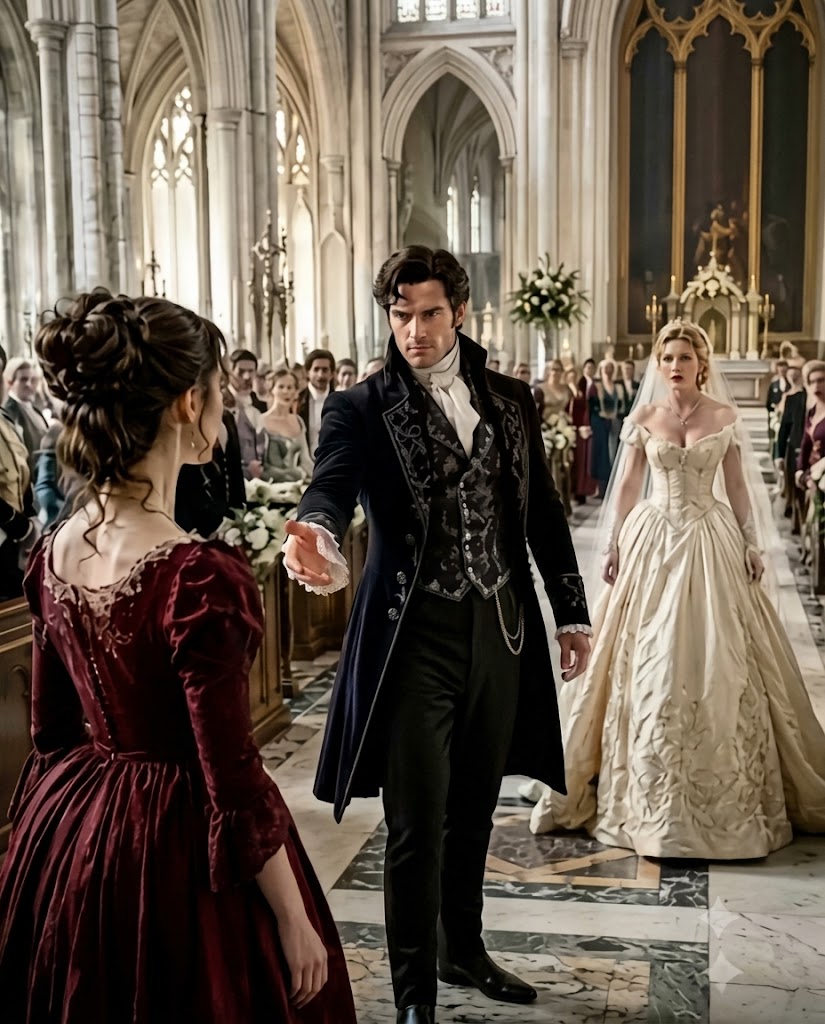
The bride standing beside the Duke was not the woman he had chosen.
Arthur reached for the ledger, but Beatrice did not let go.
For a moment, neither of them moved.
The fire crackled behind them.
Outside, the wind pressed against the tall windows of Ashcraftoft, carrying the distant cry of something wild across the moors.
“Tell me,” Beatrice said again.
Arthur’s eyes remained on the signature.
“Your father invested money in Ashcraftoft twelve years ago.”
“My father?”
“Yes.”
“That makes no sense.”
“It did at the time.”
Arthur finally pulled the ledger from her hands and opened it to the next page.
“He claimed the investment was a private loan. Your family received shares in several of my northern properties. In return, your father promised to provide capital for repairs, tenant housing, and the expansion of the wool mills.”
Beatrice frowned.
“My father never had that kind of money.”
“No,” Arthur said quietly. “He didn’t.”
She looked at him.
“Then where did it come from?”
Arthur turned another page.
“From my estate.”
The words struck her harder than she expected.
Beatrice stared at him.
“You mean Ashcraftoft paid my father?”
“Not exactly.”
Arthur walked to the desk and removed a second ledger from a locked cabinet.
“This is the original account.”
He placed it beside the first.
Beatrice opened it.
The numbers were different.
Entire payments had vanished from the family records.
Funds had been transferred from Ashcraftoft to companies Beatrice had never heard of, then redirected to her father’s accounts.
She traced one column with her finger.
“This is fraud.”
Arthur nodded.
“On a considerable scale.”
“And you knew?”
“I suspected.”
“Suspected my father?”
“I suspected the accounts.”
Beatrice closed her eyes for a moment.
She thought of her father’s quiet voice at breakfast.
Her mother’s carefully chosen words.
Charlotte’s sudden engagement to Arthur.
The hurried wedding.
The strange insistence that Beatrice remain away from the church.
Everything suddenly seemed connected.
She opened her eyes.
“The marriage.”
Arthur said nothing.
“My family arranged Charlotte’s marriage to you because of this.”
“Yes.”
“But you knew Charlotte wasn’t the woman who had been corresponding with you.”
“I knew.”
Beatrice’s face tightened.
“Then why did you let the ceremony begin?”
“Because I wanted to see who would panic when I stopped it.”
She looked at him sharply.
“And who panicked?”
“Your father.”
The answer came without hesitation.
Beatrice stepped away from the desk.
Her heart was beating too quickly.
“What does my father have to fear?”
Arthur closed the ledger.
“Three days ago, one of my former clerks disappeared.”
She stared at him.
“What?”
“He had discovered the missing payments.”
“Where is he?”
“I don’t know.”
“And you think my father had something to do with it?”
“I think someone wanted him silent.”
A chill moved through her.
“Arthur.”
He came closer.
“You should leave this matter alone.”
She almost laughed.
“You married me because you needed the truth, and now you’re telling me not to look for it?”
“I married you because I thought you were brave.”
“And?”
His expression softened for the first time.
“I am beginning to realize I may have underestimated you.”
Before she could answer, a sharp knock sounded at the door.
Both turned.
The door opened.
An old servant stood there, pale and breathless.
“Your Grace.”
Arthur straightened.
“What is it?”
“There was a fire in the west barn.”
Arthur’s face changed.
“How long ago?”
“Minutes.”
He was already moving.
Beatrice followed.
They crossed the stone corridors and ran into the courtyard.
Smoke was rising beyond the stables.
Men were shouting.
Buckets passed from hand to hand as flames consumed the old barn.
Arthur grabbed a lantern.
“Keep everyone away from the north wall!”
Beatrice stopped.
The north wall.
Her eyes narrowed.
“Arthur.”
He looked back.
“What?”
“That is where the old records are kept.”
He swore under his breath.
They ran.
The barn doors were already burning.
Arthur kicked one open.
Heat struck them.
Beatrice pulled her sleeve over her mouth.
Inside, wooden crates had been stacked against the far wall.
Records.
Dozens of them.
Arthur pushed through the smoke.
“Stay here.”
“No.”
“Beatrice—”
“I know what we’re looking for.”
She grabbed the nearest crate.
“Help me.”
Together they dragged it toward the entrance.
A beam cracked overhead.
Arthur looked up.
“Out!”
They barely reached the doorway before the roof collapsed behind them.
The explosion of sparks sent everyone stumbling backward.
For several seconds, there was only fire.
Then Beatrice noticed something on the ground.
A metal box.
It had been thrown clear by the collapse.
She crouched and picked it up.
The lock had been broken.
Inside lay several letters.
One bore her father’s seal.
Another bore the seal of the Earl of Ravenscroft.
And the third had Arthur’s name written across the front.
Arthur took it.
His face became unreadable.
“What does it say?”
He opened the letter.
His eyes moved slowly across the page.
Then he handed it to her.
Beatrice read.
Your Grace,
If the accounts are ever discovered, you must understand that the money was not stolen for personal gain.
It was payment.
Your father and Ravenscroft were instructed to move the funds into a private trust until the Westland succession was secured.
The woman who controls the trust will determine who controls Ashcraftoft.
Beatrice read the final line twice.
The woman who controls the trust will determine who controls Ashcraftoft.
Her blood ran cold.
“Who is the woman?”
Arthur took the letter.
“The letter doesn’t say.”
“Then why mention her?”
“Because someone expected us to know.”
A sound came from behind them.
Footsteps.
Arthur turned.
A shadow moved between the trees.
“Stop!”
He ran after it.
Beatrice followed as far as the garden wall.
The figure disappeared into the darkness.
Arthur returned several minutes later, breathing hard.
“Nothing.”
Beatrice looked toward the burning barn.
“This wasn’t about destroying the records.”
Arthur looked at her.
“It was a warning.”
“No.”
She held up the letter.
“They wanted us to find this.”
Arthur’s expression darkened.
“Then someone wants us to follow the trail.”
“And we will.”
He stared at her for a long moment.
Then he nodded.
The next morning, Beatrice went to London.
Arthur insisted on accompanying her.
They traveled under assumed names, leaving Ashcraftoft before dawn.
Neither spoke much during the journey.
But as the carriage crossed the mist-covered roads, Beatrice kept thinking about one question.
Who was the woman?
By noon, they arrived at the townhouse of Arthur’s former solicitor, Mr. Edmund Vale.
He was an elderly man with silver hair and nervous hands.
When Arthur told him what they had found, Vale went pale.
“I prayed this day would never come.”
Beatrice stepped forward.
“You know about the trust.”
Vale looked at her.
“I know who created it.”
“Who?”
“Your grandmother.”
Beatrice froze.
“My grandmother died before I was born.”
“She left instructions.”
“Why?”
Vale glanced toward Arthur.
“Because she knew your father could not be trusted.”
The room fell silent.
“My father?”
“Your grandmother believed he was using the family name to conceal debts. She established a private trust in your mother’s name.”
Beatrice stared at him.
“My mother’s?”
“Yes.”
“Then why does the letter say the woman who controls the trust determines who controls Ashcraftoft?”
Vale hesitated.
“Because your mother was not the final beneficiary.”
Beatrice felt a strange pressure in her chest.
“Who was?”
Vale reached into a drawer and removed an old document.
He placed it before her.
Beatrice read the name.
Her hands began to tremble.
“Me.”
Vale nodded.
“Your grandmother named you.”
Arthur looked at her.
“She knew.”
“Knew what?”
“That you were the only person in the family she believed would protect the estate.”
Beatrice looked down at the document.
Suddenly, memories returned.
Her grandmother taking her hand when she was a child.
Telling her never to sign anything she did not understand.
Teaching her how to read numbers before she was old enough to understand why.
Her mother always saying that such things were not suitable for a young lady.
Her father laughing when Beatrice questioned the household accounts.
“You have your grandmother’s mind,” he had once said.
But he had not sounded proud.
He had sounded afraid.
Beatrice looked up.
“My family knew.”
Vale nodded.
“Your father discovered the trust several years ago. He tried to have it dissolved.”
“And failed.”
“Because your grandmother had placed a condition upon it.”
“What condition?”
Vale’s eyes moved toward Arthur.
“The trust could only be transferred to a husband chosen by you.”
Beatrice went still.
Arthur said nothing.
She looked at him.
“So that is why.”
“Yes.”
“My father arranged Charlotte’s marriage to you.”
“Yes.”
“But Charlotte could not inherit the trust.”
“No.”
“So they planned to use her marriage to control me.”
Vale nodded.
“Once Charlotte became your sister-in-law, your father intended to pressure you into signing the trust over.”
Beatrice’s face hardened.
“And if I refused?”
Vale lowered his eyes.
“He intended to declare you mentally incapable of managing the inheritance.”
Arthur’s jaw tightened.
“They would have locked her away.”
“Yes.”
Beatrice sat down.
For the first time, the truth felt larger than anger.
Her family had not merely stolen her wedding.
They had tried to erase her future.
And they had used Charlotte to do it.
“Where is my mother?” Beatrice asked.
Vale looked surprised.
“She was supposed to be here.”
“Was?”
“She came to London three days ago.”
Arthur and Beatrice exchanged a glance.
“Where did she go?”
Vale’s face changed.
“She received a message the night before the wedding.”
“From whom?”
“I don’t know.”
Arthur stood.
“We find her.”
They searched every address they knew.
Nothing.
Until late that evening, a message arrived at the townhouse.
One sentence.
Come to the old chapel at midnight.
Come alone.
Beatrice read it twice.
Arthur reached for the paper.
“No.”
She pulled it away.
“I am going.”
“Not alone.”
“It says alone.”
“I don’t care.”
She looked at him.
“You cannot protect me by locking me in a room.”
His expression tightened.
“I can protect you by keeping you alive.”
“And if my mother is in danger?”
That silenced him.
At midnight, Beatrice entered the abandoned chapel alone.
Moonlight spilled through broken windows.
Rows of empty pews stretched into darkness.
Then a voice came from behind the altar.
“You should never have married him.”
Beatrice stopped.
Her mother stepped into the light.
She looked older than she had that morning.
Tired.
Frightened.
And ashamed.
“Mother.”
“I tried to stop them.”
“Who?”
“Your father. Ravenscroft. They believed they could control the trust through Charlotte.”
Beatrice’s voice trembled.
“You knew?”
“I knew enough.”
“You let me walk into that church believing I had been forgotten.”
Her mother’s eyes filled with tears.
“I thought I was protecting you.”
“You were protecting yourself.”
The words landed like a blow.
Her mother looked down.
“Yes.”
Beatrice’s anger faltered.
“Where is Father?”
Her mother closed her eyes.
“At Ravenscroft House.”
“Why?”
“Because he discovered that the trust has another condition.”
Beatrice felt dread rising again.
“What condition?”
Her mother looked directly at her.
“The trust cannot be activated unless the Duchess of Westland proves that the estate is solvent.”
Beatrice understood immediately.
“They destroyed the accounts.”
“Yes.”
“And if the estate appears bankrupt, I lose everything.”
“Your father arranged the debt.”
“How?”
“By borrowing against Ashcraftoft through false companies.”
Beatrice’s mind raced.
The missing payments.
The erased pages.
The fake companies.
The disappearing clerk.
The fire.
It was all connected.
Her mother stepped closer.
“Your father plans to present the evidence at the court hearing tomorrow.”
“What hearing?”
“The hearing to determine whether Ashcraftoft must be sold to pay its debts.”
Beatrice’s blood turned cold.
“When?”
“Ten in the morning.”
“We have twelve hours.”
Her mother shook her head.
“No.”
She reached into her cloak.
“We have less.”
She handed Beatrice a small brass key.
“What is this?”
“The final ledger.”
Beatrice stared at it.
“Where?”
“Under the old chapel.”
A noise sounded outside.
Her mother froze.
“They followed me.”
Arthur stepped from the shadows.
Beatrice turned sharply.
“You said you would stay behind.”
“I lied.”
Her mother almost smiled despite herself.
“Your husband has your grandmother’s stubbornness.”
Arthur approached.
“Who is outside?”
“Ravenscroft’s men.”
Arthur drew his pistol.
“Then we leave through the crypt.”
They ran.
The chapel doors burst open behind them.
Men shouted.
Arthur pushed Beatrice down the narrow stone staircase.
Her mother followed.
They descended into darkness.
At the bottom stood an iron door.
Beatrice inserted the brass key.
The lock clicked.
Inside was a hidden chamber.
There were no treasures.
No gold.
Only shelves of books.
And in the center, one large black ledger.
Beatrice opened it.
Every missing payment was recorded.
Every false company.
Every signature.
Every transfer.
At the end was a list of names.
Her father’s.
Ravenscroft’s.
And several bankers.
But one name appeared beside every major transaction.
Charlotte.
Beatrice stopped breathing.
“No.”
Arthur took the ledger.
“Wait.”
“She knew.”
“Perhaps.”
“Arthur, she knew.”
A voice came from the doorway.
“Yes.”
Charlotte stood there.
Her wedding dress was gone.
She wore a dark traveling coat.
Her face was pale.
But her eyes were steady.
Beatrice stared at her sister.
“You.”
Charlotte swallowed.
“I never wanted your life.”
“You helped them steal it.”
“I was afraid.”
“So was I.”
“I know.”
Charlotte stepped into the room.
“I thought if I married Arthur, Father would finally stop. He told me you would be sent away if I refused.”
Beatrice’s anger burned.
“And you believed him?”
“I was nineteen.”
“So was I when they first taught me that my opinions didn’t matter.”
Charlotte looked down.
“I was wrong.”
Silence filled the chamber.
Then Charlotte reached into her coat.
“I brought something.”
She placed several documents on the table.
“These are the original contracts. Father made me sign copies so he could claim I had agreed to the arrangement.”
Arthur examined them.
“These are enough to expose him.”
Charlotte shook her head.
“Not without the bank records.”
Beatrice closed the ledger.
“Then we get them.”
Arthur looked at the clock.
“Six hours.”
They worked through the night.
Vale obtained the bank statements.
Charlotte gave testimony.
Beatrice reconstructed every transaction from the missing ledger.
Arthur gathered the tenants who had been cheated by the false accounts.
By sunrise, the truth was no longer a suspicion.
It was a mountain of evidence.
At ten o’clock, they entered the courtroom.
Her father stood at the front.
He looked confident.
Ravenscroft sat beside him.
When Beatrice walked in, her father smiled.
Then he saw Arthur.
The smile disappeared.
“You were never supposed to marry him,” he whispered.
Beatrice walked past him.
“No.”
She stopped.
“I was supposed to disappear.”
Her father stiffened.
“You don’t understand what you’re doing.”
“For the first time in my life,” Beatrice said, “I understand perfectly.”
The hearing began.
Her father presented the estate accounts.
He claimed Ashcraftoft was drowning in debt.
Then Beatrice stood.
She placed the black ledger before the court.
The room erupted in whispers.
One by one, the false accounts were exposed.
Then came the bank statements.
Then the contracts.
Then Charlotte’s testimony.
Finally, Beatrice’s mother entered the courtroom.
She testified against her husband.
The last blow came from Arthur.
He produced the letter found after the fire.
The court demanded to know who had ordered the money transfers.
Ravenscroft tried to leave.
He was stopped at the door.
Her father said nothing.
For the first time, Beatrice saw him not as the powerful man who had controlled her childhood, but as a frightened man standing before the consequences of his own choices.
The estate was not sold.
The trust was activated.
Ashcraftoft remained in Beatrice’s hands.
But she did something no one expected.
She refused to keep the estate exactly as it was.
She opened the books.
She dismissed the corrupt managers.
She restored the tenants whose names had been crossed out.
She ordered the abandoned cottages repaired.
She created a fund for the workers’ children.
And she returned every payment that could be proven to have been stolen from them.
When Arthur asked why, she answered simply.
“Because an estate is not made valuable by how much it owns.”
She looked across the valley from the windows of Ashcraftoft.
“It is valuable because of how many lives it can protect.”
Months passed.
The scandal faded from newspapers.
Her father was convicted.
Ravenscroft lost his title and fortune.
Charlotte left Yorkshire for a time, determined to build a life that belonged to her rather than to their family.
Her mother remained at Ashcraftoft, quieter now, helping Beatrice rebuild what had been broken.
And Arthur?
He never again asked Beatrice to be the wife he had imagined.
Instead, he learned to stand beside the woman she actually was.
One evening, nearly a year after the wedding, Beatrice found him in the library.
He was holding the first ledger.
The same one in which she had written her angry notes months before.
“You kept it,” she said.
Arthur smiled.
“I keep important things.”
She took the book from him.
“You realize half of my comments are insults.”
“Only half?”
She laughed.
It was a sound he had rarely heard in the beginning.
“You married me for the truth,” she said.
“I did.”
“And did you find it?”
Arthur looked at her.
“I found more than I expected.”
“What?”
He stepped closer.
“A woman who refused to become what everyone else wanted.”
Beatrice looked down at the ledger.
“I thought I had lost everything that day at the church.”
“You lost something.”
She raised an eyebrow.
“What?”
“The life your family had planned for you.”
“And gained?”
Arthur took her hand.
“Your own.”
For a while, neither spoke.
Outside, the first snow of winter began falling over Ashcraftoft.
Beatrice watched the white flakes settle over the fields where tenants were now repairing fences, children were running through the lanes, and lights glowed warmly in cottages that had once stood empty.
She remembered the girl she had been.
The quiet daughter.
The inconvenient daughter.
The girl who had been told to keep her opinions to herself.
She had believed power belonged to people who spoke the loudest.
She knew better now.
Sometimes power belonged to the person who kept reading after everyone else stopped.
Sometimes courage was not standing in front of a crowd.
Sometimes it was simply refusing to sign your name to a lie.
And sometimes the life that was stolen from you was not the life you were meant to have at all.
Arthur squeezed her hand.
“Come.”
“Where?”
“The tenants are waiting.”
“For what?”
He smiled.
“The Duchess promised them she would attend the winter feast.”
Beatrice smiled back.
She closed the ledger and placed it on the desk.
The missing pages had been found.
The hidden debts had been exposed.
The truth had finally been given a name.
But she had learned something more important than who had stolen the money.
She had learned that truth was not merely something to uncover.
It was something to choose.
Every day.
In every decision.
And when Beatrice walked down the grand staircase that evening, she did not walk as the daughter of a disgraced man, nor as the replacement bride who had unexpectedly inherited a title.
She walked as herself.
The Duchess of Westland.
Not because a marriage had given her a name.
Not because a trust had given her an estate.
But because, at last, she had stopped asking other people what she was worth.
And Ashcraftoft, once built on secrets, finally became a house built on something stronger.
The truth.
The winter feast began beneath a sky heavy with snow.
For the first time in years, the great hall of Ashcraftoft was filled not with whispered calculations or anxious servants, but with laughter.
Farmers sat beside estate workers.
Children ran between the tables.
Old Mrs. Harlow, whose cottage had nearly been taken from her, raised a glass toward Beatrice.
“To the Duchess.”
A cheer followed.
Beatrice smiled, but she did not drink immediately.
Her eyes wandered across the hall.
Arthur stood near the fireplace, speaking with several tenants.
He looked different now.
Or perhaps she simply saw him differently.
When they had first met, he had seemed like a man carved from winter.
Cold.
Controlled.
Impossible to read.
Now she knew that beneath the sternness lived a man who had spent years carrying responsibilities he had never asked for.
Arthur looked across the room and caught her watching him.
He smiled.
Only slightly.
But it was enough.
Beatrice lifted her glass.
“To Ashcraftoft,” she said.
The hall erupted again.
Yet before the celebration could continue, the great doors opened.
A servant hurried inside.
“Your Grace.”
Beatrice turned.
“What is it?”
The servant held out a letter.
“This arrived from London.”
Arthur approached.
“Who sent it?”
The servant shook his head.
“There is no name.”
Beatrice took the envelope.
The seal was black.
Her smile vanished.
Arthur noticed immediately.
“What is it?”
“I don’t know.”
She broke the seal.
Inside was a single sheet of paper.
There was only one sentence.
You found the ledger, but you never found the first account.
Beatrice’s blood went cold.
Arthur read it over her shoulder.
For several seconds, neither spoke.
Then Arthur took the paper.
“Whoever wrote this knows about the ledger.”
“And knows about my grandmother.”
He looked toward the windows.
“Lock the doors.”
The servants obeyed.
The music stopped.
The feast dissolved into confusion.
Beatrice looked around the hall.
Every face seemed suddenly unfamiliar.
Someone in the room might know more than they had admitted.
Arthur lowered his voice.
“We search the house.”
“For what?”
“The first account.”
Beatrice shook her head.
“My grandmother died more than twenty years ago.”
“Then why would someone claim it still exists?”
“Because they want us to look for it.”
Arthur studied her.
“Or because it does.”
They began with the library.
Every shelf was searched.
Every drawer was opened.
Nothing.
Then Beatrice remembered something.
“The portrait gallery.”
Arthur followed her.
They walked beneath the portraits of generations of Highmiths and Pendletons.
At the end of the corridor hung her grandmother’s portrait.
Beatrice stopped.
Her grandmother’s eyes were painted toward the right.
Toward a small wooden cabinet.
Beatrice opened it.
Nothing.
Arthur frowned.
“Perhaps the portrait was moved.”
“No.”
She touched the frame.
There was a faint line in the wood.
A hidden latch.
She pressed it.
The portrait swung forward.
Behind it was a narrow compartment.
Inside lay a leather-bound book.
Beatrice removed it carefully.
The first account.
Arthur opened it.
The handwriting was unmistakably her grandmother’s.
But the contents were not what they expected.
There were no financial transactions.
Instead, there were names.
Dozens of them.
Politicians.
Bankers.
Landowners.
Judges.
And beside each name were dates and amounts.
Arthur’s face hardened.
“This goes beyond Ashcraftoft.”
Beatrice continued reading.
At the bottom of the final page was a sentence.
If my husband fails, my daughter must hide this book.
If my daughter fails, my granddaughter must expose it.
Beatrice stared at the words.
“She knew.”
Arthur nodded.
“She knew someone would eventually come for it.”
A floorboard creaked behind them.
They turned.
Charlotte stood in the doorway.
Her face was pale.
“I know who sent the letter.”
Beatrice closed the book.
“Who?”
Charlotte swallowed.
“Your father.”
“He’s in prison.”
“I know.”
“Then how?”
“He sent it before the trial.”
Beatrice frowned.
“Why would he?”
Charlotte stepped closer.
“Because he told me there was someone above him.”
Arthur’s eyes narrowed.
“Who?”
Charlotte looked at the old ledger.
“Your grandfather.”
Silence.
Arthur stared at her.
“My grandfather died fifteen years ago.”
“Yes.”
“Then explain.”
Charlotte’s hands trembled.
“Your grandfather wasn’t the man everyone believed him to be.”
Arthur walked toward her.
“What did he do?”
“He created the network that your father later continued.”
Arthur’s face hardened.
“My grandfather was a respected duke.”
“He was also a man who believed power should never be allowed to leave his family.”
Beatrice looked at the book.
“So the accounts were never just about money.”
“No,” Charlotte said.
“They were about control.”
The revelation changed everything.
For generations, the two families had manipulated estates, marriages and debts to preserve influence.
Beatrice’s wedding had not been an isolated betrayal.
It had been the latest move in a game that began long before she was born.
Arthur turned away.
“My entire family.”
Beatrice approached him.
“You didn’t choose what they did.”
“But I benefited from it.”
“Not anymore.”
He looked at her.
“What do you want to do?”
Beatrice held up the book.
“Finish what my grandmother started.”
Arthur nodded.
But before they could act, the doors downstairs slammed open.
Voices echoed through the corridor.
Arthur drew his pistol.
“Stay here.”
“No.”
“Beatrice.”
“I am tired of being told to stay behind.”
He almost smiled.
“Then stay close.”
They descended the staircase.
Three men stood in the entrance hall.
Behind them was a fourth man.
Older.
Elegant.
Dressed in black.
Beatrice recognized him immediately.
Lord Edmund Ravenscroft’s elder brother.
Lord William Ravenscroft.
The man who had disappeared from public life years ago.
Arthur raised his pistol.
“Leave.”
William smiled.
“You have something that belongs to me.”
“The book?”
“Yes.”
“It belongs to Ashcraftoft.”
“No,” William replied.
“It belongs to history.”
Beatrice stepped forward.
“You killed people for it.”
William’s smile faded.
“People die when they stand between power and survival.”
Arthur moved closer.
“You will not leave this house.”
William laughed softly.
“You still think this is about your estate.”
He pointed toward Beatrice.
“It is about her.”
Beatrice felt a chill.
“Why me?”
“Because your grandmother was clever enough to understand that the old order would eventually collapse.”
He looked at Arthur.
“She believed you would become Duke.”
Then at Beatrice.
“And she believed your marriage would be the one thing powerful enough to unite two estates without bloodshed.”
Beatrice understood.
Her grandmother had not simply named her as heir.
She had planned for Beatrice to become the bridge between two families.
William continued.
“But your grandmother made one mistake.”
“What?”
“She believed love could be stronger than ambition.”
The words hung in the hall.
Beatrice glanced at Arthur.
William noticed.
“That is why your family tried to replace you.”
Arthur’s voice became dangerously quiet.
“Enough.”
William raised his hand.
His men moved forward.
The fight was sudden.
Arthur struck the first man before he could raise his weapon.
Charlotte threw a candlestick at another.
Beatrice ran toward the study.
She knew what they wanted.
The book.
But she also knew something William did not.
There was another copy.
Her grandmother had written it into the first account.
If this book is found, the truth exists elsewhere.
Beatrice reached the desk.
She pulled open the hidden drawer.
Inside was a bundle of papers.
The second copy.
She grabbed it.
Then the door closed behind her.
William stood there.
“Give it to me.”
“No.”
“You have no idea what you are holding.”
“I know exactly what it is.”
“Then you know what will happen if those names become public.”
Beatrice looked at him.
“The powerful will fall.”
“Governments will shake.”
“Perhaps.”
“People will suffer.”
“Perhaps.”
He stepped closer.
“And you think that makes you righteous?”
Beatrice shook her head.
“No.”
She held the papers tighter.
“I think it makes the truth necessary.”
William reached for her.
The door burst open.
Arthur struck him from behind.
William fell.
Within minutes, the men were restrained.
The police arrived before dawn.
This time, there was no secret escape.
No missing witness.
No destroyed evidence.
Everything was placed into the hands of the authorities.
The first account became the evidence that finally dismantled the network.
Names once whispered only behind closed doors appeared in newspapers.
Bankers resigned.
Estates were investigated.
Old debts were reopened.
Several powerful men fled the country.
Others were arrested.
The world that Beatrice’s grandmother had feared exposing finally began to change.
But Beatrice did not feel victorious.
She stood on the balcony of Ashcraftoft several weeks later, watching snow melt from the rooftops.
Arthur joined her.
“You’re quiet.”
“I keep thinking about my grandmother.”
“What about her?”
“She spent her entire life preparing for this.”
Arthur leaned against the railing.
“And you finished it.”
Beatrice shook her head.
“No.”
She looked toward the valley.
“She started it.”
He waited.
“I simply refused to stop.”
Arthur smiled.
“That may be the same thing.”
She looked at him.
“Do you regret marrying me?”
He gave her a long look.
“Every day.”
Her eyes widened.
Then he smiled.
“Because you have made my life impossible.”
She laughed.
“And you?”
“I had expected a quiet wife.”
“You received me instead.”
“Yes.”
He took her hand.
“I consider it an improvement.”
For a moment, they stood in silence.
Then Beatrice noticed something moving across the snow.
A small group of children were walking toward the house.
Behind them came several tenants.
One of the children carried a wooden box.
Beatrice frowned.
“What is that?”
Arthur looked.
“I have no idea.”
They went downstairs.
The children stopped before Beatrice.
A little girl stepped forward.
“My mother said I should give this to you.”
She handed Beatrice the box.
There was no lock.
Inside was a small silver key and a letter.
Beatrice opened it.
The handwriting was unfamiliar.
But the message was simple.
Your grandmother saved our village once.
Now you have saved ours.
Do not forget that an inheritance is not what you receive.
It is what you leave behind.
Beatrice read the sentence twice.
Then she closed her eyes.
All her life, people had told her what an inheritance meant.
A title.
A fortune.
A house.
A name.
But standing there among the people whose lives had been touched by the choices she had made, she finally understood.
An inheritance was responsibility.
It was memory.
It was the courage to repair what previous generations had broken.
That evening, Beatrice returned to the library.
She placed the old ledger beside the new estate accounts.
Then she opened a blank book.
Arthur watched from the doorway.
“What are you writing?”
“The next account.”
“For what?”
“Our family.”
He smiled.
“Should I be worried?”
“Very.”
She dipped her pen into the ink.
On the first page, she wrote:
Let it be known that no fortune is worth more than a person’s dignity.
No marriage should be a transaction.
No family name should excuse cruelty.
And no woman should be taught that obedience is the same thing as virtue.
Arthur came to stand beside her.
He read the words.
Then he placed his hand over hers.
“That’s quite a beginning.”
Beatrice looked at the empty pages ahead.
“It has to be.”
Outside, the snow had stopped.
For the first time in generations, Ashcraftoft was quiet without being afraid.
The old secrets had been uncovered.
The debts had been paid.
The powerful had been forced to answer for what they had done.
And two women who had once been used as pieces in someone else’s game had chosen different futures.
Charlotte left the family name behind and became a teacher.
Beatrice remained Duchess of Westland, but she transformed Ashcraftoft into an estate where tenants had contracts they could understand, workers had fair wages, and children could study regardless of their parents’ wealth.
Arthur stood beside her through every change.
Not above her.
Not in front of her.
Beside her.
Years later, people would tell the story differently.
Some would say Beatrice had stolen her sister’s wedding.
Others would say Arthur had married her for her intelligence.
Some would remember the scandal.
Some would remember the trial.
Some would remember the mysterious ledger.
But Beatrice remembered something simpler.
She remembered standing in the shadows of St. George’s Church while everyone believed she had been forgotten.
She remembered Arthur asking for the veil to be removed.
She remembered walking down that aisle with no idea what the future would hold.
And she remembered the thought that had crossed her mind then.
They stole my wedding.
I might as well keep the husband.
Years later, whenever Arthur reminded her of those words, she would laugh.
“You know,” he would say, “you were remarkably bold.”
“I was terrified.”
“I couldn’t tell.”
“That was the point.”
And sometimes they would walk together through the estate at sunset.
The same fields.
The same old stone walls.
The same Yorkshire wind.
But everything else had changed.
Because the greatest victory had never been the title.
It had never been the fortune.
It had never been defeating the people who had tried to control them.
It was that Beatrice had finally learned the difference between being chosen and choosing.
For years, she had waited for someone to recognize her worth.
Her father had not.
Her mother had been too afraid.
Society had expected obedience.
Even Arthur had initially looked at her as the solution to a problem.
But in the end, she had become something none of them had planned.
A woman who knew her own value.
A woman who could inherit a house without becoming a prisoner of its history.
A woman who could love without surrendering herself.
And perhaps that was the lesson her grandmother had been trying to leave behind all along.
A person’s true inheritance is not the wealth left in a locked drawer.
It is the freedom to decide what kind of person will inherit it.
On the anniversary of the day she became Duchess, Beatrice returned alone to St. George’s Church.
The pews were empty.
The altar was quiet.
She stood where she had once hidden in the shadows.
Then she smiled.
She no longer felt shame.
She no longer felt anger.
She simply felt grateful.
Not for the betrayal.
Not for the scandal.
Not for the pain.
But for what she had become because she had survived them.
Arthur appeared at the church entrance.
“You disappeared.”
“I wanted to remember.”
He walked toward her.
“Anything worth remembering?”
Beatrice looked toward the altar.
“Yes.”
“What?”
“That sometimes the worst day of your life is only the door to the life you were too afraid to choose.”
Arthur held out his hand.
“Come home, Duchess.”
She took it.
Together, they walked out into the sunlight.
Behind them stood the church where one wedding had been stolen.
Ahead of them waited the life they had built themselves.
And this time, no one was choosing it for them.
THE END.