The bride disappeared before the wedding bells could ring.
The name was not supposed to be there.
Clara stared at the ink until the letters seemed to blur.
Arabella Hastings.
Her sister’s name.
Her sister’s handwriting.
And beneath it, a sum so large that Clara had to count the digits twice.
She slowly turned the page.
There were more entries.
Payments made every three months.
Always the same recipient.
Always recorded in a different hand.
And beside several of them were small black marks that Clara recognized immediately.
Her father’s seal.
“What is this?” she whispered.
Gideon did not answer.
He stood beside the library fireplace, one hand resting against the mantel, watching her with the patience of a man who had been waiting years for someone else to discover the truth.
Clara looked up.
“You knew my sister was receiving money from you.”
“Yes.”
“How long?”
“Three years.”
The room seemed to shrink around her.
“Three years,” Clara repeated.
Gideon’s expression remained unreadable.
“Why?”
“Because she asked for it.”
Clara pushed the ledger across the desk.
“She told us she was drowning in debt.”
“She was.”
“She told us she had borrowed from strangers.”
“She did.”
“She told us she had no choice but to marry you.”
Gideon’s jaw tightened.
“That part was a lie.”
Clara stood so quickly that the chair struck the floor.
“Then tell me the truth.”
He looked toward the rain-streaked window.
“Your sister did not run because she feared marrying me.”
“Then why did she run?”
“Because she discovered who was really paying her.”
Clara went still.
“Who?”
Gideon finally met her eyes.
“Your father.”
For several seconds, Clara could not understand the words.
“My father?”
“Yes.”
“No.”
“You asked for the truth.”
“I asked for the truth, not another accusation.”
“I am not accusing him.”
“Then explain.”
Gideon crossed the room and took the ledger from her.
He opened it to the oldest entry.
“Your father borrowed money from my grandfather eighteen years ago. Not once. Repeatedly. He pledged Hastings land as security. When the debts became impossible to repay, he began selling pieces of the estate without telling anyone.”
Clara’s heart sank.
“That cannot be.”
“I thought so too.”
Gideon turned another page.
“Then I found these.”
Several folded documents slipped from between the pages.
Clara opened the first.
It was a deed.
Her father’s signature was unmistakable.
The second was another.
Then another.
Every one of them transferred property belonging to the Hastings family.
Not to Gideon.
Not to the bank.
To a company called Blackthorn Holdings.
Clara frowned.
“I’ve never heard of it.”
“You weren’t supposed to.”
“Who owns it?”
Gideon’s voice lowered.
“I don’t know.”
“You expect me to believe that?”
“I expect you to believe what the documents say.”
Clara read the next page.
At the bottom was a seal.
A black thorn wrapped around a crown.
Her stomach tightened.
She had seen that symbol before.
Not on a document.
On a letter.
A letter Arabella had once hidden beneath her mattress.
Clara had found it accidentally two years earlier.
She remembered only one sentence.
You cannot keep taking from us forever.
At the time, she had assumed it was from a creditor.
Now she wasn’t so sure.
“Where is Arabella?” Clara asked.
“I don’t know.”
“You said she discovered who was paying her.”
“She discovered that someone was using her name to move money through my estate.”
Clara looked sharply at him.
“Using her name?”
Gideon nodded.
“Payments went out to her. Then the money disappeared. It was transferred through several accounts before ending up in Blackthorn Holdings.”
“So she was stealing from you?”
“No.”
“Then what?”
“She was being used.”
A cold silence settled between them.
Clara closed her eyes.
Her sister had always been impulsive.
Spoiled, yes.
Careless, often.
But not cruel.
Not deliberately dishonest.
And certainly not clever enough to orchestrate something this elaborate.
“Why didn’t you tell me before the wedding?”
“Because I didn’t know whether you were part of it.”
Clara stared at him.
“You thought I was?”
“I thought you might know more than you claimed.”
“And now?”
“I think you know less than I feared.”
The answer should have comforted her.
It didn’t.
A knock came at the door.
Before either of them could respond, the door opened.
A footman stood there, pale and breathless.
“Your Grace, there is a carriage at the front gate.”
“Who?”
“The driver says he has a message for the Duchess.”
Clara exchanged a glance with Gideon.
“Bring it here.”
The footman hesitated.
“He says it must be delivered directly into her hands.”
Gideon’s expression hardened.
“Bring the man.”
A few minutes later, an old coachman entered the library.
His coat was soaked through.
His boots were covered in mud.
He held a small wooden box against his chest.
When he saw Clara, he bowed.
“Your Grace.”
“Who sent you?”
The man swallowed.
“Lady Arabella.”
Clara’s breath caught.
“Where is she?”
“She told me not to say.”
“Then why come here?”
“Because she said if you married the duke, I was to bring you this.”
He placed the box on the desk.
Clara opened it.
Inside was a silver necklace.
Her mother’s necklace.
The one Arabella had taken the night she disappeared.
Beneath it lay a folded piece of paper.
Clara unfolded it with trembling fingers.
Only six words had been written.
Trust no one. Not even Father.
She looked up.
Gideon was already reaching for the bell.
“Lock the estate gates.”
The coachman suddenly moved.
Not toward the door.
Toward the window.
Gideon caught him before he could reach it.
The old man’s face twisted in panic.
“Please!”
“Who sent you?” Gideon demanded.
“I told you. Lady Arabella.”
“Who else?”
The coachman said nothing.
Gideon tightened his grip.
Clara stepped forward.
“Let him go.”
Gideon looked at her.
“He knows something.”
“So does everyone in this house.”
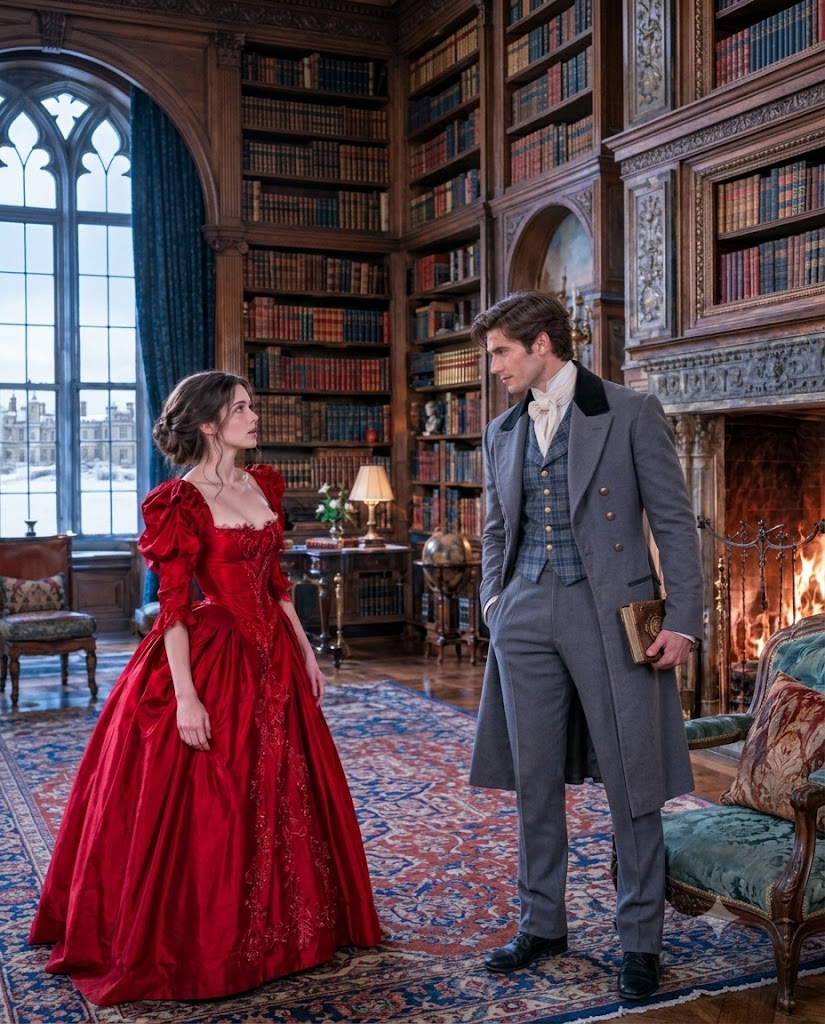
She turned to the coachman.
“If Arabella is alive, take me to her.”
The man stared at her.
Then his shoulders dropped.
“She is alive.”
Clara’s heart seemed to stop.
“Where?”
“An old hunting lodge near the northern border.”
“Why is she hiding?”
The coachman looked at Gideon.
“Because someone wants her dead.”
That night, Clara and Gideon left Westland with only two guards.
The rain had turned the roads into rivers of mud.
For hours, neither spoke.
Clara sat opposite Gideon in the carriage, Arabella’s necklace clenched in her hand.
Finally she broke the silence.
“You should have told me everything.”
“Yes.”
“You knew my father was involved.”
“Yes.”
“You knew Arabella was alive.”
“No.”
Clara frowned.
“I only knew she might be.”
“Why didn’t you look for her?”
“I did.”
“And?”
“I found three false trails, two dead informants, and one burned house.”
Clara looked out into the darkness.
“And you still married me.”
“I married the woman who walked into my chapel and told me the truth when everyone else had spent years lying to me.”
Her eyes returned to him.
“That’s not an answer.”
“It is the only one I have.”
The carriage jolted over a stone.
Clara caught herself against the seat.
Gideon reached for her instinctively.
His hand closed around her wrist.
For a moment, neither moved.
Then he released her.
“I don’t know what happens when we find your sister,” he said quietly.
“Neither do I.”
“But if she is innocent, I will protect her.”
Clara studied his face.
“And if she isn’t?”
“Then we discover why.”
The hunting lodge appeared just before dawn.
It stood among black pine trees, half-hidden by fog.
One window glowed.
Clara stepped down before the carriage had fully stopped.
“Arabella!”
No answer.
Gideon drew his pistol.
“Stay behind me.”
Clara ignored him.
She pushed open the door.
The room was empty.
A fire still burned in the hearth.
A cup of tea sat untouched on the table.
Someone had left only minutes earlier.
Gideon crouched beside the fireplace.
“Fresh footprints.”
Clara turned.
Then she saw the blood.
A thin trail crossed the wooden floor.
It disappeared beneath the table.
Her breath caught.
“Gideon.”
He followed her gaze.
The blood was not Arabella’s.
It belonged to one of the guards.
He was lying behind the sofa, unconscious but alive.
Gideon knelt beside him.
“He was attacked from behind.”
Clara searched the room.
A door stood open at the back.
She ran through it.
Beyond the lodge was a narrow path leading into the forest.
At the end of it stood a ruined stone chapel.
And beside the chapel was Arabella.
Her dress was torn.
Her hair was loose.
A pistol was pressed against her temple.
Clara froze.
A man stood behind her.
He wore a black coat.
On his glove was the black thorn.
“Another step,” he said, “and your sister dies.”
Gideon emerged behind Clara.
The stranger smiled.
“Duke of Westland.”
“Release her.”
“You still believe this is about money?”
Gideon raised his pistol.
The man laughed.
“It was never about the money.”
Clara stared at Arabella.
Her sister’s face was pale.
But her eyes were clear.
“Clara,” she whispered.
“Don’t move.”
The stranger pressed the pistol harder against her head.
“You were supposed to marry the duke and disappear quietly.”
Clara’s blood ran cold.
“Who are you?”
The man smiled.
“Someone your father knows very well.”
A gunshot cracked through the trees.
For one terrifying second, Clara thought Arabella had been shot.
Then the stranger staggered.
Gideon had fired.
Arabella dropped to the ground.
Clara ran.
She pulled her sister behind the stone wall as Gideon fired again.
The stranger vanished into the forest.
“Are you hurt?”
Clara grabbed Arabella’s shoulders.
“Are you hurt?”
Arabella shook her head.
“No.”
“Then tell me what happened.”
Arabella looked at Gideon.
“He will come back.”
“Who?”
“My father’s partner.”
Clara felt something inside her collapse.
“Father has a partner?”
Arabella nodded.
“Not just a partner. The man who built everything.”
She reached into her coat and pulled out a small packet of papers.
“I found these in Father’s study.”
Clara opened them.
Her eyes widened.
Bank transfers.
Forged signatures.
Property deeds.
Letters.
And finally, a list of names.
At the top was their father’s.
Below it were names of judges, merchants, bankers, and members of Parliament.
But one name appeared again and again.
Lord Edmund Vale.
Gideon’s expression changed.
“Vale.”
“You know him?” Clara asked.
“I know of him.”
Arabella shook her head.
“You don’t understand. He doesn’t merely know Father. He owns him.”
Clara stared at the papers.
“What does he want?”
Arabella looked toward the forest.
“Westland.”
Gideon said nothing.
Arabella continued.
“Vale has been buying debts across the county for years. He lends money through intermediaries, waits until families collapse, then takes their land. But Westland was different.”
“Why?”
“Because Gideon refused to sell.”
Gideon’s eyes narrowed.
Arabella looked at him.
“Your estate sits above a vein of iron.”
Silence.
Clara frowned.
“Iron?”
“An enormous deposit,” Arabella said. “Your grandfather knew. Vale discovered it later. He wanted the land, but Gideon wouldn’t sell.”
Gideon stared at her.
“How did you learn this?”
“I was told by Father.”
Clara’s stomach turned.
“So Father helped him.”
“Yes.”
“And you?”
“I found out too late.”
Arabella’s voice cracked.
“Father borrowed money from Vale. Then he borrowed more. When he couldn’t repay it, Vale offered another arrangement. Father would help him acquire Westland.”
Clara looked at Gideon.
“By destroying you.”
Arabella nodded.
“The debts. The false accounts. The forged payments. Everything was designed to make Gideon look financially unstable.”
Gideon’s face hardened.
“And my steward?”
“Vale paid him.”
“The missing grain?”
“Vale’s people.”
“The money sent through Arabella?”
“I was forced to receive it,” Arabella said. “They told me if I refused, they would expose Father’s crimes and send him to prison. Then they told me I would have to marry Gideon.”
Clara understood.
“The wedding was another trap.”
“Yes.”
“Why run?”
“Because I discovered they never intended to let me survive the marriage.”
Clara pulled her sister into her arms.
For the first time since the wedding, she allowed herself to cry.
Not from fear.
From relief.
Arabella was alive.
But the danger was not over.
When they returned to Westland, the gates were open.
The guards were gone.
The estate was silent.
Gideon stopped at the entrance.
“Something is wrong.”
A letter waited on the library desk.
It was addressed to Clara.
She opened it.
Bring the original ledgers to the old mill by midnight. Come alone. If you refuse, your father dies.
Clara’s hands went cold.
“My father.”
Gideon took the letter.
“We don’t know if he’s alive.”
Arabella shook her head.
“He is.”
“How?”
“He always kept a second signet ring. Vale uses it to authenticate his orders.”
Gideon looked at Clara.
“We set a trap.”
“No.”
Both sisters spoke at once.
Clara shook her head.
“We don’t know how many men Vale has.”
Gideon answered calmly.
“We don’t need to.”
Arabella looked at him.
“What are you planning?”
“To give him what he wants.”
At midnight, Clara entered the old mill alone.
She carried the ledgers in a leather case.
A lantern swung above her.
The mill was empty.
Then a voice came from the shadows.
“You came.”
Lord Edmund Vale stepped into the light.
He was older than Clara expected.
Elegant.
Calm.
Almost pleasant.
Two armed men stood behind him.
And between them sat Clara’s father.
His wrists were tied.
His face was gray.
“Father.”
He looked away.
Vale smiled.
“You see? Families are such useful things.”
Clara placed the case on the table.
“Let him go.”
“Of course.”
Vale opened the ledger.
His smile disappeared.
“This isn’t everything.”
“You asked for the original accounts.”
“I asked for all of them.”
Clara stepped closer.
“You’ll get the rest when Father walks out.”
Vale laughed softly.
“You sound like your husband.”
“I’ve learned from him.”
Vale closed the ledger.
“You have no idea how close you are to losing everything.”
Clara looked at him.
“No.”
She smiled faintly.
“I think you are.”
Vale’s expression changed.
A shot rang out.
One of his men dropped.
Another turned.
Gideon emerged from the darkness.
Guards flooded through the mill doors.
Vale reached for his pistol.
Clara kicked the weapon away.
The room erupted into chaos.
Her father shouted.
Arabella pulled him toward the exit.
Gideon fought through two men before reaching Vale.
The two stood face to face.
Vale smiled.
“You think this ends tonight?”
Gideon answered quietly.
“No.”
He looked toward Clara.
“It ends when every document reaches the Crown.”
Vale’s smile vanished.
Clara understood.
The ledgers were not merely evidence.
They were copies.
Gideon had sent the originals to London before they entered the mill.
The arrests began three days later.
Bankers.
Merchants.
Officials.
Men who had believed their titles made them untouchable.
Lord Edmund Vale was taken to trial.
Clara’s father confessed to his part in the scheme.
He lost the Hastings estate.
He lost his fortune.
But Clara refused to let him die in prison.
She arranged for him to live in a small country house under supervision.
Not because he deserved forgiveness.
Because she had learned that revenge could destroy what justice was meant to protect.
Arabella remained at Westland for several months.
Then she left to rebuild her life far from the society that had once measured her worth by marriage.
As for Clara, she changed Westland in ways no one had expected.
The estate accounts became public.
Workers were paid fairly.
Debts were recorded openly.
No servant could be dismissed without review.
And every year, on the anniversary of the wedding that had begun with a lie, Clara opened the estate library to anyone who needed help understanding a contract.
Gideon watched her one afternoon from the doorway.
“You’ve turned my library into a courtroom.”
Clara smiled.
“Better a courtroom than a hiding place.”
He walked toward her.
“You know, when you first came here, I thought you were reckless.”
“I was.”
“I thought you were frightened.”
“I was.”
“I thought you were hiding something.”
“I was.”
Gideon raised an eyebrow.
“What were you hiding?”
Clara closed the ledger.
“That I was beginning to believe I could survive.”
He reached for her hand.
“You did more than survive.”
Clara looked around the room.
At the shelves.
The ledgers.
The sunlight falling across the desk.
“No,” she said softly. “We did.”
For a moment, they stood together in silence.
Their marriage had begun as a bargain.
Then it had become an investigation.
Then a battle.
But somewhere between the hidden ledgers and the midnight roads, something neither of them had planned had grown quietly between them.
Trust.
Not the blind kind.
Not the kind built from promises.
The kind earned one truth at a time.
Gideon squeezed her hand.
“Do you ever regret wearing her dress?”
Clara smiled.
“Every time I remember how uncomfortable it was.”
He laughed.
It was a rare sound.
Warm.
Unrestrained.
Clara leaned against him.
“Do you regret marrying me?”
“No.”
“Even after I fired your steward?”
“Especially after you fired my steward.”
She laughed.
Then her expression became thoughtful.
“Gideon?”
“Yes?”
“What do you think would have happened if I had never opened that ledger?”
He looked toward the old books lining the walls.
“The lies would have continued.”
“And if Arabella had never run?”
“We might never have discovered the truth.”
Clara nodded slowly.
“Then perhaps the worst night of our lives was also the beginning of something better.”
Gideon looked at her.
“That’s a dangerous lesson.”
“Why?”
“Because people might start believing that suffering is necessary for change.”
Clara shook her head.
“No. The lesson is that suffering should never be romanticized. But when it comes, we decide what we do with it.”
Gideon smiled.
“And what did you decide?”
Clara looked down at the ledger before her.
“I decided that no one should ever again be powerless simply because they don’t understand the numbers on a page.”
She closed the book.
Outside, the first snow of winter began to fall over Westland.
The estate that had once been drowning in secrets was finally quiet.
Not the fearful silence of people hiding something.
A peaceful silence.
The kind that comes when there is nothing left to conceal.
Clara had entered the chapel wearing another woman’s dress because she believed she was sacrificing herself to save her family.
She had walked into the library believing numbers were merely numbers.
She had discovered that debts could become chains, signatures could become weapons, and secrets could destroy generations.
But she had also discovered something else.
A person does not become powerful by having nothing to fear.
They become powerful when fear no longer decides what they do.
Arabella had run because she was afraid.
Clara had stayed because she was afraid.
Gideon had trusted no one because he was afraid.
And yet each of them eventually chose truth over safety.
That choice had cost them dearly.
But it had also given them their freedom.
Years later, when people told the story of the Duchess of Westland, they often began with the vanished bride.
They spoke of the mysterious wedding.
The hidden fortune.
The corrupt lord.
The midnight confrontation at the mill.
But Clara always corrected them when they reached the end.
“It wasn’t the wedding that changed everything,” she would say.
“It was the ledger.”
Because a ledger did not care about titles.
It did not care about beauty.
It did not care who stood at the altar.
It simply recorded what had been done.
And sometimes, the smallest line on the oldest page was enough to expose an entire kingdom of lies.
Clara learned that truth rarely arrived like thunder.
More often, it appeared quietly.
In a missing receipt.
A strange signature.
A name that did not belong.
A question no one wanted asked.
And when that question finally came, someone had to be brave enough to turn the page.
So Clara did.
And this time, she was not afraid of what she might find.Years later, Clara would still remember the morning when the first snow fell over Westland.
It had been the first winter in years when she did not wake expecting bad news.
No messenger stood outside the door with a sealed letter.
No creditor waited in the entrance hall.
No servant whispered that another account had gone missing.
There were no footsteps outside her bedroom at midnight.
For the first time, silence did not frighten her.
It comforted her.
The estate had changed.
So had she.
But peace, Clara soon learned, was not something that arrived once and stayed forever.
It had to be protected.
One spring morning, a young maid came running into the library.
“Your Grace.”
Clara looked up from the accounts.
The girl was breathless.
“There is a gentleman at the gates.”
“Who?”
“He says he has come from London.”
Clara’s pen stopped.
“What does he want?”
“He says he has a letter for you.”
She held out a sealed envelope.
Clara recognized the seal immediately.
Blackthorn.
Her heart tightened.
For a moment, the old fear returned.
The dark mill.
The gunshots.
Her father’s frightened face.
Arabella’s bloodied dress.
Gideon’s voice telling her to stay behind him.
Then Clara breathed slowly.
Fear was a memory now.
Not a command.
“Bring him in.”
The gentleman who entered the library was young.
Perhaps thirty.
Well dressed, but not extravagantly.
He carried no weapon.
He bowed.
“Your Grace.”
“Your name?”
“Thomas Vale.”
Clara stared at him.
“Vale?”
“Yes.”
Her fingers tightened around the letter.
“Are you related to Edmund Vale?”
“He was my father.”
The room became very still.
Gideon, who had been reading near the window, lowered his book.
Thomas noticed him and immediately stepped back.
“I did not come to cause trouble.”
“Then why are you here?”
Thomas placed another packet on the desk.
“My father left this behind.”
Clara did not touch it.
“What is it?”
“Everything he never confessed.”
Gideon walked toward the desk.
“Why bring it here?”
Thomas looked at Clara.
“Because he wrote your name on the outside.”
Clara opened the packet.
Inside was a single letter.
The handwriting was old.
The ink had faded.
She read.
Duchess of Westland,
If you are reading this, then I am either dead or unable to finish what I began.
You may believe that the crimes I committed were driven by greed. That is only partly true. Greed was the instrument. Fear was the reason.
I spent twenty years believing that powerful men survive because they are ruthless. I was wrong. They survive because frightened people keep helping them.
Clara stopped reading.
Gideon watched her.
She continued.
Your father helped me because he was afraid of losing his estate. My bankers helped me because they were afraid of losing their positions. Officials helped me because they were afraid of losing their titles. Even those who hated me remained silent because they feared what would happen if they spoke.
That was my greatest weapon.
Not money.
Fear.
Clara slowly lowered the letter.
Thomas looked at her.
“My father wanted you to know that.”
“Why?”
“Because he knew what happened to the people who refused him.”
Gideon picked up the final page.
There was a list.
Names.
Dates.
Payments.
But one name was unfamiliar.
Gideon’s expression changed.
“What is it?”
He pointed to the bottom.
“Your grandfather.”
Clara frowned.
“My grandfather?”
Thomas nodded.
“My father believed your grandfather knew about the iron beneath Westland long before anyone else.”
Gideon looked at the document.
“That isn’t possible.”
“Why?”
“Because my grandfather never owned the land when the deposit was discovered.”
Thomas shook his head.
“He did.”
The room fell silent.
Gideon turned the page.
A second document had been attached.
It was an old survey.
The date was nearly forty years earlier.
A large section of land beneath Westland had been marked in red.
Iron deposits.
Extensive.
Untouched.
Clara looked at Gideon.
“Why would your grandfather hide this?”
Gideon studied the map.
“I don’t know.”
Thomas spoke quietly.
“Because he believed mining it would destroy the villages.”
Clara looked at him.
“What?”
“My father found his journals.”
Thomas opened another packet.
“Your grandfather refused to sell the land because he believed the mine would bring wealth for a few people and poverty for everyone else.”
Gideon stared at the old map.
For years, everyone had believed Westland was valuable because of the iron.
Perhaps that had never been the point.
Clara understood before he did.
“Your grandfather protected the land.”
Gideon slowly nodded.
“And my father tried to destroy you to get it.”
“Yes.”
Clara looked toward the window.
The villages beyond the estate were green beneath the spring sun.
Children were running along the road.
Farmers were repairing fences.
The land was alive.
And suddenly, she understood why Gideon’s grandfather had refused.
Some things were worth more untouched.
Gideon closed the journal.
“Then we leave it alone.”
Thomas looked surprised.
“You won’t mine it?”
“No.”
“Even though it could make you extraordinarily wealthy?”
Gideon looked at Clara.
She smiled.
“We’ve had enough wealth built on fear.”
Thomas lowered his eyes.
For the first time, Clara saw something unexpected in him.
Shame.
Not the shame of someone guilty of his father’s crimes.
The shame of someone carrying a name that had become poisonous.
“You are not your father,” Clara said.
Thomas looked up.
“You don’t know that.”
“No.”
Clara closed the journal.
“But you came here carrying evidence that could have protected your family and handed it to us instead.”
She paused.
“That tells me enough.”
Thomas’s eyes filled with tears.
He bowed.
“Thank you.”
After he left, Gideon stood beside the window.
“You trust him?”
Clara considered the question.
“I don’t know.”
Gideon smiled faintly.
“Good.”
She turned toward him.
“Good?”
“Trust should never mean refusing to question someone.”
Clara smiled.
“You sound like me.”
“I learned from you.”
She crossed the room.
“What will we do with the mine?”
“Nothing.”
“And the land?”
“Protect it.”
“Why?”
Gideon looked outside.
“Because my grandfather understood something I didn’t.”
“What?”
“That owning land doesn’t mean you have the right to destroy it.”
Clara slipped her hand into his.
“And perhaps that is the real inheritance.”
They never opened the mine.
Instead, they created a trust.
The land was protected.
The villages were given access to the forests and water.
Farmers were allowed to continue working without fear that another wealthy man would arrive and claim everything beneath their feet.
The decision cost Gideon a fortune.
But it gained something money could never buy.
Trust.
Not from aristocrats.
From ordinary people.
And for Clara, that mattered more.
Her greatest project began the following year.
She called it the Westland House of Accounts.
Anyone could enter.
Farmers.
Servants.
Widows.
Merchants.
Young women who had never been taught how contracts worked.
Clara taught them to read ledgers.
To understand interest.
To recognize fraudulent agreements.
To question signatures.
To ask what happened when a debt could not be paid.
She often told them the same thing.
“Numbers are not frightening. What is frightening is allowing someone else to understand them while you do not.”
The room would always become quiet when she said that.
Then she would smile.
“And never sign anything simply because someone tells you that you are too ignorant to understand it.”
Years passed.
Arabella returned to Westland more often.
She had changed.
The recklessness was gone.
In its place was confidence.
She had become a successful writer, publishing stories under a false name about women trapped by debts, marriages, and family expectations.
Clara knew immediately who the stories were about.
Arabella denied it.
Clara never believed her.
Their father grew old in the small house Clara had arranged for him.
For years, he refused to speak about the past.
Then one autumn evening, he sent for Clara.
She almost refused to go.
Gideon did not tell her what to do.
He simply said,
“If you go, go because you choose to.”
So she went.
Her father looked smaller than she remembered.
Older.
Fragile.
But his eyes were still the same.
“You look like your mother,” he said.
Clara sat across from him.
“You said you wanted to speak to me.”
“I owe you an apology.”
She waited.
“I should have protected you.”
“Yes.”
“I should have protected Arabella.”
“Yes.”
“I should never have used either of you to save myself.”
Clara looked at him for a long time.
“No,” she said quietly. “You shouldn’t have.”
He lowered his head.
“Do you hate me?”
The question surprised her.
She had expected many things.
Anger.
Regret.
Excuses.
Not that.
Clara looked out the window.
“I used to.”
He swallowed.
“And now?”
“Now I understand you.”
His eyes lifted.
“That isn’t the same as forgiving you.”
“I know.”
Clara stood.
“But I don’t want to carry hatred for the rest of my life.”
Her father began to cry.
She did not embrace him.
Not yet.
Some wounds needed distance.
But she placed her hand on his shoulder.
And for the first time, he did not ask her to save him.
He simply let her leave.
When Clara returned to Westland, Gideon was waiting outside.
She stepped down from the carriage.
“How did it go?”
She looked at him.
“He apologized.”
“And?”
“I accepted the apology.”
Gideon nodded.
“Did you forgive him?”
Clara thought about it.
“I’m trying.”
He held out his hand.
She took it.
“That is enough.”
Years later, people would ask Clara whether she believed everything happened for a reason.
She always disliked the question.
“No,” she would say.
“Some things happen because people make terrible choices.”
Then she would add,
“But what happens afterward depends on what we choose to do.”
That became the lesson she passed on to every young woman who entered the library.
Do not confuse sacrifice with surrender.
Do not confuse kindness with weakness.
Do not mistake wealth for worth.
And never allow fear to make your decisions for you.
One winter evening, many years after the wedding, Clara and Gideon returned to the chapel.
The stained-glass windows had been repaired.
The broken stones had been replaced.
Candles burned along the walls.
Clara stood beneath the same arch where she had once walked toward a man she had never met.
Gideon stood beside her.
“You’re thinking about that day,” he said.
“Yes.”
“Do you remember what you were afraid of?”
“Everything.”
He smiled.
“And now?”
Clara looked around the chapel.
“I don’t think fear ever disappears.”
Gideon waited.
“You simply learn that it doesn’t get to choose.”
He took her hand.
“Would you do it again?”
She laughed softly.
“Wear Arabella’s dress?”
“No.”
“Absolutely not.”
They both laughed.
Then Clara became quiet.
“If I could return to that morning, I would tell that frightened girl one thing.”
“What?”
“That she doesn’t have to become fearless.”
She looked at Gideon.
“She only has to take the next step.”
Gideon kissed her forehead.
Outside, snow began to fall.
The same soft snow that had covered Westland on the morning the estate first became peaceful.
Clara watched the flakes through the chapel window.
Once, she had believed her life had ended when Arabella disappeared.
Then she believed it had ended when she was forced to marry Gideon.
Then she believed it had ended when she discovered her father’s betrayal.
Each time, she had been wrong.
Sometimes what feels like the end is only the moment before a life changes direction.
The bells began to ring.
Clara smiled.
Not because a wedding was beginning.
But because this time, the bells belonged to a life freely chosen.
She looked at Gideon.
“Come.”
“Where?”
“Home.”
They walked out together.
Behind them, the chapel doors closed gently.
The bells continued ringing over Westland.
And somewhere in the old library, on the final page of a ledger that had once contained nothing but debts, Clara had written one last line.
Not a payment.
Not a name.
Not a warning.
A promise.
A life built on truth may cost more in the beginning, but it will never demand that you lose yourself to keep it.
Then she closed the book.
And this time, there was nothing left to hide.
THE END