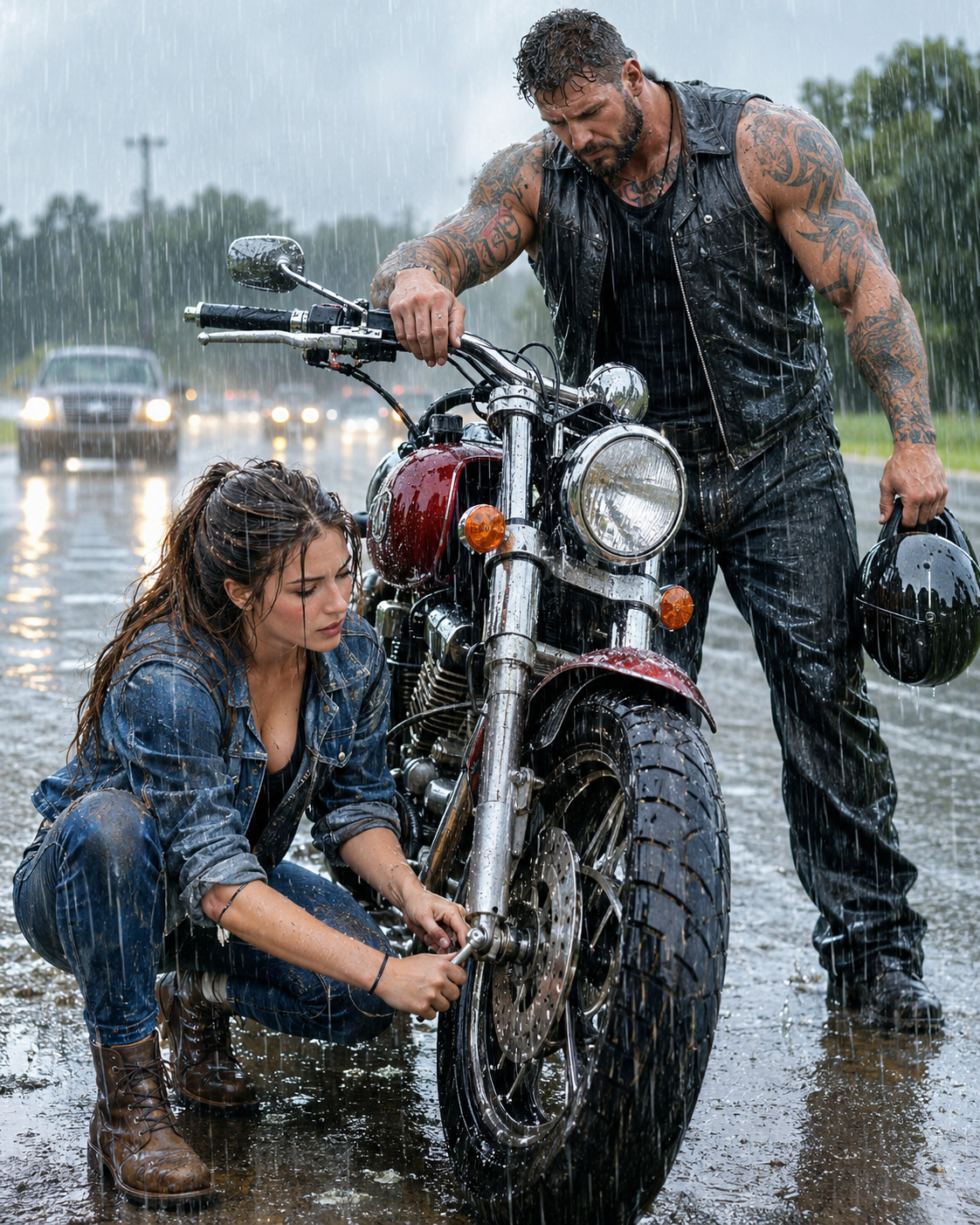
The biker was sitting beside his broken Harley in the pouring rain, crying so hard he barely noticed the woman pulling over.
Rebecca knew what she wanted to protect. It wasn’t just the little shop with its freshly painted walls and three service bays. It was the promise she’d made to herself the night she stopped beside a crying stranger on the highway: that no matter how hard life became, she would never let fear turn her into someone who drove past another person’s suffering.
But promises were easier to keep when the bills weren’t piling up.
Bear leaned against the counter, watching her study the contract.
“What’s bothering you most?” he asked.
Rebecca tapped the third page. “They want guaranteed priority service. If one of their trucks breaks down, I have to move it ahead of everything else.”
“Sounds like a normal business arrangement.”
“Until Mrs. Henderson comes in with her twenty-year-old Buick and needs it fixed so she can get to her dialysis appointments. Or a single mother needs her brakes repaired before picking up her kids.”
Bear nodded slowly.
“And there’s something else,” Rebecca continued. “They want me to use their approved parts distributor. I checked the prices. Some of those parts cost almost twice what I normally pay.”
“Would that affect your customers?”
“Not directly. But it would affect how much I charge the company. And eventually, somebody would start asking me to cut corners to keep costs down.”
Bear folded his arms.
“Then you already know what you think.”
Rebecca sighed. “Knowing what I think doesn’t mean knowing how to pay next month’s rent.”
He looked toward Sophie, who was arranging sockets by size.
“Your daughter ever ask you why you work so hard?”
“Every week.”
“What do you tell her?”
“That I’m trying to give us a better life.”
Bear smiled faintly. “Maybe a better life isn’t just about having more money.”
Rebecca looked down at the contract again.
That evening, after Sophie had fallen asleep, she spread the company’s proposal across her kitchen table.
The numbers were tempting. The contract could bring in nearly $9,000 a month before expenses. With careful planning, she might finally stop worrying about whether the electricity would stay on.
But the agreement also included a clause allowing the company to cancel without penalty if she failed to meet its service deadlines three times.
Three mistakes.
That was all it would take to lose the income she would be depending on.
At 11:43 p.m., Rebecca picked up her phone and called the company’s operations manager, Thomas Whitaker.
“I’d like to discuss a few changes,” she said.
Whitaker laughed.
“Ms. Lawson, we’ve already made you a generous offer.”
“I appreciate that. But I won’t sign an agreement that prevents me from serving my regular customers.”
There was a pause.
“You’re a new business owner,” Whitaker replied. “You might want to think carefully before turning down an opportunity like this.”
“I have thought carefully.”
“Then you understand we can take our business elsewhere.”
“Yes, sir.”
Rebecca’s hand trembled around the phone.
“But I also understand that if I build my business around one customer who can walk away whenever he wants, I won’t really own much of a business.”
Whitaker went silent.
Finally, he said, “I’ll speak with my regional director.”
The call ended.
Rebecca sat staring at the dark phone screen.
She had no idea whether she’d just made the smartest decision of her life or the most expensive mistake.
The answer seemed to arrive four days later.
Whitaker called back.
“The company won’t accept your changes,” he said. “We’re going with another provider.”
Rebecca closed her eyes.
“I understand.”
“Good luck, Ms. Lawson.”
When the call ended, she sat motionless behind her desk.
Outside, two motorcycles waited for oil changes. An elderly man was asking about a strange noise in his pickup. Sophie was coloring at the little table in the waiting room.
Life continued as though nothing had happened.
But Rebecca could already see the numbers collapsing in her head.
That afternoon, she called Mr. Harris.
“I think I made a mistake,” she admitted.
Her former boss listened while she explained everything.
Then he asked a question she hadn’t expected.
“Did you turn down the contract because you were scared?”
“No. I turned it down because the terms weren’t right.”
“Then don’t call it a mistake yet.”
Rebecca rubbed her forehead.
“Easy for you to say. You’re not staring at a rent payment.”
Mr. Harris chuckled.
“Rebecca, when I opened my garage thirty-one years ago, I nearly lost it six times in the first year.”
“Six?”
“At least. I stopped counting after the fourth.”
“How did you survive?”
“I learned that a good mechanic fixes cars. A good business owner fixes problems before they become disasters.”
He paused.
“Come see me tomorrow morning. Bring your numbers.”
The next day, Mr. Harris spent three hours reviewing Rebecca’s expenses.
He pointed out unnecessary inventory, suggested better payment terms with suppliers, and helped her calculate the actual profit on each service.
Then he slid a sheet of paper across the desk.
“You don’t need one giant customer,” he said. “You need twenty smaller ones who trust you.”
Rebecca studied the figures.
“If I could get six more regular fleet vehicles and keep my current appointments steady, I’d cover my overhead.”
“Exactly.”
“But finding those customers could take months.”
Mr. Harris smiled.
“Then you’d better start making phone calls.”
For the next two weeks, Rebecca worked harder than she ever had.
She visited local plumbers, electricians, landscaping companies, and small delivery businesses.
She offered honest inspections, clear pricing, and maintenance schedules that would help them avoid expensive breakdowns.
Most people politely declined.
A few never returned her calls.
One business owner laughed when he learned she operated the shop alone.
“Sweetheart, I need somebody who can handle real work.”
Rebecca forced a smile.
“I’ve been handling real work since I was sixteen.”
He shrugged.
“Maybe when you hire a man.”
She walked out without another word.
That night, Sophie found her mother crying quietly over a stack of unpaid invoices.
“Mommy?”
Rebecca quickly wiped her face.
“Hey, baby. Why aren’t you asleep?”
Sophie climbed into her lap.
“Are we going to lose our shop?”
Rebecca felt her heart tighten.
“Why would you ask that?”
“Because you look scared like you did when Daddy left.”
The words struck harder than anything Rebecca had heard all week.
She wrapped her arms around her daughter.
“I’m trying very hard to make sure we don’t.”
Sophie rested her head against Rebecca’s shoulder.
“Bear says brave people get scared too.”
Rebecca smiled through her tears.
“He does?”
“He said being brave means doing the right thing even when your knees feel funny.”
Rebecca laughed softly.
“That sounds like Bear.”
Sophie lifted her head.
“Then you’re the bravest person I know.”
Rebecca held her daughter for a long time.
The following morning, something unexpected happened.
A white utility van pulled into the shop with smoke rising from beneath its hood.
The driver, a middle-aged man named Carlos Ramirez, stepped out looking desperate.
“Please tell me you can help,” he said. “I’ve got four jobs scheduled today, and if this van dies, I’m in serious trouble.”
Rebecca inspected the engine.
The water pump had failed, and the serpentine belt was badly damaged.
“I can fix it,” she said. “But I’ll need a few hours.”
Carlos looked at his watch.
“I can’t afford to lose the whole day.”
Rebecca considered the situation.
Then she handed him her pickup keys.
“Take my truck.”
Carlos stared at her.
“What?”
“It’s old, but it runs. You can move your tools into the bed and finish your jobs.”
“Lady, you don’t even know me.”
Rebecca smiled.
“Funny. Somebody said that to me once.”
Carlos hesitated.
“What if I damage it?”
“Then we’ll deal with it.”
He looked at the keys, then at her.
“Why would you trust me?”
“Because you need to work, and I’ve got a truck sitting outside.”
Carlos accepted the keys.
Six hours later, he returned with the pickup, a full tank of gas, and a paper bag containing two enormous sandwiches.
Rebecca had finished repairing his van.
When he saw the bill, he frowned.
“That’s less than the other garage quoted me.”
“I only charged you for the work it needed.”
Carlos looked around the shop.
“You do fleet maintenance?”
“Yes.”
“How many vehicles can you handle?”
“Depends on the schedule.”
He pulled out his phone.
“I run a plumbing company. I’ve got seven vans. And my brother runs an electrical business with five more.”
Rebecca stared at him.
Carlos smiled.
“Maybe we should talk.”
By Friday, she had signed two maintenance agreements.
They weren’t worth nearly as much as the delivery company’s proposed contract, but together they provided predictable work without forcing her to abandon her other customers.
For the first time in weeks, Rebecca slept through the night.
But just when she began to believe the worst was behind her, a much bigger problem arrived.
It happened on a rainy Tuesday morning.
Rebecca was replacing brake pads on a customer’s SUV when a silver sedan pulled into the parking lot.
A man in an expensive gray suit stepped out.
He introduced himself as Richard Vale.
“I’m here on behalf of the property owner,” he said.
Rebecca wiped her hands.
“Is something wrong?”
Vale opened a leather folder.
“The building has been placed on the market.”
Rebecca stared at him.
“What?”
“The owner has received an attractive offer from a commercial development group.”
“But I have a lease.”
“Of course. And the buyer will be informed of that.”
Rebecca felt her stomach tighten.
“What does that mean?”
“It means the property may change hands. You’ll receive formal notice regarding any matters affecting your tenancy.”
He handed her a business card.
“Personally, I’d recommend you begin exploring other locations.”
Rebecca looked at the card.
“Are you telling me they’re going to force me out?”
“I’m telling you that plans change.”
Then he returned to his car and drove away.
For several minutes, Rebecca stood in the rain, unable to move.
Six weeks of renovations.
Every dollar she had saved.
Hundreds of hours of labor from people who had believed in her.
All of it could disappear because somebody with more money wanted the building.
When Bear arrived that afternoon, he found Rebecca sitting on the workshop floor.
She handed him Vale’s card.
Bear read it.
His expression darkened.
“Did he threaten you?”
“Not exactly.”
“What did he say?”
She told him everything.
Bear listened without interrupting.
Then he pulled out his phone.
“I know somebody who can look at your lease.”
Rebecca shook her head.
“Bear, I don’t want trouble.”
“Neither do I.”
He crouched beside her.
“But protecting yourself isn’t causing trouble.”
The next morning, a woman named Evelyn Price arrived at the shop.
She was a retired attorney who had spent twenty-five years handling commercial property disputes. Her husband, a longtime biker named Duke, had been one of the men who helped install Rebecca’s workbenches.
Evelyn read the lease twice.
Then she looked up.
“Rebecca, you have a three-year lease with a properly documented renewal option.”
Rebecca leaned forward.
“So they can’t just throw me out?”
“Not simply because the building is sold. A buyer generally takes the property subject to existing lease obligations, though we need to verify the recorded documents and applicable terms.”
Rebecca exhaled.
“But there is something else,” Evelyn continued.
She pointed to a clause near the bottom of the page.
“The owner gave you a right of first refusal if he decides to sell.”
Rebecca blinked.
“What does that mean?”
“If he receives a bona fide offer that triggers this provision, you may have the right to match it under the stated conditions.”
Rebecca laughed bitterly.
“With what money?”
Evelyn didn’t smile.
“That’s a different problem. But it’s a problem worth understanding.”
Over the next several days, Evelyn contacted the owner and requested the relevant sale documents.
What she discovered was troubling.
The development company had offered $285,000 for the property.
The owner was considering the offer because he wanted to retire and move closer to his grandchildren.
But the developer had also been pressuring him to deliver the building vacant, despite Rebecca’s lease.
Worse, Richard Vale had been contacting local suppliers and suggesting that Lawson Auto & Motorcycle Repair would soon close.
Rebecca learned about it when her parts distributor suddenly reduced her credit terms.
Then two customers canceled appointments.
By Thursday, rumors were spreading through the neighborhood.
The shop was going bankrupt.
The bikers had abandoned the project.
Rebecca was supposedly leaving town.
None of it was true.
But rumors didn’t need to be true to hurt a small business.
When Bear heard what was happening, he became furious.
“That man is trying to scare you out,” he said.
Rebecca stood behind her counter, exhausted.
“I know.”
“Let me talk to him.”
“No.”
“Rebecca—”
“No, Bear.”
Her voice was firmer than he’d ever heard it.
“I know you want to protect me. But if a group of bikers shows up at his office, he’ll use it against us.”
Bear looked away.
She stepped closer.
“You told me this was my business. Remember?”
He nodded reluctantly.
“Then let me handle it the right way.”
Bear studied her for a moment.
Then a small smile appeared beneath his beard.
“Michael would’ve liked you.”
Rebecca smiled back.
“I think I would’ve liked him too.”
That weekend, Evelyn helped Rebecca prepare a formal letter demanding that the developer stop making false statements about her business.
She also advised Rebecca to document every canceled order, every supplier conversation, and every financial loss connected to the rumors.
Mr. Harris called several local business owners and corrected the misinformation.
Carlos Ramirez posted a glowing review and encouraged his employees to bring their personal vehicles to Rebecca.
And Bear?
He did something nobody expected.
He organized a charity motorcycle ride.
Not to intimidate anyone.
Not to protest.
But to raise money for a cause Michael had cared about deeply.
The ride would support a local program that provided transportation assistance and emergency vehicle repairs for struggling families.
Rebecca agreed to offer free safety inspections during the event.
On Saturday morning, more than 150 motorcycles gathered outside the shop.
Families arrived carrying folding chairs, homemade food, and donations.
Local reporters came to photograph the event.
Rebecca stood beside Bear as riders lined up along the road.
“I can’t believe all these people came,” she whispered.
Bear looked toward Michael’s Harley.
“My brother used to say you could measure a community by what happened when somebody needed help.”
He paused.
“I think he’d be proud of this.”
The event raised more than $18,000 for the transportation program.
It also brought Lawson Auto & Motorcycle Repair more attention than any advertisement Rebecca could have purchased.
But the most important visitor arrived just before closing.
An elderly man stepped out of a dark blue sedan.
His name was Harold Bennett.
He owned the building.
Rebecca had met him only twice before.
He looked around at the freshly painted walls, the busy service bays, and the photograph of Michael behind the counter.
“I heard there was quite a gathering today,” he said.
Rebecca nodded.
“Yes, sir.”
Harold smiled sadly.
“I almost sold this place for scrap three years ago.”
He ran a hand along the counter.
“My father built this shop in 1968. He repaired tractors and pickup trucks here until he was seventy-four.”
Rebecca listened quietly.
“When he died, I couldn’t bring myself to sell it. But I couldn’t afford to keep fixing it either.”
He looked toward the workshop.
“Then those motorcycle fellows showed up.”
Rebecca smiled.
“They’re good people.”
“I can see that.”
Harold hesitated.
“Richard Vale told me you were having financial trouble.”
Rebecca straightened.
“I’m a new business owner. Of course money is tight. But I’m paying my bills, and I’ve never missed your rent.”
Harold nodded.
“I checked.”
He reached into his coat pocket and removed a folded document.
“I’ve decided not to accept the developer’s offer.”
Rebecca’s breath caught.
“What?”
“I don’t want my father’s building torn down for another strip mall.”
He handed her the paper.
It was a proposal to sell the property directly to Rebecca.
The price was $240,000.
He was willing to finance part of the purchase himself, provided she could obtain the remaining funds and meet the legal and financial requirements.
Rebecca stared at the document.
“Mr. Bennett, I don’t have that kind of money.”
“I know.”
“Then why offer it?”
Harold glanced toward Michael’s photograph.
“Because somebody once gave my father a chance when he had nothing.”
His voice softened.
“And because I’d rather see this building filled with honest work than empty promises.”
Rebecca covered her mouth.
For a moment, she couldn’t speak.
Then she whispered, “Thank you.”
But the offer came with a deadline.
Harold needed an answer within thirty days.
He was preparing to move, and he couldn’t leave the sale unresolved indefinitely.
Rebecca had thirty days to secure financing for a building she had barely begun to believe she deserved.
That night, she gathered Bear, Evelyn, Mr. Harris, and Carlos around the shop’s small office table.
They reviewed the proposal.
The down payment, closing expenses, insurance requirements, and working capital needs were daunting.
Rebecca would need nearly $50,000 in accessible funds and a lender willing to finance a young business.
Bear immediately offered to organize another fundraiser.
Rebecca shook her head.
“No.”
He frowned.
“Why not?”
“Because you’ve already given me more than I can ever repay.”
“Rebecca—”
“I mean it.”
She looked around the table.
“I love every one of you for helping me. But I can’t keep building my future on everybody else’s sacrifices.”
The room fell quiet.
Then Mr. Harris leaned back in his chair.
“Good,” he said.
Rebecca stared at him.
“Good?”
“You’re finally thinking like an owner.”
He tapped the financial statements.
“Now let’s figure out how to make the bank believe in you.”
Over the next three weeks, Rebecca worked with a small-business adviser to prepare a detailed financing application.
Carlos provided copies of his maintenance agreements.
Mr. Harris helped document her years of mechanical experience.
Evelyn reviewed the purchase terms and coordinated with the lender.
Bear offered to serve as a reference, but Rebecca insisted the loan stand on the business’s actual ability to repay.
She wanted the shop to survive because it was sound, not because her friends were willing to risk everything for her.
The first bank rejected her application.
The second requested additional collateral she didn’t have.
The third said her business hadn’t operated long enough.
Rebecca began to lose hope.
On the twenty-fourth day, she received another rejection.
She sat alone in the office after closing, staring at the letter.
Outside, rain began tapping against the windows.
The sound brought her back to the night she’d found Bear beside Michael’s Harley.
She remembered his trembling hands.
His broken expression.
The way he’d asked her to leave him alone.
And she remembered how close she’d come to driving past.
Her phone buzzed.
It was Sophie, calling from Mrs. Henderson’s house, where she’d been staying after school.
“Mommy, are you coming soon?”
Rebecca swallowed.
“Yes, sweetheart.”
“Are you sad?”
“A little.”
Sophie was quiet for a moment.
Then she said, “Remember what you told me when I couldn’t ride my bike?”
Rebecca smiled faintly.
“What did I say?”
“You said falling down doesn’t mean the road is over.”
Rebecca closed her eyes.
“I remember.”
“Then don’t stop, Mommy.”
After hanging up, Rebecca opened her laptop.
She searched for local community lenders and small-business financing programs.
One organization caught her attention: a regional community development lender that specialized in helping small businesses with limited conventional credit histories.
She submitted an inquiry that night.
The next morning, a loan officer named Angela Brooks called.
“I’ve reviewed your preliminary information,” Angela said. “I’d like to visit your business.”
Rebecca almost dropped the phone.
“When?”
“Tomorrow afternoon.”
Angela arrived carrying a folder and a long list of questions.
She inspected the equipment, reviewed the maintenance agreements, and asked Rebecca to explain her pricing strategy.
She wanted to know what would happen if Carlos canceled his contracts.
What would happen if repair volume dropped.
What would happen if Rebecca became ill and couldn’t work.
Rebecca answered every question.
Sometimes the answers were uncomfortable.
Sometimes she admitted she needed to improve.
But she didn’t exaggerate.
At the end of the meeting, Angela closed her folder.
“Ms. Lawson, I can’t promise approval.”
Rebecca nodded.
“I understand.”
“But I can tell you something. Most applicants spend their time telling me how successful they’re going to be.”
Angela glanced around the shop.
“You’ve spent your time explaining how you’ll survive when things go wrong.”
Rebecca smiled nervously.
“Life’s given me plenty of practice.”
Angela returned the smile.
“That may be more valuable than you realize.”
Three days later, on the morning of Harold’s deadline, Rebecca received a call.
The lender had conditionally approved her financing.
The amount would cover the bank-financed portion of the purchase, subject to appraisal, title review, and final documentation.
Harold agreed to extend the closing period so those conditions could be completed.
Rebecca stood frozen behind the counter.
“Does that mean…” she began.
“It means we’re moving forward,” Angela said. “You’re not finished yet, but you’ve cleared the hardest hurdle.”
Rebecca sank into her chair.
Then she began to cry.
Not because someone had rescued her.
But because, for the first time in years, she had built something strong enough that a lender believed it could stand.
The closing took another six weeks.
There were inspections, paperwork, unexpected repair requirements, and more than one sleepless night.
But finally, on a bright October morning, Rebecca walked into a title company’s office and signed the documents that made the building hers.
When she returned to the shop, Bear was waiting beside Michael’s Harley.
“Well?” he asked.
Rebecca held up the keys.
Bear grinned.
“Look at you, boss lady.”
She laughed and threw her arms around him.
He hugged her carefully, as though she were something precious.
“I couldn’t have done this without you,” she whispered.
Bear shook his head.
“You might not have started without us. But you finished it yourself.”
For a while, everything seemed perfect.
Then, two months later, Rebecca received a phone call that would test everything she’d learned.
It was from a woman named Patricia Mercer.
Bear’s mother.
Her voice was shaking.
“Rebecca, I don’t know who else to call.”
Rebecca stood immediately.
“What’s wrong?”
“It’s Daniel.”
Rebecca felt a cold wave of fear.
“Is he hurt?”
“He’s alive. But he hasn’t been himself. Michael’s birthday is tomorrow, and Daniel hasn’t answered my calls in three days.”
Rebecca glanced at Michael’s photograph.
“Do you know where he is?”
Patricia hesitated.
“There’s an old cabin near Douglas Lake. The boys used to go there with their father.”
Rebecca grabbed her keys.
“I’ll see what I can do.”
She called Duke first.
He confirmed that Bear had told the club he needed a few days alone.
There was no evidence of an emergency, but his silence worried everyone.
Rebecca asked Duke to remain available and drove toward the lake.
By the time she reached the cabin, the sun was setting.
Michael’s Harley stood beneath a wooden awning.
Bear sat on the porch, staring across the water.
He looked older than she remembered.
When Rebecca stepped out of her pickup, he didn’t seem surprised.
“Mom sent you?”
“She’s worried.”
He nodded.
“Figures.”
Rebecca climbed the porch steps.
For a while, neither spoke.
Then Bear said, “Tomorrow would’ve been Michael’s thirty-eighth birthday.”
Rebecca sat beside him.
“I know.”
“He was supposed to be here.”
His voice cracked.
“We were supposed to take a ride through the mountains. We planned it last spring.”
Rebecca listened.
Bear rubbed his face.
“Everybody keeps telling me how proud he’d be. How happy he’d be about the shop. About the charity ride.”
He looked toward the lake.
“But he’s not here to see any of it.”
Rebecca felt tears gathering in her eyes.
“No,” she said softly. “He’s not.”
Bear turned toward her.
She continued.
“And I won’t pretend that helping me makes losing him any easier.”
His face crumpled.
For the first time since she’d met him, Bear didn’t try to hide his grief.
“I miss my brother,” he whispered.
Rebecca placed a hand over his.
“I know.”
“I keep thinking about our last conversation.”
“What happened?”
Bear swallowed.
“We argued.”
Rebecca remained silent.
“Something stupid. He wanted me to slow down. Spend more time with Mom. Stop treating every disagreement like a fight.”
Bear shook his head.
“I told him to mind his own business.”
He stared at his hands.
“Two days later, he was gone.”
Rebecca felt the weight of his words.
“Did you love him?”
Bear looked at her as though she’d asked something impossible.
“More than anything.”
“Did he know?”
Bear’s eyes filled again.
“I think so.”
Rebecca squeezed his hand.
“Then one argument didn’t erase a lifetime of being brothers.”
Bear lowered his head.
For a long time, he cried.
Rebecca stayed beside him until the sky turned dark.
Eventually, Bear whispered, “I don’t know how to live without him.”
“You don’t have to figure that out tonight.”
He looked at her.
“But you do have people who love you. Your mother. Duke. The club. Sophie.”
Rebecca paused.
“And me.”
Bear stared at her.
She smiled gently.
“You’ve become family, Daniel.”
He covered his face with one hand.
That night, Rebecca called Patricia and let her know Bear was safe.
Then she sat with him while he told stories about Michael.
Funny stories.
Embarrassing stories.
Stories about childhood adventures, broken motorcycles, and the time Michael had accidentally painted their father’s garage door bright orange.
For the first time in months, Bear laughed without immediately looking guilty.
The next morning, they rode back toward Knoxville together, Rebecca in her pickup and Bear on Michael’s Harley.
At the shop, Sophie was waiting with a small birthday cake.
She had written Michael’s name on it in uneven blue frosting.
Bear stopped in the doorway.
“What’s this?”
Sophie smiled.
“Mommy said it’s your brother’s birthday.”
Bear knelt beside her.
“You made this?”
“Mostly. Mrs. Henderson helped with the oven.”
He looked at the cake.
Then at Rebecca.
Then back at Sophie.
“Thank you, sweetheart.”
Sophie wrapped her arms around his neck.
Bear held her close.
And something inside him, something that had been frozen since Michael died, began to soften.
The following spring, Lawson Auto & Motorcycle Repair celebrated its first anniversary.
Rebecca had hired two mechanics, including a young single father named James who had struggled to find steady work after his previous employer closed.
She had also started an apprenticeship program for local teenagers interested in automotive repair.
One afternoon, a seventeen-year-old girl named Emily arrived asking about the program.
She was nervous, carrying a notebook filled with sketches of engines.
“My guidance counselor said you might take students,” she explained.
Rebecca smiled.
“Do you like working on cars?”
Emily nodded eagerly.
“More than anything.”
“Then you’re in the right place.”
Emily hesitated.
“Some shops told me girls don’t belong in this business.”
Rebecca looked toward the service bays.
Then she remembered the man who had laughed at her months earlier.
She smiled.
“Well, around here, we judge mechanics by their work, not by whether they’re boys or girls.”
Emily’s face lit up.
Rebecca handed her a pair of safety glasses.
“Come on. Let me show you something.”
Over the following months, Emily became one of Rebecca’s most promising apprentices.
James helped train her.
Carlos continued bringing his company vehicles.
Mr. Harris visited every Friday with coffee and advice.
And Bear?
He became the unofficial grandfather of the shop.
He taught Sophie how to identify motorcycle parts, attended her school events, and never missed a birthday.
He also began spending Sunday afternoons with his mother.
Sometimes they talked about Michael.
Sometimes they simply sat together.
He eventually understood that remembering his brother didn’t mean remaining trapped in the worst day of his life.
It meant carrying forward the parts of Michael that deserved to live on.
On the second anniversary of the night Rebecca had stopped on the highway, Bear arrived at the shop carrying a small wooden box.
Rebecca was closing the register.
“What’s that?” she asked.
Bear placed the box on the counter.
“Something I’ve been meaning to give you.”
Inside was a small brass plaque.
It read:
IN MEMORY OF MICHAEL MERCER
A MAN WHO BELIEVED THAT NO ONE SHOULD FACE THE ROAD ALONE.
Rebecca traced the letters with her fingertips.
“It’s beautiful.”
Bear nodded.
“I was hoping we could put it near the entrance.”
Rebecca smiled.
“I know exactly where it belongs.”
They mounted the plaque beside the front door.
Then Bear stepped back and looked at it for a long time.
“You know,” he said quietly, “I used to think the worst night of my life was the night Michael’s motorcycle broke down.”
Rebecca turned toward him.
“Why?”
“Because I thought it meant I was losing him all over again.”
He looked at the busy workshop, where James was finishing a repair and Emily was helping a customer understand an estimate.
“But now I think maybe that was the night I finally started finding my way back.”
Rebecca smiled.
“You helped me find mine too.”
Bear shook his head.
“No. You were already on your way. You just needed somebody to remind you not to quit.”
Outside, the late afternoon sunlight spread across the parking lot.
Sophie, now ten, ran toward them carrying a drawing.
It showed a woman holding a toolbox beside a motorcycle in the rain.
Above them was a bright yellow sun breaking through dark clouds.
“Look!” Sophie announced. “It’s the night Mommy met Bear.”
Rebecca laughed.
“But there wasn’t any sunshine that night, sweetheart.”
Sophie looked at her as though the answer were obvious.
“I know.”
She pointed to the yellow sun.
“That’s what happened afterward.”
Bear stared at the drawing.
Then he slowly knelt beside her.
“You’re a pretty smart kid, you know that?”
Sophie grinned.
“Mommy says I get it from her.”
Rebecca laughed so hard she had to lean against the doorway.
Bear joined her.
And for a moment, the little shop was filled with the kind of laughter Michael would have loved.
Later that evening, after the customers had gone and the tools were put away, Rebecca stood outside watching Bear prepare to leave.
He climbed onto Michael’s Harley and started the engine.
The familiar rumble filled the parking lot.
“Hey, Rebecca!” he called.
She turned.
“Yeah?”
Bear smiled.
“Everybody needs somebody sometimes.”
Rebecca felt her throat tighten.
She smiled back.
“Don’t you forget it.”
He raised two fingers in farewell and rode into the fading sunlight.
Rebecca watched until the motorcycle disappeared around the bend.
Then she turned toward the shop.
Two years earlier, she had been a struggling single mother with an overdue rent notice, an aging pickup, and barely enough money for gasoline.
She had stopped for a stranger when she had almost nothing to give.
She hadn’t known his name.
She hadn’t known his reputation.
She hadn’t known that one small act of kindness would change both their lives.
And she certainly hadn’t known that the broken motorcycle beside the highway would eventually lead to a building filled with opportunity, friendship, and hope.
But perhaps that was the point.
Kindness wasn’t a transaction.
It wasn’t something you offered because you expected a reward.
It was a choice you made when nobody was watching and there was nothing obvious to gain.
Sometimes that choice cost you twenty minutes in the rain.
Sometimes it meant trusting someone who had been turned away by everyone else.
Sometimes it meant refusing an easy opportunity because it required abandoning the people who believed in you.
And sometimes it meant sitting beside a grieving friend without trying to fix what couldn’t be fixed.
Rebecca locked the shop door and glanced at the brass plaque beside the entrance.
Michael Mercer had never met her.
Yet his kindness had reached her through his brother, just as hers had reached Bear on a lonely highway.
That was the strange beauty of doing good.
You rarely knew how far it would travel.
Inside, Sophie called from the office.
“Mommy! Are we going home?”
Rebecca smiled.
“Coming, sweetheart.”
She switched off the lights, took her daughter’s hand, and stepped into the cool Tennessee evening.
For once, she wasn’t afraid of tomorrow.
Not because life had become easy.
Not because every problem had disappeared.
But because she had learned something more valuable than financial security or business success.
A person could be strong and still need help.
A person could be grieving and still find reasons to live.
And a person with almost nothing could still have something extraordinary to give.
Years later, people around Knoxville would tell the story of the tough biker who helped a struggling mechanic open her own garage.
Some would call it a miracle.
Others would call it an incredible act of generosity.
But Rebecca always corrected them.
“It didn’t start with a garage,” she would say.
“It started with a broken motorcycle, a man who needed somebody, and a decision not to drive past.”
And whenever someone asked Bear why he had done so much for a woman he barely knew, his answer never changed.
“Because she stopped when I needed her. And she didn’t ask what I could do for her in return.”
The real miracle wasn’t the money, the building, or even the successful business.
It was that two strangers, both carrying more pain than anyone could see, had found a way to remind each other that the world still held goodness.
And sometimes, the smallest kindness offered on the darkest road becomes the light that guides someone home.
THE END.