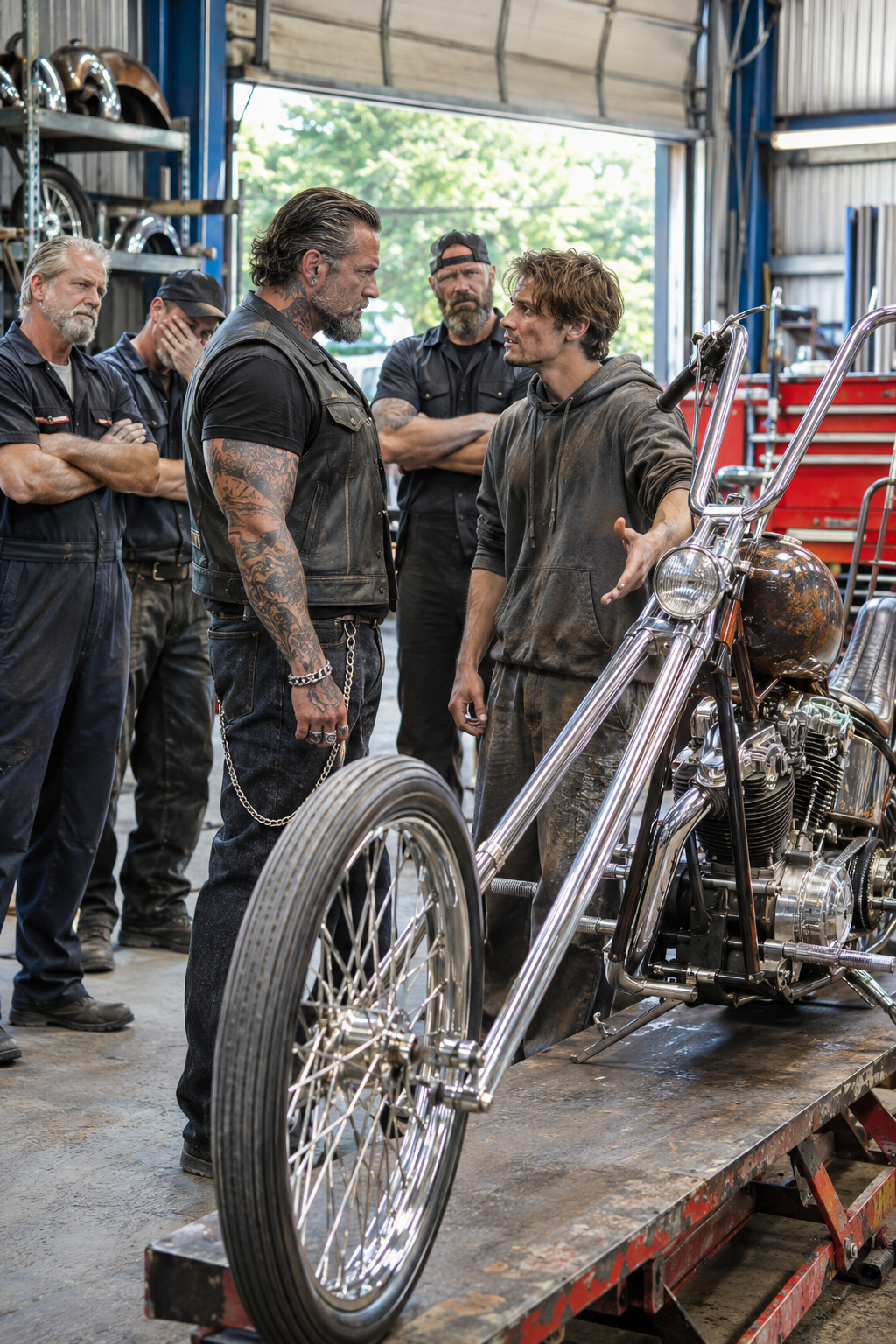
The biker slammed his fist on the workbench. “Nobody touches my Harley again unless they know what they’re doing.”
Ray picked up the small metal component and held it beneath the fluorescent light. For several seconds, he said nothing. Then his expression changed in a way that made even the toughest men in the garage take a step backward.
“Who touched this bike before it came here?” he asked.
The older mechanic, a gray-haired man named Walter, exchanged a nervous glance with the others.
“Ray, we’ve had six different guys working on it. Could’ve been anybody.”
Ray turned the component over in his palm.
“That’s not what I asked.”
Dustin stood beside the workbench, his stomach twisting. He recognized those marks. Someone had deliberately altered the locating surface of the flywheel assembly, creating just enough movement to throw off the timing reference under load.
It wasn’t an accident.
Someone had wanted the motorcycle to fail.
“Mr. Ray,” Dustin said quietly, “I don’t think this was done by a mechanic making a mistake.”
Ray looked at him.
“Explain.”
Dustin pointed toward the damaged metal.
“See how the marks are concentrated on one side? Someone used a tool to weaken the alignment. It would look normal when the engine was sitting still, but once it started vibrating, everything would shift.”
Walter nodded slowly.
“The kid’s right.”
Ray’s jaw tightened.
“So somebody sabotaged my Harley.”
Nobody answered.
Then a voice came from the back of the garage.
“Maybe somebody was trying to keep you alive.”
Everyone turned.
Standing near the rear entrance was a tall man wearing a black leather vest. His name was Vince Carter, and he had been Ray’s closest friend for almost twenty years.
Ray stared at him.
“What did you just say?”
Vince stepped forward, his boots echoing against the concrete floor.
“I said maybe that bike wasn’t supposed to be running.”
The silence became unbearable.
Dustin glanced toward the exit. He had spent enough nights on the streets to recognize the moment when a room became dangerous.
Ray slowly placed the metal component on the workbench.
“You’d better explain yourself, Vince.”
Vince looked around at the mechanics.
“Not in front of everybody.”
“Then you shouldn’t have opened your mouth in front of everybody.”
For a moment, neither man moved.
Then Vince gave a humorless smile.
“Fine. You want the truth? That motorcycle should’ve been buried with your brother.”
Ray’s face went white.
Walter lowered his eyes.
Dustin knew nothing about Ray’s brother, but he could feel the weight of the name that hadn’t even been spoken.
Ray grabbed Vince by the front of his vest.
“Don’t you ever talk about Danny like that.”
Vince didn’t resist.
“Then stop pretending that machine is just a motorcycle.”
Ray shoved him backward.
“Get out.”
“Ray—”
“GET OUT!”
Vince stared at him for another second before turning and walking through the rear door.
The moment he disappeared, Ray slammed his fist against the workbench so hard that several tools jumped.
Walter approached carefully.
“Ray, maybe you should sit down.”
Ray ignored him.
Instead, he turned toward Dustin.
“How much do I owe you, kid?”
Dustin blinked.
“Sir?”
“For fixing the bike.”
Dustin hesitated.
“Whatever you think is fair.”
Ray pulled out his wallet and placed three hundred-dollar bills on the bench.
Dustin stared at the money.
Three hundred dollars.
To someone who hadn’t eaten in nearly two days, it looked like a fortune.
But before he could reach for it, his vision blurred.
He grabbed the edge of the workbench.
Walter noticed immediately.
“Kid, you okay?”
“Yeah,” Dustin whispered. “Just a little dizzy.”
Then his knees buckled.
The last thing he heard was Ray shouting for someone to catch him.
When Dustin opened his eyes, he was lying on an old leather couch in the garage office.
A blanket covered his legs.
The smell of hot food filled the room.
Ray sat across from him, holding a paper bag.
“Welcome back.”
Dustin tried to sit up.
“I’m sorry. I didn’t mean to—”
“Stop apologizing.”
Ray pulled a container from the bag and placed it on the table.
“Burger. Fries. Eat.”
Dustin looked at the food, then at Ray.
“Is it really for me?”
Ray frowned.
“Who else would it be for?”
Dustin picked up the burger with trembling hands.
He tried to eat slowly, but hunger overwhelmed him. Within minutes, half the meal was gone.
Ray watched without speaking.
Finally, he asked, “When’s the last time you ate?”
Dustin stopped chewing.
“Yesterday morning.”
“Where are your parents?”
The boy’s expression closed immediately.
“Don’t have any.”
Ray leaned back.
“Everybody comes from somewhere.”
Dustin stared at the floor.
“My mom died when I was twelve. My dad disappeared before that.”
“Foster care?”
Dustin nodded.
“For a while.”
“What happened?”
Dustin hesitated, then shrugged.
“Some places were okay. Some weren’t. I ran away from the last one.”
Ray studied the boy’s taped shoes, the bruises on his knuckles, and the way he kept one hand near his jacket pocket.
“Where do you sleep?”
“Different places.”
“That’s not an answer.”
“Under the railroad bridge mostly.”
Ray looked away.
Outside, the rain continued beating against the windows.
For the first time in years, the feared biker found himself unable to think of anything to say.
Then Dustin noticed a photograph on the office wall.
Two young men stood beside the same Harley, smiling beneath a bright summer sky.
One was Ray, much younger.
The other looked remarkably similar.
“Is that your brother?” Dustin asked.
Ray followed his gaze.
“Yeah. Danny.”
“He owned the bike?”
Ray nodded.
“Built most of it himself.”
Dustin looked back at the photograph.
“He must’ve been a good mechanic.”
Ray’s voice softened.
“The best I ever knew.”
“What happened to him?”
Ray remained silent for so long that Dustin thought he wouldn’t answer.
Then he said, “He died on that motorcycle seventeen years ago.”
Dustin slowly lowered his food.
“I’m sorry.”
Ray stared at the photograph.
“Police said he lost control on a mountain road. Mechanical failure. Nothing anybody could’ve done.”
“But you kept the bike.”
“I rebuilt it from what was left. Took me years.”
Ray rubbed his face.
“Every time I got it running, something went wrong. I started thinking maybe Vince was right. Maybe I should’ve left it alone.”
Dustin looked toward the garage.
“Mr. Ray?”
“Yeah?”
“If somebody damaged that timing assembly on purpose, there’s something else you should know.”
Ray turned.
“What?”
Dustin swallowed.
“Those marks aren’t all fresh.”
Ray’s eyes narrowed.
“What do you mean?”
“Some are new. But underneath them, there are older marks. Someone may have been interfering with that part for a long time.”
Ray stood so suddenly that his chair scraped across the floor.
“Show me.”
Twenty minutes later, Walter was examining the component under a magnifying lamp.
Dustin stood beside him, pointing to the uneven metal surface.
Walter’s expression grew increasingly troubled.
“The boy’s right. Different tool marks. Different ages.”
Ray gripped the edge of the bench.
“Could this have caused Danny’s accident?”
Walter hesitated.
“Not enough evidence to say that. And this isn’t necessarily the same part that was on the bike seventeen years ago.”
Ray nodded slowly.
But Dustin could see that something had changed inside him.
The motorcycle wasn’t simply a memory anymore.
It had become a question.
And Ray intended to find the answer.
That evening, after the other mechanics left, Ray offered Dustin a place to sleep in the garage’s small storage room.
“Just for tonight,” he said.
Dustin nodded gratefully.
But around midnight, he woke to the sound of breaking glass.
He sat upright.
Footsteps moved through the garage.
Then a metallic crash echoed from the work area.
Dustin slipped out of bed and crept toward the doorway.
Two figures stood beside the Harley.
One held a flashlight.
The other was removing something from the workbench.
“Find the part,” a voice whispered.
Dustin froze.
He recognized that voice.
Vince.
The second man opened a drawer.
“It’s not here.”
“Then check the office.”
Dustin backed away, his heart pounding.
The office was where Ray had placed the damaged component inside a small evidence bag.
If Vince wanted it badly enough to break into the garage, the marks must mean something.
Dustin hurried toward the office through the narrow side corridor.
He reached the desk and grabbed the bag.
Then a flashlight beam struck his face.
“Well, look what we have here.”
Vince stood in the doorway.
Dustin stepped backward.
“I wasn’t stealing anything.”
Vince smiled coldly.
“Funny. Neither was I.”
He extended his hand.
“Give me the bag.”
Dustin clutched it tighter.
“Why?”
Vince’s smile vanished.
“Because I’m asking nicely.”
Dustin glanced toward the window.
Too small to escape through.
The only door was blocked.
Vince took another step.
“Kid, you have no idea what you’re involved in.”
“Then tell me.”
For a moment, Vince looked almost surprised.
Then he laughed.
“You think fixing an engine makes you clever?”
“No,” Dustin answered. “But breaking into a garage at midnight makes you look guilty.”
Vince lunged.
Dustin ducked beneath his arm and bolted toward the hallway.
A hand caught his jacket.
The fabric tore.
Dustin stumbled, hit the floor, and slid beneath a worktable.
Vince reached for him.
Then the garage lights snapped on.
“Take your hands off that boy.”
Ray stood near the main entrance, holding a heavy flashlight.
Walter was behind him, already calling the police.
Vince straightened.
“Ray, listen—”
“No.”
Ray walked toward him.
“You came into my shop. You went after a sixteen-year-old kid. And you’re trying to steal something from my brother’s motorcycle.”
Vince’s face hardened.
“You don’t understand what happened.”
“Then make me understand.”
Vince looked toward the open garage door.
A police siren sounded in the distance.
His shoulders dropped.
“Danny found out about the stolen bikes.”
Ray stopped walking.
“What stolen bikes?”
Vince swallowed.
“Seventeen years ago. There was a crew moving stolen motorcycles through a warehouse outside town. Danny discovered what they were doing.”
Ray stared at him.
“You told me Danny was helping you with a legitimate parts business.”
“I lied.”
The words seemed to drain all sound from the room.
Vince continued.
“Danny wanted to report everything. He said innocent people were getting hurt and he wasn’t going to stand by.”
Ray’s voice became dangerously quiet.
“And?”
“I tried to talk him out of it.”
“Did you touch his bike?”
Vince looked down.
“I loosened a component. Just enough to make it run badly. I thought he’d cancel his trip and stay home.”
Ray stepped closer.
“You sabotaged his motorcycle?”
“I never meant for him to crash.”
Vince’s voice cracked.
“I thought he’d notice the problem before he left. But he didn’t.”
Ray’s hands began trembling.
For seventeen years, he had blamed a defective machine, bad weather, and sometimes even his brother’s riding.
Now the man standing in front of him was admitting that he’d interfered with Danny’s motorcycle.
Ray grabbed Vince by the collar.
“You let me bury my brother thinking it was an accident.”
Vince closed his eyes.
“I’m sorry.”
Ray drew back his fist.
Dustin saw the rage in his face.
One punch might not be enough.
And everyone in the garage knew it.
“Mr. Ray!”
Ray froze.
Dustin crawled out from beneath the table.
“Please.”
Ray looked at him.
“He killed my brother.”
Dustin’s voice shook.
“Then don’t let him destroy your life too.”
For a moment, Ray seemed not to hear.
Then his eyes moved toward the photograph hanging above the office doorway.
Danny was smiling beside the Harley, one hand resting proudly on its handlebars.
Slowly, Ray released Vince.
He stepped backward.
And for the first time since Dustin had met him, the enormous biker looked like a man who had suddenly become very old.
When the police arrived, Vince didn’t run.
He sat on the concrete floor and waited.
Before the officers took him away, he looked at Ray.
“I’ve carried this for seventeen years.”
Ray’s expression remained cold.
“You should’ve carried it to the police seventeen years ago.”
The investigation that followed uncovered more than anyone expected.
Old financial records connected Vince to the stolen motorcycle operation. A retired warehouse employee confirmed that Danny had discovered the scheme shortly before his death.
Investigators also found evidence that Vince had recently interfered with Ray’s rebuilt Harley, apparently hoping to discourage him from riding it and examining its mechanical history.
But the original crash remained complicated.
Most of the motorcycle’s damaged parts had been replaced years earlier, and no forensic examination could establish exactly how Danny lost control.
Vince’s confession proved he had deliberately interfered with the machine, but it didn’t settle every question about the fatal accident.
Ray struggled with that uncertainty.
He wanted a clear answer.
He wanted someone to tell him precisely what had happened on that mountain road.
Instead, he was left with the painful truth that his closest friend had betrayed his brother and hidden it for seventeen years.
The police pursued the evidence they could establish, including the recent break-in and Vince’s involvement in the old criminal operation.
Ray stopped asking Dustin whether he thought Vince deserved forgiveness.
The boy had already given him the only answer that mattered.
Justice belonged in a courtroom, not at the end of Ray’s fist.
Three days later, Dustin woke to the smell of bacon.
He stepped into the garage office and found Ray preparing breakfast on a portable griddle.
“Morning, kid.”
Dustin rubbed his eyes.
“Morning.”
“Sit down.”
Ray placed a plate in front of him.
Dustin hesitated.
“Mr. Ray, I should probably leave today.”
Ray stopped cooking.
“Why?”
“I don’t want to keep taking up space.”
Ray turned toward him.
“Taking up space?”
Dustin looked at his hands.
“You’ve already done a lot for me.”
Ray switched off the griddle.
“Dustin, you fixed a motorcycle that six professional mechanics couldn’t repair. You also helped stop a man from destroying evidence.”
“That doesn’t mean you owe me anything.”
Ray studied him.
Then he pulled a chair across the floor and sat down.
“Tell me something. Who taught you to work on engines?”
Dustin’s face changed.
“My grandfather.”
Ray waited.
“He had a little repair shop in Ohio. Nothing fancy. Two lifts, an old radio, and a coffee machine that never worked right.”
A small smile appeared on Dustin’s face.
“I used to sit on a stool and watch him fix things. He’d make me guess what was wrong before he’d tell me.”
“Sounds like a smart man.”
“He was.”
“What happened?”
“He died when I was eleven. A year before my mom.”
Dustin stared at the plate.
“After that, everything fell apart.”
Ray leaned forward.
“Your grandfather ever tell you why he liked fixing motorcycles?”
Dustin nodded.
“He said machines were honest.”
Ray raised an eyebrow.
“What does that mean?”
Dustin smiled sadly.
“He said if something was broken, there was always a reason. You just had to be patient enough to find it.”
Ray looked toward the garage.
“Sounds like Danny.”
For several moments, neither spoke.
Then Ray said, “Walter’s getting older. He’s been talking about needing an apprentice.”
Dustin blinked.
“An apprentice?”
“Someone to sweep floors, organize tools, learn the trade. Get paid for doing it.”
Dustin stared at him.
“You mean me?”
“Unless there’s another sixteen-year-old mechanical genius sleeping in my storage room.”
Dustin laughed before he could stop himself.
But the laughter quickly faded.
“I don’t have an address. Or proper paperwork. I haven’t been in school for months.”
Ray nodded.
“Then we’ll work on those things too.”
Dustin shook his head.
“You don’t understand. It’s complicated.”
“Most worthwhile things are.”
Ray slid a business card across the table.
It belonged to a local youth outreach organization.
“I spoke with them this morning. They can help sort out your situation and find you a safe place to stay while we figure out the rest.”
Dustin looked at the card.
For years, adults had made promises that disappeared as soon as helping him became inconvenient.
He wanted to believe Ray.
But believing someone meant giving them the power to disappoint you.
“What if I mess up?” he asked.
Ray shrugged.
“Then you learn.”
“What if I’m not as good as you think?”
“Then Walter teaches you.”
Dustin swallowed.
“And what if I leave?”
Ray’s expression softened.
“Then I hope you leave because you’ve found something better. Not because you’re afraid nobody wants you here.”
Dustin looked away before Ray could see the tears gathering in his eyes.
That afternoon, Walter handed Dustin a clean pair of coveralls.
His name had been stitched above the pocket.
DUSTIN.
The boy ran his fingers over the letters.
He had owned so little for so long that seeing his name on something new felt almost unreal.
Walter cleared his throat.
“Don’t get emotional. We’ve got three oil changes waiting.”
Dustin grinned.
“Yes, sir.”
But rebuilding a life turned out to be harder than rebuilding an engine.
The first few weeks were difficult.
Dustin struggled to sleep in the temporary housing arranged by the outreach center. He hid food in his backpack because part of him still believed the next meal might not come.
At the garage, he flinched whenever someone raised their voice.
One afternoon, Walter found him sitting alone behind the building after making a mistake on a customer’s motorcycle.
Dustin had installed a replacement cable incorrectly, and Walter had caught the problem during inspection.
Nobody had been hurt.
But Dustin looked devastated.
“I knew you’d figure out I wasn’t good enough,” he muttered.
Walter sat beside him.
“Kid, I’ve been a mechanic for forty-two years.”
Dustin said nothing.
“Want to know how many mistakes I’ve made?”
Dustin shrugged.
“Hundreds?”
Walter laughed.
“Thousands.”
“Seriously?”
“Seriously. The difference is, I learned to check my work before sending a bike out the door.”
Dustin stared at the ground.
Walter nudged his shoulder.
“You’ve got talent. But talent doesn’t mean you never make mistakes. It means you’ve got something worth developing.”
Dustin slowly nodded.
“And for the record,” Walter added, “if you quit every time you get something wrong, you’ll never become half the mechanic you could be.”
From that day forward, Dustin carried a small notebook in his pocket.
Every mistake went into it.
Every lesson.
Every unusual sound or mechanical problem he encountered.
He began studying in the evenings, working with an education counselor to return to school while keeping his part-time apprenticeship.
Some nights he fell asleep over his textbooks.
Other nights he stayed awake wondering whether everything would disappear.
But each morning, the garage doors opened.
Walter was there.
Ray was there.
And there was work waiting for him.
For the first time in years, Dustin had somewhere he was expected to be.
Three months later, Ray announced that he was going to ride the Harley again.
Walter nearly dropped his coffee.
“Are you out of your mind?”
Ray smiled.
“Probably.”
“After everything that’s happened?”
“Especially after everything that’s happened.”
Dustin stood beside the motorcycle, now polished and gleaming beneath the garage lights.
He had helped Walter inspect every major system, replacing questionable parts and checking the repairs until both were satisfied the machine was roadworthy.
But one thing still worried him.
“Where are you going?” he asked.
Ray looked toward the mountains.
“Danny’s favorite road.”
Walter folded his arms.
“Ray, you don’t have to prove anything.”
“I’m not proving anything.”
Ray picked up his helmet.
“I’m saying goodbye.”
Dustin looked at the old Harley.
“Can I come?”
Ray hesitated.
“Not on this ride, kid.”
Dustin’s face fell.
Ray rested a hand on his shoulder.
“This one’s something I need to do alone. But I want you here when I get back.”
Dustin nodded.
He understood.
Still, when Ray rolled the Harley out of the garage, fear tightened around his chest.
The engine started immediately.
Its deep rumble filled the street.
Ray looked back once, raised two fingers in farewell, and rode away.
An hour passed.
Then two.
Walter kept working, pretending not to watch the clock.
Dustin checked his phone every few minutes.
By the third hour, the boy could barely concentrate.
“What if something happened?”
Walter looked up.
“Ray knows how to ride.”
“But Danny knew how to ride too.”
Walter didn’t answer.
The silence made Dustin feel worse.
He walked outside and stood beneath the garage sign, staring down the empty road.
Then, in the distance, he heard it.
A familiar low rumble.
He turned.
A motorcycle appeared around the corner.
The old Harley rolled into the parking lot, its chrome shining beneath the afternoon sun.
Ray stopped the engine and removed his helmet.
His eyes were red.
But he was smiling.
Dustin hurried toward him.
“You’re okay!”
Ray laughed.
“Of course I’m okay.”
“Where were you?”
Ray looked toward the mountains.
“Stopped at the overlook where Danny used to take me when we were kids.”
He reached into his jacket and removed a small photograph.
It showed Danny beside the Harley, smiling into the camera.
“I carried this up there.”
Dustin waited.
Ray’s voice grew quiet.
“For seventeen years, every time I thought about my brother, all I could see was the accident. The funeral. Everything I lost.”
He looked at the photograph.
“Today, I remembered the good things.”
Dustin swallowed.
“Like what?”
“Like how Danny used to sing terribly whenever we worked on bikes. How he burned every steak he ever cooked. How he once drove eighty miles in the rain because I called him after my first girlfriend broke my heart.”
Ray laughed softly.
“I’d forgotten how much he made me laugh.”
Dustin smiled.
Ray placed the photograph back inside his jacket.
“I can’t change what happened to him. And I may never know every detail. But I don’t have to spend the rest of my life living inside that day.”
Walter stepped outside and nodded.
“About time you figured that out.”
Ray grinned.
“Don’t ruin the moment, old man.”
They laughed together.
And Dustin realized something.
The motorcycle had brought all three of them to the same place, but none of them had been looking for the same thing.
Ray had been searching for his brother.
Walter had been searching for a way to help an old friend.
And Dustin had been searching for somewhere to belong.
Somehow, they’d found pieces of what they needed in one another.
A year later, the garage looked different.
A new sign hung above the entrance.
MILLER & SONS MOTORCYCLE REPAIR.
Underneath, in smaller letters, someone had added:
EVERY MACHINE DESERVES A SECOND CHANCE.
Ray had named the business after his family, but everyone knew the second line had been Dustin’s idea.
The boy was seventeen now.
He attended school regularly, worked approved hours at the garage, and lived with a licensed foster family who had gradually earned his trust.
He had gained weight, grown taller, and no longer wore shoes held together with tape.
His notebook was filled with diagrams, measurements, and lessons Walter had taught him.
And he was becoming one of the most promising young mechanics in town.
But the biggest change wasn’t visible.
Dustin no longer apologized every time someone offered him food.
He no longer hid money beneath his mattress.
And when people complimented his work, he was learning to say thank you instead of looking away.
One Saturday morning, a young boy appeared at the garage entrance.
He couldn’t have been older than thirteen.
His clothes were dirty, and he carried a broken bicycle chain in one hand.
“Excuse me,” the boy whispered.
Dustin looked up from a motorcycle engine.
“Can I help you?”
The boy hesitated.
“My bike broke. I don’t have any money.”
Dustin glanced outside.
An old bicycle leaned against the wall, its rear wheel crooked.
“Bring it in.”
The boy’s eyes widened.
“Really?”
“Sure.”
“But I can’t pay.”
Dustin smiled.
“Didn’t ask you to.”
For the next twenty minutes, he showed the boy how to repair the chain and adjust the rear wheel.
He didn’t simply fix the bicycle.
He explained what he was doing.
He let the boy hold the tools.
And when the repair was finished, he handed him a clean rag.
“There. Good as new.”
The boy stared at the bicycle.
“Why’d you help me?”
Dustin paused.
Across the garage, Ray stood watching.
Walter leaned against the workbench, smiling quietly.
Dustin looked back at the boy.
“Because somebody helped me when I needed it.”
The boy nodded, climbed onto his bicycle, and rode away.
Dustin watched him disappear down the street.
Then Ray approached.
“You know,” he said, “Danny used to do that.”
“Do what?”
“Fix things for kids who couldn’t afford it.”
Dustin smiled.
“Guess he was a pretty good guy.”
Ray looked at the photograph hanging above the workbench.
“Yeah. He was.”
Then he turned toward Dustin.
“And I think he would’ve liked you.”
For a moment, Dustin couldn’t speak.
He looked around the garage at the tools, the motorcycles, the familiar faces, and the place that had slowly become his second home.
He remembered the night he’d walked through those doors soaked from the rain, hungry, frightened, and expecting to be thrown out.
He had believed that being homeless meant being invisible.
That nobody cared what he knew.
That nobody would ever see anything in him beyond his dirty clothes.
But one broken motorcycle had changed everything.
Not because it had magically solved his problems.
It hadn’t.
He had still needed help, patience, education, and the courage to trust people again.
What changed his life was that someone finally gave him a chance to show who he was.
And then stayed long enough to help him become who he could be.
Ray placed a hand on his shoulder.
“Come on, kid. We’ve got work to do.”
Dustin grinned.
“Coming.”
As he walked toward the next motorcycle, he noticed the old Harley parked beside the window.
Sunlight reflected from its chrome.
The engine was quiet now, but Dustin knew exactly how it would sound when it started.
Strong.
Steady.
Alive.
He thought about his grandfather and the lesson he’d taught him all those years ago.
A broken machine always had a reason.
You just had to be patient enough to find it.
But Dustin had learned something his grandfather never got the chance to teach him.
People weren’t machines.
Their pain couldn’t always be repaired with a wrench, and some losses could never be undone.
Sometimes healing meant having someone listen.
Sometimes it meant accepting help.
Sometimes it meant choosing not to let the worst thing that happened to you become the only thing that defined you.
And sometimes, the smallest act of kindness could become the beginning of an entirely different life.
That afternoon, Dustin hung a handwritten sign beside the garage entrance.
Ray noticed it as he was locking up.
He stopped to read the words.
“If you’re having a hard day, come inside. You don’t have to buy anything to be treated like somebody.”
Ray stood quietly for a long moment.
Then he smiled.
“Leave it there, kid.”
Dustin looked up.
“You sure?”
Ray nodded.
“Yeah. I think your grandfather would’ve liked that.”
Dustin smiled as he switched off the garage lights.
Outside, the evening rain began to fall.
And somewhere in town, another person was looking for shelter, another person was wondering whether anyone would notice them, and another person was carrying a talent the world had never given them the chance to reveal.
The garage door remained open a little longer that night.
Because Ray and Dustin had learned that sometimes the most important thing you can repair isn’t an engine.
It’s someone’s belief that their life still matters.
And all it takes to begin is one person willing to open the door.
And that open door would become the beginning of something neither Ray nor Dustin could have imagined.
Over the following years, Miller & Sons became more than a motorcycle repair shop. It became a place where struggling teenagers could learn a trade, earn an honest wage, and discover that their past didn’t have to determine their future.
Dustin was the first apprentice, but he wasn’t the last.
By his twenty-first birthday, he had completed his professional mechanic certification and helped dozens of young people find their footing. Some became mechanics. Others returned to school, joined different trades, or simply found the confidence to start again.
Walter eventually retired, although he still visited almost every morning, complaining about the coffee and offering advice nobody had asked for.
Ray grew older too. His beard turned silver, and his movements became slower, but he never lost the habit of arriving before sunrise to unlock the garage.
One morning, Dustin found him sitting beside the old Harley, holding Danny’s photograph.
“You okay, Ray?”
Ray smiled.
“Just thinking about how different things could’ve been.”
Dustin sat beside him.
“Different how?”
Ray looked around the garage.
“All these kids. This business. You. None of it would’ve happened if you hadn’t walked through that door.”
Dustin shook his head.
“And none of it would’ve happened if you’d thrown me out.”
Ray chuckled.
“Guess we both got lucky.”
“No,” Dustin said softly. “I think we both made a choice.”
Ray turned toward him.
Dustin continued.
“You chose to give a homeless kid a chance. And I chose to believe I might actually deserve one.”
Ray looked at him for a long moment.
Then he nodded.
“Best decision I ever made.”
Several months later, Ray announced that he was stepping away from the daily operation of the garage.
He gathered the employees beneath the old photograph of Danny and handed Dustin a folder.
Inside were documents outlining a carefully arranged transfer of ownership.
Dustin stared at them in disbelief.
“Ray, I can’t accept this.”
“You’re not being handed something you haven’t earned,” Ray replied. “You’ve helped build this place. And I want you to keep building it.”
Dustin’s eyes filled with tears.
“But this was your brother’s dream.”
Ray shook his head.
“Danny dreamed of fixing motorcycles. You turned that dream into a place that fixes lives.”
He placed the garage keys in Dustin’s hand.
“Take care of it.”
Dustin closed his fingers around them.
“I will.”
Years later, people would still tell the story of the homeless teenager who repaired a motorcycle that six experienced mechanics couldn’t fix.
They would talk about the mysterious mechanical problem, the betrayal that followed, and the feared biker who became an unlikely father figure.
But Dustin always corrected them when they called him a miracle.
“The motorcycle wasn’t the miracle,” he would say. “It was just a broken machine.”
Then he would point toward the garage, where young apprentices worked beneath the watchful eyes of experienced mechanics.
“The miracle was that somebody looked at me when I had nothing and saw what I could become.”
And every time a frightened teenager appeared at the entrance, wearing worn-out clothes and carrying more pain than anyone could see, Dustin remembered the rainy afternoon that changed his life.
He would put down his tools, walk toward the doorway, and ask the same simple question.
“Hey, kid. You hungry?”
Because he understood something that had taken him years to learn.
A person’s worth is never measured by the clothes they wear, the money in their pockets, or the mistakes behind them. Sometimes, the person everyone overlooks is the very person who has something extraordinary to offer.
And sometimes, changing someone’s life doesn’t begin with a grand gesture.
It begins with a warm meal, an open door, and the willingness to say:
“I believe you deserve a chance.”
THE END.