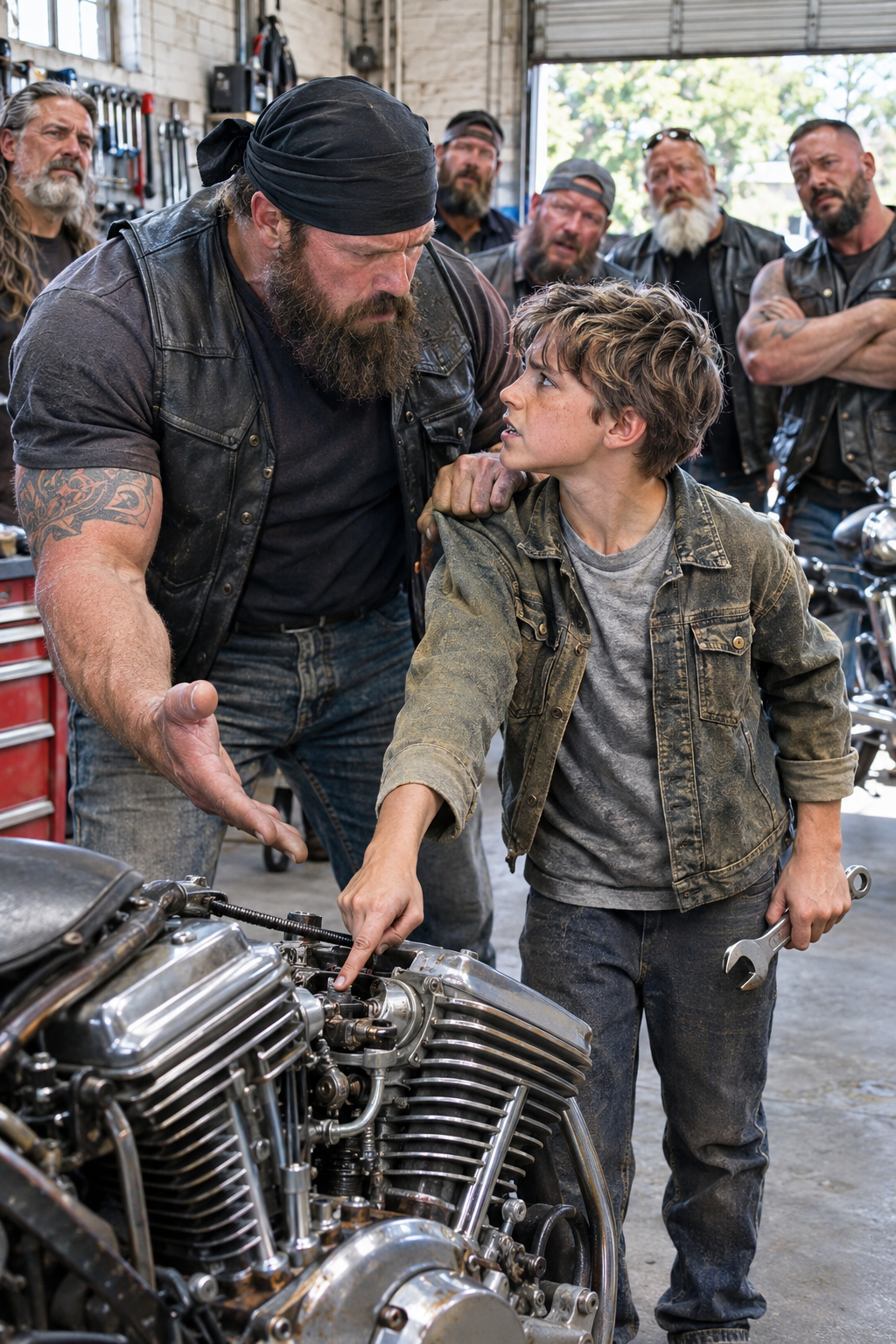
The biker slammed a hammer onto the workbench and pointed at my hands. “Forty-eight hours, kid. Fix that Harley, or you’ll never hold a wrench again.”
The photograph showed three men standing beside a motorcycle outside a small garage. Two wore leather vests. The third wore a faded blue work shirt, his sleeves rolled to the elbows, with an easy smile I recognized immediately.
My father.
I grabbed the photograph so quickly that Harlan nearly dropped it.
“Where did you get this?”
Harlan didn’t answer. He was staring at me as though he’d just seen a ghost.
“That’s my dad,” I whispered. “That’s Daniel Mercer.”
The big man’s face changed. For the first time since I’d entered the clubhouse, I saw something other than anger in his eyes.
I saw fear.
“How old are you, kid?”
“Thirteen.”
“And your mother?”
“She’s dead.”
His jaw tightened.
“When?”
“Last February.”
Harlan turned away, pressing one enormous hand against the workbench.
For several seconds, the only sound was the heater rattling against the bitter November wind.
Then he asked, “When did your father disappear?”
I swallowed.
“Three years ago. He left for work one morning and never came home.”
Harlan closed his eyes.
“Jesus Christ.”
I looked down at the photograph again.
My father was standing beside the same dusty Harley sitting behind me. His right hand rested on the handlebars, and his left arm was draped around Harlan’s shoulders.
But something else caught my attention.
The motorcycle looked brand-new.
“Why do you have a picture of my dad?”
Harlan pulled out a chair.
“Sit down.”
“I don’t want to sit down. I want to know where my father is.”
His expression hardened, but his voice remained quiet.
“Your father was my best friend.”
Those six words hit me harder than the cold outside.
I had spent three years believing my father had abandoned us. Three years listening to neighbors whisper that he was a coward who couldn’t handle responsibility.
And now a man who had threatened to destroy my hands was telling me he’d known him.
“Then why didn’t you help us?”
The question escaped before I could stop it.
Harlan flinched.
It was small, almost invisible, but I saw it.
“Because I didn’t know you existed.”
“That’s a lie.”
“No, son. It’s the worst truth I’ve ever had to tell.”
He leaned forward.
“Your father disappeared from our lives sixteen years ago. He came back briefly three years ago, asking questions about something that happened before you were born. Then he vanished again.”
I stared at him.
“That doesn’t make sense. He lived with us until I was ten.”
“I know that now.”
Harlan rubbed his forehead.
“Daniel had enemies, kid. Dangerous ones. And he spent years making sure they couldn’t find his family.”
A chill ran through me.
“Who?”
Harlan hesitated.
Before he could answer, somebody pounded on the garage door.
“Harlan! Open up!”
It was the old mechanic.
Harlan cursed under his breath, crossed the room, and unlocked the door.
The old man stepped inside, looking pale.
“We’ve got trouble.”
“What kind?”
“Black SUV outside the south gate. Been sitting there twenty minutes.”
Harlan looked at me.
“Did anybody follow you here?”
“No.”
“Think carefully.”
I remembered walking along the railroad tracks after leaving the abandoned house where I’d been sleeping.
A dark vehicle had passed me twice.
At the time, I hadn’t thought anything of it.
“I saw a black SUV near the tracks.”
The old mechanic whispered something ugly.
Harlan immediately grabbed his phone.
“Lock the gates. Nobody comes in without my permission.”
Then he turned toward me.
“Kid, what’s your name?”
“Eli.”
His face softened.
“Eli Mercer.”
He repeated it like the name meant something.
Then he crouched until we were eye level.
“Listen carefully. Whatever happens tonight, you’re not going back outside alone.”
I wanted to believe him.
But I’d learned that grown men could make promises they had no intention of keeping.
“Why should I trust you?”
Harlan looked at the hammer lying on the floor.
“You shouldn’t. Not yet.”
He picked it up and placed it inside a drawer.
“And I owe you an apology for that.”
I didn’t respond.
He stood.
“First, you’re getting something to eat.”
The old mechanic, whose name was Walter, led me into the clubhouse kitchen.
There was a pot of chili on the stove, half a loaf of bread, and a refrigerator covered in motorcycle stickers.
Walter filled a bowl so generously that the chili nearly spilled over.
I tried eating slowly.
I couldn’t.
By the time I finished, my hands were trembling.
Walter quietly placed another bowl in front of me.
“When did you last eat?”
“Yesterday.”
“What did you have?”
I stared down.
“Half a sandwich.”
He sighed.
“Where have you been sleeping?”
“Different places.”
“Kid.”
“An abandoned house. Sometimes the bus station.”
Walter pulled out the chair opposite mine.
“Where’s your family?”
I hesitated.
“My mom died in February. After that, I stayed with her cousin. He said I was too much trouble. Then he started drinking and hitting me.”
Walter’s expression went completely still.
“So you ran.”
I nodded.
“How long ago?”
“Six weeks.”
He looked toward the garage.
“Does Harlan know?”
“No.”
“Then he needs to.”
I grabbed his sleeve.
“Please don’t call that cousin. He’ll make me go back.”
Walter gently removed my hand.
“Nobody’s sending you back to somebody who hurts you without finding out what’s going on.”
Then he stood and walked toward the garage.
I sat alone, listening to voices rise behind the closed door.
A few minutes later, Harlan returned.
He looked older.
Not weaker, exactly.
Just tired in a way I hadn’t noticed before.
“Eli, I need to tell you something about that motorcycle.”
I put down my spoon.
“Okay.”
“That Harley belonged to your father.”
I glanced through the doorway.
“I figured.”
“No. You don’t understand. Daniel built that engine himself. Every modification, every adjustment. He could identify that machine by its sound.”
Harlan sat.
“Twenty-two years ago, Daniel, Walter, and I opened a small motorcycle repair business. We weren’t rich, but we were good. We worked on old Harleys, rebuilt engines nobody else wanted, and sometimes slept right there in the shop.”
He smiled briefly.
“Your dad was the best mechanic I’ve ever known.”
I felt something tighten in my chest.
My father used to say machines were honest.
If something was broken, there was always a reason.
People were harder.
Harlan continued.
“One day, a man named Victor Raines offered us a contract. He owned transportation companies, salvage yards, warehouses. He wanted us to modify motorcycles and vans for his business.”
“What kind of modifications?”
“Hidden compartments. Reinforced frames. Electrical systems that bypassed ordinary tracking equipment.”
Walter appeared in the doorway.
“We thought it was shady, but we didn’t understand how bad.”
Harlan nodded.
“Until Daniel found something inside one of the vehicles.”
“What?”
“A ledger. Names, dates, payments. Records connecting Raines to stolen shipments, corrupt officials, and people who’d disappeared after crossing him.”
I felt sick.
“Why didn’t Dad call the police?”
“He tried. But somebody inside the department warned Raines.”
Walter folded his arms.
“Two nights later, our shop burned down.”
Harlan’s voice became rough.
“Daniel escaped. Walter and I barely made it out. One of our apprentices didn’t.”
I stared at the floor.
“Then what happened?”
“Daniel vanished. He said staying near us would get more people hurt.”
“But he came back three years ago.”
“Yes.”
Harlan leaned closer.
“He told me he’d finally found the evidence he’d hidden years earlier. He said he wanted to make things right.”
“Did he give it to you?”
“No.”
“Why not?”
“Because he didn’t trust anybody.”
Walter looked toward the garage.
“Except maybe that motorcycle.”
I suddenly understood why the old mechanic had warned me that the Harley wasn’t supposed to run.
“Did Dad hide something inside it?”
Harlan exchanged a glance with Walter.
“We’ve suspected it for years,” he admitted.
“Then why didn’t you take it apart?”
“We did. Carefully. But your father knew that motorcycle better than anyone. If he hid something, he knew how to make sure nobody else would find it.”
I looked at my grease-covered hands.
“And the ignition?”
Walter nodded slowly.
“Someone deliberately jammed the advance mechanism. We discovered the problem once, years ago. Before we could repair it, our workshop was broken into. After that, Harlan refused to let anybody take the bike outside the compound.”
Harlan’s eyes darkened.
“When Daniel disappeared again, I made a promise to keep it here until I knew what happened.”
Outside, an engine started.
Then another.
Harlan checked his phone.
The color drained from his face.
“Vehicle’s gone.”
Walter frowned.
“That’s good, isn’t it?”
“No.”
Harlan turned the screen toward him.
“Security camera caught the plates. They’re registered to a company owned by Victor Raines.”
My mouth went dry.
“He’s looking for me?”
Harlan didn’t answer immediately.
Then he said, “I think he’s looking for whatever your father left behind. And tonight, you may have led him straight to it.”
I stared at the motorcycle.
A terrible thought crossed my mind.
“What if Dad didn’t hide the evidence somewhere inside the engine?”
Walter looked at me.
“What do you mean?”
“What if the bike itself tells us where it is?”
Harlan frowned.
I hurried toward the garage.
The engine had been sitting silent for years, but there was something familiar about it.
Something my father had tried teaching me when I was little.
He used to say, “A good mechanic doesn’t just look at what a machine does. He asks what somebody wanted it to do.”
I examined the ignition assembly again.
There were fresh scratches near one mounting screw.
Not ordinary wear.
Tool marks.
I pointed them out to Walter.
“Somebody’s been inside here recently.”
Walter leaned closer.
His expression tightened.
“That’s impossible.”
“Why?”
“Because I haven’t opened that cover in five years.”
Harlan stepped beside us.
“Can you fix it?”
“The ignition? Yes.”
“How long?”
“Maybe an hour if nothing else is wrong.”
“Then do it.”
I looked up.
“You said forty-eight hours.”
Harlan gave a humorless smile.
“Forget the clock.”
I started cleaning the seized mechanism while Walter inspected the springs.
One had been installed incorrectly.
Another had been bent just enough to prevent proper movement.
Someone had deliberately made the motorcycle unreliable.
And they had been clever about it.
The engine might start, but it wouldn’t run correctly under changing speeds.
A careless mechanic could spend days chasing carburetor problems or replacing perfectly good electrical parts.
My father had taught me to recognize exactly that kind of mistake.
By midnight, we’d freed the weights, replaced the damaged spring, and checked the timing.
Walter connected a temporary fuel supply after making sure the tank and lines were safe.
Harlan stood behind us.
“You ready?”
I nodded.
Walter turned on the ignition.
Then he pressed the starter.
The engine turned once.
Twice.
A deep cough shook the frame.
Then the old Harley roared to life.
The sound filled the garage like thunder.
I jumped backward.
Walter laughed.
Harlan didn’t move.
He just stared.
For a moment, his eyes glistened.
“That’s his bike,” he whispered.
“That’s Daniel’s sound.”
I grinned before I could stop myself.
For the first time in months, I felt like I had done something right.
But then I heard it.
A faint metallic rattle beneath the normal engine rhythm.
It came and went at idle.
I leaned closer, listening.
Walter noticed.
“What?”
“Something’s loose.”
He listened.
“Primary chain?”
“Maybe. But it’s not coming from the primary cover.”
I moved around the motorcycle.
The sound seemed to come from beneath the fuel tank.
Harlan shut off the engine.
I reached under the tank and touched a small metal bracket.
It vibrated loosely.
“What is this?”
Walter bent down.
“An old mounting bracket.”
I examined it.
There were two tiny bolts, both coated in grime.
But the bracket itself looked unusual.
I removed it carefully.
Inside was a narrow cavity containing a small brass cylinder.
Harlan stopped breathing.
Walter whispered, “Dear God.”
The cylinder was barely longer than my thumb.
Its cap was sealed with a tiny screw.
Harlan took it from me with trembling fingers.
He opened it.
Inside was a tightly rolled strip of waterproof paper.
Three words were written across it.
MERCER. UNIT SEVEN.
Underneath was a string of numbers.
And at the bottom, in handwriting I knew better than my own, was a sentence.
“Eli, if you found this, I’m sorry.”
My knees almost gave out.
Harlan caught my shoulder.
I read the words again.
They were real.
My father had written my name.
He had known I might someday find the motorcycle.
Walter stared at the paper.
“Unit Seven.”
Harlan swallowed.
“The old freight depot.”
“What?”
“Daniel rented storage space there before he vanished.”
Walter shook his head.
“That place was demolished two years ago.”
“Not all of it,” Harlan said.
“The underground storage units were sold to a private company.”
I stared at the message.
“Then Dad wanted us to go there.”
Harlan folded the paper.
“Maybe.”
“No. He wrote my name.”
“Eli, listen—”
“He knew I’d understand.”
Harlan’s expression changed.
“Understand what?”
I pointed at the numbers.
“They’re not random.”
Walter leaned forward.
“Then what are they?”
I recognized the pattern from evenings spent helping Dad in our garage.
He used to give me small mechanical puzzles when I finished my homework.
Sometimes he’d hide a wrench or a toy inside a toolbox and make me solve combinations to find it.
The numbers on the paper were arranged exactly the same way.
I whispered, “They’re a sequence.”
Harlan watched me.
“Can you read it?”
I nodded.
“The first part is the storage number. The rest is a combination.”
Walter smiled nervously.
“Your father always did love puzzles.”
Then the compound alarm sounded.
A harsh electronic scream echoed through the building.
Someone shouted outside.
“Harlan! South fence!”
A second later, glass shattered.
Harlan grabbed my shoulder.
“Down!”
Something heavy struck the garage door.
Men were yelling.
Boots pounded across concrete.
Walter killed the lights.
The room plunged into darkness.
Through a narrow window, I saw headlights sweep across the courtyard.
A black SUV had smashed through the outer gate.
Two men climbed out.
One carried a crowbar.
The other held something dark at his side.
Harlan pulled me behind a stack of tires.
“Stay here.”
Then he turned to Walter.
“Get him out through the back.”
“But the motorcycle—”
“Forget the motorcycle!”
I grabbed Harlan’s sleeve.
“They’ll destroy it.”
He looked at me.
“That machine is steel and rubber, kid. You’re a living person.”
The words stunned me.
Nobody had spoken about my life like that in a very long time.
Walter guided me toward a rear exit.
We had almost reached it when another man stepped from the shadows.
He wore a black coat and carried a flashlight.
“Nobody moves.”
Walter stopped.
The man lifted the beam toward my face.
Then he smiled.
“Well, look at that.”
He took one step closer.
“Daniel Mercer’s boy.”
I froze.
“You know my dad?”
“Oh, I know him.”
The man was maybe fifty, with thin lips and a long scar near his chin.
He looked at me with unsettling interest.
“Your father caused a lot of trouble.”
Walter stepped in front of me.
“Leave the kid alone, Raines.”
My blood turned cold.
Victor Raines.
The man my father had spent years hiding from.
Raines smiled.
“Walter. Still pretending you’re a mechanic instead of a criminal?”
Walter’s hands clenched.
“You burned our shop.”
“And yet here you are.”
Raines looked past him toward the motorcycle.
“I heard that old engine running.”
He shook his head.
“I should’ve had that thing crushed years ago.”
Then he glanced at me.
“Tell me what you found.”
I didn’t answer.
Raines sighed.
“I don’t enjoy frightening children, Eli.”
He said my name so casually that my stomach twisted.
“But your father made certain decisions. Those decisions have consequences.”
I swallowed.
“Where is he?”
Raines stared at me.
For a moment, something flickered across his face.
Then he said, “You really don’t know?”
My heart began hammering.
“Know what?”
Before he could answer, Harlan appeared behind him.
“Step away from the boy.”
Raines turned.
Harlan held a heavy steel pipe.
His expression was terrifying.
But his voice was controlled.
“Police are coming, Victor. Your people attacked a property full of witnesses and security cameras.”
Raines laughed.
“You think I care about a few cameras?”
“No,” Harlan said. “I think you’ll care about what happens when those recordings reach people you haven’t paid off.”
Raines’s smile disappeared.
Harlan took one step forward.
“Last chance.”
For several seconds, nobody moved.
Then sirens sounded in the distance.
Raines glanced toward the open doorway.
He backed away.
“This isn’t over.”
His gaze returned to me.
“Ask Harlan what happened to your father at Blackwater Bridge.”
Then he disappeared into the darkness.
The next half hour passed in confusion.
Police vehicles surrounded the compound.
Two intruders were arrested after trying to flee through a service entrance. Raines escaped through the damaged south gate before officers reached the property.
Harlan gave a statement.
Walter showed the officers the security footage.
I sat on a wooden bench, wrapped in a borrowed jacket, trying to understand what Raines had said.
Blackwater Bridge.
I knew that name.
It was twenty miles outside town.
Three years earlier, an abandoned pickup truck had been found near the river beneath that bridge.
My father’s pickup.
I remembered the police officer telling Mom there was no evidence of foul play.
I remembered her crying in the kitchen.
And I remembered hearing her whisper something after she thought I’d fallen asleep.
“Daniel wouldn’t leave us.”
Now I understood.
She had never believed he abandoned us.
Neither had I, deep down.
An officer named Detective Alvarez approached me.
She had kind eyes and a notebook tucked under one arm.
“Eli, I’d like to ask you a few questions.”
I glanced at Harlan.
He nodded.
Alvarez sat beside me.
“Harlan told me about your father.”
I stared at my shoes.
“Do you know where he is?”
She hesitated.
“We’ve been trying to find out what happened to him.”
“Then Raines knows something.”
“We believe he does.”
I looked up.
“Why didn’t anybody catch him?”
Her expression grew serious.
“Because the investigation was handled badly. Some evidence disappeared. Some witnesses changed their statements.”
“Harlan said Raines paid people.”
“We have reason to suspect corruption.”
I thought about the paper hidden inside the motorcycle.
I hadn’t told the police about it yet.
Neither had Harlan.
Suddenly, I understood why.
If someone inside law enforcement was helping Raines, revealing our discovery to the wrong person could destroy everything.
Alvarez lowered her voice.
“Eli, I need you to trust me.”
I almost laughed.
Trust.
That word had become dangerous.
“How do I know you’re different?”
She studied me.
Then she reached into her notebook and removed an old photograph.
It showed my father standing beside a younger woman in a police uniform.
“Because your father came to me three years ago.”
My breath caught.
“That’s you?”
She nodded.
“He was trying to reopen a case involving several missing people and a transportation company. He told me he’d found proof, but he disappeared before we could meet again.”
“Why didn’t you help him?”
“I tried. I was transferred off the case shortly afterward. By the time I got back, the evidence was gone.”
She paused.
“Your father wasn’t running away from his family, Eli. He was trying to protect you.”
Tears burned my eyes.
I turned my face away.
For three years, I’d been angry at him.
For three years, I’d told myself he hadn’t loved us enough to stay.
Now I didn’t know what to feel.
Alvarez placed a card beside me.
“If you remember anything, call me directly.”
Then she stood.
I waited until she left before walking back into the garage.
Harlan was sitting beside the Harley.
He held the photograph from his wallet.
“Raines mentioned Blackwater Bridge,” I said.
His shoulders stiffened.
“I heard.”
“What happened there?”
Harlan looked at me for a long time.
Then he said, “The last time I saw your father, he was supposed to meet somebody near that bridge.”
“Who?”
“A man he believed could expose Raines.”
“Did he tell you the man’s name?”
“No.”
I stared at the motorcycle.
“Then the answer is in Unit Seven.”
Harlan shook his head.
“We’re not taking a thirteen-year-old kid into danger.”
“Then go without me.”
“You think I’d leave you here alone?”
I swallowed.
“Then what do we do?”
Harlan looked toward the damaged gate.
“We do this properly.”
The following morning, he called Detective Alvarez.
He told her about the storage unit, the note, and the evidence we suspected was hidden there.
At first, I was furious.
“What if she’s working for Raines?”
Harlan met my eyes.
“Then I’ve made a terrible mistake. But hiding evidence and sneaking into a dangerous place with a child would be another one.”
He was right.
I hated that he was right.
Alvarez arrived with two investigators from a regional task force that had been examining Raines’s businesses.
She explained that the storage location could be secured and searched under a warrant.
When she saw the note, her face changed.
“Daniel left a trail.”
Harlan nodded.
“And Eli found it.”
By afternoon, officers had obtained access to the underground storage area.
I wasn’t allowed inside during the search.
Harlan stayed with me in a vehicle across the street.
The old freight depot was a crumbling brick building surrounded by weeds and broken fencing.
For three hours, nobody came out.
Then Alvarez appeared.
She walked toward our vehicle, carrying a sealed evidence bag.
Her expression told me something important had happened.
“Your father was a very careful man,” she said.
Inside Unit Seven, investigators had discovered a locked metal cabinet containing several hard drives, financial records, photographs, and handwritten notes.
There was also a small cassette recorder.
And an envelope.
My name was written across the front.
Alvarez handed me a photocopy of the letter after the original was documented.
My fingers shook as I unfolded it.
Dear Eli,
If you’re reading this, it means something went wrong.
I hope you’re older now. I hope you’re safe.
I wanted to tell you the truth myself, but I was afraid that bringing it home would put you and your mother in danger.
There are people who hurt others because they believe nobody can stop them. I made mistakes when I was younger. I worked for one of those people before I understood what he was doing.
When I tried to walk away, people suffered.
I’ve spent years trying to make that right.
You once asked me why engines were easier than people.
I told you that engines always have an answer.
I was wrong.
Sometimes people do terrible things, and there is no answer that makes the hurt disappear.
But there is always a choice about what we do next.
You are not responsible for my mistakes.
You never were.
Whatever happens, remember that I loved you every day.
Love,
Dad.
I couldn’t finish reading aloud.
Harlan took the paper gently and waited while I cried.
I cried for my mother.
For the abandoned house.
For every night I’d gone to sleep hungry, believing nobody cared whether I woke up.
And for the father who had loved me enough to leave a message, but who hadn’t been there when I needed him.
Eventually, Alvarez spoke.
“Eli, there’s something else.”
I looked up.
“One of the drives contains video footage from Blackwater Bridge.”
My stomach tightened.
“Does it show Dad?”
She nodded.
“We haven’t finished reviewing everything. But we have enough to believe your father was attacked there.”
I gripped the letter.
“Is he dead?”
Alvarez didn’t answer immediately.
“We don’t have proof of that.”
“Then he could be alive?”
“Possibly.”
Hope can hurt worse than fear.
For the next two days, I barely slept.
Harlan gave me a room upstairs in the clubhouse while Alvarez contacted child protective services to arrange a safe, lawful placement. He made sure a social worker knew about my mother’s cousin and the abuse I’d described.
Walter brought me breakfast every morning.
One of the younger bikers found me a winter coat.
Nobody asked me to repair anything.
Nobody threatened me.
But I kept returning to the garage.
The Harley sat where we’d left it.
Every time I looked at it, I felt closer to my father.
On the third evening, Alvarez called.
Harlan answered.
I watched his expression change.
“Where?”
He listened.
“Are you certain?”
Then he sat down.
For one terrible second, I thought the news was bad.
But when he looked at me, his eyes were wet.
“Eli,” he whispered, “they found him.”
The room seemed to tilt.
“Found who?”
“Your father.”
I grabbed the table.
“Is he alive?”
Harlan nodded.
“Yes.”
I couldn’t move.
Alvarez had traced a name in the storage records to a remote medical facility in another state.
My father had survived the attack at Blackwater Bridge but suffered serious injuries, including a traumatic brain injury.
For months afterward, he’d struggled with memory loss and confusion. During his recovery, someone connected to Raines had arranged for him to be transferred under a false name.
He eventually regained enough memory to tell a doctor about his son, but his account was dismissed as confusion because nobody could verify his identity.
Then the facility changed ownership.
His records became even harder to trace.
For three years, he’d been alive.
Three years.
I sat down hard.
“Does he remember me?”
Harlan’s voice broke.
“He asked for you.”
The following morning, Alvarez arranged for me to travel with a social worker to a hospital where my father had been transferred for evaluation.
Harlan came too, with the necessary permissions.
I spent the entire drive staring out the window.
What if he looked different?
What if he didn’t remember our garage?
What if he blamed me for not finding him sooner?
When we reached the hospital, my legs felt weak.
A nurse led us down a quiet hallway.
She stopped outside Room 214.
“He’s waiting.”
I stood there, unable to touch the handle.
Harlan rested a hand on my shoulder.
“You don’t have to rush.”
I looked at him.
“What if he doesn’t want me?”
Harlan’s face crumpled.
“Oh, kid.”
He knelt.
“Your father spent years fighting to get back to you.”
Then he opened the door.
My father sat beside the window in a wheelchair.
His hair was grayer.
His face was thinner.
There was a scar above his right eyebrow that hadn’t been there before.
But when he turned, I recognized his eyes.
“Eli?”
His voice was rough and uncertain.
I couldn’t speak.
He lifted a trembling hand.
“Buddy?”
That was what he used to call me.
Before school.
Before bedtime.
Whenever I managed to repair something he thought was too difficult.
I crossed the room and threw my arms around him.
He held me as tightly as he could.
“I’m sorry,” he whispered.
“I’m so sorry.”
I buried my face against his shoulder.
“I thought you left us.”
His breathing broke.
“Never.”
“Mom died.”
He went completely still.
I felt his arms loosen.
Then he began to cry.
Not quietly.
Not the way grown men sometimes pretend they’re not crying.
He sobbed as though something inside him had finally shattered.
I held him.
There was nothing I could say that would make it better.
Eventually, he whispered, “She was supposed to know I was coming home.”
I pulled back.
“What?”
He looked toward Harlan.
“I remembered enough. A year ago, I asked someone here to find my family.”
The nurse checked the records.
The request had been documented but never completed. Staff had tried contacting an outdated address, and without a confirmed identity, the search had stalled.
My father closed his eyes.
“I kept telling them I had a son.”
I squeezed his hand.
“I’m here now.”
He looked at me.
And despite everything, he smiled.
For the first time in three years, I saw my father smile.
The investigation that followed changed everything.
The records from Unit Seven exposed a network of theft, bribery, and intimidation stretching across several counties.
Several officials were suspended while investigators examined missing evidence and falsified reports.
Victor Raines was arrested six weeks later while attempting to leave the country.
The case took many months to move through court.
Not everyone responsible was convicted. Some charges were dismissed, and some questions remained unanswered.
But the evidence my father had protected finally reached prosecutors who couldn’t simply make it disappear.
As for my father, recovery wasn’t easy.
His memory improved, but his injuries left him with weakness in one leg and occasional difficulties finding words.
He couldn’t work the way he used to.
Some mornings were better than others.
I learned that getting somebody back doesn’t erase what happened while they were gone.
Dad couldn’t undo my mother’s death.
He couldn’t give me back the birthdays he’d missed.
He couldn’t make the hunger or fear disappear.
But he could sit beside me.
He could listen.
And when I woke from nightmares, he could remind me that I wasn’t alone anymore.
Harlan helped arrange a small apartment near the rehabilitation center after Dad was discharged.
A social worker helped establish a safe plan for us, with additional support while Dad recovered.
Walter visited every weekend.
Sometimes he brought tools.
Sometimes groceries.
Once, he brought a photograph of the old repair shop before the fire.
Dad stared at it for a long time.
Then he laughed.
“Look at Harlan’s hair.”
Harlan, who had come along, groaned.
“Don’t start.”
For the first time, the room filled with laughter instead of grief.
Several months later, Dad was strong enough to visit the clubhouse.
Harlan had cleaned the old Shovelhead until its chrome shone.
The engine had been inspected, serviced, and repaired properly.
Its faded paint remained untouched.
When Dad saw it, he stopped walking.
“She’s still here.”
Harlan nodded.
“Right where you left her.”
Dad reached out and rested his palm on the fuel tank.
For a moment, neither man spoke.
Then Harlan said, “Your boy fixed her.”
Dad looked at me.
“Did he?”
I nodded.
“The advance weights were stuck. Somebody bent the spring.”
Dad smiled.
“Good catch.”
I laughed nervously.
“You taught me.”
He studied the motorcycle.
Then he looked at Harlan.
“Does she run?”
Harlan grinned.
“Like thunder.”
Walter pressed the starter.
The engine came alive.
Dad closed his eyes.
I watched his face as the familiar rhythm filled the garage.
He wasn’t thinking about Raines.
Or the bridge.
Or the years he’d lost.
For one brief moment, he was the man I’d remembered.
The mechanic who taught his son that every strange noise had a reason.
When Walter shut the engine off, Dad wiped his eyes.
“Sounds better than I remember.”
Harlan chuckled.
“Your kid’s got talent.”
Dad turned toward me.
“He’s got patience.”
Then he took my hand.
“That’s worth more.”
I looked at Harlan.
The enormous biker who had once threatened my hands stood beside the workbench with his arms folded.
He caught me watching.
“What?”
I smiled.
“You still owe me something.”
He raised an eyebrow.
“Do I?”
“You gave me forty-eight hours to fix that Harley.”
Harlan groaned.
Walter started laughing.
“I finished in less than one night.”
Harlan looked toward Dad.
“Your boy drives a hard bargain.”
Dad smiled.
“He gets that from his mother.”
Harlan reached into his pocket.
He pulled out a small brass key attached to a leather cord.
I recognized it immediately.
It was the key to the toolbox he’d pushed toward me that first night.
He placed it in my palm.
“That toolbox is yours.”
I stared at him.
“Really?”
“Really. But there’s a condition.”
I looked up.
“What?”
“You finish school. You follow the safety rules. And you don’t let anybody convince you that being good with your hands means you have nothing worth learning from books.”
I nodded.
Then Harlan crouched.
His expression turned serious.
“And one more thing.”
“What?”
“Nobody gets to threaten you into proving your worth. Not here. Not anywhere.”
My throat tightened.
He held out his hand.
“I’m sorry I did.”
I shook it.
His hand swallowed mine.
“I forgive you.”
Years passed.
My father never returned to full-time mechanical work, but he taught classes at a vocational training center. Walter helped him adapt his lessons to his physical limitations.
Harlan’s garage became a place where local teenagers could learn practical skills after school.
Some came from difficult homes.
Others were simply curious.
Nobody had to earn a meal or a warm place to sit by repairing a motorcycle.
That rule was Harlan’s idea.
He called it Mercer’s Garage Project.
Dad protested when he saw the name.
Harlan told him to stop complaining.
I graduated from high school with a scholarship to study mechanical engineering.
On graduation day, Dad sat in the front row beside Harlan and Walter.
When my name was called, the three of them cheered so loudly that the principal laughed.
I spotted Dad wiping his eyes.
He was smiling.
That mattered more than the diploma in my hand.
Four years later, I returned to town with an engineering degree, a job offer, and a decision.
I wanted to build something of my own.
Not because I needed to prove myself.
Not because somebody had given me a deadline.
But because I loved the work.
With Dad’s guidance and help from the community, I opened a small repair and restoration workshop.
Above the entrance hung a simple wooden sign.
MERCER & SON MOTOR WORKS.
On opening day, Harlan arrived riding the restored 1974 Shovelhead.
He parked outside and handed me the keys.
I stared at him.
“What’s this?”
He smiled.
“Your dad says the bike belongs in the family.”
Dad stood beside him, leaning on his cane.
“She’s yours, Eli.”
I looked from one man to the other.
“But that’s your motorcycle.”
Dad shook his head.
“No, son. It was mine when I needed it. Then it helped bring us back together.”
He rested his hand on my shoulder.
“Now it’s part of your story.”
I stared at the machine.
I remembered the freezing November night.
The hunger.
The hammer striking the workbench.
The old mechanic whispering that the motorcycle wasn’t supposed to run.
I remembered believing that a broken engine was the only reason anyone would let me stay somewhere warm.
And I remembered the faded photograph that had changed everything.
Harlan stepped closer.
“You know something, Eli?”
“What?”
“That night, I thought you were just a kid who’d broken into my garage.”
He glanced at the motorcycle.
“I figured I’d scare you into learning a lesson.”
I smiled faintly.
“You succeeded.”
He shook his head.
“No. I learned the lesson.”
He looked at Dad, then back at me.
“I saw a hungry child standing in front of me, and the first thing I gave him was a threat.”
His voice grew quiet.
“I should’ve given him dinner.”
Nobody spoke for a moment.
Then Dad reached out and squeezed his shoulder.
“You gave him something eventually.”
Harlan nodded.
“A chance to find his way home.”
That afternoon, after everyone left, I stayed in the workshop alone.
The old Harley stood beneath the bright overhead lights.
Its chrome reflected the clean concrete floor.
I took out the little brass cylinder that investigators had eventually returned to our family after the trial.
The paper inside had been carefully preserved.
I unfolded a copy of my father’s message.
“Eli, if you found this, I’m sorry.”
For years, I’d thought those words were about his disappearance.
Now I understood they meant something more.
My father had been sorry for the danger he’d brought into our lives, for the choices he’d made when he was young, and for the years he couldn’t be there.
But he’d also left me something far greater than an explanation.
He’d taught me to look beyond the obvious.
To listen before judging.
To recognize that a machine could look ruined when one small part was preventing everything else from working.
And through Harlan, I’d learned another lesson.
People weren’t machines.
You couldn’t repair a frightened child by giving him a deadline.
You couldn’t heal loneliness with threats.
And you couldn’t measure someone’s worth by what they could do for you.
Sometimes the most important thing a person needed wasn’t a solution.
It was somebody willing to notice they were hurting.
I placed the paper back inside its protective case.
Then I walked to the workshop door.
Outside, the evening air was cold.
A teenage boy stood near the sidewalk, studying the sign above my entrance.
His jacket was too thin for the weather.
His shoes were worn.
He looked about thirteen.
When he noticed me watching, he turned to leave.
“Hey,” I called.
He stopped.
“You interested in motorcycles?”
He hesitated.
“Maybe.”
“Ever worked on one?”
He shook his head.
I smiled.
“Want to learn?”
His eyes flickered toward the open garage.
“I don’t have any money.”
“Didn’t ask for any.”
He looked confused.
“Then what do you want?”
I thought about the man who’d threatened me with a hammer, then learned to protect me instead.
I thought about Walter bringing me a second bowl of chili.
I thought about my father, sitting in a hospital room, waiting for someone to tell him his son was alive.
Then I looked at the boy.
“Nothing,” I said. “But I’ve got some soup inside if you’re hungry.”
He stared at me.
For one brief second, I saw my younger self standing there.
Cold.
Scared.
Convinced that kindness always came with a price.
I stepped aside and held the door open.
“Come on in. You can get warm.”
He hesitated.
Then he walked past me.
And as the workshop door closed against the November wind, I understood something I’d spent half my life learning.
The greatest thing my father taught me wasn’t how to fix an engine.
It was how to recognize when something precious was worth saving.
And the greatest thing Harlan taught me wasn’t how to be tough.
It was that real strength begins when you realize somebody weaker than you needs protection, not fear.
That night, I didn’t pick up a hammer.
I didn’t point at a clock.
And I didn’t ask the boy to prove he deserved to stay.
I simply put a bowl of hot soup in front of him, pulled out a chair, and listened.
Because sometimes, saving a life doesn’t begin with a heroic act.
Sometimes it begins with a warm room, a full stomach, and four simple words.
“You’re safe here now.”
And if that old Harley taught me anything, it was this: what looks broken beyond repair may still have a beautiful future, provided someone cares enough to look for the real problem—and loves enough to help without demanding anything in return.
The boy sat across from me, holding the warm bowl of soup with both hands. His name was Noah, and he was fourteen years old. He had been sleeping behind a grocery store for nearly a week after running away from an unsafe home.
I recognized the way he watched the door, the way he apologized whenever he asked for something, and the way he seemed convinced that kindness would eventually come with a price.
That night, I called a trusted social worker who helped us arrange a safe place for him to stay. With the proper support, Noah began attending school again. Every afternoon, he returned to the workshop, where I taught him the same lessons my father had taught me.
Months passed, and the frightened boy gradually became a confident young mechanic.
One afternoon, Noah discovered a problem in an old motorcycle that three experienced mechanics had overlooked. When he explained his diagnosis, I couldn’t help smiling.
“What?” he asked nervously.
“Nothing,” I said. “You just reminded me of somebody.”
“Who?”
“A thirteen-year-old kid who once thought fixing a motorcycle was the only way to earn a warm place to sleep.”
Noah looked at me for a moment.
“Was that you?”
I nodded.
He stared at the wrench in his hand.
“Did everything turn out okay?”
I glanced through the workshop window.
Outside, my father was sitting beside Harlan, watching the sunset. Walter stood nearby, arguing cheerfully about which motorcycle deserved to be restored next.
My family wasn’t perfect. We had lost years we could never recover, and there were wounds that time could soften but never completely erase.
But we were together.
“Not everything,” I answered. “But enough to make me grateful.”
Years later, Noah graduated from technical college and returned to work beside me. Eventually, our little workshop expanded into a training center that offered free mechanical courses to teenagers facing difficult circumstances.
We named the program Second Chances.
On the wall near the entrance, I hung two photographs.
The first showed my father, Harlan, and Walter standing beside the Harley in their younger years.
The second showed Noah, me, and a dozen smiling teenagers gathered around that same motorcycle.
Beneath the pictures, I placed a small brass plaque.
It carried a sentence my father had repeated throughout my childhood:
“Never judge something only by how broken it appears.”
My father lived long enough to see the training center welcome its hundredth student.
On that day, he stood before the young mechanics, leaning on his cane, and told them something I would remember forever.
“Your past may explain where you started, but it doesn’t get to decide where you finish. What matters is what you choose to build with the life you have.”
The room erupted in applause.
I stood beside him, trying unsuccessfully to hide my tears.
When he passed away peacefully several years later, surrounded by people who loved him, I found a small envelope inside his old toolbox.
My name was written across the front.
Inside was a photograph of us together when I was five years old. I was sitting on his lap, holding a wrench almost as big as my arm.
On the back, he had written:
“Eli, you were never the broken thing that needed fixing. You were always the reason I wanted to make things right.”
I held that photograph for a long time.
Then I returned it to the toolbox and placed the box beneath his portrait in the workshop.
That evening, as I prepared to close, Noah approached me with a young girl standing beside him.
She was frightened, shivering in a thin jacket, and clutching a worn backpack.
“She needs some help,” Noah explained quietly.
I looked at the girl, then at the warm lights glowing inside our workshop.
And I remembered the bitter November night when I had walked through an unlocked door, desperate for somewhere to belong.
I smiled gently.
“Come inside. We’ve got dinner.”
Noah opened the door for her.
As they walked inside, I glanced one last time at the old Harley parked beneath my father’s photograph.
That motorcycle had once been a symbol of danger, secrets, and loss.
Now it stood as a reminder of everything love, courage, and compassion could rebuild.
Because the greatest legacy we leave behind isn’t the money we earn, the machines we repair, or the victories we achieve. It’s the lives that become better because we were here.
And sometimes, the most extraordinary stories don’t end when someone finally finds a home.
They truly begin when that person learns how to become a home for somebody else.
THE END.