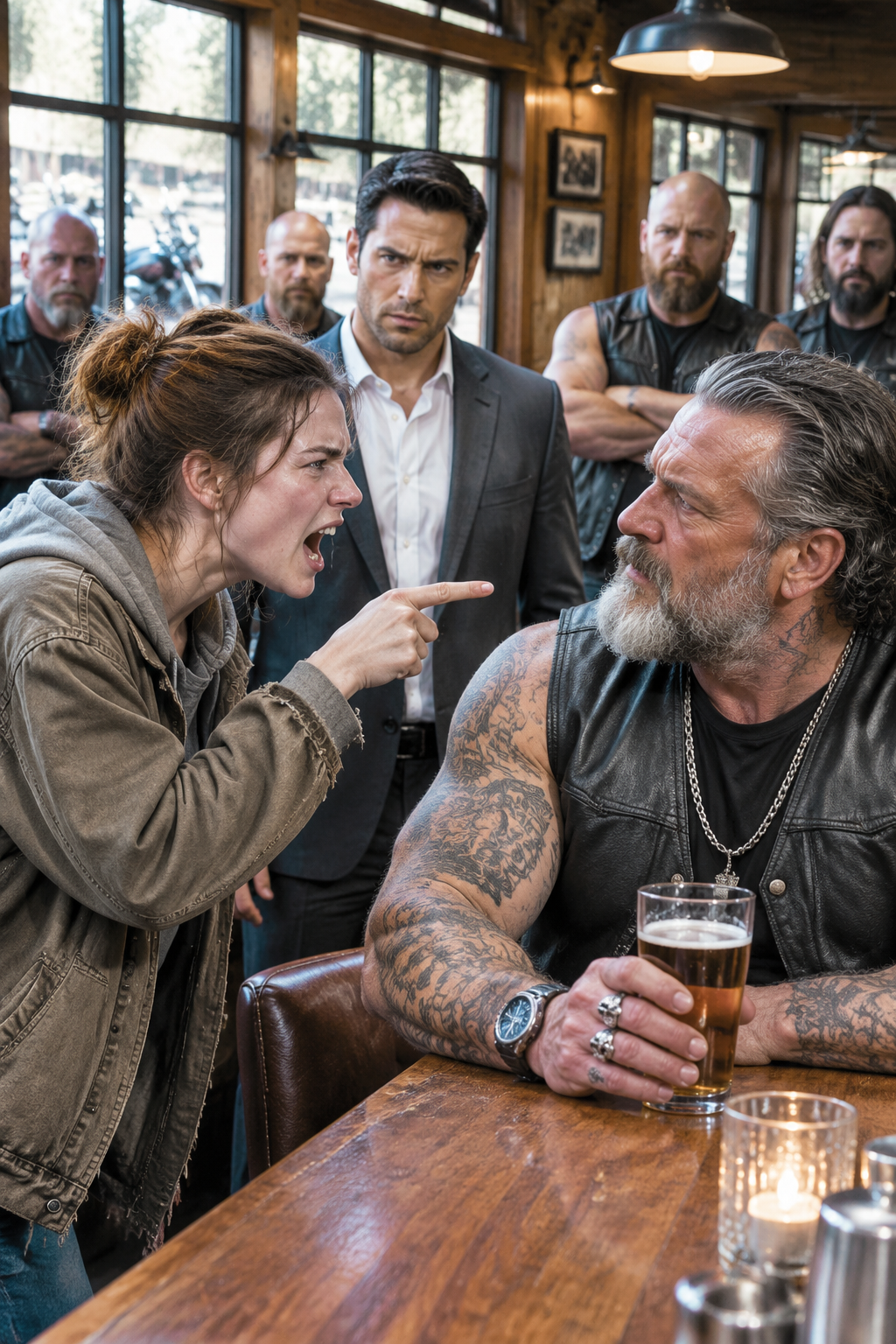
The bartender had just handed the Hells Angels president a cold beer when a homeless woman rushed across the tavern and knocked it out of his hand.
A young woman stumbled inside, clutching her left arm. Blood seeped through the sleeve of her denim jacket, and her breathing was shallow.
“Dad!” she cried.
The bartender rushed around the counter.
“Emily!”
Before he could reach her, Maggie stepped forward and caught the young woman as her knees buckled. She lowered her carefully to the floor and examined the wound.
“Get me some clean towels. Now.”
Nobody questioned her.
The massive biker who had threatened Maggie moments earlier hurried behind the bar. Another grabbed the first aid kit from the wall.
Emily looked up at her father.
“They came to the house,” she whispered. “They said you didn’t finish the job.”
The bartender covered his mouth.
Brick’s expression hardened.
“Who came to your house?”
“Two men. One of them had a scar across his neck. They took Mom.”
The bartender staggered backward as though someone had punched him in the chest.
“No. Please, God, no.”
Maggie pressed a towel against Emily’s wound.
“Stay with me, sweetheart. You’re going to be all right.”
Then Emily noticed the security footage still playing on the phone beside her.
Her eyes widened.
“That’s him.”
She pointed at the second man.
Maggie felt a chill travel through her entire body.
The man in the footage was wearing a gray suit and an expensive watch. His silver hair was neatly combed, and his face carried the warm, reassuring expression of someone who had spent years convincing people to trust him.
His name was Richard Caldwell.
And Maggie knew him better than anyone in that room could possibly imagine.
Three years earlier, Richard Caldwell had been the administrator of the hospital where she worked.
He was also the man responsible for destroying her life.
“That man,” Maggie said quietly, “is the reason I’m homeless.”
Brick turned toward her.
“What are you talking about?”
Before Maggie could answer, police sirens sounded outside.
Two officers entered the tavern, followed by paramedics. While Emily was being treated, Maggie explained everything she had witnessed. The officers secured the broken bottle, collected the plastic cap, and took statements from everyone present.
But when Maggie mentioned Caldwell’s name, one of the officers stopped writing.
“Richard Caldwell? The chairman of the Caldwell Foundation?”
“Yes.”
“Are you certain?”
“I worked for him for eleven years.”
The officer exchanged a glance with his partner.
Caldwell was practically royalty in Vallejo. His foundation donated money to schools, hospitals, and community programs. His photograph appeared regularly in local newspapers.
He was the kind of man who shook hands with mayors and attended charity dinners.
Nobody wanted to believe he was capable of attempted murder.
Brick noticed the hesitation.
“You got a problem believing her?”
“We’ll investigate every possibility,” the officer replied.
After the ambulance departed with Emily, the bartender accompanied the police to provide information about his missing wife.
Brick waited until the tavern had emptied.
Then he pulled out a chair for Maggie.
“Sit down.”
She hesitated.
“I’m probably not welcome here.”
“You just saved my life. You’re welcome here whenever you want.”
Someone placed a steaming bowl of soup in front of her.
Maggie stared at it.
She hadn’t eaten a proper meal in two days.
Brick sat across from her while she slowly lifted the spoon.
“Tell me what Caldwell did to you.”
For several moments, Maggie said nothing.
Then she began.
Three years earlier, she had worked the night shift at St. Catherine’s Medical Center. She loved her patients, knew their families, and often stayed beyond her scheduled hours.
One evening, she discovered unusual discrepancies in the hospital’s medication records.
Several expensive medications had been documented as administered to patients who had never received them. Other records contained signatures belonging to nurses who weren’t even working those shifts.
Maggie reported her findings.
Caldwell personally assured her that he would investigate.
Two weeks later, a patient died unexpectedly.
The medication records indicated that Maggie had administered the wrong drug.
She hadn’t.
She had been helping another nurse resuscitate a patient on a different floor when the fatal medication was given.
But the electronic records told a different story.
Her access credentials had been used. Her name appeared everywhere.
The security footage that could have cleared her was mysteriously unavailable.
“I begged them to believe me,” Maggie whispered. “I told them someone had changed the records.”
Caldwell testified that she had been under considerable emotional stress and had become unreliable.
Maggie’s nursing license was suspended. The hospital fired her. Although criminal charges were never filed because of insufficient evidence, her reputation was ruined.
Legal expenses consumed her savings.
Then she lost her apartment.
Her friends gradually stopped answering her calls.
Eventually, the woman who had spent her life caring for others found herself sleeping beneath cardboard boxes.
Brick listened without interrupting.
“Why didn’t you leave town?”
Maggie looked down at her soup.
“My daughter is buried here.”
Brick’s expression softened.
“She died when she was nine. Leukemia. After that, nursing was the only thing that made me feel like my life still mattered.”
She wiped her eyes.
“When Caldwell took that away, I didn’t know who I was anymore.”
Brick leaned back.
“And he approached you this morning?”
“Yes. He offered me money. Told me there was a shelter opening in Sacramento and that he could arrange transportation.”
“Did you accept?”
“No. Something about it frightened me.”
Brick looked toward the darkened window.
“He wanted you gone before tonight.”
The realization made Maggie’s stomach tighten.
Caldwell had recognized her.
Perhaps he had even noticed her watching the tavern.
Before either could speak again, Brick’s phone rang.
The caller was an attorney named Daniel Foster, who had represented Brick during the waterfront negotiations.
“Brick, we’ve got a serious problem,” Daniel said. “Someone filed documents this afternoon claiming you agreed to sell the property.”
“I never signed anything.”
“I know. The signature looks forged. But there’s something else. The purchasing company is controlled through several subsidiaries.”
“Who owns it?”
There was a brief silence.
“Richard Caldwell.”
Brick slowly lowered the phone.
Maggie stared at him.
The hospital administrator, the waterfront development, the poisoned beer.
Everything was connected.
But neither of them understood how deep the connection went.
At least, not until the following morning.
Maggie awoke in a small upstairs room above the tavern. Brick had insisted she stay there, and for the first time in months, she had slept beneath clean blankets without worrying about someone stealing her belongings.
Downstairs, several bikers were gathered around a television.
A reporter stood outside Caldwell’s luxurious waterfront office.
“Local philanthropist Richard Caldwell has denied allegations connecting him to an apparent poisoning incident yesterday evening.”
Caldwell appeared on screen.
“I am deeply disturbed by these accusations,” he said. “Unfortunately, they seem to originate from a former employee with a documented history of instability.”
Maggie’s face drained of color.
He was talking about her.
“I sincerely hope Ms. Sullivan receives the professional assistance she clearly needs.”
Brick switched off the television.
“That son of a—”
“It’s happening again,” Maggie whispered.
Her hands began trembling.
“He’s doing exactly what he did before.”
Brick approached her.
“Look at me. This time you’re not alone.”
Just then, the tavern door opened.
An elderly man wearing a faded brown jacket entered cautiously.
“Maggie?”
She recognized him immediately.
“Dr. Harris?”
Dr. Leonard Harris had been the chief physician at St. Catherine’s before retiring two years earlier.
He looked older than she remembered.
“I saw the news,” he said. “We need to talk somewhere private.”
Brick led them upstairs.
Dr. Harris sat heavily in a chair and removed an envelope from his jacket.
“I owe you an apology, Maggie.”
She stared at him.
“What for?”
“Because I knew.”
The room became painfully quiet.
“I knew the medication records had been altered. I suspected Caldwell was involved. When you were accused, I could have demanded an independent investigation.”
“Why didn’t you?”
The elderly doctor’s eyes filled with shame.
“He threatened my son’s medical career. I convinced myself that staying silent was protecting my family.”
Maggie stood abruptly.
“You watched them destroy me.”
“I did.”
“You knew I was innocent, and you let me lose everything.”
Dr. Harris lowered his head.
“Yes.”
Maggie turned away, struggling to breathe.
For three years, she had wondered whether she could have made a mistake. Whether exhaustion had somehow caused her to forget something important.
Now she knew.
Someone could have saved her.
Someone had chosen not to.
Dr. Harris placed the envelope on the table.
“Before I retired, I kept copies of internal correspondence and billing records. Caldwell was diverting hospital funds through shell companies. I believe some of that money financed his waterfront acquisitions.”
Brick picked up the envelope.
“Will this put him away?”
“It’s a beginning. But the strongest evidence was stored on an internal server. A former hospital accountant copied part of it before disappearing.”
“Disappearing?”
“Her name was Laura Bennett.”
Maggie froze.
Laura had been one of her closest friends at the hospital.
She remembered Laura calling her shortly after the accusations began, promising to find proof that would clear her name.
Then the calls stopped.
Everyone said Laura had moved away.
“Where is she?” Maggie asked.
“I don’t know. But she mailed me something six months ago.”
Dr. Harris handed her a photograph.
It showed a storage facility near the waterfront. On the back, someone had written a unit number.
Maggie recognized Laura’s handwriting.
Brick immediately contacted Daniel, who arranged to pass the information to a detective handling the poisoning investigation.
The detective agreed to meet them at the storage facility.
But when they arrived, smoke was already rising above the buildings.
Firefighters were struggling to contain a blaze that had engulfed several units.
Maggie climbed out of Brick’s truck.
“No.”
She watched flames consume the row of storage containers.
“Not again.”
A firefighter blocked her path.
“Ma’am, you need to stay back.”
Then Maggie heard someone shouting near an ambulance.
A woman was being treated for smoke inhalation.
Her hair was gray at the temples, her face covered in soot.
But Maggie recognized her.
“Laura!”
The woman turned.
For a moment, neither moved.
Then Laura burst into tears.
“Maggie?”
They embraced beside the ambulance.
“I tried to reach you,” Laura sobbed. “Your phone was disconnected. I couldn’t find you anywhere.”
“What happened here?”
“Someone followed me. I came to collect the evidence after seeing Caldwell on television. Before I could get everything out, the fire started.”
Maggie’s heart sank.
“Everything’s gone?”
Laura shook her head.
“Not everything.”
She pulled a small flash drive from inside her coat.
“I learned a long time ago never to keep only one copy.”
The detective took possession of the drive.
For the first time, Caldwell’s carefully constructed empire began to crack.
But a dangerous man with everything to lose was about to become even more dangerous.
That evening, the bartender’s phone received a message.
It contained a photograph of his wife, Susan, tied to a chair inside an abandoned warehouse.
Beneath the photograph were instructions.
Bring Maggie Sullivan to the old shipyard office before midnight.
Come alone.
The bartender immediately showed Brick.
“I can’t lose her,” he said desperately. “Please. I don’t know what to do.”
Brick called the detective.
Maggie stared at Susan’s photograph.
She understood why Caldwell wanted her. She could connect him directly to the poisoning, and her testimony could help expose the hospital fraud.
He was running out of ways to silence her.
“I’ll cooperate with whatever the police decide,” Maggie said.
Brick shook his head.
“You’re not risking your life for this.”
“There’s a woman out there who might die because of what happened yesterday.”
“And getting yourself killed won’t save her.”
Maggie looked at him.
“Three years ago, people decided my life wasn’t worth risking their comfort. I won’t make that same decision about someone else.”
Brick had no answer.
The detective arranged a controlled operation around the shipyard.
Maggie agreed to participate under police supervision, but she was terrified.
As midnight approached, the waterfront disappeared beneath a thick blanket of fog.
The old shipyard office stood beside a deserted loading dock.
Maggie entered with the bartender.
Inside, a single overhead light illuminated Susan, who was bound to a chair.
A man with a scar across his neck stood behind her.
And beside him was Richard Caldwell.
He looked remarkably calm.
“Maggie,” he said. “You’ve caused quite a mess.”
The bartender rushed toward his wife, but the scarred man raised a gun.
“Don’t move.”
Caldwell studied Maggie’s worn coat.
“You could have accepted my offer this morning. A fresh start. Somewhere comfortable.”
“Like the fresh start you gave Laura?”
His smile disappeared.
“You should have stayed out of matters you didn’t understand.”
“I understood enough to know you were stealing from sick people.”
Caldwell sighed.
“You always were painfully self-righteous.”
“A patient died because of what you did.”
“An unfortunate complication.”
Maggie felt sick.
That patient had been a grandfather named Walter Jenkins. She remembered his daughter bringing him homemade cookies and his grandchildren drawing pictures beside his hospital bed.
To Caldwell, he was merely a complication.
“Did you change my records?” she asked.
Caldwell stepped closer.
“You were going to expose millions of dollars in transactions. I needed your allegations discredited.”
“So you blamed me for his death.”
“You were convenient.”
The words struck harder than Maggie expected.
Three years of suffering.
Three years of humiliation.
All because she had been convenient.
Outside, officers were moving into position.
But before they could enter, the scarred man noticed a shadow passing across the window.
“Police!”
Everything happened at once.
Caldwell grabbed Susan’s chair and pulled it backward. The bartender lunged toward his wife. The scarred man fired, shattering the overhead light.
Darkness swallowed the room.
Maggie heard screaming, footsteps, and officers shouting commands.
Then a heavy object struck the floor.
When emergency lights illuminated the warehouse moments later, the gunman was lying facedown, surrounded by officers.
Caldwell was attempting to escape through a rear exit.
Brick, who had been waiting beyond the police perimeter, saw him stumble from the building.
Caldwell slipped on the wet dock and fell hard.
Brick could have walked away.
He could have watched the man who tried to murder him disappear into the freezing water below.
Instead, when Caldwell slid toward the edge, Brick grabbed his jacket and dragged him back.
Two officers arrived and placed Caldwell in handcuffs.
“You should’ve let me fall,” Caldwell muttered.
Brick looked at him with disgust.
“No. You’re going to live long enough to answer for what you did.”
Inside the warehouse, Maggie found the bartender kneeling beside Susan.
He was bleeding from his shoulder.
“Help him!” Susan screamed.
Maggie immediately went to work.
Her hands were steady now.
She instructed Susan to maintain pressure while she assessed the injury. When paramedics arrived, she provided a clear account of his condition.
As they lifted him onto a stretcher, the bartender caught Maggie’s hand.
“I’m sorry.”
She knew what he meant.
He had nearly helped kill Brick. He had lied. He had allowed fear to guide his decisions.
“You’ll have a chance to make things right,” she told him. “Don’t waste it.”
He nodded through his tears.
Over the following weeks, investigators uncovered evidence of financial fraud, falsified medical records, bribery, and illegal property transactions.
Laboratory testing confirmed that Brick’s beer had contained a dangerous substance.
Laura’s evidence exposed years of criminal activity.
Caldwell and several associates were charged with multiple offenses. The bartender cooperated with investigators, knowing that his own actions would also carry consequences.
Dr. Harris testified about his silence and Caldwell’s threats.
For Maggie, however, the most important moment came seven months later.
She received a letter from the state nursing board.
Following an extensive review, the board had overturned the disciplinary findings against her and reinstated her license.
Maggie read the letter three times.
Then she sat on the edge of her bed and cried.
Not because everything was suddenly perfect.
The years she had lost could never be returned.
But the truth had finally been acknowledged.
Downstairs, Brick and the others were waiting.
When Maggie appeared holding the letter, the entire tavern erupted in applause.
The massive biker who had once threatened her lifted a glass.
“To Nurse Maggie!”
She laughed through her tears.
Brick handed her another envelope.
Inside was a set of keys.
“What’s this?”
“There’s an empty building next door. Used to be a dentist’s office.”
Maggie looked confused.
“The club bought it,” he continued. “Daniel helped us organize a nonprofit. We’ve got some doctors willing to volunteer, including Harris. We thought you might want to help run a clinic.”
“A clinic?”
“For people who can’t afford one.”
Maggie stared at the keys.
She thought about the countless nights she had spent outside, watching people hurry past without acknowledging her existence.
She remembered the untreated wounds, the sick elderly men, and the frightened women who had nowhere to turn.
“What would we call it?” she asked.
Brick smiled.
“That’s up to you.”
One year later, a modest blue sign appeared beside the tavern.
The Lily Sullivan Community Clinic.
Named after Maggie’s daughter.
On opening day, dozens of people lined up outside. Some needed medical attention. Others needed help finding housing, counseling, or simply someone willing to listen.
Maggie welcomed every person who walked through the door.
Dr. Harris volunteered twice a week. Laura managed the clinic’s finances, determined that every donated dollar would be accounted for.
Brick and his fellow bikers repaired the building, delivered supplies, and occasionally drove patients to medical appointments.
One rainy afternoon, a homeless man approached the clinic.
His clothes were filthy, and his shoes were held together with tape.
He stood outside, staring through the window.
Maggie recognized the hesitation.
She opened the door.
“Can I help you?”
The man lowered his eyes.
“I don’t have any money.”
“That’s all right.”
“I probably shouldn’t come inside. I’m a mess.”
Maggie smiled gently.
“Come in anyway.”
Across the street, Brick watched her lead the man inside.
He remembered the afternoon she had rushed into his tavern and knocked a beer from his hand.
Back then, everyone had seen a homeless woman causing trouble.
Nobody had seen the experienced nurse, the grieving mother, or the courageous person who was willing to risk everything to save a stranger.
Except, perhaps, the stranger she had saved.
Maggie had entered his tavern with nothing but a battered backpack and a warning.
She had given him something more valuable than any possession he owned.
Another chance at life.
And together, they had turned that chance into something that would outlive them both.
Because a person’s worth is not measured by the clothes they wear, the money they possess, or the place they sleep at night.
Sometimes, the person the world has forgotten is the very person who can teach it how to care again.
But Maggie’s story wasn’t quite finished.
Six months after the clinic opened, a black sedan pulled up outside the building on a cold November morning.
A woman in her early forties stepped out, carrying a large brown envelope. She stood beneath the blue sign for several minutes before finally entering.
Maggie was helping an elderly patient when the receptionist approached her.
“There’s someone here asking for you. She says it’s personal.”
Maggie finished examining the patient and walked into the waiting room.
The moment she saw the visitor, she stopped.
She recognized those eyes.
They belonged to a woman she had last seen crying beside a hospital bed three years earlier.
“Mrs. Jenkins?”
The woman nodded.
Her name was Rebecca Jenkins, the daughter of Walter Jenkins, the patient whose death had been used to destroy Maggie’s career.
“I wasn’t sure you’d remember me,” Rebecca said.
“Of course I remember you.”
An uncomfortable silence followed.
Rebecca looked around the clinic.
“My father used to talk about you. He said you were the only nurse who could convince him to take his medication without arguing.”
Maggie smiled sadly.
“He was a stubborn man.”
“He certainly was.”
Rebecca tightened her grip on the envelope.
“When he died, I believed what the hospital told me. I believed you had killed him.”
Maggie lowered her eyes.
“I know.”
“I wrote letters demanding that your license be revoked. I called the hospital every week. I wanted you punished.”
“You were grieving. You deserved answers.”
Rebecca’s lips trembled.
“But I blamed the wrong person.”
She opened the envelope and removed several documents.
“Caldwell’s attorneys contacted me last month. They offered a substantial settlement if I agreed not to pursue further legal action against the hospital.”
Maggie looked at her.
“Did you accept?”
“No.”
Rebecca placed the documents on the reception desk.
“I wanted to understand what really happened to my father. So I hired an independent attorney. He discovered something that wasn’t included in the original investigation.”
Maggie felt her heartbeat quicken.
“What did he find?”
“My father wasn’t the only patient.”
Rebecca explained that at least seven patients had died under suspicious circumstances during Caldwell’s administration. Their families had received different explanations, but each case involved irregularities in medication records.
Some had been blamed on nurses.
Others had been attributed to unavoidable medical complications.
“And there’s something else,” Rebecca continued. “One of the nurses who was blamed took her own life.”
Maggie sank into a chair.
She remembered a quiet nurse named Patricia Moore who had suddenly resigned several months before Walter’s death.
Nobody had told her what happened afterward.
Rebecca sat beside her.
“I want those families to know the truth.”
Maggie looked at the documents.
For a moment, she wanted to push them away.
She had finally rebuilt her life. The clinic was growing, her patients trusted her, and she no longer woke every morning feeling ashamed of who she had become.
Returning to the past meant reopening wounds that had barely healed.
But then she thought about Patricia.
She thought about the families who still believed their loved ones had died because of innocent nurses.
And she knew she couldn’t turn away.
“Let’s find them,” Maggie said.
Over the next several weeks, Maggie and Rebecca contacted the families.
Some refused to speak with them.
Others broke down the moment they heard Caldwell’s name.
One elderly man revealed that his wife had died after undergoing what should have been a routine procedure. A mother described losing her twenty-three-year-old son and being told that his condition had deteriorated unexpectedly.
Each conversation uncovered another piece of the same terrible story.
Caldwell had built his fortune while vulnerable people paid the price.
Laura helped organize the records. Daniel contacted investigators. Dr. Harris agreed to review the medical evidence.
Then, just when they believed they had uncovered everything, another unexpected visitor arrived.
It was the bartender.
His name was Frank Miller.
He had served several months in custody after pleading guilty to his involvement in the poisoning attempt. His cooperation with prosecutors had helped secure a reduced sentence.
Now he stood outside Maggie’s clinic, looking thinner and older.
“Can we talk?”
Maggie invited him inside.
Frank removed his baseball cap.
“Susan and Emily are doing better. We’re trying to start over.”
“I’m glad.”
He looked toward the floor.
“I haven’t spoken to Brick since I got out.”
“Why not?”
“Because I don’t know how to face him.”
Maggie understood.
Frank had been living with the knowledge that his fear had nearly cost someone else his life.
“I came because there’s something I never told the police,” he continued.
Maggie straightened.
“What?”
“The man who approached me about Brick wasn’t the first person Caldwell had tried to intimidate over the waterfront.”
Frank explained that an elderly property owner named Samuel Brooks had refused to sell his family’s boat repair shop two years earlier.
Shortly afterward, Samuel died in what authorities believed was an accidental fall.
His grieving widow sold the property within a month.
“I overheard Caldwell’s man talking about it,” Frank said. “He was laughing. He said stubborn people always become reasonable eventually.”
Maggie stared at him.
“Have you told the detective?”
“Not yet. I wanted to tell you first.”
“Then we’ll go together.”
Frank’s eyes filled with tears.
“Why are you still helping me?”
“Because doing something wrong doesn’t mean you’re incapable of doing something right.”
That afternoon, Frank gave investigators a complete statement.
His testimony prompted authorities to reopen Samuel Brooks’s death.
More witnesses came forward.
The waterfront project, once celebrated as a symbol of economic progress, became the center of one of the largest corruption investigations the city had seen in years.
Caldwell’s trial began the following spring.
Reporters crowded the courthouse entrance. Former employees, grieving relatives, and community members filled the courtroom.
Maggie arrived wearing a simple navy-blue dress.
Brick walked beside her.
“You nervous?” he asked.
“Terrified.”
“Good thing courage doesn’t require you to feel comfortable.”
She smiled.
“Since when did you become a philosopher?”
“Since a homeless woman taught me not to judge people.”
Inside the courtroom, Caldwell sat beside his attorneys.
He looked different without his expensive suits, carefully arranged interviews, and smiling photographs.
When Maggie took the witness stand, he refused to look at her.
The prosecutor asked her to describe what had happened at St. Catherine’s.
She explained the discrepancies she had discovered, the altered records, and the consequences of reporting them.
Then Caldwell’s attorney stood.
“Ms. Sullivan, isn’t it true that following the death of your daughter, you experienced significant emotional distress?”
“Yes.”
“And isn’t it possible that your grief affected your professional judgment?”
Maggie looked directly at him.
“My grief made me understand what families experience when someone they love is sick. It made me more careful, not less.”
The attorney shuffled his papers.
“You were homeless at the time of the alleged poisoning incident, correct?”
“Yes.”
“You had no stable employment?”
“Correct.”
“And you expect this jury to believe that you, a homeless woman, uncovered a conspiracy involving one of the city’s most respected businessmen?”
The courtroom became silent.
Maggie took a breath.
“I expect them to examine the evidence.”
The attorney opened his mouth, but Maggie continued.
“Being homeless didn’t make me blind. Losing my job didn’t erase my education. And having nowhere to sleep didn’t make me less capable of telling the truth.”
Several jurors looked toward Caldwell.
For the first time that morning, he appeared uncomfortable.
The defense attorney quickly changed the subject.
Over the following days, Laura testified about the fraudulent transactions. Dr. Harris admitted that he had remained silent despite knowing Maggie was innocent.
Frank described the threats against his family.
The detective presented laboratory findings, surveillance footage, financial records, and evidence recovered during the investigation.
Finally, prosecutors played a recording from the shipyard operation.
Caldwell’s voice filled the courtroom.
“You were convenient.”
Maggie closed her eyes.
She had heard those words in her nightmares for months.
But this time, she wasn’t hearing them alone.
Rebecca reached across the bench and squeezed her hand.
After weeks of testimony, the jury began deliberating.
Maggie returned to the clinic.
She didn’t want to spend every waking moment waiting for a verdict.
There were patients who needed her.
On the third afternoon, Brick rushed through the clinic doors.
“They’re coming back.”
Maggie removed her gloves.
“The jury?”
He nodded.
They reached the courthouse just before the verdict was announced.
Richard Caldwell was found guilty on multiple charges, including attempted murder, kidnapping, fraud, and conspiracy.
Several of his associates were also convicted in separate proceedings.
As the verdicts were read, Rebecca began crying.
Frank covered his face.
Dr. Harris sat motionless.
Maggie watched Caldwell.
For years, she had imagined what she would feel when this moment finally arrived.
She had expected satisfaction.
Perhaps even happiness.
Instead, she felt an enormous weight lifting from her shoulders.
She was free.
Not because Caldwell was going to prison, but because his lies no longer controlled her life.
At his sentencing hearing several weeks later, Maggie was given an opportunity to speak.
She stood before the court and unfolded a piece of paper.
“Mr. Caldwell took away my career, my home, and my reputation. For a long time, I believed he had taken away my future as well.”
She looked toward him.
“But he was wrong.”
Caldwell stared at the table.
“I cannot recover the years I lost. The families in this courtroom cannot recover the people they loved. No sentence can change that.”
Her voice trembled.
“What we can do is make sure that people with power are held responsible when they abuse it. We can make sure that the next nurse who reports wrongdoing is protected instead of punished. And we can remember that silence has consequences.”
She folded the paper.
“I don’t want revenge. I want accountability. There is a difference.”
Caldwell received a lengthy prison sentence.
His fraudulent assets became the subject of restitution proceedings, and the victims’ families began the long process of seeking compensation.
Outside the courthouse, reporters surrounded Maggie.
“Do you feel victorious?”
“Are you planning to sue?”
“Do you have anything to say to Richard Caldwell?”
Maggie stopped.
“I have something to say to anyone who has been treated as though their life doesn’t matter.”
The reporters grew quiet.
“Don’t let another person’s cruelty become the measure of your worth.”
Then she walked away.
That evening, Brick organized a gathering at the tavern.
There was food, music, and laughter.
But one person remained outside.
Frank.
He stood near the entrance, unable to make himself go inside.
Brick eventually noticed him.
The two men looked at each other.
Frank swallowed.
“I don’t expect you to forgive me.”
Brick stepped outside.
“You could’ve told me what was happening.”
“I was scared.”
“You think I don’t understand being scared?”
Frank lowered his head.
“I almost got you killed.”
“Yeah. You did.”
The words hung between them.
Then Brick sighed.
“But you also helped put Caldwell away. You told the truth when it would’ve been easier to keep hiding.”
Frank looked up.
“Does that mean—”
“It means you’ve got a lot of work ahead of you. Trust doesn’t come back overnight.”
Brick opened the tavern door.
“But you can start by coming inside.”
Frank broke down.
For the first time since the poisoning incident, he entered the tavern without feeling that everyone wished he were dead.
Maggie watched from across the room.
She understood that forgiveness wasn’t the same as forgetting.
It was giving someone the opportunity to become better than the worst thing they had ever done.
Two years passed.
The Lily Sullivan Community Clinic expanded into the neighboring building.
With donations, grants, and support from local volunteers, it began offering additional services, including mental health counseling, addiction treatment referrals, and assistance for people struggling to find permanent housing.
Maggie refused several offers to return to prestigious hospitals.
She had found where she belonged.
One winter evening, she was preparing to close when a teenage girl entered the clinic.
She wore an oversized sweatshirt and carried a plastic grocery bag containing all her belongings.
“Are you Maggie?” the girl asked.
“Yes.”
“My name’s Sophie.”
The girl hesitated.
“Someone at the shelter told me you help people.”
Maggie invited her to sit.
Sophie explained that her mother had died the previous year. After a series of family conflicts, she had ended up living on the streets.
She hadn’t attended school in months.
“I wanted to be a nurse,” Sophie admitted. “But that’s never going to happen now.”
Maggie studied her.
“Why not?”
Sophie laughed bitterly.
“Look at me.”
Maggie remembered saying almost the same thing to Brick.
She pulled a chair closer.
“Let me tell you something about the woman who runs this clinic.”
For the next twenty minutes, Maggie told Sophie about the hospital, the false accusations, and the nights she had spent behind a grocery store.
She told her about the tavern and the beer bottle.
When she finished, Sophie was staring at her.
“You were homeless?”
“For quite a while.”
“And now you have all this?”
Maggie smiled.
“Now I have people who helped me find my way back.”
She arranged for Sophie to meet with a social worker and helped her obtain temporary accommodation.
Over the following months, Sophie returned to school.
She visited the clinic regularly, first as a patient, then as a volunteer.
Years later, Maggie received an invitation to a nursing school graduation.
Inside was a handwritten note.
You were the first person who asked me what I wanted to become instead of asking me what had gone wrong.
Please come.
Maggie attended the ceremony with Brick.
When Sophie’s name was called, they stood and applauded louder than anyone else in the auditorium.
Afterward, Sophie ran toward Maggie and wrapped her arms around her.
“I did it.”
Maggie held her tightly.
“Yes, you did.”
Brick turned away, pretending to examine something in the distance.
Maggie noticed him wiping his eyes.
“Are you crying?”
“Something got in my eye.”
“Both eyes?”
“Very dusty auditorium.”
They laughed.
That afternoon, Maggie visited the cemetery where Lily was buried.
She placed fresh flowers beside the small headstone and sat on the grass.
For years, visiting this place had been painful.
She used to come here feeling that everything good in her life had disappeared.
Now she came with stories.
She told Lily about Sophie.
She told her about the clinic, the patients, and the bikers who had become her unexpected family.
“I wish you could see it, sweetheart,” she whispered.
A gentle breeze moved through the trees.
Maggie touched the engraved letters of her daughter’s name.
“I think you’d like what we’ve built.”
When she returned to the clinic, she found Brick standing beside a newly installed plaque near the entrance.
“What have you done now?” she asked.
“Read it.”
The plaque contained a short dedication.
IN HONOR OF MAGGIE SULLIVAN.
A WOMAN WHO HAD EVERY REASON TO TURN AWAY, BUT CHOSE TO HELP.
Maggie stared at it.
“Brick, you didn’t have to do this.”
“I know.”
He stood beside her.
“Remember the day you knocked that beer out of my hand?”
“How could I forget?”
“I thought you were crazy.”
“You weren’t the only one.”
He chuckled.
Then his expression became serious.
“I spent most of my life thinking strength meant making people afraid of you. Then you walked into my tavern. You were hungry, exhausted, and scared. You knew those men might hurt you, but you still tried to save me.”
Maggie looked at him.
“That took more strength than anything I’ve ever done,” he said.
She shook her head.
“I was just doing what I thought was right.”
“Exactly.”
Across the street, motorcycles began arriving for the clinic’s annual fundraising event.
Volunteers carried boxes of supplies inside.
Frank and Susan were setting up tables. Emily, now a college graduate, was helping children paint colorful pictures for the waiting room.
Laura was arguing good-naturedly with Daniel about the event budget.
Dr. Harris, older and slower than before, was showing a young volunteer how to properly organize medical supplies.
And Sophie, wearing her new nurse’s uniform, was greeting patients at the entrance.
Maggie watched them all.
None of these people would have been standing together if she had walked past the tavern that afternoon.
She could have ignored what she saw.
She could have decided that a stranger’s life was none of her business.
After everything the world had done to her, nobody would have blamed her for looking away.
But she hadn’t.
And that single decision had changed more lives than she could ever count.
As the sun began setting over the Vallejo waterfront, Maggie noticed a woman standing alone near the sidewalk.
Her coat was torn. Her hair was tangled. She carried a battered backpack.
People walked around her without stopping.
Maggie recognized something familiar in the woman’s expression.
She approached her.
“Are you hungry?”
The woman looked startled.
“A little.”
“Come inside. We’ve got plenty of food.”
“I don’t want to cause trouble.”
Maggie smiled.
“You won’t.”
The woman hesitated before following her.
Brick watched them enter the clinic.
He remembered another woman with a battered backpack, standing inside his tavern while angry men demanded an explanation.
He smiled to himself.
Some things had changed beyond recognition.
Others hadn’t changed at all.
Maggie Sullivan was still the same woman who couldn’t walk away when someone needed help.
Only now, she had an entire community standing beside her.
And perhaps that was the greatest lesson her journey had taught them.
Kindness is not a reward reserved for people who have earned it. Compassion does not require wealth, status, or a respectable appearance. And courage is not always found in the loudest voice or the strongest person in the room.
Sometimes, courage belongs to someone who has lost everything but refuses to lose their humanity.
Maggie had once believed that her life ended when the world stopped believing in her.
Instead, it had led her toward a purpose greater than anything she could have imagined.
She had lost her home, but found a family.
She had lost her reputation, but recovered her dignity.
She had lost years of her life, but spent the years that followed giving hope to people who believed their own futures were gone.
And every morning, when she unlocked the doors of the Lily Sullivan Community Clinic, she remembered the promise she had silently made to herself during those lonely nights on the streets.
If she ever had the opportunity to help someone who felt invisible, she would make sure they were seen.
Because sometimes, all it takes to change the direction of a person’s life is one human being willing to stop, look beyond appearances, and say three simple words.
“You matter here.”
And for the rest of her life, Maggie made sure that nobody who walked through her doors ever had reason to doubt them.
THE END.