The ballroom went silent before Clara Whitfield even reached the door.
“Lord Everard.”
Adrian said the name so quietly that for a moment Clara wondered if she had heard him correctly.
Then the shears in her hand stopped moving.
Lord Everard Vale was one of the most respected men in the county. A widower with impeccable manners, an ancient family name, and enough influence to make servants lower their voices when he entered a room.
He had attended Clara’s engagement dinner.
He had sent flowers after the scandal.
He had even written to her sister, Eleanor, offering his sympathy.
Clara stared at Adrian.
“You are accusing Lord Everard?”
“I am telling you that he arranged it.”
“Why?”
“That is the question I have spent three weeks trying to answer.”
Adrian stepped closer, but Clara instinctively moved back.
“What exactly did he arrange?”
“Your sister’s letters. The ones that appeared to prove she had been accepting money from a married man.”
Clara’s face tightened.
“Those letters were real.”
“The paper was real.”
She said nothing.
“The handwriting was real,” Adrian continued. “But the letters were not written when everyone believes they were.”
A cold feeling settled in Clara’s stomach.
“Explain.”
“Your sister wrote those letters two years ago.”
“I know.”
“She wrote them to a woman in London. Not to Lord Everard.”
Clara’s fingers slowly closed around the shears.
“Then how did he get them?”
“That is what I have not been able to prove.”
Adrian reached into his coat and withdrew a small envelope.
He held it out.
Clara did not take it.
“What is that?”
“A copy of the account ledger belonging to Everard’s solicitor.”
Her eyes narrowed.
“And why would you have that?”
“Because I stopped trusting polite explanations.”
For the first time, Clara noticed the exhaustion beneath his eyes.
“You stole it?”
“No.”
“Then someone gave it to you.”
“Yes.”
“Who?”
Adrian looked toward the distant fields.
“Someone who will probably be dead by tomorrow.”
Clara’s breath caught.
“Adrian.”
“He was a clerk in Everard’s office. He disappeared two nights ago.”
She finally took the envelope.
Inside was a single sheet of paper covered with names, dates, and payments.
Near the bottom, one entry had been circled.
Whitfield.
Clara looked up.
“What does this mean?”
“It means someone paid Everard’s solicitor to obtain your sister’s letters.”
“Who?”
“That name was written in the margin.”
Adrian’s jaw tightened.
“I haven’t shown it to anyone.”
“Why?”
“Because the person who wrote it is terrified.”
Clara unfolded the paper completely.
The handwriting in the margin was hurried and uneven.
One word.
Ashford.
She looked at Adrian.
His expression had become unreadable.
“You.”
“No.”
“Then someone used your name.”
“Yes.”
“For what?”
“To make it appear that I wanted your sister destroyed.”
Silence settled between them.
Clara looked toward the house.
Eleanor was inside.
Her sister had spent months carrying shame that had never belonged to her.
And now Clara understood the cruelty of the plan.
Someone had not merely wanted to ruin Eleanor.
They had wanted to make Clara believe Adrian was responsible.
She looked back at him.
“Why?”
“Because if you hated me, you would never listen when I told you the truth.”
The answer struck harder than she expected.
Adrian continued quietly.
“And because you were the only person who could expose him.”
“Me?”
“Your father left something behind.”
Clara’s heart stopped.
“My father?”
Adrian nodded.
“Before he died, he was investigating Everard.”
Clara shook her head.
“My father was a quiet man. He spent his final year managing the estate.”
“That is what everyone believed.”
Adrian reached into his coat again.
This time, he produced an old key.
Clara recognized it immediately.
It belonged to her father’s study.
Her father had kept it on a brass chain around his neck.
After his death, Clara had searched everywhere for it.
“I thought it was buried with him.”
“It wasn’t.”
“Where did you get it?”
“From your father’s old solicitor.”
Clara stared at the key.
“What was my father investigating?”
“Land.”
“That makes no sense.”
“It does if you understand what Everard wanted.”
Adrian lowered his voice.
“Your father discovered that several estates were being pressured into selling their land cheaply. Farms, mills, cottages, even entire villages.”
Clara frowned.
“Why?”
“Because a railway company was planning a new route through the valley.”
She felt the pieces beginning to move.
“Everard owned shares.”
“Not enough to matter.”
“Unless he controlled the land.”
“Exactly.”
Adrian looked at her.
“And your father refused to sell.”
Clara remembered something suddenly.
A conversation from childhood.
Her father standing beside the window, angry in a way she had never seen before.
He had said, “There are men who would sell the ground beneath their own feet if someone offered enough gold.”
At the time, she had not understood.
Now she did.
“What happened after he refused?”
“He died.”
Clara went still.
“You think Everard killed my father?”
“I think your father discovered something dangerous.”
“That isn’t an answer.”
“No.”
Adrian’s voice hardened.
“It is the reason I came here.”
A gust of wind moved through the rose garden.
Clara looked at the old house.
For years she had believed her father’s death was an illness, tragic but ordinary.
Now every memory felt different.
“Take me to the study.”
Adrian nodded.
They entered the house without another word.
The study had remained almost untouched since her father’s death.
Dust covered the shelves.
The curtains were faded.
A clock on the mantel had stopped at ten minutes past three.
Clara unlocked the door with the key.
The room smelled of old paper and cedarwood.
She stepped inside.
Adrian remained behind her.
“You said my father left something.”
“Yes.”
“Where?”
“I don’t know.”
Clara looked around.
“You came all this way and you don’t know?”
“I knew the key mattered.”
She moved toward the desk.
Her father had always kept his correspondence there.
She opened the drawers.
Nothing.
Adrian examined the bookshelves.
“Your father was methodical.”
“Obsessively.”
“Then he would hide something in a place only he would remember.”
Clara closed her eyes.
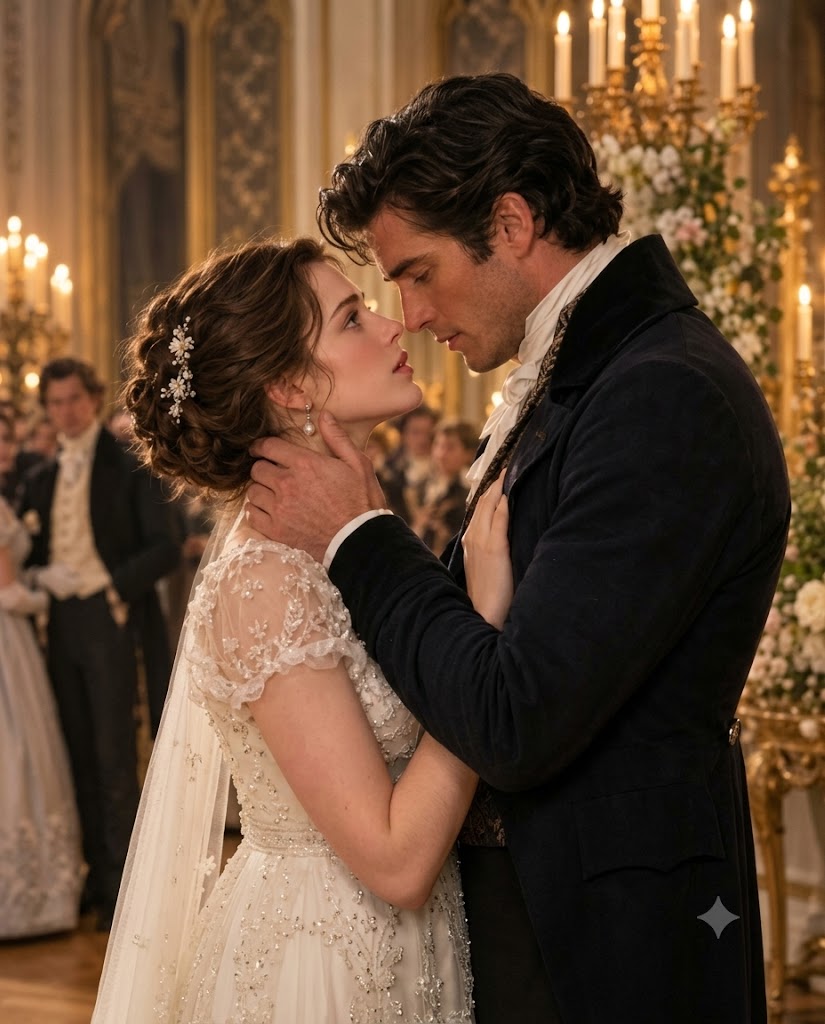
She tried to see the room as her father had seen it.
The desk.
The shelves.
The fireplace.
The globe.
Then she remembered.
“The clock.”
Adrian turned.
“What?”
“My father wound that clock every Sunday.”
She crossed the room.
The clock had stopped years ago.
She lifted it.
Behind it was a narrow cavity in the wall.
Empty.
Adrian frowned.
“Someone got there first.”
Clara felt disappointment rise.
Then she noticed something.
A scratch on the wooden backing.
Three letters.
E.W.
“Everard Vale,” Adrian said.
“No.”
Clara touched the carving.
“My father’s initials were W.W.”
Adrian looked at her.
“Then whose are they?”
Clara whispered the answer.
“Eleanor Whitfield.”
Her sister.
The study door suddenly slammed shut.
Both of them turned.
A key scraped in the lock from the other side.
Clara rushed toward it.
“Eleanor!”
No answer.
Adrian grabbed the handle.
Locked.
Then smoke began curling beneath the door.
Clara coughed.
“Fire.”
Adrian kicked the door once.
The old wood cracked.
Again.
The lock broke.
They stumbled into the corridor.
Flames were already climbing the curtains at the far end.
“Get outside!” Adrian shouted.
Clara froze.
“My sister!”
Adrian caught her arm.
“Where is she?”
“In the kitchen.”
They ran.
The house had become a maze of smoke.
Clara shouted Eleanor’s name.
A muffled cough answered from upstairs.
“She’s upstairs!”
Adrian looked at the burning staircase.
“Stay here.”
“No.”
“Clara.”
“She is my sister.”
He stared at her for one second.
Then he took her hand.
“Then we go together.”
They climbed.
Smoke filled the upper corridor.
Clara could barely see.
A door stood open at the end.
Eleanor was inside, trapped beneath a fallen cabinet.
Adrian rushed forward.
“Eleanor!”
He lifted the cabinet enough for Clara to pull her sister free.
A beam crashed behind them.
The flames spread across the ceiling.
“Move!”
They ran.
At the staircase, part of the floor collapsed.
Adrian pushed Clara and Eleanor toward the wall.
He landed hard, his shoulder striking the railing.
“Adrian!”
“Go!”
“You’re hurt.”
“I said go!”
Clara refused.
She grabbed his hand.
“Not without you.”
For one heartbeat they stared at each other through the smoke.
Then Eleanor shouted.
“Clara!”
They moved together.
They barely reached the front door before the roof groaned.
The three of them stumbled onto the lawn.
Moments later, flames swallowed the upper windows.
Clara collapsed to her knees.
Eleanor coughed beside her.
Adrian stood a few feet away, breathing heavily.
His left sleeve was torn.
Blood darkened the fabric.
Clara looked at him.
“You could have died.”
“So could you.”
“That doesn’t answer me.”
His expression softened.
“No.”
“It doesn’t.”
For the first time since their engagement had ended, neither of them looked away.
That night, they stayed at the neighboring estate.
Eleanor slept under the care of the housekeeper.
Adrian refused treatment until Clara forced him to sit still.
“You’re impossible,” she muttered as she wrapped his shoulder.
“I have been called worse.”
“You deserve it.”
“I probably do.”
She tied the bandage.
Silence followed.
Then Adrian said, “I am sorry.”
Clara stopped.
“For the ballroom?”
“Yes.”
“You’ve said that before.”
“Not like this.”
He looked at her.
“I thought if I ended the engagement publicly, Everard would believe I had abandoned you.”
Clara frowned.
“You could have told me.”
“I was afraid.”
The confession surprised her.
“Of what?”
“Of watching him destroy you because of me.”
“You still humiliated me.”
“I know.”
“And you expected me to understand?”
“No.”
His eyes dropped.
“I expected you to hate me.”
Clara sat back.
“Why?”
“Because hatred is safer than hope.”
The words remained between them.
Clara looked away.
She had spent months telling herself Adrian’s betrayal had been easy for him.
Now she wondered whether the coldness she had hated was simply fear wearing an expensive coat.
But forgiveness was not the same as understanding.
And understanding was not the same as trust.
“I don’t know if I can forgive you.”
“I know.”
“I don’t know if I want to.”
“I know.”
She studied him.
“You keep saying that.”
“Because I finally understand that wanting forgiveness doesn’t give me the right to receive it.”
Something inside Clara shifted.
Not enough to forgive him.
But enough to listen.
The next morning, Eleanor revealed the truth.
She had received a letter three months earlier.
It threatened to expose her private correspondence unless she delivered a small box hidden in their father’s study.
She had obeyed.
But before she could retrieve it, someone stole the box.
“Who sent the letter?” Clara asked.
“I never saw the name.”
“Why didn’t you tell me?”
“Because I was afraid.”
Eleanor’s eyes filled with tears.
“I thought if I told you, they would hurt you too.”
Clara took her sister’s hand.
“We don’t hide things from each other anymore.”
Eleanor nodded.
Adrian stood near the window.
“There is something else.”
They looked at him.
“The box was not the real target.”
“What was?” Clara asked.
“The documents inside it.”
“What documents?”
“Your father’s evidence.”
A knock came at the door.
A servant entered carrying a message.
“Your Grace, this arrived from Ashford Hall.”
Adrian opened it.
His face changed.
“What?”
He handed Clara the note.
Only one sentence had been written.
COME TO THE OLD MILL BEFORE MIDNIGHT, OR THE CLERK DIES.
Clara looked up.
“The missing clerk.”
Adrian nodded.
“We’re going.”
“No,” Clara said.
He stared at her.
“You’re staying here.”
“Absolutely not.”
“Clara, this is dangerous.”
“So was my house.”
She folded the note.
“If someone wants me frightened, they have chosen the wrong woman.”
They reached the old mill just before midnight.
The river moved beneath the broken bridge.
No lights burned inside.
Adrian carried a pistol.
Clara carried the small knife her father had once given her.
“Stay behind me,” Adrian whispered.
“No.”
He almost smiled.
“You are becoming very difficult.”
“I learned from you.”
They entered.
A lantern flickered upstairs.
A man’s voice called from the darkness.
“Duke of Ashford.”
Adrian stopped.
“Release the clerk.”
A figure stepped into the light.
Lord Everard Vale.
Clara felt the world tilt.
He smiled.
“You finally came.”
Adrian raised the pistol.
“You’re finished.”
Everard laughed.
“No. You are.”
He snapped his fingers.
Two men appeared behind Clara.
Before Adrian could turn, one struck him across the head.
He fell.
“Adrian!”
Clara tried to move, but a hand seized her arm.
Everard approached.
“I am sorry it had to become unpleasant.”
“You burned my house.”
“I merely removed evidence.”
“You murdered my father.”
His smile disappeared.
For the first time, she saw anger.
“Your father was an obstacle.”
Clara’s blood ran cold.
“Did you kill him?”
“I did not need to.”
Everard leaned closer.
“Men like your father often destroy themselves when they discover how powerless they are.”
“You poisoned him.”
“No.”
He smiled again.
“I paid his doctor.”
Clara went still.
“That is not the same thing.”
“It is when the doctor decides which medicine he receives.”
Her hands trembled.
Everard turned away.
“Your father discovered the railway plan. He found proof that I had bribed officials and forced landowners into selling.”
“Then why didn’t you destroy the evidence?”
“Because he hid it.”
“Where?”
Everard smiled.
“You tell me.”
Clara understood.
He still did not have the documents.
That was why he needed her.
She glanced at Adrian.
He was conscious.
Barely.
Their eyes met.
He gave the smallest movement of his head.
Wait.
Everard stepped closer.
“Where are the documents, Clara?”
She smiled.
“Safe.”
His face hardened.
“Where?”
“You’ll never find them.”
He raised his hand.
One of his men struck Eleanor, who had secretly followed them into the mill.
Clara gasped.
Everard whispered, “Try again.”
Clara looked at her sister.
Then at Adrian.
Then at the river below.
An idea came.
“My father trusted only one person with the documents.”
“Who?”
“Me.”
Everard’s eyes narrowed.
“You?”
“Yes.”
“And where are they?”
Clara smiled.
“In the one place you cannot search without destroying yourself.”
Everard stared at her.
Then he understood.
“The church?”
“No.”
“The magistrate?”
“No.”
“Then where?”
Clara took one step backward.
“Your own solicitor’s office.”
Everard went pale.
Adrian suddenly moved.
He kicked the lantern.
Darkness swallowed the room.
A shot thundered.
Someone screamed.
Clara ducked.
She heard Adrian fighting.
Wood splintered.
A body crashed against the wall.
She grabbed Eleanor’s hand.
“Run!”
They raced toward the stairs.
Everard seized Clara before she reached the door.
“You stupid girl.”
She drove her elbow into his ribs.
He staggered.
Adrian appeared behind him.
“You should have stayed away from her.”
Everard turned.
Adrian struck him.
The two men crashed into the railing.
The rotten wood broke.
Everard fell toward the river.
His fingers caught the edge.
Adrian grabbed his wrist.
Clara stared.
Everard looked up.
“Help me.”
Adrian’s face was cold.
“You murdered my father too.”
Everard’s eyes widened.
“I never—”
“You ordered the doctor.”
“I didn’t kill him.”
“You ordered the conditions that killed him.”
Adrian’s grip tightened.
For a moment, Clara saw the temptation in his eyes.
One movement.
One release.
Justice would be easy.
But Clara stepped forward.
“Adrian.”
He looked at her.
“Don’t become him.”
The words changed something.
Adrian pulled Everard back onto the platform.
Within minutes, the local constable arrived.
The missing clerk had escaped during the confusion and reached the village for help.
Everard was arrested.
The evidence was recovered two days later from his solicitor’s records.
The railway scheme collapsed.
Several officials resigned.
The Whitfield lands were saved.
But the greatest victory came weeks later.
The newspapers published the truth.
Eleanor’s name was cleared.
Clara’s humiliation was exposed as part of a larger conspiracy.
And Adrian publicly admitted that he had wronged Clara by ending their engagement without giving her the truth.
People expected her to forgive him immediately.
She did not.
Instead, Clara returned to her garden.
Spring came slowly.
Roses began blooming again beside the stones blackened by the fire.
One afternoon, Adrian arrived without a carriage.
He walked through the garden alone.
Clara looked up from her work.
“Why are you here?”
“To ask you something.”
She waited.
He removed his gloves.
“I loved you before I knew what love required.”
Clara said nothing.
“I thought protecting you meant making decisions for you.”
He swallowed.
“I was wrong.”
The wind moved through the roses.
“I don’t want to ask you to forget what I did,” he continued. “I don’t want another promise made in a ballroom.”
He reached into his pocket.
There was no ring.
Only a folded piece of paper.
He handed it to her.
“What is this?”
“A proposal.”
She looked confused.
“Without a ring?”
“Without conditions.”
She unfolded the paper.
It contained one sentence.
If you ever choose me again, I will spend the rest of my life making sure you never have to choose between loving me and being free.
Clara read it twice.
Then she looked at him.
“You finally understand.”
“I hope so.”
She folded the paper.
“I am not the woman who left that ballroom.”
“I know.”
“And you are not the man who stood beneath those chandeliers.”
“I hope not.”
A small smile appeared on her lips.
“But trust takes time.”
“I have time.”
She returned the paper.
“Then walk with me.”
Adrian offered his hand.
Clara looked at it.
For a moment, she remembered the ballroom.
The whispers.
The humiliation.
The broken promise.
Then she remembered the burning house.
The old mill.
The moment he had held the hand of the man who deserved to fall.
She placed her hand in his.
They walked together beneath the roses.
Not as duke and duchess.
Not as a scandal and its apology.
But as two people who had finally learned that love was not proven by possession, sacrifice, or public promises.
It was proven by truth.
By freedom.
By the courage to let another person choose.
Years later, Clara would remember the night of the ballroom differently.
Not as the night she was rejected.
But as the night her old life ended.
She had believed losing Adrian was the greatest humiliation she could suffer.
She had been wrong.
The greatest danger was not losing someone.
It was losing herself while trying to keep them.
The garden became famous for its roses.
Visitors often asked why Clara had kept the scorched stones from the old house beside the flower beds.
She always gave the same answer.
“Because beautiful things grow from places we once thought were ruined.”
And whenever Adrian heard her say it, he would smile.
Because he knew the truth.
They had not been saved by love alone.
They had been saved by the courage to face the truth, the strength to forgive without forgetting, and the wisdom to understand that a second chance is not a return to the past.
It is the decision to build something better.
And that, Clara believed, was the only kind of happily ever after worth having.
For a long time, Clara believed that happiness would feel like certainty.
She had imagined it as a quiet house, a loving husband, a family gathered around a long table, and a life untouched by scandal.
But life had taught her something different.
Happiness was not certainty.
It was trust built slowly after certainty had been destroyed.
Three years passed.
The old Whitfield estate changed with the seasons.
The burned house was never rebuilt in exactly the same form.
Clara refused to let anyone erase every trace of what had happened.
Instead, she restored only the eastern wing and transformed the old grounds into a school for village children.
Eleanor managed the school.
Clara managed the gardens.
And Adrian, whenever Parliament allowed him to escape London, came home and pretended he understood anything about roses.
“You are pruning them incorrectly,” Clara said one spring morning.
Adrian looked at the shears in his hand.
“I have been doing this for twenty minutes.”
“Exactly.”
He raised an eyebrow.
“You could have told me twenty minutes ago.”
“I wanted to see how much damage you could do.”
He looked at the rose bush.
“It appears to have survived.”
“Barely.”
A laugh escaped him.
Clara tried not to smile.
She failed.
Their relationship had become something neither of them had expected.
It was not the dramatic romance whispered about in drawing rooms.
There were no grand declarations every week.
There were disagreements.
There were quiet mornings when they barely spoke.
There were evenings when Clara wanted solitude and Adrian knew better than to follow her.
And there were moments when an old memory returned unexpectedly.
Whenever that happened, Adrian never told her to forget.
He simply stayed.
That was the difference.
He had once believed love meant protecting someone from pain.
Now he understood that sometimes love meant standing beside them while they carried it.
One autumn afternoon, Clara received a letter from London.
She opened it while sitting beneath the old oak tree.
Her face changed as she read.
Adrian noticed immediately.
“What is it?”
She folded the letter.
“Everard is dead.”
He went still.
“How?”
“An illness.”
Adrian waited.
“His estate has been divided among his remaining relatives. The solicitor sent me this because there was something in the final papers addressed to my father.”
She handed him the letter.
Adrian read it.
Inside was a confession.
Not from Everard himself, but from the doctor who had treated Clara’s father.
The doctor had been old and dying when he finally confessed everything.
He had accepted money to withhold a treatment that might have prolonged William Whitfield’s life.
He had also admitted that Everard had threatened him into silence afterward.
Clara looked toward the fields.
For years, she had wondered whether there was another truth hidden beneath her father’s death.
Now she had it.
It should have brought peace.
Instead, tears filled her eyes.
Adrian folded the letter carefully.
“You don’t have to read the rest.”
“I need to.”
She continued.
The final paragraph contained only one sentence.
Your father knew he might not survive, but he believed his children would one day understand why he refused to surrender.
Clara covered her mouth.
“He knew.”
Adrian sat beside her.
“He knew he was dying?”
“Perhaps.”
She wiped her eyes.
“And he still fought.”
“Yes.”
She looked at him.
“Why do people fight so hard when they know they might lose?”
Adrian considered the question.
“Perhaps because winning isn’t always the point.”
Clara smiled sadly.
“My father would have said that.”
“What would you say?”
She looked across the garden.
“I think sometimes fighting is how we tell the people we love that their future matters.”
Adrian took her hand.
“And yours matters.”
She squeezed his fingers.
“So does yours.”
They sat beneath the tree until sunset.
Neither spoke again.
They did not need to.
Years later, when Clara’s hair had begun to silver at the temples, she sometimes walked alone through the rose garden.
The children who had once studied in the school were now grown.
Some became teachers.
Some became farmers.
Some left for London.
One became a doctor.
Another became a lawyer.
Eleanor married a quiet man who loved books and hated society dinners.
The Whitfield estate prospered.
The old scandal became a story people told without knowing how much pain had once lived inside it.
And Adrian remained Adrian.
Still stubborn.
Still serious.
Still occasionally impossible.
But he had changed in the places that mattered.
He never again made a decision for Clara because he believed he knew what was best for her.
When difficult choices came, he asked.
When she disagreed, he listened.
When she wanted to leave, he trusted that she would return if she wished.
That was how their marriage survived.
Not because they never hurt one another.
But because neither of them was willing to use love as a weapon.
One evening, many years after the fire, Clara found Adrian standing beside the remains of the old ballroom.
The structure had never been restored.
Only the stone foundation remained.
She walked toward him.
“You’re thinking again.”
“I do that occasionally.”
“Dangerous habit.”
He smiled.
“I was remembering the first time I saw you.”
“At the ballroom?”
“Yes.”
“I remember it too.”
“I thought you were the most composed woman I had ever seen.”
Clara laughed softly.
“I was terrified.”
“I know that now.”
“You didn’t then.”
“No.”
He looked toward the empty foundation.
“I thought strength meant never showing fear.”
Clara stood beside him.
“And now?”
“Now I think strength is admitting you’re afraid and choosing to do the right thing anyway.”
She leaned her head against his shoulder.
“That took you long enough.”
“I had an excellent teacher.”
“Who?”
“You.”
She smiled.
For a while, they watched the sunset.
Then Adrian reached into his coat.
Clara frowned.
“If that is another proposal, I am going to refuse.”
He laughed.
“No proposal.”
He handed her a small wooden box.
She opened it.
Inside was the loose button from the glove she had worn on the night of the ballroom.
Clara stared at it.
“You kept this?”
“I found it the next morning.”
“Why?”
“I don’t know.”
She touched the little button.
Perhaps he had kept it because that night had changed everything.
Perhaps he had kept it because he had known, even then, that he had lost something precious.
Or perhaps some part of him had simply hoped that the story was not finished.
Clara closed the box.
“It was a terrible night.”
“Yes.”
“I thought my life was over.”
“So did I.”
She looked at him.
“Do you regret it?”
Adrian took a long breath.
“I regret hurting you.”
“But not what happened afterward?”
“No.”
He shook his head.
“Because if I could change that night, I might erase the road that brought us here.”
Clara smiled.
“Then perhaps some endings are really beginnings.”
“Perhaps.”
She slipped her hand into his.
Together they walked away from the old ballroom.
Neither of them looked back.
Years earlier, Clara had entered that room believing her worth depended on whether a powerful man chose her.
She left believing something entirely different.
Her worth had never belonged to him.
It had never belonged to her family name, her reputation, her beauty, or the approval of society.
It had belonged to her all along.
That was the lesson she carried into old age.
Not that betrayal never happens.
It does.
Not that love can solve every wound.
It cannot.
And not that forgiveness requires forgetting.
It does not.
Sometimes forgiveness means remembering exactly what happened and deciding that the past will no longer control the future.
Sometimes love means staying.
Sometimes it means leaving.
And sometimes the greatest act of love is giving someone the freedom to choose without fear.
Clara had learned all three.
On the last evening of her life, she sat in the garden with Adrian beside her.
The roses were in bloom.
The school bell rang in the distance.
Children laughed somewhere beyond the hedges.
Adrian held her hand.
“You’re quiet,” he said.
“I am listening.”
“To what?”
She smiled.
“To everything.”
He looked at her for a long moment.
“Are you happy?”
Clara closed her eyes.
She thought of the ballroom.
The carriage.
The fire.
The old mill.
Her father’s study.
Her sister’s tears.
The first time she had trusted Adrian again.
All the mistakes.
All the choices.
All the mornings that had come after the darkest nights.
“Yes,” she whispered.
“Very.”
Adrian lowered his head and kissed her hand.
“I am too.”
The sun disappeared behind the hills.
The garden became quiet.
And for the first time, Clara understood that a life did not have to be perfect to be beautiful.
It only had to be honestly lived.
The next spring, the roses bloomed again.
Eleanor found the wooden box beneath Clara’s writing desk.
Inside was the old button from the ballroom and a final letter.
It was addressed to anyone who might one day wonder how Clara Whitfield had survived everything that happened to her.
Eleanor opened it.
There were only a few lines.
She had once believed that the worst thing a person could lose was love.
She was wrong.
The worst thing we can lose is ourselves.
If someone breaks your heart, let yourself grieve.
If someone betrays you, let yourself be angry.
If someone leaves, let them go.
But never surrender the part of yourself that knows your own worth.
Because one day, when the noise has faded and the doors have closed, you will have to live with yourself.
Make sure that person is someone you are proud to know.
Eleanor cried when she finished reading.
Then she folded the letter and placed it beside the button.
Outside, the wind moved through the roses.
The same roses Clara had once pruned with shaking hands after the world had turned against her.
They were taller now.
Stronger.
Their roots had survived fire.
Their branches had survived winter.
And every spring, they bloomed again.
Just as she had.
Clara Whitfield’s story was eventually remembered as a love story.
But those who knew her best understood that it had never truly been about a duke, a scandal, or even a marriage.
It was about a woman who walked out of a ballroom believing she had lost everything, only to discover that the one thing she could never afford to lose was herself.
And that was why, when people later asked what saved Clara Whitfield, the answer was never simply love.
It was courage.
It was truth.
It was forgiveness without surrender.
It was the strength to begin again.
And above all, it was the quiet decision she made on that first terrible night:
to walk away with her head held high, even when the whole world wanted her to believe she had been defeated.
She had not been defeated.
She had simply not yet reached the part of her story where she understood why she had been forced to leave.
And sometimes, that is the strangest mercy life can give us.
The door that closes in our face may be the very door that leads us toward the life we were always meant to live.
The ballroom had fallen silent when Clara first walked away.
Years later, the roses spoke for her.
And they said what she had finally learned:
You do not need to be chosen to be worthy.
You do not need to be believed by everyone to know the truth.
And you do not need to return to the life that broke you in order to prove that you survived it.
Sometimes the bravest ending is not getting back what you lost.
It is becoming someone who no longer needs it.
And Clara Whitfield did exactly that.
She became free.
She became whole.
And, in the end, she became happy.
Not because her life had never broken.
But because she had learned how to grow again.
The End.