The ballroom fell silent when the Duke announced that he intended to leave his wife.
She broke the seal.
There was only one sentence beneath Sebastian’s signature.
“Come back to me, Eleanor, and I will give you everything you ask.”
She read it twice.
Then she smiled.
Not because the words pleased her.
Because they revealed that, even now, Sebastian did not understand her.
He still believed she wanted something from him.
A title.
An apology.
A larger house.
A place beside him at the head of some glittering table.
He had mistaken her patience for ambition for eleven years.
Now he was mistaking her freedom for a negotiation.
Eleanor folded the letter carefully and placed it beside the account books on her desk.
Outside her window, the new school was alive with voices.
Girls crossed the courtyard carrying slates.
Two widows sat beneath the elm tree, learning figures from a young teacher Eleanor had hired.
A farmer’s daughter was reading aloud from a history book while three other girls listened.
None of them knew that a duke had just offered his wife everything.
And none of them would ever need to accept a man’s definition of everything.
The next morning, Eleanor wrote her answer.
She did not ask for money.
She did not ask for the house.
She did not ask for a reconciliation.
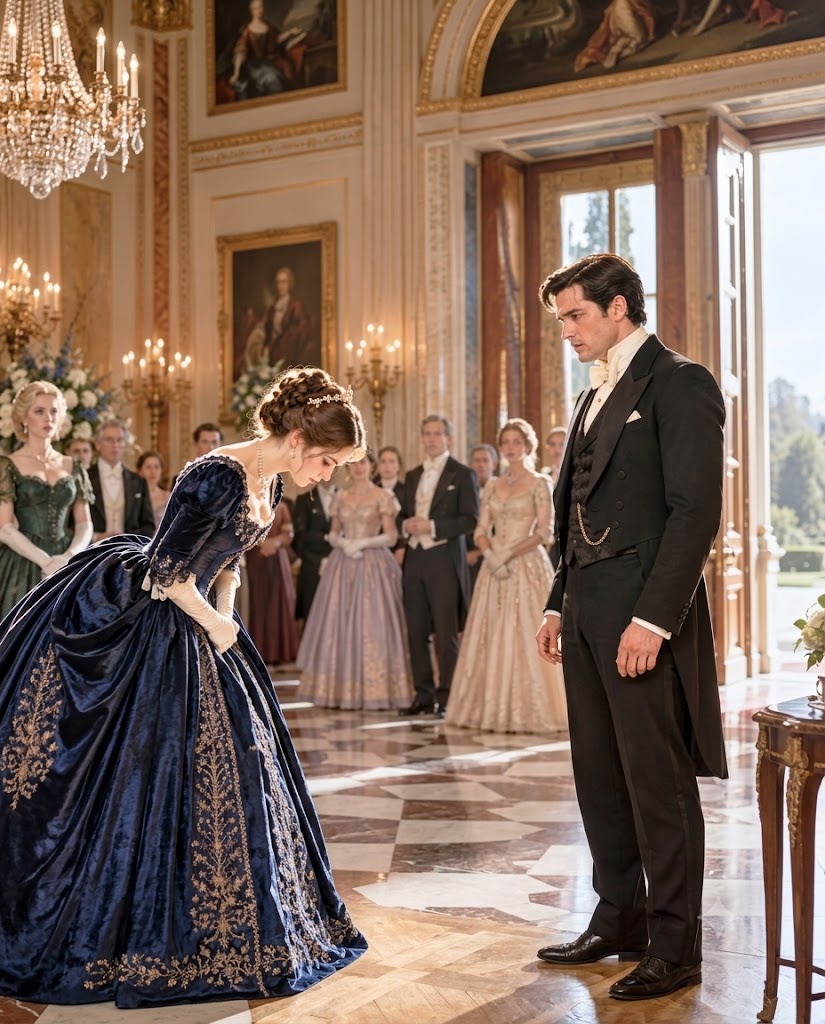
She asked for the truth.
“Before I consider anything,” she wrote, “I require you to tell me why you want me back.”
She sealed the letter and sent it.
Three days passed.
On the fourth, Sebastian arrived himself.
The schoolmaster tried to stop him at the gate.
Eleanor saw him from the upstairs window.
He looked different.
Not older, exactly.
Smaller.
His shoulders were tense beneath his dark coat, and there was no carriage waiting proudly behind him.
He had come alone.
Eleanor did not rush downstairs.
She finished the lesson she was supervising.
Then she walked into the courtyard.
Sebastian stood when he saw her.
For a moment, neither spoke.
“I received your letter,” he said.
“I assumed you would.”
“I came because I could not put the answer on paper.”
“That is convenient.”
His jaw tightened.
The old Sebastian might have taken offense.
This Sebastian seemed too tired to do so.
“I deserve that.”
“No,” Eleanor replied quietly. “You deserve honesty.”
He looked at the school behind her.
“You built all this.”
“Yes.”
“With your family money?”
“Partly.”
“And the rest?”
“From the estate.”
His eyes narrowed.
“You used my money.”
“I used money that would have been lost without me.”
He looked away.
“That ledger was not meant for you to find.”
“I found it because the estate is collapsing.”
“Is it?”
Sebastian hesitated.
That hesitation told her enough.
“What happened?”
He exhaled slowly.
“Victoria.”
Eleanor felt no surprise.
Only confirmation.
“She told me you were mismanaging the estate,” he continued. “She said the accounts were deliberately complicated so I could not see what you were doing.”
“And you believed her.”
“I did.”
“Why?”
His eyes met hers.
“Because believing her was easier than admitting I had never bothered to understand you.”
The words hung between them.
For the first time, Eleanor saw something in Sebastian’s face she had wanted to see years ago.
Shame.
Real shame.
But shame was not repentance.
And repentance was not change.
“What did Victoria promise you?” Eleanor asked.
Sebastian reached inside his coat.
He pulled out a packet of letters.
“She promised that if you left, she could arrange the sale of several properties.”
Eleanor looked at the packet.
“Why?”
“Because she already had buyers.”
“Buyers for what?”
“The northern farms.”
Eleanor went still.
Those farms supported nearly two hundred families.
Sebastian continued.
“She told me the land was producing too little. She said selling it would clear our debts.”
“Our debts?”
He swallowed.
“There were debts I knew nothing about.”
Eleanor stepped closer.
“Show me.”
He handed her the letters.
The first few contained nothing remarkable.
Then she found the figures.
Loans.
Private agreements.
Payments to intermediaries.
Money transferred through companies that did not appear in the estate books.
And finally, a signature.
Sebastian’s.
Eleanor stared at it.
“You signed this?”
“I thought it was a temporary investment.”
“You signed away the northern farms.”
“I was told it was collateral.”
“You were told.”
He flinched.
She handed the papers back.
“This is worse than I thought.”
“I know.”
“No, Sebastian. You do not.”
She walked toward the school office.
He followed.
Inside, Eleanor opened a cabinet and removed a large leather-bound volume.
She placed it on the desk.
“This is the original estate register.”
Sebastian looked at it.
“I thought the one at the house was the original.”
“It is a copy.”
His face drained.
“Why?”
“Because twelve years ago, your father warned me that someone might eventually try to strip the estate of its productive land.”
Sebastian stared at her.
“My father told you?”
“He trusted me.”
“And not me?”
“He knew you did not listen.”
The answer struck harder than any accusation.
Eleanor opened the register.
“There are clauses here that protect the tenants. The northern farms cannot be sold individually without a vote from the estate trustees.”
Sebastian leaned over the page.
“Who are the trustees?”
She pointed.
“Your uncle. The solicitor. And me.”
He looked up.
“You?”
“Your father appointed me before he died.”
“Why did no one tell me?”
“Because you never asked.”
Silence filled the room.
Then Sebastian laughed bitterly.
“So Victoria cannot sell them.”
“Not legally.”
“But she already has buyers.”
“Then we stop her.”
He looked at Eleanor.
“You would help me?”
“I would help the tenants.”
The distinction was unmistakable.
Sebastian nodded slowly.
“What do you want from me?”
“For once?”
“Yes.”
“Nothing.”
He frowned.
“I do not understand.”
“That is the problem.”
She closed the register.
“I am not helping you because I want my marriage restored. I am helping because innocent people should not lose their homes because two wealthy fools trusted the wrong person.”
Sebastian looked down.
“I was the fool.”
“Do not make yourself noble by accepting blame now.”
He looked at her again.
“What do you mean?”
“Calling yourself a fool does not repair anything.”
She walked toward the window.
“You want to know why I left without crying?”
He said nothing.
“Because I had already cried.”
Sebastian froze.
“For years,” she continued. “In rooms where you never entered. At tables where you spoke over me. In bedrooms where you turned away. I cried until there was nothing left to prove.”
He lowered his head.
“And then,” she said, “one day I realized I did not want revenge. I wanted a life.”
Sebastian’s voice was barely audible.
“I am sorry.”
Eleanor closed her eyes.
She had imagined those words a thousand times.
Once, they would have broken her.
Now they simply existed.
“I believe you.”
He looked surprised.
“You do?”
“Yes.”
“Then perhaps—”
“Do not.”
He stopped.
“I believe you are sorry,” Eleanor said. “That does not mean I belong to you again.”
He nodded.
The conversation might have ended there.
But before he could leave, the school bell rang.
A sharp cry came from the courtyard.
Then another.
Eleanor rushed outside.
Smoke was rising from the rear storage building.
Students were running toward the gates.
“Get them away from the building!” Eleanor shouted.
Sebastian moved instantly.
“Everyone to the front courtyard!”
The teachers began herding the girls away.
Then Eleanor heard a scream.
“Miss Eleanor!”
A young girl was trapped inside.
Without thinking, Eleanor ran toward the smoke.
Sebastian caught her arm.
“No.”
“She is inside.”
“I will go.”
“You do not know the building.”
“I know fire.”
Before she could argue, he disappeared through the doorway.
The smoke thickened.
Seconds passed.
Then a window shattered.
Sebastian emerged carrying the girl in his arms.
Her face was blackened with soot, but she was breathing.
Eleanor rushed forward.
The girl clung to her.
Sebastian dropped to one knee, coughing violently.
For a moment, Eleanor forgot everything between them.
She reached toward him.
Then stopped.
He saw it.
So did she.
The moment passed.
That evening, the fire was declared suspicious.
The building had not caught fire accidentally.
Someone had poured lamp oil across the back entrance.
The police found footprints in the mud.
And among the ashes, they found something else.
A torn piece of paper.
Eleanor recognized the seal.
Victoria Harkort.
The next morning, Victoria was summoned to the estate.
She arrived wearing pale blue silk and an expression of perfect innocence.
She walked into the drawing room as though she still belonged there.
Then she saw Eleanor.
Her smile disappeared.
“You.”
Eleanor stood beside Sebastian.
“Yes.”
Victoria looked at him.
“You brought her back.”
“No,” Sebastian said. “She came because she chose to.”
Victoria laughed softly.
“You cannot possibly believe she is innocent.”
Sebastian placed the packet of letters on the table.
Victoria’s face changed.
“You told me she was destroying the estate,” he said.
“She was.”
“You told me the northern farms could be sold.”
“They can.”
“You told me you had no financial interest in the buyers.”
“I do not.”
He slid another document across the table.
Victoria stared at it.
Her name appeared in the ownership records of one of the companies purchasing the farms.
She went pale.
Eleanor watched her carefully.
“How?”
Victoria whispered.
“Because I had the solicitor investigate.”
“You cannot prove—”
“We have your letters.”
Victoria turned toward Sebastian.
“You signed the agreements.”
“I did.”
“So you are guilty too.”
“Yes.”
The answer silenced her.
Sebastian continued.
“But I am not hiding it.”
Victoria’s composure cracked.
“You would ruin yourself to save her?”
“No.”
He looked at Eleanor.
“I would ruin myself to stop becoming the man I was.”
For the first time, Victoria looked frightened.
The authorities arrived before noon.
By evening, the evidence was enough to begin an investigation into fraud, forgery, and attempted arson.
But there was one final surprise.
The solicitor discovered that Sebastian’s debts were larger than anyone had known.
Even after Victoria’s scheme was exposed, the estate could not survive without selling something.
Sebastian called Eleanor into his study.
“I am going to sell the western manor.”
Eleanor looked at him.
“That will leave you with very little.”
“I know.”
“And the title?”
“I will keep it.”
“Why?”
He smiled faintly.
“Because it is the one thing I cannot sell.”
She almost smiled.
“Perhaps that is the lesson.”
He looked at her.
“What lesson?”
“That a title is useful only when there is a person beneath it worth respecting.”
He accepted the blow.
“I deserve that too.”
“Probably.”
He laughed.
It was the first time Eleanor had heard him laugh without arrogance.
Weeks passed.
The western manor was sold.
The northern farms were protected.
The tenants remained in their homes.
Victoria’s scheme collapsed completely.
And the estate began to recover—not because Eleanor returned to it, but because Sebastian finally began doing the work she had done silently for years.
He visited the tenants.
He read the accounts.
He sat with the workers.
He learned their names.
He discovered how many problems had been hidden from him because everyone had assumed he would not care.
For the first time in his life, Sebastian Wickliffe became responsible for the life attached to his title.
Eleanor watched from a distance.
She did not move back to the estate.
She did not wear the wedding ring.
But she did not hate him either.
That was perhaps the greatest victory of all.
Months later, the school held its first graduation.
Twenty-three young women stood beneath the same oak tree where Eleanor had once signed the school’s founding papers.
Each received a small leather-bound notebook.
On the first page, Eleanor had written the same sentence:
“Never mistake being needed for being loved, and never mistake being loved for having to surrender yourself.”
When the ceremony ended, one of the girls approached her.
“Mrs. Wickliffe?”
Eleanor smiled.
“You may call me Eleanor.”
The girl hesitated.
“Are you happy?”
Eleanor looked across the courtyard.
At the classrooms.
At the teachers.
At the girls who were laughing as they chased one another through the garden.
Then she looked toward the distant road.
Sebastian was standing there.
He had come without an invitation.
He did not approach.
He simply waited.
Eleanor turned back to the girl.
“Yes.”
The girl smiled.
“Because of the school?”
“Because I chose it.”
That afternoon, Eleanor walked to the gate.
Sebastian remained several steps away.
“I heard the graduation went well.”
“It did.”
“I brought something.”
He held out a small box.
Eleanor did not take it immediately.
“What is it?”
“Your ring.”
Her eyes lowered.
He opened the box.
The wedding ring rested inside.
“I found it on the tablecloth the night you left,” he said. “I kept it.”
“Why return it now?”
“Because it belongs to you.”
She took the box.
For a moment, neither spoke.
“I am not asking you to come back,” Sebastian said.
“I know.”
“I am not asking you to forgive me.”
“I know.”
“I only wanted to return something I had no right to keep.”
Eleanor closed the box.
“Thank you.”
He nodded.
Then he turned to leave.
“Sebastian.”
He stopped.
She looked at him.
“You did change.”
His shoulders relaxed slightly.
“But that does not change what happened.”
“I know.”
“And it does not mean we should be married again.”
“I know.”
A pause.
Then he smiled.
“I am beginning to understand.”
Eleanor smiled back.
“Good.”
He walked away.
She watched him until he disappeared beyond the trees.
Then she looked at the ring in her hand.
Once, she had believed it represented her worth.
Then she had believed removing it meant freedom.
Now she understood something more important.
The ring had never held the power.
Neither had Sebastian.
Neither had the title.
Neither had the house.
The power had always been hers.
She simply had to remember it.
Years later, the school would become one of the most respected institutions in the county.
Women who had once been told they were too poor to learn became teachers, accountants, writers, and business owners.
Some married.
Some did not.
Some stayed.
Some left.
But all of them learned the same lesson Eleanor had learned too late and wanted them to learn early:
A person can love someone deeply and still refuse to disappear inside that love.
And sometimes the strongest ending is not revenge.
It is the quiet decision to build a life so full that the person who underestimated you no longer has the power to define your future.
As for Sebastian, he never remarried.
People whispered about it for years.
Some said he still loved Eleanor.
Others said he was punished by regret.
But those who knew him best understood the truth.
He had finally learned that losing someone is not always the tragedy.
Sometimes the tragedy is realizing, too late, that you had been given something precious and spent years treating it as though it were yours by right.
And Eleanor?
She never needed another man to prove that she had won.
Every morning, when the school bell rang and young women filled the halls, she heard something far more valuable than applause.
She heard a future being built.
Not for her.
For them.
And that was enough.
The years did not erase what had happened.
They softened it.
That was different.
Eleanor learned that healing was not the same as forgetting.
Some memories remained sharp no matter how much time passed.
The ballroom.
The white tablecloth.
The ring.
Sebastian’s voice announcing their separation before three hundred people.
For a long time, she wondered whether that night had been the moment her marriage ended.
Eventually, she understood that it had not.
Her marriage had ended much earlier.
It had ended in all the small moments when she had been ignored.
In every dinner where her opinion was dismissed.
In every problem she solved that someone else received credit for.
In every night she waited for Sebastian to notice that she was unhappy.
The ballroom had merely been the place where she finally stopped pretending.
And perhaps that was why she no longer hated that night.
It had given her back to herself.
Five years after the school opened, Eleanor received an invitation to a grand charity ball in London.
She almost refused.
Then she saw the name of the institution hosting it.
It was the same organization that had once rejected her proposal for a women’s education fund.
She smiled.
“Perhaps I will go.”
The ballroom was larger than the one where Sebastian had abandoned her.
Hundreds of people filled the room.
Music floated beneath golden chandeliers.
And Eleanor walked through the doors wearing a simple dark-blue gown.
No diamonds.
No family jewels.
No husband’s crest.
Only the small silver pendant her mother had given her when she was seventeen.
People turned to look.
Some recognized her immediately.
Others whispered.
“That is the Duchess of Wickliffe.”
“No,” someone corrected.
“She is the former Duchess.”
Eleanor heard them.
She kept walking.
Then the room became strangely quiet.
She knew why before she turned.
Sebastian stood near the far end of the ballroom.
He looked older.
Not diminished.
Simply changed by time.
His hair had begun to gray at the temples.
His face carried lines that had not been there before.
But there was something different in his eyes.
He no longer looked at Eleanor as though she were something he owned.
He looked at her as though she were someone he was grateful to have known.
He approached slowly.
“Good evening.”
“Good evening.”
“I did not know you were coming.”
“Neither did I.”
A faint smile touched his mouth.
“That sounds like you.”
They stood in silence.
Then he glanced toward the crowd.
“Would you like to leave?”
Eleanor raised an eyebrow.
“Are you asking me to run away from a ballroom?”
“No.”
He smiled.
“I am asking whether you would rather sit somewhere quiet.”
She considered him.
“Tea?”
“Tea.”
They left the ballroom together.
Not as husband and wife.
Not as enemies.
Simply as two people who had survived the consequences of their own choices.
In a small room overlooking the garden, they sat across from each other.
Sebastian poured the tea.
He had become surprisingly good at such things.
“You changed,” Eleanor said.
“I had to.”
“Why?”
“Because I finally realized that remorse is useless if it only makes you miserable.”
She listened.
“So what did you do with it?”
“I used it.”
“How?”
He looked down at his hands.
“I established a fund for the estate workers.”
Eleanor said nothing.
“Education grants,” he continued. “Medical expenses. Loans for families who want to start businesses.”
“That sounds familiar.”
He smiled.
“I stole the idea from you.”
“You stole many things from me.”
The smile disappeared.
“I know.”
She immediately regretted the sharpness of her words.
But Sebastian shook his head.
“You should not regret telling the truth.”
He reached into his coat.
“I brought something else.”
Eleanor looked at him suspiciously.
He placed a document on the table.
She opened it.
Her eyes widened.
“What is this?”
“A transfer.”
“To the school?”
“Yes.”
“Sebastian.”
“It is not charity.”
She looked at him.
“I know you hate charity.”
“I do.”
“It is repayment.”
“For what?”
“For all the years you carried what should have been mine to carry.”
Eleanor closed the document.
“You do not owe me a debt.”
“I know.”
“Then why?”
“Because I owe the truth a debt.”
She stared at him.
He continued quietly.
“I spent years believing that because I had a title, I was entitled to obedience. Because I provided money, I was entitled to loyalty. Because I was your husband, I was entitled to your forgiveness.”
He paused.
“I was wrong.”
Eleanor looked toward the window.
Outside, rain had begun falling over the garden.
“Do you regret leaving me?”
Sebastian did not answer immediately.
“Yes,” he finally said.
She looked back.
“I regret the way I did it. I regret the years that led to it. I regret every time I made you feel invisible.”
He swallowed.
“But there is one thing I do not regret.”
“What?”
“That you left.”
Eleanor frowned.
He smiled sadly.
“If you had stayed, I might never have become the man I am now.”
The words surprised her.
She realized he was not asking for praise.
He was simply telling the truth.
“And if you had not left,” he continued, “those women would not have this school.”
Eleanor glanced at him.
“You think everything happened for a reason?”
“No.”
His answer came immediately.
“I think some things happen because people make terrible choices.”
She smiled faintly.
“That is more sensible.”
“But I believe we can decide what those choices become.”
For a long moment, Eleanor said nothing.
Then she reached across the table.
Not to touch his hand.
To close the document.
“I will accept the money.”
He looked surprised.
“For the school,” she added.
“Of course.”
“And I will never call it repayment.”
“What will you call it?”
“An investment.”
He smiled.
“That sounds like you.”
When they returned to the ballroom, the orchestra had begun playing again.
Sebastian stopped near the entrance.
“May I ask you something?”
“You may.”
“Do you ever think about what would have happened if I had not made that announcement that night?”
Eleanor considered the question.
“Sometimes.”
“And?”
“I think I would have stayed longer.”
His face tightened.
“How much longer?”
“Perhaps another year.”
He nodded slowly.
“Then I suppose I should thank you for the honesty you gave me that night.”
“No.”
She looked at him.
“You should thank yourself for finally listening to it.”
They separated at the carriage entrance.
There was no dramatic kiss.
No sudden reconciliation.
No promise that they would remarry.
Only a quiet understanding that some relationships are not meant to be restored.
Some are meant to be understood.
And sometimes understanding is the final form of forgiveness.
Years later, when Eleanor was an old woman, she returned to the school on the anniversary of its opening.
The buildings had expanded.
There was now a library, a laboratory, a printing room, and a scholarship office.
The courtyard was filled with students.
Above the entrance hung a simple inscription:
“Knowledge belongs to those brave enough to seek it.”
Eleanor stood beneath it for a long time.
A young teacher approached her.
“Mrs. Wickliffe?”
Eleanor smiled.
“Just Eleanor.”
The teacher laughed.
“I always forget.”
“That is because people were taught to put titles before names.”
She looked around the courtyard.
“Have you seen the new scholarship list?”
“Yes.”
“How many students?”
“Forty-eight this year.”
“Good.”
The teacher hesitated.
“There is one more thing.”
“What?”
She pointed toward the gate.
A messenger stood there holding a letter.
Eleanor opened it.
The handwriting was familiar.
Sebastian.
She read slowly.
He was ill.
Not dying, according to the doctor.
But old enough to understand that time had become something precious.
He wanted to see her.
Only once.
If she was willing.
Eleanor folded the letter.
She did not answer immediately.
That evening, she walked alone through the school.
She entered the first classroom she had opened.
She touched the old wooden desk.
She remembered how frightened she had been.
How uncertain.
How determined.
Then she understood something.
She was no longer afraid of the past.
She could visit it without returning to it.
The next morning, Eleanor went to Sebastian.
He lived in a modest house near the western estate.
Not the great manor.
That had been sold years before.
He was sitting beside the window when she entered.
He looked up.
For a moment, neither spoke.
Then he smiled.
“You came.”
“Yes.”
“I wasn’t certain you would.”
“Neither was I.”
He laughed softly.
“That sounds like you.”
She sat beside him.
They talked for three hours.
About the school.
The estate.
The tenants.
The weather.
Books they had read.
People they had lost.
They did not talk about remarrying.
They did not talk about the past except when the past naturally entered the room.
At sunset, Sebastian looked at her.
“Are you happy?”
Eleanor smiled.
“Yes.”
“Good.”
His eyes closed briefly.
“That is all I wanted to know.”
She took his hand.
This time, there was no hesitation.
Not because she belonged to him.
Because she no longer needed to prove that she did not.
They sat together until the light disappeared.
Sebastian died quietly several months later.
Eleanor attended the funeral.
She stood among tenants, teachers, servants, merchants, and townspeople.
There were no grand speeches.
No attempt to turn him into a saint.
He had made mistakes.
He had hurt people.
He had nearly destroyed what his family had built.
But he had also changed.
And perhaps the most honest thing Eleanor could say about him was this:
He had learned.
After the funeral, she walked alone to the edge of the estate.
The northern farms stretched beyond the hill.
Children ran between the fields.
A farmer waved when he saw her.
Eleanor waved back.
She looked toward the manor.
Once, she had believed that house was the center of her world.
Now it was simply a building.
Beautiful.
Old.
And strangely small.
She touched the silver pendant around her neck.
Then she smiled.
The ring Sebastian had returned remained in a drawer at home.
She had never thrown it away.
She had never worn it again.
It was not a symbol of regret.
It was a reminder.
A reminder of the woman who had once believed she needed permission to choose herself.
She had forgiven that woman.
She had forgiven Sebastian.
And, most importantly, she had stopped measuring her life by what she had lost.
That became the lesson Eleanor carried until the end of her life.
You do not reclaim your power by making someone else suffer.
You reclaim it by refusing to surrender yourself again.
You do not prove your worth by being chosen.
You prove it by choosing what kind of life you are willing to live.
And sometimes the person who walks away from you does not destroy your future.
Sometimes they accidentally open the door to it.
The ballroom had once been the place where Eleanor believed her life had ended.
Years later, she understood that it had been the place where it finally began.
Not with a husband.
Not with a title.
Not with revenge.
With one simple decision.
She had looked at the ring on her finger.
She had removed it.
And she had walked away.
Not because she had stopped loving someone.
But because she had finally learned to love herself enough not to disappear.
That was her victory.
And it was one no one could ever take from her.
THE END.