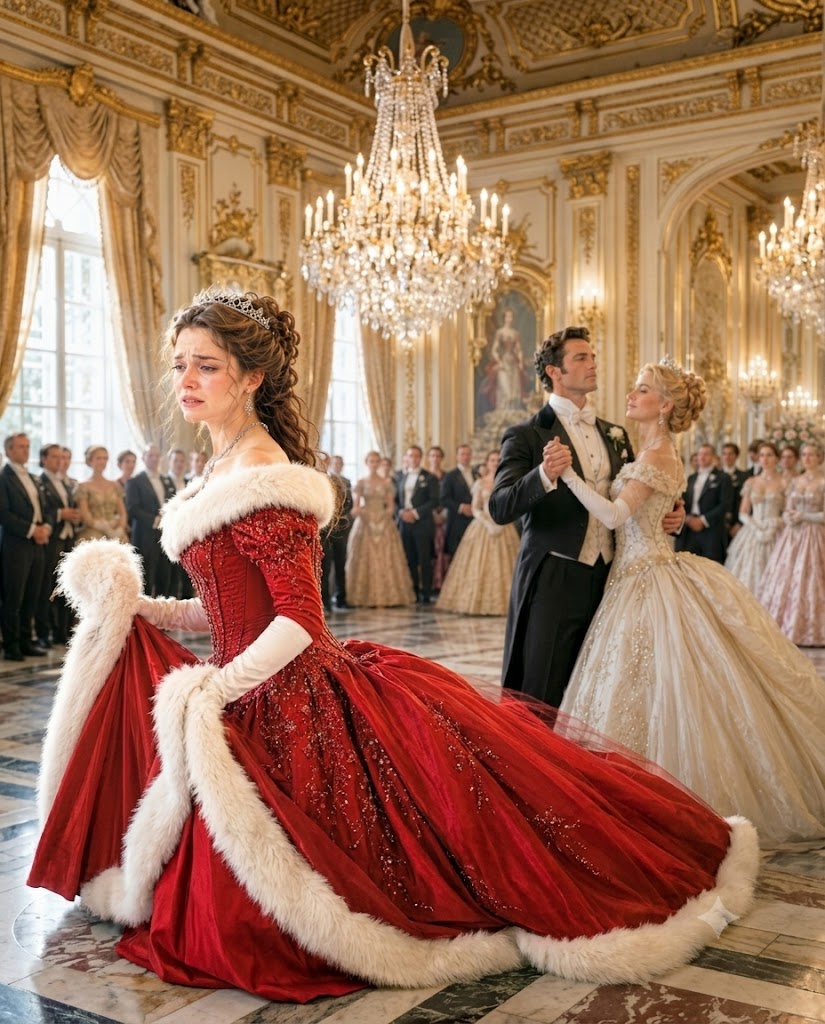
The ballroom applauded when the Duke of Ashborne announced he was marrying another woman.
Eleanor stared at the signature until the ink seemed to darken beneath her gaze.
The name was unmistakable.
Edmund Ashborne.
The Duke.
Her former fiancé.
The man who had stood beneath crystal chandeliers and announced his marriage to another woman while Eleanor still wore his ring.
For several seconds, nobody moved.
Rain struck the windows in hard, relentless waves.
Then Eleanor lifted her eyes.
“Why is the Duke of Ashborne signing a land transfer that predates his own inheritance?”
Her solicitor, Mr. Harrow, swallowed.
“I believe there may be an explanation.”
“There always is.”
Her voice was calm.
That frightened him more than anger would have.
Eleanor pushed the document across the table.
“Explain it.”
Harrow hesitated.
“The Duke’s father held certain financial interests in your estate.”
“My father owned this estate.”
“Technically, yes.”
“Technically?”
Harrow rubbed his fingers together.
“There were loans.”
Eleanor remembered the last years of her father’s life.
His increasing silence.
The endless letters.
The sudden sale of horses.
The servants dismissed one by one.
She had believed he had simply been unlucky.
Now she wondered whether someone had made certain he remained unlucky.
“How much did my father owe?”
Harrow named the figure.
Eleanor went still.
It was enormous.
Far larger than the debts she had inherited.
“Impossible.”
“The amount grew through interest.”
“Who held the debt?”
Harrow did not answer.
Eleanor leaned forward.
“Who?”
“The Ashborne family.”
A strange coldness moved through her.
The Duke had not merely betrayed her.
His family had been tied to hers for years.
And someone had been waiting for this estate to fail.
She gathered the documents into a neat stack.
“Bring me everything.”
“Everything?”
“Every loan. Every transfer. Every payment. Every letter between my father and the Ashborne family for the last ten years.”
Harrow looked uncomfortable.
“My lady, that could take weeks.”
“Then you had better begin today.”
That evening Eleanor went into the old library.
Her father had kept his private papers there.
She had avoided the room since his death because every shelf still carried some trace of him—his spectacles, his tobacco box, the old leather chair where he had fallen asleep reading newspapers.
She lit the lamps.
Then began searching.
At midnight she found nothing.
At one in the morning, she noticed a loose panel behind the writing desk.
Her heart began to beat faster.
She pulled it open.
Inside was a narrow compartment.
And inside that compartment were six letters.
All bore the same seal.
Ashborne.
Eleanor opened the first.
It was from Edmund’s father.
The second was from the Duke himself.
The third made her hands tremble.
It was dated six years earlier.
The same date as the land contract.
She read it once.
Then again.
Her father’s land had not been sold.
It had been pledged as security for a loan.
But the loan had already been repaid.
Eleanor stared at the final paragraph.
The debt had been cleared by an anonymous payment.
Yet the land had never been released.
Someone had kept the contract alive.
Someone had deliberately hidden the repayment.
She opened the fourth letter.
Her father’s handwriting appeared.
“If you are reading this, Eleanor, then I have failed to protect you.”
Her breath caught.
She sat down.
“My debts were never as large as they told you. The Ashbornes wanted the eastern valley. I refused. After that, everything changed.”
Eleanor continued.
“Edmund knows.”
The room seemed suddenly too small.
She read the next line.
“He may not know everything, but he knows enough.”
A fire cracked in the grate.
Eleanor barely heard it.
She had spent three months rebuilding an estate that someone had been trying to steal for years.
And Edmund had known.
Perhaps not everything.
But enough.
A knock sounded at the door.
Eleanor quickly folded the letter.
“Who is it?”
“It is me.”
Harrow.
She opened the door.
The solicitor looked exhausted.
“I found something.”
“So did I.”
He looked at the papers in her hand.
“Then we have both found trouble.”
“Tell me.”
Harrow closed the door.
“The man claiming your eastern land is Lord Marcus Vale.”
Eleanor frowned.
“Vale?”
“Yes. He is the Duke’s cousin.”
The name suddenly connected with the contract.
A stranger claiming her land.
A man whose inheritance supposedly gave him the right.
A man connected to the Ashborne family.
Harrow continued.
“He has already filed a petition in London. If he wins, the eastern valley goes to him.”
“And if I refuse?”
“He will take you to court.”
“Then let him.”
Harrow stared at her.
“My lady, you could lose.”
Eleanor looked toward the rain-dark windows.
“I have already lost a duke.”
She folded the letter.
“I can survive losing a courtroom.”
But beneath her confidence was something else.
Fear.
Not of losing the land.
Of discovering how much of her past had been built on lies.
The following morning, Eleanor rode to the eastern valley.
The fields were still wet, but the drainage work had begun to transform them.
Workers were clearing the channels she had ordered rebuilt.
The valley was worth fighting for.
Not because it was valuable.
Because it was the part of the estate her father had refused to surrender.
She dismounted beside the oldest drainage ditch.
One of the laborers approached.
“My lady.”
“What is it?”
He pointed toward the hill.
“There is an old stone marker under the weeds.”
Eleanor walked over.
Half-buried in mud was a boundary stone.
She brushed it clean.
There was a symbol carved into the top.
Ashborne.
Her stomach tightened.
This was no ordinary boundary marker.
It was old.
Much older than the contract.
She called Harrow.
He arrived before sunset with a surveyor.
The man studied the stone.
Then the old maps.
Finally, he looked at Eleanor.
“This changes everything.”
“How?”
“The eastern valley may never have belonged to the Ashbornes at all.”
Eleanor felt the world shift.
The land had been hers.
The debt had been repaid.
The contract was fraudulent.
And now the boundary itself was wrong.
But one question remained.
Why had Edmund’s signature appeared on the document?
Three days later, Eleanor received a letter.
There was no family seal.
Only her name.
She opened it.
“I know what you found.”
Her heart stopped.
The handwriting was Edmund’s.
“Meet me at Blackmere Chapel. Alone.”
She nearly burned the letter.
Instead, she went.
Blackmere Chapel stood abandoned on a hill overlooking the sea.
Wind pushed through the broken windows.
Eleanor entered just before dusk.
Edmund was waiting near the altar.
He looked different.
Less polished.
More tired.
For the first time, she noticed how deeply exhaustion had settled around his eyes.
“You came.”
“I came for answers.”
“You deserve them.”
“No.”
She stepped closer.
“I deserve the truth.”
He lowered his head.
“I knew about the debt.”
Eleanor’s jaw tightened.
“How much?”
“Not everything.”
“That is what everyone says when they want forgiveness without earning it.”
He flinched.
She continued.
“Did you know your family intended to take my land?”
“Yes.”
The word struck harder than any denial could have.
“Did you sign the contract?”
“Yes.”
“Then why are you here?”
Edmund looked toward the broken window.
“Because I was trying to stop them.”
Eleanor laughed once.
There was no humor in it.
“You signed the document.”
“I signed it to keep Vale from taking the land immediately.”
“That makes no sense.”
“It will.”
He pulled a packet from inside his coat.
“The original contract was never valid. My father ordered me to sign a duplicate so Vale could use it later.”
Eleanor took the papers.
“Why would you help him?”
“I didn’t.”
His voice broke slightly.
“I was trying to buy time.”
“For what?”
“To find proof.”
Eleanor looked at him.
“And did you?”
He nodded.
“Your father repaid the debt six years ago. I found the payment record three months after your father’s death.”
“Then why didn’t you tell me?”
“Because my father was still alive.”
She stared at him.
Edmund’s father had died only weeks before the ballroom announcement.
“I was trying to expose him.”
“And instead you married someone else.”
Silence.
The old chapel seemed to absorb the accusation.
Edmund closed his eyes.
“That was part of the plan.”
Eleanor’s expression hardened.
“Do not insult me.”
“I am not.”
He stepped closer.
“I was told that if I refused the marriage, my father would destroy your estate immediately.”
She froze.
“He threatened you?”
“He threatened you.”
Edmund’s voice dropped.
“He had men watching your accounts. He knew about the drainage failures. He knew your father had hidden the repayment records. He told me that if I married you, he would ruin you. If I married Lady Catherine, he would leave your estate alone.”
Eleanor stared at him.
“Then why did you not tell me?”
“Because I believed I could solve it myself.”
“And you couldn’t.”
“No.”
The honesty hurt.
“No, I couldn’t.”
Eleanor looked down at the papers.
For the first time, she understood the strange pause in the ballroom.
The half-second too long.
The look Edmund had given her when she removed his ring.
He had not been indifferent.
He had been terrified.
But fear did not erase what he had done.
“You chose to sacrifice me without asking whether I wanted to be sacrificed.”
Edmund said nothing.
“That was your mistake.”
“I know.”
“No. You don’t.”
She stepped back.
“You thought protecting me meant making decisions for me. You thought I would be safer if I knew less.”
Her eyes burned.
“But ignorance is not protection.”
Edmund lowered his head.
“You are right.”
Eleanor handed back the papers.
“Then help me finish what you started.”
He looked up.
“What?”
“You heard me.”
She walked toward the door.
“If Vale wants my land, he can come and take it from me in court.”
Edmund followed.
“I have evidence.”
“Then give it to my solicitor.”
“I will.”
“And after that?”
He stopped.
Eleanor turned.
“After that, Edmund, you and I are finished.”
His face went pale.
She did not wait for an answer.
The trial began six weeks later.
London newspapers called it the Ashborne Land Dispute.
Society called it scandal.
Eleanor called it work.
She arrived at court without jewelry.
Without a carriage emblazoned with her family crest.
Without the title of a future duchess.
She arrived as the owner of Whitmore Estate.
Lord Marcus Vale’s barrister presented the contract first.
He argued that the eastern valley had been transferred legally six years earlier.
Then Harrow stood.
He presented the repayment record.
The courtroom murmured.
Vale’s barrister dismissed it as incomplete.
Harrow produced the original letter.
Then the boundary maps.
Then the surveyor’s report.
One by one, the pieces fell into place.
But Vale had one final weapon.
He produced a letter bearing Eleanor’s father’s signature.
It appeared to acknowledge the debt.
The courtroom fell silent.
Eleanor looked at it.
Something was wrong.
The signature was hers to recognize.
Her father’s handwriting.
His words.
But the date was impossible.
She stood.
“My lord.”
The judge looked at her.
“Do you recognize this letter?”
“Yes.”
The barrister smiled.
“Then you accept its validity?”
“No.”
The smile disappeared.
“My father was left-handed.”
The courtroom went silent.
“He wrote with his left hand. This signature was copied from an older document.”
The barrister protested.
Eleanor continued.
“And there is another problem.”
She pointed to the ink.
“That type of ink was not used in our household until two years after the date shown.”
The judge ordered the document examined.
The hearing was suspended.
During the recess, Eleanor found Edmund in the corridor.
“You knew about the forgery?”
“I suspected.”
“You suspected?”
“I did not have proof.”
She nodded.
“Now we do.”
The document was examined.
The signature was forged.
The ink was wrong.
The contract was fraudulent.
But then the clerk returned with another discovery.
The original repayment record had been deliberately removed from the Ashborne financial archives.
And the person who had ordered its removal was not Edmund’s father.
It was Lord Marcus Vale.
Vale had forged the contract.
He had used Edmund’s signature.
He had manipulated the debt.
And he had intended to seize the valley for himself.
The case collapsed.
The court restored Eleanor’s ownership.
But the greatest surprise came afterward.
Vale had been arrested.
Edmund’s father was dead.
Lady Catherine’s marriage to Edmund was revealed to have been a political arrangement that had never been consummated, and the marriage itself was later annulled when the coercion became public.
Society expected Eleanor to return to Edmund.
She did not.
Instead, she returned to Devon.
Spring arrived slowly.
The eastern valley turned green.
The drainage channels worked.
The tenants paid their rents.
New roofs appeared on cottages that had once leaked.
Eleanor opened a small school for the children of estate workers.
She established a fund for widows.
She changed the leases so tenants could never again be quietly dispossessed through hidden debts.
People began calling her Lady Eleanor of Whitmore.
Not because she had once been promised a dukedom.
Because she had built something of her own.
One evening, as the sun disappeared beyond the fields, a carriage stopped outside the estate.
Eleanor knew who it was before the servant announced him.
Edmund.
She found him waiting in the garden.
He looked nervous.
“May I speak with you?”
“You may.”
“I am not here to ask you to forgive me.”
“That is wise.”
He smiled faintly.
“I deserve that.”
He looked across the valley.
“It looks different.”
“It is different.”
“I heard about the school.”
“And the new leases?”
“Yes.”
“You approve?”
“I admire you.”
Eleanor said nothing.
Edmund took a breath.
“I spent years believing love meant protecting someone from pain.”
He looked at her.
“I was wrong.”
She waited.
“Sometimes love means trusting someone enough to let them face the truth beside you.”
Eleanor’s expression softened, but only slightly.
“You learned.”
“Too late.”
“Perhaps.”
He nodded.
“I will not ask you to marry me.”
She almost smiled.
“Good.”
“I only wanted to say that I am sorry.”
The wind moved through the trees.
For a moment they stood in silence.
Then Eleanor said, “I believe you.”
Edmund looked surprised.
“But forgiveness,” she continued, “does not mean returning to the life we had.”
“I understand.”
She turned toward the house.
“Goodbye, Edmund.”
He nodded.
“Goodbye, Eleanor.”
He walked away.
She watched until the carriage disappeared beyond the gates.
Then she returned to the valley.
Years later, people would still tell the story of the ballroom.
They would say the Duke abandoned Lady Eleanor.
They would say she lost everything.
They would say she was betrayed by the man she loved.
But those who knew the truth told a different story.
Eleanor had not lost everything that night.
She had lost an illusion.
And that was the beginning of her freedom.
She learned that a title could be inherited, but strength could not.
That love without honesty could become another kind of prison.
That being protected without being trusted was not protection at all.
Most importantly, she learned that rebuilding a life was not about proving someone wrong.
It was about refusing to let what they had done determine what came next.
Years after the trial, Eleanor stood in the eastern valley at harvest time.
Children ran between the fields.
Workers laughed beside carts overflowing with grain.
The old boundary stone remained where she had found it.
She had never removed the Ashborne symbol.
Instead, she had placed a new stone beside it.
On the new stone were three words.
“Nothing Given Away.”
A young girl from the village once asked her why.
Eleanor smiled.
“Because sometimes people think they can decide what you are worth.”
The girl frowned.
“And can they?”
“No.”
Eleanor looked across the fields.
“Only you can decide that.”
The sun lowered over Whitmore.
The bells from the village church began to ring.
Eleanor stood there until the last light touched the valley.
Once, she had walked out of a ballroom believing she had been rejected.
She had thought the closing doors marked the end of her story.
She had been wrong.
They were the doors through which she finally walked into her own life.
And when the years passed, she never regretted leaving that ballroom without tears.
Because the woman who walked out had lost a duke.
The woman who came home had found herself.
The woman who came home had found herself.
But Eleanor soon learned that finding yourself was not the same as being free from the past.
Some wounds did not disappear simply because the person who caused them had gone.
They became quieter.
They waited.
And sometimes, years later, they returned wearing a different face.
It happened on an autumn morning.
Eleanor was standing in the schoolroom when a messenger arrived from London.
The boy was barely sixteen.
His coat was soaked from the rain.
“My lady, I was told to deliver this directly into your hands.”
He gave her a sealed envelope.
There was no crest.
No name.
Only a single line written across the front.
For Eleanor Whitmore.
She recognized the handwriting immediately.
Edmund.
Her fingers tightened around the envelope.
For several moments, she did not open it.
Then she broke the seal.
Inside was a single sheet.
“I would not write unless it mattered.
There is something you never knew about the night your father died.
Come to Ashborne Hall.
If you refuse, I will understand.
But if you come, you may finally learn why he was so afraid.”
Eleanor read it twice.
Then she folded the letter.
She had promised herself she would never return to Ashborne.
Yet there were some doors that could not remain closed forever.
The following morning, she rode north.
Ashborne Hall stood beneath a grey sky.
It looked smaller than she remembered.
When she had first entered those gates as a young woman, she had imagined them leading into her future.
Now they looked like the entrance to a graveyard.
Edmund was waiting in the library.
He looked older.
Not merely in years, but in the way a man looked when he had spent too long carrying something he could not put down.
“You came.”
“I almost didn’t.”
“I know.”
“What did you discover?”
Edmund walked to the desk.
On it lay a small wooden box.
“I found this after my father’s death.”
Eleanor frowned.
“Why didn’t you give it to me years ago?”
“Because I was afraid of what was inside.”
He opened it.
There was a photograph.
An old ledger.
And a letter.
Eleanor picked up the photograph first.
It showed her father standing beside Edmund’s father.
But there was someone else in the picture.
A young man Eleanor had never seen before.
“Who is he?”
Edmund’s expression hardened.
“My uncle.”
“Your uncle?”
“Arthur Ashborne.”
She stared at him.
“I thought he died before I was born.”
“So did everyone.”
Eleanor looked up.
“What do you mean?”
“He didn’t die.”
A chill moved through her.
“He disappeared.”
“Why?”
“Because my father believed he had betrayed the family.”
Edmund opened the ledger.
“There were accounts hidden outside the Ashborne estate. Money moved through them for years. Land purchases. Political payments. Bribes.”
Eleanor turned the pages.
Then she saw a familiar name.
Her father.
Beside it was a payment.
Then another.
Then another.
But the amounts were not debts.
They were payments made to him.
Her father had not been borrowing from the Ashbornes.
He had been receiving money.
Eleanor’s mind raced.
“For what?”
Edmund pointed to a note in the margin.
“Protection.”
“From whom?”
He looked at her.
“Arthur.”
Silence filled the room.
Edmund continued.
“My father believed Arthur was trying to destroy the family. Your father knew something about him. They made a secret agreement.”
Eleanor read the note again.
“My father was protecting your father?”
“Yes.”
“Then why did everything collapse?”
“Because Arthur came back.”
Eleanor’s fingers went cold.
“When?”
“Six years ago.”
The same year as the contract.
The same year her father’s health had begun to fail.
The same year Edmund had suddenly become distant.
Everything she thought she understood began rearranging itself.
“Where is he now?”
“We don’t know.”
A sound came from the corridor.
Both turned.
A servant entered, pale-faced.
“My lord.”
“What is it?”
“There is a man at the east gate.”
“Who?”
The servant hesitated.
“He gave no name.”
Eleanor stood.
“Describe him.”
“Older. Tall. Grey hair. He said he has come to collect what belongs to him.”
Edmund and Eleanor looked at each other.
Arthur.
Within minutes, the household was in chaos.
Eleanor should have left.
Instead, she remained.
Because fear had once controlled her life.
She would not allow it to do so again.
A carriage appeared beyond the gates.
The man who stepped out was older than the photograph.
But there was no mistaking the face.
Arthur Ashborne entered the hall without waiting to be invited.
His eyes settled on Eleanor.
“So,” he said quietly.
“You are the daughter.”
Eleanor did not move.
“You know who I am.”
“I knew your father.”
“You destroyed him.”
Arthur smiled faintly.
“No.”
He looked toward Edmund.
“Your father destroyed him.”
Edmund stepped forward.
“Leave.”
Arthur laughed.
“You still believe you know the truth.”
He placed a document on the table.
Eleanor opened it.
Her heart stopped.
It was a confession signed by Edmund’s father.
In it, he admitted manipulating Eleanor’s father’s debts.
He admitted ordering the forged contract.
He admitted threatening Edmund.
But there was one final paragraph.
“I did it because Arthur knew the truth about the Whitmore estate.”
Eleanor looked up.
“What truth?”
Arthur answered.
“The estate was never entirely yours.”
Silence.
“What are you talking about?”
“Your grandfather had another heir.”
Eleanor’s breath caught.
“My grandfather had no son.”
“He had a daughter.”
Arthur looked directly at her.
“My mother.”
Eleanor stared at him.
“If your mother was my grandfather’s daughter, then—”
“Then half of Whitmore was legally hers.”
“And you inherited her claim.”
“Yes.”
Eleanor felt the room tilt.
All these years.
The estate she had fought to save.
The land she had rebuilt.
Could it be taken from her after all?
Arthur smiled.
“I came for what is mine.”
Edmund reached for the document.
“You have no proof.”
Arthur produced another paper.
A birth record.
A marriage certificate.
A family register.
Every document connected.
Eleanor’s mind raced.
Her father’s entire life had been shaped by this secret.
The debts.
The Ashbornes.
The threats.
The forged contract.
Everything had been part of a struggle over ownership.
But then Eleanor noticed something.
A small inconsistency.
She turned the birth record toward the light.
“This date is wrong.”
Arthur’s smile faded.
“What?”
“My grandfather died in March.”
She pointed to the document.
“This says your mother was born in November of the same year.”
Arthur’s expression changed.
“You could have changed the date.”
“I could have.”
She picked up another paper.
“But this one was registered in the parish records.”
She looked at Edmund.
“Do you have access to the original registry?”
“Yes.”
“Then we verify everything.”
Arthur’s confidence disappeared.
The next three days were spent searching archives.
Records were brought from three counties.
Witnesses were found.
Letters were uncovered.
And finally, the truth emerged.
Arthur’s mother had indeed been connected to Eleanor’s grandfather.
But she had not been his daughter.
She had been his sister.
Arthur had manipulated the family records to create a false inheritance claim.
His entire case rested on a lie.
When confronted, Arthur finally admitted it.
He had wanted Whitmore.
He had wanted Ashborne.
And for decades, he had used family secrets as weapons.
The court later rejected his claim.
But Eleanor did not celebrate.
She returned to Devon and stood alone in the eastern valley.
Edmund came to her a week later.
“You won.”
She shook her head.
“No.”
He looked confused.
“I survived.”
There was a difference.
Winning meant defeating someone.
Survival meant refusing to become like them.
Edmund understood.
“I have something else.”
He handed her a small envelope.
Eleanor opened it.
Inside was a letter from her father.
This one was addressed simply:
“My dear Eleanor.”
She read it slowly.
“If you ever discover the truth, do not waste your life seeking revenge.
There will always be another man who believes he can own your future.
Do not become obsessed with proving him wrong.
Build something he cannot take from you.”
Her eyes filled with tears.
For the first time in years, Eleanor allowed herself to cry.
Not because she was broken.
Because she was finally finished carrying everything alone.
She folded the letter carefully.
Then looked at Edmund.
“My father knew.”
“He knew enough.”
“And he never told me.”
“He wanted you to have a chance at an ordinary life.”
Eleanor smiled sadly.
“He should have trusted me with the truth.”
“Yes.”
Edmund looked down.
“I understand that now.”
They stood in silence.
Then Eleanor said something he did not expect.
“Thank you.”
He looked at her.
“For what?”
“For finally telling me the truth.”
He smiled.
“That is all I ever should have done.”
Eleanor looked across the fields.
The valley stretched beneath the golden evening light.
“I don’t know what the future holds.”
“Neither do I.”
“And I don’t want you to promise me anything.”
“I won’t.”
She turned toward him.
“But you can stay for dinner.”
Edmund smiled.
“I would like that.”
It was not a proposal.
It was not a reconciliation.
It was something better.
A beginning without promises.
A relationship built not on titles, duty, or fear, but on honesty.
Years passed.
Eleanor never became a duchess.
She became something more difficult to define.
She became a woman whose decisions mattered.
Her school grew into an academy.
The tenants became partners in the estate rather than people living beneath its shadow.
She created legal funds for women who had inherited property but did not know how to defend it.
Whenever someone asked why she had devoted herself to such work, she gave the same answer.
“Because I once believed that having no power meant having no choice.”
She wanted no other woman to believe that.
Edmund remained in her life.
Sometimes as a friend.
Sometimes as a companion.
Never again as someone who decided what was best for her without asking.
They eventually married.
Not because society expected it.
Not because their families had arranged it.
And certainly not because Eleanor needed a duke.
They married because, after everything they had survived, they had learned how to stand beside each other without standing over one another.
On the morning of their wedding, Eleanor looked at the ring on her finger.
It was not the same ring.
She had sold the old one years earlier.
This one was simple.
No enormous diamond.
No family crest.
No symbol of rank.
Only a narrow band of gold.
Edmund noticed her looking at it.
“Do you regret it?”
She smiled.
“Which part?”
“Everything.”
She looked toward the window.
Beyond it, the fields were green.
The school bell was ringing.
Children were running toward their lessons.
Workers were beginning another harvest.
Her father’s house stood behind her.
Her own life stood before her.
“No,” she said.
“Not even the ballroom?”
She laughed softly.
“Especially not the ballroom.”
Edmund smiled.
“I hated that night.”
“So did I.”
“I thought it ended us.”
“It did.”
He looked at her.
“Then how are we here?”
Eleanor took his hand.
“Because the people we were had to end before the people we became could begin.”
Outside, the church bells started ringing.
For years, Eleanor had believed that the worst moment of her life was the night hundreds of people applauded another woman’s engagement to the man she loved.
She had believed the applause was proof that she had lost.
She understood now that it had been something else.
A door closing.
A life ending.
A false future collapsing.
And sometimes, the collapse of a false future was the greatest gift a person could receive.
Because not every ending was punishment.
Some endings were rescue.
Some betrayals were warnings.
Some losses were invitations to become stronger than the person you had once depended upon.
Eleanor looked one final time at the old ring box sitting on the dressing table.
It was empty.
And she was glad.
She no longer needed a symbol of what she had once been promised.
She had built a life no promise could take away.
Years later, when Eleanor was an old woman, the young girls at the academy would often ask her about the Duke.
They had heard the romantic version of the story.
The beautiful ballroom.
The broken engagement.
The scandal.
The eventual marriage.
They wanted to know whether she had always loved him.
Eleanor would smile.
“Yes.”
“And did he break your heart?”
“Yes.”
“Then why did you forgive him?”
She would look out over the fields.
“Because forgiveness is not a reward you give someone.”
The girls would listen.
“It is a burden you stop carrying.”
“And did you ever regret leaving that ballroom?”
Eleanor would shake her head.
“Never.”
“Why?”
She would smile.
“Because that was the night I learned the most important thing about myself.”
“What?”
“That I could walk away.”
The girls would remain silent.
Eleanor would continue.
“Anyone can stay where they are loved. It takes courage to leave where you are no longer respected.”
And that became the lesson she wanted them to remember.
Not the duke.
Not the scandal.
Not the inheritance.
Not the beautiful ring.
The choice.
The choice to leave.
The choice to rebuild.
The choice to forgive without surrendering.
The choice to love without losing yourself.
And whenever Eleanor returned to the eastern valley, she would pass the two stones standing side by side.
The old Ashborne marker.
And the new stone beneath which three words remained carved forever:
Nothing Given Away.
She had once believed those words meant that no one could take anything from her.
She understood them differently now.
They meant that no one could take her worth unless she surrendered it.
No title could give it.
No lover could define it.
No betrayal could destroy it.
No ending could erase it.
Her worth had been there before the ballroom.
It had been there during the years of debt and rain.
It had been there when she stood alone in court.
It had been there when she forgave.
And it would remain long after every name carved into the family records had faded.
The sun set slowly over Whitmore.
The fields turned gold.
The school bell rang in the distance.
Eleanor stood beneath the old oak tree, watching the children run home.
For a moment, she remembered the young woman who had walked out of that ballroom with a ring in her hand and no idea what would come next.
She wished she could tell that woman something.
Not that everything would become easy.
It would not.
Not that she would never be hurt again.
She would.
Not that every betrayal would have a happy ending.
They would not.
She would simply tell her this:
“Keep walking.”
“Do not beg for a place at a table where they have already decided you do not belong.”
“Build your own table.”
“And when the day comes that you finally understand your worth, do not apologize for it.”
Eleanor smiled.
Then she turned toward home.
The woman who had walked out of the ballroom had once thought she was leaving behind the greatest love of her life.
She had been wrong.
She had been leaving behind the version of herself who believed she needed someone else to decide her future.
And in the years that followed, she discovered something far greater than a title, a fortune, or even a perfect love story.
She discovered that the most powerful inheritance a person can receive is not land.
It is courage.
Not a family name.
But a voice.
Not a promise from another person.
But the ability to make one to yourself.
And keep it.
The ballroom had applauded when Eleanor lost the Duke.
Years later, the same society would whisper about the woman who had rebuilt an estate, defeated a legal conspiracy, opened a school, changed the lives of hundreds, and refused to become bitter.
But Eleanor never cared about their applause again.
She had learned something applause could never teach her.
The world could cheer for you.
The world could abandon you.
The world could misunderstand you.
None of it changed who you were.
Only what you chose to do next mattered.
And Eleanor chose to keep walking.
She chose to build.
She chose to forgive.
She chose to love.
But above all, she chose herself.
And that was the one thing no duke, no family, no fortune, and no betrayal could ever take away.
THE END.