The applause stopped before the wine glasses did.
The second page was not a plea.
It was a confession.
Eleanor read it twice before allowing herself to sit.
Alexander’s handwriting, once so confident that even his signatures seemed impatient, had become uneven.
The estate was failing.
Not merely struggling.
Failing.
Three major creditors had demanded repayment. Two tenant farms had stopped producing enough income to cover their leases. A shipping investment Alexander had approved without reading the underlying contracts had collapsed. Worse, a private loan secured against the northern lands was due within six weeks.
If payment was not made, the Whitmore estate would lose nearly half its acreage.
But that was not what made Eleanor’s fingers tighten around the page.
At the bottom, beneath the figures and legal language, Alexander had written one final paragraph.
I know now that I did not understand what you were doing all those years. I thought the estate survived because it was strong. I did not understand that it survived because you were.
Eleanor stared at those words for a long time.
Outside her office window, workers crossed the courtyard carrying crates from the new textile warehouse. Beyond them, the fields that had once been choked with weeds were divided into orderly sections of winter crops.
Two years earlier, no one had wanted this property.
Now merchants traveled from three counties to negotiate contracts there.
Her estate had become profitable enough to employ more than a hundred families.
She had built it without the Whitmore name.
Without Alexander.
Without asking anyone whether she was allowed.
There was a knock at the door.
“Come in.”
Margaret Hale entered carrying the morning accounts. She had once served as Eleanor’s personal maid. When Eleanor left Whitmore House, Margaret had resigned three days later and found her here.
Over time, she had become something far more valuable than a servant.
She had become Eleanor’s chief administrator.
Margaret looked at the letter.
“Bad news?”
“Old news,” Eleanor replied.
Margaret understood immediately.
“The duke?”
Eleanor handed her the pages.
Margaret read them silently.
When she finished, her expression hardened.
“He wants money.”
“He wants help.”
“That is a prettier word for money.”
Eleanor almost smiled.
Almost.
“He says the estate may lose the northern lands.”
Margaret placed the pages on the desk.
“And if it does?”
Eleanor looked toward the window again.
She remembered those lands.
She remembered riding through them at dawn with ledgers tucked beneath her cloak because Alexander had complained that financial discussions ruined breakfast.
She remembered negotiating lower grain transport fees with merchants who refused to address her directly until she doubled the estate’s profits.
She remembered discovering that three of Alexander’s advisers had been overcharging the household for years.
She remembered dismissing them.
Alexander had later accepted congratulations for “reforming the accounts.”
And Eleanor had said nothing.
Margaret studied her face.
“You are thinking of going back.”
“No.”
The answer came quickly.
Then Eleanor looked again at the letter.
“But I am thinking of seeing what remains.”
Three days later, a black carriage stopped before the gates of Whitmore House.
Eleanor stepped down alone.
The first thing she noticed was the silence.
Whitmore had never been silent during daylight.
There had always been stable boys running between buildings, gardeners calling to one another, wagons arriving with supplies, tenants waiting near the estate office.
Now half the windows were dark.
The fountain in the central courtyard had stopped running.
Paint peeled from one side of the western wing.
One of the iron gates hung slightly crooked.
Eleanor stood looking at the house where she had spent fourteen years of her life.
She expected pain.
Instead, she felt something stranger.
Distance.
The front door opened.
Alexander appeared.
For a moment neither spoke.
He had changed.
Not dramatically enough for a stranger to notice, perhaps, but Eleanor did.
His shoulders were less certain. His face looked thinner. There were gray streaks near his temples that had not been there when she left.
“Eleanor.”
“Alexander.”
He stepped aside.
She entered.
The entrance hall was exactly as she remembered it except for one thing.
The table where she had left the family crest was empty.
Alexander noticed her glance.
“I kept it.”
She looked at him.
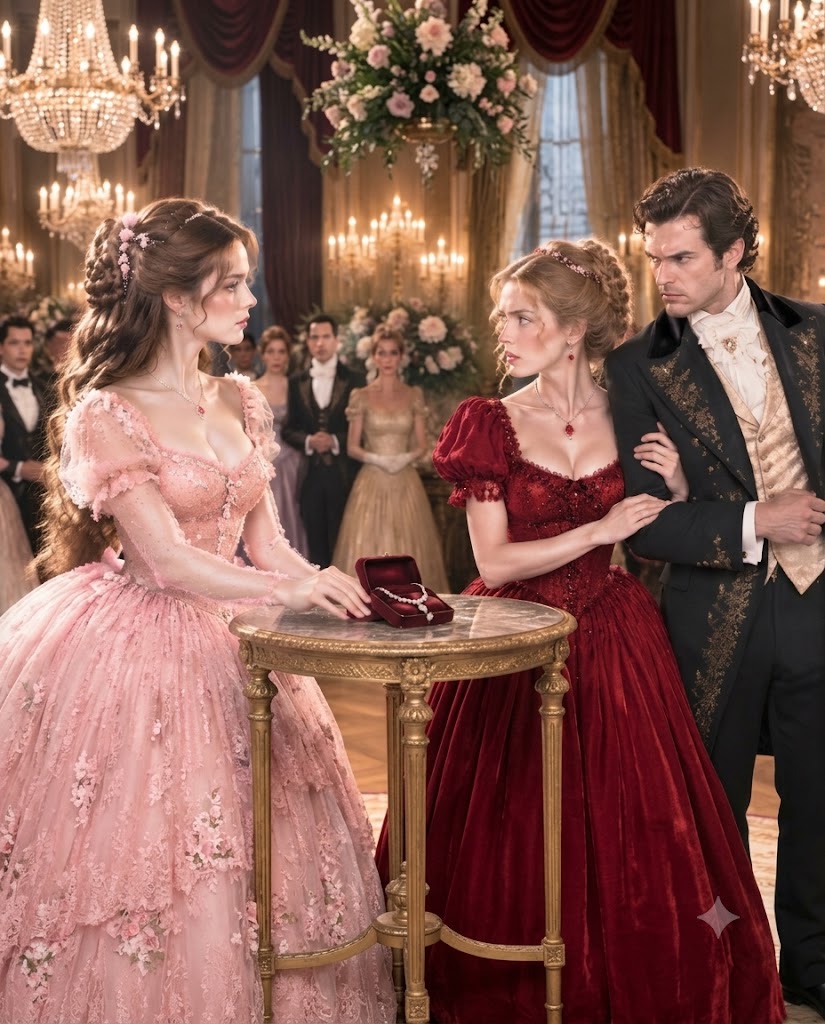
“The necklace.”
“I know what you meant.”
He said nothing more.
Eleanor removed her gloves.
“Show me the accounts.”
They spent four hours in the library.
Alexander attempted explanations at first.
Eleanor stopped him after twenty minutes.
“I don’t need explanations. I need records.”
He brought them.
The deeper she read, the worse the situation became.
Alexander had borrowed heavily to maintain appearances after Eleanor’s departure. When income declined, he had hosted larger dinners. When creditors became impatient, he had purchased new horses.
It was absurd.
But beneath the absurdity was something Eleanor had not expected.
Fraud.
She turned one ledger toward the light.
“Who authorized this?”
Alexander leaned closer.
“Clara’s brother.”
Eleanor looked at him.
“Edmund Vale?”
Alexander nodded.
“Clara said he had experience in finance.”
“He has experience in theft.”
Alexander stiffened.
“What?”
“These transport payments are invented.”
He frowned.
“They cannot be. The receipts—”
“Are duplicates.”
She pulled another book from the table.
“Here. Same invoice number. Same cargo weight. Different date.”
Alexander stared.
Eleanor turned another page.
“And this company, Westbridge Agricultural Holdings?”
“Yes.”
“It does not exist.”
“You cannot know that.”
“I can because I tried to purchase grain from them eighteen months ago.”
Alexander’s face changed.
Eleanor closed the ledger.
“How much authority did you give Edmund?”
Silence.
“How much?”
“Full purchasing authority.”
Eleanor slowly leaned back.
“And access to estate securities?”
Another silence.
“Alexander.”
“Yes.”
She stood.
For the first time that day, genuine anger entered her voice.
“You did not lose this estate through bad luck.”
“I know.”
“No, you don’t. You handed the keys to a man you barely knew because reading contracts bored you.”
Alexander’s jaw tightened.
“You think I have not understood that?”
“I think you understood it only when there was nothing left to protect you from the consequences.”
He looked at her across the desk.
“That may be true.”
The answer stopped her.
The old Alexander would have argued.
He would have found someone else to blame.
This man simply stood there.
Eleanor gathered several papers.
“Where is Clara?”
His eyes shifted.
“London.”
“Why?”
“She left.”
“When?”
“Six months ago.”
Eleanor waited.
Alexander gave a tired laugh without humor.
“When the creditors began arriving at breakfast.”
Something in her expression softened, but only slightly.
“She and Edmund disappeared within the same week,” he continued. “I have not heard from either.”
“You were used.”
“Yes.”
“And now you expect me to repair it.”
Alexander looked toward the dying fire.
“No.”
Eleanor paused.
“That is precisely what your letter asks.”
“My letter asks whether you can save the estate.”
“That is the same thing.”
“No.”
He met her eyes.
“I do not expect you to.”
Eleanor said nothing.
Alexander walked to the window.
“The northern farms employ seventy-three families. The village school is funded by estate rents. So is the clinic. If the creditors divide the land, they will sell the farms individually. The tenants will be removed.”
Now Eleanor understood.
“You are asking for them.”
“I am.”
“And yourself?”
Alexander smiled faintly.
“I suspect I have already received what I deserve.”
She hated that answer.
Not because it was false.
Because it made things harder.
Revenge was easier when the person who had hurt you remained cruel.
Hatred was comfortable when nothing changed.
But people sometimes did change.
And forgiveness, Eleanor knew, was far more complicated than anger.
She returned to her estate that evening with three boxes of Whitmore accounts.
For ten days, she barely slept.
Margaret objected.
Eleanor ignored her.
She traced payments.
Compared contracts.
Sent discreet messages to merchants in London.
By the eleventh day, she knew exactly what Edmund Vale had done.
And she knew something worse.
He had not vanished.
He was preparing to purchase the northern Whitmore lands through a third party after foreclosure.
The fraud had never merely been theft.
It had been acquisition.
Eleanor summoned Margaret.
“We need a solicitor.”
“We have three.”
“A ruthless one.”
Margaret smiled.
“Then we have two.”
Within forty-eight hours, Eleanor’s representatives had gathered bank records, forged invoices, witness statements, and correspondence linking Edmund to the shell companies draining Whitmore funds.
But there was a problem.
It might be enough to prosecute him.
It was not enough to stop the foreclosure.
The payment was still due.
Thirty-two thousand pounds.
Eleanor possessed the money.
That was what made the decision unbearable.
She stood in her office at midnight while rain struck the windows.
Thirty-two thousand pounds could expand her own warehouses.
Purchase the eastern mill.
Fund new housing for her workers.
Why should she risk everything she had built to save the estate of the man who had humiliated her?
Why should responsibility always return to the person capable of carrying it?
She thought of the dinner.
Clara beside Alexander.
Forty guests watching.
She thought of the necklace on the table.
Then she thought of something else.
The northern farms.
Children walking to school.
Families who had never been invited beneath Whitmore chandeliers and had never chosen Alexander’s mistakes.
By dawn, Eleanor had made her decision.
She would save the lands.
But not Alexander.
Two weeks later, Whitmore’s creditors arrived for a formal meeting.
Six men entered the library expecting a desperate duke.
Instead, they found Eleanor seated at the head of the table.
Alexander stood near the fireplace.
The lead creditor, Mr. Harcourt, stopped.
“Duchess.”
“Lady Eleanor will do.”
He glanced at Alexander.
“Are we negotiating through your wife?”
“Former wife in everything but law,” Eleanor said calmly. “And you are negotiating with me.”
Harcourt smiled.
“With respect, this debt belongs to His Grace.”
“Not anymore.”
She placed a document on the table.
“I purchased the primary note yesterday.”
The room changed instantly.
Harcourt’s smile disappeared.
Alexander stared at her.
“You did what?”
Eleanor did not look at him.
“I now control the debt secured against the northern lands.”
One creditor leaned forward.
“Then I assume you intend to restructure.”
“I intend to separate the productive lands from the duke’s personal liabilities.”
“That cannot be done without his consent.”
Alexander spoke.
“You have it.”
Everyone turned.
Eleanor looked at him for the first time.
He walked to the table.
“What must I sign?”
Harcourt frowned.
“Your Grace, you should consider—”
“I have spent most of my life avoiding consideration.”
Alexander pulled out a chair.
“I think I will try it now.”
The negotiations lasted six hours.
By evening, the agreement was complete.
The northern farms would transfer into a new agricultural trust controlled by Eleanor’s company. Tenant leases would remain protected. A percentage of future profits would fund the village school and clinic.
Whitmore House and its remaining lands would stay with Alexander, along with the debts attached to them.
Eleanor had saved the people.
Not the title.
Not the lifestyle.
Not the illusion.
When the final solicitor left, Alexander remained in the library.
“You could have taken everything,” he said.
“Yes.”
“Why didn’t you?”
Eleanor gathered her documents.
“Because then I would be making decisions for the same reason you once did.”
“What reason?”
“Pride.”
He lowered his eyes.
She reached the door.
“Eleanor.”
She stopped.
“There is something you should know.”
She turned.
Alexander opened a drawer and removed a small velvet box.
Inside was the Whitmore crest.
Her necklace.
“I found it the morning after you left.”
He placed it on the desk between them.
“For two years I told myself you had forgotten it.”
Eleanor looked at the silver crest.
“And then?”
“Then I understood that you had left it deliberately.”
“Yes.”
“Why?”
Her answer was quiet.
“Because everyone in that house believed the crest gave me value.”
She looked at him.
“I needed to discover whether I had any without it.”
Alexander swallowed.
“And?”
Eleanor closed the box.
“I did.”
She left the necklace on the table.
Three weeks later, Edmund Vale was arrested in Dover while attempting to board a ship for France.
Clara was arrested two days later.
The investigation revealed that she had known far more than Alexander believed.
She and Edmund had used similar schemes before, attaching themselves to wealthy households, gaining access to finances, creating artificial debt, then purchasing distressed property through intermediaries.
Whitmore had simply been their largest target.
The scandal spread quickly.
Newspapers printed Alexander’s humiliation in detail.
Society whispered.
Invitations disappeared.
Families that had once fought for seats at his table suddenly forgot his name.
Eleanor expected him to retreat.
Instead, he did something no one anticipated.
He sold the London residence.
Then the hunting lodge.
Then most of the horses.
He dismissed the expensive advisers who had survived by flattering him and used the proceeds to pay creditors.
For the first time in his life, Alexander began appearing in the estate office before breakfast.
The clerks were terrified.
Then confused.
Then amused.
Because the Duke of Whitmore did not understand half the documents placed before him.
But he began asking questions.
And, more importantly, listening to the answers.
Months passed.
Eleanor heard reports occasionally.
She did not seek them.
Her own work had become too large.
The eastern mill came up for sale.
She purchased it.
Then converted part of it into a training facility for widows and young women who had previously been denied skilled employment.
Critics called the idea impractical.
The first year produced record profits.
By the second, other estates began copying her model.
One spring morning, Margaret entered Eleanor’s office with an envelope.
“No seal this time.”
Eleanor recognized the handwriting.
She opened it.
There was only one page.
The village school roof has been repaired.
The northern trust paid half. I paid the other half.
I thought you might like to know.
A.
Eleanor folded the letter.
Margaret raised an eyebrow.
“No request for money?”
“No.”
“No apology?”
“No.”
“No dramatic declaration of eternal regret?”
“Fortunately, no.”
Margaret smiled.
“Progress.”
Eleanor placed the letter in a drawer.
A year later, she returned to Whitmore for the first time since the creditor meeting.
Not for Alexander.
The village school was opening a new wing, financed jointly by the trust and the remaining Whitmore estate.
Children crowded the courtyard carrying flowers.
Farmers stood beside merchants.
Workers from Eleanor’s factories arrived in wagons.
There were no chandeliers.
No polished silver.
No orchestra.
Eleanor preferred it.
She saw Alexander near the school entrance.
His coat was good but old.
He was speaking with a tenant farmer.
Not speaking at him.
With him.
When he noticed Eleanor, he excused himself and approached.
“You came.”
“You invited half the county.”
“I was hoping you might accidentally be among them.”
She smiled despite herself.
They walked around the side of the building.
For a moment, neither knew what to say.
Finally Alexander spoke.
“I owe you an apology I cannot finish.”
“That sounds inconvenient.”
“I have tried writing it.”
“I imagine the drafts were terrible.”
“Catastrophic.”
She laughed.
It surprised both of them.
Alexander looked down.
“I thought being a duke meant everything around me belonged to me.”
Eleanor’s smile faded.
He continued.
“The land. The house. The people’s loyalty. Your labor. Even your silence.”
A breeze moved through the trees.
“I mistook what was given freely for something I was entitled to.”
Eleanor listened.
“I cannot undo what I did at that dinner,” he said. “Or the years before it.”
“No.”
“I know.”
He looked toward the schoolyard.
“But I can spend whatever years remain becoming someone who would never do it again.”
Eleanor studied him.
There was a time when she had desperately wanted those words.
She had imagined hearing them at night after arguments, during lonely dinners, in rooms where Alexander had treated her intelligence like useful furniture.
Now they arrived years too late.
And somehow, that made them more honest.
Because he was no longer saying them to keep her.
He had already lost her.
“I forgive you,” Eleanor said.
Alexander’s eyes lifted.
“But I am not coming back.”
Pain crossed his face.
Then acceptance.
“I know.”
She nodded.
“Forgiveness is not restoration, Alexander.”
“No.”
“And regret is not payment.”
“No.”
“But change matters.”
He breathed out slowly.
“Thank you.”
They returned to the school together.
Not as husband and wife.
Not quite as friends.
As two people who had survived different versions of the same life.
The legal separation became official the following winter.
Society treated it as another scandal.
Eleanor treated it as paperwork.
She reclaimed her family name.
Eleanor Ashford.
For the first time, it felt entirely her own.
Five years after she had walked out of Whitmore House, Eleanor stood before another dinner table.
There were nearly fifty people in the room.
But this table looked nothing like Alexander’s.
Factory managers sat beside farm tenants.
Merchants sat beside teachers.
Widows who had become supervisors spoke comfortably with landowners.
Margaret sat at Eleanor’s right hand, wearing a blue dress she had once insisted was too expensive.
Above them hung simple lamps instead of crystal chandeliers.
The occasion was the opening of the Ashford Foundation, an institution created to provide loans and training to women who wished to establish businesses, purchase land, or learn trades.
Eleanor had spent months preparing the program.
That evening, however, she did not speak about herself.
She spoke about value.
“There are many ways to imprison a person,” she told the room. “Some prisons have locks. Others have titles.”
The room became quiet.
“Sometimes we are taught that security means being needed by someone powerful. That dignity comes from being chosen. That if we are patient enough, useful enough, silent enough, eventually our value will be recognized.”
She paused.
“I believed that once.”
Margaret looked at her.
“So I worked harder. I solved problems no one knew existed. I protected people who never understood they were being protected.”
A few guests lowered their eyes.
“And one evening, I realized something.”
Eleanor touched the place at her throat where the Whitmore crest had once rested.
“If someone can only see your value while you are serving them, they do not value you.”
No one moved.
“And if losing their approval causes you to lose yourself, then what you possessed was never security.”
At the back of the room, a man stood quietly beside the doorway.
Alexander.
Eleanor had not known whether he would come.
She met his eyes.
He bowed his head slightly.
She continued.
“Walking away did not make me strong. I was already strong. Walking away merely forced me to discover it.”
Applause began slowly.
Then filled the hall.
This time, Eleanor did not disappear before the glasses were empty.
She stayed.
She spoke with workers.
She laughed with Margaret.
She listened to women describing businesses they hoped to build.
Near midnight, Alexander approached.
“I brought something.”
He held out the old velvet box.
Eleanor looked at it.
“I thought we settled this.”
“We did.”
“Then why bring it?”
“Open it.”
She did.
The Whitmore crest was gone.
Inside lay a small silver key.
Eleanor looked at him.
“The old estate office,” Alexander explained. “We converted it into a public records room and lending library.”
“A library?”
“For tenants. Farmers. Anyone who wants to understand contracts before signing them.”
Eleanor laughed softly.
“That sounds suspiciously sensible.”
“I have recently become acquainted with sensible ideas.”
She picked up the key.
“Why give it to me?”
“Because the building exists because of what you taught me.”
He hesitated.
“And because I thought a key was more appropriate than a crest.”
Eleanor closed her fingers around it.
For the first time, the symbol he gave her was not something meant to identify whom she belonged to.
It opened a door.
“Thank you,” she said.
Alexander smiled.
Then he left.
Years later, people told many versions of Eleanor Ashford’s story.
Some said she had destroyed a duke.
Others said she had saved him.
Neither version was correct.
Alexander had destroyed the life he once knew through arrogance, and later rebuilt what remained through humility.
Eleanor had neither ruined nor rescued him.
She had simply stopped carrying him.
And that had changed everything.
The Ashford Foundation grew far beyond the county.
Hundreds of women received loans.
Dozens purchased farms.
Some failed and tried again.
Others created companies that lasted generations.
The northern lands prospered under the trust.
The school expanded twice.
The clinic became a small hospital.
Whitmore House never returned to its former extravagance.
Alexander never tried to make it.
He closed several grand rooms and converted one wing into agricultural offices.
Visitors sometimes found him there late in the evening reading contracts slowly, line by line.
He never remarried.
Neither did Eleanor.
Not because either life had ended with their marriage.
Because both had finally learned that a complete life did not require another person to complete it.
On the tenth anniversary of the night Eleanor left Whitmore House, she returned to the old entrance hall.
Alexander was away on estate business.
The housekeeper allowed Eleanor inside.
The grandfather clock still stood against the wall.
Ticking.
Steady.
Unimpressed by human pride.
Eleanor walked to the small table near the door.
The same table where she had once placed the crest.
She remembered the woman who had stood there ten years earlier.
Silent.
Humiliated.
Terrified beneath her calm.
That woman had believed she was abandoning everything.
Her home.
Her status.
Her marriage.
Her future.
She had not known that sometimes what feels like losing everything is merely the moment you stop confusing everything with what you have outgrown.
Eleanor placed her hand on the table.
Then smiled.
She needed no necklace now.
No title.
No permission.
Outside, a carriage waited to take her home.
Not to a refuge.
Not to a replacement for Whitmore.
Home.
The estate she had rebuilt.
The company she had created.
The life that existed because one night, surrounded by people waiting for her to accept humiliation politely, Eleanor had finally chosen herself.
She stepped through the door.
Behind her, the clock continued ticking.
Ahead of her, morning light stretched across the road.
And Eleanor understood the lesson that had taken half a lifetime to learn:
Sometimes the greatest revenge is not watching someone regret losing you.
It is reaching a point where their regret is no longer necessary.
Sometimes strength is not fighting to keep your place at someone else’s table.
It is building a table of your own.
And sometimes walking away is not the end of a story.
It is the first decision in a life that finally belongs to you.
Years passed, but some doors did not close simply because people stopped looking at them.
Eleanor learned that on a gray morning in early November, when Margaret entered her office carrying a newspaper folded beneath one arm.
“You may want to read this.”
Eleanor looked up from a stack of loan applications.
“That sentence has never brought me anything pleasant.”
Margaret placed the paper on the desk.
A headline stretched across the front page.
WHITMORE ESTATE TO BE SOLD?
Eleanor’s expression changed.
She read quickly.
Alexander had suffered a serious riding accident three weeks earlier.
He had survived.
But his injuries had left him unable to manage the estate for an indefinite period.
Without his daily oversight, several outstanding obligations had resurfaced.
The article suggested that Whitmore House itself might finally be sold.
Eleanor folded the paper slowly.
Margaret watched her.
“You are thinking of going.”
“I am thinking.”
“You always say that immediately before doing something exhausting.”
Eleanor gave her a look.
Margaret smiled faintly.
“Shall I have the carriage prepared?”
“No.”
Margaret raised an eyebrow.
Eleanor stood.
“I’ll take the motorcar.”
By afternoon, she was on the road.
The journey felt shorter than it had years before.
Perhaps because the distance between places mattered less once the distance inside a person had changed.
Whitmore House appeared beyond the trees just before sunset.
For the first time, Eleanor saw lights burning in only three windows.
The great house looked smaller.
Not physically.
Humanly.
At the entrance, the housekeeper greeted her with visible relief.
“He has refused nearly everyone.”
“Then why did you let me in?”
The woman looked almost embarrassed.
“Because he did not refuse you.”
Eleanor said nothing.
Alexander was in the library.
Of course he was.
He sat beside the fire with one leg heavily bandaged and a walking cane resting against his chair.
When he saw Eleanor, surprise flickered across his face.
Then amusement.
“I expected Margaret.”
“She considered coming in my place.”
“That would have been terrifying.”
“She would be pleased to hear it.”
Eleanor removed her gloves.
“You look terrible.”
“Your compassion remains overwhelming.”
“It has become more efficient with age.”
Alexander smiled.
For several seconds, neither spoke.
Then Eleanor noticed the documents on the desk.
Account books.
Loan notices.
Property assessments.
Her eyes narrowed.
“You are working.”
“I am sitting near work.”
“That is not the same thing.”
“I have discovered this.”
She approached the desk.
“You should be resting.”
“So everyone keeps saying.”
“Perhaps because everyone is correct.”
Alexander leaned back.
“Now I know the accident was serious. You agreed with everyone.”
Despite herself, Eleanor laughed.
Then the laughter faded.
“I read the paper.”
“So did I.”
“Is it true?”
His eyes moved toward the fire.
“Some of it.”
“Which part?”
“The house may have to be sold.”
Eleanor studied him carefully.
“And how do you feel about that?”
He was silent for longer than she expected.
“Ten years ago, I would have considered it death.”
“And now?”
“Now I think it is a building.”
She looked around.
The carved shelves.
The portraits.
The ceiling painted by men who had been dead for a century.
“A very expensive building.”
“Yes.”
“Filled with dreadful furniture.”
“That was mostly my mother.”
“And some of your choices.”
“I was young.”
“You were thirty-six.”
“Tragically young.”
Eleanor shook her head.
But Alexander’s smile faded.
“There are people here who still depend on the estate.”
“There are fewer than before.”
“Fewer is not none.”
“What do you want from me?”
The question landed between them without softness.
Alexander looked at her.
“Nothing.”
Eleanor’s expression hardened.
“Do not do that.”
“Do what?”
“Pretend you have no reason for allowing me to come.”
“I allowed you to come because you wanted to.”
“You did not know I wanted to.”
“No.”
“Then why?”
He looked down at his hands.
“When I woke after the accident, I thought I was going to die.”
Eleanor said nothing.
“I had one ridiculous thought.”
“What was it?”
“I wondered whether the library key still worked.”
Eleanor stared at him.
“That was your final thought?”
“It was not a distinguished moment.”
“Apparently not.”
He smiled faintly.
Then his face grew serious.
“I realized I was not afraid of losing the house.”
He paused.
“I was afraid of leaving things unfinished.”
Eleanor’s eyes narrowed slightly.
“What things?”
“Not between us.”
That answer surprised her.
Alexander continued.
“I learned long ago that some things cannot be repaired simply because you regret breaking them.”
The fire cracked softly.
“I meant the tenants. The records. The school endowment. The agricultural trust. All the things that became better only after I stopped assuming they would survive me.”
Eleanor sat opposite him.
“So what is unfinished?”
Alexander reached for a folder.
His hand trembled slightly.
He placed it before her.
Inside were legal documents.
Eleanor began reading.
Her expression slowly changed.
“You want to transfer Whitmore House.”
“Yes.”
“To the trust?”
“No.”
She looked up.
“To the Ashford Foundation.”
Eleanor stared at him.
“No.”
Alexander almost smiled.
“I expected that.”
“Then why ask?”
“Because you should refuse after knowing why.”
“I am refusing before knowing why.”
“You have become efficient.”
She closed the folder.
“What exactly would my foundation do with a house this size?”
“Turn it into something useful.”
Eleanor’s eyes sharpened.
Alexander continued.
“Training rooms. Offices. Housing. A school. A place for women who need time before they know where they are going.”
For a moment, Eleanor could not speak.
He looked toward the shelves.
“This house spent generations teaching people where they belonged.”
His voice was quieter now.
“Perhaps it should spend the next generation giving them choices.”
Eleanor looked at him for a long time.
Then at the papers.
“You have thought about this.”
“For nearly two years.”
“You never said anything.”
“I was afraid you would think it was guilt.”
“Is it?”
“Partly.”
Eleanor appreciated the answer.
“And the rest?”
“Use.”
She looked at him.
Alexander took a slow breath.
“I spent most of my life believing inheritance meant keeping things.”
He glanced around the library.
“I was wrong.”
“What does it mean?”
“Leaving something capable of doing good after no one remembers why you owned it.”
Silence filled the room.
Eleanor opened the folder again.
This time, she read every page.
By midnight, she had marked eighteen clauses.
Alexander looked offended.
“Eighteen?”
“Twenty-one, if I include the financial language.”
“You have not changed.”
“I have improved.”
“You were always frightening.”
“You were simply underprepared.”
They worked until the fire nearly died.
For the first time in their lives, Eleanor and Alexander sat at the same table without one serving the other.
No marriage.
No obligation.
No resentment demanding payment.
Only two people trying to make one final good decision with what remained.
The transfer took eight months.
Society called it madness.
Several newspapers called it revolutionary.
One called it “a spectacular act of noble surrender.”
Eleanor cut that article out and sent it to Alexander with a note.
You always did enjoy spectacle.
He replied three days later.
At last, an accurate obituary in advance.
Whitmore House reopened the following spring.
The iron gates stood open.
Not for carriages carrying titled guests.
For apprentices.
Widows.
Farmers.
Teachers.
Young women carrying small suitcases and frightened expressions.
The ballroom became a lecture hall.
The east wing became temporary housing.
The old dining room became a cooperative kitchen.
The hunting room became an accounting classroom.
Margaret personally insisted on that.
“If men can learn to shoot in a room,” she said, “women can learn compound interest in it.”
No one argued.
The grand staircase remained unchanged.
Eleanor wanted it that way.
Some histories did not need to be erased.
They needed to be repurposed.
On opening day, hundreds gathered in the courtyard.
Eleanor stood beneath the stone balcony where generations of Whitmores had once addressed tenants.
Alexander stood beside her with a cane.
He walked more slowly now.
But he stood without assistance.
The crowd quieted.
Eleanor stepped forward.
“When this house was built, its doors were designed to separate.”
Her voice carried across the courtyard.
“To distinguish who belonged inside from who remained outside.”
She looked toward the open gates.
“Today, that purpose ends.”
Applause began.
Eleanor raised one hand.
“This place will not exist to teach obedience.”
The crowd quieted again.
“It will exist to teach independence.”
Behind her, Alexander lowered his head.
Eleanor continued.
“No woman who comes here will be told that gratitude is the price of opportunity.”
Margaret smiled from the front row.
“No worker will be taught that poverty means lack of intelligence.”
A farmer removed his hat.
“No child will be told that birth determines the size of their future.”
The silence grew deeper.
“This house once represented inheritance.”
Eleanor looked at the building.
“From today forward, it represents access.”
The applause that followed was unlike the applause at dinners.
It did not celebrate status.
It celebrated possibility.
Later that evening, after the crowd dispersed, Eleanor walked through the entrance hall alone.
The grandfather clock still stood there.
Ticking.
The small table remained beside the door.
Someone had placed fresh flowers upon it.
She stopped.
For years, that table had been a symbol in her memory.
The place where she had left the crest.
The place where one life ended.
She heard footsteps behind her.
Alexander approached slowly.
“You always stop there.”
“I suppose I do.”
“I almost had the table removed.”
“Why?”
“I thought you hated it.”
Eleanor touched the edge of the wood.
“No.”
“What does it mean to you?”
She considered the question.
“Choice.”
Alexander nodded.
They stood together.
Then he reached into his coat pocket.
Eleanor looked at him suspiciously.
“If that is another symbolic object, I may leave.”
“It is worse.”
He handed her a small envelope.
Inside was a single sheet.
A resignation.
Alexander was stepping down from every formal role connected to the Whitmore lands.
Eleanor looked at him.
“Why?”
“Because I am tired.”
“That has never stopped men in positions of authority.”
“I am attempting innovation.”
She almost smiled.
He continued.
“And because they no longer need me.”
There was no sadness in the words.
Only peace.
Eleanor folded the paper.
“What will you do?”
“I have been offered a position.”
She stared.
“You?”
“Yes.”
“By whom?”
“The school.”
“For what?”
Alexander looked mildly embarrassed.
“History.”
Eleanor burst out laughing.
He waited.
“You?”
“So I have been told.”
“Teaching history?”
“I possess considerable experience making mistakes within it.”
She continued laughing.
Alexander shook his head.
“I regret telling you.”
“No, you do not.”
“No.”
He smiled.
And for one brief moment, Eleanor remembered the man she had once loved.
Not the careless duke.
Not the selfish husband.
A younger man riding beside her in summer fields, before entitlement hardened into habit.
She did not wish for that life back.
That was the strange mercy of healing.
You could remember something tenderly without wanting to return to it.
“Alexander.”
“Yes?”
“I think you will be a terrible teacher.”
“Thank you.”
“But perhaps not forever.”
“That is unusually generous.”
“Do not become accustomed to it.”
They parted in the entrance hall.
Eleanor returned to Ashford.
Alexander moved into a small cottage near the school.
Whitmore House belonged to no duke after that.
And that was exactly the point.
Three years later, Margaret died peacefully in her sleep.
It was the loss Eleanor had never prepared for.
Margaret had been there when Eleanor had nothing but an abandoned house and anger.
She had been there through the first contract.
The first profitable harvest.
The first employee.
The first expansion.
She had argued.
Protected.
Mocked.
Corrected.
Loved.
After the funeral, Eleanor locked herself inside her office and wept until evening.
There are griefs that teach nothing.
They simply prove that love existed.
Weeks later, Eleanor found an envelope hidden in Margaret’s desk.
On the front were five words.
For when you become unbearable.
Inside was a letter.
Eleanor,
If you are reading this, I have finally escaped your paperwork.
Do not look offended.
You know perfectly well I stayed longer than any reasonable woman would.
There are three things you must do.
First, stop pretending the foundation depends entirely on you. That would mean you failed to build a foundation and merely built another version of yourself.
Second, appoint Lydia to my position. She is smarter than you think, which is saying something because you already think highly of her.
Third, take a holiday.
A real one.
More than two days.
You have spent years teaching women that they are more than what they provide for others.
Try believing your own lesson.
With great affection and increasing irritation,
Margaret
Eleanor laughed while crying.
Then she did something Margaret would have considered miraculous.
She listened.
Lydia became director of operations.
Eleanor reduced her working hours.
And six months later, she traveled to Italy for three weeks.
She hated the first four days.
By the seventh, she discovered sitting beside the sea did not cause civilization to collapse.
By the tenth, she stopped checking letters.
By the fifteenth, she began to understand one final truth.
Independence was not the same as endless strength.
She had spent years learning not to depend on Alexander.
Then years learning not to depend on anyone.
But that, too, had become a kind of cage.
The strongest person in the room did not always have to carry the room.
Sometimes strength meant trusting what you had built to stand without you.
When Eleanor returned, the foundation was thriving.
No disaster.
No crisis.
No collapse.
Lydia had even improved the reporting system.
Eleanor was deeply offended.
And secretly delighted.
Time moved as it always did.
Without permission.
Alexander grew older.
So did Eleanor.
Their friendship became quieter.
Letters arrived occasionally.
Short.
Dry.
Comfortable.
When Alexander died at seventy-four, Eleanor was sitting beside his bed.
He had been ill for several months.
There was no dramatic final confession.
No desperate apology.
They had finished those conversations years before.
Near the end, he opened his eyes.
“Did I become a better man?”
Eleanor looked at him.
“You became a man who kept trying.”
He smiled faintly.
“That sounds suspiciously like avoiding the question.”
“It is the answer.”
He was quiet.
Then he whispered,
“Good.”
Those were his last words.
At the funeral, former tenants stood beside teachers.
Students stood beside farmers.
No aristocratic spectacle remained.
Alexander had requested none.
Afterward, Eleanor walked alone to the school.
A group of children were arguing beneath a tree about a history lesson.
One girl noticed her.
“Lady Ashford?”
“Yes?”
“Did you know the Duke of Whitmore?”
Eleanor smiled.
“Yes.”
“Was he important?”
Eleanor looked toward the old house.
Then toward the classrooms filled with voices.
“He became useful.”
The girl frowned.
“Is that better than important?”
Eleanor thought for a moment.
“Yes.”
“I think so.”
The girl ran back to her friends.
Eleanor continued walking.
She lived another eleven years.
By the time she was eighty-two, the Ashford Foundation operated across the country.
Its original loan program had financed thousands of businesses.
Whitmore House had educated generations.
Women who once arrived with nothing became managers, farmers, accountants, teachers, inventors.
Some returned years later as donors.
Others returned as mentors.
Eleanor’s name became famous.
She disliked that.
“What matters,” she often said, “is whether the doors remain open after my name disappears.”
Near the end of her life, a young journalist asked to interview her.
He arrived with ten pages of questions.
Eleanor dismissed nine.
He asked only one.
“What was the most important decision you ever made?”
He expected her to say leaving her husband.
She did not.
“Leaving was necessary.”
She looked through the window.
“But leaving is only movement.”
“What mattered was what I built afterward.”
The journalist wrote quickly.
Eleanor continued.
“People romanticize the moment someone walks away.”
She smiled faintly.
“They forget the morning after.”
“What happened the morning after?”
“I had work to do.”
The journalist laughed.
Eleanor did not.
“The world does not transform because you make one brave choice.”
She leaned back.
“It transforms because you keep choosing.”
“To do what?”
“To stop returning to what diminishes you.”
“To build where there was nothing.”
“To learn when pride tells you that you already know.”
“To forgive without surrendering your boundaries.”
“To help without becoming someone’s crutch.”
“To rest without believing you have become weak.”
The journalist stopped writing.
Eleanor looked at him.
“That is the part people rarely tell you.”
“What part?”
“Freedom is not one decision.”
She smiled.
“It is a practice.”
Eleanor Ashford died the following spring.
Her funeral was held at Whitmore House.
Thousands came.
Not because she had once been a duchess.
Because somewhere in their lives, a door she had opened had changed what was possible.
There was no family crest on her coffin.
No aristocratic insignia.
Only a small silver key.
The one Alexander had given her decades earlier.
After the funeral, it was placed in a glass case in the entrance hall.
Beneath it, a plaque carried no title.
Only a sentence.
A key has value only when it opens something.
Years became decades.
Names changed.
Buildings were renovated.
The world outside moved faster.
But the old entrance hall remained.
So did the grandfather clock.
And beside the door, the small wooden table still stood.
Every year, new students passed it.
Most did not know that once, long ago, a woman had stood in that exact place believing she had lost everything.
They did not know she had removed a necklace.
They did not know she had walked into the night with no applause following her.
They only knew what came after.
A school.
A foundation.
A system of loans.
A thousand opportunities.
A different future.
And perhaps that was the final measure of Eleanor’s life.
The world remembered the doors she opened.
Not the one she closed.
Because the deepest victory was never that Alexander regretted losing her.
It was not that Clara was punished.
It was not that society eventually respected her.
It was not even that Eleanor proved she could survive alone.
Her greatest victory was that the pain meant to reduce her became something that expanded the lives of others.
She had been humiliated at one table.
So she built a thousand places where others could sit with dignity.
She had once been treated as useful but invisible.
So she built institutions that taught people to see their own worth.
She had once confused endurance with love.
So she spent the rest of her life showing that love without respect was merely another form of possession.
And in the end, no title defined her.
No marriage completed her.
No revenge sustained her.
She became something far more difficult to take away.
A woman who knew exactly who she was.
The old clock kept ticking.
Students kept entering.
Doors kept opening.
And somewhere beyond the gates, morning continued to arrive.
Not because every wound had disappeared.
Not because every wrong had been undone.
But because life had moved forward.
And so had she.
That was the legacy Eleanor left behind:
You do not always get to choose what breaks your heart.
But you can choose what you build from the pieces.
And sometimes, the life waiting after the ending is greater than anything you once begged not to lose.
THE END.