The accusation came in Italian.
Lady Pembery was the first to move.
She reached for the document, but Julian placed two fingers upon it before she could touch the paper.
“I should advise you to read carefully, my lady,” he said. “The last person who underestimated what was written here lost eleven years of his life.”
Cordelia gave a nervous laugh.
“Surely we are not to entertain ancient grievances over dinner.”
“Ancient?” Clara repeated softly. “My father died six years ago believing the world considered him a thief. I hardly think grief becomes ancient simply because those responsible have grown comfortable.”
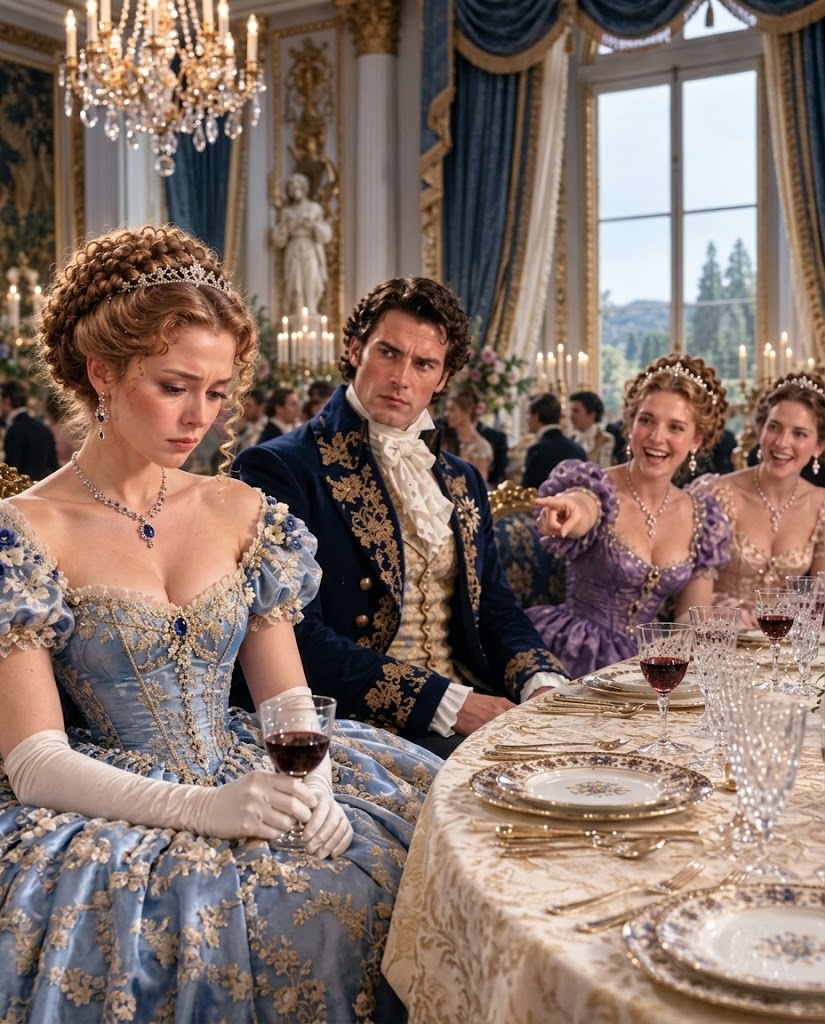
A terrible stillness descended upon the dining room.
At the far end of the table, Lord Pembery lowered his wineglass.
Clara noticed the movement.
She also noticed something else.
His expression had not changed when Julian produced the document.
It had changed when Julian mentioned the lie being used twice.
As though he had recognized a pattern he had never expected anyone else to see.
Julian unfolded the paper.
“Eleven years ago, Edmund Vale was accused of stealing thirty thousand pounds from the Bellmont charitable trust. The accusation destroyed his reputation, his livelihood, and eventually his health.”
Clara kept her eyes lowered.
She could still remember her father sitting beside a dying fire, turning an unopened letter between his hands because he could no longer bear another rejection.
She remembered the way he had smiled whenever she entered the room, pretending poverty was merely an inconvenience.
And she remembered his final words.
Never let another person’s lie teach you to be ashamed of your own name.
Julian continued.
“This document authorizes the transfer of those funds into an account belonging to the late Earl of Ashcombe.”
Cordelia’s father.
Her face drained of color.
“That is impossible.”
“Your father’s signature is quite unmistakable.”
“Then it is a forgery.”
“Perhaps,” Julian said. “Which is why I brought someone capable of confirming it.”
The dining-room doors opened.
An elderly gentleman stepped inside, carrying a leather portfolio.
Clara recognized him immediately.
“Mr. Whitcomb?”
The old solicitor bowed.
“Mrs. Ashford.”
Her heart struck painfully against her ribs.
Mr. Whitcomb had served her father until the accusation ruined his practice. She had believed him dead.
“I owe your father an apology,” he said. “One I was too much of a coward to offer while he lived.”
Cordelia rose.
“This is an outrage.”
“No,” Julian replied. “What happened to Edmund Vale was an outrage. This is merely its consequence.”
Mr. Whitcomb laid three documents upon the table.
The first contained the original transfer authorization.
The second recorded a payment to a witness who had testified against Clara’s father.
The third was a letter.
And at the bottom of that letter stood a signature none of them had expected.
Lady Pembery’s.
Clara looked toward her hostess.
The older woman sat perfectly still, one hand resting upon the embroidered tablecloth.
“Lady Pembery,” Clara whispered.
The woman closed her eyes.
Cordelia began speaking rapidly in Italian, urging her aunt to deny everything.
Clara understood every word.
But she no longer felt the triumph she had imagined she might feel.
For the first time, the truth looked less like victory than the opening of a grave.
Lady Pembery finally spoke.
“I did not steal the money.”
Julian inclined his head.
“Then explain why you signed the letter instructing Mr. Whitcomb to suppress the original accounts.”
“Because I was protecting someone.”
“Your brother?”
“No.”
Her gaze drifted toward the man sitting beside the fireplace.
Lord Pembery.
The silence that followed seemed to swallow even the rain.
He stood so abruptly that his chair struck the wall.
“This conversation is finished.”
Julian did not move.
“I believe it has only just begun.”
Lord Pembery turned toward the door.
Then Clara noticed the smallest thing.
His right hand was shaking.
Not with anger.
With fear.
And suddenly she remembered a story her father had told her long ago.
A story about a man who could destroy another person’s life with a signature and still sleep soundly afterward.
Her father had never spoken that man’s name.
But he had described a particular habit.
Whenever the man was nervous, he rubbed his thumb against the inside of his wedding ring.
Lord Pembery was doing precisely that.
Clara rose.
“You knew my father.”
He stopped.
“Most men in London knew your father.”
“No. You knew him before the scandal.”
Lord Pembery glanced at his wife.
For one brief instant, she looked frightened for him.
Then he smiled.
A cold, practiced smile.
“My dear Mrs. Ashford, I knew a great many unfortunate men. You cannot expect me to remember them all.”
Clara stepped forward.
“Then perhaps you remember the name Margaret Vale.”
The smile vanished.
Julian turned toward her.
Clara had never told him about her mother.
Or rather, she had told him the parts that could be spoken without reopening wounds.
Margaret Vale had died when Clara was seven.
That was all society needed to know.
But Clara remembered more.
She remembered her mother crying behind a locked door.
She remembered a gentleman arriving in a carriage at midnight.
And she remembered the argument that followed.
A man’s voice, furious and frightened.
A woman’s voice demanding that he tell the truth.
The next morning, her mother had been found unconscious near the staircase.
She died three days later.
The incident had been called an accident.
Her father had never believed it.
Lord Pembery’s face had turned gray.
“Where did you hear that name?”
Clara stared at him.
“It belonged to my mother.”
The room seemed to tilt.
Cordelia whispered something.
Julian placed a steadying hand near Clara’s elbow, but she did not take it.
She wanted nothing between herself and the answer.
“Did you know her?”
Lord Pembery looked toward the windows.
“I knew of her.”
“Did you visit our house the night she fell?”
He said nothing.
Clara felt her pulse in her throat.
“Answer me.”
Lady Pembery suddenly stood.
“Enough.”
Her voice cracked across the room.
Every face turned toward her.
She looked not at Clara, but at her husband.
“You promised me she would never have to learn this.”
Lord Pembery closed his eyes.
And Clara understood.
There had been another lie.
A greater one.
One hidden beneath the accusation that had destroyed her father.
Julian stepped forward.
“What did Margaret Vale discover?”
Lady Pembery began to weep.
Not delicately, as society ladies were expected to weep.
But with the helpless grief of someone whose conscience had been buried alive.
“She discovered the accounts,” she whispered. “Not merely the charitable trust. There were investments, properties, fortunes belonging to widows and children. Money taken from people who would never have the means to challenge it.”
Clara could barely breathe.
“My mother knew?”
“She had been copying correspondence for my husband. She discovered the discrepancies.”
Lord Pembery slammed his palm against the table.
“She had no right to interfere.”
Clara turned toward him.
“My mother died because she interfered?”
The question hung between them.
And for the first time that evening, Lord Pembery had no answer.
Then a sound came from the corridor.
A sharp cry.
Followed by hurried footsteps.
The doors flew open.
A footman stood trembling in the doorway.
“My lord,” he stammered. “There is a fire in the west study.”
Julian moved instantly.
“The documents.”
Mr. Whitcomb clutched his portfolio.
Cordelia stepped backward.
Through the open doorway, smoke curled beneath the ceiling.
The footman shouted for water.
Servants began running.
But Clara was watching Lord Pembery.
He was not surprised.
He was relieved.
“Everyone must leave,” he declared. “At once.”
Julian seized Clara’s hand.
“Come with me.”
But Clara looked toward the study.
Her father’s name lay somewhere inside that burning room.
The original ledgers.
The evidence of what had happened to her mother.
And perhaps the only proof strong enough to prevent another eleven years of silence.
She pulled her hand free.
“Clara.”
“I cannot leave it.”
Julian’s eyes widened.
“Nothing in that room is worth your life.”
She looked at him.
“My father believed that too, once. That truth would survive if decent people simply waited.”
“Clara, please.”
But she was already running.
The corridor was thick with smoke.
Heat pressed against her face as she reached the study door.
Inside, flames had climbed one side of the bookshelves.
A curtain burned fiercely beside an open window.
Papers scattered across the floor.
Clara covered her mouth with her sleeve.
She knew the room.
Lady Pembery had once shown it to her during a charitable gathering.
Behind the large walnut desk stood a locked cabinet.
She remembered because Lord Pembery had become visibly irritated when his wife approached it.
Now the cabinet stood open.
Someone had already searched it.
She stumbled toward the desk.
The smoke made her eyes water.
Then she saw a narrow drawer hanging halfway out.
Inside lay a familiar ribbon.
Faded blue.
Her mother had always tied her correspondence with blue ribbon.
Clara pulled it free.
Attached was a packet of letters.
Before she could open them, a burning section of curtain collapsed across the doorway.
She cried out.
A man’s voice answered.
“Clara!”
Julian.
He appeared through the smoke, his coat held over his face.
“Give me your hand!”
She clutched the packet.
“The letters!”
“I see them. Now come!”
He reached her just as a shelf collapsed behind the desk.
They staggered toward the door.
Heat swept across Clara’s back.
Julian pushed her through the opening and shielded her as burning wood struck the floor.
They emerged into the corridor coughing.
Servants rushed toward them.
Julian fell to one knee.
Clara dropped beside him.
“Are you hurt?”
He shook his head.
Then he looked at the packet in her hands.
“You found something.”
She nodded.
And only then did she notice the burns along his wrist.
A terrible tenderness rose within her.
He had entered a burning room for her.
Yet minutes earlier, he had confessed that he had married her for reasons he had concealed.
Love and deception had become entangled so tightly she could scarcely distinguish them.
Outside, the rain had become a downpour.
Guests sheltered beneath the entrance portico while servants battled the flames.
Cordelia was nowhere to be seen.
Neither was Lord Pembery.
Mr. Whitcomb approached, breathless.
“The carriage house,” he said. “I saw his lordship going toward it.”
Julian stood.
“He’s escaping.”
Clara caught his arm.
“Then let him.”
Julian stared at her.
She held up the letters.
“We have what he feared.”
But Mr. Whitcomb shook his head.
“Not enough, perhaps. His lordship controls half the magistrates who might hear the case.”
Clara looked toward the rain.
Then she made a decision.
“Not if the evidence reaches the people whose money he stole.”
Julian understood immediately.
“The beneficiaries.”
“The widows. The families. Every person who has been told for years that asking questions would bring shame upon them.”
He looked at her with something like astonishment.
Clara’s voice steadied.
“He has survived because each victim believed they stood alone.”
Mr. Whitcomb bowed his head.
“Then perhaps we should introduce them to one another.”
By morning, the fire had been extinguished.
The west study was ruined.
Lord Pembery had vanished.
And Cordelia, whose accusation had begun the evening’s events, was discovered in her bedroom packing a traveling trunk.
But Julian had arranged for the household servants to remain as witnesses until the magistrate arrived.
When Cordelia was questioned, she insisted the missing sapphire brooch had been stolen by Clara.
Julian asked the housekeeper to search the velvet-lined jewel drawer in Lady Pembery’s dressing room.
There, wrapped in a handkerchief bearing Cordelia’s initials, lay the brooch.
Cordelia began to cry.
“I only wanted to frighten her.”
Clara regarded her calmly.
“You wanted them to despise me.”
Cordelia lowered her eyes.
“You had everything.”
Clara almost laughed.
Everything.
She had a father buried beneath an undeserved disgrace.
A mother whose death had never been explained.
And a husband whose affection might have been part of an elaborate bargain.
“What did you imagine I possessed that you lacked?” she asked.
Cordelia’s answer was barely audible.
“Julian’s regard.”
Clara felt the words like a small, sharp blade.
For months she had wondered whether Julian truly loved her.
Now Cordelia’s envy suggested that even strangers had noticed something Clara herself had been afraid to trust.
But envy did not excuse cruelty.
“I hope,” Clara said, “that one day you learn admiration cannot be stolen by destroying the person who receives it.”
Cordelia covered her face.
Clara left without waiting for a reply.
That afternoon, she and Julian returned to Ashford House.
Rainwater dripped from the carriage roof.
Neither spoke during the journey.
When they entered the drawing room, Clara placed her mother’s letters upon the table.
Julian stood by the fireplace.
“You have questions,” he said.
“Yes.”
“Then ask them.”
She looked at him steadily.
“Why did you marry me?”
He flinched.
It was the first time she had ever seen him seem uncertain of his own words.
“My brother died eleven years ago.”
Clara frowned.
“I thought your brother died abroad.”
“He did. But not before discovering that the Bellmont trust had been used to conceal illegal investments. He tried to expose the scheme.”
Julian looked toward the fire.
“Lord Pembery threatened him. My brother refused to retreat. Within a month, he was found dead after a riding accident.”
Clara felt the air leave her lungs.
“You believe Pembery killed him.”
“I believe Pembery arranged the circumstances that made his death convenient.”
“And you married me because my father was involved?”
“Because your father was innocent. Because I believed he had kept records that could prove what happened.”
Clara stepped backward.
The room suddenly felt unfamiliar.
“So I was a means of reaching those records.”
“At first,” Julian admitted.
The honesty hurt more than a denial might have.
She turned away.
He continued quietly.
“I intended to offer you security and a respectable name. I told myself it was a fair exchange.”
“A fair exchange,” she repeated.
“I was wrong.”
She faced him again.
“When did you intend to tell me?”
“I thought I could finish the investigation without ever burdening you with it.”
“You mean without ever allowing me to choose.”
Julian lowered his head.
“Yes.”
For a long moment, Clara said nothing.
Then she asked the question she feared most.
“Was any part of our marriage real?”
His expression changed.
He crossed the room, then stopped several feet from her.
“The night you sat beside the kitchen maid whose mother had died, although a duchess was waiting for you upstairs—that was real.”
Clara stared at him.
“The morning you laughed because I had tried to make tea and nearly poisoned us both with salt instead of sugar—that was real.”
He swallowed.
“When you defended a servant I had unjustly dismissed, when you read by the window until dawn, when you spoke of your father with pride instead of bitterness—those were the moments that taught me what sort of woman I had married.”
His voice broke.
“I began with a purpose, Clara. But I fell in love without permission.”
Tears stung her eyes.
She wanted to believe him.
That was what frightened her.
“You should have trusted me.”
“I know.”
“You should have given me the truth.”
“I know.”
“And you cannot expect forgiveness simply because your reasons were honorable.”
Julian nodded.
“No. I can only hope to become a man worthy of receiving it.”
Clara turned toward the letters.
For the first time, she did not feel compelled to answer immediately.
She had spent much of her life surviving other people’s decisions.
This one would be her own.
Three days later, a gathering took place at Mr. Whitcomb’s office.
Not a gathering of aristocrats.
A widow whose pension had mysteriously disappeared.
A retired schoolmaster who had lost his savings.
Two sisters whose inheritance had been invested without their consent.
A young mother who had been told there was no money remaining for her children’s education.
They came carrying receipts, correspondence, and faded promises.
Clara listened to each of them.
As their stories unfolded, the scale of Lord Pembery’s theft became clear.
For years he had borrowed against charitable assets, concealed losses, and forged authorizations.
Whenever an accountant questioned him, that accountant was dismissed.
Whenever a beneficiary complained, influential acquaintances made the complaint disappear.
And when Edmund Vale refused to approve the accounts, Pembery arranged for the missing funds to appear beneath his name.
But the packet recovered from the fire contained something no one had expected.
Among Margaret Vale’s letters was a small notebook.
Inside were dates, account numbers, and names.
Beside several entries, Margaret had written a single word.
Witness.
Clara traced the handwriting with trembling fingers.
Her mother had not merely uncovered the scheme.
She had begun gathering testimony.
At the back of the notebook was one final entry.
A name.
Thomas Bell.
Mr. Whitcomb turned pale.
“He was Lord Pembery’s former secretary.”
“Where is he now?” Clara asked.
“I was told he died in India.”
Julian, standing near the window, shook his head.
“He returned to England last winter. He lives under his mother’s surname in Bath.”
For the first time since the dinner, Clara looked at her husband with uncomplicated hope.
“Can we find him?”
Julian met her gaze.
“We can try.”
They traveled to Bath the following morning.
Thomas Bell lived in a narrow house overlooking a quiet square.
He was a frail man in his sixties, with frightened eyes and hands stained by ink.
When Clara introduced herself, he nearly closed the door.
But then she showed him Margaret’s notebook.
He stared at it for a long time.
“I told her not to go,” he whispered.
Clara’s heart stopped.
“Go where?”
“To Pembery House. She said she had enough proof to force his confession.”
“Was my mother pushed down the stairs?”
Thomas covered his face.
“I heard the argument. I heard her scream.”
Julian stepped closer.
“Did you see what happened?”
Thomas shook his head.
“When I entered, she was lying at the bottom of the staircase. Lord Pembery stood above her.”
Clara gripped the notebook.
“Why did you never speak?”
“Because he threatened my wife. My children. He promised they would suffer if I told anyone.”
“And now?”
Thomas looked toward a framed photograph upon the mantel.
“My wife is dead. My children are grown. And I have spent eleven years wondering whether cowardice can become a kind of murder.”
Clara’s eyes filled.
She thought of her father, who had carried the weight of an accusation he did not deserve.
Then she thought of all the people who had remained silent because they had been frightened.
“You cannot change what happened,” she said. “But you can prevent him from doing it again.”
Thomas looked at her.
For a moment, she saw a man standing at the edge of a lifetime’s regret.
Then he nodded.
“I will testify.”
The return journey brought the first real danger.
Their carriage had barely crossed the outskirts of Bath when a horseman emerged from a narrow lane.
Then another.
The driver shouted.
A pistol cracked.
The carriage lurched violently.
Clara struck her shoulder against the door.
Julian pulled her down as a second shot shattered the window.
“Keep your head below the seat!”
The horses bolted.
Outside, wheels thundered across wet stones.
A rider drew alongside.
Clara saw his face through the broken glass.
A scar beneath his left eye.
She recognized him.
He had stood behind Lord Pembery’s chair during the dinner.
A servant, supposedly.
But no servant wore a pistol beneath his coat.
Julian reached for the small revolver he carried when traveling.
Clara caught his wrist.
“Don’t fire unless you must.”
The carriage swung around a bend.
One wheel struck a stone.
For a dreadful instant, Clara thought they would overturn.
Then the driver shouted and guided the horses through a narrow gate.
The carriage plunged into the courtyard of a coaching inn.
People screamed.
The riders vanished.
Julian climbed down, his face white with fury.
Clara followed, shaking.
On the carriage seat lay a folded paper.
One of the attackers had thrown it through the broken window.
Julian opened it.
Only seven words were written inside.
The dead should remain where they lie.
Clara read them.
Then she folded the note carefully.
“Now we know he’s frightened.”
Julian stared at her.
“You could have been killed.”
“Yes.”
“And you are smiling?”
She looked at him.
“Because for eleven years, he was the only one allowed to be dangerous.”
Julian took her hand.
This time, Clara did not pull away.
Within a fortnight, Mr. Whitcomb had assembled enough evidence to bring the matter before the courts.
The case became the subject of every newspaper in London.
Some papers called Clara a courageous daughter.
Others described her as an ambitious woman seeking revenge against distinguished families.
Society divided itself according to convenience.
Old friends of Lord Pembery insisted the accusations were preposterous.
Families who had lost their savings began speaking publicly.
And through it all, Lady Pembery remained silent.
Until the morning of the hearing.
Clara found her waiting outside the courthouse.
The older woman looked suddenly very old.
“I have something for you,” she said.
From her handbag she withdrew a small ivory box.
Inside lay a miniature portrait.
Margaret Vale.
Clara gasped.
Her mother smiled from the painted surface, young and bright-eyed.
“I kept it,” Lady Pembery whispered. “After she died.”
Clara could scarcely speak.
“Why?”
“Because she was my friend.”
The answer struck harder than any accusation.
“You were her friend?”
Lady Pembery nodded miserably.
“She came to me for help. She begged me to persuade my husband to return the money. I promised I would.”
“But you didn’t.”
“No.”
Tears slipped down the older woman’s cheeks.
“I believed that if I remained loyal, he would protect our family. I told myself silence was kindness. That exposing him would destroy innocent people.”
“And instead?”
“I helped destroy them anyway.”
Clara closed the box.
For years, she had imagined confronting the people responsible for her family’s suffering.
She had imagined anger.
Accusations.
The satisfaction of seeing them reduced to shame.
But standing before Lady Pembery, she discovered that shame was a pitiful substitute for justice.
“Will you tell the court what you know?”
Lady Pembery raised her chin.
“Yes.”
“Even if it ruins you?”
The older woman looked toward the courthouse doors.
“My dear, it already has.”
Inside, the courtroom was crowded.
Lord Pembery stood beside his counsel, elegant and composed.
But when he saw Thomas Bell enter, his expression hardened.
When Lady Pembery took the witness stand, his composure shattered.
She testified to the altered accounts.
The payments.
The intimidation.
She admitted signing the letter that helped condemn Edmund Vale.
Then Thomas Bell described the night Margaret died.
The courtroom fell silent.
Under questioning, he admitted he had not witnessed the fall itself.
But he confirmed hearing the argument and finding Lord Pembery alone at the staircase immediately afterward.
It was not enough to prove murder.
Clara knew that.
She had learned that truth and proof were not always the same thing.
Yet the financial evidence was overwhelming.
For years, Lord Pembery had built his safety upon the belief that those beneath him would never dare challenge his word.
Now they were speaking.
One after another.
Finally, Julian was called.
He described his brother’s investigation and produced correspondence linking Lord Pembery to the threats issued before his death.
Then Clara entered the witness stand.
She spoke of her father’s refusal to sign false accounts.
Of the forged documents.
Of the years spent in disgrace.
She did not raise her voice.
She did not ask the court to pity her.
Instead, she read from her father’s final letter.
“Truth does not become less true because powerful men refuse to acknowledge it. But if we wish it to prevail, we must give it a voice.”
For a moment, no one moved.
Then the judge asked whether she wished to add anything.
Clara looked directly at Lord Pembery.
“Yes.”
Her voice carried through the courtroom.
“My father lost his good name because good people chose silence over inconvenience. My mother lost her life while trying to expose wrongdoing. And every person harmed by this scheme was taught that questioning authority was a form of ingratitude.”
She paused.
“I ask this court to remember that reputation is not proof of character. And a person’s place in society does not determine the worth of their testimony.”
Lord Pembery looked away.
The financial proceedings continued for several weeks.
When judgment finally came, he was found guilty of fraud, forgery, and conspiracy.
His properties were placed under orders intended to recover the stolen funds.
The investigation into Margaret Vale’s death was reopened, though the passage of time left questions no court could fully resolve.
And Edmund Vale’s conviction was formally overturned.
Clara received the news at home.
Mr. Whitcomb delivered the official document himself.
She read it three times.
Then she walked into the garden.
Autumn had begun to touch the trees.
The air smelled of damp earth and fallen leaves.
For years, she had imagined this moment as a great triumph.
But when it arrived, she felt only an aching stillness.
Her father was still dead.
Her mother would never return.
Justice had restored their names, but it could not restore the ordinary mornings that had been stolen from them.
Julian found her beside the rose arbor.
He did not speak immediately.
Instead, he placed a shawl around her shoulders.
Clara looked down at the document.
“It says he was innocent.”
Julian nodded.
“He was.”
“But he never heard it.”
Tears came then.
Not the restrained tears she had permitted herself during years of hardship.
They came fiercely, carrying grief she had never been allowed to finish.
Julian held her while she wept.
He did not tell her to be strong.
He did not promise that everything was repaired.
He simply remained.
When she could finally speak, she whispered, “I spent so long believing that when his name was cleared, the pain would disappear.”
Julian brushed a loose strand of hair from her face.
“And has it?”
“No.”
She looked toward the darkening garden.
“But something else has.”
“What?”
“The shame.”
He kissed her forehead.
Clara closed her eyes.
For the first time since their marriage, she allowed herself to rest against him without wondering what truth he might still be hiding.
Months passed.
Some friendships disappeared.
Others, more unexpected, took their place.
Cordelia withdrew from society and later sent Clara a letter of apology.
Clara answered politely, though she did not pretend forgiveness required friendship.
Lady Pembery sold much of her jewelry to contribute toward the restitution fund.
Thomas Bell began volunteering at a small school.
And Mr. Whitcomb helped establish a charitable office offering legal assistance to women and families who could not afford it.
Clara insisted the office bear her father’s name.
The Edmund Vale Society opened the following spring.
On its first morning, a young widow arrived carrying a bundle of letters and an expression Clara recognized immediately.
Fear disguised as embarrassment.
“My lady,” the woman whispered, “I am told my case is hopeless.”
Clara invited her to sit.
“Who told you that?”
“A gentleman who manages my late husband’s affairs.”
Clara smiled gently.
“Then perhaps we ought to examine the matter for ourselves.”
That evening, Julian came to collect her.
The office was nearly empty.
Clara stood by the window, gathering the day’s correspondence.
“You are working too hard,” he said.
“And you are becoming terribly predictable.”
“Is that a complaint?”
“Not entirely.”
He approached her with a small parcel.
“What is this?”
“Something I should have given you a long time ago.”
Inside was a simple gold locket.
On one side, a miniature portrait of her father.
On the other, her mother.
Between them was an inscription.
No truth is ever wasted when it gives another person courage.
Clara touched the words.
Then she looked at Julian.
“Do you still wonder whether I forgive you?”
He hesitated.
“Sometimes.”
She closed the locket.
“I cannot change the way our marriage began.”
“I know.”
“But I can decide what it becomes.”
Julian’s breath caught.
“And what have you decided?”
Clara took his hand.
“That I should like to be your wife. Not because you rescued me, or because I helped you seek justice. But because I know who you are now, including the parts you wish you could undo.”
He bowed his head until his forehead rested against hers.
“I love you.”
“I know,” she whispered.
Then she smiled.
“And I love you enough to insist that you never make decisions on my behalf again.”
He laughed softly.
“A most reasonable condition.”
“A most necessary one.”
Outside, London moved beneath a golden evening sky.
Carriages rattled across the street.
Shopkeepers closed their doors.
Somewhere, a church bell rang.
Life continued, as it always did, indifferent to the tragedies and triumphs contained within its ordinary hours.
Clara slipped the locket around her neck.
For years, she had believed that her greatest task was to restore her father’s reputation.
But now she understood something he had tried to teach her long before his death.
A good name was precious.
Yet goodness itself was more precious still.
It lived not in titles or fortunes, not in the admiration of strangers, and certainly not in the silence demanded by the powerful.
It lived in the courage to speak when speaking carried a cost.
In the humility to admit wrongdoing.
In the strength to seek justice without surrendering compassion.
And in the willingness to become, for someone else, the person one had needed in the darkest hour.
As Julian opened the door for her, Clara glanced once more at the little office bearing her father’s name.
She thought of the frightened widow who had arrived that morning.
She thought of the children whose inheritances might now be protected.
And she realized the most important victory had not occurred in the courtroom.
It had occurred when she stopped allowing the cruelty of others to determine the shape of her future.
Eleven years earlier, a lie had stolen her father’s peace.
But it would not steal hers.
Clara stepped into the evening beside the man she had freely chosen.
And for the first time in her life, she was no longer walking toward the restoration of something lost.
She was walking toward something she had built.
Something honest.
Something hopeful.
Something entirely her own.
THE END