Texas, 1887. By the time the last strip of sunlight disappeared behind the mesquite trees, Gabriel Cross had learned to recognize nearly every sound his ranch could make
Gabriel turned the deed toward the faint moonlight leaking through the kitchen window.
The writing on the back had nearly disappeared with age, but the signature beneath it was unmistakable.
His father’s.
Harper stood behind him, one hand resting protectively on Samuel’s shoulder.
“What does it say?” she whispered.
Gabriel read it again before answering.
The original water claim did not belong only to the parcel Samuel had inherited. According to the handwritten agreement, the underground spring fed three neighboring ranches as well. Gabriel’s father and two other settlers had legally established permanent access rights decades earlier.
And there was something else.
If Samuel died before reaching adulthood without a legally recognized guardian, the disputed portion of the land could be purchased at county auction.
Gabriel finally understood.
Boon did not merely want a valuable deed.
He needed Samuel dead before anyone could establish guardianship.
Another voice came from outside.
“You’ve had your warning, Cross.”
Gabriel recognized the confidence in it—the calm of a man who had frightened people often enough to mistake fear for obedience.
“Send the boy out, and nobody else needs to get hurt.”
Gabriel moved toward the door.
Harper caught his arm.
“Don’t.”
“I’m not giving him Samuel.”
“That’s not what I’m afraid of.”
For an instant they stared at one another.
Then Gabriel noticed Harper’s hands trembling.
He had seen her lift boiling kettles without flinching, face rattlesnakes in the chicken house, and once drive a drunken ranch hand off the property with nothing but a broom handle.
He had never seen her tremble.
Gabriel lowered his voice.
“Take Samuel to the root cellar. Stay there until I come for you.”
Harper shook her head.
“No.”
“Harper—”
“You said he is family.”
“He is.”
“Then stop speaking as though you’re the only one allowed to protect him.”
Gabriel had no answer.
Samuel watched their faces carefully. Unable to hear their argument, he understood its meaning through their expressions.
He reached for Harper’s hand, then pointed toward the window.
A shadow moved near the barn.
Gabriel saw it too late.
Glass shattered.
A bullet buried itself in the wall behind him.
“Down!”
Harper pulled Samuel to the floor as Gabriel fired through the broken window.
Outside, horses scattered through the corral.
The rider at the gate had been a distraction.
There were at least three more men in the darkness.
Gabriel crawled behind the heavy kitchen table.
“Boon!” he shouted. “You want the deed? Come take it yourself!”
Laughter answered from somewhere near the barn.
Then the unmistakable voice returned.
“I don’t need the paper tonight, Cross. I just need the heir.”
Gabriel’s jaw tightened.
The cruelty of the sentence was almost casual.
That frightened him more than shouting would have.
Harper touched his shoulder and pointed toward the rear of the house.
The cellar.
Gabriel nodded.
This time she did not argue.
She led Samuel through the pantry while Gabriel fired twice toward a shape moving beside the water trough.
The attackers answered with a storm of gunfire.
Plaster rained from the ceiling.
A lantern shattered in the parlor.
Within seconds, the house Gabriel had spent years preserving became a battlefield.
Harper guided Samuel down the narrow cellar steps.
The boy was breathing hard now.
She cupped his face in both hands until his eyes focused on hers.
Samuel had learned a small collection of signs from his mother before she died. Harper had learned them from him during their weeks on the road.
She signed slowly.
Stay.
Samuel shook his head.
Harper repeated it.
Stay here.
He grabbed her sleeve.
She understood.
Don’t leave me.
Her heart nearly broke.
Harper crouched beside him and touched two fingers to his chest, then to her own.
Together.
She would not abandon him.
Above them, another shot thundered through the floorboards.
Dust fell from the beams.
Samuel flinched at the vibration even though he could not hear the gunfire.
Harper suddenly realized something.
His deafness did not make him unaware of danger.
It made him experience danger differently.
He felt the pounding through the wood.
He saw shadows.
He read faces.
And because everyone underestimated him, he noticed things adults missed.
Samuel pointed toward the small cellar window.
A pair of boots passed outside.
Harper grabbed a shovel.
The cellar door began to open.
A man descended one step.
Then another.
Harper waited until his head dropped below floor level.
She swung.
The shovel struck his shoulder and sent him tumbling down the stairs.
Samuel darted backward.
The intruder cursed and reached for his revolver.
Harper swung again.
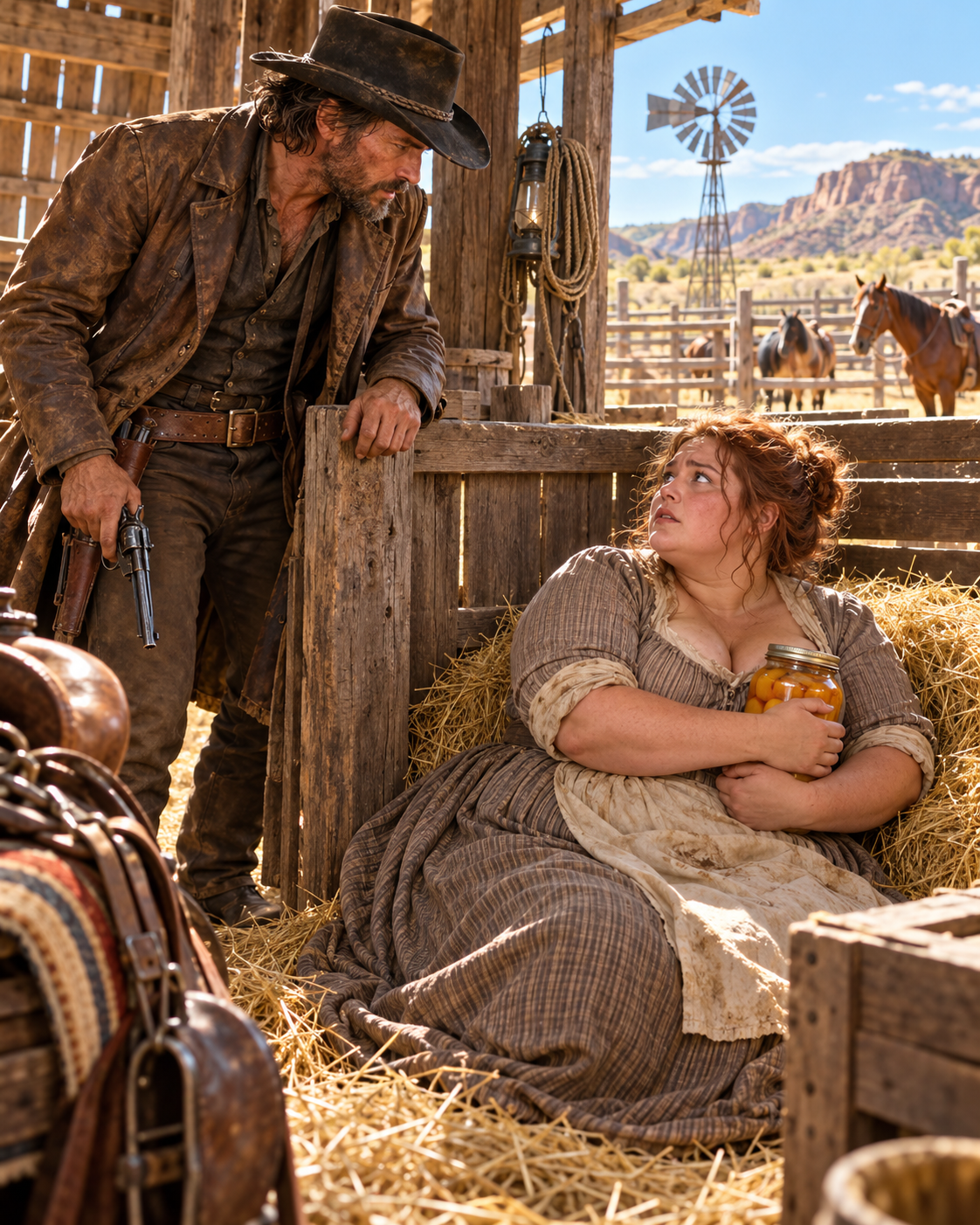
This time the metal edge struck his wrist.
The gun fell.
She kicked it beneath a barrel.
The man stared at her in disbelief.
Perhaps he had expected a frightened housekeeper.
Perhaps he had seen her size and assumed slowness, weakness, submission.
Harper gave him no opportunity to reconsider.
She drove the shovel handle into his chest and sent him crashing into a rack of preserves.
Glass jars exploded around him.
Samuel’s eyes widened.
Harper took his hand.
Together they climbed out of the cellar.
In the kitchen, Gabriel was pinned behind the stone fireplace.
Two men were firing from the barn while another had moved toward the porch.
Gabriel had only four cartridges remaining.
Then the porch door opened.
Harper appeared behind the intruder.
She brought the shovel down across his back.
Gabriel stared.
“Harper!”
“Move!”
He moved.
They dragged the stunned gunman inside and took his ammunition.
“You were supposed to stay in the cellar.”
“You were supposed to stay alive.”
Despite everything, Gabriel almost laughed.
Then Samuel ran to the kitchen window and began waving urgently.
Harper followed his gaze.
Fire.
One corner of the barn roof had caught.
Boon’s men were trying to burn the ranch buildings and force them outside.
Gabriel’s expression changed immediately.
“The horses.”
“I’ll get them,” Harper said.
“No.”
“Gabriel—”
“You and Samuel stay inside.”
Harper stepped closer.
“Those horses are the only chance we have if this house catches next.”
She was right.
Gabriel hated that she was right.
He reloaded the revolver taken from the wounded attacker.
“We go together.”
They crossed the yard beneath a moon turned orange by smoke.
Gabriel fired toward the fence line while Harper and Samuel raced for the corral.
Samuel climbed between two rails and began opening the gate.
The terrified horses surged forward.
One nearly knocked him down.
Harper caught the boy and pulled him clear.
Then she saw a figure emerging through the smoke.
Tall.
Black hat.
Long coat.
Jebidiah Boon.
He raised his pistol toward Samuel.
Harper threw herself over the boy.
The shot came.
Gabriel felt something burn across his left side.
He staggered but remained standing.
His return shot forced Boon behind the barn.
“Gabriel!”
Harper ran toward him.
“I’m all right.”
Blood was already spreading through his shirt.
“You are not.”
“It’s a graze.”
It was more than a graze, but less than death, and they had no time to debate the difference.
Gabriel leaned against the fence.
“Take Samuel to the dry creek bed.”
Harper looked toward the darkness beyond the pasture.
The creek bed curved south toward an abandoned stage road.
“If you follow it two miles, you reach the Miller place.”
“You expect me to leave you?”
“I expect you to get the boy somewhere Boon can’t find him.”
Samuel suddenly tugged Gabriel’s coat.
He pointed north.
Three flashes blinked in the distance.
Then disappeared.
Then appeared again.
Gabriel frowned.
Not gunfire.
Lanterns.
Moving lanterns.
Riders.
For one hopeful second, Gabriel thought they might be neighbors.
Then Boon shouted from behind the barn.
“Your time is finished!”
Gunfire erupted again.
Gabriel shoved Harper and Samuel behind the trough.
The approaching riders were still too far away.
Boon’s remaining men advanced from both sides.
The ranch house began to burn at the porch.
Harper stared at the flames.
Everything Gabriel owned seemed to be disappearing at once.
His home.
His barn.
Perhaps his life.
And still he positioned himself between Samuel and the bullets.
Something inside Harper changed.
For years she had accepted the world’s judgments as though endurance were the same as courage.
She had endured laughter.
She had endured whispers.
She had endured being treated as invisible until someone needed a meal cooked or a floor scrubbed.
But courage, she understood now, was not enduring what others chose for you.
Sometimes courage was choosing what you would no longer allow.
She picked up the fallen rifle.
Gabriel looked at her.
“Do you know how to use that?”
“My father raised six daughters on a Kansas farm.”
She worked the lever.
“He taught all of us.”
They fired together.
One attacker dropped his weapon and fled toward the trees.
Another retreated behind the barn.
Boon remained.
The lanterns in the north were closer now.
Hoofbeats finally reached Gabriel’s ears.
Boon heard them too.
His confidence disappeared.
He ran from cover, heading directly for Samuel.
Gabriel fired.
Empty.
Harper raised the rifle.
Empty.
Boon smiled.
He leveled his pistol at the boy.
Samuel could not hear Gabriel shouting.
Could not hear Harper scream.
But he saw Boon’s arm rise.
He saw Gabriel’s face.
And he moved.
Samuel ducked beneath the trough just as Boon fired.
The bullet tore through the wooden rail behind him.
Then another gunshot cracked across the ranch.
Boon stopped.
His pistol slipped from his hand.
He stared down at the dark stain spreading across his coat.
A rider emerged from the smoke.
A silver badge reflected the firelight.
“Federal Marshal!” the man called. “Drop your weapons!”
Boon turned as though considering escape.
The marshal kept his revolver trained on him.
Two deputies spread across the yard.
Boon reached toward a second gun hidden beneath his coat.
The marshal fired again.
Jebidiah Boon fell beside the corral fence.
For several seconds, nobody moved.
Then Gabriel heard Harper breathing.
Samuel crawled from beneath the trough.
Harper seized him and held him so tightly the boy’s boots lifted from the ground.
The marshal dismounted.
He was an older man with a gray mustache and a coat coated in road dust.
“Gabriel Cross?”
Gabriel lowered his weapon.
“Who wants to know?”
“Marshal Nathaniel Ward.”
He reached into his coat and produced folded papers.
“I’ve been looking for Samuel Cross for six weeks.”
Harper instinctively pulled the boy closer.
Ward noticed.
“You’re the woman who took him from Fort Worth.”
“I protected him.”
“I know.”
The answer surprised her.
The marshal looked toward Boon’s body.
“So did I, eventually.”
Inside what remained of the kitchen, Ward explained the truth.
Samuel’s father, Thomas Cross, had discovered that Boon was working with a land speculator who had been buying drought-stricken ranches across West Texas for almost nothing.
The water beneath Samuel’s property could restore thousands of acres.
But the old agreement on the back of the deed created a problem.
As long as the Cross heir lived, neighboring ranchers retained access to the spring.
If Samuel died without a guardian and the property entered auction, the agreement could be challenged and perhaps erased.
Thomas had realized what Boon planned.
Before his death, he had mailed copies of his papers to a federal land office.
That was why Marshal Ward had begun investigating.
“Your brother did one smart thing before he died,” Ward told Gabriel. “He made certain the truth existed in more than one place.”
Gabriel looked toward Samuel.
“What killed Thomas?”
Ward hesitated.
“Officially? A wagon accident.”
“And unofficially?”
“Boon was seen nearby.”
The room went silent.
Gabriel closed his eyes.
For eleven years, he had blamed his brother for their estrangement.
Their final argument had begun over their father’s ranch.
Thomas wanted to leave Texas. Gabriel had accused him of abandoning the family.
Pride had done the rest.
Neither brother apologized.
Neither wrote.
Now Gabriel would never have the chance.
Samuel approached him.
The boy held out a small object.
A pocket watch.
Gabriel recognized it immediately.
It had belonged to their father.
Thomas must have carried it all those years.
Samuel placed it in Gabriel’s palm.
Gabriel’s composure broke.
He sank into a chair.
Harper quietly turned away, giving him the dignity of pretending she had not seen the tears.
By dawn, the fire was under control.
The barn had lost half its roof, and the porch was blackened, but the main house remained standing.
One of Boon’s men had surrendered. Another had fled but was captured before noon.
Marshal Ward examined the deed, took statements, and formally placed Samuel under temporary federal protection until a court could determine guardianship.
Gabriel disliked the phrase immediately.
“Temporary protection?”
Ward raised an eyebrow.
“The boy needs a lawful guardian.”
“He has one.”
“Does he?”
Gabriel looked at Samuel.
Then at Harper.
The decision no longer felt complicated.
“If he’ll have me.”
Harper translated the question through signs as best she could.
Samuel stared at Gabriel for several seconds.
Then he walked forward and wrapped both arms around Gabriel’s waist.
Ward smiled.
“I suppose the court will find that persuasive.”
The weeks that followed changed Cross Ranch more than the gunfight had.
Neighbors arrived to rebuild the barn.
Some came because they respected Gabriel.
Others came because they had learned about the water agreement and understood Samuel’s survival had protected their own families.
Harper noticed how differently the townspeople treated her now.
Women who once whispered behind her back brought pies to the ranch.
Men who once ignored her asked about the night she struck an armed man with a shovel.
She accepted their new respect politely.
But she did not need it.
That realization was its own kind of freedom.
Samuel slowly settled into ranch life.
Gabriel hired a teacher from San Antonio who knew methods for educating deaf children. Harper learned more signs beside Samuel, and Gabriel, despite fingers made stiff from years of rope and reins, practiced every evening.
At first his signs were terrible.
Samuel laughed at him constantly.
Gabriel did not mind.
The first sign Samuel taught him properly was horse.
The second was hungry.
The third was family.
That one Gabriel never forgot.
Three months later, a federal judge confirmed Samuel’s inheritance and approved Gabriel as his legal guardian.
The water rights remained protected.
Gabriel could have become wealthy by selling access to investors.
Instead, he honored the original agreement.
During the next drought, neighboring ranches drew water from the Cross spring.
Families who might have abandoned Texas stayed.
Cattle survived.
Fields remained green along narrow irrigation trenches while the surrounding plains turned gold and brown.
People began calling it Samuel’s Spring.
Gabriel insisted on the name.
One evening in early autumn, Harper stood on the rebuilt porch watching Samuel race a young horse along the fence.
Gabriel joined her.
His gunshot wound had healed, though cold mornings still made him stiff.
“You know,” he said, “I’ve been trying to ask you something for three weeks.”
Harper glanced at him.
“That sounds inefficient.”
“I’m discovering courage is easier when people are shooting at you.”
She laughed.
Gabriel looked unusually nervous.
That frightened Harper more than Boon ever had.
He removed his hat.
“After my wife died, I thought the decent part of my life was finished.”
Harper’s expression softened.
“I thought work was enough. Then you came here and made this place feel lived in again.”
“I was your housekeeper.”
“You were never just that.”
The words settled between them.
Gabriel continued.
“When Samuel came, I thought I was protecting him because he was Thomas’s boy.”
He looked toward the pasture.
“But somewhere along the way I realized he was saving me from becoming a man who had nothing left except land.”
Harper swallowed.
“And what does that have to do with me?”
“Everything.”
He stepped closer.
“You protected him before you knew anyone would stand beside you. You crossed towns alone with a child men were hunting. You faced Boon when armed men made grown ranchers hide behind locked doors.”
Harper looked down.
“People have called me many things, Gabriel. Brave was rarely one of them.”
“Then they weren’t paying attention.”
Her eyes filled.
Gabriel took her hand.
“I don’t want a housekeeper.”
Harper raised an eyebrow.
“That’s an unfortunate way to begin a proposal.”
Gabriel froze.
Then she smiled.
His relief came out as laughter.
“I want a wife,” he said. “And I want Samuel to have a home where nobody ever has to hide him again.”
He hesitated.
“But only if the wife is you.”
Samuel had stopped riding.
He was watching from the fence.
Harper noticed him first.
The boy grinned.
He signed something.
Gabriel squinted.
“What did he say?”
Harper began laughing.
“He said you’re taking too long.”
Gabriel looked offended.
“I’ve known the boy three months and already he insults me.”
“He has excellent judgment.”
Gabriel turned serious again.
“Harper Higgins, will you marry me?”
For most of her life, Harper had imagined that if anyone ever proposed to her, she would wonder whether he truly wanted her or merely feared being alone.
Standing on that porch, she had no such doubt.
She had watched Gabriel face death for Samuel.
She had watched him spend evenings learning a language spoken with hands because he wanted a deaf child to know he belonged.
She had watched grief soften him rather than harden him.
And he had seen her too.
Not the version strangers judged from across a street.
Her.
“Yes,” she said.
Samuel saw the answer on her face before Gabriel reacted.
He jumped from the fence and ran toward them.
Their wedding took place beneath the cottonwood trees the following spring.
Half the county attended.
Marshal Ward returned from New Mexico for the ceremony and claimed he had ridden four hundred miles solely for Harper’s cooking.
Nobody believed him.
Samuel stood beside Gabriel.
When the preacher spoke the vows, Harper signed key words so Samuel could follow.
Love.
Promise.
Home.
Family.
Years later, travelers passing through the county would hear stories about the siege at Cross Ranch.
Some versions claimed twenty gunmen had attacked.
Others said Harper defeated five men by herself.
One particularly imaginative account insisted Samuel had ridden through gunfire to summon the federal marshal.
The family usually laughed at those versions.
The truth was simpler.
There had been fear.
There had been violence.
There had been ordinary people who chose not to surrender someone vulnerable merely because protecting him was dangerous.
Samuel eventually inherited the ranch.
He became a skilled horse breeder and an advocate for deaf children across Texas, donating part of the ranch’s profits to schools and teachers willing to educate children whom many people of that era wrongly considered incapable of learning.
The spring continued flowing.
So did the agreement.
Samuel never allowed desperate neighbors to be denied water simply because they lacked money.
When people asked why, he pointed toward an old framed document hanging inside the ranch house.
Beside it was a photograph of Gabriel and Harper on their wedding day.
Samuel understood something his father had tried to preserve and his uncle had learned almost too late:
Land could be inherited.
Money could be inherited.
Even grudges could be inherited if people were careless enough.
But so could mercy.
So could courage.
So could the decision to protect someone who had no power to repay you.
Gabriel had once believed family was determined by blood and obligation.
Harper had spent much of her life believing she had to prove her worth before anyone would choose her.
Samuel had entered Cross Ranch believing safety was temporary.
All three had been wrong.
Family was not simply the people history handed you.
Sometimes family was built in the moment someone could walk away—and chose to stay.
And on a battered ranch beneath the enormous Texas sky, three lonely people discovered that the most valuable inheritance Samuel Cross had ever received was never the deed beneath his name.
It was the home that formed around him when others decided his life was worth defending.
But peace, Gabriel Cross would later learn, did not arrive simply because a dangerous man had been buried.
Sometimes the dead left debts behind them.
Nearly a year after the wedding, when the spring rains had turned the Texas grasslands green and Samuel had begun riding alone along the southern fence, a stranger arrived at Cross Ranch carrying a black leather case.
He came at noon.
Harper saw him first from the kitchen window.
The man was thin, clean-shaven, and dressed far too well for a ranch road. His gray coat bore almost no dust despite the long ride, and the horse beneath him looked expensive.
Gabriel stepped onto the porch.
Samuel followed but remained behind the railing.
The stranger removed his hat.
“Gabriel Cross?”
“Depends who’s asking.”
The man smiled politely.
“Edmund Vale. Attorney from Austin.”
Gabriel did not return the smile.
“What does an Austin attorney want with me?”
Vale glanced toward Samuel.
“Not you, Mr. Cross.”
His eyes rested on the boy.
“Him.”
Harper appeared at the doorway.
Gabriel immediately stepped between Vale and Samuel.
“You can speak to me.”
Vale opened the black case and removed several folded documents.
“I represent the Western Consolidated Land Company.”
Gabriel’s face hardened.
He remembered Marshal Ward mentioning the company during the investigation into Boon.
“They employed Boon?”
“Officially, no.”
“And unofficially?”
Vale’s smile disappeared.
“I wasn’t sent here to discuss Jebidiah Boon.”
Harper descended the porch steps.
“Then why were you sent?”
Vale unfolded one of the papers.
“Because the company claims the original Cross water agreement is invalid.”
Gabriel stared at him.
“A federal court confirmed Samuel’s inheritance.”
“The inheritance, yes.”
Vale tapped the document.
“The communal water rights are another matter.”
Harper’s stomach tightened.
Vale continued.
“Western Consolidated recently purchased more than twenty thousand acres east of this property. If the water beneath Samuel’s land is legally tied to surrounding ranches, the value of those purchases collapses.”
“So they want Samuel’s spring.”
“They want clarity.”
Gabriel laughed without humor.
“Men like you always find prettier words.”
Vale ignored him.
“The company intends to challenge the agreement in territorial court.”
“Texas isn’t a territory.”
“A figure of speech.”
“No,” Gabriel said. “A mistake.”
For the first time, Vale looked irritated.
“I suggest you take this seriously.”
“I did that the last time men came after my family.”
Gabriel’s hand moved slightly toward his holster.
Harper touched his arm.
Vale noticed.
“This isn’t a gunfight, Mr. Cross.”
“No?”
“No. And that is precisely why you may lose.”
He placed the documents on the porch table.
Then he looked at Samuel.
“The courts will decide what belongs to whom.”
Samuel could not hear him, but he understood the coldness in his face.
He signed to Harper.
Who is he?
She answered.
A man who wants the water.
Samuel’s expression changed.
He walked forward, took the deed from Harper’s nearby writing desk, and held it against his chest.
Vale watched.
“Tell the boy documents don’t become stronger because you hold them tightly.”
Harper turned toward him.
“He understands more than you think.”
“Perhaps.”
Vale placed his hat back on his head.
“Thirty days.”
Gabriel frowned.
“What?”
“The hearing is in thirty days.”
Vale mounted his horse.
“If you have evidence that the old agreement was properly registered, I suggest you find it.”
He rode away.
For several minutes, no one spoke.
Then Gabriel picked up the legal papers.
At the bottom was the name of the company president.
Silas Mercer.
The name meant nothing to Harper.
It meant something to Gabriel.
He sat down slowly.
Harper saw the color leave his face.
“Gabriel?”
He handed her the paper.
“My father used to work with a man named Silas Mercer.”
“When?”
“Before Thomas and I were born.”
Harper waited.
Gabriel looked toward the distant hills.
“They hated each other by the end.”
That evening Gabriel opened a cedar trunk that had remained locked since his father’s death.
Inside were letters, receipts, cattle records, and maps drawn by men who had measured property lines when much of West Texas was still considered wilderness.
Harper sat beside him while Samuel sorted papers on the floor.
They searched until midnight.
Nothing proved that the water agreement had been officially registered.
The writing on Samuel’s deed established intent.
But Vale’s papers claimed the agreement was never filed with the county.
Without a registry copy, Western Consolidated could argue it was private and unenforceable against later purchasers.
Gabriel rubbed his eyes.
“There has to be another copy.”
“Where would your father have kept it?”
“If I knew, we’d have found it.”
Samuel suddenly tapped the floor.
They looked at him.
He held an old photograph.
Four men stood beside a stone well.
Gabriel recognized his father immediately.
Beside him stood two neighboring ranchers.
The fourth man was younger than the others.
But Gabriel knew the face.
Silas Mercer.
On the back, someone had written:
FIRST FLOW, APRIL 1861.
H. CROSS – M. DALTON – E. REEVES – S. MERCER
Harper studied it.
“Mercer was there.”
“Apparently.”
“Then he knew about the spring from the beginning.”
Gabriel’s eyes narrowed.
“And maybe that’s what this has been about all along.”
Over the next week, Gabriel visited every courthouse, survey office, and land clerk within riding distance.
Harper wrote letters to Austin.
Marshal Ward sent inquiries through federal offices.
No registered copy appeared.
Western Consolidated’s case grew stronger.
Then an elderly neighbor named Elias Dalton came to the ranch.
He was nearly eighty and moved with a cane.
His father had been one of the men in the photograph.
“I heard what Mercer is doing,” Elias said.
Gabriel poured him coffee.
“Did your father ever mention the water agreement?”
“Every summer.”
“Did he say where it was filed?”
Elias stared into the cup for a long moment.
“County courthouse.”
“We checked.”
“The new courthouse?”
Gabriel leaned forward.
“What do you mean?”
“The first courthouse burned in ’69.”
Harper stopped moving.
Elias continued.
“Some records survived. Some didn’t.”
“Where were the surviving records taken?”
“A church.”
“Which church?”
Elias frowned, searching through decades of memory.
“Methodist, I think.”
Gabriel stood.
“Where?”
“Old settlement outside Red Bluff.”
The church had been abandoned for fifteen years.
They reached it the following morning.
The roof sagged.
One window was missing.
Bird nests filled the rafters.
Gabriel searched the small office behind the pulpit while Harper examined rotting cabinets.
Samuel crawled beneath a collapsed shelf.
After nearly two hours, Gabriel slammed a drawer shut.
“Nothing.”
Harper wiped dust from her hands.
“There’s another room.”
“Where?”
She pointed toward a narrow door partly concealed behind the old organ.
They opened it.
Inside were boxes.
Hundreds of papers lay tied in bundles.
Tax rolls.
Marriage certificates.
Survey records.
Court filings.
Gabriel stared.
“If what we need survived, it’s here.”
They searched all day.
By sunset Harper’s fingers were black with dust.
Samuel had begun arranging documents by year.
Then the boy suddenly froze.
He pulled one sheet from a bundle dated 1861.
At the top were four names.
Henry Cross.
Matthew Dalton.
Ezekiel Reeves.
Silas Mercer.
Gabriel read the first paragraph.
His heart began pounding.
It was not the water agreement.
It was better.
A partnership declaration.
The four men had jointly financed the first excavation of the spring.
It stated that any successful water source discovered on land held by one member would remain accessible to the families and ranches of the other partners “for as long as water shall flow beneath the earth.”
Harper smiled.
“We found it.”
Gabriel kept reading.
His smile disappeared.
“What?”
“The registration page is missing.”
Harper’s hope collapsed.
Without the official stamp, Western Consolidated could argue it was merely another private paper.
Gabriel searched the box frantically.
Nothing.
Night fell outside.
“We should go,” Harper said.
“We’re not leaving.”
“We can’t see.”
“I’ll light another lantern.”
“Gabriel.”
He looked at her.
She knew that expression.
It was the same face he had worn during the siege.
A man willing to destroy himself if that was the price of protecting his family.
Harper touched his cheek.
“Samuel needs you more than he needs this paper.”
Gabriel closed his eyes.
She was right.
Again.
They gathered the documents.
As Harper tied the bundle, Samuel wandered toward the old pulpit.
He ran his hand along the wood.
Then he stopped.
He felt something.
A faint vibration beneath his fingers.
He tapped again.
Hollow.
Samuel waved urgently.
Gabriel approached.
The pulpit base contained a hidden compartment.
Inside was a small metal box.
The lock had rusted through.
Gabriel broke it open.
There were twelve documents inside.
The last one carried the seal of the former county registrar.
The partnership declaration.
Registered May 3, 1861.
Harper sat down on the church floor and laughed.
Gabriel laughed too.
Samuel watched them.
Then he signed:
We win?
Gabriel knelt beside him.
Not yet.
But now we can fight.
The hearing took place in a crowded courthouse three weeks later.
Ranchers traveled from miles away.
Some had depended on Samuel’s water during drought.
Others simply wanted to see whether a corporation from the east could take something a Texas family had defended with blood.
Silas Mercer appeared in person.
He was sixty-seven, silver-haired, and physically smaller than Gabriel expected.
He carried himself like a man accustomed to entering rooms where people stood when he arrived.
Mercer stared at Gabriel across the courtroom.
“So you’re Henry’s older boy.”
“Gabriel.”
“I remember.”
“You remember the spring?”
Mercer’s face remained still.
“I remember many things.”
The judge entered.
The hearing began.
Western Consolidated’s attorney argued for nearly two hours.
He claimed Samuel owned the land but not the obligation to share its water.
He described the handwritten deed note as informal.
He dismissed the old photograph as meaningless.
Then Harper watched Gabriel’s attorney place the registered 1861 partnership agreement before the judge.
For the first time, Mercer reacted.
Only slightly.
But Harper saw it.
His hand clenched around the head of his cane.
The judge read silently.
Then he looked toward Mercer.
“Mr. Mercer, is this your signature?”
Mercer’s attorney stood.
“We object—”
“Sit down.”
The room became silent.
Mercer examined the paper.
“Yes.”
“You personally agreed that access to the water would continue?”
“I was twenty-two.”
“Age doesn’t erase a signature.”
Mercer said nothing.
The judge continued.
“Did you know this agreement existed when your company purchased neighboring land?”
Mercer’s attorney objected again.
The judge overruled him.
Mercer looked toward Gabriel.
Then toward Samuel.
For a moment, something old and bitter crossed his face.
“Yes.”
A murmur filled the courtroom.
The judge struck his gavel.
“Then why challenge it?”
Mercer hesitated.
“Because Henry Cross cheated me.”
Gabriel stiffened.
The judge leaned back.
“Explain.”
Mercer took a breath.
“The spring was found because of my survey. I located the underground channel. Henry claimed the land first.”
Gabriel’s voice came from behind the attorneys.
“So that’s it?”
Everyone turned.
Mercer looked at him.
“You don’t know what your father was.”
“I know enough.”
“He took everything.”
“And you’ve spent thirty years trying to take it back from his grandchildren?”
Mercer’s expression hardened.
“Your family prospered because of what I discovered.”
Samuel watched the exchange.
Harper translated as much as she could through signs.
Gabriel stepped forward until his lawyer caught his sleeve.
The judge allowed him to speak.
“My father may have wronged you.”
Mercer’s eyes flashed.
“He did.”
“Then you should have fought him.”
Mercer said nothing.
Gabriel pointed toward Samuel.
“You sent men after a deaf child because you were angry at a dead man.”
“I never ordered Boon to kill anyone.”
“No. You only built the road that led him here.”
The courtroom was silent.
Mercer looked at Samuel.
For the first time, his certainty seemed to weaken.
Samuel met his gaze without fear.
Then the boy signed something.
Mercer did not understand.
Harper spoke.
“He said the spring doesn’t belong to dead men.”
Everyone turned toward her.
She continued translating.
“It belongs to the living people who need it.”
The judge looked at Samuel for several seconds.
Then back at Mercer.
Two days later, the ruling came.
The 1861 agreement was valid.
Samuel retained ownership of the land and spring.
The neighboring access rights remained permanent.
Western Consolidated’s challenge was dismissed.
But there was more.
Because testimony during the hearing connected company payments to Boon’s movements, federal investigators reopened the criminal inquiry.
Silas Mercer was never convicted of ordering Thomas Cross’s death.
There was not enough evidence.
But his company collapsed under lawsuits, debt, and public scandal within three years.
Gabriel expected to feel satisfaction.
He did not.
Instead, he felt tired.
That surprised him.
One evening, after the final legal papers arrived, he sat with Harper beside the spring.
Samuel was throwing stones into the water.
“I used to think winning would feel different,” Gabriel said.
“Different how?”
“Like the world suddenly made sense.”
Harper leaned against him.
“The world rarely makes sense because a judge signs a paper.”
Gabriel smiled faintly.
“Then what was all of it for?”
She watched Samuel.
“For that.”
The boy had removed his boots and was standing ankle-deep in the water.
Harper continued.
“He gets to grow up.”
Gabriel looked at her.
“Maybe that’s the only victory that matters.”
Years passed.
Samuel grew tall.
At fifteen he could outride most of the ranch hands.
At seventeen he knew nearly every acre of Cross land better than Gabriel.
At eighteen the deed became fully his.
Gabriel expected Samuel to take control.
Instead, Samuel handed the document back.
Harper translated.
“He says the land belongs to all three of us.”
Gabriel shook his head.
“Legally, it’s yours.”
Samuel smiled.
Then he signed.
Family is not legal.
Gabriel laughed.
“That boy uses my own lessons against me.”
At twenty-one, Samuel traveled east for several months and returned with books, teaching materials, and ideas no one in the county had heard before.
He wanted to build a school.
“For deaf children?” Harper asked.
Samuel nodded.
There were families across Texas keeping deaf children at home because teachers did not know how to educate them.
Some parents believed they could never learn.
Samuel intended to prove them wrong.
Gabriel donated land near the spring.
Harper organized families.
Ranchers donated timber.
Marshal Ward, now retired, arrived carrying a crate of schoolbooks and claimed he had stolen them from Washington.
Nobody believed him.
The Samuel Cross School opened with twelve students.
Within five years, there were forty.
Children arrived from ranches, towns, railroad camps, and settlements hundreds of miles away.
Some used signs.
Some learned to read lips.
Some learned trades.
All of them learned that silence was not emptiness.
Samuel became a teacher without ever planning to.
Parents trusted him because he knew what their children experienced.
He remembered adults talking around him instead of to him.
He remembered people confusing deafness with ignorance.
He refused to allow that mistake inside his school.
Harper often watched him from the doorway.
Sometimes she remembered the frightened seven-year-old hiding in Gabriel’s pantry.
The boy who had clung to her sleeve because he believed everyone eventually left.
That boy was gone.
In his place stood a man surrounded by children who knew exactly where they belonged.
Gabriel grew older more slowly than he expected.
His hair turned gray.
His injured side ached when storms approached.
He complained about both.
Harper ignored his complaints with the patience of a woman who had listened to him complain for thirty years.
They remained on the ranch.
Every evening they sat on the porch.
Sometimes they spoke.
Sometimes they did not.
Silence had changed meaning in their family.
It was no longer absence.
With Samuel, they had learned that meaning could exist without sound.
A hand against another hand.
A look across a room.
A chair pulled closer.
A lamp left burning for someone who had not yet returned.
Those things became their language too.
One autumn morning, nearly forty years after Boon’s attack, Gabriel walked alone to the family cemetery.
Thomas’s grave stood beneath a cottonwood.
Samuel had moved his father’s remains there years earlier.
Gabriel lowered himself onto a stone beside it.
“I’m sorry,” he said.
The wind moved softly through the grass.
“I spent eleven years waiting for you to apologize.”
He looked at the grave.
“Then I spent another forty wishing I’d apologized first.”
He laughed quietly.
“Stubborn fool.”
It was impossible to know which brother he meant.
Gabriel placed the old pocket watch on the grave.
Then he changed his mind.
He picked it up again.
“No.”
He smiled.
“Samuel should have this.”
When Gabriel died two winters later, he did so at home.
Harper sat beside him.
Samuel held his hand.
The room was quiet.
Gabriel looked toward Samuel and slowly raised his fingers.
His hands were weak.
But the sign was clear.
Family.
Samuel answered with the same sign.
Gabriel smiled.
Those were the last words he ever spoke, though no sound passed his lips.
Harper lived another seven years.
By then Samuel’s school had expanded into three buildings.
Hundreds of children had passed through its doors.
On the anniversary of Harper’s death, Samuel stood beside the spring with his own children.
His oldest daughter asked why the water was free to neighboring ranches when they could charge money and become wealthy.
Samuel smiled.
He told her about four men who once signed an agreement.
Then he told her about a woman who crossed Texas protecting a child who was not her own.
He told her about a rancher who nearly lost his life because he decided blood meant responsibility instead of ownership.
He told her about a bounty hunter who believed a deed was worth more than a boy.
And he told her about people who had learned the opposite.
His daughter listened.
Then she asked one final question.
“Was Aunt Harper really as brave as everyone says?”
Samuel laughed.
He looked toward the old ranch house.
Above the fireplace still hung Harper’s shovel.
Gabriel had mounted it there after the siege despite her protests.
Samuel answered carefully.
“No.”
His daughter frowned.
Samuel continued.
“She was braver.”
Decades later, Cross Ranch remained standing.
The original barn was replaced twice.
The house gained new rooms.
The school became an institution known across the state.
The town grew.
Railroads came.
Telephones arrived.
Automobiles replaced horses on the main road.
The world changed.
But the spring continued flowing.
And beside it stood a small stone marker.
On the front were three names:
GABRIEL CROSS
HARPER HIGGINS CROSS
SAMUEL CROSS
Beneath them were words chosen by Samuel:
WE KEPT THE WATER SO OTHERS COULD STAY.
WE KEPT THE DOOR OPEN SO OTHERS COULD ENTER.
WE KEPT EACH OTHER SO NONE OF US HAD TO STAND ALONE.
Travelers sometimes stopped to read the inscription.
Few knew the entire story.
They did not know about the night bullets tore through the ranch house.
They did not know Harper had once been mocked by people who later spoke of her with admiration.
They did not know Gabriel had almost allowed an old family argument to keep him from knowing his nephew.
They did not know Samuel had once hidden in a pantry because powerful men had decided his life stood between them and profit.
But perhaps they did not need every detail.
Because the lesson remained even after the names became history.
Cruelty often begins by convincing people that another person’s life is less valuable.
Greed survives by making ownership seem more important than responsibility.
Pride survives by persuading people there will always be another day to say what should have been said.
Gabriel learned there might not be.
Harper learned that dignity did not require the approval of those who mocked her.
Samuel learned that being different did not make him weaker, smaller, or incomplete.
And together they proved something no deed, gun, courtroom, or fortune could ever fully measure:
A family is not made strong because nothing threatens it.
A family becomes strong when danger comes and its members decide, again and again, that no one will be left behind.
Long after Gabriel and Harper were gone, Samuel would sometimes sit beneath the cottonwood trees at sunset.
He would watch the light turn the Texas plains gold.
He would feel the vibration of horses moving across the earth.
He would see children leaving the school in groups, talking with their hands.
And he would remember the first night at Cross Ranch.
He had been seven.
Terrified.
Certain that every home was temporary.
Then a widow had stood between him and a gunman.
A lonely rancher had called him family.
And two people who believed their best years were already behind them had built a future around a child who could not hear them say that he was loved.
Samuel would touch the old pocket watch in his vest.
Then he would look toward the spring.
Water still moved beneath the earth, invisible until it reached the surface.
Love, he eventually understood, was much the same.
For years it could remain hidden beneath grief, pride, fear, or loneliness.
But given one opening, it could rise.
It could nourish everything around it.
It could turn dry ground green again.
And that was the true inheritance of Cross Ranch.
Not the land.
Not the spring.
Not the deed that men had once been willing to kill for.
It was the simple, stubborn belief that what gives life becomes more valuable when it is shared.
And as long as the spring continued to flow beneath the wide Texas sky, the story of Gabriel, Harper, and Samuel Cross never truly ended.
It simply became part of everything that grew there afterward.
THE END.