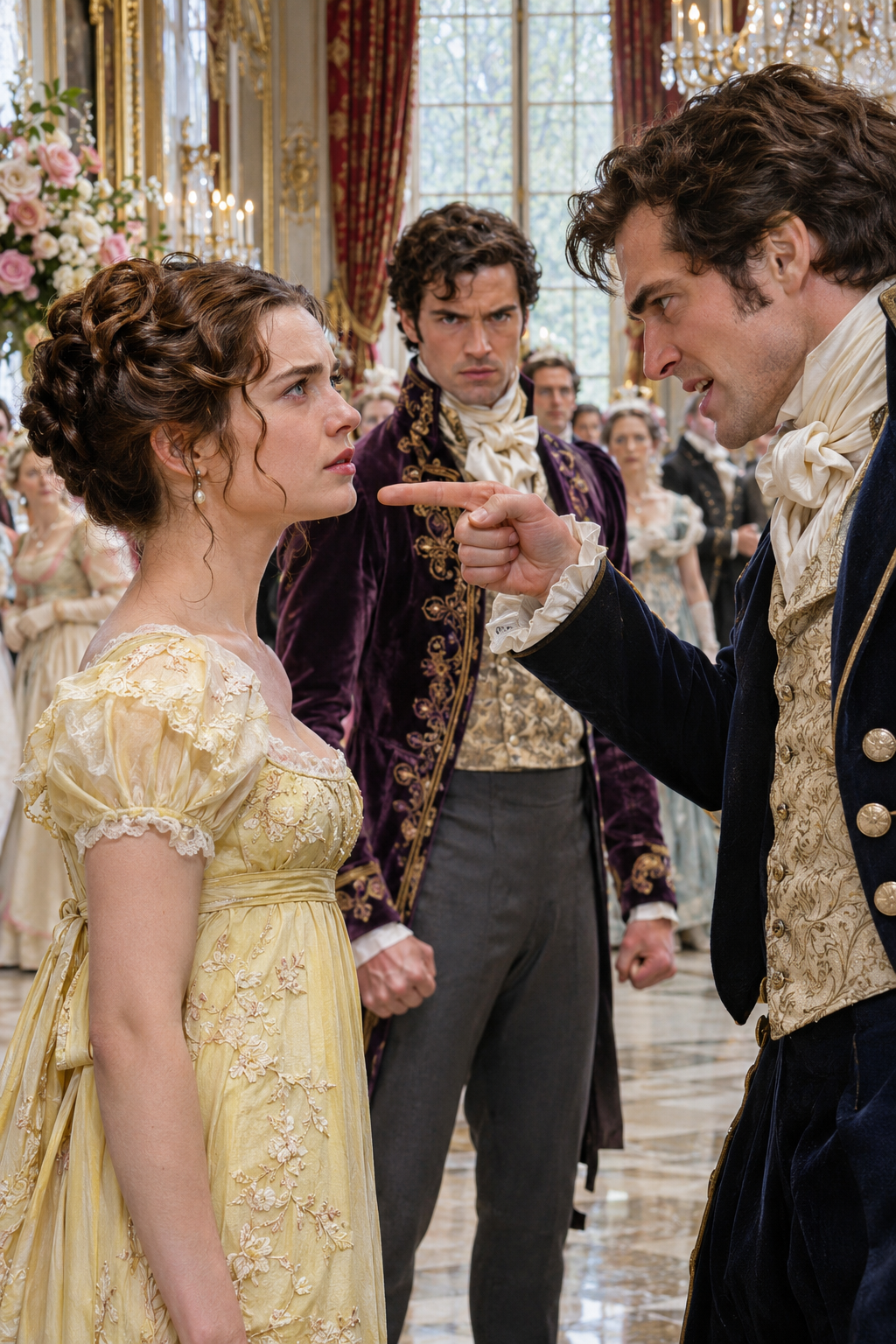
“Still wearing that old dress, Clara? I suppose poverty leaves a woman with few choices.”
Thomas unfolded the document with the confidence of a man who believed he had already won.
“Perhaps you should read this first, Your Grace,” he said, holding the paper toward William Cavendish. “It concerns the unfortunate circumstances surrounding Miss Clara’s family.”
The Duke of Ashbourne did not reach for it.
Instead, he looked at Thomas with an expression so calm that Clara felt a strange chill.
“Be careful what you say next, Clifford.”
Thomas gave a nervous laugh.
“Surely Your Grace isn’t suggesting that a gentleman should conceal the truth?”
“Not at all. I’m suggesting that a gentleman should understand the difference between truth and blackmail.”
A murmur passed through the ballroom.
Clara stood motionless beside William, her left hand still resting in his. The gold wedding ring on her finger caught the candlelight.
She had imagined many ways their secret marriage might become public.
She had never imagined it would happen like this.
Thomas straightened his shoulders.
“Very well. Since everyone seems interested, perhaps the Duke should know that Miss Clara’s late father left debts totaling nearly forty thousand pounds.”
Several ladies gasped.
Clara lowered her eyes.
Forty thousand pounds.
She had known the amount was terrible, but hearing it announced before London’s wealthiest families made the humiliation almost unbearable.
Thomas continued.
“Those debts were secured against the family estate, and certain agreements were made regarding repayment. Agreements that Miss Clara has conveniently forgotten.”
“That’s enough,” Clara whispered.
Thomas ignored her.
“Her father signed documents promising that his daughter would cooperate with arrangements made by the principal creditor.”
William’s expression hardened.
“Are you claiming that a father can legally sell his daughter’s freedom?”
“I’m claiming that Miss Clara has obligations.”
“Financial obligations?”
“Among others.”
The room fell silent.
William finally extended his hand.
“Give me the document.”
Thomas surrendered it with a satisfied smile.
The Duke read the first page, then turned to the second.
Clara watched his face, searching for some sign of anger or disappointment.
Instead, William gave a quiet, humorless laugh.
“How interesting.”
Thomas frowned.
“Your Grace?”
“This document bears the signature of a man named Edward Bellamy.”
“Yes. The principal creditor.”
“And you are acquainted with Mr. Bellamy?”
“We have conducted business.”
“How closely?”
Thomas hesitated.
“That is hardly relevant.”
William folded the document.
“I believe it is extremely relevant.”
He turned toward the gathering crowd.
“Ladies and gentlemen, I apologize for interrupting your evening. However, Lord Clifford has chosen to make a private financial matter public. I believe fairness requires that the entire matter be examined.”
Thomas’s smile faded.
“Entire matter?”
“Indeed.”
William glanced toward the ballroom entrance.
“Mr. Pembroke, would you come forward?”
A silver-haired gentleman stepped away from the wall.
Clara recognized him as William’s solicitor, a quiet man who had visited their home twice since the wedding.
Mr. Pembroke bowed.
“Your Grace.”
“Did you bring the papers I requested?”
“Yes, Your Grace.”
Thomas took a step backward.
Clara noticed it immediately.
For the first time that evening, he looked genuinely frightened.
Mr. Pembroke opened a leather case and removed a thick envelope.
William turned back to Thomas.
“Three weeks ago, my solicitor began examining the debts left by Clara’s father.”
Clara looked sharply at her husband.
Three weeks?
That was before their wedding.
Before William had asked her to trust him with her future.
He had never mentioned an investigation.
Thomas recovered enough to speak.
“An investigation proves nothing.”
“Quite right,” William replied. “But forged signatures, altered dates, and payments made through false accounts may prove considerably more.”
The ballroom erupted in whispers.
Thomas’s face drained of color.
“Those are serious accusations.”
“Then I suggest you take them seriously.”
Clara felt William’s hand move gently against hers.
He was not holding her tightly.
He was giving her the choice to stay or walk away.
She remained beside him.
Thomas suddenly pointed toward Clara.
“She knew nothing about her father’s affairs! She’s an innocent little fool who would believe anything a wealthy man told her!”
William moved one step forward.
His voice dropped.
“You will not speak about my wife that way.”
The word seemed to strike the room like thunder.
Wife.
A woman near the fireplace dropped her fan.
Thomas stared at William.
“Your… wife?”
William raised Clara’s left hand.
The Cavendish family crest shone on her wedding ring.
“Allow me to introduce Her Grace, Clara Cavendish, Duchess of Ashbourne.”
For several seconds, nobody moved.
Then the room filled with astonished voices.
Clara heard fragments of conversation.
“Married?”
“The Duke?”
“Impossible!”
“Since when?”
Thomas looked from the ring to Clara’s face.
“No.”
His voice was barely audible.
“No, that cannot be true.”
Clara finally found her voice.
“It is true, Thomas.”
He shook his head.
“You married him?”
“Yes.”
“Without telling anyone?”
“Without telling you.”
The words were quiet, but they landed harder than any insult.
Thomas’s expression twisted.
“You think you’ve won? You think a title changes what your family owes?”
William stepped between them.
“Your conversation with my wife is finished.”
Thomas laughed bitterly.
“You cannot simply erase forty thousand pounds!”
“No,” William replied. “Money cannot erase dishonesty. But it can settle a debt.”
Mr. Pembroke opened the envelope.
Inside were several documents, each marked with an official seal.
Thomas stared at them.
William continued.
“Every legitimate debt held against Clara’s father’s estate has been purchased and discharged.”
Clara stopped breathing.
“What?”
William turned toward her.
“You’re free of them, Clara.”
She searched his face.
“William… what have you done?”
“Something I should have told you sooner.”
Thomas snatched one of the papers from Mr. Pembroke.
He examined the signatures, then flipped through the remaining pages.
His hands began to shake.
“This is impossible.”
“The transactions were completed yesterday,” Mr. Pembroke explained. “The creditors have been paid in full.”
Thomas’s eyes darted toward the door.
William noticed.
“However, the matter of the forged agreements remains unresolved.”
Thomas threw the papers onto a nearby table.
“You have no proof that I forged anything!”
“I did not say you personally forged them,” William replied.
Thomas went still.
The Duke studied him.
“Why did you assume I was accusing you?”
A terrible silence followed.
Clara saw Thomas’s mouth open, then close.
He had trapped himself.
But William did not press further.
Instead, he turned to Mr. Pembroke.
“Please deliver the evidence to the proper authorities tomorrow morning.”
“Of course, Your Grace.”
Thomas stepped forward.
“You would destroy my reputation over a misunderstanding?”
William’s expression did not change.
“You seemed quite willing to destroy Clara’s reputation over a debt.”
For the first time, Thomas had no answer.
Then a woman pushed through the crowd.
Lady Eleanor Whitmore, Thomas’s wealthy fiancée, stood before him with tears shining in her eyes.
“Thomas,” she whispered, “tell me this isn’t true.”
He reached for her.
“Eleanor, darling, you must understand—”
“Did you offer to keep Clara as your mistress while you were courting me?”
Thomas froze.
Clara closed her eyes.
She had never wanted Eleanor to discover the truth in such a cruel way.
But the young woman deserved an answer.
Thomas looked around the ballroom.
“These are private matters.”
Eleanor removed the pearl bracelet from her wrist.
It was the engagement gift Thomas had given her.
She placed it in his hand.
“Then you may keep your private matters.”
“Eleanor!”
“My father will hear about this before morning.”
She turned and walked away.
Thomas stood alone.
The same guests who had laughed at Clara now avoided his eyes.
William offered Clara his arm.
“Shall we go home?”
Home.
Such a simple word.
Yet Clara had spent months believing she would never have one again.
She nodded.
“Yes, William.”
They crossed the ballroom together.
Nobody laughed.
Nobody whispered loudly enough for her to hear.
And when they reached the doors, the guests stepped aside.
Outside, rain swept across the stone steps.
A carriage waited beneath the lamps.
William removed his coat and placed it around Clara’s shoulders.
“You’ll catch cold,” she protested.
“Then I’ll have to suffer the terrible inconvenience of drinking hot tea.”
Despite everything, she smiled.
He helped her into the carriage and climbed in beside her.
For several minutes, neither spoke.
The wheels rolled through wet London streets.
Clara watched the rain slide down the glass.
Finally, she turned toward him.
“You paid my father’s debts?”
William nodded.
“Yes.”
“All of them?”
“Every legitimate claim.”
She looked down at her hands.
“Forty thousand pounds.”
“Clara—”
“That is more money than I could earn in several lifetimes.”
“I know.”
“Why didn’t you tell me?”
William was silent for a moment.
“Because I was afraid you would think I had purchased your gratitude.”
She stared at him.
He continued.
“When I first met you, you were surrounded by people who believed money gave them the right to decide your future. I never wanted to become another one of them.”
Clara swallowed.
“But you should have trusted me with the truth.”
“You’re right.”
His answer surprised her.
There was no excuse.
No attempt to dismiss her feelings.
Only those two words.
“You’re right,” he repeated. “I should have told you before taking action.”
Clara looked at him carefully.
“Did you marry me because you felt sorry for me?”
William’s expression changed.
For the first time that evening, the powerful Duke of Ashbourne looked uncertain.
“No.”
“Then why?”
He glanced toward the rain-darkened window.
“Do you remember the afternoon we met at Lady Margaret’s charity gathering?”
Clara nodded.
She remembered it painfully well.
She had been helping distribute food to struggling families when a gentleman in a plain dark coat arrived.
She had not known he was a duke.
She had mistaken him for one of the volunteers.
“You carried those heavy baskets without complaining,” she said.
“And you scolded me for giving an entire loaf of bread to a little boy.”
“He needed to share it with his sisters.”
William smiled.
“Yes. You made that quite clear.”
Clara remembered how he had listened to her instructions without revealing his identity.
“You could have told me who you were.”
“And missed the pleasure of being ordered around by you?”
She laughed softly.
Then William grew serious.
“That afternoon, I watched you give away your own lunch to a mother who had not eaten in two days.”
Clara looked away.
“Anyone would have done that.”
“No, Clara. Many people walked past her.”
He paused.
“I had spent years surrounded by people who praised my title, admired my estates, and agreed with everything I said. You didn’t know who I was, and you treated me like an ordinary man.”
“Because you were behaving like one.”
“Exactly.”
His voice softened.
“For the first time in years, I felt ordinary. And I liked the man I was when I was with you.”
Clara felt tears gathering.
William took a breath.
“I did not marry you because you needed saving. I married you because I wanted to spend my life beside you.”
She pressed her fingers against her lips.
“But the debts…”
“I began investigating them because I suspected someone was using them to frighten you. The investigation started before our wedding, but the final purchase was completed only yesterday.”
“Thomas?”
“I suspected him. I did not know how deeply he was involved.”
Clara remembered the document he had produced.
“The agreement about my father’s debts. Was it real?”
“Some of the original borrowing was real. The document Clifford showed us was not.”
She stared at him.
“What do you mean?”
“Your father signed several loans when his business began failing. But someone later altered the terms and added a clause suggesting that your cooperation was required for repayment.”
“Could they legally do that?”
“No.”
William’s jaw tightened.
“But they could frighten you into believing it.”
Clara felt suddenly sick.
For months, she had lived beneath the shadow of those papers.
She had refused invitations, sold jewelry, dismissed servants, and lain awake wondering whether she would lose everything.
And Thomas had known.
Perhaps he had even helped create the fear.
“Why would he do that?” she whispered.
William hesitated.
“Because he believed desperation would make you accept his offer.”
Clara closed her eyes.
The carriage continued through the rain.
For a moment, she could almost hear Thomas’s voice from months earlier.
You need someone to protect you, Clara.
You cannot afford to be proud.
You should be grateful I’m willing to help.
She had mistaken his cruelty for the ordinary harshness of a world that no longer welcomed her.
Now she understood that some of her suffering had been deliberately arranged.
When she opened her eyes, William was watching her.
“I’m sorry,” he said.
She shook her head.
“You didn’t do this.”
“No. But I wish I had discovered it sooner.”
Clara reached across the carriage and took his hand.
“Then promise me something.”
“Anything within my power.”
“Never make decisions about my life without speaking to me first. Even when you think you’re protecting me.”
William held her gaze.
“I promise.”
“And don’t hide difficult truths because you’re afraid I’ll leave.”
He nodded.
“I promise that too.”
Clara leaned back against the seat.
For the first time that evening, she allowed herself to breathe.
But another question remained.
“What happened to the original debt papers?”
William looked toward the small leather case resting beside him.
“They’re here.”
He opened it.
Inside lay a bundle of documents tied with blue ribbon.
Clara recognized her father’s handwriting on the top page.
Her throat tightened.
“May I see them?”
William handed her the bundle.
She carefully untied the ribbon.
There were loan agreements, receipts, letters from creditors, and records of payments.
Her father had borrowed money in desperate attempts to save his business.
Some loans had been legitimate.
Others carried interest so severe that repayment had become nearly impossible.
At the bottom of the bundle, Clara found a letter.
It was addressed to her.
Her name was written in her father’s familiar, uneven handwriting.
She stared at it.
“William…”
He leaned forward.
“What is it?”
“This is from my father.”
William looked genuinely surprised.
“I haven’t read that.”
Clara’s hands trembled as she opened the envelope.
The letter had been written shortly before her father’s death.
My dearest Clara,
If you are reading this, I fear I have failed to protect you from the consequences of my mistakes.
I trusted men who spoke kindly while they planned to profit from my ruin.
I borrowed more than I should have, believing one successful investment would repair everything.
I was wrong.
But there is something I need you to understand.
My greatest regret is not losing our fortune.
It is allowing you to believe that your worth depended upon it.
You were my greatest blessing long before we owned a fine house, and you remain so now that everything is gone.
Never let a man convince you that gratitude requires obedience.
Never confuse rescue with love.
And never surrender your freedom to someone who demands it as payment.
I pray you find a life in which you are loved for yourself.
Your loving father.
By the time Clara reached the final line, tears were falling onto the paper.
She had spent so long feeling ashamed of her father’s failure.
She had imagined he died believing she was disappointed in him.
But he had been thinking of her freedom.
Her dignity.
Her future.
William quietly offered her his handkerchief.
She accepted it without speaking.
For several minutes, the only sound was the rain against the carriage roof.
Then Clara whispered, “He knew.”
William looked at her.
“He knew Thomas was trying to use the debts against me.”
“Perhaps he suspected.”
“He tried to warn me.”
She folded the letter carefully.
“And I never received it.”
William frowned.
“Where did you find it?”
“Inside the debt papers.”
His expression grew thoughtful.
“Then it may have been held by one of the creditors.”
Clara looked toward the window.
Her father’s final words had been kept from her by the very people who had tried to control her.
The thought hurt more than she expected.
William gently closed the leather case.
“Tomorrow, we can find out how it ended up there.”
Clara nodded.
But she knew something else.
She would not allow Thomas Clifford to frighten her again.
The carriage finally turned through the gates of Ashbourne House.
Warm lights glowed behind the tall windows.
Servants hurried forward as the carriage stopped.
William helped Clara down.
The rain had softened to a fine mist.
Inside, the entrance hall smelled faintly of polished wood and fresh flowers.
A fire burned in the marble fireplace.
Clara had visited Ashbourne House only a handful of times since their quiet wedding.
It was magnificent, but its size still intimidated her.
William noticed her hesitation.
“Tired?”
“A little.”
“Then I have one more thing to show you before you rest.”
She raised an eyebrow.
“Another secret?”
He gave a sheepish smile.
“A much smaller one.”
He led her upstairs, past portraits of stern-looking ancestors and along a corridor overlooking the gardens.
They stopped before a set of double doors.
William looked unusually nervous.
“I hope you like it.”
He opened the doors.
Clara stepped inside.
Then she stopped.
The room was nothing like the formal guest chambers she remembered.
The walls were painted a soft sage green.
Cream curtains framed tall windows overlooking the garden.
A comfortable sofa stood beside a fireplace, with shelves of books nearby.
Fresh white roses filled a vase on a writing desk.
There was a small table for tea, a cushioned chair near the window, and a beautiful embroidered quilt folded across the bed.
Everything felt warm.
Peaceful.
Lived in.
Clara walked slowly across the carpet.
“William…”
He remained by the doorway.
“I remembered you saying that green reminded you of your mother’s garden.”
She touched the curtain.
“And the books?”
“You mentioned missing the library at your father’s house.”
She turned toward the writing desk.
On it sat a familiar wooden box.
Her breath caught.
“That belonged to my mother.”
William nodded.
“It was included in the estate sale. Mr. Pembroke located the buyer.”
Clara opened the box.
Inside were her mother’s sewing needles, a silver thimble, and a faded ribbon she had worn as a child.
She pressed the ribbon against her chest.
“I thought these were gone forever.”
William approached slowly.
“I couldn’t bring back everything you lost.”
Clara looked around the room.
“No.”
Her voice broke.
“You gave me something I thought I would never have again.”
He waited.
“A place where I don’t have to be afraid.”
William took her hands.
“This is your home, Clara. Not because you’re my wife or because you carry my title.”
He paused.
“Because you belong here as much as I do.”
She looked into his eyes.
“And if I want to change something?”
“Change it.”
“The furniture?”
“Certainly.”
“The curtains?”
“If you dislike them.”
“The dreadful portrait of your grandfather in the upstairs hall?”
William looked horrified.
“That may require negotiation.”
Clara burst into laughter.
He smiled, relieved.
Then she stepped forward and wrapped her arms around him.
For a moment, William stood still.
Then he held her close.
Outside, the rain continued falling.
Inside, Clara finally felt safe enough to cry.
The following morning, London awoke to scandal.
News of the Duke of Ashbourne’s secret marriage spread through drawing rooms, breakfast tables, and gentlemen’s clubs.
But that was only the beginning.
By noon, Mr. Pembroke had delivered the financial documents to the authorities.
An examination of the records revealed that Edward Bellamy had worked with Thomas Clifford to acquire several of Clara’s father’s debts.
Together, they had inflated the amounts owed through false charges and altered repayment schedules.
The forged agreement Thomas displayed at the ball had been designed to frighten Clara into accepting his protection.
It had never given him legal control over her.
Within days, Bellamy was taken into custody for questioning.
Thomas faced a formal investigation.
His creditors, already concerned about his reckless spending, began demanding repayment.
The wealthy families who once welcomed him suddenly found reasons to close their doors.
But Clara did not celebrate.
One afternoon, she sat beside the library window reading a newspaper account of the investigation.
William entered carrying two cups of tea.
“You’re quiet.”
She folded the paper.
“I thought I would feel happier.”
“About Clifford?”
She nodded.
“He humiliated me. He tried to frighten me into becoming someone I never wanted to be.”
“And now?”
“Now everyone is humiliating him.”
William placed the tea on the table.
“Does that trouble you?”
Clara considered the question.
“I don’t pity him for facing the consequences of his actions. But I don’t want his suffering to become my happiness.”
William sat beside her.
“Then don’t let it.”
She looked at him.
“Is it really that simple?”
“Not always. But justice and revenge are different things.”
Clara rested her head against his shoulder.
“I want to stop thinking about him.”
“Then perhaps we should give you something better to think about.”
She looked up suspiciously.
“What have you planned?”
“Nothing.”
“William.”
“Very little.”
She laughed.
He reached into his coat and produced a small envelope.
Clara opened it.
Inside was a letter from Lady Margaret, the woman who organized the charity gathering where they had first met.
The letter explained that the organization had lost several donors and was struggling to continue its work.
Families who depended on its food deliveries were facing a difficult winter.
Clara read it twice.
“Why are you showing me this?”
William leaned back.
“Because you understand their work better than I do.”
“They need money.”
“Yes.”
“And volunteers.”
“Certainly.”
“And someone to organize the deliveries.”
William smiled.
“I was hoping you might say that.”
Clara stared at him.
“You want me to help run the charity?”
“I want you to decide whether you’d like to.”
She looked down at the letter.
For months, society had treated her as a woman whose future depended entirely upon the man she married.
Now her husband was asking what she wanted to build.
“Could we create something more permanent?” she asked.
“What do you have in mind?”
“A place where women who have lost their income can learn skills and find work. Widows. Daughters of ruined families. Women abandoned by men who promised to provide for them.”
William listened carefully.
“Not simply charity,” Clara continued. “A chance to become independent.”
He nodded.
“That sounds worth doing.”
She looked at him.
“Would you help me?”
“Of course.”
“But I want to manage it.”
“Then you shall.”
“And I want the accounts to be completely transparent.”
William’s smile widened.
“After everything we’ve experienced, I would insist upon nothing less.”
Within three months, Clara had established the Ashbourne Women’s Employment Society.
It began in a modest building near the charity kitchen.
Women learned sewing, bookkeeping, reading, and practical business skills.
Local merchants agreed to offer paid work to those who completed training.
Clara visited almost every day.
She listened to women whose stories reminded her painfully of her own.
Some had lost husbands.
Others had lost family fortunes.
A few had escaped men who believed financial dependence gave them the right to demand obedience.
Clara never asked them to explain why they needed help before offering it.
She remembered too well how humiliating such questions could feel.
One cold afternoon, a young woman named Mary approached her.
“Your Grace?”
Clara looked up from a ledger.
“Yes?”
Mary twisted her hands together.
“I wanted to thank you.”
“For what?”
“For letting me work here.”
“You’ve earned your place, Mary.”
The young woman swallowed.
“My former employer said I would never amount to anything. He said nobody would hire a girl without family connections.”
Clara closed the ledger.
“And what do you think now?”
Mary smiled shyly.
“I think he was wrong.”
Clara returned her smile.
“So do I.”
That evening, Clara came home to find William waiting in the library.
He was holding a letter.
His expression was serious.
“Clara, there’s something you should know.”
She stopped.
“What happened?”
“It’s about Thomas Clifford.”
Her stomach tightened.
The investigation had continued for months, and although she tried not to follow every development, she knew Thomas’s position had become desperate.
William handed her the letter.
“He’s asked to speak with you.”
Clara stared at the page.
“Why?”
“He says he wishes to apologize.”
She looked at William.
“Do you believe him?”
“I don’t know.”
“Do you think I should see him?”
William shook his head.
“That is entirely your decision.”
Clara read the letter.
Thomas claimed he had lost his engagement, much of his fortune, and nearly every friend he possessed.
He wrote that he finally understood how cruelly he had treated her.
He begged for one conversation.
Clara sat quietly for a long time.
Then she folded the letter.
“I’ll see him.”
William studied her.
“Are you certain?”
“Yes.”
“Would you like me to be present?”
She considered it.
“No. But I’d like you nearby.”
William nodded.
“Always.”
Two days later, Thomas Clifford arrived at Ashbourne House.
He looked almost unrecognizable.
His fashionable clothes were gone.
His face was thinner, and his once-confident posture had become stiff and uncertain.
Clara received him in the morning room.
William remained in the adjoining library, leaving the door partly open at her request.
Thomas bowed.
“Your Grace.”
Clara remained standing.
“Lord Clifford.”
He glanced around the beautiful room.
“I suppose you’ve done rather well for yourself.”
Clara’s expression cooled.
“If you’ve come to discuss my fortune, this will be a very short conversation.”
Thomas looked ashamed.
“No. Forgive me.”
He stared at his hands.
“I came because I owe you an apology.”
Clara waited.
“I was cruel to you,” he continued. “When your father lost his fortune, I was afraid of losing my own standing. I told myself that marrying Eleanor was simply practical.”
He swallowed.
“But when you refused my other offer, I was angry. I couldn’t bear that you would rather struggle than accept my terms.”
Clara said nothing.
“So I helped Bellamy pressure you. I knew the agreement wasn’t valid. I knew it frightened you.”
His voice cracked.
“And I did it anyway.”
For a moment, Clara remembered every sleepless night, every sold possession, every cruel whisper.
“Why are you telling me this now?”
Thomas looked up.
“Because I have finally understood what I did.”
“Or because you have lost everything?”
He flinched.
“Perhaps both.”
Clara walked toward the window.
Outside, sunlight touched the garden.
“Do you know what hurt most, Thomas?”
He shook his head.
“It wasn’t losing our engagement.”
He looked startled.
“It was realizing that the man I trusted believed my dignity was worth less than his comfort.”
Thomas lowered his eyes.
“I know.”
“No,” Clara said gently. “I don’t think you do. But perhaps someday you will.”
He took a shaky breath.
“Can you forgive me?”
Clara turned toward him.
She had imagined this moment many times.
Sometimes she had pictured herself shouting.
Sometimes she had wanted him to suffer exactly as she had suffered.
But now, standing in her own home, she felt something unexpected.
Distance.
Thomas no longer held the power to decide how she felt about herself.
“I can choose not to carry hatred for you,” she said. “But that doesn’t mean I trust you.”
He nodded slowly.
“I understand.”
“And it doesn’t mean I will interfere with the investigation.”
His face tightened.
“I wasn’t asking—”
“Then we understand each other.”
Thomas looked toward the door.
“Clara, I truly am sorry.”
She studied him one last time.
“I hope you become a better man, Thomas. But that work belongs to you.”
He bowed and left.
When the door closed, Clara stood motionless.
A moment later, William entered.
“Are you all right?”
She nodded.
“I think so.”
“Did he upset you?”
“A little.”
William approached.
“Would you like to talk?”
Clara took his hand.
“Not yet.”
He kissed her forehead.
“Then we won’t.”
They stood together in the quiet room.
Clara realized that the conversation she had feared for so long had ended without shouting, threats, or humiliation.
She had not needed to destroy Thomas.
She had simply needed to stop allowing him to define her.
Several weeks later, Thomas admitted his involvement in the fraudulent scheme through his solicitor. His confession became part of the legal proceedings, and he faced the consequences without Clara’s intervention.
Edward Bellamy was convicted of fraud.
Thomas was also convicted for his role, though his cooperation was considered during sentencing.
Clara followed the outcome only enough to know that the false agreements could never be used against another woman.
Then she returned her attention to the work that mattered.
By spring, the Ashbourne Women’s Employment Society had helped more than sixty women find paid employment.
A second building opened before summer.
And Clara, once mocked for wearing a faded dress, began receiving invitations to speak at gatherings where wealthy ladies discussed charitable work.
At one such gathering, a woman approached her after the speeches.
“Your Grace, I hope you won’t think me rude, but may I ask something?”
“Of course.”
“How did you manage to recover so beautifully from your family’s misfortune?”
Clara thought about the question.
She remembered the ballroom.
Thomas’s cruel smile.
The rain against the carriage window.
Her father’s letter.
And William standing beside her, offering his hand without demanding anything in return.
“I didn’t recover because I became a duchess,” she answered.
The woman looked surprised.
“Then what changed?”
Clara smiled.
“I learned that losing money doesn’t mean losing your worth. And I was fortunate enough to find someone who understood that before I did.”
That evening, she returned home to find William in the garden.
He was attempting to plant roses.
Rather unsuccessfully.
Clara stopped beside him.
“Your Grace, are you gardening?”
William looked up, his sleeves rolled to his elbows.
“I am trying.”
“Those roots are facing the wrong direction.”
He sighed.
“I feared you might say that.”
She knelt beside him.
“Move over.”
He obeyed.
Together, they planted the rosebush properly.
As the sun began to set, William brushed a loose strand of hair from Clara’s face.
“Are you happy?” he asked.
She considered the question carefully.
Not because she doubted the answer.
But because she understood its meaning now.
Happiness was not the absence of sorrow.
It was not wealth, admiration, or a title.
It was being able to speak without fear.
To make choices without begging permission.
To be loved without being owned.
“Yes,” she whispered. “I am.”
William smiled.
“Good.”
Clara leaned against him.
“And you?”
He looked toward the house, where warm light shone through the windows.
“I used to think this place was simply somewhere I lived.”
“And now?”
“Now it’s somewhere I want to come home to.”
Clara kissed him.
Years later, people would still tell the story of the night the Duke of Ashbourne entered a crowded ballroom and publicly claimed a young woman everyone else had dismissed.
They would speak of the wedding ring, the ruined lord, and the extraordinary fortune spent settling a dead man’s debts.
But those who truly knew Clara understood that the greatest moment of her life had not been when a powerful man announced that she was his wife.
It had been the moment she realized she no longer needed anyone’s permission to believe in her own worth.
William had given her love, protection, and a home.
But he had never asked her to surrender herself in exchange.
And Clara had given him something his wealth could never have purchased.
A life filled with warmth, purpose, laughter, and the certainty that he was loved for the man beneath the title.
The faded dress from that terrible ballroom evening remained carefully folded in a cedar chest.
Clara never threw it away.
Sometimes, when young women came to her seeking help, she would show it to them.
They often looked confused.
“Why would you keep something that reminds you of such a painful time?”
Clara would smile.
“Because I never want to forget the woman who wore it.”
She would run her fingers over the worn silk.
“She was frightened. She was lonely. And she believed she had lost everything.”
Then she would look at the young women gathered around her.
“But she still had her courage. She still had her dignity. And those were the things that carried her forward.”
For Clara Cavendish, Duchess of Ashbourne, that was the lesson worth passing on.
A person’s value is not measured by the fortune they possess, the clothes they wear, or the title attached to their name.
True love does not use another person’s weakness as an opportunity for control.
It offers kindness without demanding obedience, support without taking away freedom, and loyalty even when the world turns its back.
And sometimes, the greatest victory over those who tried to break you is not watching them fall.
It is building a life so full of love and purpose that their cruelty no longer has a place in it.
Many years passed, and Ashbourne House became a place filled with laughter, warmth, and the sound of children running through its halls.
Clara and William welcomed two children, a daughter named Elizabeth and a son named Henry.
They raised them with the same values that had brought their parents together: kindness, courage, honesty, and respect for others.
One autumn afternoon, Elizabeth found the old faded dress inside her mother’s cedar chest.
“Mother,” she asked, holding up the worn silk, “why do you keep this when you have so many beautiful gowns?”
Clara smiled and sat beside her daughter.
“Because, my darling, this dress reminds me of a time when I believed I had nothing left.”
Elizabeth frowned.
“But you’re a duchess. You’ve always had everything.”
Clara gently shook her head.
“No, sweetheart. There was a time when people laughed at me because my family had lost its money. Someone I trusted made me feel as though I was worth nothing.”
Elizabeth’s eyes widened.
“Who would do something so cruel?”
“Someone who believed wealth made him better than other people.”
“And what happened to him?”
Clara looked toward the garden, where William was teaching Henry how to care for the roses.
“He lost the respect of the people around him. But more importantly, I learned that his opinion never determined my worth.”
Elizabeth touched the faded fabric.
“Did Father save you?”
Clara considered her answer carefully.
“Your father helped me when I needed help. He loved me when others turned away. But he never asked me to give up my freedom in return.”
She took her daughter’s hand.
“Remember this, Elizabeth. A good person will never make you feel small so they can feel powerful.”
Years later, when William’s hair had turned silver and Clara’s hands showed the gentle marks of age, they still walked together through the gardens of Ashbourne House.
One evening, they stopped beside the rosebush they had planted together so many years earlier.
It had grown tall and strong, covered in beautiful flowers.
William smiled.
“Do you remember the night I brought you home through the rain?”
Clara laughed softly.
“How could I forget? You looked so serious that I thought you were angry with me.”
“I was angry,” he admitted. “But never with you.”
She rested her head against his shoulder.
“You gave me a home when I thought I had lost mine.”
William kissed her forehead.
“And you turned that house into a home.”
For a while, they stood together without speaking.
Then Clara looked up at him.
“If you could go back to that night in the ballroom, would you change anything?”
William thought for a moment.
“Yes.”
Clara raised an eyebrow.
“What?”
“I would have found you sooner.”
Tears filled her eyes, but she smiled.
“And I would have trusted that happiness was still possible.”
He took her hand, just as he had done beneath the chandeliers all those years before.
This time, there was no cruel former fiancé, no frightened crowd, and no debt hanging over their future.
There was only the quiet garden, the evening sunlight, and two people who had spent a lifetime choosing each other.
When Clara eventually passed away many years later, her children discovered a small handwritten note tucked inside the cedar chest beneath the faded dress.
It read:
“My dearest children,
If life ever takes away your fortune, your position, or the approval of others, do not believe that it has taken away your value.
Never mistake wealth for goodness, power for character, or possession for love.
Choose the people who respect your freedom, especially when you have nothing to offer them but your heart.
And if you are fortunate enough to have more than you need, use what you have to help someone stand on their own feet.
That is how kindness becomes a legacy.
With all my love,
Mother.”
Elizabeth kept the letter for the rest of her life.
The employment society Clara founded continued helping struggling women long after her death, eventually expanding into several towns.
And although the world remembered Clara as the Duchess of Ashbourne, the women whose lives she changed remembered her differently.
They remembered the woman who listened without judgment.
The woman who offered opportunities instead of pity.
The woman who understood that sometimes the greatest gift you can give someone is the chance to reclaim their dignity.
And that became Clara’s true legacy.
Not the title she gained.
Not the fortune her husband possessed.
Not even the scandal that once shocked London’s finest ballroom.
But the countless lives made better because she refused to let her own suffering turn her heart bitter.
For in the end, the greatest wealth is not what we own, but the love we give, the dignity we preserve, and the kindness we leave behind.