Six years of saving a man from his own ruin ended with one suitcase by the front door.
The first line read:
“By instruction of Her Grace, the Duchess of Wickliffe, all financial guarantees previously extended on behalf of His Grace, the Duke of Wickliffe, are hereby withdrawn.”
Nathaniel read it twice.
Then a third time.
The words did not change.
Clarabel watched him from the doorway, her face pale beneath the loose curls around her temples.
“What does it mean?”
Nathaniel folded the letter too quickly.
“Nothing.”
But outside, someone knocked hard against the front doors.
Not the careful knock of a guest.
Not the discreet arrival of a neighbor.
Three heavy blows.
A pause.
Then three more.
Nathaniel already knew what it meant.
By sunset, Wickliffe Hall had begun to feel less like a great house and more like a besieged fortress.
The wine merchant refused another delivery.
The butcher sent word that the household account was suspended.
The coal merchant demanded payment before another cart would enter the gates.
Most humiliating of all, Nathaniel’s creditors had apparently learned of Eleanor’s departure before half the county did.
Men he had successfully avoided for years were suddenly standing in his entrance hall.
One carried promissory notes.
Another carried the deed to two horses Nathaniel had pledged against gambling losses.
A third simply smiled and said, “I suppose Her Grace is no longer handling your affairs.”
That smile burned worse than an insult.
Nathaniel dismissed him.
The man did not leave.
“I am afraid, Your Grace, dismissal is no longer sufficient.”
Nathaniel nearly struck him.
Only the presence of the footmen stopped him.
The irony was not lost on either man.
Nathaniel still had servants.
He still had silver.
He still had a title.
Yet everyone in that hall understood that none of those things meant he had money.
For six years, Eleanor’s fortune had hidden that truth beneath polished floors and candlelight.
Now the candles were burning down.
Clarabel heard everything.
That night she sat across from Nathaniel in the small morning room because the grand dining room was too cold to use.
Coal, apparently, was no longer something one took for granted.
She placed both hands around a cup of weak tea.
“I did not know.”
Nathaniel stared into the fire.
“There was nothing for you to know.”
“I thought you were wealthy.”
He gave a bitter laugh.
“I am a duke.”
“That is not what I said.”
His eyes lifted.
For the first time since bringing her to Wickliffe Hall, he saw Clarabel not as the beautiful young woman who had adored him in rented rooms and whispered promises, but as someone who had believed those promises.
“I told you this house would be yours,” he said.
Clarabel’s expression tightened.
“Yes.”
“And I told you our child would want for nothing.”
“Yes.”
Nathaniel looked away.
The fire cracked.
Neither of them spoke again.
In London, Eleanor slept peacefully for the first time in years.
Her rooms were not grand.
That surprised everyone.
Her family owned a townhouse in Grosvenor Square, another property in Kent, and enough investments to furnish her with half a dozen estates if she desired.
Yet she chose a modest house belonging to her late aunt, a narrow residence overlooking a quiet garden.
When her solicitor, Mr. Harcourt, arrived the following morning, he found her at a desk beside the window.
Not crying.
Not raging.
Working.
“I have prepared the documents,” he said.
Eleanor held out her hand.
He placed them before her.
There were agreements regarding her personal fortune, records proving which improvements to Wickliffe Hall had been paid from her funds, and legal notices preventing Nathaniel from using her name to secure further credit.
Then came the separation settlement.
Mr. Harcourt hesitated.
“You are certain?”
Eleanor dipped her pen.
“I was certain long before yesterday.”
He studied her.
“You knew about Miss Clarabel?”
“Not her name.”
“But you knew there was someone.”
Eleanor gave the smallest smile.
“There was always someone.”
The answer silenced him.
For six years, Eleanor had rescued Nathaniel from scandals no one else had ever learned about.
Cards in Paris.
A racehorse purchased with borrowed money.
A woman in Bath whose husband had demanded compensation rather than blood.
Debts at private clubs.
A forged signature that Eleanor had quietly bought back before it reached the authorities.
Each disaster had ended the same way.
Nathaniel apologized.
Eleanor paid.
Nathaniel promised.
Eleanor believed less each time.
Eventually she stopped believing at all.
What she had not stopped doing was protecting the name she carried.
That had been her mistake.
She had mistaken preservation for love.
Sacrifice for loyalty.
Silence for dignity.
Clarabel’s arrival had not broken Eleanor’s marriage.
It had simply made the ruins impossible to decorate.
“Send the papers,” Eleanor said.
Mr. Harcourt nodded.
“And Wickliffe?”
She looked through the window.
Rain silvered the garden.
“Let it stand or fall by the man who inherited it.”
Three weeks later, Nathaniel sold his best carriage.
A week after that, four hunting horses disappeared from the stables.
Then came the paintings.
Portraits of Wickliffe ancestors watched from paneled walls as strangers examined their frames and discussed prices.
Nathaniel refused to sell the portrait of his father.
Everything else became negotiable.
The servants began leaving.
Some had families to feed.
Others had been loyal to Eleanor more than to the house itself.
Mrs. Finch, the housekeeper, remained until Nathaniel could no longer pay her full wages.
He found her one morning in the servants’ hall tying a ribbon around a small box.
“You are leaving.”
She looked at him directly.
“Yes, Your Grace.”
“You served this family for twenty-two years.”
“I did.”
“My father employed you.”
“He did.”
“And you abandon the house now?”
Something changed in the old woman’s face.
Not anger.
Weariness.
“Begging your pardon, Your Grace, but it is not the house I am abandoning.”
Nathaniel stiffened.
Mrs. Finch tied the ribbon carefully.
“Her Grace kept this household standing long after pride and good sense should have told her to leave. We all knew it.”
Nathaniel’s voice turned cold.
“You knew nothing about my marriage.”
“No, sir. But we knew who paid us.”
She picked up her box.
At the doorway she stopped.
“And we knew who remembered our children’s names.”
Nathaniel stood alone after she had gone.
For the first time in his life, he had no one nearby whom he could blame without hearing how foolish the accusation sounded.
Winter approached.
Clarabel’s pregnancy became difficult.
The village doctor came twice, then refused a third visit without payment.
Nathaniel rode personally to fetch him.
The doctor stared at him from his surgery.
“I have three unpaid bills from Wickliffe Hall.”
“My child may be in danger.”
The doctor’s face softened, but not enough.
“That is precisely why gentlemen should pay their physicians.”
Nathaniel removed his signet ring.
It had belonged to his grandfather.
He placed it on the desk.
The doctor looked down.
Nathaniel swallowed.
“Take it.”
That night, as the doctor examined Clarabel upstairs, Nathaniel sat alone in the corridor.
He thought of Eleanor.
He hated himself for it.
Not because he missed her.
At least, that was what he told himself.
He thought of how effortless everything had once seemed.
A doctor arrived when summoned.
Coal appeared.
Meals were prepared.
Roof leaks vanished.
Bills disappeared.
Scandals dissolved before morning.
He had assumed that was what wealth looked like.
Only now did he understand.
It had looked like Eleanor.
Clarabel survived the night.
So did the child.
But the doctor warned that the remaining months would be dangerous.
“She needs warmth. Good food. Quiet. And no unnecessary distress.”
Nathaniel almost laughed.
Wickliffe Hall had none of those things.
Two days later, he went to London.
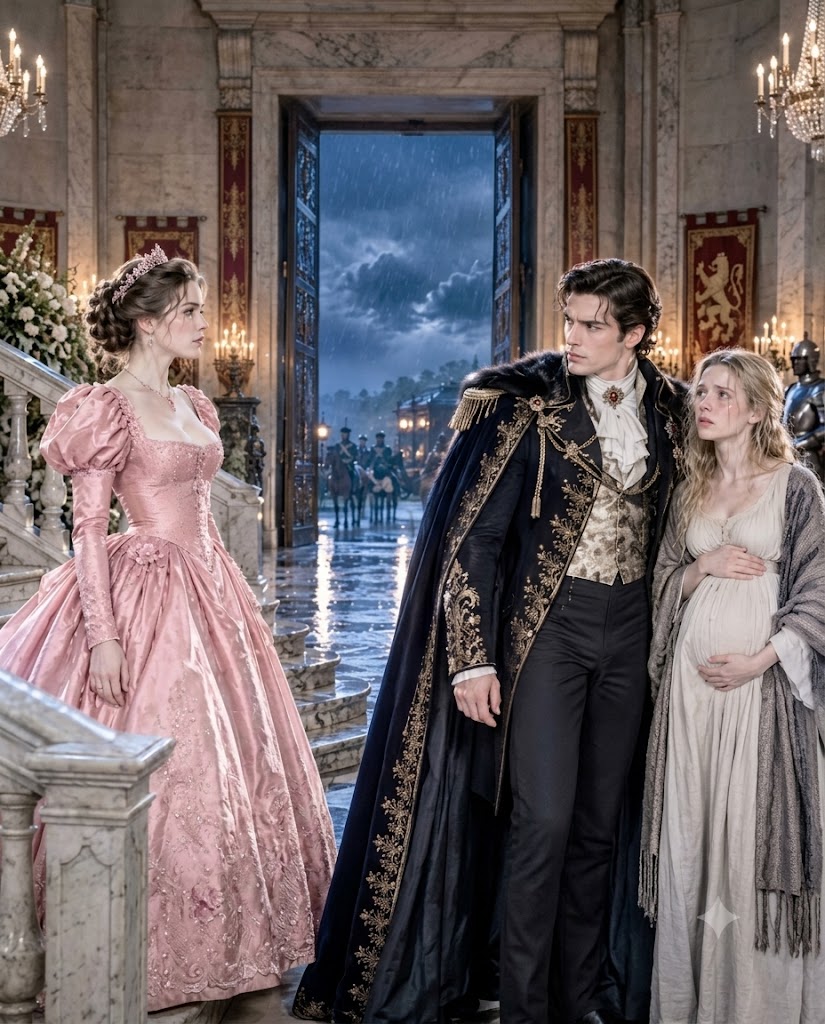
Eleanor received him in the drawing room at eleven in the morning.
She had expected him.
Desperate men became predictable.
Nathaniel had changed.
His coat was still expensive, but the cuffs showed wear.
His face looked thinner.
There were shadows beneath his eyes.
He remained handsome.
That had always been part of the problem.
People forgave handsome men faster.
Eleanor had once been one of them.
Nathaniel did not sit.
“I need money.”
Eleanor almost admired the absence of ceremony.
“How much?”
Relief flickered across his face.
He named the sum.
Eleanor’s eyebrows rose.
“For what?”
“Clarabel is unwell.”
There it was.
Not gambling.
Not racing.
Not another mistress.
A sick woman carrying his child.
For one dangerous moment, Eleanor felt the old instinct awaken.
Solve it.
Pay.
Prevent suffering.
Then she remembered that compassion did not require self-destruction.
“I will pay the physician directly,” she said. “And I will arrange proper food and coal for Clarabel until the child is born.”
Nathaniel stared at her.
“You will?”
“Yes.”
His shoulders loosened.
Then Eleanor continued.
“But I will give nothing to you.”
The relief vanished.
“You think I would steal money intended for my own child?”
“I think you have spent six years proving that money placed in your hands eventually becomes someone else’s problem.”
His face reddened.
“You enjoy this.”
Eleanor looked at him with genuine surprise.
“No.”
“You enjoy seeing me humiliated.”
“No, Nathaniel. That is what makes this so difficult for you. I do not hate you enough to enjoy it.”
The words struck deeper than cruelty.
He stepped closer.
“You were my wife.”
“I still am, legally.”
“You vowed to stand beside me.”
“And I did.”
“Then why stop now?”
For the first time, Eleanor’s composure sharpened.
“Because standing beside you became standing between you and every consequence you earned.”
Nathaniel opened his mouth.
She did not allow him to interrupt.
“I paid your debts. I protected your reputation. I repaired your estate. I lied to creditors, relatives, servants, and sometimes to myself. Every time your life began collapsing, I placed my hands beneath it and held it up.”
Her voice remained quiet.
“That was not love. It was rescue.”
Nathaniel stared at her.
“And rescue, repeated often enough, becomes permission.”
The room seemed suddenly smaller.
Eleanor rose.
“I will help Clarabel because she is vulnerable and because the child is innocent. I will not help you escape yourself again.”
Nathaniel left without saying goodbye.
The journey back to Wickliffe Hall took six hours.
He spent every one of them angry.
At Eleanor.
At Clarabel.
At his father for leaving the estate burdened.
At creditors.
At luck.
At the rain.
By the time the carriage reached Wickliffe, his anger had exhausted every target except the only one remaining.
Himself.
Clarabel’s child arrived six weeks early.
It happened during a storm.
The wind tore branches from the old elms and rain flooded the eastern road.
The doctor could not reach the house.
Nathaniel sent riders in three directions.
None returned in time.
Only two maids remained at Wickliffe Hall.
One had assisted with births before.
Nathaniel waited outside the bedroom while Clarabel screamed.
Hours passed.
At dawn, the screaming stopped.
Then came the thin cry of an infant.
Nathaniel closed his eyes.
A maid appeared.
Her sleeves were stained with blood.
“You have a daughter, Your Grace.”
He smiled.
Then saw the maid’s face.
“And Clarabel?”
The maid looked back toward the room.
“She is very weak.”
Nathaniel entered.
Clarabel lay almost colorless against the pillows.
A tiny bundle rested beside her.
He sat carefully.
Clarabel opened her eyes.
“She has your mouth.”
Nathaniel looked down.
The baby’s fist was smaller than his thumb.
“She is perfect.”
Clarabel smiled faintly.
“I want to call her Rose.”
He swallowed.
“Rose.”
For several minutes, everything else disappeared.
Debt.
Scandal.
Cold rooms.
The estate.
Eleanor.
There was only a child breathing against his hand.
Then Clarabel whispered, “Promise me something.”
Nathaniel leaned closer.
“What?”
“Do not raise her to believe that someone else will always clean up what she breaks.”
He froze.
Clarabel’s eyes remained closed.
“I loved you because you made the world sound easy,” she said. “I was foolish enough to believe you.”
“Clarabel—”
“I do not hate you.”
Her breathing became shallow.
“That might be worse.”
She survived.
But barely.
Recovery took months.
During those months, something happened at Wickliffe Hall that no one in the county expected.
Nathaniel began working.
Not dramatically.
Not nobly.
At first, merely because there was no alternative.
He met tenant farmers whose names he had never learned.
He discovered cottages with leaking roofs.
Fields that had been poorly drained.
Contracts that had not been renegotiated in fifteen years.
He learned that the estate could produce income, but not while its duke treated it as a private purse.
He sold three remaining racehorses.
He closed the London club account.
He dismissed his valet.
He leased two hundred acres to a neighboring farmer.
Then he did something that caused more gossip than Clarabel’s arrival had.
He opened the west wing of Wickliffe Hall to a girls’ school run by the vicar’s widowed sister.
The rent was modest.
The scandal was enormous.
Nathaniel accepted both.
Two years passed.
Wickliffe did not become rich.
But it stopped dying.
Clarabel moved with Rose to a cottage near the village.
Nathaniel offered marriage once the separation from Eleanor became legally settled.
Clarabel refused.
“I loved you when I believed your promises,” she said.
“And now?”
“Now I believe your actions more.”
It was not a declaration of love.
But neither was it a farewell.
Nathaniel visited his daughter every day he could.
He learned to hold her when she was feverish.
He learned which stories made her laugh.
He learned how terrifying it was to love someone you could not protect with a title.
Eleanor heard about the changes.
She never asked.
Information found her anyway.
One spring afternoon, Mr. Harcourt arrived carrying estate papers.
He placed them on her desk.
“Wickliffe has cleared the oldest agricultural debt.”
Eleanor continued reading.
“Hm.”
“He has also repaid part of what you advanced for the tenant cottages.”
That made her look up.
“He is not legally required to repay me.”
“No.”
“Then return it.”
Mr. Harcourt smiled slightly.
“I tried.”
“And?”
“He sent it back.”
Eleanor stared at the figures.
Once, Nathaniel’s refusal to listen had driven her to despair.
Now, inconveniently, it almost amused her.
Five months later, Eleanor returned to Wickliffe Hall.
Not as a wife returning home.
As an owner attending to business.
Part of the adjoining woodland remained legally hers through her marriage settlement, and a dispute over timber rights required her presence.
She arrived expecting ghosts.
Instead she found children.
Girls in plain dresses crossed the western lawn carrying books.
Their laughter echoed against stone walls once devoted to hunting parties and drunken dinners.
Eleanor stood beside her carriage, astonished.
A small child ran directly into her skirts.
“Oh!”
A woman hurried after her.
“I am terribly sorry.”
Eleanor looked down.
The little girl had dark hair, serious gray eyes, and one muddy shoe.
Eleanor knew immediately.
“Rose?”
The woman blinked.
Then Nathaniel’s voice came from behind them.
“Yes.”
Eleanor turned.
Two years had changed him more than six years of marriage ever had.
He wore no fashionable coat.
There was mud on his boots.
His hands looked rougher.
He stopped several feet away.
Neither knew which greeting belonged to them anymore.
Finally Eleanor said, “The school?”
Nathaniel glanced toward the west wing.
“It pays rent.”
She smiled despite herself.
“Of course.”
“And the roof was already repaired.”
“With whose money?”
He met her eyes.
“Mine.”
That answer meant more than it should have.
Rose tugged Eleanor’s glove.
“Are you a duchess?”
Eleanor looked down.
“I am.”
“My papa says duchesses are terrifying.”
Nathaniel closed his eyes.
Clarabel, standing nearby, coughed to hide a laugh.
Eleanor crouched.
“Only when necessary.”
Rose considered this with great seriousness.
Then she offered Eleanor a crushed daisy.
“For you.”
Eleanor took it.
“Thank you.”
Later that afternoon, after the solicitor had finished discussing timber boundaries, Eleanor walked alone toward the lake.
Nathaniel found her there.
For several moments they stood side by side without speaking.
“I owe you an apology,” he said.
Eleanor looked across the water.
“You owe me several.”
“I have written them.”
“I know.”
She had never answered.
Nathaniel nodded.
“I deserved that.”
Another silence.
Then he said, “I used to think you left because you stopped loving me.”
Eleanor’s fingers tightened around the stem of Rose’s daisy.
“I left because loving you had become an excuse for allowing you to destroy yourself.”
He absorbed the words.
“And did you stop?”
She turned.
“Loving you?”
“Yes.”
Eleanor considered lying.
Instead she said, “Eventually.”
Pain crossed his face.
But he nodded.
“I am glad.”
That surprised her.
Nathaniel gave a small, tired smile.
“If you still loved the man I was, then perhaps neither of us would have learned very much.”
For the first time, Eleanor saw no attempt to charm her.
No hidden request.
No plea for forgiveness.
Just a man accepting a truth.
“What changed you?” she asked.
Nathaniel looked toward the house.
“Nothing changed me.”
Eleanor waited.
“I simply ran out of people willing to prevent me from changing.”
That stayed with her.
Before leaving the next morning, Eleanor found Clarabel in the garden.
Rose was collecting stones beside the path.
Clarabel had grown stronger, though the difficult birth had left traces in the careful way she moved.
“I owe you thanks,” Clarabel said.
“No.”
“You paid the doctor.”
“I paid a doctor.”
“You kept my child warm that winter.”
Eleanor looked at Rose.
“She was not responsible for her father.”
Clarabel smiled.
“Neither were you.”
The simplicity of it struck them both.
For years Eleanor had believed marriage made Nathaniel her responsibility.
Clarabel had believed love made Nathaniel her destiny.
Both women had nearly disappeared inside his mistakes.
“Are you happy?” Eleanor asked.
Clarabel considered the question.
“I am becoming so.”
Eleanor nodded.
“That may be better.”
Clarabel looked toward Nathaniel, who was speaking with a tenant near the gate.
“He still wants to marry me.”
“And will you?”
“Perhaps.”
Eleanor raised an eyebrow.
Clarabel laughed.
“When I am certain he wants a wife rather than someone to save him.”
Eleanor smiled.
“Then make him wait.”
“I intend to.”
Nathaniel eventually repaid every debt Eleanor had personally covered in his final year of ruin.
It took him seven years.
The last payment arrived in a plain envelope.
There was no apology inside.
No request.
Only a short note.
This is the last of it.
You once gave me money because I would not carry my own weight.
I return it because I finally can.
Eleanor read the note twice.
Then she placed it in a drawer beside the first solicitor’s letter.
Years later, Rose would ask her father why the Duchess of Wickliffe lived in London while he lived at Wickliffe Hall.
By then Nathaniel and Clarabel had married.
Not lavishly.
Not publicly.
Rose had been the only bridesmaid.
Nathaniel answered his daughter carefully.
“Because sometimes two people can care for each other and still be wrong for each other.”
Rose frowned.
“Did you hurt her?”
“Yes.”
“Did she forgive you?”
Nathaniel looked toward the window.
“I think she stopped needing to.”
Rose did not understand.
Not then.
But one day she would.
Eleanor never married again.
Not because Nathaniel had ruined love for her.
Quite the opposite.
Leaving him taught her what love was not.
It was not paying every debt someone refused to face.
It was not making endless excuses for cruelty.
It was not proving loyalty by accepting humiliation.
It was not carrying another adult until your own back broke.
Eleanor filled her life instead with things she had once postponed.
She funded schools.
She traveled.
She built a small lending society for widows who wished to open businesses.
And whenever someone praised her generosity, she corrected them.
“Generosity should help people stand,” she would say. “Not teach them to remain helpless.”
Wickliffe Hall survived.
Not unchanged.
The ballroom was eventually converted into a library for the girls’ school.
Part of the estate became productive farmland.
The great dining room, once capable of seating forty drunken guests, hosted tenant meetings every winter.
Nathaniel lost friends who had admired him when he was reckless.
He gained others who respected him when he became useful.
There were still difficult years.
Harvests failed.
Roofs leaked.
Rose became ill once and frightened everyone.
Nathaniel sometimes felt the old temptation to gamble when pressure became unbearable.
But responsibility, once practiced long enough, became its own kind of habit.
He learned that dignity did not come from never falling.
It came from refusing to demand that someone else bleed every time you did.
Many years later, after Nathaniel’s hair had begun to gray, a fire damaged part of the eastern wing.
Eleanor received the news in London.
Her solicitor asked whether she wished to offer assistance.
For a long moment, she said nothing.
Then she smiled.
“No.”
The solicitor looked surprised.
“Nothing at all?”
“Oh, I shall write to them.”
“And money?”
“No.”
At Wickliffe Hall, Nathaniel received her letter three days later.
Clarabel found him reading it beside the damaged staircase.
“Well?”
He handed it to her.
The note contained only four lines.
Nathaniel,
I am sorry to hear about the fire.
I trust you will know what to do.
You have managed worse.
Eleanor.
Clarabel looked at him.
Nathaniel began to laugh.
Not bitterly.
Not angrily.
He laughed until he had to sit down on the stairs.
“What is so amusing?”
He wiped his eyes.
“Sixteen years ago, that letter would have terrified me.”
“And now?”
Nathaniel looked around the blackened hall.
At the workmen measuring beams.
At Rose, now a young woman, carrying plans beneath one arm.
At the estate manager discussing costs.
At the home he had finally learned to maintain rather than merely inherit.
“Now,” he said, “it feels like a compliment.”
And perhaps that was the strangest ending of all.
Eleanor’s greatest act of love had not been the fortune she spent rescuing Nathaniel.
It had been the day she stopped.
Because some people do not change when they are loved harder.
They change when love finally refuses to protect them from the truth.
And sometimes walking away is not abandonment.
Sometimes it is the first honest thing two people have ever given each other.
Sometimes it is the first honest thing two people have ever given each other.
But life, Eleanor would later discover, was rarely kind enough to end at the exact moment a lesson was learned.
There were always consequences.
There were always echoes.
And sometimes, years after a wound had closed, something returned to test whether it had truly healed.
It happened in the winter of Rose’s twenty-first year.
Eleanor was fifty-three then.
Her hair had begun to silver at the temples, though her posture remained straight and her eyes as observant as ever.
London knew her now for reasons that had nothing to do with Nathaniel.
The lending society she had founded for widows had expanded into three counties.
Two schools bore her name.
A small hospital wing in Kent had been built after she refused to attend a grand society ball and donated the cost of the evening instead.
People called her generous.
Powerful.
Independent.
Some even called her formidable.
Eleanor had learned to accept all those words without needing any of them.
Then, one cold January morning, a letter arrived from Wickliffe Hall.
It was not Nathaniel’s handwriting.
It was Rose’s.
Eleanor opened it beside the fire.
The first sentence made her sit down.
Papa has taken ill.
The second made her close her eyes.
The physician says we must prepare ourselves.
Nathaniel had always seemed impossible to imagine as an old man.
Even when selfish, even when reckless, there had been something fiercely alive about him.
He had entered rooms as if they existed for his amusement.
He had gambled because consequences felt distant.
He had betrayed trust because he believed tomorrow would always be available for apologies.
Yet tomorrow, eventually, stopped offering itself so freely.
The illness had begun as a fever.
Then came pain in his chest.
Then weakness.
By the time the London physician arrived, there was little to be done.
Rose’s letter contained no request.
Only information.
That was why Eleanor packed that afternoon.
She told herself she was going for Rose.
Perhaps part of her was.
But honesty had become a habit.
She knew the truth.
There were goodbyes that could be postponed until regret made them unbearable.
She had spent too much of her life cleaning up other people’s failures.
She would not spend the rest of it creating one of her own.
Wickliffe Hall looked almost unchanged from the road.
The same ancient stone.
The same towers dark against the winter sky.
But inside, the house felt different.
Warm.
Lived in.
Useful.
Children’s drawings from the school still hung in one corridor.
Shelves of books occupied rooms that had once displayed weapons and trophies.
The front hall no longer seemed built to impress strangers.
It seemed built to receive people.
Clarabel met Eleanor at the door.
Time had softened her beauty rather than diminished it.
There were lines around her eyes now, and confidence in the way she carried herself.
For a moment, the two women simply looked at each other.
Then Clarabel stepped forward and embraced her.
Eleanor returned it.
“He has been asking for you,” Clarabel said.
Eleanor’s throat tightened.
“For how long?”
“Since yesterday.”
“Why didn’t you write sooner?”
Clarabel gave her a sad look.
“He would not let us.”
That, at least, sounded like Nathaniel.
Even dying, he was capable of making an inconvenient decision.
Rose appeared at the top of the staircase.
She was no longer the muddy child who had handed Eleanor a crushed daisy.
She was tall now, dark-haired like her father, with the same gray eyes and none of his youthful carelessness.
She hurried down.
“Duchess.”
Eleanor smiled.
“After all these years, you may call me Eleanor.”
Rose’s composure broke.
She embraced her.
“He looks terrible.”
“I imagine he is very offended by that.”
Rose laughed through tears.
“Yes.”
Then she covered her mouth.
Eleanor touched her cheek.
“Take me to him.”
Nathaniel was in the room that had once belonged to his father.
Eleanor paused at the doorway.
He had become thin.
Far thinner than she had expected.
His face had sharpened, and the hand resting upon the blanket looked fragile.
For one terrible instant she saw the young man he had been.
The beautiful, reckless duke standing beneath chandeliers while everyone forgave him before he had even apologized.
Then Nathaniel opened his eyes.
And time returned.
“Well,” he whispered.
Eleanor crossed the room.
“You look dreadful.”
He smiled weakly.
“I knew you still cared.”
“Do not become unbearable on your deathbed.”
“I have very little time left. I intend to use it efficiently.”
She sat beside him.
For a while, neither spoke.
The silence between them no longer carried accusation.
It carried history.
Six years of marriage.
Years of resentment.
Years apart.
A strange friendship built from distance.
Lessons bought at enormous cost.
Nathaniel looked toward the window.
“I thought you might not come.”
“I considered it.”
“Cruel.”
“Practical.”
His smile faded.
“I am glad you did.”
“So am I.”
Nathaniel studied her.
“Are you?”
“Yes.”
“Why?”
Eleanor considered the question.
“Because I do not wish to spend the rest of my life wondering what we failed to say.”
His eyes closed briefly.
“I am sorry.”
She did not answer immediately.
Nathaniel opened his eyes again.
“I know I have said it before.”
“You have.”
“And I know apologies are cheap.”
“They can be.”
He breathed carefully.
“But there is one thing I never apologized for properly.”
Eleanor waited.
“For making you smaller.”
The words struck somewhere she had not expected.
Nathaniel’s voice weakened.
“When we married, you were cleverer than I was. Better with money. Better with people. More patient. More disciplined. Everyone knew it.”
He swallowed.
“I think part of me resented you for it.”
Eleanor remained still.
“So I let you become useful instead of allowing you to remain extraordinary.”
Her eyes stung.
Nathaniel continued.
“I turned your strength into a service I expected.”
He looked at her.
“You saved me so often that I stopped seeing the cost to you.”
Eleanor looked down at their hands.
Once, she would have given almost anything to hear those words.
Now they hurt differently.
Not as a wound.
As recognition.
“You were not the only one responsible,” she said.
Nathaniel frowned.
“I was responsible for what I allowed.”
“You loved me.”
“Yes.”
“And that made you foolish.”
“Frequently.”
A faint smile passed between them.
Then Eleanor said, “I believed endurance was proof of character.”
Nathaniel’s eyes remained on her.
“I thought leaving meant failure.”
“And then?”
“I learned that staying can also be failure.”
He nodded.
They were quiet again.
At last Nathaniel whispered, “Rose wants to marry.”
Eleanor’s eyebrows rose.
“That sounds serious.”
“It is catastrophic.”
“Who is he?”
“A physician.”
“Respectable?”
“Painfully.”
“Kind?”
Nathaniel sighed.
“Very.”
“Then I fail to see the catastrophe.”
“He has opinions.”
Eleanor almost laughed.
“You produced a daughter with opinions. Surely this is justice.”
Nathaniel smiled.
“He wants her to continue managing the school after they marry.”
“Good.”
“I said the same.”
Eleanor looked at him.
That surprised her more than she expected.
Nathaniel noticed.
“I have learned some things.”
“Yes,” she said softly. “You have.”
Later that evening, Rose sat with Eleanor in the library.
Snow pressed against the windows.
“My father told me something once,” Rose said.
“What?”
“That you saved his life by leaving him.”
Eleanor looked at the fire.
“That sounds more poetic than the truth.”
“Was it not true?”
“In part.”
Rose waited.
Eleanor folded her hands.
“People like simple stories. A villain. A victim. A punishment. A redemption.”
“And ours was not simple?”
“No.”
She looked toward Rose.
“Your father behaved terribly. I allowed too much. Your mother believed too easily. We all paid for different mistakes.”
Rose lowered her eyes.
“But Papa changed.”
“He did.”
“Because you left.”
Eleanor shook her head.
“No.”
Rose looked surprised.
“I leaving created a consequence. That is not the same as creating his change.”
She leaned back.
“Your father changed because he chose to do something with that consequence.”
Rose was silent.
“Many people lose everything and learn nothing,” Eleanor continued. “Pain does not automatically make us wiser. Sometimes it only makes us bitter.”
“Then what makes the difference?”
“What we decide pain means.”
Rose thought about that.
Eleanor looked toward the dark windows.
“If your father had spent the rest of his life blaming me, his creditors, his childhood, or bad luck, nothing would have changed. He decided eventually that suffering was not proof of injustice. Sometimes it was information.”
Rose smiled faintly.
“That sounds like something you would put above the entrance of a school.”
“Then please stop me before I become unbearable.”
Rose laughed.
Nathaniel died three mornings later.
He did not die dramatically.
There was no final speech.
No sudden thunder.
No perfect sentence preserved for generations.
Clarabel sat beside him.
Rose held his hand.
Eleanor stood near the window.
Just before dawn, Nathaniel opened his eyes.
He looked first at Clarabel.
Then Rose.
Then Eleanor.
His gaze rested on each of them as though he were taking account of his life one final time.
His lips moved.
Rose bent closer.
“What is it, Papa?”
Nathaniel whispered something.
Rose laughed through her tears.
“What did he say?” Clarabel asked.
Rose shook her head.
“He said the roof over the eastern classroom still needs repairing.”
Eleanor covered her mouth.
Clarabel began to laugh as well.
Even Nathaniel smiled.
Then he closed his eyes.
And did not open them again.
The funeral was held four days later.
There were no grand politicians.
No princes.
No fashionable gamblers.
Most of the men who had once surrounded Nathaniel in London had disappeared years before.
Instead, tenant farmers filled the church.
Teachers came.
Former servants returned.
Girls from the school stood in rows outside.
The village doctor attended with his wife.
Mrs. Finch, now nearly eighty, traveled two hours by carriage.
When Rose saw her, she began to cry again.
Mrs. Finch took her face between both hands.
“He became a good man,” she said.
Rose nodded.
“Eventually.”
The old woman smiled.
“Eventually counts.”
Eleanor heard those words.
She remembered Mrs. Finch leaving Wickliffe Hall years earlier with a small box and twenty-two years of service behind her.
She remembered Nathaniel standing alone after accusing the woman of abandonment.
Eventually counts.
Perhaps that was the most generous judgment any human being could receive.
Not that we began well.
Not that we never failed.
Not that our apologies erased damage.
Only that, when given enough truth, we finally became better than we had been.
After the funeral, Clarabel found Eleanor in the old ballroom.
Or what had once been the ballroom.
Bookshelves covered three walls now.
Long tables stood where dancers had once turned beneath chandeliers.
A chalkboard occupied the place where musicians once played.
“He left something for you,” Clarabel said.
Eleanor turned.
Clarabel held a small wooden box.
“What is it?”
“I do not know.”
Eleanor opened it.
Inside was a bundle of letters.
Her letters.
Not all of them.
Only the ones she had written during the first three years of their marriage.
Notes about repairs.
Warnings about expenses.
Requests that Nathaniel come home.
Apologies she had written after arguments he had caused.
Messages begging him to stop gambling.
Letters offering him forgiveness before he had asked for it.
Eleanor’s fingers trembled.
Beneath them was a newer letter.
Her name was written across the front.
She opened it.
Eleanor,
If you are reading this, then I have finally managed to inconvenience you from beyond the grave.
Forgive me.
There is something I should tell you.
I kept your old letters because they embarrassed me.
For years, I could not read them without seeing how hard you were trying to build a life with someone determined to escape responsibility.
Later, I kept them for another reason.
They reminded me of the difference between being loved and being entitled to love.
I had confused those things.
I believed that because you loved me, you would always rescue me.
I believed your loyalty was a resource I could spend.
I believed forgiveness meant the bill had disappeared.
I was wrong.
Forgiveness does not erase a debt.
Sometimes forgiveness only means the person you hurt has chosen not to become cruel because of you.
You did that for me.
You did not become cruel.
Even when you had every reason.
Do not misunderstand me.
I am not asking you to remember me kindly.
Remember me accurately.
Remember the foolish man.
Remember the selfish man.
Remember the frightened man who hid behind charm.
But if you can, remember also the man who eventually tried.
That is the only legacy I can honestly ask for.
Nathaniel.
Eleanor read the letter twice.
Then she sat at one of the school desks and cried.
Not like the abandoned wife she had once been.
Not like a woman longing for what might have happened.
She cried for time.
For the strange cruelty of maturity arriving after damage.
For the truth that some people become worthy only after the person they hurt no longer needs them to.
Clarabel sat beside her.
Neither woman spoke.
After a while, Eleanor folded the letter.
“Did you love him?” Clarabel asked.
Eleanor looked at her.
“Yes.”
“Even at the end?”
Eleanor considered it.
“Not as a husband.”
Clarabel nodded.
“I understand.”
Eleanor touched the edge of the letter.
“I think I loved the proof that people can become different.”
Clarabel smiled sadly.
“That may have been the best part of him.”
Rose inherited Wickliffe.
There were distant male relatives who complained.
There were lawyers who argued.
There were traditions that resisted.
But years earlier, Nathaniel had begun restructuring the estate so that Rose would control as much as legally possible.
He had spent his youth wasting inheritance.
He spent his later years ensuring his daughter would not be trapped by it.
Rose married the physician the following autumn.
Eleanor attended.
Clarabel cried through most of the ceremony.
The groom cried more.
Nathaniel would have disapproved of that only because he was not there to make a joke about it.
After the wedding, Rose approached Eleanor.
“I have something for you.”
She held out a small cloth pouch.
Inside was an old signet ring.
Eleanor recognized it immediately.
Nathaniel’s grandfather’s ring.
The one he had surrendered to the doctor on the night Clarabel nearly died.
“I thought this was gone.”
“It was.”
Rose smiled.
“Papa bought it back twelve years later.”
Eleanor turned the ring between her fingers.
“Then you should keep it.”
Rose shook her head.
“He left instructions.”
“For me?”
“Yes.”
“Why?”
Rose handed her another slip of paper.
One sentence.
A title is only worth wearing when you no longer need it to excuse who you are.
Eleanor laughed quietly.
“That sounds suspiciously wise.”
“He practiced.”
Rose closed Eleanor’s fingers around the ring.
“Keep it.”
So she did.
Not as a memory of rank.
As a memory of cost.
Years passed.
The school at Wickliffe expanded.
Then another opened in the neighboring county.
Rose and her husband had three children.
Clarabel became the terrifying grandmother everyone adored.
Mrs. Finch reached ninety-one and continued criticizing household management until the day she died.
Eleanor grew older.
Her movements slowed.
Her travels became shorter.
But her mind remained sharp.
Young women continued visiting her London house for advice.
Some came because their husbands gambled.
Some because fathers controlled their money.
Some because they wanted careers everyone considered unsuitable.
Some because they were simply exhausted from being told that love required endless sacrifice.
Eleanor never told them what to do.
She had learned the danger of living another person’s life for them.
But she often asked one question.
“What are you protecting them from?”
A woman might answer:
Debt.
Embarrassment.
Failure.
Consequences.
Then Eleanor would ask:
“And what are you teaching them by doing so?”
That question changed more lives than advice ever could.
When Eleanor was seventy-one, Rose visited her in London with her eldest daughter, Margaret.
Margaret was nineteen.
She had Nathaniel’s gray eyes.
Eleanor noticed immediately.
The girl noticed Eleanor noticing.
“Mama says I look like Grandfather.”
“You do.”
“Was he handsome?”
“Unfortunately.”
Margaret laughed.
Rose rolled her eyes.
“Mama also says he was difficult.”
“That is a diplomatic word.”
They took tea beside the window.
At one point Margaret noticed the old signet ring resting in a glass case on Eleanor’s bookshelf.
“What is that?”
Rose went quiet.
Eleanor opened the case.
She placed the ring in Margaret’s palm.
“It belonged to your great-great-grandfather. Then your grandfather.”
“Why do you have it?”
Eleanor smiled.
“Because your grandfather once gave it away when he had nothing else left to give.”
Margaret looked confused.
So Eleanor told her the story.
Not every detail.
Not the betrayals that belonged to private history.
But enough.
She told her about debt.
Pride.
Rescue.
Failure.
Change.
When she finished, Margaret stared at the ring.
“So if you had kept helping him, he might never have changed?”
“Perhaps.”
“And if you had left earlier?”
“Perhaps he might have changed earlier.”
Eleanor smiled.
“Or perhaps not.”
Margaret frowned.
“That is unsatisfying.”
“Most truth is.”
The girl thought.
“Then how do you know when to help someone?”
Eleanor looked at Rose.
Then back at Margaret.
“Help should increase someone’s ability to stand without you.”
Margaret listened carefully.
“If your help makes them more honest, more capable, more responsible, continue.”
“And if it does not?”
“If your help becomes the reason they never have to grow, then what you are giving may no longer be help.”
Margaret looked down at the ring.
“Even if you love them?”
“Especially then.”
That afternoon, after Rose and Margaret left, Eleanor remained beside the window.
The city moved below.
Carriages.
Children.
Vendors.
Lives passing one another without knowing which ordinary decisions would become turning points.
She thought about the day Nathaniel had walked into Wickliffe Hall with Clarabel.
At the time, Eleanor had believed it was the worst day of her life.
She understood now that pain often disguised itself poorly.
Some disasters were simply disasters.
There was no need to romanticize suffering.
But occasionally, catastrophe tore down a structure that should never have been standing.
Nathaniel bringing Clarabel home had humiliated her.
It had also freed her.
Her leaving had terrified Nathaniel.
It had also forced him to meet himself.
Clarabel’s disappointment had wounded him.
It had also taught him that affection could survive without obedience.
Rose had grown up in the aftermath of all of them.
She had inherited their mistakes as warnings rather than destinies.
Perhaps that was the closest thing to victory families were ever given.
Not perfection.
Interruption.
One generation making a mistake.
The next understanding it.
The one after that refusing to repeat it.
Eleanor died peacefully the following spring.
There was no great public funeral because she had specifically forbidden one.
She requested something smaller.
Teachers.
Friends.
Women from the lending society.
Rose and her family.
Clarabel, now elderly, sat in the front pew.
After the service, Rose opened the envelope Eleanor had left for her.
Inside was the signet ring.
And a letter.
My dear Rose,
Your father once inherited a title before he had earned the character to carry it.
You inherited his consequences before you were old enough to understand them.
Yet you became neither bitter nor careless.
I hope you will give this ring to one of your children someday, but only when they understand what it means.
Tell them it is not a symbol of greatness.
It is a reminder.
We inherit many things we did not earn.
Names.
Money.
Beauty.
Privilege.
Pain.
Mistakes.
Love.
What matters is not merely what reaches our hands.
What matters is what leaves them.
Your father inherited pride and passed down humility.
Your mother inherited uncertainty and passed down courage.
I inherited money and, after many mistakes, learned to turn some of it into opportunity for others.
You inherited all of us.
Pass down only what deserves to survive.
With love,
Eleanor.
Rose pressed the letter against her chest.
Margaret, now twenty, sat beside her.
“What does it say?”
Rose handed it to her.
Margaret read slowly.
Then she looked at the signet ring in her mother’s hand.
“Will you give it to me?”
Rose smiled.
“One day.”
“When?”
“When you no longer want it because it belonged to a duke.”
Margaret raised an eyebrow.
“And what should I want it for?”
Rose looked toward Eleanor’s grave.
“As a reminder that who we become matters more than what we inherit.”
Years later, the original Wickliffe Hall ceased to be a private residence entirely.
Rose’s descendants converted the last family apartments into classrooms.
The estate became a foundation supporting education, medical care, and small business loans.
Above the entrance to the old ballroom, which had long since become a library, a sentence was carved into the stone.
Not Nathaniel’s name.
Not Eleanor’s.
Not the family motto.
Just twelve words:
“Help people rise, but never teach them that they need not stand.”
Visitors often asked who had said it first.
No one knew.
Some credited Eleanor.
Others believed it had been Rose.
A few insisted Nathaniel must have written it near the end of his life.
Perhaps it did not matter.
The words belonged to all of them.
To the woman who had confused rescue with love.
To the man who had confused love with permission.
To the young mother who learned that promises meant nothing without responsibility.
To the daughter who grew up among the ruins and chose not to rebuild the same house.
That was the true inheritance of Wickliffe.
Not the stone walls.
Not the title.
Not the fortune.
Not even the scandal.
The inheritance was the lesson paid for by all of them:
Love is not measured by how much suffering you are willing to endure for someone.
Forgiveness is not permission for them to hurt you again.
Compassion does not require surrendering your boundaries.
And sometimes the kindest thing you can do for a person you love is to stop carrying the weight that only they can learn to lift.
Because when Eleanor finally put down Nathaniel’s burden, two lives changed.
His, because he was forced to stand.
And hers, because she finally remembered she was allowed to walk.
And in the end, neither the duke nor the duchess was remembered most for the marriage they failed to save.
They were remembered for what they built after it ended.
That was the part of the story no scandal sheet had ever predicted.
The ruin had not been the ending.
It had only been the place where responsibility began.
THE END.