“Sign the papers, Varity. No one in this house wants you here.”
The solicitor turned the document toward Varity and placed one finger beneath a line written in her aunt’s firm hand.
“Your aunt left you eighty thousand pounds,” he said.
For a moment, Varity thought she had misunderstood him.
The Copperfinch Inn seemed to fall completely silent. Even the rain tapping against the windows sounded distant.
“Eighty… thousand?”
“And Bellamy Hall, along with several parcels of land and the Bellamy silk manufactory.”
Varity stared at the page.
That amount of money was more than Garrick had ever allowed her to discuss, let alone control.
“There must be some mistake.”
“There is none.”
The solicitor, Mr. Alden Firth, opened another document.
“Lady Anuria anticipated that your husband might attempt to interfere. The inheritance was placed in trust. Under its terms, Duke Garrick has no legal claim to the capital, the estate, or the manufactory.”
Tobias slowly exhaled.
Varity did not.
Her eyes remained fixed on her aunt’s signature.
Six years of letters.
Six years of believing the woman who had raised her like a daughter had simply stopped caring.
And all that time, Anuria had been reaching for her.
A knock struck the inn door.
Three hard blows.
Posie jumped.
Tobias moved toward the window and looked through the curtain.
“It’s one of Calderick’s men.”
Varity’s stomach tightened.
The messenger entered moments later, rain dripping from his hat.
He bowed stiffly.
“His Grace requests the immediate return of the duchess.”
Varity almost laughed.
Three days earlier, Garrick had told her no one wanted her.
Now he was summoning her back.
“Tell His Grace,” she said, “that Duchess Varity is no longer available to be summoned.”
The man looked uncomfortable.
“He says there has been a misunderstanding.”
“No. For the first time in seven years, there has been perfect understanding.”
She turned away.
The messenger hesitated, then left.
Mr. Firth watched her carefully.
“I suspect the duke has learned something of your inheritance.”
Varity looked at the sealed documents on the table.
“Then we should assume he will not leave me in peace.”
“He cannot touch the trust legally.”
“Garrick has never required legality when cruelty would serve him better.”
That afternoon, Varity traveled with Mr. Firth to Bellamy Hall.
Tobias offered to accompany her, but she refused gently.
“This is something I must see alone.”
Bellamy Hall stood on a low hill beyond fields silvered by rain. It was smaller than Calderick House, but warmer somehow, built of pale stone with climbing ivy surrounding tall windows.
Varity had spent summers there as a girl.
The moment she stepped through the door, memories rushed toward her.
Anuria teaching her to read account books at the dining table.
Anuria laughing when Varity ruined a batch of lavender soap.
Anuria telling her, long before her marriage, “Never confuse a grand title with a grand character.”
Varity closed her eyes.
She had ignored that lesson once.
She would not ignore it again.
But the greatest surprise waited beyond the house.
The Bellamy silk works occupied several brick buildings beside a narrow river.
Varity expected noise and activity.
Instead, she found silence.
Inside, dozens of looms stood still.
A handful of workers remained, their faces tired and suspicious.
The foreman, Mr. Harrow, removed his cap.
“We did not know whether you would come, Your Grace.”
“Why wouldn’t I?”
He glanced toward the idle machinery.
“Because most owners do not come when a business is failing.”
Varity learned the truth over the next several hours.
The manufactory was deeply troubled.
Orders had declined.
Several London merchants had stopped buying.
Wages were overdue.
Families in the nearby village depended on those looms, yet the company had barely enough money to survive another season.
Anuria’s fortune could save it temporarily.
But only temporarily.
Mr. Firth quietly advised Varity that she could close the works, sell the machinery, and still live in extraordinary comfort for the rest of her life.
Varity walked among the silent looms.
She saw a woman repairing thread beside her twelve-year-old son.
She saw an elderly weaver whose hands shook as he explained that three generations of his family had worked there.
Then she remembered Calderick House, where rooms full of expensive furniture had meant nothing because no one inside treated her with kindness.
“No,” she said.
Mr. Firth looked up.
“No?”
“I will not inherit my aunt’s people merely to abandon them.”
The next morning, Varity returned to the manufactory before sunrise.
She removed her gloves, sat with the workers, inspected ledgers, examined damaged equipment, and asked questions until even Mr. Harrow looked surprised.
For weeks, she worked harder than she ever had at Calderick House.
She reduced unnecessary expenses.
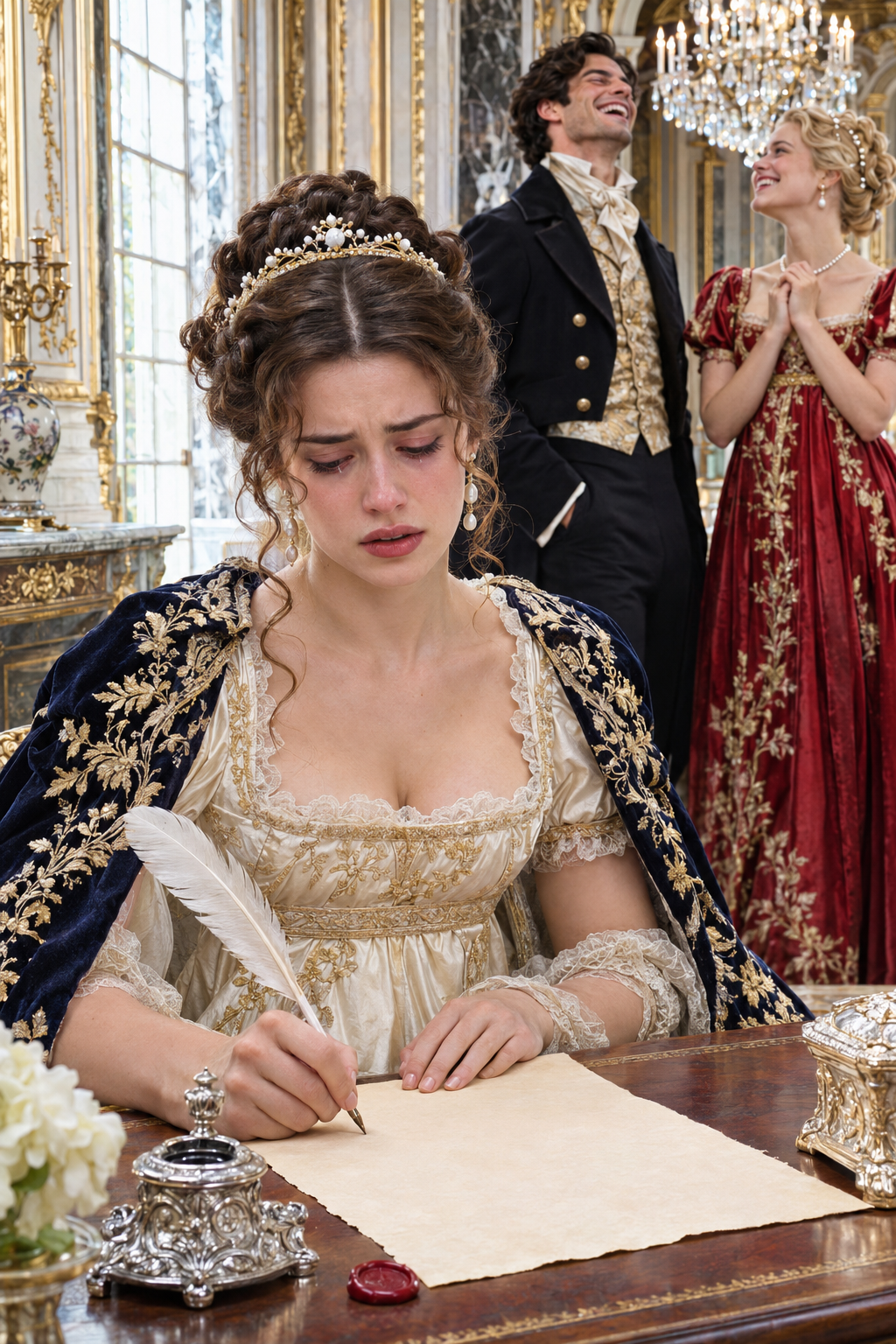
She paid the oldest unpaid wages from her own inheritance.
She negotiated with suppliers.
Then, while searching Anuria’s design room, Varity discovered a wooden chest filled with old silk patterns.
One caught her attention.
It showed small copper-colored birds woven among dark green branches.
“The copperfinch,” she whispered.
The pattern had been abandoned years earlier because it was difficult to produce.
Varity carried it to the master weaver.
“Can we make this again?”
He studied the drawing.
“With adjustments.”
“Then make the adjustments.”
She ordered a limited run.
Rather than sell it cheaply through the merchants who had ignored the Bellamy works, she sent samples directly to dressmakers in London.
For two weeks, nothing happened.
Then a letter arrived.
A fashionable dressmaker wanted twenty yards.
Two days later, another requested fifty.
Within a month, the copperfinch silk appeared at a London musicale on the dress of a countess.
By the following morning, three more orders had arrived.
Within six weeks, the manufactory could barely keep pace.
The looms that had once stood silent now thundered from dawn until evening.
Workers who had feared losing their homes received full wages again.
Varity stood on the factory floor one afternoon as bolts of shimmering green-and-copper silk were packed for London.
Mr. Harrow smiled.
“Your aunt would have been proud.”
Varity touched the fabric.
“I hope so.”
News traveled quickly.
Eventually, it reached Calderick House.
Garrick arrived at Bellamy Hall without invitation.
Varity found him waiting in the drawing room, dressed as perfectly as ever.
“You look well,” he said.
“So do you.”
His smile weakened.
“I hear you’ve become quite the merchant.”
“I own a manufactory. Merchants are useful people.”
“You were never interested in business during our marriage.”
“You never permitted me to be interested in anything.”
He ignored that.
“I came because this separation has become unnecessarily unpleasant.”
“I found it remarkably peaceful.”
“Varity.”
His voice changed.
It was the voice he used when charm failed and control took its place.
“We are still married.”
“Separated by your request.”
“A request made in anger.”
“In front of your mistress.”
Garrick paced toward the window.
“Cresa means nothing.”
Varity almost pitied Lady Cresa then.
Almost.
“You humiliated me for years because of a woman who means nothing?”
“That is not what I meant.”
“No. It is exactly what you meant.”
He turned.
“You are being childish.”
The old Varity would have gone silent.
This Varity smiled.
“You came here for money.”
Garrick’s face hardened.
“There are financial matters at Calderick that concern both of us.”
“They concern you.”
“Your fortune could easily repair them.”
“And why should I repair what you destroyed?”
“Because you are my wife.”
“You remembered that rather suddenly.”
He stepped closer.
“Do not make an enemy of me.”
Varity held his gaze.
“You accomplished that yourself.”
Garrick left before supper.
Three weeks later, the first disaster struck.
A London shipment of Bellamy silk arrived soaked in foul water, ruining nearly the entire order.
The carrier insisted the barrels had been intact when loaded.
A second shipment disappeared.
Then rumors began circulating that Bellamy silk used inferior imported thread.
Orders slowed.
Mr. Harrow came to Varity with another problem.
“Someone is offering our best weavers twice their wages to leave.”
“Who?”
“Roland Strake.”
Varity knew the name.
Strake owned one of the largest textile trading companies in London and had spent years trying to purchase Bellamy’s operation.
He had also recently been seen dining with Garrick.
Varity understood immediately.
“They want the manufactory weakened.”
Mr. Firth agreed.
“But knowing it and proving it are different matters.”
Then came the document that nearly destroyed everything.
A solicitor representing Strake appeared with papers claiming Anuria had sold a controlling interest in the manufactory shortly before her death.
According to the contract, Strake now owned sixty percent of the Bellamy works.
Varity read the document twice.
The signature looked like Anuria’s.
The seal appeared genuine.
Mr. Firth’s face became grim.
“If this is authentic, he may have a claim.”
“It isn’t.”
“How can you be certain?”
Varity pointed toward the date.
“This was supposedly signed on the ninth of February.”
“Yes.”
“My aunt was in Bath that winter.”
Mr. Firth frowned.
“Are you certain?”
“I remember one of the letters you gave me. She wrote that she was recovering from a fever there.”
They searched the recovered correspondence.
The letter was exactly where Varity remembered.
But it was not enough.
A person could sign documents while traveling.
They needed stronger evidence.
Meanwhile, Strake petitioned the court for control of the manufactory.
Banks became nervous.
Suppliers demanded faster payment.
Several London buyers withdrew orders rather than risk becoming involved in a legal dispute.
For the first time since reopening the works, Varity saw fear returning to the faces of her employees.
Then Garrick came again.
This time, he arrived smiling.
“I heard about your difficulties.”
Varity remained behind her desk.
“How fortunate that bad news travels so quickly to you.”
“I can help.”
“Of course you can.”
His smile disappeared.
“Return to Calderick House. End this foolish separation. I will settle matters with Strake.”
“And what do you receive?”
“You are my wife.”
“That is not an answer.”
He leaned both hands on the desk.
“We could restore what we had.”
Varity looked at him for several seconds.
“What exactly did we have, Garrick?”
“A marriage.”
“We had a house. We had a title. We had dinners, servants, carriages, portraits, and rooms large enough for two people to avoid one another for days.”
He straightened.
“We can begin again.”
“No.”
“You would sacrifice hundreds of workers merely to spite me?”
That angered her.
She rose.
“Do not pretend concern for people whose names you do not know.”
His eyes narrowed.
“You will regret this.”
“Perhaps.”
She walked to the door and opened it.
“But whatever happens next will be my mistake to make, not yours.”
Two nights later, a fire broke out in one of the storage buildings.
Tobias arrived from the Copperfinch with several villagers to help.
Together they formed lines of buckets from the river.
The main warehouse survived, but thousands of pounds’ worth of thread burned.
After the flames were extinguished, Tobias found Varity standing in the mud, staring at the blackened building.
“You should rest,” he said.
“I cannot.”
“You’ve been awake all night.”
“So have you.”
“I’m an innkeeper. We specialize in bad hours.”
She gave a tired laugh.
Then her face crumpled.
It happened so quickly that Tobias almost missed it.
Varity covered her eyes.
“I cannot lose this place.”
He did not tell her to be strong.
He did not promise everything would be fine.
He simply stood beside her.
After a moment, she lowered her hands.
“I spent seven years believing endurance was the same thing as strength.”
Tobias looked at the ruined warehouse.
“And now?”
“Now I think strength is choosing what deserves to be endured.”
He smiled faintly.
“That sounds more useful.”
The next morning, Varity entered Anuria’s old study and began searching everything.
If her aunt had feared Garrick enough to create a protected trust, perhaps she had also feared Strake.
Drawer after drawer revealed nothing.
Then Posie, who had come with Tobias, noticed that one bookcase did not sit evenly against the wall.
“There’s something behind it.”
With Tobias’s help, they moved the cabinet.
A narrow panel appeared.
Inside was a small iron box.
Mr. Firth opened it that evening.
The contents changed everything.
There were original ownership records for the Bellamy manufactory.
There were letters from Roland Strake offering to purchase it.
Anuria had rejected every offer.
Most importantly, there was a ledger recording every legal transaction involving the business.
No sale to Strake existed.
But one more paper lay beneath the ledger.
A letter from Anuria to her solicitor.
It described a visit from Garrick six months before her death.
He had demanded information about Varity’s expected inheritance.
When Anuria refused, Garrick threatened to have Varity declared financially incompetent.
Anuria had written one chilling sentence:
“My niece’s husband does not desire her happiness. He desires whatever may someday become hers.”
Varity read it twice.
Then she folded the page carefully.
“I want this in court.”
The hearing in London drew half the fashionable society Garrick had once used to humiliate her.
This time, however, they were not whispering about the abandoned duchess.
They were whispering about him.
Strake’s solicitor presented the supposed ownership contract.
Mr. Firth presented Anuria’s original ledger.
A handwriting specialist testified that the signature on Strake’s contract had likely been copied from another document.
Then Mr. Firth produced the surviving letters.
One revealed that on the exact day Anuria supposedly signed Strake’s agreement in London, she had appeared personally before a magistrate in Bath to amend a charitable trust.
The magistrate’s register confirmed it.
Strake’s face drained of color.
But the most damaging evidence came from an unexpected source.
A young clerk employed by Garrick entered the courtroom carrying a packet of papers.
He had kept copies of instructions Garrick had ordered him to burn.
Among them were payments to the carrier whose shipment had been ruined.
Payments to men connected to the warehouse fire.
And correspondence between Garrick and Strake discussing how financial pressure might force Varity to surrender control of the manufactory.
The judge read the papers in complete silence.
Garrick stared at the clerk as if he might kill him.
Varity stared at Garrick and felt something surprising.
Not rage.
Not triumph.
Nothing.
For years, she had thought freedom would feel like defeating him.
Instead, freedom felt like no longer needing him to lose.
The court rejected Strake’s claim.
An investigation into fraud and sabotage began immediately.
Strake’s reputation collapsed almost overnight.
Several of his business partners abandoned him.
Garrick, already drowning in debt, discovered that creditors were far less patient with a duke accused of conspiracy than with one protected by appearances.
Lady Cresa disappeared before the end of the month.
According to London gossip, she left for France with a wealthy widower.
Varity heard the news while reviewing new wages at the manufactory.
She simply said, “I hope she has learned to inspect a man’s accounts before his promises.”
Mr. Harrow laughed so loudly that three clerks looked up.
Winter came.
The Bellamy works expanded.
Varity hired more weavers, improved ventilation in the workrooms, established shorter hours for children, and created a fund for families injured or widowed in industrial accidents.
The copperfinch pattern remained popular, but Varity refused to depend on one success.
She hired young designers.
She invested in new looms.
She opened direct relationships with dressmakers rather than surrendering control to powerful middlemen.
And then, one cold December afternoon, Garrick appeared for the final time.
He came alone.
No carriage crest.
No servant.
His coat was expensive but worn at the cuffs.
Varity received him in Bellamy Hall’s library.
For several seconds, neither spoke.
At last he said, “Cresa has gone.”
“I heard.”
“Calderick may be sold.”
“I heard that too.”
“Everything is falling apart.”
Varity waited.
Garrick looked older than she remembered.
“I made mistakes.”
“Yes.”
“I was angry. Proud. Foolish.”
“Yes.”
His jaw tightened.
“You could at least make this easier.”
“For whom?”
“For both of us.”
“No, Garrick. Only for you.”
He walked toward the fireplace.
“We were not always miserable.”
Varity thought carefully.
“No. There were pleasant mornings. A few good conversations. Once, you stayed beside me all night when I was ill.”
He turned hopefully.
“But scattered kindness does not erase years of cruelty.”
“I can change.”
“Perhaps you can.”
That answer surprised him.
Varity continued.
“But you do not need me in order to change.”
His expression hardened.
“So that is it?”
“That was it long before I walked out of Calderick House. I simply did not understand it yet.”
He looked around the room.
“You have everything now.”
“No.”
She shook her head.
“I have something better.”
“What?”
“My own decisions.”
For once, Garrick had no answer.
He left Bellamy Hall before sunset.
Varity watched from the window until he disappeared beyond the trees.
Then she returned to her desk.
There were letters waiting.
There was work to do.
There was a life still being built.
In the spring, Varity purchased an old boarding house near the manufactory.
Instead of turning it into another business, she opened its doors to women who had nowhere else to go.
Widows without money.
Servants dismissed after becoming pregnant.
Wives fleeing violent homes.
Girls whose families had abandoned them.
They received beds, meals, temporary work, and help finding safer futures.
Varity named it Anuria House.
Above the entrance, she placed a simple bronze plaque.
It did not mention titles.
It did not mention wealth.
It read:
“A closed door should never be the end of a woman’s road.”
Tobias helped repair the building.
Posie chose curtains for every bedroom, insisting that no one who arrived frightened should wake in a room that looked frightening too.
Years passed.
Varity never returned to Calderick House.
She did not need to.
Her friendship with Tobias grew slowly, without promises forced by loneliness.
He never asked her to become smaller so that he could feel larger.
He never mocked her work or treated her independence as an insult.
Sometimes they walked beside the river after the factory closed.
Sometimes they sat in silence at the Copperfinch while Posie did her lessons nearby.
There was no grand declaration before an audience.
No dramatic bargain.
Only trust, built patiently.
One evening, Tobias asked, “Do you ever wish you had left Garrick sooner?”
Varity considered the question.
“Yes,” she said. “And no.”
He raised an eyebrow.
“I wish I had known my own worth sooner. But I cannot change the woman who stayed. I can only honor her by making sure the woman who left does not waste what she fought to find.”
Tobias smiled.
“And what did she find?”
Varity looked across the courtyard of Anuria House.
A young mother was laughing with another resident near the doorway.
Beyond them, workers were walking home from the silk mill with wages in their pockets.
Posie was chasing a copper-colored ribbon caught by the wind.
“Myself,” Varity said.
For years, society had called Varity fortunate because she had married a duke.
Later, people called her fortunate because she inherited money.
But Varity knew fortune had not saved her.
Money had given her choices, certainly.
Anuria’s inheritance had opened doors.
Yet the hardest door had been the one Varity opened herself on the morning she carried a single trunk out of Calderick House.
She had left without knowing that wealth awaited her.
She had left believing she might have nothing.
That was the choice that changed everything.
Because sometimes the most dangerous prison is not a locked room.
It is the belief that being mistreated is better than being alone.
And sometimes rebuilding a life does not begin when someone finally rescues you.
It begins the moment you decide that losing comfort, status, approval, or certainty is a price worth paying to stop losing yourself.
Varity’s greatest inheritance was not eighty thousand pounds, Bellamy Hall, or a thriving silk business.
It was the truth her aunt had tried to teach her years before:
A grand title cannot give a person character.
Love without respect is not love.
And freedom does not always arrive as a gift.
Sometimes, you must be brave enough to walk out into the rain and claim it for yourself.
Seven years later, the copperfinch still hung above the door of Tobias Marwood’s inn.
The paint had faded around the edges, but the little bird remained bright enough to catch the morning sun.
Varity noticed it every time she passed.
Some things, she had learned, did not need to be replaced simply because they had grown older.
Some things became more precious because they had survived.
Anuria House had expanded twice since it opened.
What began as a refuge for six women now sheltered nearly forty at a time.
A schoolroom had been added to the eastern wing.
A small nursery occupied the garden side.
Two former residents had become supervisors there, and another now managed the accounts.
Varity had insisted on that.
She did not want Anuria House to become a place where women merely waited to be saved.
She wanted it to become a place where they learned they could save themselves.
On a chilly October morning, Varity stood in the schoolroom doorway watching Posie help a little girl form letters on a slate.
Posie was no longer the child who had hidden behind Tobias’s coat on the night Varity arrived at the Copperfinch.
At nineteen, she had grown into a confident young woman with her father’s patience and an alarming habit of speaking her mind.
“Your B is wandering into your A,” Posie told the girl.
The child frowned.
“It doesn’t want to stay still.”
“Neither do I. But we must both try.”
Varity smiled.
Posie looked up and caught her.
“You’re laughing at me.”
“I’m admiring your teaching methods.”
“They work.”
“So did battlefield drums.”
Posie grinned.
“You sound like Papa.”
At the mention of Tobias, Varity’s expression softened.
That still happened.
Even after all these years.
Especially after all these years.
Their relationship had never become the dramatic romance London society expected.
There had been no elaborate courtship reported in gossip columns.
No public declaration.
No scandalous wedding rushed through to satisfy curiosity.
Instead, there had been shared breakfasts.
Long walks.
Quiet evenings.
Arguments over books.
Arguments over business.
Arguments over whether Tobias’s roof required repair.
It always did.
And somewhere between ordinary days, Varity had discovered something she had never possessed in her marriage to Garrick.
Peace.
Real peace.
Not silence caused by fear.
Not obedience disguised as harmony.
Peace built on trust.
Tobias had asked her to marry him only once.
It happened four years after the trial.
They had been standing beside the river when he said, almost casually, “I think I would like to spend the rest of my life annoying you.”
Varity had laughed.
“You already do.”
“Then marriage would simply make it official.”
She had stared at him.
He had looked terrified.
That, more than anything, convinced her that his question was sincere.
Garrick had proposed marriage as if offering her entrance into a superior world.
Tobias asked as if inviting her to build one with him.
Varity had said yes.
They married in the small village church.
Posie cried.
Mr. Harrow cried louder.
Mr. Firth claimed he did not cry at all, though everyone saw him wiping his eyes with a handkerchief.
Varity kept the title of duchess because the law allowed it, but she rarely used it.
At Bellamy works, she was simply Mrs. Marwood to some, Lady Varity to others, and “the mistress” to the oldest employees who refused to change their habits.
She answered to all three.
The silk business had grown beyond anything Anuria had imagined.
Copperfinch designs were now sold throughout Britain and shipped to Paris, Vienna, and even across the Atlantic.
Yet Varity refused several offers to move production to larger cities where labor would be cheaper.
“We built this business with this town,” she told investors. “We will not abandon the people who built it.”
Some businessmen called her sentimental.
Most of them later copied her employment policies when they realized healthier, better-paid workers produced better goods.
Varity found that deeply amusing.
But not every chapter of the past disappeared quietly.
One afternoon, Mr. Firth arrived at Bellamy Hall carrying a letter.
He was older now, his hair almost entirely gray.
Varity took one look at his expression.
“What is it?”
“A matter concerning Calderick.”
She froze.
She had not heard Garrick’s name spoken in years.
After the fraud investigation, he had escaped imprisonment, largely because Strake had arranged most of the direct criminal acts.
But Garrick had lost nearly everything.
Calderick House had been sold.
His remaining estates had been divided among creditors.
His name had become something people whispered rather than admired.
Varity had never asked what became of him after that.
“What does he want?”
Mr. Firth placed the letter on the table.
“He is dying.”
Varity said nothing.
Tobias, seated near the fireplace, did not move either.
Mr. Firth continued.
“He has requested to see you.”
Varity looked at the letter.
For a moment, the room seemed smaller.
She remembered breakfasts filled with humiliation.
Doors closing in her face.
Cresa’s laughter.
Garrick’s threats.
Then she remembered something else.
The last time she had seen him, he had walked away from Bellamy Hall looking like a man who finally understood that power could disappear.
“Do I owe him this?” she asked quietly.
Tobias answered before Mr. Firth could.
“No.”
Varity looked at him.
He held her gaze.
“You owe him nothing.”
There was no jealousy in his voice.
No command.
Only truth.
Varity looked back at the letter.
“But perhaps I owe myself something.”
She visited Garrick three days later.
He was living in a modest house outside London, rented by a distant cousin.
The servant who opened the door was elderly and apologetic.
“His Grace is upstairs.”
Varity almost corrected him.
Then decided it did not matter.
Garrick lay beside a window overlooking a narrow garden.
He was thinner than she remembered.
Much thinner.
His once-dark hair had turned gray.
His face looked hollow.
Yet when he saw her, something of the old Garrick returned.
Not arrogance.
Recognition.
“You came.”
“Yes.”
He tried to sit up.
Varity moved a chair closer but did not help him.
He noticed.
Perhaps he even understood.
“I heard you married the innkeeper.”
“Tobias.”
“Yes.”
Garrick gave a weak smile.
“You seem happy.”
“I am.”
Silence settled between them.
Years ago, Varity would have rushed to fill it.
Now she waited.
At last Garrick looked toward the window.
“I used to think I hated you.”
Varity’s eyebrows lifted.
“That is an unusual deathbed opening.”
He almost laughed.
“I hated what you made me feel.”
“And what was that?”
“Small.”
Varity stared at him.
Garrick continued.
“You were kind without trying to be admired for it. People trusted you. Even servants preferred you. I thought if I made you feel lesser, I would feel greater.”
His breathing became rough.
“It did not work.”
“No.”
“I know.”
For the first time in their entire history, Garrick did not attempt to defend himself.
He did not blame Cresa.
He did not blame Strake.
He did not blame debt, family pressure, or society.
“I ruined everything I touched,” he said.
Varity’s chest tightened, but not with pity.
Something more complicated.
Grief, perhaps.
Not for the man he had become.
For the years both of them had wasted.
Garrick looked at her.
“I want you to forgive me.”
There it was.
The request she had imagined many times.
Years earlier, she had thought hearing it would feel like victory.
It did not.
It felt heavy.
Varity chose her words carefully.
“I no longer carry hatred for you.”
Hope appeared in his face.
“But that is not the same as saying what you did was acceptable.”
His expression fell.
“I know.”
“I will not rewrite the past so you can leave it comfortably.”
Garrick closed his eyes.
Varity continued.
“You hurt me. You tried to take my inheritance. You endangered hundreds of families. People nearly lost everything because you wanted control.”
A tear slid from the corner of his eye.
“I know.”
Varity sat quietly.
Then she said, “But I will not spend the rest of my life punishing you in my mind either.”
He looked at her again.
“That is all the forgiveness I can honestly give.”
Garrick swallowed.
“It is more than I deserve.”
“Yes.”
Strangely, he smiled.
A real smile this time.
“Still direct.”
“I learned.”
“Too late for me.”
“Not too late for me.”
He nodded.
That afternoon, when Varity left the house, she did not look back.
Garrick died nine days later.
Varity attended no grand funeral because there was none.
Only a small burial with a few distant relatives.
She sent flowers.
White lilies.
Nothing more.
When Tobias asked how she felt, she thought for a long time before answering.
“Finished.”
Not happy.
Not sad.
Finished.
And there was peace in that too.
Years continued moving forward.
Posie eventually became the headmistress of the school attached to Anuria House.
She refused three marriage proposals and accepted the fourth from a young doctor who never once complained about her opinions.
Mr. Harrow retired from Bellamy works at seventy-two and returned twice a week because, according to him, retirement was “a ridiculous invention.”
Mr. Firth continued handling Varity’s legal affairs until his hands trembled too badly to write.
When he finally retired, Varity presented him with a silver box containing copies of Anuria’s letters.
“Why these?” he asked.
“Because you brought them back to me.”
He could not answer.
The greatest changes, however, were not recorded in newspapers.
They happened quietly.
A woman arrived at Anuria House with two children and bruises hidden beneath her sleeves.
Six months later, she was managing a sewing room.
A fifteen-year-old girl abandoned by her employer learned accounting and eventually opened her own shop.
A widow who believed she had no useful skills became one of the finest pattern designers at Bellamy works.
Each story reminded Varity of the same truth.
People did not always need someone to build a new life for them.
Sometimes they needed only safety, opportunity, and someone willing to believe that their old life did not define the next one.
On Varity’s sixtieth birthday, the workers at Bellamy surprised her.
She entered the main weaving hall expecting an ordinary inspection.
Instead, every loom had stopped.
Hundreds of employees stood waiting.
At the center of the room hung a curtain.
Posie stepped forward.
“You are going to hate this.”
Varity narrowed her eyes.
“That is not encouraging.”
The curtain dropped.
Behind it was an enormous woven tapestry.
It showed a copperfinch flying from an open cage.
Below it were hundreds of names.
Every worker.
Every resident who had passed through Anuria House.
Every teacher.
Every child educated there.
Every person whose life had been touched by what began after one rainy morning.
Varity covered her mouth.
Tobias stood beside her.
For several seconds, she could not speak.
Finally she whispered, “This is too much.”
“No,” Posie said.
“It is exactly enough.”
Varity stepped closer to the tapestry.
At the bottom was a small inscription.
She read it aloud.
“She left with one trunk and built a place where others could begin again.”
Varity’s eyes filled.
All those years ago, when she walked away from Calderick House, she had believed she was losing everything.
Her marriage.
Her home.
Her status.
Her security.
Her future.
She had been wrong.
She had been losing only the things that had taught her to doubt herself.
Everything worth keeping had come afterward.
That evening, after the celebration ended, Varity and Tobias sat outside the Copperfinch Inn.
The sun lowered behind the fields.
The village was quiet.
Tobias handed her a cup of tea.
“Do you remember the first night you came here?”
“Yes.”
“You looked terrifying.”
Varity stared at him.
“I was soaked, penniless, and carrying a broken trunk.”
“Exactly. Terrifying.”
She laughed.
Tobias smiled.
“I wanted to ask what happened.”
“Why didn’t you?”
“Because you looked like someone who had spent too long explaining herself.”
Varity became quiet.
He had understood her even then.
Not completely.
But enough.
“I was afraid,” she admitted.
“I know.”
“I thought leaving meant I had failed.”
Tobias reached for her hand.
“And now?”
Varity looked across the road toward the distant lights of Anuria House.
“No.”
She squeezed his fingers.
“Staying would have been the failure.”
The first stars appeared overhead.
Somewhere down the road, children laughed.
A loom in the night workshop began its steady rhythm.
Varity listened to the sound.
Once, she had measured her life by what other people allowed her to have.
A husband’s approval.
A place at a table.
A respectable name.
A beautiful house.
She eventually learned that none of those things mattered if possessing them required surrendering her dignity.
There are people who will convince you that losing them means losing everything.
Sometimes they are wrong.
Sometimes losing them is the first moment you finally have room to discover what your life can become.
Varity had not been rescued by money.
She had not been rescued by Tobias.
She had not even been rescued by Anuria’s carefully protected inheritance.
Those things had helped her.
But the rescue began before any of them.
It began at the breakfast table in Calderick House.
It began when a frightened woman picked up a pen and signed her name.
It began when she chose uncertainty over humiliation.
That was the decision from which every other good thing grew.
And years later, if anyone asked Varity what she considered the greatest achievement of her life, she never mentioned the fortune.
She never mentioned the silk empire.
She never mentioned the society women who once mocked her and later begged to wear Bellamy designs.
She simply pointed toward Anuria House.
“Those doors,” she would say.
Because behind those doors were people learning the lesson she had almost learned too late:
Your value does not decrease because someone fails to see it.
Love that demands your silence is not love.
A beautiful cage remains a cage.
And there is no shame in beginning again.
Even if you begin with nothing.
Even if you begin in the rain.
Even if the whole world tells you that walking away means you have lost.
Sometimes walking away is the first victory.
Sometimes starting over is the bravest thing a person can do.
And sometimes the life waiting beyond the door you are afraid to open is far greater than the one you are afraid to leave.
THE END