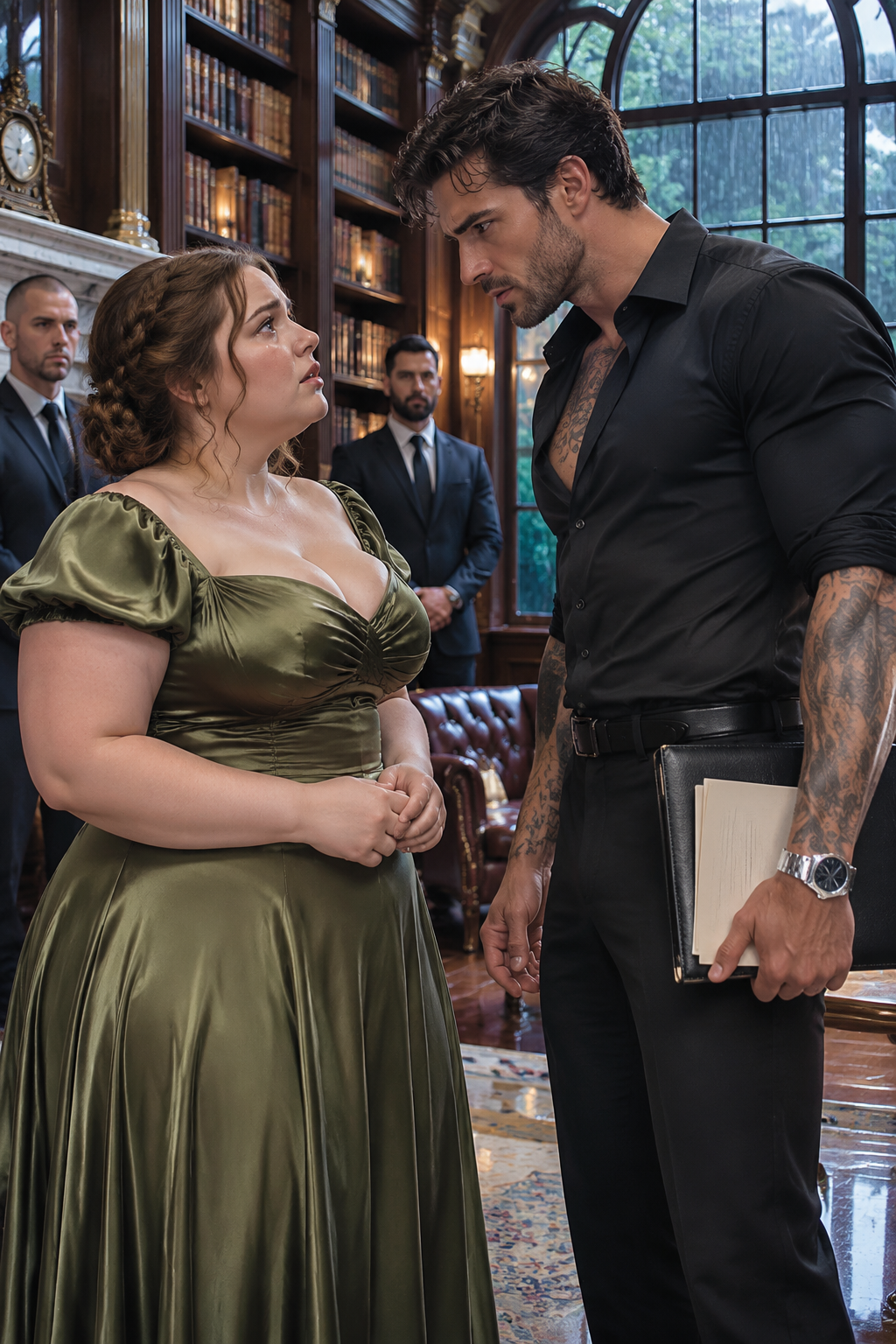
“She’s yours. Take her, and our debt is settled.”
Denham Nelson looked at Brielle for a long moment before sliding the thick folder across the desk.
“Your father has been lying to you about more than this marriage.”
Brielle stared at the documents, her heart beating so hard she could feel it in her throat.
“What do you mean?”
Denham’s attorney, a silver-haired man named Richard Hayes, opened the folder to a page marked with several signatures.
“Three years ago, Edwards Shipping began transferring money through companies that existed only on paper,” Richard explained. “Millions of dollars disappeared from the business.”
Her father, Charles Edwards, shot to his feet.
“That’s a lie!”
Richard calmly turned another page.
“We have the bank records, Mr. Edwards.”
Brielle looked from one man to the other.
She had spent her entire life believing her father was a brilliant businessman. He owned warehouses along the Chicago River, cargo terminals near Lake Michigan, and a fleet of trucks that carried shipments across the Midwest.
He also owned a mansion where Brielle had never felt welcome.
“What does any of this have to do with me?” she whispered.
Denham leaned forward.
“Your father borrowed money against the company. Then he moved much of that money into private accounts. When the debt came due, he offered me something he thought I wouldn’t want.”
Brielle understood immediately.
“Me.”
Her mother, Patricia, looked away.
Charles tried to smile.
“Sweetheart, you’re misunderstanding everything.”
“Don’t call me sweetheart.”
The words surprised even Brielle.
Charles froze.
For twenty-six years, she had swallowed every insult, accepted every rejection, and apologized for things she hadn’t done.
But something inside her had finally reached its limit.
“You told me I was embarrassing,” she continued. “You wouldn’t let me attend company dinners. You made me eat alone when important guests visited. And now you want to trade me for money?”
Patricia sighed impatiently.
“Brielle, stop being dramatic. Nobody else was going to marry you.”
The room went completely silent.
Denham slowly turned toward Patricia.
“Say that again.”
His voice was quiet, but something about it made her shrink backward.
Patricia forced a laugh.
“I only meant that Brielle has always been difficult. She’s not exactly the kind of woman a man like you would choose.”
Denham stood.
“You’re right about one thing.”
Brielle lowered her eyes.
She knew what was coming.
Another rejection.
Another reminder that she wasn’t beautiful enough.
But Denham walked to her side and offered his hand.
“I would never choose a woman because her family offered her as payment.”
He waited until she looked up.
“If I ever marry Brielle Edwards, it will be because she wants to marry me.”
Then he turned to her parents.
“And if she does, it will be because she knows she’s worth more than everything in this room.”
Brielle couldn’t speak.
Nobody had ever defended her like that.
Charles slammed his fist against the desk.
“Enough! You came here to collect your money. Take the girl or give us more time!”
Denham’s expression hardened.
“The debt is due today.”
Charles went pale.
“You can’t do that.”
“I already have.”
Richard placed another document on the desk.
“The Edwards family pledged controlling shares in the shipping company as collateral. Under the agreement, the lender can enforce those rights after default, subject to the required legal process.”
Charles grabbed the paper.
His hands shook as he read.
“No. There must be another way.”
Denham looked at Brielle.
“There is something I need to ask you.”
She swallowed.
“What?”
“Would you like to leave this house?”
The question was so simple that it almost broke her.
Leave?
She had dreamed about leaving since she was sixteen.
But every time she saved money, her parents found a reason to take it.
When she applied for jobs, Charles told employers she was unreliable.
When she tried renting an apartment, Patricia threatened to cut her off from the family completely.
Brielle had spent years believing she couldn’t survive without them.
Now the most feared man in Chicago was offering her a way out.
“Yes,” she whispered.
Denham nodded.
“Then get whatever belongs to you.”
Patricia immediately stepped forward.
“She isn’t going anywhere!”
Denham turned.
“She’s twenty-six years old.”
“She’s our daughter!”
“Then you should have treated her like one.”
Brielle walked upstairs with trembling legs.
Her bedroom was at the far end of the hallway, smaller than the guest suites.
She opened her closet and pulled out an old suitcase.
Inside went three dresses, two sweaters, her favorite books, and a small photograph of her grandmother.
That photograph was the only thing she owned that made her feel loved.
Her grandmother, Eleanor Edwards, had died when Brielle was seventeen.
She had been the one person who called her beautiful without adding conditions.
Brielle held the picture against her chest.
“I wish you were here, Grandma.”
A voice came from the doorway.
“Packing already?”
Her younger sister, Vanessa, stood there wearing a designer dress and an expensive diamond bracelet.
At twenty-three, Vanessa had everything Brielle had been denied.
Attention.
Money.
Praise.
And the freedom to do whatever she wanted.
“You’re really leaving with that gangster?” Vanessa asked.
“I’m leaving this house.”
Vanessa laughed.
“Don’t get excited. He’ll get tired of you in a week.”
Brielle zipped her suitcase.
“Maybe.”
Vanessa blinked.
“Maybe?”
“Maybe he’ll get tired of me. Maybe he won’t. But I would rather take that chance than spend another day being treated like I don’t matter.”
For the first time, Vanessa had no answer.
Brielle carried her suitcase downstairs.
Denham was waiting near the front door.
He took the suitcase from her without making a show of it.
Outside, a black SUV stood beside the driveway.
Charles followed them onto the porch.
“You walk out that door, Brielle, and you’re no daughter of mine!”
She stopped.
For one painful second, she wanted to turn around.
Not because she wanted to stay.
Because some small part of her still hoped her father would apologize.
Instead, she looked at him and said, “Then I guess nothing has changed.”
She climbed into the SUV.
Denham closed the door gently.
As the vehicle pulled away, Brielle watched the mansion disappear behind the trees.
She didn’t cry until they reached the highway.
Denham didn’t ask her to stop.
He simply handed her a clean handkerchief.
Twenty minutes later, Brielle realized they weren’t heading toward a hotel.
“Where are we going?”
“My house.”
Her stomach tightened.
“Am I supposed to stay there?”
“Only if you’re comfortable. I can arrange a hotel or an apartment instead.”
She studied his face.
“Why are you being nice to me?”
Denham looked out the window.
“Because kindness shouldn’t be something you have to earn.”
Brielle stared at him.
Then she asked the question that had been troubling her since they left.
“Are you really a mob boss?”
Denham didn’t pretend to misunderstand.
“I’ve done business with dangerous people. I’ve made decisions I’m not proud of.”
“Have you hurt people?”
His jaw tightened.
“My world has never been a gentle one.”
“Then why should I trust you?”
He turned toward her.
“You shouldn’t trust me just because I say you can. Watch what I do. Ask questions. Make your own decisions.”
It wasn’t the answer she expected.
But it was the first answer anyone had given her without demanding obedience.
Denham’s estate stood on several acres outside Chicago.
The house was enormous, with tall windows overlooking a quiet lake.
Brielle stepped inside and immediately felt out of place.
A woman in her sixties approached them.
“Mr. Nelson, welcome home.”
“Margaret, this is Brielle Edwards.”
Margaret smiled warmly.
“It’s lovely to meet you, Miss Edwards.”
Brielle instinctively lowered her head.
“Sorry for arriving without warning.”
Margaret looked confused.
“There’s nothing to apologize for.”
Denham turned to the housekeeper.
“Please prepare the east guest suite. Brielle will have complete privacy.”
Then he looked at Brielle.
“If you need anything, ask Margaret. If you want to leave, a driver will take you wherever you choose.”
He paused.
“And nobody enters your room without permission.”
Brielle almost smiled.
It sounded like such a small promise.
But to her, it meant everything.
That evening, Margaret brought dinner to the guest suite.
Brielle stared at the tray.
Roasted chicken, vegetables, warm bread, and a slice of chocolate cake.
She hesitated before touching the cake.
Margaret noticed.
“Is something wrong, dear?”
“My mother doesn’t let me eat dessert.”
Margaret’s expression softened.
“Well, your mother isn’t here.”
Brielle gave a nervous laugh.
“She says I need to lose weight before anyone will love me.”
Margaret pulled out a chair.
“Then your mother has confused love with control.”
Brielle looked down at her hands.
Margaret gently pushed the cake closer.
“Eat what you enjoy, sweetheart. You don’t need permission to exist.”
That night, Brielle slept for nearly twelve hours.
For the first time in years, nobody woke her with insults or demands.
When she came downstairs the next morning, she found Denham sitting at the kitchen table reading financial reports.
He looked up.
“Good morning.”
“Good morning.”
“Did you sleep well?”
She nodded.
“Better than I expected.”
He smiled.
It changed his entire face.
Without the cold expression he wore around her parents, Denham looked younger and almost approachable.
“Would you like breakfast?”
Brielle sat across from him.
For several minutes, they ate quietly.
Then she noticed a newspaper beside his coffee.
The headline mentioned Edwards Shipping and a possible financial investigation.
Her stomach dropped.
“Is my family going to lose everything?”
Denham put down his cup.
“Your father created a serious financial problem. My attorneys are examining the company’s assets and obligations.”
“Will the employees lose their jobs?”
Denham studied her.
“That’s your first concern?”
“There are hundreds of people working there. Some have families. Some have been there longer than I’ve been alive.”
He leaned back.
“Most people in your position would be asking how much money they could get.”
Brielle shrugged.
“I know what it’s like to be powerless. I don’t want other people to suffer because my father was greedy.”
Denham didn’t answer immediately.
Then he reached for his phone.
“Richard, arrange a meeting with the company’s operations team. I want a plan to protect payroll.”
Brielle stared at him.
“You’d do that?”
“You gave me a good reason.”
Over the next several days, Brielle discovered that Denham was nothing like the monster her parents had described.
He was demanding with his employees, careful with his words, and difficult to impress.
But he listened when she spoke.
He never mocked her appetite.
Never commented on her body.
Never treated her opinions as foolish.
One afternoon, she found him in the library examining a stack of shipping contracts.
“Can I ask something?”
“Of course.”
“Why did you lend my father so much money?”
Denham closed the folder.
“I didn’t originally lend it to him. I acquired the debt from a group of creditors after his company began failing.”
“Why?”
“Because Edwards Shipping controls valuable routes and warehouses. I believed the business could survive with better management.”
Brielle considered that.
“My grandmother used to say the company was built by people who worked with their hands, not people who sat behind expensive desks.”
Denham looked interested.
“Your grandmother worked there?”
“Every day. She knew the drivers, the dockworkers, even the night cleaners.”
“Did she teach you anything about the business?”
Brielle smiled faintly.
“More than my father knows.”
Denham raised an eyebrow.
“Really?”
She pointed to one of the contracts.
“That warehouse isn’t operating at full capacity. My father stopped using the overnight loading crew because he said it cost too much.”
Denham glanced at the document.
“And?”
“The drivers started waiting until morning. Deliveries were late, and customers began switching companies.”
He turned another page.
“How do you know?”
“Grandma used to take me there on Saturdays. After she died, I kept talking to some of the workers.”
Denham studied her for several seconds.
Then he smiled.
“Brielle, would you come to a meeting with me tomorrow?”
She looked startled.
“Me?”
“Yes.”
“Why?”
“Because I think you’ve been underestimated.”
The next morning, Brielle entered the Edwards Shipping headquarters for the first time in three years.
Employees stopped talking as she walked through the lobby beside Denham.
Some recognized her immediately.
An older dock supervisor named Walter Harris approached.
“Miss Brielle?”
Her face brightened.
“Mr. Harris!”
He smiled and shook her hand.
“Your grandmother would be happy to see you here.”
Brielle felt tears sting her eyes.
Denham noticed but said nothing.
Inside the conference room, Richard presented the company’s financial condition.
The situation was worse than anyone expected.
Charles had borrowed against warehouses, delayed supplier payments, and redirected company money into private investments.
Several contracts were close to cancellation.
One missed payroll could force entire facilities to close.
Denham listened carefully.
Then he asked Brielle what she thought.
Every executive turned toward her.
She felt her face burn.
“I don’t know everything,” she began.
“Tell us what you do know,” Denham said.
Brielle took a breath.
“The company doesn’t need to lose its workers. It needs to stop wasting money.”
She explained the overnight loading problem.
Then she described how Charles had ignored smaller customers while chasing expensive contracts that never produced reliable profits.
Walter nodded repeatedly.
“She’s right.”
One executive frowned.
“With respect, Miss Edwards has never held a management position.”
Brielle started to shrink back.
But Denham spoke first.
“Then perhaps management should explain why she understands the operations better than they do.”
Nobody laughed.
By the end of the meeting, three executives had been assigned to review her suggestions.
Two days later, Richard confirmed that reopening overnight loading could improve delivery times without requiring new warehouses.
Brielle felt proud in a way she had never experienced.
That evening, Denham found her standing beside the lake.
“You did well.”
She smiled.
“I was terrified.”
“I noticed.”
She laughed.
“Was it obvious?”
“Only to someone paying attention.”
They stood quietly together.
Then Brielle turned toward him.
“Why haven’t you asked me to marry you?”
Denham looked surprised.
“Would you want me to?”
“I don’t know.”
“Then that’s why.”
She stared at the water.
“My parents always made me feel like nobody would ever choose me.”
Denham stepped closer.
“Brielle, I noticed you the moment you entered that office.”
She looked up.
“Why?”
“Because you were frightened, but you still told the truth when everyone expected you to stay silent.”
He smiled gently.
“And because you’re beautiful.”
Brielle’s eyes filled with tears.
“Please don’t say that just to make me feel better.”
“I’m not.”
For a moment, neither moved.
Then Denham offered his hand.
She took it.
Their first kiss happened beside the lake, beneath the soft light of the setting sun.
It was gentle, uncertain, and completely her choice.
For the first time, Brielle felt wanted rather than tolerated.
But happiness didn’t last long.
Three days later, Richard arrived with troubling news.
Charles Edwards had attempted to transfer several company assets into accounts controlled by Patricia and Vanessa.
He had also contacted a rival businessman, Victor Kane, offering him access to valuable shipping contracts in exchange for help escaping his creditors.
Denham’s expression darkened.
“He’s trying to destroy the company before we can stabilize it.”
Richard nodded.
“And there’s something else.”
He placed a document on the desk.
“Brielle’s grandmother established a family trust before she died.”
Brielle looked confused.
“What trust?”
Richard opened the document.
“Eleanor Edwards placed a substantial block of company shares into a trust intended to benefit Brielle.”
Brielle stared at him.
“Nobody ever told me.”
“Your father controlled the trust administration while you were younger. But the records suggest he continued exercising authority after that control should have ended.”
Denham looked at Richard.
“Can we prove it?”
“We’re reviewing the original documents and account history. If the signatures and transfers are what they appear to be, Charles may have violated his duties.”
Brielle felt sick.
Her grandmother had left her something.
And her father had hidden it.
“Why would he do that?”
Richard hesitated.
“Because those shares could have given you influence over the company.”
Brielle remembered her grandmother’s words.
One day, sweetheart, you’ll understand that being kind doesn’t mean being weak.
Suddenly, those words felt different.
The next morning, Charles appeared at Denham’s estate.
He demanded to see his daughter.
Brielle agreed, but only with Richard present.
Charles entered the sitting room looking exhausted.
His expensive suit was wrinkled, and his face had lost its usual confidence.
“Brielle, we need to talk.”
She remained seated.
“I’m listening.”
He glanced at Denham.
“Privately.”
“No,” she answered.
Charles clenched his jaw.
“You’re letting this man turn you against your own family.”
Brielle looked at him steadily.
“You did that yourself.”
His expression changed.
For a moment, she saw anger beneath his desperation.
“Everything I built is falling apart!”
“Grandma helped build it.”
“Your grandmother didn’t understand modern business.”
“She understood honesty.”
Charles stepped closer.
“You think you can run a shipping empire? You barely finished college!”
Brielle stood.
“I finished college with honors. You refused to attend my graduation.”
Charles opened his mouth, then closed it.
She continued.
“You told me I wasn’t smart enough to work at the company. But you were afraid I might discover what you were doing.”
He looked toward Richard.
“Those trust documents aren’t what they seem.”
Richard calmly replied, “Then you can explain them to the investigators.”
Charles turned pale.
“You wouldn’t do that to your father, Brielle.”
She felt the old guilt rising.
For years, those words would have been enough to silence her.
But not anymore.
“I didn’t create this problem, Dad.”
He stared at her.
Then he whispered, “You’ll regret this.”
Denham stepped forward.
“The meeting is over.”
Charles left without another word.
That night, Brielle couldn’t sleep.
She kept thinking about her father.
About the company.
About the workers who might lose everything.
And about the possibility that her grandmother had believed in her long before anyone else did.
At midnight, she found Denham in his study.
“I need to ask you something.”
He closed his laptop.
“Anything.”
“If the company becomes yours, what happens to it?”
“That depends on the legal process and what can be recovered.”
“Would you sell it?”
“I had considered selling parts of it.”
Brielle’s heart sank.
“But the employees—”
“I know.”
She took a breath.
“Then don’t sell it. Let me try to save it.”
Denham watched her carefully.
“Do you understand how much responsibility that would be?”
“No. Not completely.”
“Good answer.”
She frowned.
He smiled.
“People who think they know everything usually make the worst leaders.”
Brielle stepped closer.
“I don’t want the company because it’s valuable. I want it because my grandmother loved it. And because people have spent their lives making it work.”
Denham stood.
“Then we’ll find a way to give you that opportunity.”
The following weeks changed everything.
Richard’s team uncovered the missing transfers and documented the company’s true financial condition.
The trust records were authenticated.
Charles’s unauthorized transactions were challenged.
The creditors agreed to a restructuring plan that protected essential operations while allowing the legitimate ownership claims to be resolved.
Patricia and Vanessa discovered that the luxury accounts they depended on were under financial scrutiny.
Their expensive lifestyle began collapsing almost overnight.
Vanessa called Brielle repeatedly.
At first, she demanded money.
Then she begged.
Finally, she accused Brielle of ruining the family.
Brielle listened quietly before answering.
“I didn’t take your future away, Vanessa. Dad gambled it away.”
“But you’re rich now!”
“That doesn’t mean you get to keep treating me like your servant.”
Vanessa hung up.
For once, Brielle didn’t call back.
Meanwhile, Denham began taking steps to separate his legitimate shipping investments from the criminal connections that had made his reputation so frightening.
He knew that loving Brielle meant offering her more than protection.
It meant refusing to drag her into the dangerous parts of his life.
One evening, he told her about the difficult decisions he had made when he was younger.
He didn’t excuse them.
He didn’t pretend to be innocent.
“I can’t change everything I’ve done,” he said. “But I can decide what kind of man I become.”
Brielle took his hand.
“Then become someone you can respect.”
He looked at her for a long moment.
“That’s what I’m trying to do.”
Several months later, the restructuring was completed.
The court-approved arrangements and settlements restored Brielle’s inherited ownership interests and transferred the remaining controlling shares to her through agreements funded and arranged by Denham.
He also assigned his acquired economic interests in the business to her, with independent attorneys ensuring that she understood every document.
When the final papers were signed, Brielle became the controlling owner of Edwards Shipping.
The company that had once excluded her now belonged to her.
Denham handed her the completed documents.
“It’s yours.”
Brielle stared at the signatures.
“All of it?”
“The controlling ownership, yes. Along with the responsibilities.”
Her hands began shaking.
“Why would you give me something worth this much?”
Denham smiled.
“Because I bought into a company. You reminded me it was made of people.”
She looked at him.
“You’re not asking for anything in return?”
“Nothing.”
“Not even marriage?”
He shook his head.
“Especially not marriage.”
Brielle began crying.
Denham moved closer.
“Did I upset you?”
She laughed through her tears.
“No. Nobody has ever given me something without expecting me to pay for it.”
He gently wiped a tear from her cheek.
“Then it’s time someone did.”
The company’s first board meeting under Brielle’s leadership was held on a cold Monday morning.
She walked into the conference room wearing a simple navy dress.
No expensive jewelry.
No dramatic entrance.
Just a woman who had finally learned to stand tall.
Walter Harris sat beside the operations director.
Richard attended as legal counsel.
Denham remained at the back of the room, making it clear that the decisions belonged to Brielle.
She opened the meeting with one sentence.
“Nobody working for this company should ever feel invisible.”
Then she announced her priorities.
Outstanding employee wages would be protected under the restructuring plan.
Unsafe equipment would be replaced.
Experienced workers would be invited to help improve operations.
And management bonuses would depend on actual performance, not personal connections.
The room remained silent.
Then Walter began clapping.
One by one, the others joined him.
Brielle looked toward Denham.
He was smiling.
Not because she had become powerful.
Because she had become herself.
Six months later, Edwards Shipping reported its first profitable quarter in years.
The company had regained several important customers.
Employees who once feared losing their jobs were receiving stable paychecks again.
Brielle visited the warehouses regularly.
She learned workers’ names.
She listened when they raised concerns.
And whenever someone thanked her for saving the business, she reminded them that they had saved it together.
Charles, meanwhile, faced legal consequences for his financial misconduct.
The family mansion was sold to satisfy legitimate debts.
Patricia moved into a modest apartment.
Vanessa found work for the first time in her adult life.
None of them were left helpless, but the life they had built on dishonesty was gone.
One afternoon, Patricia appeared at Brielle’s office.
Brielle nearly refused to see her.
Then she decided she was ready.
Her mother entered wearing an ordinary coat.
She looked around the office, taking in the view of Chicago’s skyline.
“So this is yours now.”
Brielle nodded.
“Yes.”
Patricia sat down.
“Your father says you could help him.”
“He has attorneys.”
“You could make things easier.”
Brielle folded her hands.
“Did you come here to ask how I’m doing?”
Patricia looked surprised.
“Of course I care how you’re doing.”
“Then ask me.”
Her mother hesitated.
“Are you happy?”
Brielle thought about the question.
“Yes.”
Patricia’s eyes filled with tears.
“I suppose we weren’t very good parents.”
Brielle felt the familiar urge to comfort her.
But this time, she didn’t rush to make someone else feel better.
“You hurt me for years, Mom.”
Patricia looked down.
“I know.”
“You made me believe I was impossible to love.”
Her mother’s shoulders trembled.
“I’m sorry.”
Brielle listened.
She had waited her entire life for those words.
But hearing them didn’t erase the past.
“I hope you mean that,” she said gently. “But I need time.”
Patricia nodded.
For once, she didn’t argue.
When she left, Brielle sat alone for several minutes.
Then she picked up her phone and called Denham.
“Are you busy?”
“Never too busy for you.”
“Can we have dinner tonight?”
“Anywhere you want.”
She smiled.
“Somewhere with really good chocolate cake.”
Denham laughed.
“I know just the place.”
That evening, they returned to the lake where they had shared their first kiss.
A small table had been arranged beneath the trees.
Candles flickered in the evening breeze.
Brielle looked around.
“What’s all this?”
Denham appeared unusually nervous.
“I wanted to celebrate.”
“What are we celebrating?”
“You.”
She laughed.
“We’ve celebrated me plenty.”
“Not like this.”
He reached into his jacket.
Brielle’s breath caught.
Denham lowered himself onto one knee.
For a moment, she couldn’t move.
The man Chicago feared was kneeling in front of the woman her family had considered worthless.
“Brielle Edwards,” he began, “when I first met you, I thought I was walking into another business negotiation.”
His voice softened.
“Instead, I met someone who changed the way I see the world.”
Tears filled her eyes.
“You taught me that strength isn’t always loud. Sometimes it’s a frightened woman telling the truth when everyone wants her to stay silent.”
He opened a small velvet box.
Inside was a beautiful diamond ring.
“I don’t want to own your future. I want to share it.”
Brielle covered her mouth.
“Will you marry me?”
She looked at the ring.
Then at the man holding it.
And she remembered the day her father had offered her as payment.
Back then, she had believed marriage meant being handed from one controlling man to another.
Now she understood that love was something entirely different.
It was freedom.
Respect.
Choice.
And the courage to be fully herself.
“Yes,” she whispered.
Denham smiled.
“Yes?”
She laughed through her tears.
“Yes, Denham. I’ll marry you.”
He slipped the ring onto her finger.
Then he stood and pulled her into his arms.
Their wedding took place the following spring.
It wasn’t the enormous society event Patricia would have planned.
Brielle chose a small ceremony beside the lake.
Margaret helped her prepare.
Walter Harris walked her down the aisle after Brielle asked him to represent the people who had always treated her with kindness.
Richard stood beside Denham.
Several employees attended with their families.
Brielle wore a beautiful ivory gown designed for her body, not for the body her mother had always demanded she have.
When she looked in the mirror, she didn’t search for flaws.
She smiled.
Margaret stood behind her, wiping away tears.
“You look beautiful, sweetheart.”
Brielle touched the necklace that had belonged to her grandmother.
“For the first time, I believe it.”
As she walked toward Denham, he watched her with an expression she would never forget.
Not surprise.
Not pity.
Not possession.
Love.
During their vows, Brielle spoke first.
“I used to think love was something I had to earn by becoming smaller, quieter, and easier to please.”
She paused, looking directly into his eyes.
“But you never asked me to become less.”
Denham squeezed her hands.
“You reminded me that a man’s power means nothing if he uses it to make someone else afraid.”
He smiled.
“I promise to stand beside you, never above you.”
When they kissed, their friends and employees cheered.
And for the first time in her life, Brielle wasn’t wondering whether she deserved to be happy.
She knew she did.
A year later, Edwards Shipping opened a new employee training center named after Eleanor Edwards.
Brielle stood before the gathered workers and unveiled a portrait of her grandmother.
Beneath it was a simple inscription.
“Every person deserves dignity, opportunity, and respect.”
After the ceremony, Brielle remained beside the portrait.
Denham approached quietly.
“What are you thinking?”
She smiled.
“About how different everything could have been.”
He slipped his arm around her waist.
“Do you regret anything?”
Brielle considered the question.
She regretted the years she had spent believing cruel words.
She regretted the opportunities she had been too frightened to pursue.
But she no longer believed those years defined her.
“I wish I’d learned sooner that I was enough,” she said.
Denham kissed her forehead.
“You were always enough.”
Brielle looked around the training center.
Young employees were laughing together.
Older workers were sharing stories.
People who had once feared for their jobs now had reasons to believe in the future.
She thought of her grandmother.
Of the frightened young woman standing in her father’s office.
Of the suitcase she had carried out of that mansion.
And of the man who had offered her a choice when everyone else had tried to take it away.
Then she smiled.
“Grandma used to tell me something.”
“What?”
“She said the world will always have people who try to decide what you’re worth. But you must never let them be the ones who write the price tag.”
Denham laughed softly.
“She sounds like a remarkable woman.”
“She was.”
Brielle took his hand.
“And I think she’d be proud of us.”
Outside, the afternoon sunlight spilled across the Chicago River.
Cargo trucks moved steadily through the shipping yard.
Workers waved as Brielle and Denham walked toward their car.
She waved back, her wedding ring catching the sunlight.
Once, her family had offered her to a dangerous man because they believed nobody would want her.
They thought her body made her undesirable.
They thought her kindness made her weak.
They thought her silence meant she had nothing important to say.
They were wrong about every single thing.
Brielle hadn’t become valuable when she inherited a shipping empire.
She hadn’t become beautiful when Denham fell in love with her.
And she hadn’t become worthy when someone finally treated her with respect.
She had possessed those things all along.
What changed was that she finally believed them.
And that became the greatest victory of her life.
Because the most powerful thing anyone can give another person isn’t money, status, or even protection.
It’s the freedom to recognize their own worth.
And sometimes, the greatest revenge against people who tried to make you feel small is not watching them fall.
It’s building a life so full of purpose, kindness, and happiness that their judgment no longer has the power to reach you.
Three years after Brielle Edwards walked out of her family’s mansion with a single suitcase, she received a letter that brought her past rushing back.
It arrived on a rainy Tuesday morning, just as she was preparing for an important meeting at Edwards Shipping.
The envelope was addressed in handwriting she recognized immediately.
Her father’s.
Brielle stood beside her office window for several minutes before opening it.
Inside was a short letter.
“Brielle, I know I have no right to ask you for anything. I have lost my business, my reputation, and nearly everyone who once respected me. But I have spent these past years thinking about what I did to you. There is something I should have told you long ago. Something your grandmother wanted you to know.”
Brielle’s hands trembled.
At the bottom of the page, Charles had written an address and a simple request.
“Please come alone if you feel comfortable. I will understand if you don’t.”
She read the letter twice.
Then she folded it and placed it in her desk.
For years, she had worked hard to build a peaceful life.
She and Denham were happily married. Edwards Shipping was growing, and the employee training center named after her grandmother had helped hundreds of workers advance their careers.
She had everything she once believed was impossible.
Yet one question had never completely disappeared.
Why had her father hated her so much?
That evening, she showed Denham the letter.
He read it quietly.
“Do you want to see him?” he asked.
“I don’t know.”
“Then you don’t have to decide tonight.”
Brielle sat beside him.
“What if he really has something important to tell me?”
“Then you can listen. But you don’t owe him forgiveness.”
She leaned against his shoulder.
“Would you be upset if I went?”
Denham kissed her forehead.
“Never. Your decisions belong to you.”
The next afternoon, Brielle drove to the address.
It was a modest apartment building on Chicago’s west side.
Charles opened the door himself.
He looked much older.
His hair had turned almost completely gray, and the confidence that once filled every room had disappeared.
“Brielle.”
“Hello, Dad.”
He stepped aside.
“Thank you for coming.”
The apartment was clean but small.
There were no expensive paintings, no marble floors, and no servants waiting nearby.
Charles offered her coffee.
She declined.
For a moment, neither spoke.
Then he reached into a drawer and removed a worn wooden box.
“This belonged to your grandmother.”
Brielle recognized it immediately.
Eleanor had kept letters and family photographs inside that box.
“I thought Mom threw it away.”
“She wanted to.”
Charles lowered his eyes.
“I kept it.”
He placed the box in front of her.
Inside were photographs, handwritten notes, and a sealed envelope bearing Brielle’s name.
Her breath caught.
She carefully opened the envelope.
The letter inside was dated nine years earlier, shortly before Eleanor died.
“My beautiful Brielle,” it began.
“If you are reading this, I am no longer there to remind you how extraordinary you are.”
Tears blurred the words.
Her grandmother wrote about the afternoons they spent at the shipping yard, the workers they met, and the questions Brielle always asked.
She described a young girl who noticed when people were tired, remembered birthdays, and treated everyone with kindness.
Then came the words Brielle would remember forever.
“Your father believes strength means controlling people. I believe strength means helping them stand on their own. One day, I hope you will lead this company. Not because you are my granddaughter, but because you understand something many powerful people forget: a business is nothing without the people who keep it alive.”
Brielle pressed the letter against her chest.
Charles stared at the floor.
“She wanted you involved in the company.”
“I know that now.”
“No,” he whispered. “You don’t understand.”
He swallowed.
“She wanted you to take over when you were ready. She told me you had the heart for it.”
Brielle looked at him.
“Then why did you spend years telling me I was useless?”
Charles covered his face.
“Because I was afraid.”
“Afraid of what?”
“That she was right.”
The answer stunned her.
He continued, his voice breaking.
“I spent my whole life trying to prove I was worthy of running that company. My mother never trusted my judgment. She questioned my decisions, criticized my spending, and warned me about taking unnecessary risks.”
He looked toward the window.
“Then she started talking about you. About how naturally you understood the workers. About how you might become a better leader than I ever was.”
Brielle felt a terrible sadness settle over her.
“So you punished me because Grandma believed in me?”
Charles nodded.
“I told myself I was protecting the business. But I was protecting my pride.”
He wiped his eyes.
“And when the company began failing, I blamed everyone except myself.”
Brielle sat quietly.
For years, she had wondered what was wrong with her.
Now she understood that her father’s cruelty had never been proof of her inadequacy.
It had been evidence of his insecurity.
“Why are you telling me this now?” she asked.
Charles took a shaky breath.
“Because I don’t want to die leaving you with the belief that you were ever the problem.”
Brielle’s eyes filled with tears.
“You should have told me that when I was a little girl.”
“I know.”
“You should have protected me.”
“I know.”
“You should have loved me without making me earn it.”
Charles began crying.
“I’m sorry, Brielle.”
She looked at the man who had caused so much pain.
For the first time, she didn’t see an all-powerful father.
She saw a deeply flawed human being who had allowed jealousy and pride to destroy his family.
But understanding him didn’t erase what he had done.
“I believe you’re sorry,” she said.
Charles looked up hopefully.
“But forgiveness doesn’t mean we can pretend everything was fine.”
His expression fell.
“I understand.”
“I have a good life now. And I won’t let anyone take that peace away.”
He nodded.
“That’s fair.”
Brielle stood, holding the wooden box.
At the door, Charles spoke again.
“Your grandmother would be proud of you.”
Brielle turned.
“I think so, too.”
Then she walked outside.
She didn’t feel the sudden happiness she once imagined forgiveness would bring.
Instead, she felt something quieter.
Freedom.
When she returned home, Denham was waiting in the kitchen.
He looked up as she entered.
“How did it go?”
Brielle placed the wooden box on the table.
“I finally got an answer.”
“Was it the answer you wanted?”
She thought for a moment.
“No. But it was the answer I needed.”
Denham opened his arms.
She stepped into them.
For several minutes, they stood together without speaking.
Later that evening, Brielle read her grandmother’s letter aloud.
Denham listened carefully.
When she finished, he smiled.
“She knew exactly who you were.”
Brielle nodded.
“And she believed I could become something more.”
Denham shook his head gently.
“No, sweetheart. She believed you could become who you already were.”
The following spring, Edwards Shipping celebrated its seventy-fifth anniversary.
Hundreds of employees and their families gathered at the company’s largest Chicago facility.
Brielle stood on a small stage overlooking the warehouse floor.
Behind her hung photographs of the company’s earliest workers.
She looked across the crowd and recognized dozens of faces.
Walter Harris stood near the front, smiling proudly.
Margaret sat beside Denham.
Richard Hayes was talking with several managers.
And near the back of the room stood a familiar gray-haired man.
Charles.
Brielle had invited him.
Not because she had forgotten the past.
Not because their relationship had magically healed.
But because she no longer needed to punish him to prove that she had survived.
Their relationship remained cautious and limited, built slowly through honest conversations and respected boundaries.
Charles had accepted that he would never control her life again.
Brielle approached the microphone.
“Seventy-five years ago, this company began with a few trucks, a small warehouse, and people who believed hard work could build something lasting.”
The crowd grew quiet.
“For a long time, I thought success meant money, expensive buildings, and important titles.”
She glanced at Denham.
“But I learned something different.”
She smiled.
“Success means creating a place where people are treated with dignity. It means keeping your promises. And it means remembering that every person matters, whether they own the company or sweep its floors.”
Applause filled the warehouse.
Brielle waited before continuing.
“My grandmother taught me that lesson. And today, I want to honor her by announcing something new.”
A large screen behind her displayed the words Eleanor Edwards Opportunity Fund.
The program would provide scholarships for employees’ children, emergency assistance for struggling families, and professional training for workers who wanted to advance.
The applause became thunderous.
Walter wiped his eyes.
Denham watched his wife with unmistakable pride.
Brielle looked around the room.
There had been a time when she couldn’t speak at her family’s dinner table without being interrupted.
Now hundreds of people were listening to her because they respected what she had built.
After the ceremony, Charles approached her.
“That was a wonderful speech.”
“Thank you.”
He looked toward the scholarship announcement.
“Your grandmother would have loved that.”
Brielle smiled.
“That’s why I did it.”
Charles hesitated.
“Would you mind if I made a donation?”
She considered his request.
“Through the foundation, like everyone else.”
He nodded.
“Of course.”
For the first time, their conversation ended without guilt, demands, or anger.
Just two people learning to accept the truth about their past.
That evening, Brielle and Denham returned home as the sun disappeared over Lake Michigan.
They walked along the shore, holding hands.
“Do you ever think about the day we met?” Brielle asked.
“More often than you know.”
She laughed.
“I was terrified of you.”
“I noticed.”
“I thought you were going to reject me the moment you saw me.”
Denham stopped walking.
He turned toward her.
“Brielle, I never saw someone who needed to become thinner, prettier, or more obedient.”
“What did you see?”
“A woman who had been taught to hide her light.”
She smiled through sudden tears.
“And you decided to rescue me?”
Denham shook his head.
“No. I decided to open a door. You were the one brave enough to walk through it.”
Brielle looked toward the water.
For so long, she had thought her story was about a powerful man saving an unwanted woman.
But that wasn’t the whole truth.
Denham had protected her when she needed protection.
He had offered kindness when she expected cruelty.
He had believed in her when she struggled to believe in herself.
Yet the life she now enjoyed had also required her own courage.
She had confronted her family.
Learned to lead.
Made difficult decisions.
Accepted responsibility.
And chosen love without surrendering her independence.
“I used to think I had to prove my worth to everyone,” she said.
Denham squeezed her hand.
“And now?”
She smiled.
“Now I know I never needed their permission to be worthy.”
They continued walking as the first stars appeared.
Behind them stood the home they had built together.
Ahead lay a future neither could fully predict.
But Brielle no longer feared uncertainty the way she once had.
She knew that whatever happened, she could face it without abandoning herself.
And that was the ending her younger self would never have believed possible.
The daughter her family had tried to trade away had become the woman who restored their broken company.
The woman they called undesirable had found a husband who loved her without conditions.
The girl they had silenced had become a leader whose voice changed hundreds of lives.
But her greatest achievement wasn’t the shipping empire, the beautiful home, or even the marriage she cherished.
It was the peace she felt when she looked in the mirror.
Because Brielle finally understood a truth that had taken her twenty-six painful years to discover.
Your worth is not determined by the people who fail to recognize it.
You do not become valuable when someone chooses you.
You do not become beautiful when someone falls in love with you.
And you do not become deserving of respect when you achieve success.
You were worthy of love and dignity long before anyone offered them.
Sometimes the people who should protect us become the ones who hurt us most.
Sometimes we must walk away from the family we were born into to discover the life we deserve.
And sometimes forgiveness means releasing the past without allowing it to control the future.
As Brielle rested her head against Denham’s shoulder, she remembered her grandmother’s final lesson.
“Never let anyone else decide what you’re worth.”
This time, she didn’t need anyone to remind her.
She already knew.
THE END.