She Lost Her Father, Her Family Business, and Everything She Once Called Home. Then an 11-Word Marriage Advertisement Led Her to a Montana Ranch Hiding a Terrible Secret…
Lenora Whitfield stared at the document in Gideon Thorne’s outstretched hand, her fingers tightening around the worn leather ledger she had carried from her father’s home.
The morning sun had barely risen above the Montana hills, yet the air in the ranch yard felt strangely cold.
Beside her, Kalen Mercer stood motionless, his expression darkening as he recognized the official seal at the bottom of the page.
“That’s impossible,” he said. “The agreement gives me until next Friday.”
Thorne adjusted his expensive black hat, wearing the satisfied smile of a man who believed the argument had already ended.
“Agreements change, Mercer. Particularly when certain conditions have been violated.”
Lenora accepted the document without answering.
She studied the carefully typed paragraphs, then stopped at the signature authorizing an immediate inspection and accelerated foreclosure proceedings.
It belonged to Walter Hensley, the former foreman who had disappeared eight months earlier.
For several seconds, she could hear nothing except the restless movement of horses behind Thorne.
Kalen leaned closer, and the blood drained from his face.
“Hensley?” he whispered. “That man abandoned this ranch.”
“Apparently,” Thorne replied smoothly, “he left behind certain legal responsibilities.”
Lenora examined the date beneath the signature.
It was dated three days earlier.
A man who had supposedly vanished without a trace had somehow signed a document concerning the Mercer property.
And Gideon Thorne had arrived carrying it.
“Where is Walter Hensley?” Lenora asked.
Thorne’s smile faded slightly.
“That is hardly your concern, Mrs. Mercer.”
“Then perhaps you can explain why a former employee has authority to alter the terms of a ranch owner’s mortgage.”
Thorne looked toward Kalen.
“Your wife seems remarkably interested in matters she doesn’t understand.”
Before Kalen could respond, Lenora folded the document and placed it inside her father’s ledger.
“I understand dates, signatures, and contracts, Mr. Thorne. My father taught me that much.”
For the first time, the land speculator studied her carefully.
Then he reached into his coat and produced a silver pocket watch.
“You have seventy-two hours to satisfy the revised conditions. After that, I begin the legal process of taking possession.”
He turned toward his horse.
“Enjoy your remaining time on the property.”
The three riders departed beneath a cloud of prairie dust, leaving twenty-two ranch hands standing in complete silence.
Kalen watched until the men disappeared beyond the distant cottonwood trees.
Then he turned toward Lenora.
“We’re finished.”
She looked at him steadily.
“Not yet.”
He gave a bitter laugh.
“You saw the paper. You heard him.”
“I also saw a signature that shouldn’t exist.”
Kalen lowered his eyes.
For months, he had carried the burden of failure alone, convinced that every disaster on the ranch was proof of his own incompetence.
He had watched cattle prices fall, equipment disappear, creditors circle, and loyal workers grow desperate.
Now the woman who had arrived expecting to become his wife was standing between him and a man determined to take everything.
“Lenora,” he said quietly, “you didn’t come here to fight my battles.”
“No,” she answered. “I came here hoping to build a life. That is exactly why I’m not leaving.”
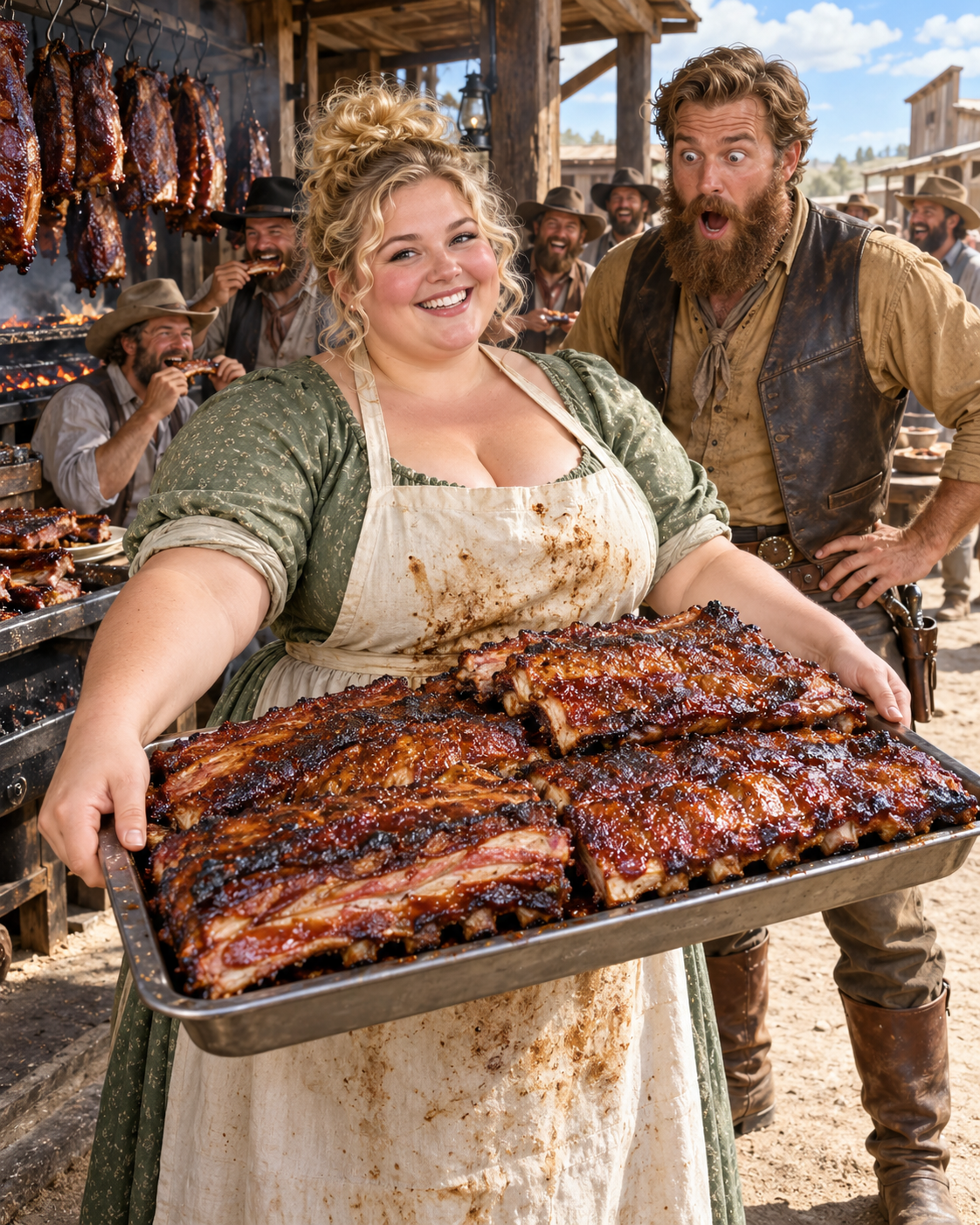
By noon, the abandoned smokehouse was alive with movement for the first time in eight months.
Samuel Briggs organized the carpenters while two younger workers hauled scrap iron from the machine shed.
Others cleaned the stone floors, repaired broken doors, and cleared years of accumulated soot from the ventilation shafts.
Lenora moved among them with her father’s ledger open beneath one arm.
She assigned tasks according to each man’s experience, calculated the materials they already possessed, and refused to spend a dollar they could not afford.
The smokehouse had once been the pride of the Mercer property.
Built from thick timber and fieldstone, it contained four curing chambers and enough storage space to supply merchants throughout southern Montana.
But its heart had been removed.
The original ventilation regulator, a heavy iron mechanism essential to controlling smoke and temperature, had disappeared along with several brass fittings.
Without it, the building could not safely produce meat for commercial sale.
Samuel knelt beside the damaged equipment.
“Even if we repair everything else, we can’t make this work without a regulator.”
Lenora studied the drawings in her father’s ledger.
Her father had faced a similar problem during a harsh winter when a replacement machine failed to arrive from Chicago.
Instead of shutting down production, he had designed a simpler system using adjustable iron dampers and carefully positioned thermometers.
It required patience and constant attention, but it had kept the family business operating.
She placed the drawing beside Samuel.
“Could you build something like this?”
The old ranch hand studied the page for nearly a minute.
Then he looked at the blacksmith standing behind him.
“Give me the forge, two wagon axles, and every usable iron plate on this property.”
The blacksmith grinned.
“Now you’re talking.”
For the first time in months, laughter echoed through the Mercer ranch.
But beyond the smokehouse walls, another danger was approaching.
That afternoon, Lenora found Kalen in the ranch office, examining an old payroll book.
He had been searching through Walter Hensley’s records.
Something had begun to trouble him.
During the months before the smokehouse closed, several shipments of cattle and cured meat had been recorded as losses.
Yet the corresponding transportation receipts were missing.
Kalen spread the accounts across the desk.
“Hensley told me those shipments spoiled on the road.”
Lenora compared the entries with the dates in her father’s ledger.
“How many shipments?”
“Seven.”
“And you never saw the damaged goods?”
Kalen shook his head.
“He handled the buyers. I trusted him.”
Lenora followed the columns with one finger.
The recorded losses were substantial, but the pattern was too consistent.
Every shipment had supposedly failed shortly before a major payment came due.
Someone had drained the ranch of income, then used the resulting desperation to force Kalen into borrowing money.
Money supplied by Gideon Thorne.
“Your ranch may not have failed because of bad business,” Lenora said.
Kalen looked at her.
“Then why?”
“Because someone wanted it to fail.”
That evening, Samuel arrived at the ranch house carrying a small iron box.
He had discovered it hidden behind loose stones beneath the old smokehouse furnace.
Inside were several freight receipts, a broken brass pocket-watch chain, and a folded letter.
The handwriting belonged to Walter Hensley.
But the letter was addressed to Gideon Thorne.
Lenora unfolded it carefully.
The message was short, yet its meaning was unmistakable.
Hensley had reported that the smokehouse equipment had been removed, the production records altered, and the workforce brought close to rebellion.
He also confirmed that Kalen would soon have no choice but to accept Thorne’s loan.
At the bottom of the page appeared a request for the remaining payment promised in exchange for Hensley’s cooperation.
Kalen read the letter twice.
His hands began to tremble.
“That man ate at my table,” he whispered. “I trusted him with my father’s ranch.”
Lenora gently took the paper.
“Then we’ll make sure his betrayal doesn’t finish what he started.”
They needed someone who could challenge the document Thorne had delivered.
But the nearest courthouse was miles away, and seventy-two hours would vanish quickly.
Samuel suggested contacting Sheriff Elias Boone in the nearby town.
Kalen hesitated.
“Thorne has friends everywhere.”
“Then we find someone who values the law more than his friendships,” Lenora answered.
Before dawn the following morning, she rode into town with Samuel.
The October wind cut through her coat as their horses followed the narrow trail across the prairie.
By sunrise, they reached a settlement of wooden storefronts, hitching posts, and dusty streets where farmers gathered around the general store.
Sheriff Boone occupied a modest office beside the telegraph station.
He was a broad-shouldered man with silver hair and the measured manner of someone who preferred evidence to excitement.
He examined Hensley’s letter, the mortgage agreement, and the recently signed notice.
When Lenora finished explaining, the sheriff remained silent.
Then he pointed to the document.
“This signature doesn’t transfer ownership by itself. And a former foreman doesn’t gain legal authority simply because his name appears on a piece of paper.”
“Can you stop Thorne?” Lenora asked.
“I can investigate suspected fraud and speak to the county clerk. But challenging a foreclosure requires proper legal action.”
“How much time will that take?”
“More than three days, unless we find evidence that Thorne knowingly falsified these papers.”
Samuel leaned forward.
“We already have the letter.”
Boone shook his head.
“It proves Hensley was involved in something dishonest. But Thorne could claim the letter is a forgery.”
Lenora understood immediately.
They needed the man himself.
“Has anyone seen Walter Hensley recently?”
The sheriff paused.
Then he opened a drawer and removed a small notebook.
“A man matching his description bought supplies near the old silver mine north of town last week.”
Lenora exchanged a glance with Samuel.
The abandoned mine sat on land controlled by Gideon Thorne.
Before leaving, she stepped into the telegraph office.
She wrote a message to Thomas Bell, a wholesale merchant in Billings whose name appeared several times in her father’s ledger.
She explained who she was, described the smokehouse, and asked whether he would consider purchasing a limited shipment of properly cured beef.
Then she added one personal sentence.
“My father always said a good reputation was the only inheritance no creditor could seize.”
She paid for the message with the last silver coins in her purse.
By the time they returned to the ranch, dark clouds had gathered above the mountains.
The repaired smokehouse was nearly ready.
Samuel’s makeshift ventilation system had been installed, and the workers were testing the airflow while the blacksmith monitored the temperature.
Lenora inspected every chamber carefully.
They could not afford spoiled meat, but more importantly, they could not risk selling anything unsafe.
The first production run would require proper curing and temperature control, and the established recipes could not be hurried merely because a creditor had imposed a deadline.
She therefore selected a smaller batch of meat that could be safely prepared using the available equipment and suitable methods, while setting aside products requiring longer curing periods.
The men worked through the afternoon, cutting, seasoning, preparing, and carefully documenting each stage.
Kalen watched as the workers followed Lenora’s instructions.
Only two days earlier, the same men had been discussing whether to abandon the property.
Now they were working with a determination he had not seen in nearly a year.
“How did you convince them?” he asked.
Lenora looked across the room.
“I didn’t promise them everything would be fine. I showed them what we could do, and I told them the truth.”
Kalen considered those words.
His father had always taught him that a rancher must appear strong, even when circumstances seemed hopeless.
Perhaps that lesson had made him confuse leadership with silence.
He had hidden the debts because he was ashamed.
He had avoided the payroll because he feared the numbers.
And he had allowed his workers to lose confidence because he never explained what they were fighting for.
That evening, he gathered all twenty-two men beneath the smokehouse roof.
“I owe every one of you an apology,” he said.
The workers stopped what they were doing.
“I should have told you how bad things were. I thought carrying the burden alone would protect you, but it only made everything worse.”
He swallowed.
“If we save this place, your unpaid wages will be our first priority. Before improvements, before new cattle, and before a single luxury for me.”
Samuel stepped forward.
“We stayed because we believed in this land, Kalen. We just needed to know you still believed in us.”
Kalen looked toward Lenora.
“I do now.”
The following morning brought a new problem.
A violent storm swept across the Montana prairie, driving heavy rain against the ranch buildings.
Lightning flashed over the distant hills as thunder rolled through the valley.
Inside the smokehouse, the workers struggled to maintain a steady temperature.
A sudden gust tore loose part of the old chimney covering, allowing rainwater to enter the upper ventilation shaft.
Samuel climbed onto the roof with two men while Kalen secured a ladder against the building.
Lenora monitored the temperature gauges below.
The fire could not be allowed to burn unpredictably, and the food-processing area had to remain protected from smoke contamination and rain.
Then a sharp crack echoed overhead.
One of the timber supports gave way.
Samuel lost his footing.
Kalen lunged forward and caught the old man’s arm just as he began sliding down the wet roof.
For a terrible moment, both men hung dangerously close to the edge.
The workers rushed toward the ladder.
Lenora shouted instructions, directing them to secure a rope around the strongest roof beam.
Together they hauled the men to safety.
Samuel reached the ground shaking but unharmed.
Kalen, however, had cut his hand badly against a broken iron bracket.
Blood darkened his sleeve.
Lenora hurried him into the ranch house and cleaned the wound.
He sat quietly while she bandaged his palm.
“You should never have climbed up there,” she murmured.
“And let Samuel fall?”
“You could have been killed.”
Kalen looked into her eyes.
“Would that have mattered to you?”
Lenora stopped wrapping the bandage.
Until that moment, their marriage had existed mostly as an agreement between two desperate strangers.
They had shared responsibilities, worries, and hurried meals, but neither had dared speak about the feelings slowly growing between them.
“More than you know,” she whispered.
Kalen reached for her hand.
But before he could say another word, someone knocked urgently at the door.
It was Sheriff Boone.
And he had brought a prisoner.
Walter Hensley stood on the porch in handcuffs, his face pale beneath a rain-soaked hat.
The sheriff had found him hiding in a cabin near the abandoned mine.
At first, Hensley refused to speak.
But when Boone confronted him with the letter from the smokehouse, the former foreman’s confidence crumbled.
He admitted that Gideon Thorne had promised him a substantial payment for weakening the Mercer business.
He had arranged the disappearance of equipment, altered shipment records, and redirected some of the ranch’s merchandise through a freight agent.
But the scheme had grown more dangerous than he expected.
Thorne had pressured him into signing additional documents, including the false notice of accelerated foreclosure.
“I wanted money,” Hensley said bitterly. “I never agreed to help him destroy a whole family.”
Kalen stared at the man he had once considered a friend.
“You destroyed more than a family. Twenty-two men went hungry because of you.”
Hensley lowered his head.
Sheriff Boone explained that Hensley’s statements would need formal documentation and independent verification.
But the testimony, combined with the original records, gave them a strong basis to challenge Thorne’s actions.
For the first time, the Mercer ranch had a chance to fight in court.
Yet Thorne still held the original mortgage.
And its legitimate debt remained unpaid.
The following afternoon, a telegram arrived from Billings.
Thomas Bell remembered Lenora’s father.
He remembered the quality of his cured meat, his careful bookkeeping, and the time he had delivered an important order despite a blizzard closing the main roads.
Bell was willing to consider a purchase.
But he required an inspection, a reliable delivery schedule, and proof that the smokehouse could maintain consistent production.
He could arrive within two days.
Lenora read the telegram aloud.
The workers cheered.
Then Kalen pointed out the obvious problem.
Thorne’s deadline would arrive before Bell could complete his inspection.
They still needed enough time to turn their progress into a genuine business.
Lenora returned to the mortgage documents.
This time, she examined the pages not as a desperate wife but as the daughter of a man who had spent his life negotiating contracts.
She found a provision requiring written notice and a reasonable opportunity to address certain operational defaults before foreclosure could proceed.
The original agreement also distinguished financial default from the shutdown of the ranch’s processing facilities.
Thorne’s revised notice had attempted to combine them.
And the supposed authorization bore Hensley’s fraudulent signature.
Lenora carried the documents to Sheriff Boone.
He immediately contacted the county clerk and arranged for the evidence to be presented to a judge.
The next morning, Kalen and Lenora traveled to the county courthouse.
Thorne was already waiting.
He wore a dark tailored suit and appeared perfectly calm.
When he saw Lenora, he smiled.
“Still playing businesswoman, Mrs. Mercer?”
She met his gaze without hesitation.
“Still trying to take something that doesn’t belong to you, Mr. Thorne?”
His smile vanished.
Inside the courtroom, the matter unfolded with a tension that made every whispered conversation feel unusually loud.
Thorne’s attorney argued that the ranch had failed to satisfy its financial obligations and that the lender possessed the right to enforce the agreement.
Kalen’s attorney acknowledged the legitimate debt but challenged the shortened deadline and the authenticity of the revised notice.
Then Sheriff Boone submitted the evidence collected from Walter Hensley.
The freight receipts revealed diverted merchandise.
The hidden letter demonstrated deliberate interference with the smokehouse.
And Hensley’s sworn statement connected the sabotage directly to Thorne’s efforts to acquire the property.
Thorne’s attorney objected, questioning the former foreman’s credibility.
The judge listened carefully.
He did not declare every allegation proven, nor did he erase the debt simply because the lender’s conduct was suspicious.
Instead, he found sufficient grounds to prevent the disputed accelerated foreclosure from proceeding until the authenticity of the notice and the alleged misconduct could be properly examined.
The original debt still existed.
But Gideon Thorne would not be allowed to seize the ranch under the challenged seventy-two-hour deadline.
The order gave Kalen and Lenora the breathing room they desperately needed.
As they stepped outside the courthouse, Thorne approached them.
His expression had changed.
The effortless confidence was gone, replaced by cold anger.
“You think you’ve won?” he asked.
Lenora held her father’s ledger against her chest.
“No. I think we’ve finally been given the chance to fight fairly.”
Thorne leaned closer.
“The ranch still owes money. And no judge can turn worthless cattle into gold.”
Kalen stepped beside his wife.
“Then it’s fortunate we never planned to sell gold.”
Thorne walked away without another word.
That evening, the Mercer ranch welcomed Thomas Bell.
He arrived in a sturdy freight wagon accompanied by an assistant who carried inspection instruments, order books, and enough skepticism to discourage anyone offering a careless promise.
Bell was older than Lenora remembered.
His beard had turned silver, and his shoulders had grown narrow, but his eyes brightened when she introduced herself.
“Whitfield,” he repeated softly. “Your father was one of the finest men I ever traded with.”
Lenora struggled to maintain her composure.
“He taught me everything I know.”
Bell shook his head.
“He taught you where to begin. What you’ve done here is your own work.”
He spent the next day examining the smokehouse, checking records, reviewing the preparation methods, and inspecting the first carefully controlled batches.
He rejected some products that failed his standards.
Lenora accepted his decisions without argument.
Her father had taught her that protecting customers mattered more than recovering a loss.
But other products met the required quality.
The meat was properly prepared, consistently handled, and accompanied by records detailed enough to satisfy the merchant’s expectations.
Bell tasted a sample from an approved batch.
Then he closed his eyes.
For several seconds, nobody spoke.
Finally, he opened his order book.
“I can work with this.”
Samuel gripped the edge of the table.
Kalen looked at Lenora.
She barely dared breathe.
Bell offered a modest initial purchase, with the possibility of larger orders after successful deliveries and continued quality checks.
He also agreed to provide a limited advance against the confirmed order.
It was not enough to eliminate every debt.
But it would help cover immediate operating costs and begin paying the men who had remained loyal.
Lenora examined the numbers carefully.
Then she accepted.
When Bell signed the purchase agreement, Samuel removed his hat and wiped his eyes.
The workers did not celebrate wildly.
Most were too exhausted for that.
Instead, they stood quietly beneath the smokehouse beams, understanding that something important had changed.
They were no longer working merely to delay failure.
They were building a business again.
The weeks that followed demanded more discipline than any of them had imagined.
Lenora established detailed production schedules and transparent financial records.
Kalen renegotiated supply arrangements and reduced unnecessary expenses.
Samuel supervised repairs while younger workers learned the curing techniques recorded in her father’s ledger.
Every shipment was documented.
Every wage payment was entered into the books.
And no major agreement was signed without careful review.
The ranch began selling selected products to merchants in Billings and nearby communities.
Word traveled slowly at first.
Then customers began asking specifically for Mercer smoked beef.
The flavor was consistent, the quality dependable, and the business developed a reputation for keeping its promises.
By the first heavy snowfall, the smokehouse was operating on a regular schedule.
The ranch still faced obligations, but its income had improved, and its workers were receiving wages again.
Meanwhile, Sheriff Boone continued investigating Gideon Thorne’s activities.
Freight records and testimony revealed that the Mercer ranch was not the only struggling property he had attempted to acquire through questionable arrangements.
Several neighboring ranchers came forward with accounts of misleading contracts and suspicious financial pressure.
The investigation eventually led to formal proceedings against Thorne and his associates.
He fought the allegations through his attorneys, but the documentary evidence became increasingly difficult to explain.
Walter Hensley cooperated with investigators, hoping his testimony would be considered when his own punishment was determined.
His cooperation did not erase what he had done.
And Kalen never offered him forgiveness simply because he had finally told the truth.
One afternoon, months later, a letter arrived from the county attorney.
The disputed foreclosure effort had been abandoned, and the fraudulent documents could no longer be used against the Mercer property.
Thorne’s other alleged misconduct remained subject to the courts.
Kalen read the letter beside the kitchen window.
Outside, snow covered the pasture fences, and smoke rose steadily from the restored processing building.
Lenora stood at the stove preparing supper.
He folded the paper and placed it beside her.
“We’re keeping the ranch.”
She turned toward him.
“Of course we are.”
Kalen laughed softly.
“You say that as though you never doubted it.”
Lenora looked down at her hands.
“I doubted it every day.”
He stared at her.
“Then why didn’t you ever say so?”
“Because doubt isn’t the same as surrender.”
Kalen crossed the kitchen and gently took her hands.
For months, he had watched this woman transform an abandoned smokehouse into a thriving enterprise, restore dignity to exhausted workers, and confront a powerful man who had expected her to remain silent.
But what moved him most was not her cleverness.
It was the way she refused to measure people by their failures.
When she arrived, he had been ashamed of everything he had lost.
She had never pretended those losses were unimportant.
Instead, she had shown him that failure did not have to become a permanent identity.
“I thought I was asking a stranger to marry a ruined man,” he said.
Lenora smiled.
“And I thought I was marrying a rancher because I had nowhere else to go.”
“What do you think now?”
She glanced toward the window.
Beyond the falling snow, twenty-two men worked together with a renewed sense of purpose.
The smokehouse chimney released a gentle stream of smoke into the winter air.
Inside the old ledger, her father’s handwriting still filled the yellowed pages.
Yet beside those fading notes were new records written in her own hand.
New recipes.
New customers.
New plans.
A future that had not existed when she stepped off the stagecoach.
“I think,” she answered, “we were both looking for a place to belong.”
Kalen kissed her forehead.
“You’ve given me more than a place to belong.”
“And you’ve given me something I thought I’d lost forever.”
“What?”
“A family.”
That winter, the Mercer ranch held its first proper Christmas gathering in years.
The long dining table was crowded with roasted vegetables, warm bread, smoked beef, and pies prepared by the workers’ families.
Children raced through the hallways while their parents laughed over stories of the terrible storm that had nearly destroyed the chimney.
Samuel stood to offer a toast.
He looked toward Kalen, then toward Lenora.
“I’ve worked this ranch for thirty-two years,” he began. “I’ve seen good seasons and bad ones. I’ve watched strong men lose heart and frightened men find courage.”
He raised his glass.
“But I’ve never seen a place saved by one person alone.”
The room grew quiet.
“Mrs. Mercer reminded us that we still had something worth building. Mr. Mercer reminded us that a man can admit his mistakes and still lead with honor. And every soul in this room helped turn that reminder into something real.”
The workers lifted their glasses.
Lenora blinked back tears.
Later that evening, after the celebration ended, she walked alone to the smokehouse.
Snow crunched beneath her boots.
The restored building stood warm and sturdy against the Montana night.
She stepped inside and opened her father’s ledger one final time.
On the last page, beneath his careful handwriting, she found a sentence she had read many times without fully understanding.
“A business is built with hands, but it survives through trust.”
She traced the faded words with her fingertips.
Her father had not left her money.
He had not left her land.
And he had not been able to protect her from grief.
But he had given her the knowledge to create something when everything seemed lost.
Lenora took a pencil and wrote beneath his final sentence.
“Trust must be protected by honesty, courage, and the willingness to begin again.”
Then she closed the book.
Years later, travelers passing through southern Montana would know the Mercer ranch for its prosperous cattle operation and the unmistakable aroma rising from its famous smokehouse.
Some would remember the legal battle against Gideon Thorne.
Others would speak of the mysterious disappearance of Walter Hensley or the winter when twenty-two unpaid workers somehow became partners in rebuilding a failing enterprise.
But the people who had lived through those difficult days remembered something simpler.
They remembered a young woman arriving with one suitcase and an eleven-word advertisement.
A woman who had lost nearly everything.
A woman who had every reason to turn away when she discovered that her promised new beginning was buried beneath debt, disappointment, and betrayal.
Instead, she had opened an old leather ledger and asked what could still be saved.
The ranch eventually paid off its remaining obligations, and Kalen made certain that every worker received what he had once been owed.
With growing profits, he and Lenora established a reserve fund to protect employees during difficult seasons.
They also created opportunities for workers’ children to learn practical trades and bookkeeping, believing that knowledge should never belong only to those fortunate enough to inherit wealth.
Above the smokehouse entrance, Kalen placed a wooden sign bearing the name WHITFIELD–MERCER SMOKEHOUSE.
Lenora protested when she first saw it.
“This is your family’s ranch,” she told him.
Kalen shook his head.
“It was my family’s ranch. You helped make it our family’s future.”
And on quiet evenings, when the Montana sunset painted the distant mountains gold, they would sit together on the front porch and watch the smoke curl above the trees.
They sometimes spoke of the terrible days when foreclosure seemed inevitable.
They remembered the men who stayed, the hardships they overcame, and the friendships that endured.
But they never forgot the most important truth their struggle had taught them.
A person can lose money, property, reputation, and even the life they once imagined.
Those losses are real, and no amount of courage makes them painless.
Yet as long as knowledge, integrity, and the willingness to work with others remain, a different future may still be possible.
Lenora had answered an eleven-word advertisement because she believed she needed someone to rescue her from a broken life.
What she discovered beneath the wide Montana sky was something far greater.
She did not need a rescuer.
She needed an opportunity to use the strength she already possessed.
And Kalen, who had once believed that asking for help meant admitting defeat, learned that the greatest strength of a leader was not carrying every burden alone.
It was giving others a reason to stand beside him.
Their story was never truly about a desperate marriage, a wealthy land speculator, or even an abandoned smokehouse.
It was about the extraordinary things ordinary people can accomplish when they refuse to let fear make their decisions.
Because sometimes the future does not arrive as a beautiful promise.
Sometimes it arrives as a neglected ranch, twenty-two unpaid workers, a mountain of debt, and a stranger waiting at the end of a dusty road.
And sometimes, the smallest thing we carry from our past becomes the very thing that helps us build a future worth fighting for.
THE END.