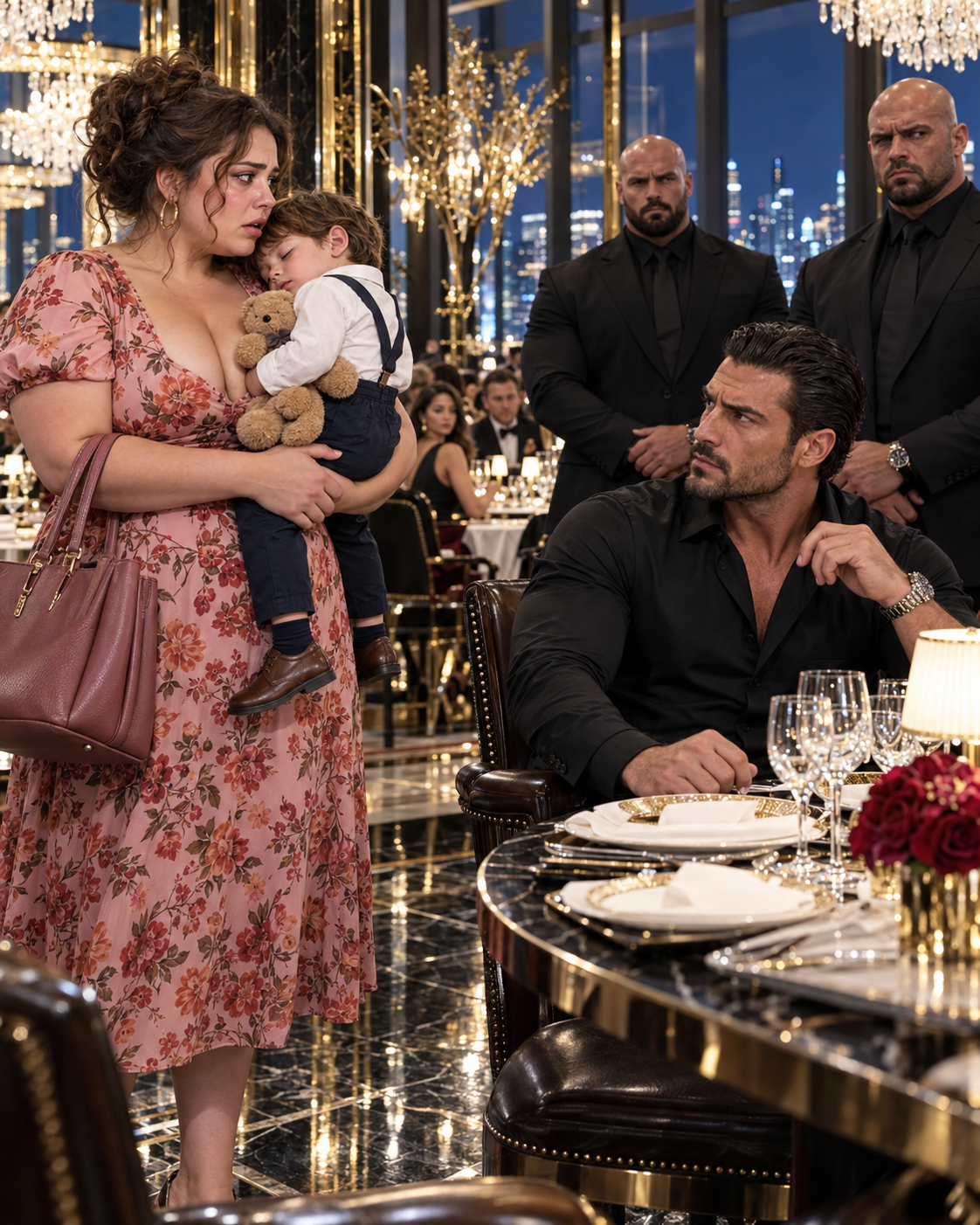
She Arrived 27 Minutes Late, Barefoot, and Carrying a Sleeping Child. The Chicago Millionaire Was Ready to Walk Away—Until One Unexpected Moment Changed Everything…
Adrien Russo stared at the faded photograph in his hand, feeling the warmth of the Chicago restaurant disappear around him.
For a moment, the conversations, clinking glasses, and distant jazz music seemed to fade into complete silence.
Standing beside an elderly woman in the photograph was a man Adrien recognized immediately.
His grandfather, Vincent Russo.
But that was impossible.
Vincent had died nearly fifteen years earlier, leaving behind a fortune, an investment empire, and a collection of unanswered questions that Adrien had learned never to ask.
Yet there he was, smiling beneath the summer sunshine, his arm resting affectionately around a woman Adrien had never seen before.
“Maya,” Adrien said slowly, “who is this woman?”
Maya looked down at the photograph, and the color drained from her face.
“My grandmother,” she whispered. “Eleanor Bennett.”
Adrien turned the photograph over.
Written in faded blue ink were four words.
Chicago, August 1989. Forever grateful.
His fingers tightened around the edges.
“Where did you get this?”
Maya reached for the photograph, suddenly uncomfortable with his intensity.
“It belonged to my grandmother. She passed away three years ago.”
“And the man standing beside her?”
Maya hesitated.
“His name was Vincent. She never told me much about him.”
Adrien slowly lowered himself into his chair.
“That man was my grandfather.”
For several seconds, neither spoke.
Then Leo, completely unaware that something extraordinary had just happened, reached for another dinner roll.
“So,” he announced, “does this mean we’re cousins?”
Maya nearly choked on her water.
Adrien surprised himself by laughing.
“No, buddy. I don’t think that’s what it means.”
“Good,” Leo replied. “Because Aunt Maya said cousins can’t marry each other, and I think you should marry her.”
“LEO!”
Maya covered her face with both hands.
Adrien laughed harder than he had in years.
And just like that, the tension broke.
But the mystery didn’t disappear.
It settled quietly between them, waiting.
By the time dinner ended, snow had begun drifting across the sidewalks outside.
Adrien insisted on driving Maya and Leo home.
She refused three times.
He offered four.
Eventually, Leo settled the argument.
“Aunt Maya, my feet are tired, and I’m wearing shoes. You aren’t.”
Maya sighed.
“Traitor.”
Twenty minutes later, Adrien’s black Mercedes pulled up outside a modest brick apartment building on Chicago’s North Side.
The neighborhood was nothing like his luxurious Gold Coast surroundings.
Small businesses lined the street, colorful murals decorated nearby walls, and warm yellow light spilled from apartment windows.
Maya unbuckled Leo and lifted him carefully into her arms.
Before she could close the car door, Adrien spoke.
“Would you have dinner with me again?”
She froze.
“Without the barefoot entrance?”
“Preferably.”
“And without Leo?”
Adrien glanced at the little boy sleeping against her shoulder.
“Actually, I’d like him to come.”
Something softened in Maya’s expression.
Most men saw Leo as an inconvenience.
Adrien had treated him like the most interesting person in the room.
“That,” she whispered, “might be the nicest thing anyone has said to me in a very long time.”
Then she smiled.
“Saturday. Six o’clock. And this time, I’m choosing the restaurant.”
Adrien nodded.
“Deal.”
He watched her disappear into the building.
For the first time in years, he drove home without thinking about business.
Instead, he thought about a barefoot woman, a curious little boy, and a photograph that shouldn’t have existed.
And somewhere beneath those thoughts, something unfamiliar began to grow.
Hope.
Saturday arrived with biting winter winds and snow piled along the sidewalks.
Adrien expected Maya to choose somewhere elegant.
Instead, she sent him the address of a tiny neighborhood diner near Lincoln Square.
When he walked inside wearing a tailored charcoal coat and polished leather shoes, three customers turned to stare.
Maya was sitting in a booth beside the window.
Leo waved enthusiastically.
“MR. GRUMPY!”
Every head in the diner turned.
Adrien stopped.
Maya buried her face in her hands.
Then Adrien did something no one in his corporate office would have believed.
He waved back.
“Hello, Mr. Trouble.”
Leo squealed with delight.
Dinner was simple.
Cheeseburgers, fries, milkshakes, and stories that somehow lasted nearly three hours.
Maya told Adrien about losing her parents when she was young and being raised by her grandmother.
She explained how Leo had come into her care after her younger sister, Claire, died in a car accident eighteen months earlier.
Leo’s father had left before the boy was born.
There had been no inheritance, no insurance fortune, and no miraculous financial rescue.
Only Maya.
A struggling salon.
A stack of bills.
And a little boy who sometimes woke up crying because he couldn’t remember exactly how his mother’s voice sounded.
Adrien listened without interrupting.
“I’m sorry,” he said finally.
Maya looked down at her hands.
“People say that a lot.”
“I know.”
“But they usually follow it with advice.”
“Then I won’t.”
She looked up.
“Really?”
“Really.”
Maya studied him for a long moment.
“You’re different from what people say.”
Adrien raised an eyebrow.
“And what do people say?”
“That you have ice water in your veins.”
“Unfortunate rumor.”
“That you’re terrifying.”
“Understandable.”
“That you once fired a man for bringing you the wrong coffee.”
Adrien frowned.
“He was stealing company funds. The coffee was unrelated.”
Maya burst into laughter.
Adrien smiled.
He was beginning to understand that making her laugh felt more satisfying than closing any deal.
Over the following weeks, Saturday dinners became a tradition.
Sometimes they ate at little restaurants around Chicago.
Sometimes Maya cooked spaghetti in her tiny apartment while Adrien helped Leo build complicated structures from colorful plastic bricks.
Once, Adrien took them ice-skating at Maggie Daley Park.
He fell twice.
Leo fell eleven times.
Maya laughed so hard she could barely stand.
Adrien had never been particularly good at falling.
But he discovered that getting back up was much easier when two people were laughing beside him.
One evening, Maya invited him to visit her salon.
Bennett & Bloom occupied a narrow storefront on a busy neighborhood street.
The sign above the door was faded, the chairs were mismatched, and one ceiling light flickered whenever someone turned on the hair dryers.
But the place was alive.
Women chatted over coffee.
A teenager showed off her new haircut.
An elderly customer hugged Maya before leaving.
Everyone knew everyone.
Adrien watched Maya move effortlessly between appointments, answering calls, sweeping hair, and helping a nervous young employee correct a mistake.
She was exhausted.
He could see it.
But she never let her customers feel rushed.
When the last appointment ended, Adrien asked a question.
“Why don’t you hire another stylist?”
Maya gave him a tired smile.
“Because good employees expect to be paid.”
“I could help.”
Her expression changed immediately.
“No.”
“Maya—”
“I appreciate it, Adrien. But I didn’t build this business so someone could rescue it.”
He studied her carefully.
“I wasn’t suggesting you needed rescuing.”
“Then what were you suggesting?”
“That you deserve someone willing to stand beside you.”
For a moment, she looked as though she might cry.
Instead, she turned away and began folding clean towels.
Adrien understood.
Maya had spent so long surviving alone that even kindness could feel dangerous.
He decided not to force his way into her life.
He would simply continue showing up.
And so he did.
He brought Leo to the playground when Maya worked late.
He learned how to make pancakes shaped like dinosaurs.
He sat through a school performance in which Leo played a tree and delivered his single line with tremendous confidence.
And every evening he returned to his silent penthouse, he found himself wishing there were three plates on the dinner table instead of one.
Then, one rainy Thursday afternoon, the past finally came looking for him.
Adrien was reviewing financial reports in his downtown office when his longtime assistant, Margaret, knocked on the door.
“Mr. Russo, I found something you asked me to investigate.”
She placed a thick folder on his desk.
Inside were property records, old photographs, and a yellowed newspaper clipping.
Adrien immediately recognized the name.
Eleanor Bennett.
The newspaper article described a devastating fire that had destroyed a small beauty salon on Chicago’s South Side in 1990.
The owner, Eleanor Bennett, had nearly lost everything.
But an anonymous businessman had paid for the repairs, covered the employees’ wages, and helped the salon reopen.
Adrien stared at the photograph accompanying the article.
His grandfather stood beside Eleanor, both smiling in front of the rebuilt storefront.
Margaret cleared her throat.
“There’s more.”
She handed him an old letter found among archived family documents.
It was addressed to Vincent Russo.
The handwriting was elegant but unmistakably emotional.
Dear Vincent,
You have given me something I thought I would never have again: a chance to begin.
I know you keep insisting that what you did was nothing, but you are wrong.
You saved the livelihood of six women and reminded me that kindness still exists in this city.
One day, I hope someone from my family can return that kindness to yours.
With gratitude,
Eleanor.
Adrien sat back slowly.
He remembered his grandfather as a stern man who rarely discussed his emotions.
Vincent had taught him discipline, responsibility, and the importance of keeping promises.
But he had never mentioned Eleanor Bennett.
Why?
Margaret placed one final document on the desk.
“Your grandfather established a small charitable fund before his death. It was never publicized.”
Adrien scanned the page.
The fund had supported struggling small businesses across Chicago for nearly two decades.
Its name stopped him cold.
The Second Chance Foundation.
He looked up.
“Why didn’t I know about this?”
“Your father handled the estate, sir. Some of the foundation’s records were kept separately.”
Adrien rubbed his forehead.
“And the fund?”
Margaret hesitated.
“It was dissolved five years ago.”
“By whom?”
“Your father.”
Adrien’s jaw tightened.
His father, Richard Russo, had spent his entire life believing generosity was a weakness.
He had taught Adrien that business existed to produce results, not emotions.
And now Adrien was discovering that his grandfather had lived by a very different philosophy.
That evening, he drove to Maya’s apartment carrying the letter.
When she finished reading it, tears slid silently down her cheeks.
“My grandmother used to say someone had once given her the courage to start over,” Maya whispered.
“She never told you who?”
“No. She always said the man’s name mattered less than what he did.”
Adrien smiled sadly.
“That sounds like my grandfather.”
Maya touched the photograph.
“Maybe they wanted us to understand something.”
“What?”
“That kindness doesn’t disappear just because people do.”
Adrien reached across the table and took her hand.
This time, she didn’t pull away.
By spring, their friendship had become something neither could pretend was ordinary.
Adrien knew how Maya took her coffee.
Maya knew he couldn’t sleep when thunderstorms rolled across Lake Michigan.
Leo knew that Adrien kept emergency chocolate-chip cookies in the glove compartment.
They had become a strange little team.
And one Sunday afternoon, after a long walk along the lakefront, Maya finally asked the question that had been resting between them for weeks.
“Adrien, what exactly are we doing?”
He stopped walking.
“What do you mean?”
“You know what I mean.”
Leo was running ahead, chasing pigeons along the path.
Maya folded her arms.
“You’re here all the time. You know my employees, my neighbors, and my nephew’s favorite cereal.”
Adrien waited.
“And every time I think about you leaving,” she continued, “I feel something I haven’t allowed myself to feel in years.”
“What?”
“Afraid.”
Adrien stepped closer.
“Maya, I’m afraid too.”
She looked surprised.
“Of what?”
“Of wanting something I don’t know how to protect.”
The wind lifted a loose strand of hair across her cheek.
Adrien gently tucked it behind her ear.
“I’ve built my entire life around making sure nothing could hurt me,” he said.
“And?”
“And somehow, you walked into a restaurant barefoot and ruined my whole system.”
Maya laughed through the tears gathering in her eyes.
“That sounds like me.”
Adrien smiled.
“I’m falling in love with you, Maya Bennett.”
Her breath caught.
“And I think,” he added, “I’ve already fallen in love with Leo.”
Maya closed her eyes.
She had imagined those words.
She had feared them.
And now that they were real, they felt almost too beautiful to trust.
“I love you too,” she whispered.
Adrien leaned forward and kissed her.
It was gentle.
Unhurried.
Nothing like the dramatic moments Maya had imagined when she was younger.
It felt like coming home.
From several feet away, Leo shouted, “FINALLY!”
Both adults burst into laughter.
For a while, life seemed almost impossibly good.
Then came the invitation.
Richard Russo requested that Adrien attend a private family dinner at his Gold Coast mansion.
He specifically asked Adrien to bring Maya.
Maya knew enough about Richard’s reputation to be nervous.
Adrien reassured her.
“He can be difficult, but he doesn’t control my decisions.”
She squeezed his hand.
“I know.”
The dinner began politely.
Richard’s house was enormous, filled with expensive artwork, marble floors, and furniture no one appeared comfortable sitting on.
Maya wore a simple navy dress.
Leo wore a little gray suit and announced that the house looked like a museum where people were afraid to touch anything.
Richard did not laugh.
During dinner, he questioned Maya about her salon, her education, and her financial circumstances.
Every question sounded polite.
Every answer felt like an examination.
Finally, Richard put down his wineglass.
“Adrien, may I speak with you privately?”
Adrien’s expression hardened.
“Whatever you need to say, you can say here.”
Richard glanced at Maya.
“Very well.”
He folded his napkin.
“I’ve recently learned that Miss Bennett’s salon is operating under considerable financial pressure.”
Maya stiffened.
“How would you know that?”
Richard ignored the question.
“Outstanding rent obligations. Equipment repairs. A pending lease renewal.”
Adrien turned toward him.
“Father.”
Richard continued.
“I’m simply concerned that certain relationships become complicated when one party possesses significant wealth.”
The room went silent.
Maya slowly set down her fork.
“Are you suggesting I’m with Adrien for his money?”
Richard gave a measured smile.
“I’m suggesting that people sometimes confuse opportunity with affection.”
Adrien stood.
“Enough.”
But Maya raised her hand.
“No, Adrien. Let me answer.”
She looked directly at Richard.
“Your son didn’t meet me wearing diamonds. He met me barefoot, carrying a sleeping child, after the worst day I’d had in months.”
Richard said nothing.
“He didn’t fall in love with my bank account, and I didn’t fall in love with his.”
Her voice remained steady.
“But I understand why someone who measures people by their money might struggle to believe that.”
Adrien looked at her with unmistakable pride.
Richard’s expression darkened.
“You may regret speaking to me that way.”
Maya rose from her chair.
“Perhaps. But I won’t regret respecting myself.”
She reached for Leo’s hand.
“We should go.”
Adrien immediately followed.
Outside, Maya fought to keep her composure.
“I warned you,” she whispered.
“About what?”
“That your world and mine don’t fit together.”
Adrien took her shoulders gently.
“My father is not my world.”
She looked at him.
“You and Leo are.”
Three days later, Maya received a letter from her landlord.
The building housing Bennett & Bloom had been sold.
Her lease would not be renewed.
She had sixty days to vacate.
Maya read the notice three times.
Then she sat on the salon floor and cried.
She had survived the death of her sister.
She had survived years of debt.
She had survived loneliness, exhaustion, and the constant fear that she wasn’t giving Leo enough.
But losing the salon felt like losing the last piece of her grandmother.
When Adrien arrived that evening, she handed him the letter without speaking.
He read it once.
His expression changed.
“Who bought the building?”
Maya shook her head.
“The letter doesn’t say.”
Adrien called his attorney.
Within an hour, they had an answer.
The property had been purchased through a limited liability company controlled by a Russo family investment subsidiary.
Adrien felt his stomach drop.
Richard.
He drove directly to his father’s office.
Richard was standing beside the windows, overlooking Chicago’s glittering skyline.
“Did you buy Maya’s building?” Adrien demanded.
Richard turned calmly.
“It’s a profitable investment.”
“Did you know her salon was there?”
“Of course.”
Adrien stared at him.
“You’re trying to destroy her business.”
“I’m trying to save you from a mistake.”
“By punishing a woman who has done nothing wrong?”
Richard sighed.
“You’re letting emotion cloud your judgment.”
“No,” Adrien replied. “For the first time in my life, I’m seeing clearly.”
Richard stepped closer.
“Don’t forget who built the empire you’re standing on.”
Adrien’s voice dropped.
“Grandfather built it.”
A flicker of irritation crossed Richard’s face.
“And I preserved it.”
“Did you preserve his foundation too?”
Richard went still.
Adrien placed Eleanor’s letter on the desk.
“Did you even know what he believed in?”
Richard looked at the paper.
For one brief moment, something uncertain passed across his face.
Then he pushed it aside.
“Your grandfather was sentimental.”
“He was generous.”
“He wasted money.”
“He changed lives.”
Richard shook his head.
“You sound just like him.”
Adrien met his father’s eyes.
“Then that’s the finest compliment you’ve ever given me.”
He walked out.
And for the first time, he didn’t look back.
Adrien could have bought the building himself.
He could have paid every debt Maya owed.
He could have made the entire problem disappear before breakfast.
But he knew Maya.
He knew that saving her business without her consent would cost him something far more valuable than money.
Her trust.
So instead, he brought her information.
Property records.
The lease agreement.
A list of legal options.
And a simple question.
“What do you want to do?”
Maya stared at him.
“You aren’t going to offer to buy everything?”
“I thought about it.”
“And?”
“And then I remembered you’re perfectly capable of deciding what happens to your own life.”
For a long moment, she said nothing.
Then she began to cry.
Adrien looked alarmed.
“Was that the wrong answer?”
She laughed through her tears.
“No. It was exactly the right one.”
Together, they met with a small-business attorney.
The attorney discovered something important.
Maya’s lease contained a renewal option that had been overlooked by the new owner.
If the original conditions had been satisfied, the landlord could not simply force her out.
There was one problem.
The deadline to exercise the option had passed six weeks earlier.
Maya felt her hope collapse.
Then one of her longtime customers, Mrs. Henderson, arrived at the salon carrying a cardboard box.
“I heard what happened,” the elderly woman said.
Inside were old appointment books, receipts, photographs, and business records Maya had given her for safekeeping during a renovation.
Among them was a certified-mail receipt.
Maya stared at it.
Six weeks earlier, she had mailed her lease renewal notice to the former landlord.
She had completely forgotten.
The landlord had never acknowledged it.
But the receipt proved she had sent it before the deadline.
Adrien looked at the attorney.
“Does this change anything?”
The attorney smiled.
“It changes everything.”
The dispute became a legal battle.
Richard’s investment company refused to acknowledge the renewal.
Maya’s attorney filed suit and sought an order preventing the eviction while the matter was resolved.
Local business owners rallied around her.
Customers wrote letters.
Neighbors shared stories about Eleanor Bennett and the salon that had served generations of Chicago families.
Even Adrien’s employees began quietly asking questions about the company’s involvement.
Then a local newspaper published the headline:
CHICAGO SALON OWNER FIGHTS TO SAVE FAMILY BUSINESS AFTER LANDLORD DISPUTE.
Maya hated the attention.
She didn’t want to become a symbol.
She wanted to cut hair, pay her employees, and pick Leo up from school.
But when a reporter asked whether she regretted standing up to one of Chicago’s wealthiest families, she answered simply.
“I don’t want anyone’s fortune. I just want the chance to keep what I’ve worked for.”
The story spread.
Richard was furious.
Adrien was proud.
And Leo, who understood only that Aunt Maya was fighting for their special place, drew a picture of the salon surrounded by enormous superheroes.
At the top, in uneven letters, he wrote:
AUNT MAYA NEVER GIVES UP.
She taped it beside the register.
The night before the court hearing, Maya stood alone inside the salon.
The mirrors reflected empty chairs.
Freshly washed towels sat neatly folded beneath the counter.
Outside, spring rain tapped against the windows.
Adrien entered quietly.
“Leo’s asleep,” he said. “Mrs. Henderson promised not to let him eat any more cookies.”
Maya smiled faintly.
Then her face crumpled.
“What if we lose?”
Adrien approached.
“Then we’ll find another way.”
“You don’t understand.”
“Help me understand.”
She gestured around the room.
“My grandmother built this place from nothing. My mother swept these floors when she was a teenager. I learned how to braid hair standing on a wooden stool in that corner.”
Her voice broke.
“When Claire died, I came here every morning because it was the only place that still felt normal.”
Adrien listened.
“And if I lose it,” she whispered, “I don’t know who I’ll be.”
He took her hands.
“You’ll still be the woman who raised a little boy through heartbreak.”
“You’ll still be the person who gives people confidence when they walk through that door.”
“And you’ll still be the woman who taught a man with everything that he was missing the most important things.”
Maya looked up.
“I don’t need you to win this battle for me,” she said.
“I know.”
“I just need you here.”
Adrien kissed her forehead.
“I’m not going anywhere.”
The hearing lasted nearly four hours.
Maya sat beside her attorney, holding the certified-mail receipt in trembling hands.
Richard’s representatives argued that the notice was insufficient and that the new owner was entitled to terminate the tenancy.
Maya’s attorney presented the lease, the mailing records, and additional evidence showing that the former landlord had received the renewal notice.
Then the judge asked a question that shifted the atmosphere in the courtroom.
“Why was the tenant’s properly submitted renewal notice not reflected in the purchaser’s records?”
The opposing attorney hesitated.
After a lengthy exchange, the judge announced that the evidence strongly supported Maya’s position and issued an order preventing her eviction while the remaining contractual issues were resolved.
Maya gripped the edge of the table.
She had not won everything yet.
But she could keep her doors open.
For now, that was enough.
Outside the courthouse, reporters gathered beneath the broad stone steps.
Maya refused to make an angry statement.
Instead, she said, “I’m grateful I have the chance to keep working and to keep serving the people who have supported my family for so long.”
Adrien stood beside her.
Not in front.
Not behind.
Beside her.
Richard watched the interview from his office.
For the first time, he appeared uncertain.
Two weeks later, Adrien received an unexpected telephone call.
His father had been admitted to Northwestern Memorial Hospital after experiencing chest pain.
The doctors determined that Richard had suffered a cardiac event requiring treatment and careful monitoring.
Adrien arrived that evening.
Richard looked smaller in the hospital bed.
The powerful businessman who once seemed capable of commanding entire rooms now lay beneath a thin white blanket.
For several minutes, neither spoke.
Then Richard broke the silence.
“I saw the interview.”
Adrien nodded.
“Maya did well.”
“She did.”
The admission surprised him.
Richard turned toward the window.
“I thought I was protecting you.”
“By hurting her?”
Richard closed his eyes.
“I spent my entire life believing that if I controlled everything, nothing could be taken from me.”
Adrien pulled up a chair.
“Did it work?”
Richard gave a bitter laugh.
“No.”
He stared at the ceiling.
“My father believed people mattered more than money. I thought that made him foolish.”
“And now?”
Richard was quiet for a long time.
“Now I’m lying in a hospital room with more money than I could spend in ten lifetimes, wondering why my son looks at me like a stranger.”
Adrien felt the weight of the words.
“I never wanted that,” he said.
“Neither did I.”
Richard swallowed.
“I had the company reject her renewal because I thought removing her from your life would be easy.”
Adrien looked down.
“It wasn’t your decision to make.”
“I know.”
Another silence settled between them.
Then Richard whispered, “I’m sorry.”
Adrien had waited most of his life to hear those words.
They didn’t erase everything.
But they opened a door.
Richard ordered his company to withdraw its opposition to Maya’s renewal, and the remaining dispute was resolved through a written agreement.
Maya secured the contractual lease term she was entitled to.
No special favor.
No secret donation.
No hidden arrangement that could be taken away later.
Just the chance she had earned.
When Adrien told her the news, she stood speechless behind the salon counter.
Then she threw her arms around him.
Leo, who had been coloring at a nearby table, jumped up.
“DID WE WIN?”
Maya laughed and cried at the same time.
“We get to stay, sweetheart.”
Leo raised both arms.
“THEN WE NEED PIZZA!”
Adrien nodded solemnly.
“An excellent business recommendation.”
That evening, they celebrated with pizza, paper plates, and sparkling lemonade.
Mrs. Henderson brought homemade cookies.
The stylists decorated the front window.
And Maya placed Eleanor’s old photograph beside Leo’s drawing.
For the first time in months, the salon felt peaceful.
But Adrien had one more surprise.
Not a check.
Not a luxury gift.
An envelope.
Inside was a copy of his grandfather’s letter and a document announcing the reopening of the Second Chance Foundation.
Adrien had decided to fund it with his own money, independently from the family investment company.
It would offer grants and practical support to struggling neighborhood businesses across Chicago.
Maya looked up.
“You did this?”
“I had help.”
“Why?”
Adrien glanced at Eleanor’s photograph.
“Because my grandfather understood something I forgot.”
“What?”
“That success means very little if it never makes anyone else’s life better.”
Maya smiled.
“He would have been proud of you.”
Adrien squeezed her hand.
“I hope so.”
Summer arrived in Chicago with bright skies, crowded lakefront parks, and warm evenings that seemed to last forever.
The salon was thriving.
Maya hired another stylist.
She replaced the flickering ceiling light.
And, after several careful months of saving, she installed a proper children’s corner where Leo could read and draw after school.
Adrien continued visiting.
Sometimes he brought lunch.
Sometimes he waited quietly with a book while Maya finished her appointments.
And sometimes he simply stood in the doorway, watching her work with an expression that made her employees exchange knowing smiles.
Leo had developed an especially important role in Adrien’s life.
He called him every Sunday to discuss dinosaurs, baseball, and the mysteries of adult behavior.
He also began introducing Adrien as “my almost-uncle.”
Adrien never corrected him.
One evening, the three of them attended a Cubs game at Wrigley Field.
Leo wore a baseball cap that was far too large for his head.
Maya cheered enthusiastically.
Adrien spent most of the game explaining the rules, although Leo was far more interested in the popcorn.
During the seventh-inning stretch, the little boy climbed onto Adrien’s lap.
“Can I tell you a secret?”
Adrien leaned closer.
“Of course.”
Leo looked toward Maya, who was speaking to a family seated beside them.
“Sometimes I forget what Mommy sounded like.”
Adrien felt his chest tighten.
Leo stared down at his small hands.
“And sometimes I feel bad when I’m happy because she’s not here.”
Adrien held him a little closer.
“Leo, being happy doesn’t mean you’ve forgotten your mom.”
“It doesn’t?”
“No. It means there’s still room in your heart for good things.”
Leo considered this.
“Do you think she would like you?”
Adrien’s throat tightened.
“I hope so.”
Leo nodded.
“I think she would. Because you make Aunt Maya smile again.”
Adrien closed his eyes briefly.
When he opened them, Leo was looking up at him.
“Can I call you something besides Mr. Grumpy?”
Adrien smiled.
“What would you like to call me?”
Leo hesitated.
“Maybe… Dad?”
The noise of the stadium seemed to disappear.
Adrien looked at the little boy whose life had become inseparable from his own.
He understood that the name was not a replacement for anyone.
It was a gift of trust.
“If that’s what you want,” he whispered, “I’d be honored.”
Leo wrapped his arms around Adrien’s neck.
And Adrien, a man who had once believed vulnerability was weakness, held him as though he were the most precious thing in the world.
That night, after Leo fell asleep, Adrien told Maya what had happened.
She stood beside the kitchen counter, one hand covering her mouth.
“He called you Dad?”
Adrien nodded.
“I told him he didn’t have to. I said he could choose whatever felt comfortable.”
Maya’s eyes filled with tears.
“He hasn’t called anyone that before.”
“I know.”
She stepped into his arms.
“Thank you for loving him.”
Adrien held her close.
“Thank you for letting me.”
For a long time, they stood together in the quiet apartment.
Outside, the sounds of Chicago drifted through the open window.
A distant siren.
Passing traffic.
Someone laughing on the sidewalk below.
Ordinary sounds from an ordinary summer evening.
But to Adrien, it felt extraordinary.
He had spent years living above the city in a penthouse filled with expensive furniture and magnificent views.
Yet here, in a modest apartment with children’s drawings on the refrigerator, he finally understood what home meant.
It wasn’t square footage.
It wasn’t a prestigious address.
It was the place where someone noticed when you were missing.
Three months later, Adrien brought Maya and Leo back to the restaurant where everything had begun.
The same elegant dining room.
The same glowing chandeliers.
The same view of downtown Chicago.
Maya paused at the entrance.
“Oh, no.”
Adrien looked amused.
“What?”
“Please tell me you aren’t planning to remind everyone that I arrived barefoot.”
“I would never.”
Leo grinned.
“He totally would.”
Their waiter led them to the very same table.
Maya glanced around with a smile.
“I can’t believe you were going to leave that night.”
Adrien took her hand.
“I can’t believe I almost did.”
Dinner unfolded with laughter, memories, and Leo’s extremely detailed explanation of his latest school project.
Then dessert arrived.
Three small chocolate cakes.
And beside Maya’s plate, a little velvet box.
She stared at it.
“Adrien…”
He stood.
For the first time in his life, the man who could address a room full of investors without a trace of nervousness found himself struggling to speak.
“I used to believe love was something that made people careless,” he began.
Maya’s eyes filled.
“I thought the safest way to live was to never need anyone.”
He opened the box.
Inside was a beautiful ring, simple and elegant.
“Then you walked into my life twenty-seven minutes late, carrying a sleeping little boy and wearing absolutely no shoes.”
Maya laughed through her tears.
“And somehow,” Adrien continued, “you gave me everything I never knew I was missing.”
He knelt beside her chair.
“Maya Bennett, will you marry me?”
Maya covered her mouth.
Leo leaned forward eagerly.
“AUNT MAYA, SAY YES!”
The nearby diners began smiling.
Adrien looked at Leo.
“I’m trying to make this romantic, buddy.”
“THEN HURRY!”
Maya burst into laughter.
Then she nodded.
“Yes.”
Adrien blinked.
“Yes?”
“Yes, Adrien Russo. I’ll marry you.”
He slipped the ring onto her finger and kissed her.
The restaurant erupted in applause.
Leo stood on his chair and shouted, “I KNEW IT!”
And somewhere in the middle of the laughter, Maya realized something extraordinary.
She was no longer afraid of happiness.
Their wedding took place the following spring in a beautiful garden overlooking Lake Michigan.
It wasn’t the enormous society event Richard had once imagined for his son.
It was small.
Warm.
Filled with people who truly mattered.
Maya’s salon employees attended.
Mrs. Henderson cried through the entire ceremony.
Margaret organized everything with the precision of a military commander.
And Richard Russo sat in the front row, quietly watching his son with an expression Adrien had rarely seen.
Pride.
When the time came for Maya to walk down the aisle, Leo appeared beside her in a little navy suit.
He held her hand tightly.
“Ready, Aunt Maya?”
She smiled.
“Ready, sweetheart.”
He straightened his tie.
“Don’t worry. I practiced.”
Maya laughed.
“Practiced what?”
“Giving you away without crying.”
Her eyes immediately filled.
“Oh, Leo.”
He hugged her waist.
“But I might cry a little.”
“So might I.”
Together, they walked toward Adrien.
When Leo reached him, he whispered something that made the groom’s expression soften.
“Take care of her, Dad.”
Adrien bent down.
“Always.”
Then he stood and took Maya’s hands.
Their vows weren’t elaborate.
They didn’t promise a life without arguments, worries, or difficult days.
They promised something more meaningful.
To choose each other.
To listen.
To remain kind when life became complicated.
To build a home where love was never measured by money, appearances, or perfection.
When Adrien kissed his bride, Leo cheered louder than anyone.
After the ceremony, Richard approached Maya.
For a moment, she stiffened.
Old memories did not disappear simply because time had passed.
Richard looked uncomfortable.
“I owe you an apology.”
Maya waited.
“I judged you without knowing you. Worse, I tried to use my position to hurt you.”
His voice trembled slightly.
“You didn’t deserve any of that.”
Maya studied him.
“No, I didn’t.”
Richard nodded.
“I know.”
A long silence followed.
Then Maya said gently, “I don’t want Leo growing up believing people can never change.”
Richard’s eyes glistened.
“Does that mean you’ll forgive me?”
“It means I’m willing to give you the opportunity to become someone he can be proud of.”
Richard swallowed.
Then he nodded.
“I’d like that.”
It wasn’t instant forgiveness.
It wasn’t a perfect ending to every wound.
But it was a beginning.
And sometimes, a beginning was enough.
Years later, the story of Adrien and Maya Russo became a favorite family memory.
Leo grew older, louder, and even more certain that his matchmaking abilities were exceptional.
Bennett & Bloom expanded into a second location, with Maya carefully mentoring young stylists who needed someone to believe in them.
The Second Chance Foundation helped dozens of Chicago families protect the businesses they had worked so hard to build.
Richard gradually became a familiar presence at Sunday dinners.
He still struggled with jokes.
Leo still called him Grandpa Serious.
But he always showed up.
And Adrien?
He changed in ways no corporate success could have accomplished.
He still managed investments.
He still attended meetings.
He still wore expensive watches.
But he no longer confused a full schedule with a full life.
Every evening, he tried to make it home for dinner.
Every weekend, he found time for the people he loved.
And whenever business demanded too much of him, he remembered that rainy evening when he almost walked away from the greatest gift of his life.
One afternoon, Leo found the old photograph of Vincent Russo and Eleanor Bennett sitting beside a newer picture of Adrien and Maya’s wedding.
He studied them carefully.
“Dad?”
Adrien looked up from his book.
“Yes, buddy?”
“Do you think Great-Grandpa Vincent knew we’d become a family?”
Adrien smiled.
“I don’t think so.”
“Then why did he help Grandma Eleanor?”
Adrien considered the question.
“Because sometimes people do good things without knowing how far that goodness will travel.”
Leo looked at the photographs again.
“So one nice thing can turn into a lot of nice things?”
“Exactly.”
The boy nodded thoughtfully.
“Then I think we should do more nice things.”
Adrien laughed.
“I think you’re right.”
That evening, as the sun sank behind Chicago’s skyline, Maya joined them on the porch of their home.
Leo ran into the garden chasing fireflies.
Adrien slipped an arm around his wife’s waist.
“Do you ever think about that first night?” he asked.
Maya smiled.
“The one where I was late, barefoot, exhausted, and carrying a child?”
“That one.”
“Occasionally.”
He kissed her temple.
“I almost left.”
“I know.”
“I would have missed everything.”
Maya rested her head against his shoulder.
“But you stayed.”
Below them, Leo’s laughter floated through the warm summer air.
Adrien looked at the woman beside him, then at the little boy racing happily across the lawn.
He thought about his grandfather’s quiet generosity.
About Eleanor’s determination.
About second chances, unexpected connections, and the strange ways life brought people together.
And he finally understood something that no amount of wealth could ever have taught him.
The most important moments in life rarely arrive perfectly dressed, precisely on time, or according to plan.
Sometimes they arrive twenty-seven minutes late.
Sometimes they come barefoot.
Sometimes they carry a sleeping child and a lifetime of responsibilities.
And sometimes, when we are brave enough to put aside our expectations, those imperfect moments become the beginning of everything we’ve ever needed.
Adrien reached for Maya’s hand.
She intertwined her fingers with his.
Neither said another word.
They didn’t need to.
Because the man who once believed he had everything had finally found the one thing money could never buy.
A family that loved him not for what he possessed, but for the person he had chosen to become.
And in a city of millions, where strangers passed one another every day without knowing the stories they carried, one unexpected dinner had proved a beautiful truth:
Love doesn’t always arrive the way we imagined. Sometimes it arrives in the middle of chaos, asking only that we make room for it.
THE END.