Seventy miners dragged me beneath a noose in a Nevada cookhouse, and their superintendent watched coldly, knowing someone had poisoned their food deliberately.
Giữa các dòng tuyệt đối ko cách nhau bởi bất kì một dòng trắng nào.
For a moment, I couldn’t hear the wind, the mine whistle, or the frightened breathing of the men surrounding us.
All I could hear was Holt’s impossible confession.
“She’s your mother, and you were born here in 1884.”
I stared at the wounded woman standing beneath the lantern light, searching her face for something that would prove this was a cruel joke.
But her eyes were filled with a grief so familiar that it hurt to look at her.
“My baby,” she whispered, reaching toward me again.
I stepped backward, shaking my head.
“No, my mother died when I was six, and I remember her funeral.”
The woman closed her eyes as though my words had struck her.
“You remember a funeral, sweetheart, but you never saw a body.”
My breath caught painfully in my throat.
She was right.
I remembered black dresses, white flowers, and my grandmother holding me so tightly I couldn’t breathe.
But I had never seen my mother’s face inside that coffin.
Silas suddenly lifted his shotgun toward the woman.
“Enough of this nonsense.”
Holt moved before Silas could pull the trigger.
The gun exploded, sending a burst of sparks through the darkness as Holt struck the barrel aside.
I screamed when he collapsed against me, blood spreading across his left shoulder.
For one terrible second, I thought he was dead.
Then he grabbed my hand.
“Run, Mara!”
But something inside me refused to run anymore.
I had spent my entire life being told that certain questions were better left unanswered.
Why did my grandmother cry whenever she smelled woodsmoke?
Why did she lock an old silver pocket watch inside a wooden box?
And why had she begged me never to visit Nevada?
Now the answers stood before me, holding a shotgun.
I snatched the fallen lantern and hurled it toward Silas.
Glass shattered against the rocks, spilling flames across the ground.
The miners scattered, shouting as Silas stumbled backward.
I dragged Holt toward the mine entrance, struggling beneath his weight.
Then the wounded woman caught my other arm.
“Inside, quickly!”
I looked into her eyes.
“Who are you?”
Her lips trembled.
“My name is Martha Carver, and I have waited a lifetime to hear you call me Mother again.”
Before I could answer, another gunshot cracked through the night.
Martha pushed us through the entrance as a bullet struck the wooden beam beside my head.
We stumbled into a narrow tunnel illuminated by strange silver light.
Behind us, Silas shouted orders to the miners.
“Don’t let them reach the lower chamber!”
Martha pulled a rusted iron lever hidden behind a support post.
A heavy wooden barrier crashed down across the entrance, sealing us inside.
The sudden silence was almost unbearable.
Holt leaned against the wall, breathing through clenched teeth.
I tore a strip from my apron and pressed it against his bleeding shoulder.
“You’re going to be okay,” I whispered.
He tried to smile.
“You always were a stubborn woman.”
I looked up sharply.
“You’ve only known me for a few days.”
His smile disappeared.
“That’s not entirely true.”
Before I could demand an explanation, Martha sank against the opposite wall.
Blood soaked through her apron, but something about the wound disturbed me.
It looked old.
Not hours old.
Not even days old.
The flesh around it was pale and strangely still.
“How are you alive?” I asked.
Martha touched the wound with trembling fingers.
“Because this mountain won’t let me die.”
A cold draft moved through the tunnel.
Somewhere beneath our feet, machinery began turning.
Martha looked toward the darkness.
“We don’t have much time.”
She took my hand, and an image flashed through my mind.
I saw a small wooden cabin beneath falling snow.
A woman rocked a baby beside a stove.
Outside, men shouted while horses screamed.
Then the image vanished.
I gasped and pulled away.
“What did you do to me?”
“Nothing,” Martha whispered.
“You’re remembering.”
She guided us deeper into the mine, where silver veins glittered like frozen lightning along the walls.
As we walked, she began telling me a story that should have been impossible.
In 1866, a mining crew had discovered a cavern beneath Blackthorn Ridge.
At its center stood an enormous silver formation shaped like an open doorway.
Every compass brought near it spun wildly.
Pocket watches stopped.
And men who entered the cavern sometimes returned with memories of places that had not yet been built.
At first, the mine owners believed they had discovered something more valuable than silver.
Then people began disappearing.
“Silas’s father was the first man to cross through,” Martha said.
“He vanished for seventeen years and returned without having aged a day.”
Holt stared at her.
“That’s why the company sealed the lower shaft.”
Martha nodded.
“But they never stopped experimenting.”
I looked at the glittering walls.
“And what does any of this have to do with me?”
She stopped walking.
“Because you were born beside that doorway during the winter of 1884.”
My chest tightened.
“The same year I’m trapped in now?”
“Yes.”
Martha’s voice broke.
“The mountain changed something inside you before you ever took your first breath.”
She told me that when I was three months old, Silas’s father had tried to take me.
He believed a child born near the doorway could cross through it without losing her memories.
He wanted to use me to move freely between centuries.
Martha had escaped with me during a violent storm.
But when she crossed the silver threshold, we emerged in Chicago in 1989.
I stopped walking.
The date struck me like a physical blow.
“That’s the year I was born.”
Martha shook her head.
“That’s the year you arrived.”
For several seconds, I couldn’t speak.
Everything I believed about my childhood began falling apart.
“My grandmother?”
“She was my younger sister, Eleanor.”
Martha pressed her hand over her mouth.
“She was already an old woman when we reached Chicago, but she took us in without asking questions.”
I remembered my grandmother sitting beside my bed, rubbing my back whenever nightmares woke me.
She had never explained why she called me her little miracle.
“Then why did you leave me?”
The question escaped before I could stop it.
Martha’s eyes filled with tears.
“I didn’t want to.”
I felt the anger rising inside me.
“Every child who loses a mother hears that.”
She flinched.
For the first time, I saw something beyond the impossible mystery.
I saw a woman who had lived with an unbearable choice.
“When you were six, the doorway began calling you back,” she said.
“You woke at night speaking words you had never learned, and silver dust appeared beneath your pillow.”
I remembered those nights.
I remembered waking with dirty feet and my grandmother crying beside the bedroom door.
Martha continued quietly.
“One morning, I found you standing in the street, walking toward a light nobody else could see.”
Her hands began shaking.
“I knew Silas’s father had found a way to reach you.”
“So you left?”
“I came back here to destroy the doorway.”
A tear slid down her cheek.
“But I couldn’t.”
I stared at her bloodstained apron.
“And you never came home.”
Martha nodded.
“I’ve been trying for twenty-five years.”
The tunnel seemed to grow colder around us.
Holt gently touched my arm.
“Mara, there’s something else.”
I turned toward him.
He looked ashamed.
“The woman I buried three nights ago wasn’t Martha.”
My heart stumbled.
“What?”
“It was someone wearing her clothes.”
Martha’s expression darkened.
“Silas wanted you to believe I was dead.”
Holt slowly reached into his coat and pulled out a small silver pendant.
“I found this around the dead woman’s neck.”
Martha gasped.
“That’s Eleanor’s.”
I recognized it immediately.
My grandmother had worn that pendant every day of her life.
Before she died, she’d told me it was the only thing connecting her to the woman she loved most.
I stared at the pendant.
“But Eleanor died in Chicago five years ago.”
Martha reached for it with trembling fingers.
“Then she must have come looking for me.”
A terrible thought settled over us.
Silas hadn’t simply stolen food and money.
He had been searching the years themselves.
And somehow, he had found my grandmother.
We reached the end of the tunnel just as a deep rumbling shook the mountain.
Beyond a narrow archway stood an immense underground chamber.
Silver covered its walls.
At the center rose a towering ring of polished stone and metal, illuminated by pale blue light.
Inside the ring, the air rippled like water.
For a moment, I saw a busy Chicago street.
Yellow taxis moved through the rain.
Then the image changed to a desert highway.
Then to the same mining camp, its buildings burning beneath a crimson sky.
I covered my mouth.
“That’s impossible.”
Martha stood beside me.
“Your grandmother used to say the same thing.”
Holt stared at the shimmering doorway.
“Silas has been moving shipments through time.”
Martha nodded.
“He discovered that silver taken from this mountain can stabilize the passage.”
Suddenly, everything clicked into place.
The missing freight invoices.
The supplies marked delivered but never received.
The enormous profits hidden behind fictional companies.
Silas wasn’t merely stealing from the miners.
He was transporting valuable goods between different eras and keeping the proceeds.
And the miners had been left starving to finance his operation.
I felt sick.
“Seventy men nearly hanged an innocent woman because Silas wanted to protect his money.”
Martha looked at me.
“He wanted more than money.”
A metallic sound echoed behind us.
Silas stepped through the archway with a revolver in one hand and the leather notebook in the other.
Two miners followed him.
“You always did talk too much, Martha.”
His voice echoed through the chamber.
Holt reached for his gun, but Silas immediately aimed at his chest.
“Don’t.”
One of the miners seized Holt while the other pulled Martha away from me.
Silas smiled.
“At last, the Carver family is together.”
I stared at him with open hatred.
“You poisoned those men.”
“I sold what belonged to the company.”
“You stole their food.”
“They were miners, not kings.”
I stepped toward him.
“One of those men cried because a piece of fried chicken reminded him of his mother.”
Silas rolled his eyes.
“Sentiment doesn’t pay wages.”
“No,” I whispered.
“But it tells you what a human life is worth.”
He struck me across the face.
I fell against the cold stone, tasting blood.
Holt shouted my name.
Silas pressed his boot against my hand.
“Your mother made the same mistake.”
He crouched beside me.
“She thought saving people mattered more than understanding what this doorway could give us.”
I looked up at him.
“What do you want from me?”
His smile vanished.
“To open the passage permanently.”
He explained that ordinary travelers could cross the doorway only when its silver mechanisms aligned.
Sometimes years passed before it opened again.
But a person born near the chamber could activate it whenever they wished.
My blood, he believed, carried the mountain’s strange energy.
He needed only a few drops.
“And once it’s open,” he said softly, “I won’t have to steal from freight companies anymore.”
I realized what he intended.
He could move weapons into the past.
Gold into the future.
People into places where nobody could find them.
He could change fortunes, destroy families, and disappear before anyone knew his name.
“You’ll destroy lives,” I whispered.
Silas smiled.
“History has never cared about ordinary lives.”
He grabbed my wrist and pulled a knife from his belt.
Martha screamed.
“Don’t touch her!”
Silas dragged me toward the glowing doorway.
The silver ring began humming as we approached.
Pain shot through my temples.
I saw fragments of memories that didn’t belong together.
My restaurant in Chicago.
My grandmother’s kitchen.
A snow-covered cabin in Nevada.
And Martha holding me as a baby, singing the same lullaby I remembered from childhood.
Tears blurred my vision.
She hadn’t abandoned me because she didn’t love me.
She had crossed a century to protect me.
And now she was prepared to die doing it again.
Silas sliced my palm.
Blood fell onto the silver pedestal.
The entire chamber trembled.
The doorway burst into brilliant white light.
Beyond it appeared a city skyline filled with glass towers and glowing advertisements.
Silas laughed.
“It worked!”
But the light suddenly flickered.
The towers vanished.
In their place appeared a burning city.
People screamed beneath falling buildings.
The chamber shook so violently that stones fell from the ceiling.
Martha stared in horror.
“He’s tearing the passage apart.”
Silas ignored her.
“More blood!”
He raised the knife again.
Before he could strike, Holt slammed his shoulder into the miner holding him.
The man fell backward.
Holt grabbed a loose iron rod and struck Silas across the arm.
The knife clattered onto the stone.
I stumbled away.
Silas fired his revolver.
The shot echoed like thunder.
Holt dropped to one knee, blood spreading across his side.
My heart stopped.
“No!”
I ran toward him, but Silas caught my ankle.
We crashed to the ground together.
He wrapped his fingers around my throat.
“You belong to this mountain!”
My vision darkened.
I clawed desperately at his hands.
Then I remembered something my grandmother had taught me when I was little.
When someone tries to make you powerless, find the one thing they haven’t noticed.
My fingers brushed the fallen knife.
I grabbed it and drove the blade into Silas’s shoulder.
He screamed and released me.
I rolled away, gasping for air.
Silas staggered toward the doorway, clutching his wound.
“You stupid girl!”
He lunged for the silver pedestal.
But the enormous ring suddenly flashed.
Something moved inside the light.
A shadow stepped forward.
An elderly man emerged, dressed in an expensive black suit that didn’t belong in 1884.
His face was deeply lined, but his eyes were identical to Silas’s.
Silas froze.
“Father?”
The man looked at him with unmistakable disgust.
“You were warned.”
Silas began trembling.
“I did everything you asked.”
“No,” the old man said.
“You learned nothing.”
He looked toward me.
For a moment, his expression softened.
“I’m sorry about your grandmother.”
My breath caught.
“You killed Eleanor.”
The old man lowered his head.
“I tried to help her return.”
Martha stepped forward, tears shining in her eyes.
“Then where is she?”
The man glanced toward the doorway.
“She crossed into another year, but the passage broke before I could follow.”
Martha covered her mouth.
“She’s alive?”
“I don’t know.”
The answer hurt more than a lie would have.
Suddenly, Silas raised his revolver toward his father.
“You ruined everything!”
The old man stepped aside as Silas fired.
The bullet struck the silver pedestal.
A deafening crack tore through the chamber.
The doorway split with blinding light.
Silas screamed as an invisible force dragged him toward it.
He grabbed the edge of the pedestal.
“Help me!”
For one moment, nobody moved.
I saw the man who had poisoned the camp.
The man who had nearly killed Holt.
The man who had stolen years from my mother.
Then I saw the terror in his eyes.
He was no longer powerful.
He was simply afraid.
I moved toward him.
Holt shouted from the floor.
“Mara, don’t!”
But I couldn’t stand there and watch another person die.
I seized Silas’s wrist.
His fingers slipped against mine.
For a heartbeat, we held on.
Then he looked directly into my eyes.
“You’re just like Martha.”
The silver light surged.
He vanished.
The doorway began collapsing inward.
The old man shouted over the noise.
“You have to seal it before the mountain tears itself open!”
Martha turned toward a large iron wheel beside the ring.
“That wheel controls the pressure chambers.”
Holt struggled to stand.
“I’ll turn it.”
“No,” I said, catching him before he fell.
He looked at me with blood on his lips.
“Someone has to.”
I stared at the wheel.
It was enormous, rusted, and half buried beneath fallen stone.
Then I noticed the silver pipes running along the cavern wall.
They were overheating.
I knew pressure systems.
In professional kitchens, I’d worked with industrial steam equipment powerful enough to kill a person if handled carelessly.
The mechanism wasn’t identical, but the principle was familiar.
The chamber had become a pressure vessel.
And something had to release that pressure before the entire mine exploded.
“There’s another way.”
I ran toward a cluster of valves near the eastern wall.
Martha followed me.
“What are you doing?”
“Saving us without making anyone a sacrifice.”
I wrapped my bloody apron around the nearest valve.
It refused to move.
Martha grabbed the other side.
Together, we pulled.
Metal screamed.
A jet of steam burst from the pipe.
The chamber shook again, but the glowing ring began dimming.
“One more!” I shouted.
Holt dragged himself across the floor and seized the second valve.
His wounded shoulder trembled.
I wanted to tell him to stop.
But his eyes met mine.
“Tell me when.”
Martha placed both hands on the final wheel.
The old man stared toward the collapsing passage.
“We have seconds!”
I looked at the two people who had risked everything for me.
My mother.
And the man who had chosen to protect me when he barely understood who I was.
“Now!”
We turned the valves together.
The silver ring flashed one final time.
The chamber filled with blinding light.
Then everything went dark.
When I opened my eyes, I was lying outside the mine beneath a sky full of stars.
Cold air burned my lungs.
Martha knelt beside me, crying.
Holt sat against a boulder while one of the miners bandaged his wounds.
The abandoned mine entrance had collapsed.
The mountain was silent.
For the first time, the whistle did not scream.
I looked around frantically.
“Silas?”
Martha shook her head.
“Gone.”
“And his father?”
“Nobody saw him come out.”
I stared at the sealed entrance.
The doorway was buried.
Whatever had brought me to 1884 was gone.
I was trapped in the past.
The truth struck with unexpected force.
My restaurant.
My apartment.
The friends who would wonder where I’d disappeared.
Everything I had spent years building was now a century away.
I lowered my face into my hands.
I had found my mother.
But I had lost my world.
Martha sat beside me and gently wrapped her arms around my shoulders.
“I’m sorry, sweetheart.”
I wanted to be angry.
I wanted someone to blame.
Instead, I leaned against her and cried like the little girl who had waited beside a window for a mother who never returned.
She held me until the sun began rising over the mountains.
For the first time in twenty-five years, I heard her sing the lullaby without stopping before the final verse.
Three days later, the camp gathered outside the cookhouse.
Holt had recovered the surviving freight invoices from Silas’s office.
The miners learned that nearly half their food allowances had been stolen.
They learned that Silas had falsified deliveries, sold supplies elsewhere, and paid armed men to frighten anyone who questioned him.
The enormous miner who had helped Silas stood before the others with his head bowed.
His name was Caleb Turner.
“My little boy was sick,” he confessed.
“Silas said he’d pay for medicine if I helped him.”
His voice broke.
“He told me nobody would really hang Martha.”
Nobody spoke.
Then Caleb looked directly at me.
“I know saying sorry won’t change what I did.”
I remembered the silver dollar he’d left beside my hand.
The same man who’d threatened me had also cried over a meal that reminded him of home.
People were rarely as simple as their worst choices.
But that didn’t erase the harm they’d caused.
“You’ll return every dollar Silas paid you,” I said.
Caleb nodded.
“And you’ll help rebuild the food storage sheds and work under Holt’s supervision.”
He nodded again, tears running through the dust on his cheeks.
“Yes, ma’am.”
The other miners agreed that Caleb would answer for his actions and help repair the damage.
Justice, I realized, didn’t always require another rope.
Sometimes it required a person to face what they’d done and spend years making it right.
Holt used the recovered records to contact the territorial authorities.
Silas’s assets were seized where they could be traced, and the money was directed toward the camp’s unpaid wages and supplies.
For the first time in months, the miners received their full food allowances.
We repaired the cookhouse.
We cleaned the water barrels.
We replaced the rotten storage shelves.
And every evening, seventy exhausted men sat down to a hot meal without wondering whether it would make them sick.
One night, Caleb’s little boy came into the kitchen holding a wooden spoon.
“Miss Mara?”
I crouched beside him.
“Yes?”
“Papa says you make food that helps people remember happy things.”
I smiled.
“Sometimes.”
He looked at the skillet.
“Can you teach me?”
My throat tightened.
I handed him the spoon.
“Of course.”
Across the room, Martha watched us with tears in her eyes.
She had missed my childhood.
But now we had something neither of us expected.
Time together.
Real time.
Not stolen.
Not borrowed.
Just ordinary mornings and evenings.
One afternoon, Holt found me sitting outside the kitchen, watching the mountains turn gold.
His wounds were healing, though he still moved carefully.
He lowered himself beside me.
“Do you miss Chicago?”
I thought about the question.
“Every day.”
He nodded.
“I figured.”
I looked toward the cookhouse, where Martha was teaching Caleb’s son how to knead bread.
“But I think I’d miss this place, too.”
Holt smiled faintly.
“Even with all its charming murder attempts?”
I laughed for the first time in what felt like years.
“Especially those.”
He grew serious.
“Mara, I know I can’t give you back your old life.”
I looked at him.
“Nobody can.”
He reached for my hand, then hesitated.
I closed the distance between us.
His fingers were warm.
“Maybe,” I whispered, “I can build something worth staying for.”
He squeezed my hand.
No promises.
No declarations.
Just two people sitting beneath the same fading sunlight, grateful they were alive to see it.
That winter, we opened a proper dining hall beside the mining camp.
I called it The Silver Table.
Martha insisted on helping with the bread.
Holt handled the accounts, recording every delivery and letting the miners examine the books whenever they wished.
And above the kitchen doorway, I hung a small wooden sign.
“NO ONE GOES HUNGRY WHILE THERE IS FOOD TO SHARE.”
On opening night, seventy miners filled the room.
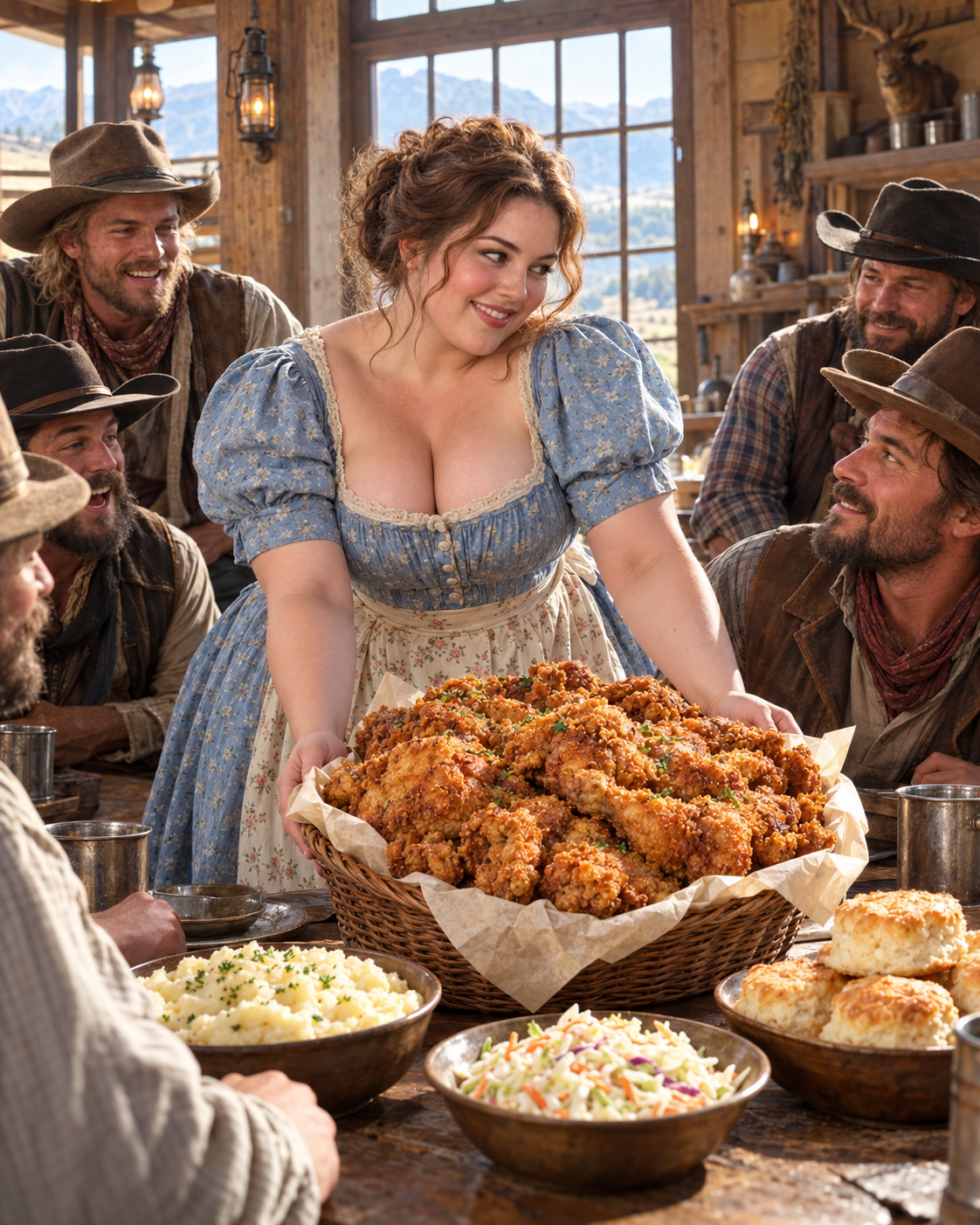
There was laughter, music, and the smell of dragon-crust chicken drifting through the cold Nevada air.
Caleb stood beside his son, teaching him how to set the tables.
Martha smiled across the room.
Holt caught my eye and lifted his coffee cup.
For one extraordinary moment, I felt completely at home.
I had arrived in this world beneath a hangman’s rope.
I had survived betrayal, hunger, gunfire, and a secret that had swallowed generations.
But the thing that had changed the camp wasn’t the silver hidden beneath the mountain.
It was a meal shared at the right moment.
A hand extended when revenge would have been easier.
And the courage to believe that even people who had made terrible mistakes could choose something better.
Years later, I would still think about the night I nearly died beneath that rope.
I would remember how easily fear had turned decent men into a mob.
And I would remember how quickly kindness had reminded them of their humanity.
I never stopped missing the world I’d left behind.
Some evenings, I still dreamed of Chicago streets glittering beneath electric lights.
Sometimes I woke crying for the people I could never see again.
But when morning came, there was bread to make, a mother to embrace, and a life waiting beyond my bedroom door.
I finally understood something my grandmother had tried to teach me.
Home isn’t always the place where your story begins.
Sometimes it’s the place where you discover who you’re willing to become.
And family isn’t measured only by the years people spend together.
It’s measured by the love that survives the years apart.
On the first anniversary of The Silver Table, Martha handed me a small wooden box.
Inside lay my grandmother’s silver pocket watch.
Its hands were frozen at the exact moment I’d first awakened in Nevada.
Beneath it was a folded letter.
I recognized Eleanor’s handwriting immediately.
My fingers shook as I opened it.
“My darling Mara, if you are reading this, then you finally found the truth we tried so hard to protect.”
Tears blurred the words.
“I never wanted you to grow up believing your mother abandoned you, but sometimes love demands a sacrifice that looks terribly like leaving.”
I pressed the letter against my heart.
The final lines were written in faded blue ink.
“Remember that time is precious because we cannot keep it, and love is precious because we can give it away.”
Outside, laughter rose from the dining hall.
Martha called my name.
Holt was waiting at the table with two empty chairs beside him.
I placed the watch carefully back into its box.
Then I stepped into the warmth of the kitchen.
For years, I’d believed the greatest thing I had lost was time.
Now I knew better.
The greatest tragedy would have been allowing that loss to keep me from living the time I still had.
I took my mother’s hand.
Holt pulled out my chair.
And as the people I’d come to love gathered around the table, I finally stopped wondering which century I belonged to.
I belonged wherever I could feed the hungry, protect the vulnerable, and love the people sitting beside me.
Because a life isn’t made meaningful by how much time we’re given.
It’s made meaningful by what we choose to do with it.
And for the first time in two lifetimes, I was no longer searching for a doorway home.
I was already there.
I thought my story had ended the night I finally found a home in 1884 Nevada, but one last secret was still waiting beneath the mountains.
It began on a quiet Sunday morning, three years after we opened The Silver Table.
Holt was repairing a broken kitchen window while Martha kneaded bread beside the stove.
I was preparing breakfast when a young boy hurried through the door, holding a dusty leather satchel.
“Miss Mara, a stranger left this for you at the freight station.”
There was no name on the satchel, only a faded silver symbol I recognized immediately.
It was the same symbol carved into the doorway beneath Blackthorn Ridge.
My hands began trembling.
Inside, I found a pocket watch, a photograph, and a letter written on paper that hadn’t yet been invented.
The photograph showed a familiar Chicago street.
Standing beneath a streetlamp was an elderly woman wearing a dark blue coat.
My grandmother.
Eleanor.
On the back of the photograph, someone had written a date.
October 8, 2026.
I stared at the numbers, unable to breathe.
Martha noticed my expression and hurried toward me.
“What is it, sweetheart?”
I handed her the photograph.
She covered her mouth.
“Ellie?”
For a long moment, neither of us spoke.
Then I unfolded the letter.
“My dearest Mara, if this reaches you, then the mountain has finally become quiet enough for my message to pass through.”
Tears blurred the words.
“I know you believe I died in Chicago, and perhaps in one version of our lives, I did.”
I gripped the kitchen counter.
“But time does not always follow the roads we imagine.”
Martha reached for my hand.
I forced myself to continue reading.
“I spent years searching for the way back to my sister, but I discovered something more important than the doorway itself.”
“The mountain was never meant to imprison us.”
“It was meant to give us a choice.”
A strange warmth spread through my chest.
I looked toward Holt, who had stopped working.
He understood without asking.
Somewhere beyond those mountains, a road to my old life might still exist.
And suddenly, everything I had buried inside myself came rushing back.
The smell of rain on Chicago sidewalks.
The sound of my restaurant’s kitchen during the evening rush.
The faces of friends who had never learned why I’d disappeared.
For three years, I had told myself those memories belonged to another lifetime.
Now someone was offering me the possibility of seeing them again.
At the bottom of the letter, Eleanor had written one final sentence.
“The passage will open once more at sunset on the winter solstice, but only for someone willing to leave without knowing whether they can return.”
That evening, I walked with Holt to the hillside overlooking the abandoned mine.
Snow had begun collecting along the rocks.
For a long time, we stood together in silence.
“You want to go,” he finally said.
I shook my head.
“I don’t know.”
He looked at me with those same steel-gray eyes that had once frightened me beneath a hangman’s rope.
“You don’t have to pretend with me.”
My throat tightened.
“I love our life, Holt.”
“I know.”
“I love Martha, and I love the people here.”
“I know that, too.”
I turned toward him.
“But there’s a part of me that still wonders whether everyone in Chicago thinks I abandoned them.”
Holt looked toward the distant mountains.
“Then perhaps you deserve the chance to tell them you didn’t.”
His kindness hurt more than anger would have.
“Would you really let me leave?”
He took my hands.
“Mara, loving someone doesn’t mean owning their future.”
Tears slipped down my cheeks.
“I don’t want to lose you.”
He brushed them away with his thumb.
“Then don’t spend the time we have together mourning a goodbye that hasn’t happened.”
When I told Martha about Eleanor’s letter, she listened quietly.
Then she opened an old wooden chest and removed a small blue blanket.
“This was yours when you were a baby.”
I touched its worn fabric.
She smiled through tears.
“I carried you through that doorway wrapped in this blanket, terrified that I might never see my own world again.”
“Did you regret it?”
“Not once.”
I looked down.
“But you lost everything.”
Martha gently lifted my chin.
“No, sweetheart, I saved everything that mattered.”
The winter solstice arrived beneath a sky filled with stars.
Holt, Martha, and I walked toward the collapsed mine carrying lanterns.
I had brought Eleanor’s watch and the blue blanket.
The entrance remained buried beneath tons of stone.
For a terrible moment, I wondered whether the letter had been nothing more than an impossible promise.
Then the earth began to hum.
Silver light seeped through the cracks in the rocks.
A narrow opening appeared where solid stone had stood moments earlier.
Beyond it, I could hear something extraordinary.
Traffic.
Distant music.
A train passing through a city.
Chicago.
My Chicago.
The doorway was open.
I stepped toward it, feeling my heart pound.
Through the shimmering light, I saw a street corner I knew.
A coffee shop.
A familiar brick building.
And standing beneath a streetlamp was Eleanor.
She looked older than I remembered, but her smile was unmistakable.
“Mara,” she called softly.
I covered my mouth as tears poured down my face.
“Grandma?”
She nodded.
“I’ve missed you, sweetheart.”
I moved forward instinctively.
Then I heard Martha crying behind me.
I turned.
My mother was standing beside Holt, trying desperately to smile.
And suddenly, I understood the true cruelty of the choice before me.
If I crossed, I might recover the world I had lost.
But I could lose the people who had helped me find myself.
Eleanor seemed to understand.
She stepped closer to the shimmering threshold.
“You don’t have to come, my darling.”
“But I’ll never see you again.”
Her eyes filled with tears.
“Perhaps not.”
I began sobbing.
“That’s not fair.”
“No,” she whispered.
“Life rarely is.”
She placed one trembling hand against the silver light.
“But love was never supposed to be measured by how long we can hold someone beside us.”
I looked at her through my tears.
“Then how do we measure it?”
“By what remains in us after they’re gone.”
The watch in my palm suddenly began ticking.
For the first time in more than a century, its hands moved.
Eleanor smiled.
“Your time was never stolen, Mara.”
She glanced toward Martha and Holt.
“It was given back to you in a different form.”
I thought of every meal I’d cooked.
Every frightened miner I’d helped.
Every morning I’d spent laughing with my mother.
Every evening Holt had sat beside me while the stars appeared over Nevada.
I had spent years believing I needed to return to the future to make my life whole.
But the future wasn’t a place.
It was whatever I chose to build next.
I stepped closer to the doorway.
Eleanor reached toward me.
For one beautiful moment, our fingertips touched through the light.
Her skin was warm.
Real.
“Thank you for raising me,” I whispered.
She smiled through her tears.
“Thank you for giving my sister her daughter back.”
Then I stepped away.
The light began fading.
Eleanor watched me with an expression filled with sadness and pride.
“Live a wonderful life, my darling.”
“I love you, Grandma.”
“I know, sweetheart.”
The doorway closed.
The humming stopped.
The mountain became silent again.
I stood in the snow, crying for the woman who had loved me enough to let me choose another life.
Then Martha wrapped her arms around me.
Holt held us both.
And for the first time, my grief didn’t feel like emptiness.
It felt like proof that I had been loved.
Years passed.
The Silver Table became more than a dining hall.
It became a refuge for travelers, widows, hungry children, and miners who had nowhere else to go.
Holt and I eventually married beneath the cottonwood trees beside the cookhouse.
Martha baked our wedding cake herself.
Caleb’s little boy, now nearly grown, carried the rings.
And when our first daughter was born, I named her Eleanor.
She had Holt’s gray eyes and my mother’s stubborn spirit.
On her fifth birthday, she asked why the old silver watch above our fireplace never seemed to keep the correct time.
I lifted her into my arms.
“Because it belongs to a very special story.”
“Is it a sad story?”
I thought about the lonely nights in Chicago, the noose outside the cookhouse, and the women who had crossed centuries to protect one little girl.
“Parts of it are.”
She rested her head against my shoulder.
“But does it have a happy ending?”
I looked across the room.
Martha was laughing beside the stove.
Holt was helping our youngest son build a wooden toy.
Outside, the dining hall was filled with people sharing warm bread.
I kissed my daughter’s forehead.
“Yes, sweetheart.”
“Why?”
I smiled.
“Because the people in that story learned that even after losing everything, you can still find something worth living for.”
She considered my answer seriously.
Then she hugged my neck.
“I’m glad they did.”
That night, after everyone had gone to sleep, I opened Eleanor’s old wooden box one last time.
Inside lay her letter, the faded photograph, and the little silver watch.
I gently wound the watch and placed it beside my bed.
Its ticking filled the quiet room.
For a moment, I imagined my grandmother somewhere beyond the reach of time, smiling at the life I had chosen.
Then I blew out the candle.
I no longer needed to know whether the doorway would ever open again.
I had stopped waiting for another world to make me happy.
I had learned to treasure the one in front of me.
And if my strange journey taught me anything, it was this.
We cannot control when life takes something precious away.
We cannot always undo betrayal, recover lost years, or bring back everyone we miss.
But we can decide what happens to the love they leave behind.
We can turn grief into kindness.
We can turn fear into courage.
We can offer someone a place at our table when the world has turned its back on them.
And sometimes, the smallest act of compassion can change more lives than all the riches buried beneath a mountain.
I arrived in 1884 with seventy men ready to hang me.
I stayed long enough to see those same men build a community where no one was left hungry.
That was the miracle I wanted my children to remember.
Not the silver doorway.
Not the journey through time.
But the simple truth that had saved my life on that first terrible morning.
You may not get to choose the world you wake up in, but you can always choose what kind of person you become within it.
And sometimes, the home you’ve spent your whole life searching for is the one you create by making someone else feel safe, loved, and welcome.
That was how my story ended.
Not with another mystery.
Not with another goodbye.
But with the sound of my children laughing, my husband’s hand resting in mine, and the smell of fresh bread rising through a house filled with love.
For the first time in my life, I had everything I needed.
And I finally understood that forever was never about having endless time.
It was about filling the time we had with something worth remembering.
THE END.