“Seventeen men need supper by six,” Benjamin Hail said. “And I don’t care what the folks in town told you.”
The man beside Benjamin’s desk was Walter Turner.
But he wasn’t alone.
Across from him stood Elias Pike, the ranch bookkeeper, a narrow-faced man Ruth had seen almost every evening carrying account books between the bunkhouse and Benjamin’s office.
For three weeks, Elias had barely spoken to her except to complain that butter cost too much and that the cowboys were eating like kings.
Now his hand was resting on the edge of Benjamin’s desk, and his face had gone white.
Walter looked even worse.
“Ruth,” he said quietly.
Elias’s expression changed first.
Not fear.
Calculation.
“You shouldn’t be wandering around after midnight,” he said.
Ruth kept one hand on the doorframe.
“And you shouldn’t be discussing me in a locked office.”
Walter stepped forward.
“Listen to me before you decide what you heard.”
“I heard enough.”
“No,” Walter said. “You heard the worst part without knowing the rest.”
Elias gave a cold laugh.
“Don’t bother explaining, Turner. She already thinks you’re stealing.”
Walter’s jaw tightened.
That was when Ruth noticed something strange.
Walter wasn’t standing beside the open ledger.
He was standing between Elias and the office door.
As though he had been blocking Elias from leaving.
Ruth looked from one man to the other.
“Where’s Benjamin?”
Walter answered.
“Checking the north pasture.”
“At this hour?”
“I sent him there.”
Ruth’s stomach dropped.
“You sent him?”
Elias suddenly moved.
He shoved Walter hard into the desk and lunged toward the door.
Ruth reacted without thinking.
She grabbed the metal bucket she had kicked moments earlier and swung it into the hallway in front of him.
Elias stumbled over it, crashed shoulder-first against the wall, and cursed.
Walter caught him by the coat before he could recover.
“Enough!”
Elias twisted free.
“You old fool! You think Hail will forgive you when he learns how long you’ve known?”
Ruth stared at Walter.
“How long he’s known what?”
Walter’s face seemed to age ten years.
“That someone has been stealing from High Timber since last spring.”
Ruth felt the cold from the hallway creeping beneath her dress.
“You knew?”
“I knew something was wrong.”
“And you said nothing?”
“I tried to find out who was doing it.”
Elias smirked.
“You signed every transfer.”
Walter turned on him.
“Because you told me Hail had ordered them.”
“And you believed me.”
“For the first two months.”
Ruth remembered the initials in the leather ledger.
W.T.
Walter Turner.
“You signed them?”
Walter nodded.
“I sign supply transfers when Benjamin is away. Elias prepares the papers. I trusted the numbers because that was his job.”
Elias straightened his coat.
“You’re admitting it yourself.”
Walter ignored him.
“Then I noticed we were buying more grain than the horses could possibly eat. I asked Elias about it. A week later, someone sent a letter to my daughter in Helena.”
Ruth’s anger faltered.
“What kind of letter?”
Walter looked toward the floor.
“My daughter is widowed. She has two little boys. The letter said that if I kept asking questions, certain men would collect a debt her husband left behind.”
Elias said nothing.
Walter continued.
“I didn’t know whether the threat was real, but I couldn’t gamble with my grandchildren. So I stopped asking in public.”
“But you kept signing,” Ruth said.
“Yes.”
His answer came without excuse.
“That was wrong. I told myself I was protecting my family while I secretly watched the shipments. Truth is, I was protecting my fear.”
Ruth appreciated that he didn’t beg for sympathy.
“What did you discover?”
Walter reached inside his coat and pulled out a folded piece of paper.
“A list of wagon numbers, dates, and drivers. Every missing shipment went north.”
“To the abandoned cabin?”
“No. Past it.”
Elias suddenly laughed.
“You’re all too late.”
Walter grabbed his sleeve.
“What does that mean?”
Elias looked directly at Ruth.
“It means your employer isn’t inspecting the north pasture.”
Ruth’s breath stopped.
Walter’s grip tightened.
“Where is Benjamin?”
Elias smiled.
“Exactly where I told him the stolen goods were being stored.”
Walter’s face drained of color.
“You told him?”
“He confronted me this afternoon. I gave him the answer he wanted.”
Ruth understood before Walter did.
“A trap.”
Elias’s smile widened.
Outside, far beyond the ranch buildings, a gunshot cracked through the winter darkness.
Then another.
Walter released Elias so quickly that the bookkeeper nearly fell.
“Benjamin.”
He ran.
Ruth followed.
Walter turned at the porch.
“Stay here.”
“Absolutely not.”
“This isn’t a kitchen problem anymore.”
“It became my problem when someone decided I needed to be dealt with before morning.”
Walter looked like he wanted to argue, but Ruth had already pulled on her heavy coat.
Two cowboys emerged from the bunkhouse after hearing the shots.
One was Caleb Morris, a broad-shouldered twenty-eight-year-old who had spent most of the evening repairing harnesses.
The other was seventeen-year-old Tommy Bell, the youngest ranch hand.
Walter pointed at Tommy.
“Wake the others. Keep Elias locked in the tack room.”
Elias stepped into the doorway.
“You can’t hold me.”
Caleb calmly took him by the arm.
“Looks like we can.”
Walter saddled three horses.
Ruth stared at the largest one.
“I don’t ride well.”
Walter looked toward the black line of pine trees.
“Tonight would be a good night to learn.”
They rode north beneath a sky without stars.
The wind blew snow across the trail until wagon tracks appeared and vanished beneath their horses.
Ruth’s hands went numb despite her gloves.
Every few minutes she thought about turning back.
Then she pictured Benjamin leaving the warmth of his office because he believed someone had finally found the stolen supplies.
He had given her work when an entire town had judged her before tasting a spoonful of her food.
She wasn’t going to leave him alone in the snow.
After nearly forty minutes, Walter raised his hand.
They stopped.
Ahead stood the abandoned storage cabin.
One wall had collapsed years earlier.
No lantern burned inside.
But there were tracks.
Many tracks.
Fresh wagon ruts continued beyond the cabin toward a narrow ravine.
Walter dismounted.
“From here, quietly.”
Caleb tied the horses behind a stand of fir trees.
Ruth’s heart hammered as they followed the ravine.
Then she smelled smoke.
A lantern appeared below.
So did three wagons.
Crates marked HIGH TIMBER RANCH were stacked beneath canvas covers.
Near them stood four men.
Benjamin was on his knees in the snow.
Blood ran from a cut above his eyebrow.
A tall man in a buffalo coat stood over him.
Ruth recognized him from town.
Harlan Voss.
Owner of the largest trading company in the county.
The same man who had refused to hire Ruth at his hotel kitchen two months earlier.
He had looked her up and down and said, “Guests expect discipline from the people preparing their food.”
Now he was stealing food from someone else’s ranch.
Walter whispered a curse.
Caleb leaned close.
“That’s Voss.”
“I know.”
Ruth watched the men load another crate.
Benjamin lifted his head.
“You’ve been bleeding me for months.”
Voss shrugged.
“Not enough.”
“You won’t get High Timber.”
“That depends.”
“On what?”
“On whether you’re alive to make next month’s bank payment.”
Walter’s face changed.
Ruth looked at him.
“What does he mean?”
Walter whispered, “Benjamin borrowed heavily after the cattle disease two years ago. The ranch recovered, but winter expenses are high.”
Suddenly everything made sense.
The stolen supplies were not merely theft.
They were designed to make High Timber spend more every week.
Food.
Grain.
Medicine.
Equipment.
Enough losses would slowly drain the ranch.
Voss wasn’t stealing because he needed flour.
He wanted Benjamin desperate.
Below them, Voss crouched beside Benjamin.
“You sell me the northern six thousand acres, your problems disappear.”
Benjamin spat blood into the snow.
“I’d rather lose the whole ranch.”
“That can be arranged.”
Ruth’s fingers tightened around the edge of Walter’s coat.
“We need help.”
Walter nodded.
“There are only three of us.”
Ruth looked at the wagons.
Then at the narrow ravine.
Then at the stacked sacks tied behind the second wagon.
She had seen those sacks every Monday.
Flour.
Dozens of them.
And beside them sat several wooden barrels.
Lamp oil.
She whispered, “Can you reach their horses without being seen?”
Walter followed her gaze.
“Maybe.”
“Don’t free them.”
“What?”
“Move them.”
“Where?”
“Upwind.”
Walter studied her for three seconds.
Then he understood.
Ten minutes later, Ruth crawled through knee-deep snow until she reached the rear wagon.
Her dress snagged twice on frozen brush.
Her knees burned.
Behind the wagon, she found exactly what she expected.
Empty burlap sacks.
Ruth took two, tore them open, and shook loose cloth fibers into the wind.
Then she reached for one of the flour sacks.
It was heavy.
She dragged it toward the edge of the ravine, cut the cord with a small kitchen knife she carried in her coat, and waited.
A gust came.
Ruth lifted the sack.
Flour exploded into the darkness.
A white cloud raced through the lantern light.
“What the devil?”
One of Voss’s men turned.
Ruth emptied the second sack.
The flour swept through the camp like sudden fog.
Men shouted.
Walter whistled sharply from the opposite ridge.
Every horse in the camp began neighing.
Caleb had moved them beyond the trees and was slapping saddle leather against a trunk to make the animals restless.
Voss shouted, “Find out what’s happening!”
Two men ran toward the horses.
Walter emerged behind Benjamin.
He cut the rope binding Benjamin’s wrists.
A third man spotted him.
“Turner!”
Walter shoved Benjamin toward the ravine wall.
The man rushed forward.
Then Ruth stepped from behind the wagon and threw a metal cooking pot directly into his path.
He stumbled, and Benjamin drove his shoulder into him.
Both men went into the snow.
Voss pulled a revolver.
“Stop!”
Everyone froze.
The wind carried the remaining flour away.
Voss pointed the revolver toward Benjamin.
“I knew you were stubborn, Hail.”
Benjamin stood slowly.
“You’ve already lost.”
Voss laughed.
“Have I?”
“You left records.”
“Elias kept the records.”
“And Elias is back at my ranch.”
For the first time, Voss’s expression changed.
Only slightly.
But Ruth saw it.
Benjamin saw it too.
Voss recovered.
“Elias knows when to disappear.”
A voice sounded from the ridge.
“Not tonight.”
Lanterns appeared among the trees.
Then more.
The seventeen cowboys of High Timber Ranch rode into view.
Tommy Bell was at the front.
Beside him rode Sheriff Amos Reed and two deputies.
Walter looked stunned.
Tommy grinned.
“You told me to wake the others.”
The sheriff dismounted.
“Harlan Voss, put the gun down.”
Voss didn’t.
His eyes moved from Benjamin to Walter to Ruth.
“You have nothing.”
Ruth pointed toward the wagons.
“I count three wagons loaded with property marked High Timber Ranch.”
“That proves transportation, not theft.”
Walter pulled the folded list from his coat.
“I have dates, wagon numbers, and drivers.”
Voss’s jaw tightened.
Benjamin stepped forward.
“And Elias Pike is going to decide whether protecting you is worth prison.”
Voss stared at him.
“You think Elias will talk?”
The sheriff answered.
“He already did.”
That finally broke him.
Voss lowered the revolver.
Sheriff Reed took it from his hand.
The truth came out before sunrise.
Elias had been diverting shipments for nearly eight months.
Voss paid him to inflate High Timber’s orders, falsify storage records, and arrange nighttime wagon transfers.
The stolen goods were resold through trading posts in three counties.
But money was only part of the scheme.
Voss had quietly purchased Benjamin’s largest outstanding loan from a struggling regional bank.
He planned to keep High Timber’s expenses high until Benjamin missed a payment.
Then he would demand the northern acreage as settlement.
The land itself contained something Benjamin didn’t know.
A proposed railway survey crossed the northern boundary.
If the route was approved, the value of that land could rise several times over.
Voss had learned about the survey from a cousin working for the railway company.
Benjamin had nearly been ruined without ever knowing why.
Walter spent the entire ride home in silence.
At dawn, after the sheriff took Elias away, Walter found Benjamin in the barn.
Ruth was there when he removed the silver foreman’s badge from his coat.
“I should have told you when I first suspected something.”
Benjamin looked at him.
“Yes.”
“I was afraid for my daughter.”
“I understand.”
“That doesn’t make what I did right.”
“No.”
Walter placed the badge on a barrel.
“I’ll pack before breakfast.”
Benjamin stared at the badge.
“You think eleven years disappear because you made one cowardly decision?”
Walter looked up.
“It lasted longer than one decision.”
“True.”
Benjamin picked up the badge.
“But you also kept records. You tried to uncover the truth. And tonight you rode into that ravine knowing Voss might shoot you.”
Walter said nothing.
Benjamin held the badge toward him.
“I’m not pretending you didn’t fail me.”
Walter’s face tightened.
“Then why give it back?”
“Because trust isn’t the belief that someone will never fail. It’s deciding what they do after they fail.”
Walter slowly accepted the badge.
Benjamin added, “But from now on, no one signs a transfer alone.”
Walter almost smiled.
“Fair enough.”
Ruth turned toward the kitchen.
Benjamin called after her.
“Where are you going?”
“Seventeen men nearly froze chasing criminals because of me.”
“Because of you?”
“They would have slept through everything if I hadn’t kicked that bucket.”
Benjamin laughed for the first time that night.
“So?”
“So they’re going to wake up hungry.”
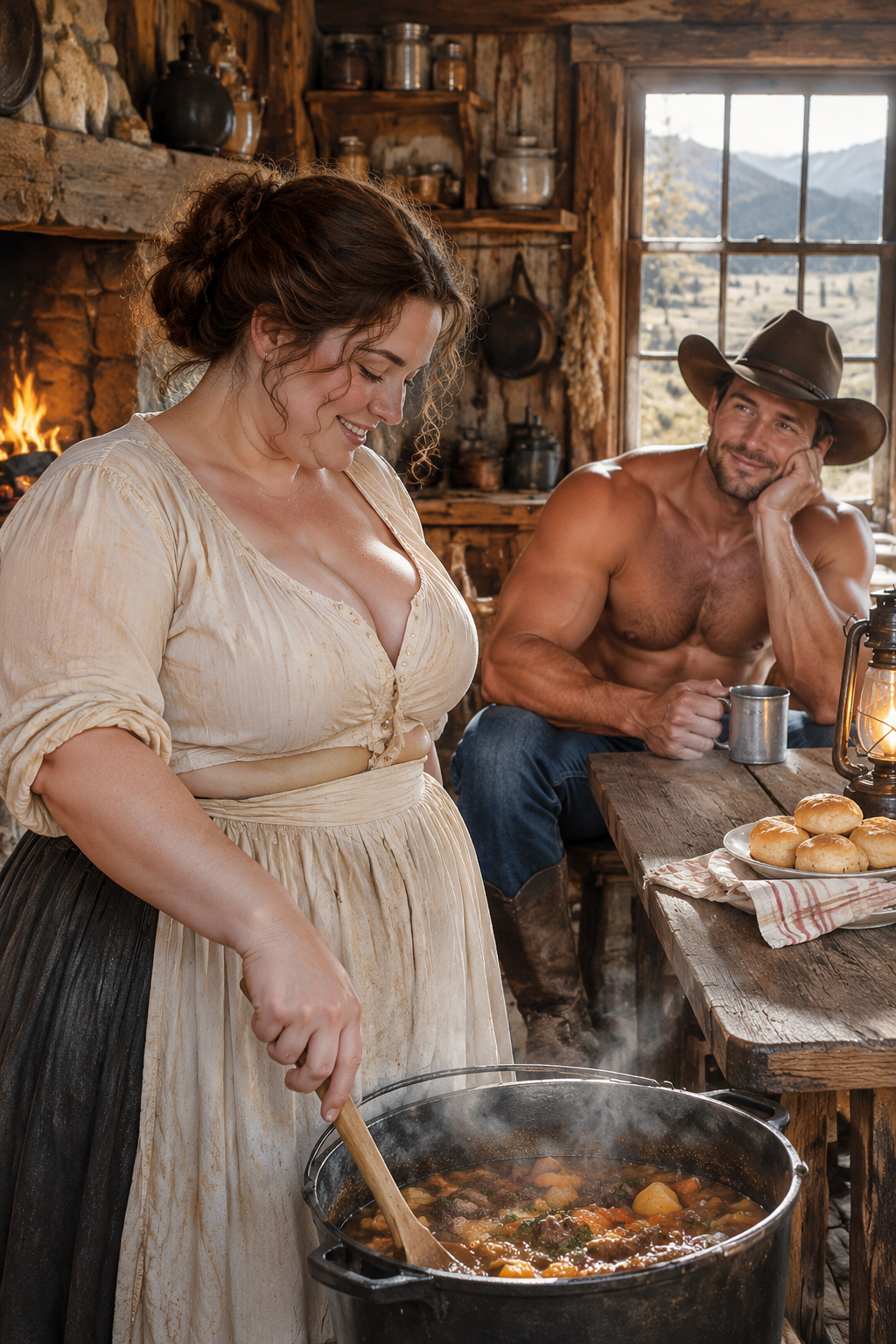
By seven, the kitchen smelled of coffee, bacon, fried potatoes, and warm biscuits.
The men entered one by one, exhausted and loud.
Tommy told the story three different times, making himself braver in each version.
By the third telling, he claimed he had personally surrounded Voss’s entire gang.
Caleb threw a biscuit at him.
“Another ten minutes and you’ll have defeated twenty men with a teaspoon.”
Even Walter laughed.
Ruth stood at the stove and realized something had changed.
Not in the ranch.
In her.
Months earlier, she had entered every room wondering what people saw when they looked at her.
Too large.
Too plain.
Too old to start over.
Too much of something and not enough of whatever they wanted.
She had allowed strangers to turn their preferences into judgments about her value.
High Timber had taught her something different.
A person could enter a room carrying exactly the qualities someone else had rejected and discover those were the qualities another place desperately needed.
Her size had not cooked the stew.
Her appearance had not counted the flour.
Her face had not solved the mystery.
Her discipline had.
Her memory had.
Her courage had.
And perhaps most importantly, her refusal to believe that noticing something small meant she should remain silent.
Two weeks later, Sheriff Reed returned.
Voss and Elias had both been formally charged.
Three merchants had admitted buying stolen High Timber supplies.
Most of the missing equipment was recovered.
A portion of the stolen money was found hidden beneath the floorboards of Voss’s warehouse.
The bank loan scheme collapsed with him.
But the winter wasn’t finished.
Neither were High Timber’s troubles.
A brutal storm arrived in February and lasted four days.
Snow buried fences.
Temperatures fell so low that water froze inside the bunkhouse washbasins.
Then thirty cattle disappeared from the western pasture.
The cowboys searched for an entire day without finding them.
Benjamin returned after dark with ice in his beard.
“If they’re trapped in the lower valley, they’ll die before morning.”
Ruth placed a bowl of stew in front of him.
“Then eat.”
“I don’t have time.”
“You haven’t eaten since sunrise.”
“Ruth—”
“You can be stubborn after six spoonfuls.”
Benjamin stared at her.
Walter, sitting nearby, grinned.
“I wouldn’t fight her.”
Benjamin ate.
After six spoonfuls, Ruth unfolded a flour delivery map beside his bowl.
“I think I know where the cattle are.”
Every cowboy turned.
Benjamin frowned.
“How?”
“The old northern supply records.”
“What about them?”
“The fake cabin wasn’t always fake.”
Walter moved closer.
Ruth pointed at a faded line on the map.
“Ten years ago, wagons used this trail. There’s a sheltered basin behind the ridge. If cattle were pushed by wind from the western pasture, they could have followed this depression.”
Benjamin looked at Walter.
Walter stared at the map.
“She might be right.”
They found all thirty cattle before midnight, packed against the sheltered side of the basin.
Only one was badly injured.
After that, nobody at High Timber called Ruth “the cook” as though cooking was the only thing she could do.
They called her Miss Dawson when they wanted to be polite.
Ruth when they wanted another biscuit.
And, when something disappeared, broke, didn’t add up, or seemed suspicious, they called her before anybody else.
Spring finally arrived in April.
Snow melted from the foothills.
Grass returned in patches.
The recovered money allowed Benjamin to repair the main barn and pay down part of the ranch debt.
The railway survey became public.
Voss had been right about one thing.
The northern land became valuable.
Benjamin received three offers.
He refused all three.
Instead, he negotiated a narrow right-of-way with the railway while keeping ownership of the land.
The payment secured High Timber’s finances for years.
One afternoon, Ruth found Benjamin sitting outside the kitchen with two cups of coffee.
He handed her one.
“I’ve been meaning to ask you something.”
“If it’s about supper, yes, there will be enough.”
“It isn’t.”
She sat.
Benjamin looked across the ranch.
“When winter started, I hired you because I needed someone who could feed seventeen men.”
“I remember.”
“I was desperate.”
“I remember that too.”
He smiled.
“Now I need someone to manage the household accounts, food contracts, and supply records.”
Ruth turned toward him.
“You’re asking me to be your bookkeeper?”
“Not exactly.”
“Then what?”
“Operations manager.”
Ruth nearly laughed.
“You invented that position.”
“Yes.”
“Why?”
“Because apparently ranches need people who notice missing flour before the owner notices someone is stealing his land.”
She looked at the coffee in her hands.
“What would I be paid?”
Benjamin named a figure.
Ruth blinked.
“That is nearly twice what you’re paying me now.”
“Correct.”
“I’ll want authority to reject bad deliveries.”
“You’ll have it.”
“And no supplier changes prices without written notice.”
“Agreed.”
“And Walter doesn’t get to move one sack of grain without signing for it.”
From inside the barn, Walter shouted, “I heard that!”
Ruth laughed.
Benjamin extended his hand.
“Do we have an agreement?”
She shook it.
“We do.”
By summer, High Timber Ranch was stronger than it had been in years.
Ruth hired a young woman named Clara to help in the kitchen.
Clara had been dismissed from two hotels because she walked with a limp after a childhood injury.
On her first day, she stood nervously beside the stove.
“I should tell you something,” Clara said.
Ruth looked up from the supply ledger.
“What?”
“The hotel manager in town said ranch work might be too hard for someone like me.”
Ruth closed the ledger.
She remembered wet snow dripping from her own coat.
She remembered three closed doors.
She remembered Benjamin saying seventeen men needed supper by six.
“What can you cook?” Ruth asked.
Clara hesitated.
“Bread. Pies. Roast chicken. My mother taught me stew.”
“Good.”
Ruth handed her an apron.
“Then you’d better show me.”
Clara stared at her.
“You don’t want to know anything else?”
“I’ll learn everything else while you work.”
That evening, seventeen cowboys, a foreman, two ranch hands, and one stubborn ranch owner gathered around the long dining table.
Clara carried out her first apple pie.
The crust was uneven.
One side was darker than the other.
Tommy took a bite.
His eyes widened.
Walter took another.
Then Benjamin looked toward Ruth.
Ruth already knew what was coming.
“Where’d you find her?” he asked.
Ruth smiled.
“Someone finally smart enough to hire her.”
The table erupted in laughter.
Clara looked confused until Ruth squeezed her shoulder.
Then she understood.
Years later, people in that part of Montana told many versions of the winter High Timber almost disappeared.
Some said Benjamin Hail defeated a land thief.
Some said Walter Turner uncovered a smuggling operation.
Tommy Bell’s version eventually involved twelve armed criminals, three blizzards, and a heroic horse that probably never existed.
But the people who had actually lived through it remembered something simpler.
The ranch was saved because one woman paid attention.
Ruth Dawson had arrived believing she needed a job badly enough to accept whatever respect came with it.
She left that winter knowing something much more important.
Work can give a person money.
A good place can give a person belonging.
But neither one creates a person’s worth.
Worth exists before anyone recognizes it.
Sometimes the people who reject you are not measuring your limitations.
They are revealing their own.
And sometimes one open door is enough to prove that every closed one was never the end of the road.
Years later, a small wooden sign appeared beside the entrance to High Timber Ranch.
Benjamin wanted it to say QUALITY. Walter suggested HONESTY. Tommy suggested COURAGE, mostly because he liked how it sounded.
Ruth chose the words herself.
They were carved into the wood beneath the ranch name.
JUDGE PEOPLE BY WHAT THEY BRING TO THE TABLE.
Every morning, Ruth passed that sign on her way to the kitchen.
And every evening, when the long table filled with tired workers, warm food, arguments, laughter, and the ordinary noise of people who trusted one another, she knew she had finally found the place she had been searching for.
Not a place where everyone thought she was perfect.
Not a place where nobody ever failed.
A place where people were allowed to prove who they were by what they did next.
And for Ruth Dawson, that was more than a job.
It was home.
But home, Ruth eventually learned, was not something a person found once and kept without effort.
It had to be protected.
Three years after the winter of the stolen supplies, High Timber Ranch had become one of the most respected operations in western Montana.
The railway line had been completed along the northern boundary, bringing buyers, freight, and opportunity closer than Benjamin Hail had ever expected.
The ranch expanded its cattle herd.
A new barn replaced the old leaning structure.
The bunkhouse received proper insulation.
The kitchen Ruth had once entered with a broken stove and flour sacks scattered across the floor now had two iron ranges, a cold storage room, and shelves so carefully labeled that even Tommy Bell was afraid to put a jar back in the wrong place.
Ruth still cooked sometimes.
She claimed it was because Clara needed help during busy weeks.
Nobody believed her.
The truth was that Ruth loved the kitchen.
She loved the first scent of coffee before sunrise.
She loved the sound of exhausted men becoming suddenly quiet when warm bread reached the table.
But her real work had grown far beyond meals.
Every wagon entering High Timber passed through her records.
Every large purchase required two signatures.
Every merchant contract was copied and locked in Benjamin’s office.
No one laughed about her counting sacks anymore.
They had learned what a missing sack could become.
Walter Turner remained foreman.
His hair had turned almost completely white, but he still rode harder than men half his age.
He also visited his daughter in Helena twice a year instead of pretending worry could be solved by silence.
Tommy was no longer the youngest cowboy.
That title belonged to a nineteen-year-old named Eli Harper, who made the mistake of believing every one of Tommy’s stories.
According to Tommy, the night Harlan Voss was arrested now included twenty-five thieves, a frozen river, and Ruth defeating three armed men with a soup ladle.
Ruth usually corrected him.
Usually.
Then, one September morning, a black automobile came rattling down the ranch road.
Automobiles were still unusual enough in the county that half the men stopped working to stare.
The vehicle stopped near the main house.
A well-dressed man stepped out.
He wore a gray suit, polished shoes, and a narrow black tie that looked entirely wrong against Montana dust.
Behind him climbed a younger man carrying a leather portfolio.
Benjamin walked from the barn.
Ruth came from the office.
The stranger removed his hat.
“Mr. Hail?”
“Yes.”
“My name is Charles Whitmore. I represent the Northern Continental Development Company.”
Benjamin’s expression became guarded immediately.
“What does a development company want with cattle?”
Whitmore smiled.
“Not the cattle.”
His eyes moved toward the northern hills.
“The land.”
Ruth felt something tighten inside her.
Three years earlier, those words would have sounded like opportunity.
Now they sounded like history knocking twice.
Benjamin crossed his arms.
“The northern property isn’t for sale.”
“We know.”
“Then you’ve had a long trip for nothing.”
Whitmore seemed amused.
“I don’t believe so.”
His assistant opened the leather portfolio.
Inside were maps.
Survey drawings.
Railroad plans.
And a document carrying a county seal.
Whitmore placed it on the porch table.
“We intend to build a freight depot and processing facility along the rail corridor.”
“Build it somewhere else,” Benjamin said.
“That is certainly one possibility.”
Whitmore tapped the map.
“But this location is ideal.”
Ruth stepped closer.
The proposed facility covered nearly four hundred acres.
Some of it bordered High Timber’s grazing land.
A narrow section appeared to cross it.
“This line is wrong,” she said.
Whitmore looked at her.
“And you are?”
“Ruth Dawson.”
His face showed no recognition.
Benjamin almost smiled.
“She runs everything around here worth running.”
Whitmore gave a polite nod.
“The line is based on county records.”
Ruth pointed again.
“The county records show the old north trail ending here.”
“Yes.”
“But your map treats it as a public access road.”
“It is listed as such.”
“No, it isn’t.”
The assistant cleared his throat.
“Our attorneys disagree.”
Ruth looked at Benjamin.
He understood instantly.
The old supply road.
The same abandoned trail used during the theft scheme.
Years ago, some maps had shown it incorrectly.
If Whitmore’s company could establish it as public access, they could reach the railway through High Timber property without negotiating directly with Benjamin.
“How much land are you trying to take?” Benjamin asked.
Whitmore’s smile disappeared.
“Take is an unnecessarily hostile word.”
“Then use the correct one.”
Whitmore folded his hands.
“We are prepared to compensate the ranch.”
“How much?”
The number he gave was large.
Very large.
Several cowboys who had gathered within hearing distance exchanged looks.
Benjamin did not.
“No.”
Whitmore blinked.
“You haven’t considered it.”
“I just did.”
The developer slowly closed the portfolio.
“Mr. Hail, progress tends to arrive whether individual landowners appreciate it or not.”
Benjamin’s voice stayed calm.
“So does winter.”
Whitmore put on his hat.
“I’ll return after you’ve had time to think.”
Ruth watched the automobile disappear down the road.
Walter came to stand beside her.
“You don’t trust him.”
“No.”
“Because he’s wearing clean shoes?”
“That doesn’t help.”
Benjamin picked up the copy of the map Whitmore had left behind.
“What did you notice?”
Ruth pointed at the legal description.
“The boundary number.”
“What about it?”
“It doesn’t match our deed.”
Benjamin’s eyes narrowed.
By afternoon, Ruth had every property document on the office table.
The original purchase deed.
The railway easement.
Tax records.
Survey copies.
Benjamin stood behind her while Walter paced.
Clara brought coffee and stayed because Ruth had taught her that information was rarely improved by excluding the person carrying the tray.
Ruth compared the documents three times.
Then she leaned back.
“Someone changed the parcel description.”
Benjamin frowned.
“Changed where?”
“Not on our deed.”
She tapped Whitmore’s county copy.
“Here.”
Walter stopped pacing.
“Recently?”
“Has to be.”
Benjamin looked toward the window.
“You think Whitmore knows?”
“I don’t know.”
Ruth paused.
“But someone does.”
The next morning they rode into town.
The county records office occupied two rooms above the sheriff’s station.
The clerk was a nervous young man named Frederick Lane.
When Ruth asked for the historical road maps, his hands began shaking.
That was enough.
Ruth looked at Benjamin.
Benjamin closed the door.
Frederick swallowed.
“I haven’t done anything.”
“No one said you had,” Ruth replied.
“You were thinking it.”
“I was thinking you look terrified.”
Frederick sat down.
Two minutes later, he started talking.
Three months earlier, a man from Northern Continental had requested access to several archived surveys.
That was legal.
A week later, Frederick noticed one of the copies had been replaced.
Not the original.
The public reference copy.
The altered version changed the status of the old north trail.
“Why didn’t you report it?” Benjamin asked.
Frederick stared at the desk.
“Because my supervisor told me it was an administrative correction.”
“Who is your supervisor?”
Frederick hesitated.
“County Commissioner Edgar Vale.”
Walter swore softly.
Vale had supported the railway project from the beginning.
Ruth asked, “Did Commissioner Vale order you to use the altered copy?”
“Yes.”
“Do you have proof?”
Frederick looked toward the records room.
Then he opened a drawer and removed three envelopes.
“I started keeping his notes.”
Benjamin took one.
Inside was a handwritten instruction directing Frederick to replace “outdated access descriptions” with revised survey information.
Another note mentioned Northern Continental.
The third mentioned payment for “consulting.”
Walter stared.
“That’s bribery.”
“Maybe,” Ruth said.
“But we don’t accuse anyone until we know exactly what happened.”
Sheriff Amos Reed was downstairs.
He read the notes twice.
Then he said, “Don’t confront Vale.”
Benjamin looked irritated.
“Why?”
“Because if he’s dirty, he’ll destroy whatever else exists.”
Ruth agreed.
The sheriff looked at her.
“You have an idea.”
“I have a habit.”
“What habit?”
“Counting what doesn’t belong.”
For the next six days, nothing happened openly.
That was what made the week dangerous.
Whitmore returned twice.
Benjamin refused the offer twice.
Vale sent a formal county notice declaring the old north trail a recognized public access route.
Ruth began examining freight records.
Northern Continental had purchased lumber, steel, and machinery for a depot that had not yet received final approval.
The company was moving too fast.
Then Clara noticed something.
A freight driver stopped at the kitchen for coffee and complained about hauling “Vale’s private shipment” after dark.
Ruth asked what shipment.
The driver shrugged.
“Crates from the county office.”
That evening, Ruth told Benjamin.
“Records.”
Walter said it first.
“They’re moving records.”
Benjamin stood.
“We go now.”
Sheriff Reed was waiting outside before they could saddle horses.
Ruth had already sent Tommy to town.
The sheriff brought two deputies.
They followed the freight road south.
Near midnight, they found a wagon outside an abandoned sawmill.
Inside were county boxes.
Maps.
Contracts.
Tax records.
Survey books.
And Commissioner Vale.
Charles Whitmore stood beside him.
So did Whitmore’s assistant.
The assistant was feeding papers into a stove.
Sheriff Reed entered with his revolver drawn.
“Nobody move.”
Whitmore went pale.
Vale did not.
He looked almost bored.
“You’re making a serious mistake, Sheriff.”
Reed kicked the stove door shut.
“I hear that a lot.”
Vale looked at Benjamin.
“This isn’t your concern.”
“You’re burning records about my land.”
“County property.”
Ruth stepped toward the table.
“Then why remove it at midnight?”
Vale’s eyes settled on her.
He recognized her this time.
“Mrs. Dawson.”
“Miss.”
“You should be careful involving yourself in matters you don’t understand.”
Ruth smiled faintly.
“People have been telling me that for years.”
Whitmore interrupted.
“This is administrative disposal.”
“Then you’ll have a disposal order,” Ruth said.
Silence.
She turned to the sheriff.
“There won’t be one.”
Whitmore’s assistant suddenly spoke.
“There is no order.”
Whitmore whipped around.
“Quiet.”
The young man stepped back.
“No.”
His hands were trembling.
“You said the county had approved everything.”
Vale moved toward him.
The sheriff blocked his path.
The assistant continued.
“They altered the access status before submitting the development application.”
Whitmore shouted his name.
The young man ignored him.
“They promised Commissioner Vale a percentage through a land consulting company.”
Sheriff Reed looked at Vale.
The commissioner finally lost his calm.
“He’s lying.”
Ruth pointed at the boxes.
“Then these records will prove it.”
Vale stared at her with hatred.
“You think saving a few acres matters?”
Ruth’s expression hardened.
“This isn’t about acres.”
“What is it about?”
“People like you deciding ordinary folks won’t notice when you move the line a little.”
No one spoke.
Ruth continued.
“A sack of flour here.”
“A road boundary there.”
“A signature changed.”
“A number moved.”
“You count on people being too busy, too tired, or too intimidated to ask questions.”
Vale laughed bitterly.
“And you think you’re some great detective because you keep ledgers?”
“No.”
Ruth looked directly at him.
“I think ledgers tell the truth when powerful men hope nobody reads them.”
By sunrise, Vale and Whitmore were in custody.
Northern Continental’s board immediately denied authorizing bribery.
An investigation followed.
Whitmore was dismissed.
Vale resigned before trial.
The altered road designation was voided.
High Timber kept every acre.
The development company eventually built its depot three miles east.
This time, it bought the land legally.
The scandal made newspapers across Montana.
One reporter came to High Timber and asked Benjamin who had saved the ranch.
He pointed toward the office.
Ruth was inside arguing with a grain supplier about inflated freight charges.
The reporter laughed.
“No, really.”
Benjamin didn’t.
“Really.”
Years passed.
Walter retired at sixty-eight.
He moved to Helena to live closer to his daughter but returned every summer.
Tommy eventually became foreman.
On his first day, Ruth handed him a supply sheet.
He looked offended.
“You don’t trust me?”
Ruth raised an eyebrow.
“I trust you enough to require receipts.”
He laughed.
Clara married Eli Harper and continued managing the kitchen.
Her limp never stopped her from working.
More importantly, she stopped apologizing for it.
Benjamin aged slowly and stubbornly.
He and Ruth never married.
People in town speculated anyway.
The truth was quieter.
They became the kind of companions who did not need a label to prove loyalty.
They drank coffee every morning.
Argued about expenses.
Sat on the porch at sunset.
And trusted one another with the things neither easily gave anyone else.
When Ruth turned sixty-five, Benjamin told her she should retire.
She stared at him.
“Are you firing me?”
“I’m suggesting rest.”
“That sounds worse.”
He never suggested it again.
At seventy-two, Ruth finally stepped away from daily management.
High Timber held a dinner in the new main barn.
Cowboys came from ranches across three counties.
Former workers returned with wives, husbands, children, and stories.
Walter traveled from Helena.
Sheriff Reed, now retired, brought a bottle of whiskey Benjamin claimed was too expensive to open.
Tommy gave a speech.
It began badly.
It grew worse.
Then he stopped joking.
“When I came here, I thought courage meant riding into storms.”
The barn grew quiet.
“Ruth taught me that sometimes courage is counting the sacks when everyone else says it doesn’t matter.”
Ruth looked down.
Tommy continued.
“Sometimes it’s asking why.”
“Sometimes it’s admitting you failed.”
“Sometimes it’s hiring someone everyone else overlooked.”
“And sometimes it’s staying when leaving would be easier.”
Benjamin sat beside Ruth.
His hand rested near hers on the table.
Tommy raised his glass.
“To Ruth Dawson.”
Everyone stood.
Ruth hated public attention.
She stood anyway.
“I don’t have a speech.”
Walter called from the back.
“That’s a lie.”
Laughter filled the barn.
Ruth waited.
Then she looked at the faces around her.
Clara.
Eli.
Tommy.
Walter.
Benjamin.
Young workers she had hired.
Older workers she had once fed through blizzards.
People who had arrived carrying stories about being unwanted somewhere else.
“I used to think being rejected meant somebody had measured me and found me lacking,” she said.
The room became still.
“I was wrong.”
“Sometimes rejection doesn’t tell you anything about your worth.”
“It only tells you the limits of the person doing the judging.”
Clara wiped her eyes.
Ruth continued.
“High Timber gave me a job.”
“But what changed my life wasn’t the paycheck.”
“It was being given the chance to prove what I could do.”
She looked toward the wooden sign hanging above the barn doors.
JUDGE PEOPLE BY WHAT THEY BRING TO THE TABLE.
“That sign has been here a long time.”
“You’ve all walked past it so often you probably don’t see it anymore.”
“But I hope you remember what it means.”
“Don’t decide someone’s value before they get a chance to show it.”
“Don’t mistake appearance for ability.”
“Don’t confuse fear with weakness.”
“And when something feels wrong, don’t assume someone more important will fix it.”
Benjamin smiled.
Ruth looked at him.
“Sometimes the person who saves the ranch is the person everyone else refused to hire.”
The applause lasted long enough to embarrass her.
That winter was gentle.
Benjamin died the following spring.
He was eighty-one.
He went peacefully in the main house before sunrise, with Ruth sitting beside him and the window open to the sound of cattle moving across the pasture.
His will surprised no one except Ruth.
High Timber Ranch was placed into a trust.
A portion went to longtime employees.
Tommy became operating partner.
Clara received ownership of the kitchen building and the right to run a public dining room there.
Walter’s grandchildren received education funds.
And Ruth was given lifetime residence in the main house.
There was also a letter.
Benjamin had written it years earlier.
Ruth read it alone on the porch.
“Ruth,
The day you arrived, I thought I was hiring a cook.
I was wrong.
I hired the person who would teach this ranch how to pay attention.
You saved High Timber from thieves, fools, greedy men, bad bookkeeping, bad suppliers, and occasionally from me.
But the greatest thing you did was make this place larger without buying another acre.
You made room for people.
That is rarer than land.
If there is any lesson worth leaving behind, it is this:
A ranch survives because of cattle, weather, money, and work.
A home survives because people know they matter there.
You made High Timber a home.
Benjamin.”
Ruth folded the letter slowly.
She cried.
Not because she was alone.
She wasn’t.
She cried because she finally understood how completely her life had changed from that snowy afternoon decades earlier.
She had arrived at High Timber believing she needed someone to choose her.
In the end, she had spent her life choosing others.
Years later, when Ruth was gone too, the ranch remained.
So did the sign.
Travelers occasionally stopped at High Timber’s public dining room, where Clara’s daughter served beef stew, biscuits, and apple cobbler using Ruth’s old recipes.
Most visitors never knew why the sign above the entrance mattered.
Some asked.
When they did, the workers told them about a woman who had once been turned away from three jobs because people thought they could judge her by looking at her.
They told them how she fed seventeen exhausted cowboys on her first night.
How she noticed missing flour.
How a few missing supplies uncovered a scheme to steal a ranch.
How she later stopped another attempt to take the land.
And how she spent the rest of her life opening doors for people who had been told they didn’t belong.
The story changed slightly with each telling.
Tommy’s version remained the least reliable.
By the time he was seventy, Ruth was supposedly six feet tall, Harlan Voss had fifty armed men, and the famous metal cooking pot had somehow knocked a criminal unconscious from thirty yards away.
But one part never changed.
The last line.
Every person who told Ruth Dawson’s story ended it the same way.
High Timber Ranch was saved twice by a woman other people had refused to hire.
But Ruth’s real victory was bigger than saving land.
She proved that dignity does not begin when someone approves of you.
Worth does not appear when someone finally recognizes it.
And a closed door does not mean the road has ended.
Sometimes it simply means you haven’t reached the right door yet.
And when that door finally opens, the greatest thing you can do is hold it open for the next person coming behind you.
THE END.