Seven men refused to dance with Rachel Dawson that evening. The seventh made sure everyone in the room knew why.
Standing on the other side of the glass was a man Rachel had prayed she would never see again.
Charles Webb.
For a moment, the years collapsed around her. She was twenty-two again, standing in a crowded church in Missouri, wearing a wedding dress she had sewn herself, while the man she loved announced that he would not marry her.
Charles had been handsome then, with golden hair and a smile that could make any woman believe she was the only person in the world. He was still handsome now, though his face had grown harder and there were shadows beneath his eyes.
Rachel’s fingers tightened around the letters.
She could pretend she wasn’t there. She could slip through the back door and leave him standing outside.
But she was tired of running from a man who had already stolen too much of her life.
She set the letters down, crossed the shop, and opened the door.
“Hello, Rachel.”
His voice was exactly as she remembered.
“What are you doing here, Charles?”
He removed his hat and offered a practiced smile.
“Is that any way to greet an old friend?”
“We were never friends.”
The smile faltered.
“I suppose I deserve that.”
“You deserve considerably worse.”
Charles glanced toward the street, where several townspeople were passing.
“May I come inside? There are things we need to discuss.”
Rachel wanted to slam the door in his face. Instead, she stepped aside, determined not to let him see how badly her hands were shaking.
Charles entered and examined the little shop.
“Well, you’ve made something of yourself.”
“I’ve worked hard.”
“I can see that.” He touched a finished dress hanging near the counter. “Still sewing for other people, I see.”
His tone carried the same quiet condescension she remembered from Missouri.
Rachel moved the dress out of his reach.
“Say what you came to say.”
Charles turned toward her.
“My wife died last spring.”
“I heard.”
“Fever. Took her in six days.”
Despite everything, Rachel felt a flicker of sympathy. Death was not something she wished upon anyone.
“I’m sorry for your loss.”
He nodded solemnly.
“I’ve had time to reconsider many things. Especially what happened between us.”
Rachel felt her stomach tighten.
“That was a long time ago.”
“Five years. Not so long when a man carries regret.”
He reached into his coat and withdrew a small velvet box.
Rachel recognized it immediately.
Inside was the silver engagement ring he had once placed upon her finger.
“I made a terrible mistake,” Charles said. “I know that now.”
Rachel stared at him.
He continued, “We could begin again. I’m a free man, and you’re still unmarried. Perhaps Providence has given us another chance.”
The audacity of it stole her breath.
Five years earlier, Charles had abandoned her at the altar after discovering that her father’s business had collapsed. He had stood before their families and declared that he could not tie his future to a woman whose family had nothing.
But he had not stopped there.
To protect his reputation, he had told everyone Rachel had pursued him desperately, that she had exaggerated their understanding, and that he had merely been too kind to correct her.
By the following Sunday, half the town had been laughing at her.
Rachel had left Missouri with two trunks, a sewing machine, and the conviction that she would never trust another man’s promises.
Now Charles stood before her offering the very ring that had once represented her greatest humiliation.
“No,” she said.
Charles blinked.
“Perhaps you misunderstood.”
“I understood perfectly.”
“Rachel, don’t be unreasonable.”
She opened the shop door.
“You should leave.”
His expression hardened.
“You always were stubborn.”
“And you always mistook kindness for weakness.”
For several seconds, they faced each other in silence.
Then Charles slipped the ring into his pocket.
“I’ll give you time to think. I heard you’ve become acquainted with Ben Walker.”
Rachel went still.
Charles smiled faintly.
“Interesting man. Wealthy, too. I wonder what he’d think if he knew the whole story about you.”
“There is nothing about me to hide.”
“Then you won’t mind if we talk again.”
He stepped outside, replaced his hat, and walked away.
Rachel closed the door and leaned against it.
She had refused him.
Yet somehow, he had managed to leave her frightened again.
That evening, Rachel sat beside her sewing machine long after sunset, trying to concentrate on repairing a child’s coat.
Every time the needle moved, she remembered Charles’s final words.
She knew how easily a charming man could turn a town against someone.
And Pine Hollow had already shown her how eagerly people believed the worst about a woman who did not fit their expectations.
The following morning, Ben arrived with a basket of fresh apples.
“Mrs. Carter made enough preserves to feed the entire territory,” he announced. “She threatened to make me eat every apple myself unless I shared.”
Rachel managed a smile.
Ben set the basket on the counter.
Then he noticed her pale face.
“What’s wrong?”
“Nothing.”
He looked at her carefully.
“Rachel, I run a ranch with sixty head of stubborn cattle. I’ve learned to recognize when someone is trying to lead me away from the truth.”
She almost laughed.
But the laughter caught in her throat.
“A man from my past came yesterday.”
Ben waited.
“Someone I once intended to marry.”
Something shifted in his expression, though his voice remained steady.
“Did he trouble you?”
“He asked me to marry him again.”
Ben lowered his gaze.
For one terrible moment, Rachel thought he was disappointed.
Then he asked, “And what did you tell him?”
“I said no.”
Ben looked up.
“Good.”
She blinked.
“Good?”
“From the way you’re shaking, I don’t imagine the gentleman deserves another answer.”
Rachel’s eyes filled unexpectedly.
Ben stepped closer, but stopped before touching her.
“You don’t have to tell me anything you aren’t ready to share.”
“I was foolish once.”
“We’ve all been foolish.”
“I trusted someone who made me feel worthless.”
Ben’s expression darkened.
“Then he was the fool, Rachel. Not you.”
She wanted to believe him.
Before she could answer, the bell above the door rang.
Frank Harris entered with two women behind him.
“Well, well,” Frank said, noticing Ben. “Looks like High Creek Ranch has taken a particular interest in our little seamstress.”
Rachel stiffened.
Ben turned slowly.
“Morning, Frank.”
Frank grinned.
“Heard an interesting story from a gentleman newly arrived from Missouri. Says Miss Dawson has quite a history with broken engagements.”
One of the women giggled nervously.
Rachel felt the blood drain from her face.
Frank continued, “Though I suppose a woman ought to be grateful when any man offers.”
Ben stepped forward.
“That’s enough.”
Frank raised his hands.
“Only repeating what I heard.”
“Then you’ve made a poor choice of what to repeat.”
The room fell silent.
Ben’s voice was quiet, but there was something in it that made Frank take a step backward.
“You insulted Miss Dawson at the dance. Now you’ve come into her place of business to insult her again. I suggest you leave before I forget that we’re supposed to be neighbors.”
Frank’s grin disappeared.
He muttered something and hurried outside.
The women followed.
Rachel stood motionless behind the counter.
Ben turned back to her.
“I’m sorry.”
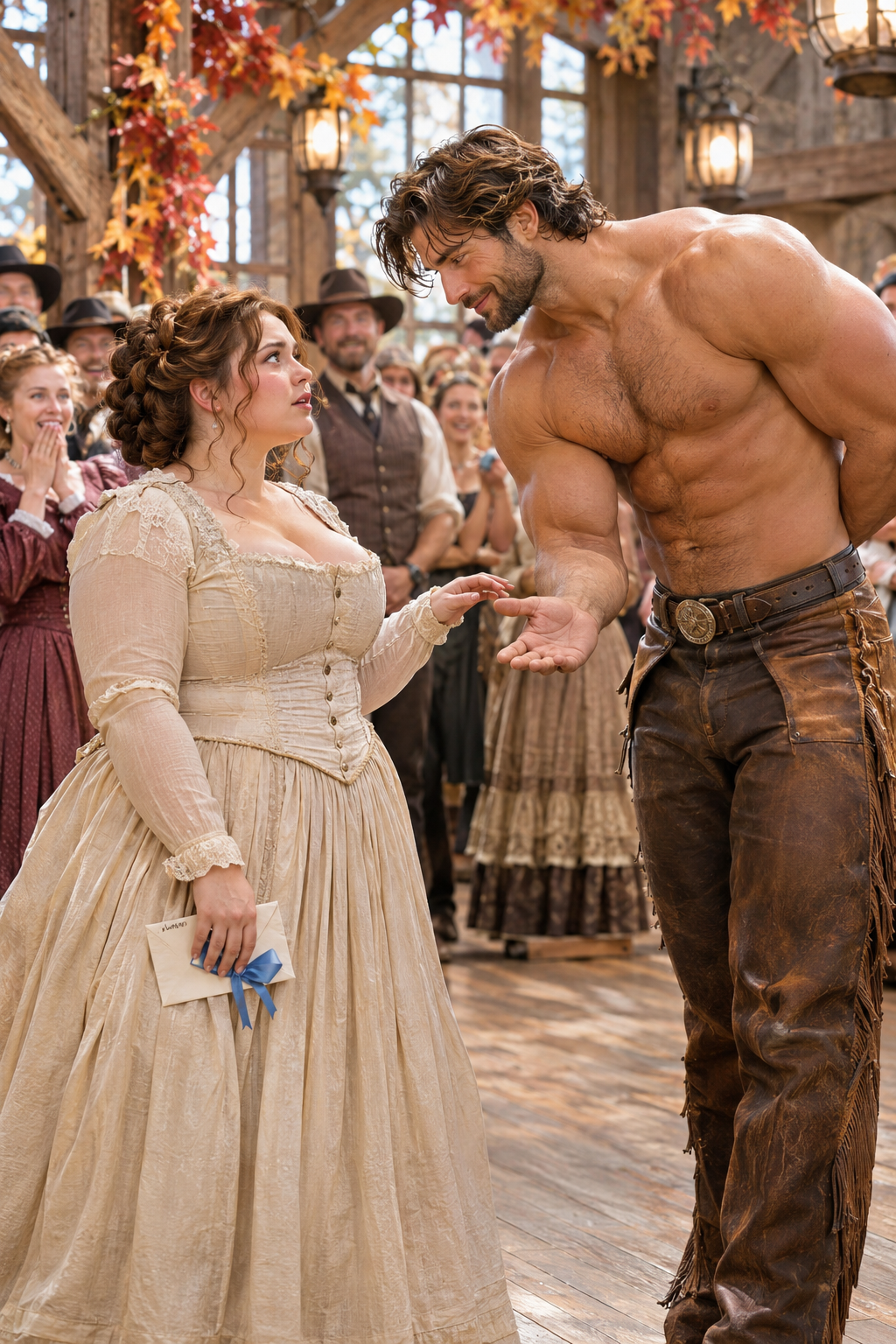
She shook her head.
“You shouldn’t have to defend me.”
“Perhaps not. But I won’t stand silent while someone is cruel.”
Rachel looked toward the window.
Across the street, Frank had already stopped to speak with another group.
The rumors were spreading.
And Charles had only just begun.
By Sunday, the entire town seemed to know about Rachel’s abandoned wedding.
Some details were true. Most were not.
Someone claimed she had followed Charles across three states. Another whispered that she had attempted to steal him from his late wife.
Customers began canceling orders.
Mrs. Fletcher returned a gown Rachel had spent two weeks making, claiming she no longer wished to associate with a woman of questionable character.
Rachel refunded the deposit without arguing.
By Wednesday, three more customers had disappeared.
Her savings were small. Winter was approaching. She could not afford to lose her business.
Then Charles returned.
He found her sitting alone at the worktable, staring at a pile of unfinished garments.
“Things seem difficult,” he observed.
Rachel did not look up.
“Leave.”
“I warned you people might misunderstand.”
“You encouraged them.”
Charles shrugged.
“People enjoy gossip. I merely answered questions.”
Rachel stood.
“What do you want?”
His pleasant expression vanished.
“I need money.”
The words surprised her.
“What?”
“My late wife’s family has become troublesome. There are debts. Investments that didn’t turn out as expected.”
Rachel stared at him.
“So this was never about reconciliation.”
“Don’t be dramatic. I did consider marrying you.”
“Because you thought I had money?”
“Because I heard you were friendly with Walker. And because you inherited that little property outside Springfield when your uncle died.”
Rachel’s heart lurched.
Her uncle had left her a modest parcel of land in Missouri, mostly rocky pasture and woodland. She had never sold it because it was the last thing connecting her to her mother’s family.
Charles leaned toward her.
“That land has become valuable. There’s a railroad survey passing nearby. Men are offering generous sums.”
Rachel had heard nothing about it.
“I don’t know what you’re talking about.”
“Then I’ll explain. Sign the property over to me, and I’ll make certain everyone learns that the rumors were exaggerated.”
Rachel felt sick.
“You created those rumors to force me to give you my land.”
Charles smiled.
“Think of it as a practical arrangement.”
“And if I refuse?”
“Your business may not survive another month.”
Rachel walked toward the door.
“Get out.”
Charles caught her wrist.
“Don’t make this difficult.”
She tried to pull away.
His grip tightened.
Suddenly, a voice sounded from behind him.
“Take your hand off her.”
Ben stood in the doorway.
His face was dangerously calm.
Charles released Rachel immediately.
“We were having a private conversation.”
“Then it appears the conversation is over.”
Charles straightened his coat.
“You must be Walker. I’ve heard a great deal about you.”
“And I’ve heard enough about you.”
For a moment, Charles looked ready to argue.
Then he smiled.
“Be careful, Mr. Walker. You don’t know what sort of woman you’re defending.”
Ben moved aside, leaving the doorway open.
“I know exactly what sort of man I’m asking to leave.”
Charles departed without another word.
Rachel sank into a chair.
Ben knelt beside her.
“Are you hurt?”
“No.”
But her voice broke.
And once it did, she could no longer contain the tears.
She told him everything.
About the wedding, the lies, the property, and Charles’s threats.
Ben listened without interrupting.
When she finished, he took her hand.
“Rachel, we need to speak with Sheriff Thompson.”
“He’ll deny it.”
“Probably.”
“And people will believe him.”
Ben shook his head.
“Some might. But that doesn’t mean we should let him win.”
The following morning, they visited the sheriff.
Sheriff Thompson was a broad-shouldered widower who had known Rachel since she first arrived in Pine Hollow.
He listened carefully, then frowned.
“Threatening a woman over her property is serious business. But without witnesses, it’ll be your word against his.”
Rachel lowered her eyes.
“I expected that.”
The sheriff leaned forward.
“That doesn’t mean we’re finished.”
He asked to see the letters from Missouri.
Rachel brought them that afternoon.
Among them, they discovered an older letter from her uncle’s attorney confirming her ownership of the Springfield property.
Another contained a warning written shortly before her uncle’s death.
Rachel read it aloud.
“Charles Webb has inquired repeatedly about the western boundary. I advise against discussing any sale with him.”
She looked up.
“He was asking about my land before he married his wife.”
Ben exchanged a glance with the sheriff.
“Then this isn’t a sudden opportunity,” Ben said. “He’s been watching that property for years.”
Sheriff Thompson tapped the letter.
“I’ll send a telegram to Springfield. Let’s see what the county records tell us.”
For the first time since Charles appeared, Rachel felt a small spark of hope.
But that hope lasted only two days.
On Friday night, someone broke into her shop.
The front window was smashed. Drawers had been overturned. Fabric lay scattered across the floor.
Her sewing machine, the one possession she had carried all the way from Missouri, had been knocked from its table.
The metal wheel was broken.
Rachel stood among the wreckage, unable to move.
Then she saw the empty drawer.
Her property papers were gone.
So was the bundle of letters.
She dropped to her knees beside the ruined machine.
It had belonged to her mother.
When her mother died, Rachel had promised never to sell it, no matter how desperate things became.
Now its iron frame was bent, and pieces of the mechanism lay among broken glass.
Ben arrived with the sheriff minutes later.
He found Rachel gathering the broken pieces with trembling fingers.
“I can fix it,” she whispered.
Ben knelt beside her.
“We’ll find someone who can.”
“You don’t understand. My mother taught me to sew on this machine.”
Her voice cracked.
“It’s all I have left of her.”
Ben took the damaged wheel from her hands.
“No, Rachel.”
She looked at him.
“Your mother’s greatest gift wasn’t this machine. It was what she taught you to do with your hands and your heart. No one can break that.”
Rachel began crying again.
This time, she allowed him to hold her.
Outside, Sheriff Thompson examined the footprints beneath the shattered window.
He found something else, too.
A brass button engraved with the initials C.W.
But Charles had already disappeared from town.
The next morning, a telegram arrived from Springfield.
The sheriff read it twice.
Then he summoned Rachel and Ben to his office.
“Your uncle’s land is worth considerably more than Webb suggested,” he explained. “The railroad company has negotiated for a right-of-way nearby. But that’s not the important part.”
He unfolded a second message.
“Charles Webb is wanted in Missouri for suspected fraud. His late wife’s family claims he forged documents to seize her inheritance.”
Rachel stared at him.
The sheriff continued.
“He isn’t merely trying to steal your property. He’s trying to escape creditors before they catch him.”
“Then where is he?” Ben asked.
The sheriff’s face grew grave.
“He bought a ticket on tomorrow’s eastbound stagecoach.”
Rachel felt a chill.
“If he has my papers, he might try to sell the land before anyone realizes.”
“Not without proving ownership,” the sheriff said. “But a skilled forger can cause a great deal of damage.”
Ben stood.
“Then we find him tonight.”
They searched the boardinghouse, the livery stable, and the abandoned mining cabins beyond town.
Nothing.
By sunset, the temperature had dropped sharply, and dark clouds gathered over the mountains.
Rachel returned to her damaged shop, exhausted and frightened.
She was locking the back door when a small figure appeared in the alley.
It was Annie Miller, the ten-year-old girl whose brothers Rachel had clothed the previous winter.
“Miss Dawson?”
Rachel turned.
“Annie? What are you doing out here?”
The girl twisted her apron.
“I think I saw the bad man.”
Rachel crouched beside her.
“What bad man?”
“The one who broke your window.”
Rachel’s heart began pounding.
Annie explained that she had been fetching water late Friday evening when she saw Charles carrying a leather satchel behind the old grain warehouse.
She had hidden because he was arguing with another man.
“What did they say?”
Annie swallowed.
“Something about a train. And a paper that needed a woman’s name.”
Rachel took the girl’s hands.
“Did you recognize the other man?”
Annie nodded.
“Mr. Harris.”
Frank Harris.
Within minutes, Rachel was running toward the sheriff’s office.
But as she crossed the street, a hand seized her from behind.
A cloth pressed over her mouth.
She struggled fiercely, knocking against a wagon, but someone dragged her into the narrow passage between two buildings.
“Quiet,” Charles hissed.
Frank Harris stood beside him, pale and sweating.
Rachel kicked Charles hard in the shin.
He cursed.
“Stop fighting!”
Frank caught her arms.
“We only need her signature,” he muttered nervously. “You said nobody would get hurt.”
“Then keep her quiet.”
They forced her into a covered wagon and drove toward the old grain warehouse beyond the edge of town.
By the time the wagon stopped, rain had begun falling.
Inside the warehouse, Charles lit a lantern and spread several documents across a wooden crate.
“Sign these,” he ordered.
Rachel recognized her uncle’s property description.
The documents were written as though she had voluntarily sold the land to Charles.
“I won’t.”
Charles removed a pistol from his coat.
Frank recoiled.
“You said you weren’t bringing that!”
“Shut up.”
Rachel felt her fear sharpen into something colder.
Charles placed the pistol beside the papers.
“Sign, Rachel. Then you can go home.”
She looked at the documents.
There was no point pleading with him. She had spent years learning that cruelty did not soften simply because its victim was frightened.
Instead, she forced herself to think.
Her mother had once told her that a good seamstress must learn to see the whole garment, not merely the stitch in front of her.
Rachel studied the room.
There was a rear door.
A stack of empty grain sacks.
A broken ladder leading to a narrow storage loft.
And near her right hand, partly hidden beneath her sleeve, was the small sewing scissors she always carried.
She lowered her eyes.
“All right.”
Charles relaxed.
“At last.”
“But my hands are shaking. I need a moment.”
He pushed a pen toward her.
Rachel reached for it, deliberately knocking over the lantern.
Flames spilled across the dusty floor.
Frank shouted.
Charles lunged to save the papers.
Rachel slashed the rope binding her wrists with the scissors and ran toward the rear door.
A gunshot thundered through the warehouse.
Wood splintered beside her head.
She screamed and stumbled.
Behind her, Charles cursed.
Then another voice roared from outside.
“RACHEL!”
Ben.
The rear door burst open.
Ben rushed inside with Sheriff Thompson and two ranch hands.
Charles swung the pistol toward them.
“Stay back!”
Ben stopped immediately.
Rachel stood between him and the gun.
For one terrible second, nobody moved.
Then Frank Harris dropped to his knees.
“I didn’t know he’d use a gun!” he shouted. “I swear I didn’t!”
Charles glanced toward him.
That moment of distraction was enough.
Rachel grabbed a heavy grain sack and hurled it toward Charles.
He fired wildly.
The bullet struck a roof beam.
Ben rushed forward, tackling him to the ground.
The pistol skidded across the floor.
Sheriff Thompson seized it while the ranch hands restrained Charles.
But the fallen lantern had ignited the dry grain dust and old sacks.
Fire climbed the wall.
“Everybody out!” the sheriff shouted.
Ben turned toward Rachel.
She was standing beside the doorway, coughing violently.
He reached her just as a burning beam crashed down behind them.
They stumbled into the rain together.
Outside, Rachel collapsed against his chest.
Ben held her so tightly she could barely breathe.
For a long moment, neither spoke.
Then he whispered, “I thought I’d lost you.”
Rachel lifted her head.
His face was streaked with soot and rain.
“How did you find me?”
“Annie saw the wagon. She told the sheriff. Then she came running to the ranch.”
Rachel closed her eyes.
The little girl whose coat she had sewn had helped save her life.
Sometimes kindness traveled farther than anyone could imagine.
Charles and Frank were taken into custody before midnight.
Frank confessed almost immediately.
Charles had promised him a share of the land sale if he helped spread rumors and frighten Rachel into signing the papers.
He admitted breaking into the shop and stealing the letters.
The stolen documents were recovered from Charles’s satchel, and the sheriff arranged for Missouri authorities to take custody of him.
For Rachel, however, the hardest part was still ahead.
The following Sunday, Sheriff Thompson gathered several witnesses at the town hall to record Frank’s confession and explain the charges.
Nearly everyone in Pine Hollow attended.
Rachel stood near the back, wishing she were anywhere else.
She listened while Frank described how he had deliberately humiliated her at the dance because Charles had paid him to make her feel unwanted.
The admission swept through the room like a cold wind.
Mrs. Fletcher covered her mouth.
Several people exchanged horrified glances.
When Frank finished, the sheriff asked whether anyone had questions.
For a moment, there was silence.
Then Mrs. Fletcher rose.
“Miss Dawson,” she said, her voice trembling, “I owe you an apology.”
Rachel looked at her.
“I believed things I had no right to believe. And I treated you shamefully.”
Another woman stood.
Then another.
Soon, apologies came from every corner of the room.
Rachel listened without speaking.
Finally, she walked to the front.
The crowd fell quiet.
“I appreciate your apologies,” she began. “But there’s something I need you to understand.”
She looked around the hall.
“Even if every rumor about my broken engagement had been true, I would not have deserved to be mocked or mistreated.”
No one moved.
“I came to Pine Hollow with very little. I worked hard. I tried to be a good neighbor. Yet one man’s words were enough to make many of you forget everything you knew about me.”
Her voice strengthened.
“I don’t ask you to think I’m beautiful. I don’t ask you to admire my clothes or approve of my life. But I do ask you to remember that a person’s worth is not decided by gossip, wealth, or whether someone chooses to marry them.”
A woman near the front began crying.
Rachel continued.
“I spent years believing I had been rejected because there was something wrong with me. I understand now that the shame belonged to the man who was cruel, not the woman he hurt.”
She paused.
“And I won’t carry that shame anymore.”
When she finished, the room remained silent.
Then Annie Miller began clapping.
Her mother joined her.
Soon the entire hall was applauding.
Rachel looked toward the back.
Ben stood with his hat in his hands, smiling at her with an expression she would remember for the rest of her life.
But Rachel’s story did not end with a public apology.
Over the following weeks, something remarkable happened.
The women who had once avoided her shop began returning, not simply to place orders but to offer help.
Mrs. Fletcher brought fabric.
Mrs. Miller helped clean the damaged workroom.
A retired blacksmith repaired the sewing machine’s broken wheel, refusing payment.
And Ben arranged for a carpenter to replace the shattered window.
Rachel insisted on paying for the work.
Ben merely smiled.
“Then consider it an investment. High Creek Ranch needs a reliable seamstress.”
By Christmas, Rachel’s shop was busier than ever.
She also received a letter from the attorney in Springfield.
Her land had been secured, and the railroad company was interested in purchasing a narrow portion of it for a fair price.
The money would be enough to expand her business.
But Rachel had another idea.
One snowy afternoon, she asked Ben to meet her at the shop.
He arrived carrying a small wooden box.
“I was hoping to speak with you,” he said.
Rachel smiled.
“Then perhaps we both have something important to say.”
She showed him a drawing she had made.
It was a plan for a larger workshop with six sewing tables and a small classroom.
“I want to teach women who need a way to support themselves,” she explained. “Widows. Girls without families. Anyone who’s been told they aren’t capable of making a living.”
Ben studied the drawing.
“You could build something wonderful.”
“I’m going to try.”
He looked at her for a long moment.
Then he set the wooden box on the counter.
“I brought you something.”
Rachel opened it.
Inside was a beautiful silver thimble engraved with a tiny rose.
Ben cleared his throat.
“My mother used to say that the strongest things in life are often held together by the smallest stitches.”
Rachel touched the thimble gently.
“Ben, it’s lovely.”
He took a breath.
“Rachel, I didn’t ask you to dance that night because I wanted to rescue you.”
“I know.”
“I asked because I’d admired you for months. I admired the way you treated people, the way you worked, and the courage it took to keep being kind in a town that wasn’t always kind to you.”
Her eyes filled.
He continued.
“Somewhere along the way, admiration became something much greater.”
Ben reached for her hand.
“I love you, Rachel Dawson.”
She stared at him, unable to speak.
“I don’t need an answer today,” he said quickly. “And I don’t want you to feel that you owe me anything. I only wanted you to know.”
Rachel laughed through her tears.
“You really are a stubborn man.”
“I’ve been told.”
She stepped closer.
“I love you too.”
Ben closed his eyes briefly, as though he had been holding his breath for months.
Then he kissed her, gently and without hesitation.
When he drew back, Rachel was smiling.
“But there’s something you should know,” she said.
“Anything.”
“I intend to build that workshop. I intend to run it. And I will never again make myself smaller to fit someone else’s expectations.”
Ben grinned.
“Good. I wouldn’t know what to do with a wife who did.”
Rachel raised an eyebrow.
“Wife?”
His face turned crimson.
“I seem to have gotten ahead of myself.”
She laughed so hard that she had to sit down.
Then Ben knelt beside her chair.
“Rachel Dawson, would you consider marrying a rancher who is occasionally foolish, frequently stubborn, and completely in love with you?”
She looked into his eyes.
Five years earlier, she had dreamed of marrying a man because she believed his love would prove she was worthy.
Now she knew better.
She was worthy whether she married or not.
And because she finally understood that, she could choose love without losing herself.
“Yes, Ben,” she whispered. “I would.”
They married the following spring beneath the blooming apple trees at High Creek Ranch.
Rachel wore a simple ivory gown she had sewn herself.
There were no expensive jewels or elaborate decorations.
Only flowers, music, friends, and two people who had chosen each other freely.
At the reception, the musicians began playing a waltz.
Ben offered Rachel his hand.
“May I have this dance, Mrs. Walker?”
She smiled.
“You certainly may.”
They stepped onto the wooden floor.
This time, Rachel did not glance around to see who was watching.
She did not worry about the shape of her body or whether her dress was fashionable.
She simply danced.
And when the music ended, Ben kissed her forehead.
Across the room, Annie Miller watched with shining eyes.
“Miss Rachel looks like a princess,” she whispered.
Her mother smiled.
“No, sweetheart. She looks like a woman who finally knows her own worth.”
Years passed.
Rachel’s workshop became one of the most respected businesses in the territory.
Dozens of women learned to sew there. Some opened their own shops. Others found employment or gained the confidence to begin entirely new lives.
Above the workshop door, Rachel hung a wooden sign bearing words she had chosen herself.
“Every Stitch Begins With Hope.”
Whenever a frightened young woman arrived, believing she had nothing valuable to offer, Rachel would invite her inside, place a needle in her hand, and tell her a story.
Not about a wealthy rancher who had rescued an unwanted seamstress.
But about a woman who had once allowed the cruelty of others to define her.
A woman who discovered that rejection did not make her unlovable, that kindness was not weakness, and that no person’s judgment could diminish the value of her heart.
And sometimes, when the evening light settled over Pine Hollow, Ben would come to the workshop after finishing his work at the ranch.
He would find Rachel standing among the sewing tables, her hair loosely pinned, her hands busy with fabric.
He would hold out his hand.
“Mrs. Walker, would you honor me with a dance?”
And Rachel, remembering the night when seven men had refused her, would smile.
Because the greatest happiness of her life had not begun when one man finally asked her to dance.
It had begun when she stopped believing that anyone else’s refusal meant she was unworthy of being loved.
The world would always contain people who measured beauty by appearances, success by money, and human worth by the approval of others.
But Rachel had learned something those people might never understand.
A person does not become valuable when someone finally recognizes their worth.
They were valuable all along.
And sometimes, the most beautiful love story is not about finding someone who chooses you.
It is about learning to choose yourself first, so that when love finally comes, you can welcome it not as a rescue, but as a gift.
But life, as Rachel would later discover, had one final lesson waiting for her.
It came on a cold November morning, nearly twelve years after the night Ben Walker first asked her to dance.
Rachel was standing inside her workshop, watching a young woman struggle to thread a needle. The girl was barely eighteen, with tired eyes and a nervous habit of apologizing for everything.
Her name was Clara.
She had arrived in Pine Hollow three weeks earlier, carrying a small suitcase and a baby boy. Her husband had abandoned her, and she had been turned away from two boardinghouses because she had no money.
Rachel had given her work, a warm room, and something Clara had nearly forgotten existed.
A reason to hope.
“I’m sorry, Mrs. Walker,” Clara whispered after dropping the needle for the third time. “I’m not very good at this.”
Rachel pulled up a chair beside her.
“Neither was I when I started.”
Clara looked doubtful.
“But everyone says you’re the finest seamstress in Montana.”
Rachel smiled.
“Everyone sees the finished dress, dear. They rarely see the crooked stitches that came before it.”
Clara laughed softly.
At that moment, the workshop door opened.
Ben entered, his hat dusted with snow.
“Rachel,” he said quietly, “there’s someone at the ranch asking for you.”
Something in his voice made her look up.
“Who?”
Ben hesitated.
“Charles Webb.”
The needle slipped from Rachel’s fingers.
For twelve years, she had not heard that name spoken inside her home.
Charles had been convicted of fraud and attempted extortion. After serving his sentence, he had disappeared from the lives of everyone who knew him.
Rachel had assumed she would never see him again.
“Why is he here?” she asked.
“He says he’s dying.”
The workshop grew silent.
Rachel looked toward the window, where snowflakes drifted past the glass.
For a long moment, she felt the old fear stirring.
Then she realized something remarkable.
It no longer controlled her.
“Where is he?”
“In the barn. I wouldn’t let him near the house.”
Rachel removed her apron.
“I’ll speak with him.”
Ben studied her.
“You don’t owe that man anything.”
“I know.”
She took his hand.
“That’s why I can decide for myself.”
They walked together through the snow.
Charles was sitting on a wooden bench near the stable entrance.
Rachel almost failed to recognize him.
His once-golden hair had turned gray. His shoulders were bent, and the confident smile that had fooled so many people was gone.
He looked like a man who had spent years running from himself and finally discovered there was nowhere left to go.
When he saw Rachel, he struggled to stand.
“Hello, Rachel.”
She stopped several feet away.
“Charles.”
He glanced at Ben.
“I suppose you have every reason to throw me off your property.”
“Yes,” Ben replied.
Charles lowered his head.
“I won’t be long.”
He reached into his coat and withdrew a worn envelope.
“I’ve carried this for almost ten years.”
Rachel did not take it.
“What is it?”
“A letter. An apology, I suppose. Though that hardly seems like enough.”
Charles coughed violently before continuing.
“When I left prison, I thought everyone else was responsible for what happened to me. You. Walker. The sheriff. Even Frank Harris.”
He looked at his trembling hands.
“But after a while, there was no one left to blame.”
Rachel remained silent.
“I lost everything because I spent my life believing that having more money, more respect, more power would make me worth something.”
His voice cracked.
“And every time I couldn’t get what I wanted, I hurt someone who stood in my way.”
He held out the envelope.
“I’m not asking you to forgive me. I only wanted you to know that I finally understand what I did.”
Rachel accepted the letter.
For several moments, she stared at his handwriting.
Then she looked at him.
“Charles, you took years of peace from me. You made me believe I was something to be ashamed of. And when I finally rebuilt my life, you came back intending to destroy it.”
Tears gathered in his eyes.
“I know.”
“I cannot give you those years again. And neither can you.”
He nodded.
“But I can tell you this,” Rachel continued. “I no longer hate you.”
Charles looked up, astonished.
“That doesn’t mean what you did was acceptable. It doesn’t mean we can become friends. And it certainly doesn’t mean you have a place in my life.”
Her voice remained gentle but firm.
“It means I refuse to spend another day carrying the bitterness you left behind.”
Charles began to cry.
Not loudly or dramatically.
Just the quiet, exhausted tears of a man who understood too late how much he had wasted.
Rachel turned to Ben.
“Will you ask the doctor to examine him before he travels?”
Ben nodded.
Charles stared at her.
“After everything I did, you’d still help me?”
Rachel wrapped her shawl more tightly around her shoulders.
“I won’t let you hurt me again, Charles. But I won’t allow what you did to turn me into someone cruel, either.”
She walked away with Ben beside her.
She never saw Charles again.
Several months later, a letter arrived informing her that he had died in a small boardinghouse in Wyoming.
Rachel read the news quietly, then placed the letter in a drawer.
She felt sadness for the life he had wasted, but no regret for the life she had chosen.
That evening, Ben found her sitting on the porch, watching the sunset turn the mountains gold.
He settled beside her.
“Are you all right?”
Rachel leaned against his shoulder.
“Yes. I think I finally am.”
Ben kissed her hair.
They sat together until the first stars appeared.
From inside the house came the laughter of their two children, followed by the sound of little feet racing across the wooden floor.
Their daughter, Rose, burst onto the porch.
“Papa! Mama! Come quickly!”
Ben laughed.
“What is it, sweetheart?”
“Thomas says girls can’t run a ranch!”
Their son appeared behind her, looking thoroughly offended.
“I only said she doesn’t know how to rope a calf!”
Rose crossed her arms.
“Because nobody’s taught me!”
Rachel exchanged a glance with Ben.
Then she stood and knelt before her daughter.
“Rose, listen carefully. There will always be people who tell you what you cannot do.”
The little girl frowned.
“Even when they’re wrong?”
“Especially when they’re wrong.”
Rachel brushed a loose curl from Rose’s forehead.
“But you must never let their words decide what you believe about yourself.”
Rose considered this.
Then she turned toward Ben.
“Papa, will you teach me to rope a calf tomorrow?”
Ben grinned.
“First thing after breakfast.”
Thomas groaned.
“She’ll never stop talking about it.”
Rachel laughed and gathered both children into her arms.
Years earlier, she had stood alone in a crowded ballroom, convinced that nobody would ever choose her.
Now, surrounded by the family she loved and the life she had built, she understood how mistaken she had been.
Her happiness had never depended on proving those seven men wrong.
It had depended on refusing to let their cruelty become the truth she believed about herself.
On the night of Rachel’s fiftieth birthday, the people of Pine Hollow organized a celebration in the newly expanded town hall.
The building overflowed with neighbors, friends, ranch hands, and women whose lives had been changed by Rachel’s workshop.
Clara was there, now the successful owner of a dressmaking business in Helena. Her son, almost grown, stood proudly beside her.
Annie Miller, once the little girl who had helped save Rachel from the warehouse, had become the town’s schoolteacher.
And on the wall near the entrance hung a framed photograph of the first six women who had graduated from Rachel’s sewing program.
When the musicians began playing, Ben approached Rachel.
His dark hair had turned silver at the temples, and a few more lines had appeared around his eyes.
But the warmth of his smile had never changed.
He bowed with exaggerated formality.
“Mrs. Walker, I was wondering whether your dance card might have an opening.”
Rachel laughed.
“After all these years, you still haven’t learned to ask properly?”
Ben extended his hand.
“Then allow me to try again. Rachel Dawson Walker, would you do me the extraordinary honor of sharing this dance?”
She looked at the man who had stood beside her through fear, hardship, joy, and ordinary days made beautiful by love.
“There’s nothing I’d like more.”
They moved onto the dance floor.
Around them stood people of every age, shape, and circumstance.
Some were wealthy. Others had barely enough to get by.
Some were married. Some had lost their spouses. Some had never found love at all.
But for that evening, nobody was left standing against the wall because they were considered unworthy.
Rachel had insisted on one rule when the celebration was planned.
Everyone who wanted to dance would be welcomed.
As the music swelled, she noticed a shy young woman standing near the doorway, clutching her shawl.
Rachel recognized the look in her eyes.
She had worn that same expression once.
Rachel gently touched Ben’s arm.
“Would you excuse me for a moment?”
He followed her gaze and understood.
“Of course.”
Rachel crossed the room and approached the young woman.
“Good evening, dear. Are you enjoying yourself?”
The girl gave an embarrassed smile.
“I’m afraid I don’t know anyone.”
“Then you know me now.”
Rachel offered her hand.
“Come. Let me introduce you to some friends.”
The girl’s eyes widened.
“But I don’t know how to dance.”
Rachel smiled.
“Neither did I, once. And I discovered that nobody has to be perfect to deserve a place on the dance floor.”
Together, they stepped into the circle of music and laughter.
Ben watched from a short distance, his heart full.
And Rachel, for one brief moment, remembered the blue dress, the empty dance card, and the terrible laughter of a man who thought her body made her less deserving of respect.
She remembered the shame she had carried.
The fear she had overcome.
The people she had helped.
And the love she had learned to accept without surrendering herself.
Then she looked around the room and realized that the most important part of her story had never been the moment Ben Walker chose her.
It was every moment afterward when she chose courage over fear, compassion over bitterness, and dignity over the opinions of those who did not know her heart.
For beauty fades, wealth changes hands, and the applause of strangers is never guaranteed.
But kindness can outlive the person who offers it.
Courage can inspire generations.
And a single act of compassion can begin a chain of goodness that reaches farther than anyone could imagine.
Rachel Dawson had once believed she was a woman nobody wanted to dance with.
In the end, she became the woman who made certain nobody else would ever have to feel that way.
And that was a legacy far greater than any fortune, any beautiful dress, or any invitation to dance.
Because the true measure of a life is not how many people choose to stand beside us when we are admired.
It is how many people find the courage to stand tall because we once stood beside them when they were alone.
THE END.