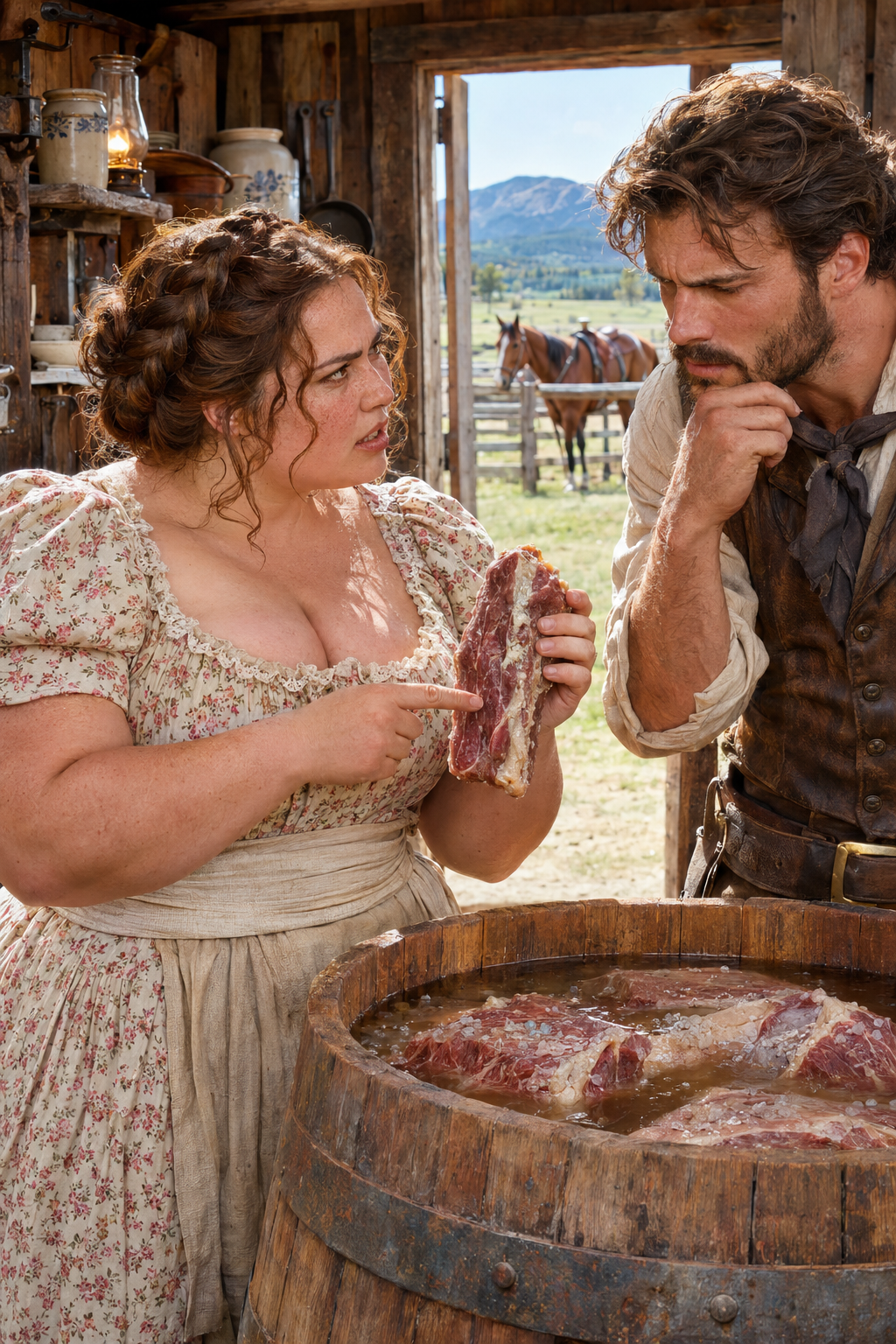
Ruth Bellamy threw a piece of salt beef into the waste bucket just as the ranch foreman walked into her kitchen.
“We’re taking the valley road,” Daniel announced. “And we’re leaving forty head of cattle behind.”
The foreman, Caleb Harker, stared at him as though he had just suggested setting fire to the barn.
“Forty head? Daniel, that’s nearly a fifth of what we’re driving to market!”
“I know exactly how many cattle we’re leaving.”
“Then you know what that means for the bank.”
Daniel folded the map and looked toward Ruth.
“It means we might get to market with every man still standing. That’s worth more to me than forty steers.”
Caleb opened his mouth to argue, then closed it.
Ruth felt an unexpected warmth rise in her chest. She had expected anger, perhaps dismissal. Instead, Daniel Mercer was risking his ranch to protect the people who worked for him.
But gratitude did nothing to quiet her conscience.
“Mr. Mercer,” she said, “there might be another way.”
Both men turned.
“My husband used to haul freight through the southern valley. There’s an old trading post near Blackwater Creek. If it’s still operating, we might be able to purchase provisions there.”
Caleb shook his head.
“Blackwater’s been abandoned for years.”
“The trading post, perhaps,” Ruth replied. “But the valley wasn’t empty the last time I passed through. There were homesteaders, small farms, and a mill near the creek. People have to eat somewhere.”
Daniel studied her.
“How long ago?”
“Six years.”
“A great deal can change in six years.”
“I know.”
Her voice softened. Six years was long enough for a husband to disappear into a fever, for a comfortable home to be sold, and for a woman who had once believed herself secure to find employment cooking for strangers.
But it was also long enough to learn that pride rarely filled an empty stomach.
“If there’s still a settlement,” she continued, “we might trade for food instead of buying it.”
“What do we have to trade?” Caleb demanded.
Ruth glanced toward the smokehouse.
“Leather, spare horseshoes, tools, perhaps even a few cattle. And something else.”
“What?”
“Work.”
Caleb gave a humorless laugh.
“You expect twenty-seven cowboys to become hired farmhands?”
“I expect hungry men to do whatever honest work keeps them alive.”
Daniel looked at the map again.
Then, slowly, he smiled.
“Caleb, gather the men. We’re taking the valley road, but we’re keeping the herd together for now.”
“That’s a gamble.”
Daniel’s eyes rested on Ruth.
“So is trusting a cook who throws away half our supper.”
Ruth stiffened, but his smile widened.
“And so far, that’s the best gamble I’ve made all week.”
By noon, Mercer Ranch had become a whirlwind of activity.
Wagons creaked beneath carefully measured supplies. Saddles were inspected. Horses were watered. Every scrap of usable food was wrapped, counted, and recorded.
Ruth supervised the packing herself.
She marked each flour sack with charcoal, divided the beans into daily portions, and established strict rations.
When one cowboy complained that breakfast looked smaller than usual, she fixed him with a stare.
“You can have two breakfasts today or one breakfast for the next two days. Which sounds wiser?”
The others laughed, and the complaints stopped.
Yet beneath the laughter, everyone understood that the ranch was in trouble.
They departed the following morning beneath a pale autumn sky.
Daniel rode near the front, while Caleb managed the cattle. Ruth traveled in the supply wagon beside a young ranch hand named Eli Turner, who had been assigned to help with cooking and camp duties.
Eli was nineteen, talkative, and perpetually hungry.
“Mrs. Bellamy,” he asked on the second afternoon, “is it true you once cooked for a railroad crew?”
“Three summers.”
“Were they worse than cowboys?”
“They complained more.”
“Hard to imagine.”
“They also washed their plates.”
Eli considered that.
“Terrible people.”
Ruth laughed for the first time in days.
For a while, the journey went well.
The valley road wound between golden hills and stands of cottonwood trees. The cattle found enough grass, and the weather remained mild.
But on the fourth morning, Ruth discovered something that turned her blood cold.
Two sacks of flour were missing.
She counted twice.
Then a third time.
They had been there the previous evening. She remembered checking the ropes before retiring.
Now the wagon’s rear canvas had been loosened, and the flour was gone.
She found Daniel near the creek.
“Someone took supplies from the wagon.”
His expression hardened.
“How much?”
“Two sacks of flour.”
“Could they have fallen?”
“The ropes were untied.”
Daniel said nothing for a moment.
Then he called Caleb.
The foreman questioned the men, searched the camp, and examined the wagon tracks.
No one admitted knowing anything.
By afternoon, suspicion had settled over the cattle drive like dust.
Ruth noticed cowboys watching one another. Conversations stopped when someone approached. Even the evening meal was unusually quiet.
That night, Daniel sat beside her fire.
“I’ve ridden with most of these men for years,” he said. “I don’t want to believe one of them would steal food.”
“Hungry people sometimes do desperate things.”
“Are you defending whoever took it?”
“No. I’m saying we should understand why before deciding what kind of man he is.”
Daniel studied the flames.
“You think understanding makes betrayal easier?”
“I think it keeps us from making another mistake.”
He looked at her for a long moment.
“You speak as though you’ve learned that lesson the hard way.”
Ruth stirred the beans.
“My husband was a proud man. Too proud to tell anyone when our freight business began failing. By the time I learned the truth, he’d borrowed money from three different people.”
“What happened?”
“He worked himself sick trying to repay them. When the fever came, he kept working.”
Her spoon stopped moving.
“He died believing he’d failed me.”
Daniel’s face softened.
“I’m sorry.”
“I was angry with him for a long time. Not because we lost everything, but because he never trusted me enough to share the burden.”
The fire cracked between them.
Finally, Daniel said, “My wife used to tell me I treated every problem like a fence I could mend alone.”
Ruth looked up.
“Your wife?”
“Sarah. She died four winters ago.”
He glanced toward the dark hills.
“She was usually right.”
Neither spoke for several minutes.
Then Daniel rose.
“Tomorrow, we’ll search the wagons again. Quietly.”
But morning brought a problem far more dangerous than missing flour.
A cold wind swept down from the northern mountains. By midday, heavy clouds swallowed the sun.
Caleb rode back from scouting the trail with mud splashed across his coat.
“Bridge is gone,” he announced.
Daniel pulled his horse alongside him.
“Which bridge?”
“Blackwater crossing. Floodwater tore away half the timbers.”
Ruth’s stomach sank.
Without the bridge, the trading settlement lay on the opposite side of a swollen creek.
Worse, the valley road narrowed into steep ravines ahead. Turning the cattle around would cost at least two days.
And they didn’t have two days to waste.
Daniel surveyed the gathering storm.
“We’ll camp on high ground. Nobody goes near that creek until I’ve examined the crossing.”
Caleb nodded, but his eyes betrayed his worry.
That evening, Ruth counted the food again.
They had enough for five days at the reduced ration.
Seven, if she watered the beans heavily and stretched the flour with whatever edible roots and wild greens she could gather.
The market was still more than a week away.
She sat beside the wagon, staring at the inventory, when Eli approached.
“Mrs. Bellamy?”
“Not now, Eli.”
“There’s something I need to tell you.”
She looked up.
The young cowboy’s face was white.
“About the flour.”
Ruth rose slowly.
“What about it?”
“I know who took it.”
Her heart began pounding.
“Who?”
Eli swallowed.
“I did.”
For a moment, Ruth couldn’t speak.
Then she took his arm and led him behind the wagon.
“Where is it?”
“Gone.”
“Gone where?”
“I gave it to somebody.”
“Who?”
He stared at the ground.
“My mother.”
Ruth felt the anger drain from her face, replaced by confusion.
Eli explained in a trembling voice.
Three nights earlier, he had slipped away from camp to visit a small homestead beyond the ridge. His mother lived there with his two younger sisters.
Their crops had failed. Their father had abandoned them the previous spring. They had been surviving on wild potatoes and whatever game Eli could occasionally bring.
“I didn’t know what else to do,” he whispered. “Mama was so thin she could barely stand.”
“Why didn’t you ask Daniel?”
“Because Mr. Mercer is already struggling. I heard Caleb talking about the bank. I thought if I asked, he’d have to say no.”
Ruth closed her eyes.
There it was again.
Pride.
Fear.
A person carrying a burden alone until the burden became a disaster.
“You should have told me,” she said.
“I know.”
“You should have asked.”
“I know.”
“And you certainly shouldn’t have stolen from twenty-six men who need that flour.”
Eli began to cry.
Ruth had seen grown men face stampeding cattle without trembling. Somehow, watching this boy struggle to hold back tears hurt worse.
“Mr. Mercer will fire me,” he whispered.
“Perhaps.”
“My mother needs the wages.”
“Then you’d better tell him the truth before someone else does.”
Eli looked terrified.
But he nodded.
Daniel listened to the confession without interrupting.
When Eli finished, the ranch owner walked several paces away.
Ruth recognized the familiar tension in his shoulders.
At last, he turned.
“You stole from men who trusted you.”
“Yes, sir.”
“You put the entire drive at risk.”
“Yes, sir.”
“Do you understand what might have happened if we were caught in a blizzard without that food?”
Eli could barely answer.
“Yes, sir.”
Daniel glanced at Ruth.
Then he asked, “How far is your mother’s place?”
“About six miles.”
“Is there a well?”
“Yes, sir.”
“A barn?”
“A small one.”
“Any hay?”
“Some.”
Daniel turned toward Caleb, who had joined them.
“Take six men and scout the homestead. If it’s safe, we’ll move camp there tomorrow.”
Caleb stared at him.
“Daniel, you can’t be serious.”
“We need shelter. They have a barn, a well, and high ground.”
“And the boy stole from us.”
“I haven’t forgotten.”
Daniel faced Eli again.
“You’ll repay those two sacks from your wages. You’ll apologize to every man on this drive. And from now on, when your family needs help, you speak to me before taking what belongs to someone else.”
Eli stood motionless.
“You’re not firing me?”
“No. But you’re going to earn the trust you’ve damaged.”
The boy covered his face.
Ruth looked away, suddenly overcome.
Daniel had chosen responsibility without cruelty.
And somehow, the difference felt enormous.
The next day, the herd reached the Turner homestead just before the storm broke.
Eli’s mother, Margaret, stood on the porch in a faded blue dress, staring at the approaching cattle.
When she saw her son, she hurried down the steps.
“Eli? What’s happened?”
He embraced her and began explaining.
Ruth watched Margaret’s face change from relief to horror as she learned about the stolen flour.
“I never knew,” Margaret whispered. “He told me Mr. Mercer had given it to him.”
She turned toward Daniel.
“Sir, I can repay you. Not today, but when the spring crops come—”
Daniel raised a hand.
“Mrs. Turner, right now we need shelter more than promises.”
Margaret glanced at the herd.
“Our barn won’t hold your cattle.”
“No,” Caleb said, “but the grove behind your field might break the wind.”
“And your house,” Ruth added, “has a kitchen.”
Margaret stared at her.
Ruth smiled.
“Twenty-seven hungry men. I’ve never needed another pair of hands more.”
Within hours, the little homestead had become a makeshift headquarters.
Cowboys repaired the barn roof, reinforced the fences, and moved firewood beneath cover.
Ruth and Margaret worked side by side, preparing a stew from the remaining bacon, beans, and potatoes.
As rain battered the windows, Margaret revealed that several families along the creek had endured the same failed harvest.
“The mill shut down when the owner died,” she explained. “Without it, nobody could grind enough grain to sell. Half the families are planning to leave.”
“Who owns the mill now?” Ruth asked.
“His daughter, Clara Whitcomb. She lives across the creek near the old trading post.”
Ruth glanced toward Daniel, who had entered the kitchen.
“Is the mill damaged?”
“Not badly, last I heard. But the waterwheel’s been stuck since summer.”
Daniel’s expression changed.
“A broken mill,” he murmured. “And ranch hands who know machinery.”
Caleb appeared in the doorway.
“Don’t even think about it.”
Daniel smiled faintly.
“Too late.”
But before they could discuss a plan, a sharp crack echoed outside.
Then another.
A cowboy burst through the door.
“Mr. Mercer! The north fence has gone down!”
Daniel grabbed his coat.
Outside, the storm had turned violent.
Wind tore through the cottonwoods. Rain struck the earth so hard it seemed to rise in clouds.
The cattle were bunching together near the broken fence, their frightened bellows carrying over the thunder.
Caleb and the men rode out immediately.
Ruth watched from the porch as lanterns disappeared into the darkness.
Then she heard a scream.
Not a human scream.
A horse.
A rider had fallen near the muddy embankment.
Ruth seized a lantern and ran.
“Mrs. Bellamy!” Margaret shouted. “Come back!”
But Ruth had already spotted the fallen figure.
It was Eli.
His horse stood nearby, trembling, while the young man lay half-submerged in rushing water.
Ruth dropped to her knees.
“Eli!”
His eyes opened weakly.
“My leg.”
She tried pulling him upright, but he cried out.
The current grew stronger.
Ruth looked toward the house, barely visible through the rain.
No one could hear her.
Then a voice rang behind her.
“Ruth!”
Daniel.
He slid down the embankment, grabbed Eli beneath the shoulders, and shouted for Ruth to take his other arm.
Together, they dragged the boy clear of the water.
But as they struggled uphill, the muddy bank collapsed.
Daniel lost his footing.
Ruth caught his sleeve just as he slipped toward the flooded creek.
For one terrible instant, she felt his entire weight pulling her down.
“Let go!” he shouted.
She tightened her grip.
“No!”
“Ruth, you’ll fall!”
“Then stop talking and climb!”
Daniel found a foothold against an exposed tree root.
With a desperate effort, he hauled himself upward.
They collapsed onto solid ground just as Caleb and two cowboys arrived.
Eli was carried into the house, where Ruth discovered his leg was broken.
She fashioned a splint from wooden slats while Margaret held her son.
Daniel stood nearby, soaked and shivering.
When Ruth finished, he approached her quietly.
“You could have been killed.”
“So could you.”
“You shouldn’t have followed him down there.”
“And you shouldn’t have expected me to let you drown.”
He looked at her, something unspoken passing between them.
Then he nodded.
“Fair enough.”
By dawn, the storm had passed.
But it left destruction behind.
The creek had risen higher than anyone remembered. The bridge was completely gone, and sections of the valley road had washed away.
Worse, Caleb returned from checking the herd with devastating news.
Seventeen cattle were missing.
Some had escaped through the broken fence. Others might have been swept downstream.
Daniel stood in the muddy yard, staring at the numbers Caleb had written on a scrap of paper.
The ranch’s financial future was slipping away one disaster at a time.
Then a rider appeared on the eastern ridge.
He approached beneath a black coat, leading a gray horse.
Caleb recognized him first.
“That’s Silas Crowe.”
Daniel’s face hardened.
Crowe was a cattle broker with a reputation for purchasing distressed ranches at ruinously low prices.
He dismounted and smiled.
“Heard you had trouble, Mercer.”
“News travels fast.”
“Especially when a man’s bank payment is overdue.”
Ruth, standing near the porch, saw Daniel’s jaw tighten.
“The payment isn’t due for another sixteen days.”
“That’s what makes this situation so unfortunate.”
Crowe withdrew a folded document.
“I purchased your note from the bank three days ago.”
The yard went silent.
Daniel took the paper.
His eyes moved across the page.
“What do you want?”
Crowe’s smile widened.
“Your ranch.”
Caleb stepped forward angrily, but Daniel raised a hand.
Crowe continued.
“I’ll forgive the debt if you sign the property over. You can keep a hundred dollars and whatever personal belongings you can carry.”
“A hundred dollars?” Caleb exploded.
“Generous, considering the circumstances.”
Ruth watched Daniel’s expression become strangely calm.
“When is the payment legally due?”
“Sixteen days, as you said.”
“Then you can’t seize anything today.”
“Not today.” Crowe glanced toward the ruined crossing. “But I doubt you’ll get those cattle to market in sixteen days.”
He mounted his horse.
“My offer expires tomorrow at sundown.”
After he rode away, Caleb kicked a fence post.
“That vulture’s been circling us for months!”
Daniel remained silent.
Ruth approached him.
“You’re not considering his offer?”
“I have twenty-seven men depending on wages, a ranch full of animals to feed through winter, and sixteen days to produce money I don’t have.”
“That’s not an answer.”
He looked at her.
“No. It’s the truth.”
That afternoon, Ruth went to the supply wagon and examined her inventory one final time.
Then she asked Margaret to bring every household ledger she possessed.
Margaret returned with three thin notebooks.
“What are you looking for?”
“Something we’ve overlooked.”
They studied the records for hours.
There were notes about crops, seed purchases, livestock, and the old mill.
Then Ruth noticed a name.
Clara Whitcomb.
Beside it was an entry describing twelve barrels of wheat stored at the mill before the waterwheel broke.
Ruth pointed to the page.
“Margaret, is that grain still there?”
“As far as I know.”
“Then there may be enough food in this valley to save everyone.”
“But it’s across the creek.”
Ruth stood.
“That’s our first problem.”
She found Daniel repairing a wagon wheel with Caleb.
“Have you ever built a temporary rope crossing?”
Daniel looked up.
“Why?”
“Because the valley may have food, the mill may have grain, and we have men who know how to build things.”
Caleb wiped his hands.
“We’d still need to get the cattle across.”
“Not necessarily.”
Ruth spread the map beside the wagon.
“There’s a southern ford, here. My husband crossed it with freight wagons years ago. If the storm hasn’t destroyed it, we could move the herd through there.”
Daniel studied the route.
“That’s fifteen miles out of our way.”
“Better fifteen miles than losing the ranch.”
“And what about the mill?”
“We send a small party across first. Repair the wheel, trade labor for provisions, and return with enough food to reach market.”
Caleb shook his head.
“That’s an awful lot of hope resting on an abandoned mill.”
Ruth met his gaze.
“Then we’d better stop wasting daylight.”
Daniel considered her plan.
Finally, he pointed toward the creek.
“Caleb, find the strongest rope we’ve got.”
The next morning, four men began constructing a crossing between two sturdy cottonwoods.
The floodwater raged below, but they managed to secure a line across the narrowest section using a weighted rope carried by a skilled swimmer working from a calmer upstream bend.
By afternoon, Daniel, Ruth, and two cowboys crossed one at a time in a suspended sling.
Ruth had never been particularly afraid of heights.
She discovered that day that hanging above roaring floodwater could change a woman’s opinion.
When she reached the opposite bank, her knees nearly gave way.
Daniel offered his hand.
“You all right?”
“Ask me after my feet remember how to stand.”
They reached the mill shortly before sunset.
Clara Whitcomb, a sharp-eyed woman in her thirties, greeted them with a shotgun.
“State your business.”
Daniel removed his hat.
“We’re hoping to repair your mill.”
Clara blinked.
“Why?”
“Because we need grain, and you need a working waterwheel.”
She studied them suspiciously.
Then Ruth stepped forward.
“We’re not asking for charity. We’re offering a fair exchange.”
Clara lowered the shotgun slightly.
“Can you actually fix it?”
Daniel looked toward the mill.
“Let us see what’s broken.”
The damage was worse than expected.
A large iron coupling had cracked, leaving the wheel disconnected from the grinding machinery.
The wooden framework had also warped.
Clara explained that a machinist from the nearest town had quoted a price she couldn’t afford.
Daniel examined the coupling.
“I can brace this temporarily, but it’ll need a proper replacement before winter.”
“How long will the repair last?” Clara asked.
“Long enough to grind what you’ve got stored, if we’re careful.”
Clara looked from Daniel to Ruth.
“And what do you want?”
“Four barrels of flour,” Ruth replied. “And enough grain to feed our horses on the road.”
Clara laughed bitterly.
“Four barrels? You’re asking me to surrender half my livelihood.”
“No,” Ruth said gently. “I’m asking you to let us help restore it.”
For the first time, Clara seemed uncertain.
Ruth continued.
“If your mill works again, people can bring their wheat here. You’ll have customers. The valley might survive another winter.”
Clara lowered the gun completely.
Finally, she said, “Three barrels. And I’ll feed your men while they work.”
Ruth smiled.
“Three barrels, plus a promise you’ll give the Turner family first chance to grind their spring harvest.”
Clara extended her hand.
“Done.”
For two days, the mill echoed with hammering.
Daniel worked beside the cowboys, strengthening the damaged machinery.
Ruth organized meals, helped Clara inventory the grain, and prepared the flour sacks.
On the second evening, the waterwheel began turning.
Slowly at first.
Then steadily.
The machinery groaned, caught, and finally began grinding wheat.
Clara pressed both hands over her mouth.
For a moment, she looked as though she might cry.
Outside, families gathered to watch.
The mill that had stood silent for months was alive again.
But their celebration ended when Caleb arrived unexpectedly, his horse lathered with sweat.
“Daniel,” he gasped, “Crowe’s taken the southern ford.”
Daniel’s expression darkened.
“What do you mean, taken it?”
“He’s hired men to block the crossing. Says the land on both sides belongs to him.”
“Does it?”
“Part of it. But the old public trail runs through there.”
Clara stepped forward.
“Crowe bought the adjoining property last spring. He’s been trying to drive everyone out of the valley.”
Ruth felt the pieces falling into place.
Crowe hadn’t simply appeared because he’d heard about the storm.
He had been waiting.
And now he was closing every escape route.
Daniel’s hands curled into fists.
“If he stops the cattle, the note comes due before we reach market.”
Clara looked toward the gathering families.
“Then perhaps it’s time the valley stopped letting Silas Crowe decide who gets to survive.”
The next morning, Ruth helped organize the settlement.
Farmers brought wagons. Blacksmiths brought chains and tools. Clara supplied flour and grain.
Daniel gathered the cowboys.
“We’re going to the ford,” he told them. “But nobody draws a gun unless it’s necessary to defend a life.”
Caleb frowned.
“What if Crowe refuses to move?”
“Then we’ll find another way.”
Ruth stood beside him.
“And we’ll make sure there are witnesses.”
By noon, nearly forty people had gathered along the southern trail.
Crowe waited with six armed riders.
He laughed when he saw the procession.
“Mercer, you brought an audience to watch yourself lose?”
Daniel remained mounted.
“This is a public crossing.”
“Prove it.”
Clara stepped forward carrying an old leather-bound ledger.
“My father helped build this trail twenty-three years ago. The county recorded it as a public right-of-way.”
Crowe’s smile faded.
“A miller’s daughter doesn’t know the law.”
“No,” Clara replied. “But Sheriff Alden does.”
A rider emerged from behind the wagons.
He wore a silver star.
Crowe went pale.
The sheriff dismounted and examined the papers Clara handed him.
Then he looked toward Crowe.
“Move your men.”
Crowe’s jaw tightened.
“You have no authority—”
“Would you like to discuss my authority in the county jail?”
For several seconds, nobody moved.
Finally, Crowe waved his riders aside.
The crossing was open.
But Ruth noticed something disturbing.
Crowe wasn’t frightened enough.
He watched Daniel with a thin, knowing smile.
And as the cattle began moving toward the ford, he called out,
“Enjoy your victory, Mercer. The bank still wants its money.”
The words followed Ruth all afternoon.
Crossing the herd took nearly six hours.
The water was swift, the banks slippery, and several cattle balked at entering.
But the cowboys worked patiently.
When the final steer reached the far bank, the men erupted in cheers.
Only then did Daniel allow himself to smile.
That night, the camp ate fresh bread made from Clara’s flour.
For the first time since leaving the ranch, nobody seemed afraid of running out.
Yet Ruth found Daniel sitting alone beside the creek.
“You should be celebrating,” she said.
“We’ve still got nine days to reach market.”
“And sixteen until the payment.”
“Seven days isn’t much room for trouble.”
Ruth sat beside him.
“No. But it’s more than we had yesterday.”
He smiled faintly.
“You always find something to be grateful for.”
“Not always.”
She gazed at the fireflies gathering over the water.
“There were years when I thought life had taken everything worth keeping.”
Daniel turned toward her.
“What changed?”
“I stopped measuring my life by what I’d lost.”
He was quiet.
Then he reached for her hand.
Ruth didn’t pull away.
For a few moments, neither of them spoke.
But the peace did not last.
Three days later, they discovered that Crowe had sent word ahead to the cattle buyers.
By the time the herd approached market, rumors were spreading that Mercer’s cattle were diseased.
Two buyers refused to inspect them.
A third offered barely half the usual price.
Caleb returned from the stockyards furious.
“Crowe’s ruined us!”
Daniel stood beside the wagon, looking older than Ruth had ever seen him.
They had survived spoiled provisions, theft, floods, a broken bridge, and an attempt to block the trail.
Now, within sight of their destination, the sale was collapsing.
Ruth watched the exhausted cowboys leading cattle into the holding pens.
She thought of Eli, still recovering at his mother’s homestead.
Of Margaret’s empty pantry.
Of Clara’s turning mill.
Of every person who had helped them along the way.
Then an idea came.
“Daniel, how many buyers have actually examined the herd?”
“Only one.”
“Then the others don’t know whether the rumors are true.”
“They’re afraid to take the risk.”
“So give them proof.”
Daniel frowned.
“How?”
“Have the livestock inspector examine every animal. Publicly. Then invite the buyers back.”
Caleb shook his head.
“The inspector charges a fee.”
Ruth looked at Daniel.
“How much?”
“Twenty dollars.”
She reached beneath her collar and withdrew a small gold locket.
It had belonged to her mother.
She had kept it through every hardship, even when she sold almost everything else.
Daniel immediately shook his head.
“No.”
“It’s worth more than twenty dollars.”
“Ruth, that’s your mother’s.”
“And she taught me that possessions are only valuable when they serve the living.”
She pressed the locket into his hand.
“Use it.”
Daniel stared at the delicate gold.
Then he gently closed her fingers around it.
“I won’t take this from you.”
“Then what will you do?”
He looked toward the cattle.
For a long moment, he seemed to be weighing something far heavier than money.
Finally, he removed his silver pocket watch.
Sarah had given it to him on their wedding day.
Ruth recognized it immediately.
“Daniel—”
He smiled sadly.
“You’re not the only one who can learn to let go.”
By evening, the inspector had examined the herd.
Every animal was certified healthy.
The following morning, Daniel posted the results outside the stockyard office.
Caleb rode through town inviting buyers to inspect the cattle themselves.
Ruth persuaded the local newspaper editor to publish a short account of the inspection and the false rumors.
The news spread quickly.
By noon, three buyers had returned.
By two o’clock, five were bidding.
And by sunset, Daniel Mercer had sold the herd for a price higher than anyone had expected.
When Caleb came running toward the wagon, waving the sale papers over his head, Ruth thought he might burst with joy.
“We did it!” he shouted.
The cowboys cheered.
Daniel stood motionless, reading the figures.
Then he sat heavily on the wagon step.
Ruth approached.
“Daniel?”
He looked up, his eyes shining.
“It’s enough.”
“For the bank?”
“For the bank. The winter feed. The wages.”
His voice broke.
“And a little left over.”
Ruth covered her mouth.
After everything they had endured, the ranch was safe.
But Daniel wasn’t finished.
The following morning, he visited the bank and repaid the note in full.
Silas Crowe arrived just as the transaction was completed.
He stopped in the doorway when he saw Daniel receiving his stamped receipt.
For once, the broker had nothing to say.
Daniel folded the document and placed it in his coat.
“Mr. Crowe,” he said calmly, “you made one mistake.”
Crowe’s eyes narrowed.
“What’s that?”
“You assumed a man standing alone was the same as a man who had no one beside him.”
Then Daniel walked out.
He returned to the ranch with a smaller herd, a repaired wagon, and enough money to face winter without fear.
But he also returned with something he hadn’t possessed when the cattle drive began.
A different understanding of what it meant to be wealthy.
Before the first snowfall, Daniel sent supplies to the Turner family.
He arranged for Eli to continue receiving a portion of his wages while his leg healed, in exchange for keeping the homestead’s livestock tended and the ranch’s winter accounts organized.
He sent Clara Whitcomb the iron coupling her mill needed, refusing repayment beyond the fair price of the grain she had provided.
And he established a small emergency fund for the ranch hands, so no man would ever feel compelled to steal food rather than admit his family was hungry.
Caleb complained that Daniel was becoming too generous.
Daniel simply replied, “Generosity saved this ranch. I intend to remember that.”
As for Ruth, she returned to her kitchen expecting life to settle back into its familiar rhythm.
But Daniel had other plans.
One cold evening in early December, he entered the kitchen carrying two small parcels.
Ruth was rolling dough for supper.
“What’s all this?”
“Something I owe you.”
He placed the first parcel on the table.
Inside lay her mother’s gold locket.
Ruth gasped.
“Daniel, how—”
“I found the man who bought it. He was willing to sell it back.”
She lifted the necklace with trembling fingers.
“I thought I’d never see it again.”
“The second parcel is a little harder to explain.”
She opened it.
Inside was a silver pocket watch.
Sarah’s watch.
She looked up.
“You bought it back too?”
“Yes.”
“Then why are you giving it to me?”
Daniel took a slow breath.
“Because for four years, I’ve carried that watch as a reminder of everything I lost. When I sold it, I thought I was giving up the last piece of my marriage.”
He stepped closer.
“But I realized something on that cattle drive. Sarah’s love wasn’t trapped inside a watch. And remembering her doesn’t mean I have to stop living.”
Ruth felt tears gathering.
Daniel continued.
“You saved my men from spoiled food. You admitted your mistake when hiding it would have been easier. You helped a frightened boy tell the truth, gave struggling families a chance to stand again, and refused to quit when everything seemed lost.”
He swallowed.
“And somewhere along the way, you reminded me that a home isn’t built from land or cattle or money.”
Ruth could barely breathe.
“Daniel…”
“I don’t know what the future holds,” he said. “But I know I don’t want to face it without you.”
He took her hand.
“Would you consider making Mercer Ranch your home? Not as my cook. As my wife.”
For a moment, Ruth could only stare.
She thought of the woman who had arrived at Mercer Ranch carrying a worn suitcase and a heart full of grief.
She had believed her best years were behind her.
She had believed survival was the most she could hope for.
And now, standing in a kitchen that smelled of warm bread and cinnamon, she realized how wrong she had been.
“Yes,” she whispered.
Daniel smiled.
Then she laughed through her tears.
“Yes, you stubborn man. Of course I will.”
He embraced her, and for the first time in many years, Ruth felt no need to be afraid of tomorrow.
They married the following spring beneath the cottonwood trees beside the ranch house.
Caleb stood as Daniel’s witness, pretending not to cry.
Eli, walking with only a slight limp, brought his mother and sisters.
Clara arrived with baskets of fresh bread from her thriving mill.
The cowboys wore their cleanest shirts, and every one of them insisted that Ruth’s wedding supper was the finest meal ever served in the territory.
During the celebration, Daniel stood and raised his glass.
“I used to believe a successful rancher was a man who never made a costly mistake,” he said.
He looked toward Ruth.
“Then I learned that mistakes aren’t what ruin a man. Pride, dishonesty, and refusing to ask for help can do far more damage.”
He paused.
“This ranch survived because one woman cared more about doing what was right than appearing to be right. And because she reminded the rest of us that when people share their burdens, even the heaviest load becomes possible to carry.”
The room filled with applause.
Ruth lowered her eyes, embarrassed by the attention.
But when she looked up again, she saw the faces gathered around her.
Men who had once been strangers.
Families who had almost lost their homes.
Friends who had been brought together by hunger, hardship, and the stubborn refusal to abandon one another.
She understood then that the greatest thing they had saved wasn’t the ranch.
It was the belief that their lives mattered to one another.
Years later, when people spoke of the famous autumn cattle drive, they often told the story of the storm, the flooded creek, the broken bridge, and the cattle broker who nearly stole Mercer Ranch.
But Ruth remembered something much smaller.
A barrel of spoiled beef.
A frightened woman standing before her employer, admitting she’d made a mistake.
And a man who chose to unfold a map instead of pointing toward the door.
Because one decision had changed everything.
Had Daniel dismissed her that morning, the ranch might have been lost.
Had Ruth concealed her error, the cowboys might have gone hungry on the trail.
Had Eli been punished without mercy, his family might never have found help.
And had the people of Blackwater Valley continued facing their troubles alone, their mill might have remained silent until the settlement disappeared.
Instead, they had chosen honesty over pride, compassion over anger, and courage over fear.
And those choices had carried them through.
On the wall of the Mercer Ranch kitchen, Ruth eventually hung a small wooden sign.
It bore words she had written herself, words that every cowboy learned by heart.
“A mistake may empty your hands, but honesty opens them. And open hands can build what pride alone will never save.”
Beneath the sign, the kitchen table remained crowded for many years.
There was always enough room for another chair, another hungry traveler, another person who needed a warm meal and a chance to begin again.
And whenever someone asked Ruth how she had managed to save a ranch with almost no food, she would smile and answer,
“I didn’t save it with what we had left in the pantry.”
She would glance around the room, at the people laughing and sharing bread.
“We saved it with what we were willing to give one another.”
And that, Ruth believed, was the kind of wealth no storm, no debt, and no misfortune could ever truly take away.
Yet the years that followed would teach Ruth Bellamy Mercer that even a happy ending was not the end of life’s trials.
The first great test came seven winters after their wedding, when a terrible drought swept across the territory. Streams disappeared beneath cracked earth, pastures turned brown, and cattle wandered for miles searching for water.
By August, neighboring ranches were selling their herds for almost nothing.
Daniel stood at the kitchen window one evening, studying the darkening sky.
“If the rain doesn’t come soon, we’ll have to sell half our cattle,” he said.
Ruth set a plate of warm bread beside him.
“Then we’ll sell half.”
He turned.
“You make it sound simple.”
“No,” she answered. “I remember what happened the last time we tried to save everything at once.”
Daniel smiled sadly.
They had built a comfortable life together. The ranch was prosperous, their workers were loyal, and their home had become a place where travelers knew they could find a warm meal.
But Ruth had never forgotten how quickly security could disappear.
The following morning, she opened the ranch’s emergency storeroom.
Over the years, she had carefully stocked it with flour, beans, dried meat, preserves, and enough grain to carry the household through difficult months.
Caleb, now gray around the temples, watched her examine the shelves.
“Planning for a long winter?”
“Planning for hungry neighbors.”
He frowned.
“Ruth, those supplies belong to the ranch.”
“And this ranch belongs to a community.”
Before Caleb could argue, Daniel appeared behind him.
“How much can we spare?”
Ruth looked at her husband.
“Enough to keep twelve families fed until the first snowfall.”
Caleb threw up his hands.
“You two will be the death of my nerves.”
But Daniel only laughed.
“Then you’d better sit down, Caleb. Ruth has already started making lists.”
Within a week, wagons began arriving from neighboring homesteads.
Some families brought eggs or firewood in exchange for grain. Others had nothing to offer but promises.
Ruth accepted both.
One afternoon, a young widow arrived with three children and an empty basket.
Her name was Helen Price, and her husband had died the previous winter.
“I heard you might have flour,” she said quietly. “I can wash clothes or mend shirts to pay for it.”
Ruth looked at the children standing behind their mother.
The youngest boy was staring at the kitchen table, where freshly baked biscuits were cooling.
“First,” Ruth said, “you’ll all have supper.”
Helen’s eyes filled with tears.
“I don’t want charity.”
“Neither did I, once.”
Ruth pulled out a chair.
“Then call it a meal between neighbors.”
That evening, as the children ate, Helen confessed that a wealthy landowner had offered to purchase her farm for a fraction of its value.
“He says I won’t survive the winter otherwise.”
Ruth’s hands grew still.
“What is his name?”
“Crowe,” Helen replied. “Silas Crowe.”
The kitchen fell silent.
Daniel slowly lowered his coffee cup.
Seven years had passed since Crowe had tried to take Mercer Ranch. But apparently the man had never abandoned his habit of profiting from desperation.
“What did you tell him?” Daniel asked.
“That I needed time.”
“Good,” Ruth replied. “Don’t sign anything.”
The following day, Daniel rode into town with Caleb.
They discovered that Crowe had already purchased four struggling farms and was pressuring several other families to surrender their land.
But this time, the people of the valley were not isolated.
Clara Whitcomb’s mill was thriving. Eli Turner had become the manager of a successful cattle operation. The farmers who had once depended on charity now had savings, livestock, and connections with merchants throughout the territory.
Ruth called them together.
They gathered inside the Mercer barn on a cool September evening.
Daniel explained Crowe’s scheme, then stepped aside.
Ruth stood before the crowd holding a ledger.
“Years ago,” she began, “we nearly lost this ranch because we believed our troubles belonged to us alone.”
She glanced at Helen.
“Now our neighbors are being forced to choose between hunger and surrendering their homes.”
A farmer near the doorway shook his head.
“What can we do? None of us has enough money to save everyone.”
“Not alone,” Ruth said.
She opened the ledger.
“But if those with grain contribute grain, those with cattle contribute livestock, and those with equipment contribute work, we can help families make it through the season.”
Clara rose.
“My mill can extend credit on flour.”
Eli stood next.
“My men can haul supplies.”
A blacksmith offered repairs. Two farmers promised seed grain. Another man volunteered to transport livestock to distant grazing land.
One by one, hands went up.
By the end of the meeting, the valley had created its first cooperative relief fund.
When Silas Crowe learned what had happened, he rode directly to Mercer Ranch.
Ruth was standing on the porch when he arrived.
“You’ve cost me a considerable amount of business,” he said.
She folded her arms.
“Then perhaps you should find a business that doesn’t depend on hungry children.”
His face darkened.
“You can’t keep helping people forever.”
“No,” Ruth replied. “But we can help them long enough to stand on their own.”
Crowe stared at her.
For a moment, she saw the same cold arrogance she remembered from the cattle drive.
Then something unexpected happened.
His shoulders sagged.
“You think I’m a monster, don’t you?”
Ruth considered him.
“I think you’ve spent so many years counting what you can take that you’ve forgotten what a person might willingly give.”
He looked away.
“My father lost everything when I was twelve. Men who called themselves his friends wouldn’t lend him a dollar.”
“And you’ve been punishing the world for it ever since.”
Crowe said nothing.
Ruth stepped closer.
“What happened to your father was cruel. But suffering doesn’t give us permission to become cruel ourselves.”
The broker slowly removed his hat.
For once, he offered no sharp reply.
He mounted his horse and rode away.
The drought lasted another three months.
It was a bitter season, filled with sacrifice and uncertainty.
Mercer Ranch sold nearly half its cattle, just as Daniel had feared.
But the cooperative kept every participating family from losing its home.
When the autumn rains finally arrived, people stood outside their houses and watched the water fall as though witnessing a miracle.
Ruth stood beside Daniel beneath the porch roof.
He slipped his arm around her waist.
“We lost a great deal this year.”
She rested her head against his shoulder.
“Yes.”
“Does that frighten you?”
“Not as much as it used to.”
“Why?”
Ruth watched the rain soaking into the thirsty earth.
“Because I’ve learned the difference between losing something and losing everything.”
Daniel kissed her forehead.
And for a long time, they listened to the rain together.
The final chapter of Ruth’s story came many years later, when Daniel’s hair had turned completely silver and Ruth’s hands had grown stiff from a lifetime of work.
One spring morning, a young woman arrived at Mercer Ranch looking for employment.
Her dress was worn, her boots were dusty, and she carried a small suitcase with a broken handle.
Ruth found her standing uncertainly beside the kitchen door.
“Can I help you?”
The young woman swallowed.
“My name is Anna. I heard you sometimes hire kitchen help.”
“Do you know how to cook?”
“A little.”
“Can you bake bread?”
“I can learn.”
Ruth studied her face.
There was fear in those eyes, but also determination.
She recognized both.
“Come inside,” Ruth said.
Anna hesitated.
“Ma’am, there’s something you should know.”
“What is it?”
“I lost my last position.”
“Why?”
The young woman’s cheeks flushed.
“I made a mistake with an order. It cost my employer money. He said someone like me couldn’t be trusted.”
Ruth was quiet for a moment.
Then she opened the kitchen door wider.
“Did you tell him the truth?”
“Yes, ma’am.”
“Did you try to make it right?”
“I did.”
Ruth smiled gently.
“Then you’ve already learned two things that matter more than knowing how to bake bread.”
Anna stared at her.
“You mean you’ll give me a chance?”
“I’ll give you work,” Ruth answered. “What you make of the chance is up to you.”
She led the young woman into the familiar kitchen.
The old wooden sign still hung above the table.
Its letters had faded, but the message remained.
Anna read the words slowly.
“A mistake may empty your hands, but honesty opens them.”
She turned toward Ruth.
“Do you really believe that?”
Ruth glanced through the window.
Outside, Daniel was teaching a young ranch hand how to repair a fence. Beyond him stretched the land they had nearly lost, the land that had become home to generations of hardworking people.
Ruth thought of spoiled beef, an empty storeroom, a dangerous cattle drive, and a frightened widow who had once expected to be turned away.
Then she looked at Anna.
“With all my heart.”
That evening, Ruth watched the young woman knead her first batch of dough.
Anna added too much water.
The dough became sticky and refused to hold its shape.
She stared at the ruined mixture in dismay.
“Oh, no. I’ve spoiled it.”
Ruth walked over, dusted the table with flour, and began working beside her.
“Not spoiled,” she said. “Just unfinished.”
Together, they kneaded until the dough became smooth.
And when the bread finally emerged from the oven, golden and fragrant, Anna smiled with a happiness that seemed almost too large for her face.
Ruth placed the first loaf on the table.
“Remember this,” she told her. “The important thing isn’t whether you make mistakes. Everyone does. What matters is whether you have the courage to admit them, the humility to learn from them, and the kindness to help someone else when their turn comes.”
Anna nodded, holding the warm loaf carefully.
Years later, she would repeat those words to another frightened young woman searching for work.
And that woman would repeat them to someone else.
Long after Ruth and Daniel were gone, the Mercer Ranch kitchen would remain a place where hungry people were fed, weary travelers were welcomed, and those who had stumbled were offered the dignity of another chance.
The ranch changed owners. Buildings were rebuilt. Fences moved, and the great cottonwoods grew old.
But the wooden sign remained.
For the true legacy of Ruth Bellamy Mercer was never the number of cattle she helped save, the money she helped recover, or even the ranch she helped preserve.
It was the simple belief that no human being should be judged only by their worst mistake, and that the greatest strength a community possesses is its willingness to stand together when life becomes difficult.
Ruth had once feared that one wrong decision would cost her everything.
Instead, by choosing honesty over fear, she discovered a future more beautiful than anything she had imagined.
And in the end, that was the lesson her life left behind:
We cannot always control the hardships that come to us, but we can choose what kind of people those hardships make us. And sometimes, the hand we extend to lift someone else becomes the very hand that saves us.