Ridgemont had seen extravagant weddings before, but nothing quite like the one Mayor Drummond planned for his daughter that July.
The first thing Kora saw was not fear in Boyd Vanney’s face.
It was recognition.
His eyes dropped to the letterhead at the top of the paper, and for the smallest fraction of a second, the confidence left him.
Then it returned.
“What is this foolishness?” he demanded.
His voice was loud enough for the guests nearest the cake table to hear. Several people leaned closer, though no one seemed certain whether the interruption was part of the ceremony or the beginning of an argument.
Mayor Drummond stepped forward.
“Miss Jessup,” he said, keeping his voice low, “this is my daughter’s wedding.”
“I know, sir.”
“Then whatever grievance you have with Mr. Vanney can wait.”
Kora swallowed.
For three nights she had imagined this moment. In every version, she had spoken clearly. Calmly. Like someone who belonged in the center of a crowd.
Now hundreds of eyes seemed to press against her skin.
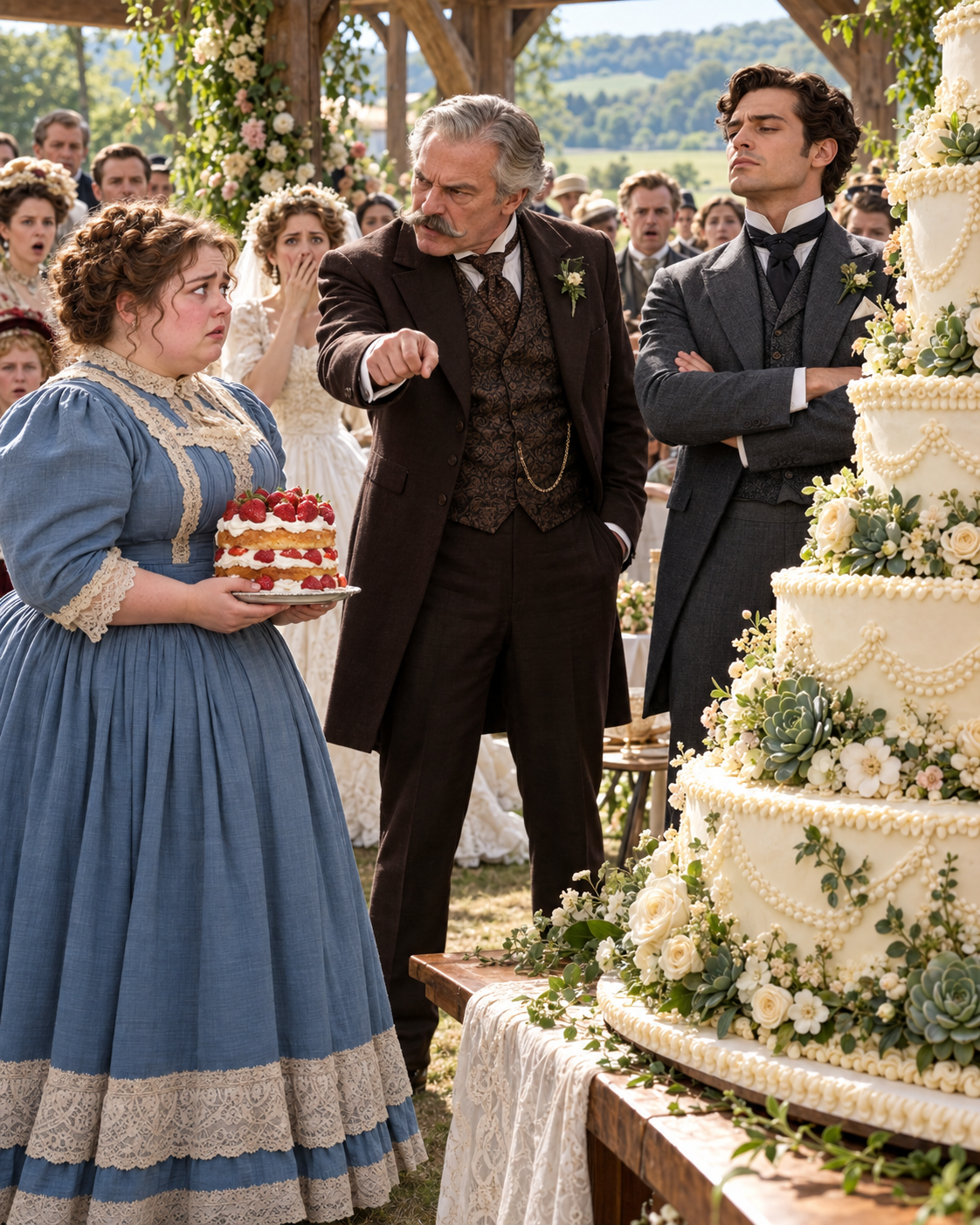
“It isn’t a grievance,” she said. “It’s the cake.”
A murmur moved across the lawn.
Vanney laughed.
“The cake?”
Kora held up the paper.
“This is a statement from the supplier whose tins Mr. Vanney received behind the Ridgemont Hotel. The company sells pigments for commercial coloring. Paint, printing, decorative work. Not food.”
Vanney’s smile tightened.
“You have no idea what you’re talking about.”
“I wrote to them.”
“And anyone may write a letter.”
“They answered.”
The deputy, Amos Bell, moved closer to the table.
Beside him came Dr. Eli Warren, Ridgemont’s physician, his summer coat hanging open and sweat darkening the band of his hat.
Mayor Drummond noticed them.
“You knew about this?”
Dr. Warren did not answer immediately.
“I knew Miss Jessup had concerns.”
“Concerns?” Vanney snapped. “A village baker becomes jealous because she lost a commission, and suddenly we are conducting chemistry lessons during a wedding?”
There it was.
The accusation Kora had feared.
She heard several people whisper.
Everyone in town knew she had wanted the job.
Everyone knew the mayor had chosen Vanney instead.
For a moment, humiliation rose hot in her throat.
Then Levi spoke from behind the crowd.
“I saw the tins.”
Heads turned.
Levi Hadley was still dressed in his work clothes. His sleeves were rolled above his elbows, and one shoulder of his shirt remained damp from hauling ice.
Vanney stared at him.
“You deliver frozen water.”
“That doesn’t keep me from reading labels.”
A few nervous laughs broke from the guests.
Levi continued.
“The crate came off the Denver freight wagon Monday morning. I helped carry it because the hotel porter had hurt his wrist. The tins were marked for commercial pigment.”
Vanney threw out his hands.
“And perhaps I use such pigments for decorations that are never eaten.”
Kora had expected that answer.
She unfolded a second sheet.
“This is from Caleb Mercer’s chemistry guide.”
“An old book?” Vanney said. “This gets better.”
Kora ignored him.
“The green compound described here contains copper salts. The red coloring listed by the supplier is also not approved for food use. Dr. Warren checked the description this morning.”
Every face turned toward the doctor.
Dr. Warren removed his spectacles, wiped them with a handkerchief, and replaced them.
“She is correct about the compounds.”
The lawn went quiet.
Not silent—never truly silent. Cicadas screamed from the cottonwoods. A horse stamped near the hitching rail. Somewhere near the courthouse porch, a baby began to fuss.
But the people were listening now.
Mayor Drummond looked from Dr. Warren to Vanney.
“Are you telling me this cake is poisonous?”
Vanney answered before the doctor could.
“No.”
Too quickly.
Dr. Warren’s eyes narrowed.
“I am saying certain compounds Miss Jessup identified should not be eaten. Whether they are present in this cake is another question.”
“There,” Vanney said. “Another question. Nothing proven.”
He seized the cake knife from the servant.
Before anyone understood what he meant to do, he cut a narrow piece from the lower tier.
Gasps rose from the crowd.
Vanney lifted the slice.
The icing was a violent red along one edge, green along the other.
“You see?” he said. “A cake. Flour, eggs, sugar, butter. Perfectly harmless.”
Kora stared at the piece in his hand.
“Then eat it.”
The words came out before she could reconsider them.
Vanney froze.
No one moved.
Kora heard Levi inhale sharply behind her.
Vanney gave a small laugh.
“You expect me to participate in this childish performance?”
“You just called it harmless.”
“I made it.”
“Then eat it.”
His expression changed.
Only slightly.
But Mayor Drummond saw it.
So did Dr. Warren.
The mayor stepped closer.
“Boyd.”
Vanney looked at him.
“Eat the piece.”
For the first time that afternoon, Boyd Vanney had nothing to say.
The sun pressed down over Ridgemont.
A bead of colored frosting slid from the slice and landed on Vanney’s cuff.
He looked at it.
Then, with sudden anger, he hurled the cake knife onto the table.
“This is absurd.”
Deputy Bell stepped forward.
“Set the slice down, Mr. Vanney.”
“You cannot arrest a man over icing.”
“No one said anything about arresting you.”
“Then get away from my cake.”
The deputy did not move.
Neither did Vanney.
Behind them, the great wedding cake gave a faint, wet creak.
Kora turned.
The lower icing had begun to shine in the heat. One decorated column leaned a fraction to the left.
She had spent enough years around ovens, buttercream, sugar work, and summer kitchens to understand what she was seeing.
“Move the table,” she said.
Vanney whirled on her.
“Do not touch it.”
“The base is softening.”
“It is stable.”
“It isn’t.”
As if the cake itself had chosen sides, the upper tier shifted.
A woman screamed.
Deputy Bell grabbed the edge of the table while two servants jumped backward.
The top tier slid sideways, hesitated, then crashed into the tier beneath it.
Red roses burst.
Green icing smeared across white frosting.
A gold-painted border cracked and folded like wet plaster.
Guests surged away from the table.
Vanney lunged forward, trying desperately to steady what remained.
His hands sank into the colored icing.
“Don’t touch your mouth,” Dr. Warren barked.
Vanney stopped.
For one terrible second, everyone stared at his fingers.
They were streaked red and green.
The doctor turned to the servants.
“Bring water. Plenty of it.”
The mood of the wedding changed instantly.
Five minutes earlier, the cake had been a spectacle.
Now people looked at it as though it were something found dead in a field.
Mayor Drummond’s face had gone pale.
“My daughter,” he said.
Then louder, “Where is Anelise?”
“She hasn’t eaten any,” Kora said.
He looked at her.
“How do you know?”
“Because she’s been with the photographer since the ceremony.”
At that moment Anelise appeared at the courthouse steps, still carrying a small bouquet of white flowers.
Her new husband, Thomas Avery, followed beside her.
“What happened?”
No one answered at first.
Anelise looked at the collapsed cake.
Then at her father.
Then at Kora.
“Kora?”
The mayor opened his mouth, but Kora spoke first.
“We stopped the cake before it was served.”
“Why?”
Vanney suddenly pushed away from the table.
“This woman has ruined your wedding.”
Anelise looked at him.
Vanney continued quickly.
“She is bitter because your father hired me instead of her. She has made accusations she cannot prove, frightened your guests, destroyed my work—”
“The heat destroyed your work,” Kora said.
“Be quiet.”
“No,” Anelise said.
It was not loud.
Still, everyone heard it.
Vanney stared at the bride.
Anelise walked toward Kora.
“Tell me.”
So Kora did.
Not dramatically.
Not triumphantly.
She explained the strange tins, Levi’s observation, the supplier, the chemical guide, the warning, and the conversation with Dr. Warren.
When she finished, Anelise looked at the broken red roses scattered across the tablecloth.
“You brought another cake, didn’t you?”
Kora blinked.
“How did you know?”
“I saw Levi carrying a covered box behind the courthouse.”
Levi looked suddenly interested in the grass.
Kora almost smiled.
“It was just a gift.”
“For me?”
“Yes.”
Anelise’s expression softened.
“You remembered.”
Kora knew what she meant.
Three summers earlier, before the Drummonds had spoken of grand weddings or Denver bakers, Anelise had sat in Kora’s shop after a rainstorm and eaten two slices of strawberry cake.
She had told Kora it tasted like July ought to taste.
“I remembered,” Kora said.
Mayor Drummond closed his eyes.
For perhaps the first time that day, he seemed less like the mayor of Ridgemont and more like a father who had made a terrible mistake.
Deputy Bell cleared his throat.
“We still need to determine what’s actually in Mr. Vanney’s coloring.”
Vanney stiffened.
“You have no right to seize my property.”
Bell glanced toward the shattered cake.
“I believe we can preserve a sample until the county authorities advise us.”
Vanney turned toward his equipment cases.
Levi moved first.
Not aggressively.
He simply stepped between Vanney and the rear exit of the pavilion.
“You planning somewhere?”
Vanney’s jaw clenched.
“I have a train to Denver.”
“The evening train isn’t for four hours.”
“You know the schedule too?”
“I deliver ice to the depot.”
That earned another ripple of laughter, though this time Vanney did not join it.
Deputy Bell opened one of the confectioner’s cases.
Inside were piping tools, sugar molds, brushes, bottles, and six small metal tins.
Kora recognized the markings immediately.
“There.”
Dr. Warren crouched beside the open case.
He did not touch the tins with his bare hands.
One had a green label.
Another red.
The third was yellow.
Bell read the manufacturer’s name aloud.
It matched the letter in Kora’s hand.
The mayor’s expression hardened.
“Mr. Vanney?”
Vanney said nothing.
Bell lifted a ledger from the bottom of the case.
Its pages contained orders, costs, and notes in Vanney’s narrow handwriting.
The deputy turned several pages.
Kora saw columns of figures.
Vanney’s face changed again.
This time there was no hiding it.
“Give me that.”
Bell stepped away.
“What is it?”
“Private accounts.”
The deputy read silently.
Then he looked at Dr. Warren.
“You’d better see this.”
Vanney lunged.
Levi caught his arm.
The movement sent a chair skidding into the grass.
Several men from the crowd stepped forward, but Bell raised a hand.
“I have him.”
Vanney stopped struggling.
The deputy turned the ledger toward Mayor Drummond.
One line had been written beside an order for edible fruit coloring.
Too costly.
Below it was another supplier.
Commercial pigments.
One-quarter price.
The mayor read the words twice.
“This was about money?”
Vanney’s face burned.
“You think people pay for ingredients? They pay for appearance. They pay to be impressed.”
Kora felt something cold settle inside her.
“You knew.”
Vanney looked at her.
He did not deny it.
“You knew those colors weren’t meant for food.”
“They are pigments.”
“For paint.”
“For color.”
“For things people don’t eat.”
Vanney scoffed.
“Do you know how many confectioners use whatever produces the best result? Customers demand bright colors. They demand spectacle. They don’t ask how it’s made.”
“Anelise didn’t ask for poison.”
“Stop calling it poison.”
Dr. Warren rose.
“Then perhaps you should have eaten the slice.”
Vanney’s mouth snapped shut.
The doctor picked up the supplier letter.
“The question is no longer whether you used these substances. Your own ledger suggests you deliberately substituted them because they were cheaper.”
Mayor Drummond stared at the man he had brought from Denver.
All afternoon he had defended appearances—his daughter’s perfect wedding, the famous confectioner, the towering cake that would make Ridgemont seem grand.
Now those appearances lay melting across a linen cloth.
“Deputy,” he said quietly, “do what you need to do.”
Bell nodded.
Vanney looked around as if searching for someone still impressed by him.
No one was.
By late afternoon, the wedding had become something entirely different.
The ruined cake was cordoned off beneath the pavilion.
Samples of icing and pigment tins were packed for testing.
Vanney sat inside the deputy’s office waiting for word from county officials.
No one had been seriously harmed because no slice had reached a guest.
But the realization of how close they had come traveled through Ridgemont faster than any newspaper.
The celebration itself might have ended there.
Anelise refused to let it.
She stood beneath the cottonwoods, took Thomas by the hand, and looked at the hundreds of uneasy guests.
“I believe,” she announced, “we still have a wedding.”
A few people laughed.
Then someone applauded.
Others joined.
The musicians, who had been standing uncertainly with their instruments lowered, began to play again.
The first tune was shaky.
The second was not.
Tables were reset.
Pitchers of lemonade appeared.
Someone brought fried chicken from the hotel kitchen.
Someone else carried over pies from the church ladies’ supper room.
And from behind the courthouse, Levi brought Kora’s cake.
Compared with Vanney’s creation, it looked almost plain.
Two layers.
White frosting.
Fresh strawberries.
No towering columns.
No metallic gold.
No colors that seemed brighter than nature had intended.
Kora suddenly wished she had decorated it more carefully.
Then Anelise saw it.
Her entire face changed.
“Oh,” she whispered.
Kora lifted the cover.
The scent of strawberries rose into the warm air.
Anelise laughed.
Not the polite laugh she had used all morning for photographers and distant relatives.
A real laugh.
“That,” she said, “is my wedding cake.”
Kora shook her head.
“It was only meant to be your private cake.”
“Not anymore.”
Mayor Drummond stood a few feet away.
For once, he did not interfere.
Anelise took the knife.
She cut the first slice herself.
Everyone watched.
She held it up.
Pink from crushed strawberries.
Nothing artificial.
Nothing hidden.
Then she took a bite.
The crowd seemed to hold its breath.
Anelise closed her eyes.
“Well?”
Thomas asked.
She smiled.
“It tastes like July.”
Kora looked down quickly because, to her annoyance, her eyes had filled with tears.
Levi leaned toward her.
“Is that good?”
She elbowed him.
He grinned.
Soon the cake was divided into small pieces.
There was not enough for hundreds of people, but no one complained.
Some shared.
Some took only a forkful.
Several children licked strawberry frosting from their fingers.
Mayor Drummond waited until nearly everyone else had been served before approaching Kora.
She expected an apology.
He seemed to expect himself to offer one.
Instead, for several seconds, he simply stood there.
Finally he said, “I was wrong.”
Kora looked at him.
The words sounded difficult for him.
He continued.
“I wanted people to see that Ridgemont could have what Denver had. Something fashionable. Something impressive.”
“There’s nothing wrong with wanting a beautiful wedding.”
“No. But I confused beautiful with expensive.”
Kora said nothing.
“And when you came to me this morning,” he added, “I nearly sent you away.”
“You did send me away.”
He winced.
“Yes.”
For the first time, Kora smiled.
“A little.”
Drummond looked toward his daughter, who was dancing badly and happily beneath the cottonwoods.
“You could have let me learn the lesson differently.”
“Not if Anelise had to pay for it.”
He nodded.
“That is what I came to say.”
He extended his hand.
“Thank you.”
Kora shook it.
The story did not end that afternoon.
Weeks later, laboratory testing confirmed what Kora and Dr. Warren had feared: the decorative colors on Vanney’s cake contained copper-based compounds and other materials unsuitable for consumption.
Because the cake had been stopped before serving, Ridgemont escaped a tragedy.
Boyd Vanney did not escape the consequences.
His ledger led investigators beyond one wedding.
Other orders were examined.
Other clients came forward.
His reputation, once built on cakes designed to astonish at first glance, collapsed much faster than the wedding centerpiece had in the July heat.
Kora expected to feel satisfied.
Instead, she mostly felt tired.
She returned to her bakery.
Bread still had to be kneaded before sunrise.
Pies still had to be cooled.
Farmers still came through the back door asking whether she had yesterday’s rolls for half price.
Life in Ridgemont continued.
But something had changed.
People began asking different questions.
What was in the candy sold at the general store?
Where did certain food colors come from?
How could a customer tell the difference between decoration and something safe to eat?
Dr. Warren borrowed Kora’s chemistry guide and organized an evening talk at the schoolhouse.
Half the town attended.
The other half claimed they had always known suspiciously bright frosting was a bad idea.
Levi attended too, though he spent most of the lecture making faces at Kora whenever the doctor used a particularly long chemical name.
Afterward, he walked her back to the bakery.
Main Street was quiet.
The summer heat had finally broken, and a breeze moved dust along the road.
“You know,” he said, “for someone rejected by the mayor, you caused an impressive amount of trouble.”
Kora unlocked the bakery door.
“I was hoping everyone would forget that part.”
“Never.”
She looked at him.
“You enjoy this too much.”
“I enjoy being right.”
“You carried ice.”
“I read the label.”
“You have mentioned that several times.”
“It was important reading.”
Kora laughed.
She stepped inside.
Levi remained in the doorway.
On the counter sat a small basket of late strawberries.
“Are those for tomorrow?” he asked.
“Yes.”
“Cake?”
“Maybe.”
He considered this.
“Any dangerous colors?”
“Extremely.”
He raised an eyebrow.
“Red from strawberries.”
“Terrifying.”
“And green.”
“From what?”
“Mint.”
Levi shook his head.
“Reckless woman.”
For the first time in many weeks, Kora felt light.
Autumn arrived.
Then winter.
By the following spring, the sign outside Jessup Bakery had been repainted—not in some fashionable metallic pigment, but in simple black letters on cream-colored wood.
Under Kora’s name was one new line:
HONEST FOOD, HONESTLY MADE.
She had not chosen the words.
Anelise had.
The mayor had paid for the sign.
Levi had hung it crooked.
Kora had made him climb the ladder and fix it.
Years later, people in Ridgemont would disagree about the details of the wedding.
Some insisted Vanney’s cake had been eight tiers high.
Others swore it was ten.
One man claimed he had personally seen blue smoke rise from the frosting, though Kora repeatedly told him that was nonsense.
Children who had not even been born that summer grew up hearing about the day a young baker stopped an entire wedding from eating a beautiful cake.
But Kora never liked the version in which she was described as heroic.
She knew what had really happened.
She had been frightened.
She had doubted herself.
She had nearly stayed silent because the man doing wrong was wealthier, louder, better dressed, and more respected by the people whose approval seemed to matter.
What saved Ridgemont was not fearlessness.
It was the decision to speak while afraid.
Years afterward, when a young apprentice in her bakery worried that customers would choose prettier goods from a larger shop in Denver, Kora placed a bowl of strawberries on the worktable.
“Look at these,” she said.
The girl looked.
“Which one is the brightest?”
She pointed.
Kora nodded.
“Does that make it the sweetest?”
“No.”
“Exactly.”
She sliced the berries and folded them gently into batter.
“There will always be someone who can make things brighter, taller, louder, cheaper, or more impressive from across a room.”
The apprentice listened.
Kora smiled.
“But people eventually come close enough to taste what you made.”
Outside, Ridgemont’s Main Street moved through another ordinary American summer afternoon.
A delivery wagon rattled past.
The courthouse bell marked the hour.
And in the bakery window, beneath the simple painted sign, a strawberry cake cooled in the sunlight.
It was not spectacular.
It did not need to be.
Because the lesson Ridgemont remembered from that wedding was never truly about cake.
It was about the danger of trusting appearances simply because they are impressive.
It was about the cost of silence when something feels wrong.
And most of all, it was about a truth Kora Jessup had understood long before the mayor did:
What is genuine does not always arrive with the brightest colors or the grandest display.
Sometimes it arrives quietly, carrying proof in one hand and a simple strawberry cake in the other.
The story should have ended there.
At least, that was what Kora believed.
Boyd Vanney was gone from Ridgemont. The wedding had become a memory. Anelise and Thomas had settled into a modest house near the eastern edge of town. Mayor Drummond had become less eager to impress strangers and slightly more willing to listen to people he had known all his life.
Even Levi had stopped mentioning the famous cake every time he delivered ice.
Almost.
Then, one morning in early May, nearly a year after the wedding, a black carriage stopped in front of Jessup Bakery.
Kora was kneading bread when she heard the horses.
She wiped flour from her hands and looked through the front window.
A man in a dark suit stepped down from the carriage.
He was tall, silver-haired, and carried a leather case.
He paused beneath the bakery sign.
HONEST FOOD, HONESTLY MADE.
Then he came inside.
“Miss Jessup?”
“Yes?”
“My name is Samuel Pierce.”
He removed his hat.
“I represent the state food inspection office.”
Kora stared at him.
For a moment, all she could hear was the ticking clock behind the counter.
“Have I done something wrong?”
To her surprise, Pierce smiled.
“Quite the opposite.”
He opened the leather case and placed several papers on the counter.
“We received reports concerning the Vanney matter. More than one.”
Kora’s hands tightened around the towel she was holding.
“What reports?”
“Complaints from Denver. Pueblo. Fort Collins. Two families from Kansas City. One hotel in Omaha.”
She looked at him.
“All about Vanney?”
“About Vanney and several suppliers like his.”
Kora felt the old uneasiness return.
Pierce continued.
“The state is reviewing the use of industrial pigments in confectionery work.”
“That should have happened years ago.”
“Yes.”
His answer came without defensiveness.
“That is partly why I am here.”
Kora folded her arms.
“What do you need from me?”
“Your account.”
“I already gave one.”
“To the deputy.”
“And the county investigator.”
“This would be for a state hearing.”
Kora looked toward the oven.
“I make bread.”
Pierce waited.
“I do not give speeches.”
“I am not asking for a speech.”
“You are asking me to stand in a room full of officials and tell them they ignored something dangerous until a baker in Ridgemont happened to notice it.”
Pierce smiled faintly.
“When you put it that way, perhaps I am asking for a speech.”
Kora did not smile.
“I am serious.”
“So am I.”
He closed the leather case.
“Miss Jessup, rules often change only after someone makes the danger impossible to ignore.”
Kora looked down at the flour on her hands.
The thought of leaving Ridgemont unsettled her.
The thought of entering a state building unsettled her more.
But another thought was worse.
Somewhere else, there might be another wedding.
Another child’s birthday.
Another bright cake.
Another person assuming that beautiful meant safe.
“When is the hearing?”
Pierce told her.
Three weeks later, Kora boarded a train.
Levi came with her as far as Denver.
She had insisted she could travel alone.
He had insisted the train might become dangerously complicated without a man who understood ice deliveries.
“That makes no sense,” Kora said as they sat beside the window.
“It sounded stronger when I practiced it.”
“You practiced that?”
“For most of yesterday.”
She shook her head.
The countryside rolled past in shades of green and brown.
Small farms disappeared behind them.
Ridgemont grew farther away.
By evening, Denver appeared ahead beneath a hazy sky.
Kora had been there only once as a child.
She remembered noise.
Now it seemed louder.
Streetcars rattled.
Wagons crowded intersections.
Brick buildings rose higher than anything in Ridgemont.
Advertisements covered entire walls.
Outside one confectionery shop, Kora saw cakes displayed behind glass.
Pink.
Blue.
Green.
Gold.
She stopped walking.
Levi noticed.
“You all right?”
“Yes.”
He looked toward the window.
“Thinking about Vanney?”
“Thinking about how easy it is.”
“What?”
“To make something look trustworthy.”
Levi was quiet for a moment.
“People trust what they want to trust.”
Kora looked at him.
“That is a very depressing thought.”
“I have others.”
“Please keep them.”
The hearing was held the following morning.
Kora entered a large room with high windows and polished benches.
At the front sat five men.
Four wore dark suits.
One wore spectacles and had ink stains on his fingers.
Kora decided immediately that she trusted the one with ink stains most.
Samuel Pierce introduced her.
Questions followed.
Where had she first noticed the tins?
Why had she suspected them?
How did she locate the supplier?
Did she understand chemistry?
“No.”
Had she received formal scientific training?
“No.”
Was she aware that some commercially produced colorants could be used safely in certain preparations?
“Yes.”
Then how had she concluded that Vanney’s were unsafe?
Kora paused.
“I didn’t conclude it because I was a chemist.”
The man in spectacles looked at her.
“Then why?”
“Because I read the labels.”
A few people shifted in their seats.
Kora continued.
“And because when I didn’t understand what I read, I found someone who did.”
The room became still.
One official leaned forward.
“So you are saying ordinary people should question ingredients they do not recognize?”
“I am saying ordinary people should be able to know what they are being given.”
The official frowned.
“That is not the same thing.”
“No.”
Kora met his eyes.
“It is more important.”
Levi, seated near the back, smiled.
Kora did not see him.
She kept talking.
She told them about the wedding.
About Anelise.
About the servant reaching for the knife.
About the cake collapsing.
About the slice Vanney refused to eat.
She did not dramatize it.
She did not need to.
Facts were enough.
After nearly two hours, she stepped outside.
Levi was waiting.
“How was it?”
“Awful.”
“That bad?”
“No.”
She exhaled.
“I think they listened.”
“That sounds worse than awful.”
Kora laughed.
They began walking toward the station.
Then someone called her name.
“Miss Jessup.”
She turned.
A woman in a gray dress hurried down the steps.
She was perhaps thirty-five.
Her face was pale.
“May I speak with you?”
Kora nodded.
The woman stopped in front of her.
“My name is Margaret Hale.”
She glanced at Levi, then back to Kora.
“My son became ill after a birthday last winter.”
Kora’s smile disappeared.
“I am sorry.”
“The cake was blue.”
Kora felt cold despite the warm day.
“He recovered,” Margaret said quickly. “But he was sick for nearly a week.”
“Was it Vanney?”
“No. Another confectioner.”
Kora understood.
Margaret’s eyes filled.
“I blamed myself.”
“You shouldn’t.”
“I bought the cake.”
“You trusted someone who was supposed to sell you food.”
Margaret pressed her lips together.
“That is what I wanted to say.”
“What?”
“If they change the rules… if labels become clearer… if people start asking questions… my son’s illness may have mattered.”
Kora hesitated.
Then she took the woman’s hand.
“It mattered before that.”
Margaret nodded.
That conversation stayed with Kora longer than the hearing.
Months passed.
Summer returned.
A notice arrived from the state.
It was written in stiff official language and contained far too many words.
Kora read it twice.
Then she carried it across Main Street to Dr. Warren.
He read it once.
“They are adopting new restrictions.”
Kora leaned over his desk.
“Where does it say that?”
He pointed to a paragraph.
“That?”
“Yes.”
“That paragraph is forty lines.”
“Government appears to dislike short sentences.”
“What exactly changes?”
“Coloring compounds intended for industrial use cannot be sold or represented for food preparation. Certain food colorants must be clearly labeled. Inspectors will be allowed to examine confectionery suppliers.”
Kora sat down slowly.
Dr. Warren smiled.
“You helped do this.”
“No.”
“Yes.”
“Many people testified.”
“You were one of them.”
She stared at the paper.
It did not feel dramatic.
There was no crowd.
No music stopping.
No collapsing cake.
Only a sheet of paper on a doctor’s desk.
And yet Kora understood that this piece of paper might prevent a moment like the one at Anelise’s wedding from ever happening again.
She walked back to the bakery in silence.
Levi was waiting outside.
He leaned against the wall.
“Well?”
“They changed the rules.”
He straightened.
“Really?”
“Yes.”
He grinned.
“You look miserable.”
“I am not miserable.”
“You look like someone told you your bread was illegal.”
Kora laughed.
“I just thought it would feel different.”
“How?”
“Bigger.”
Levi looked around Main Street.
A dog slept near the general store.
Two boys rolled a hoop along the sidewalk.
A farmer argued about the price of nails.
Nothing had changed.
And everything had.
“Maybe big things don’t always feel big when they happen,” Levi said.
Kora looked at him.
“That is almost intelligent.”
“I have my moments.”
She unlocked the bakery.
“Come in.”
“For cake?”
“For work.”
His face fell.
“That was cruel.”
She handed him a crate of strawberries.
“Wash those.”
“People usually reward heroes.”
“You carried ice.”
“I read the label.”
“There it is again.”
They worked until sunset.
Over the next several years, Jessup Bakery changed.
Not suddenly.
Kora never became rich.
She never opened a grand shop in Denver.
She never hung photographs of herself in the window.
But travelers began stopping in Ridgemont.
Some had heard the story.
Some had not.
They came for strawberry cake.
They stayed for bread.
They returned because Kora never sold anything she would not serve to someone she loved.
She trained apprentices.
And she had rules.
Every ingredient had a name.
Every supplier had to answer questions.
Nothing entered the kitchen simply because it was cheap.
Nothing was used merely because it looked impressive.
“If you do not know what it is,” Kora told every apprentice, “you do not put it in food.”
One apprentice once rolled his eyes.
“That seems obvious.”
Kora smiled.
“The most dangerous mistakes often begin with something everyone thinks is obvious.”
Anelise and Thomas visited often.
Their first child was born two years after the wedding.
A girl.
They named her Clara.
On Clara’s fifth birthday, Anelise ordered a cake.
“Strawberry?”
Kora asked.
“Of course.”
“Pink frosting?”
“Naturally.”
“Artificial?”
Anelise gave her a look.
Kora laughed.
The cake was simple.
Clara loved it.
She ate two slices.
Mayor Drummond attended.
He had more gray hair now.
He stood near the window watching his granddaughter eat.
“Do you still think I made the worst decision in Ridgemont history?” he asked.
Kora considered.
“No.”
He looked surprised.
“Really?”
“You corrected it.”
“That does not make it good.”
“No.”
Kora smiled.
“But mistakes become worse when pride keeps them alive.”
The mayor nodded.
He looked toward Clara.
“I learned that late.”
“Still learned it.”
Outside, Levi arrived with a wagon.
He was no longer simply Ridgemont’s ice deliveryman.
After years of saving money, he had purchased the small storage business near the rail depot.
He still delivered ice sometimes.
Mostly because he claimed no employee stacked blocks correctly.
No one believed him.
Kora certainly did not.
He came through the back door carrying a box.
“What is that?” Kora asked.
“A present.”
“For whom?”
“You.”
“That is suspicious.”
“It is respectable.”
He placed the box on the table.
Inside was a new set of copper baking pans.
Kora stared.
Then she looked at him.
“Copper?”
“Safe copper.”
“You are impossible.”
“Read the label.”
She threw a towel at him.
The apprentices laughed.
Years went by.
Ridgemont grew.
Electric lights appeared.
Automobiles began to replace horses.
The old hotel was renovated.
The courthouse lawn changed.
The cottonwood trees became enormous.
People who had once witnessed Anelise’s wedding grew old.
Some moved away.
Some died.
Stories changed with every telling.
Boyd Vanney became more villainous each year.
In one version, he had tried to escape Ridgemont on horseback.
In another, he had fainted when Kora showed the letter.
In a third, the cake had collapsed exactly at midnight despite the wedding taking place in the afternoon.
Kora stopped correcting people.
Mostly.
But whenever someone said she had marched into the wedding completely fearless, she objected.
“I was terrified.”
Children never believed her.
“You didn’t look scared.”
“That has nothing to do with being scared.”
“Then what does courage mean?”
Kora always gave the same answer.
“It means fear does not get the final vote.”
That sentence became more famous than the cake.
Kora disliked that too.
She had only said it because a twelve-year-old asked.
When she was nearly sixty, a young newspaper reporter from Denver arrived at the bakery.
He carried a notebook.
“Mrs. Hadley?”
Kora looked up sharply.
“Who told you to call me that?”
The reporter blinked.
“Isn’t that your name?”
“Yes, but I am standing in Jessup Bakery.”
He immediately corrected himself.
“Miss Jessup.”
“Better.”
From the back room, Levi shouted, “Coward.”
Kora ignored him.
The reporter explained that he was writing a series about changes in American food standards.
He had found records of the Ridgemont hearing.
He wanted her story.
“You have the records.”
“Records tell me what happened.”
“That is usually enough.”
“They do not tell me why you did it.”
Kora stopped sorting receipts.
Why?
The answer once would have been easy.
Because the cake was dangerous.
Because Anelise was her friend.
Because Vanney was wrong.
But after all these years, she understood there had been something else.
“I was angry.”
The reporter looked surprised.
“At Vanney?”
“At myself.”
“For what?”
“For almost deciding it was none of my business.”
The reporter began writing.
Kora watched him.
“That is the part people leave out.”
“What part?”
“The moment before someone does the right thing.”
She leaned back.
“People tell stories as if courage appears fully formed. It does not.”
He stopped writing.
“What does?”
“Discomfort.”
He frowned.
“Discomfort?”
“You notice something.”
She tapped the counter.
“It bothers you.”
“You try to explain it away.”
“You tell yourself someone more qualified will handle it.”
“You tell yourself you might be wrong.”
“You tell yourself speaking will embarrass you.”
She paused.
“And then you decide whether comfort matters more than consequence.”
The reporter wrote every word.
When the article appeared, it spread far beyond Ridgemont.
Kora received letters.
Some came from bakers.
Some from mothers.
Some from factory workers.
Some from schoolteachers.
One came from a sixteen-year-old boy who had reported unsafe machinery at the mill where he worked.
Another came from a woman who had questioned contaminated milk being sold in her neighborhood.
Kora kept every letter.
Not because they praised her.
Most did not.
They said something more important.
Your story made me ask.
Your story made me look again.
Your story made me speak.
That was when Kora finally understood what the wedding had become.
It was no longer her story.
It belonged to anyone who had ever noticed something wrong and wondered whether they had the right to say so.
Levi died first.
Peacefully.
Much older than either of them had expected him to become.
On his final morning, he complained about the coffee.
Kora told him he had been complaining about coffee for forty years.
“That long?”
“That long.”
He smiled.
“Did I ever win?”
“No.”
He closed his eyes.
“Terrible marriage.”
“The worst.”
He opened one eye.
“Would you do it again?”
Kora held his hand.
“Yes.”
“So would I.”
Those were among the last clear words he spoke.
After his funeral, Kora returned to the bakery alone.
The shop felt enormous.
Every sound echoed.
On the shelf above the oven sat the old chemist’s guide.
Its cover was cracked.
Its pages were brown.
Beside it was Levi’s first delivery receipt from the week of Anelise’s wedding.
Kora had kept that too.
At the bottom, in Levi’s handwriting, was a note:
Six blocks ice.
One crate berries.
Remember to ask about strange tins.
Kora laughed and cried at the same time.
She closed the bakery early that day.
Years later, when Kora could no longer stand for hours beside an oven, she sold Jessup Bakery to one of her former apprentices.
She had one condition.
The sign stayed.
HONEST FOOD, HONESTLY MADE.
The apprentice agreed.
On Kora’s final morning behind the counter, Ridgemont gathered outside.
There were more people than she expected.
Children.
Grandchildren.
Families she had fed for decades.
Anelise, now white-haired herself, stood near the front.
Clara stood beside her.
Someone brought flowers.
Someone else brought a brass band.
Kora groaned when she saw them.
“No speeches.”
Mayor Drummond had been dead for many years, but his grandson was now mayor.
He smiled.
“One short one.”
“No.”
The crowd laughed.
Anelise stepped forward.
She carried a small box.
Kora recognized it immediately.
“No.”
“Yes.”
Inside was a cake.
Two layers.
White frosting.
Fresh strawberries.
Kora stared.
Anelise smiled.
“Not as good as yours.”
“Obviously.”
“Still rude.”
Kora touched the edge of the box.
For a moment, the entire world seemed to fold in on itself.
She saw the courthouse lawn.
The July heat.
Vanney’s colors.
The fallen sugar rose.
The letter in her apron.
Her own shaking hands.
She saw Levi.
Young again.
Standing beside the ice wagon.
Reading a label.
“You remembered,” Kora said softly.
Anelise’s eyes filled with tears.
“I always remembered.”
They carried the cake outside.
No one photographed it.
No newspaper reporter stood nearby.
No official marked the occasion.
Children crowded the table.
Kora took the knife.
Her hands were old now.
They trembled slightly.
Anelise noticed.
“Want help?”
Kora shook her head.
“I can still cut cake.”
She made the first slice.
Pink inside.
Strawberries.
Real strawberries.
She gave the piece to a little girl standing at the front.
The child took a bite.
Kora waited.
“Well?”
The girl smiled.
“It tastes like summer.”
Anelise covered her mouth.
Kora closed her eyes.
For one brief moment, she could almost hear Levi laughing.
That evening, after everyone had gone, Kora stood alone beneath the bakery sign.
Main Street was quiet.
Electric lamps glowed where oil lanterns once burned.
Automobiles sat where horses had once been tied.
Ridgemont had changed so completely that the town of her youth seemed almost imaginary.
But some things remained.
A person still had to choose between speaking and staying silent.
A merchant still had to choose between profit and honesty.
A customer still had to decide whether appearance was enough.
A baker still had to choose what went into the food.
Kora placed her hand against the old wooden door.
She thought about Boyd Vanney.
For years, she had considered him the lesson.
Eventually, she understood he was only part of it.
Vanney had chosen appearance over truth.
Mayor Drummond had chosen status over judgment.
The guests had chosen admiration before asking questions.
And Kora herself had nearly chosen silence because speaking seemed inconvenient.
No one in the story had been completely protected from error.
That was what made the lesson worth remembering.
The danger did not begin with evil.
It began with compromise.
A cheaper pigment.
A convenient assumption.
A question left unasked.
A doubt ignored.
One small decision leaning against another until suddenly hundreds of people stood in front of a cake no one should eat.
And salvation had begun just as quietly.
A deliveryman noticing a label.
A baker opening a book.
A doctor listening.
A deputy refusing to be intimidated.
One person speaking.
Then another.
Then another.
Kora turned the key in the bakery door for the last time.
She looked once more at the sign.
HONEST FOOD, HONESTLY MADE.
She smiled.
The words had always sounded as though they were about baking.
They were not.
They were about living.
Years after Kora Jessup was gone, the sign remained above the bakery.
The paint faded.
The wood cracked.
Ridgemont became a larger town.
The old courthouse was replaced.
The railway lost passengers to highways.
The hotel became apartments.
Most people forgot Boyd Vanney’s name.
But inside the bakery, behind glass, the old chemist’s guide remained on a shelf.
Beside it lay a faded copy of the supplier’s letter.
And beneath both was a small handwritten card.
It read:
If something seems wrong, ask.
If the answer does not satisfy you, ask again.
If speaking is difficult, speak carefully.
But do not confuse silence with kindness.
The card had no signature.
It did not need one.
Every summer, when strawberries arrived, the bakery still made Kora’s cake.
Two layers.
White frosting.
Fresh berries.
No towering decorations.
No unnatural colors.
Customers came from miles away to try it.
Many knew the story.
Some did not.
But almost everyone asked why the cake was so simple.
The bakers always answered the same way.
“Because nothing honest needs to pretend to be more than it is.”
And that became the true ending of the Ridgemont wedding story.
Not that a dangerous cake collapsed.
Not that a dishonest confectioner was exposed.
Not even that one baker proved everyone wrong.
The real ending was that people learned to look more carefully.
To question more bravely.
To choose what was genuine over what merely glittered.
Because the world would always offer beautiful things that were hollow.
Cheap things dressed as luxury.
Danger hidden beneath color.
Pride disguised as certainty.
And sometimes, the only thing standing between harm and safety would be a person willing to say:
Wait.
Something is not right.
That person might be frightened.
They might be ignored.
They might be embarrassed.
They might even be wrong at first.
But asking the question could still matter.
Kora Jessup had never set out to change Ridgemont.
She only wanted to protect a bride from eating a dangerous cake.
Yet that small act outlived the wedding, the mayor, the baker who deceived them, and eventually Kora herself.
Because truth has a strange way of lasting longer than spectacle.
And somewhere in Ridgemont, on warm summer afternoons, the scent of strawberries still drifted through an open bakery door.
THE END.